

 Tiếng Việt
 日本語
日本語
Have you ever been going through a particularly heavy season of life, and a friend—with the absolute best of intentions—tried to help you in exactly the wrong way?
Maybe you were feeling completely overwhelmed and just needed a quiet, safe space to vent. You poured your heart out, hoping for a listening ear and a simple, “I’m so sorry, that sounds really hard.” But instead, your friend immediately jumped into “fix-it” mode. They started firing off a bulleted list of solutions, giving advice, and trying to strategize a way out of your pain.
Most of the time, your friend wasn’t being dismissive. In fact, they were loving you the best way they knew how. Because if they were in your shoes, they would want a plan of action.
But in that moment, their well-meaning advice just made you feel unseen.
It’s a uniquely human paradox: our deepest desires to connect and comfort, many times, get tangled up in our own preferences.
We look at the people we care about and, instinctively, we project our own internal world onto them. We buy them the types of gifts we would want to receive. We praise them the way we like to be praised. We comfort them the way we want to be comforted.
For centuries, we’ve been taught that this is the highest moral standard. We call it the Golden Rule: Do unto others as you would have them do unto you.
And let’s be fair—it is a beautiful baseline for basic human decency. If we all simply treated each other the way we wanted to be treated, the world would undoubtedly be a kinder place.
However, as we grow older and understand ourselves (and others) better, most begin to realize that this golden standard has a blind spot: it assumes that we are all exactly the same.
What happens when the person sitting across from you is fundamentally different from you? What happens when doing unto others what you want actually causes them to pull away?
To forge truly meaningful and authentic connections, we have to learn to step beyond our own reflections. We have to set down the Golden Rule and embrace something a little more profound: the Platinum Rule.
Highlights
- Platinum Rule vs Golden Rule: While the Golden Rule is self-referential—asking “How would I want to be treated?”—the Platinum Rule is other-referential, shifting the focus to “How do they want to be treated?”
- Empathy vs. Projection: The Golden Rule comes with an “empathy blind spot” because it assumes everyone shares the same emotional blueprint. The Platinum Rule presents a solution to this problem by replacing projection with curiosity and observation.
- Practical Application: Adopting the Platinum Rule requires pausing to drop assumptions, asking clarifying questions (e.g., “Do you want solutions or just to vent?”), and being willing to offer support in “languages” that may feel counterintuitive to the giver.
- Boundaries & Presence: We need to be aware of the “people-pleasing trap”; implementing the Platinum Rule should not mean self-abandonment. Ultimately, rules are just “training wheels” for the goal of genuine, mindful presence.
Tracing Back the Origins of the Golden Rule and Platinum Rule
For most of us, our earliest lessons in empathy and morality were simple. As children, when we snatched a toy from a sibling or said something unkind on the playground, an adult usually knelt down beside us and asked a variation of the same powerful question:
“How would you feel if someone did that to you?“
That simple question is the heartbeat of how we learn to connect. It asks us to step out of our own ego and imagine the inner world of someone else.
Over centuries, this idea has evolved, shaping the way we build relationships, communities, and even our modern workplaces.

Platinum Rule vs Golden Rule
What is the Golden Rule?
Long before it became a staple in modern management seminars or relationship advice, the concept of the Golden Rule had already been widely known. (and practiced)
Historically, human morality started with what philosophers call the Silver Rule: “Do not do to others what you would not want done to you.” It was a passive guideline, an ethic of “do no harm.” If you didn’t want to be gossiped about, you simply refrained from gossiping.
But humanity eventually took a major leap forward with the Golden Rule, which was – arguably – most famously articulated in the Sermon on the Mount as, “Do unto others as you would have them do unto you” (Matthew 7:12). It transformed morality from a passive restraint into an active call to love. It asked us not just to avoid harming others, but to intentionally comfort, support, and uplift them in the ways we ourselves wish to be supported.
As society evolved, the Golden Rule became the ultimate baseline for fairness.
- In the workplace, it taught us equality and basic respect.
- In friendships, it taught us to show up, to look at another human being and recognize our shared humanity: You are like me, and you deserve the same respect and care that I desire.
Indeed, the Golden Rule provides an essential foundation for society to function. But as our relationships deepen, most of us eventually bump into a realization: what if the person sitting across from us isn’t exactly like us at all?

The Golden Rule in simpler terms: The ethic of reciprocity
What is Platinum Rule?
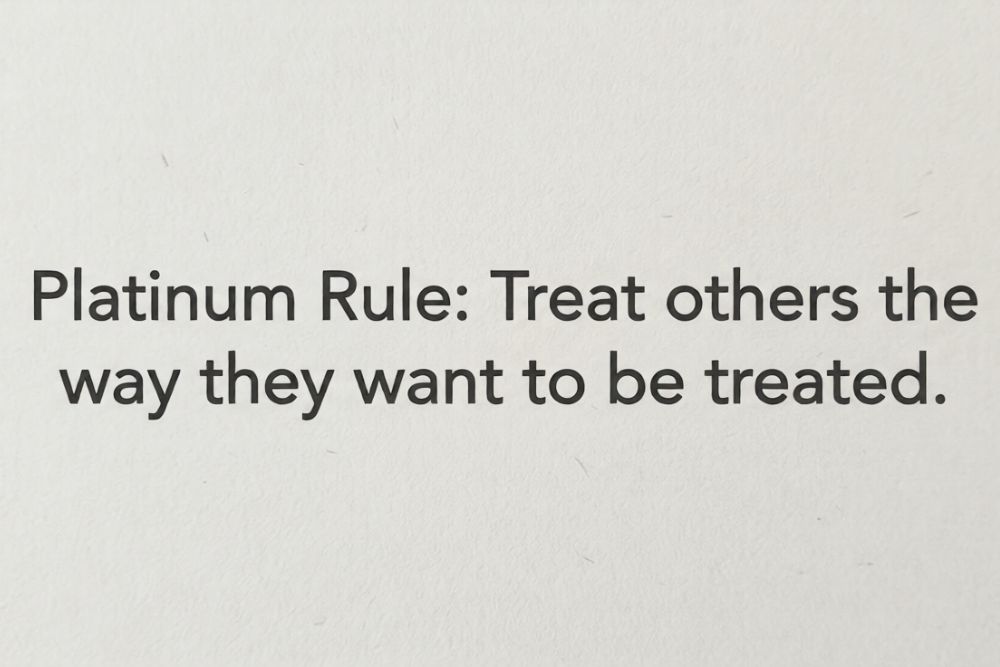
If the Golden Rule is based on humanity’s shared similarities, then the Platinum Rule starts from a deep reverence for our individual differences. Coined recently by Dr. Tony Alessandra, it shifts the paradigm with a slight but monumental adjustment: “Treat others the way they want to be treated.“
While the specific phrasing is modern, the spirit behind it is just as ancient as the Golden Rule. In fact, we can see glimpses of it across various spiritual wisdom traditions.
In the Bible, the Apostle Paul captured it perfectly in 1 Corinthians 9:22 when he wrote, “To the weak I became weak, to win the weak. I have become all things to all people.” As simple as it may seem, it demonstrates a profound willingness to adapt one’s own approach to meet the specific needs of the audience, rather than forcing the audience to adapt to him.
We also see an equally beautiful reflection in Buddhism through the concept of Upaya, often translated as “Skillful Means.” Back in the day, the Buddha did not teach the exact same way to every single person he met. He adapted his message, tone, and guidance based on the unique capacity, temperament, and immediate suffering of the person standing right in front of him.
This is the heart of the Platinum Rule: the realization that true compassion isn’t a one-size-fits-all formula.
The core shift here is moving from projection to curiosity. Instead of projecting our own desires onto someone else (“I love public praise, so I will praise my colleague in front of the whole team“), we become curious observers of their unique reality (“My colleague is incredibly introverted, so I will write them a heartfelt, private note of appreciation instead“).
In other words, it is the act of meeting someone exactly where they are, rather than where you are.
The Platinum Rule: The ethic of accommodation
Platinum Rule vs Golden Rule Differences: Why the Former Wins
Before moving further, I would like to assert one crucial point: it is not that one of these two is inherently “right” and the other “wrong.” Rather, it is a just matter of deepening our awareness. Of stretching our empathy muscles in a slightly different direction.
To better understand why we should move from the Golden Rule to the Platinum Rule, it helps to look at the three core differences in how the two philosophies operate.
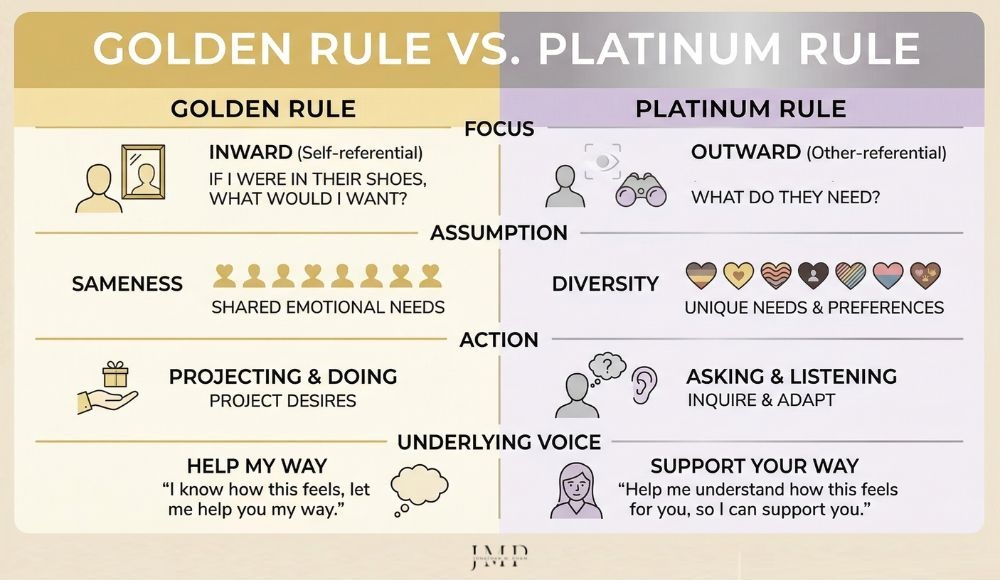
The focus: Looking inward vs. Looking outward
The Golden Rule is inherently self-referential. When we adopt it, our empathy starts by looking in the mirror. We ask ourselves, “If I were in their shoes, what would I want?” As such, it provides a beautiful starting point – because it leverages our own capacity for joy and pain as a compass for how to treat others.
The Platinum Rule, however, is other-referential. It asks us to take our eyes off the mirror and look entirely at the person standing in front of us. The guiding question changes from “What would I want?” to “What do they need?”
In other words, the focus is shifted from our own internal landscape to theirs.
Read more: 200 Self-reflection Questions – Toolkit for Life Pilgrims
The underlying assumption: Sameness vs. Diversity
The Golden Rule operates on the assumption that at our core, we are all essentially the same. And in many ways, we are—we all desire respect, safety, and kindness.
However, the Platinum Rule is based on the assumption that while our need for love is universal, the way we receive love is wonderfully diverse. It honors the fact that we all have different emotional fingerprints. What feels like a warm, comforting gesture to me might feel overwhelming or intrusive to you.
Example: Imagine a colleague is going through a difficult time.
- The Golden Rule might prompt you to organize a large group card and a public display of support, because you are an extrovert who feels loved when surrounded by community.
- The Platinum Rule, realizing the colleague is deeply private, would prompt you to quietly leave a cup of their favorite tea on their desk with a silent nod of solidarity.

Platinum Rule vs Golden Rule psychology
The action: Projecting vs. Inquiring
Because the Golden Rule assumes we want the same things, it encourages us to simply act. We project our own desires outward and get straight to the “doing.”
The Platinum Rule, by contrast, requires a pregnant pause. Before we act, we must observe and inquire. It replaces the immediate urge to do with the patient willingness to ask and listen.
As such, it is the difference between assuming you know the way, and asking for directions to someone else’s heart.
| Feature | The Golden Rule | The Platinum Rule |
| Core philosophy | Treat others the way you want to be treated. | Treat others the way they want to be treated. |
| Primary focus/ psychology | Self-referential. (Looking inward) | Other-referential. (Looking outward) |
| Assumption | “We all share the same emotional needs and preferences.” | “Our emotional needs and preferences are beautifully diverse.” |
| Required action | Projecting your own desires outward. | Asking, observing, and adapting. |
| Underlying voice | “I know how this feels, let me help you my way.” | “Help me understand how this feels for you, so I can support you.” |
The shift in perspective: Golden Rule vs. Platinum Rule differences
The Limits of the Golden Rule: When Good Intentions Miss the Mark
Let’s be clear: the Golden Rule is NOT a flawed philosophy. It has held societies together for millennia and remains the absolute bedrock of basic human decency. However, when we rely on it as our only tool for connection, we eventually hit a wall.
Why? Because, as discussed, the Golden Rule has a built-in empathy blind spot.
It tricks us into believing that our own emotional blueprint is the universal standard. When we treat others exactly as we want to be treated, we are, unintentionally, projecting our own needs onto them.
It’s a subtle, very innocent form of assumption—the belief that what brings us comfort, joy, or motivation will naturally do the same for everyone else.
This is where so much relational friction is born. We end up giving people exactly what we need, and then feel hurt or confused when they don’t respond with the gratitude we expected.
Read more: Not Saying Thank You – Why We Fail to Express Gratitude

Platinum Rule vs Golden Rule
The empathy blind spot in action
To see how easily this happens, we only have to look at our everyday relationships.
Let us think about the popular framework of “Love Languages.” Imagine your primary way of feeling loved is through receiving gifts. Following the Golden Rule, you shower your partner with thoughtful presents and surprise deliveries.
But what if their love language is quality time?
While they might logically appreciate your gestures, their heart is, deep down, aching for an uninterrupted hour sitting together on the couch.
Because you are applying the Golden Rule, you end up feeling unappreciated (“Look at all the things I buy for them!”), and they feeling unseen (“Why won’t they just put their phone away and sit with me?”).
We see this same disconnect in our professional lives. Perhaps you are someone who thrives on public recognition. To you, a glowing shout-out in a company-wide meeting is the ultimate validation. So, when your introverted, quietly brilliant colleague does an exceptional job, you make sure to praise them loudly in front of the entire department.
As you may be able to guess, instead of feeling validated, they shrink in their seat, feeling anxious and exposed.
In both scenarios, your intentions were beautiful. You gave them exactly what you would have wanted. But good intentions, when paired with the wrong execution, often miss the mark.
Read more: Behavioral Styles – 5 Dimensions of Personality
A starting line, not the finish line
This is where we must recognize the limits of the Golden Rule.
It is a wonderful philosophy for strangers – and for establishing a baseline of respect in society. It teaches us to be polite, to be fair, and to show basic kindness.
But deep intimacy—true soul-baring connection—requires more than just basic decency.
The Golden Rule gets us to the front door of empathy, but it cannot take us inside. To truly step into someone else’s world, we have to stop assuming that their inner landscape looks just like ours.
We have to be willing to learn the unique, specific language of the person standing right in front of us.

Platinum Rule vs Golden Rule
How to Practice the Platinum Rule in Daily Life
Embracing the Platinum Rule is not about adopting a new management philosophy or learning a clever communication hack. It is, essentially, a holistic life stance. A commitment to moving through the world with a softer, more observant, and compassionate heart.
Applying it to our daily lives—whether in our most intimate relationships, friendships, or professional interactions—requires a conscious shift in our habits.
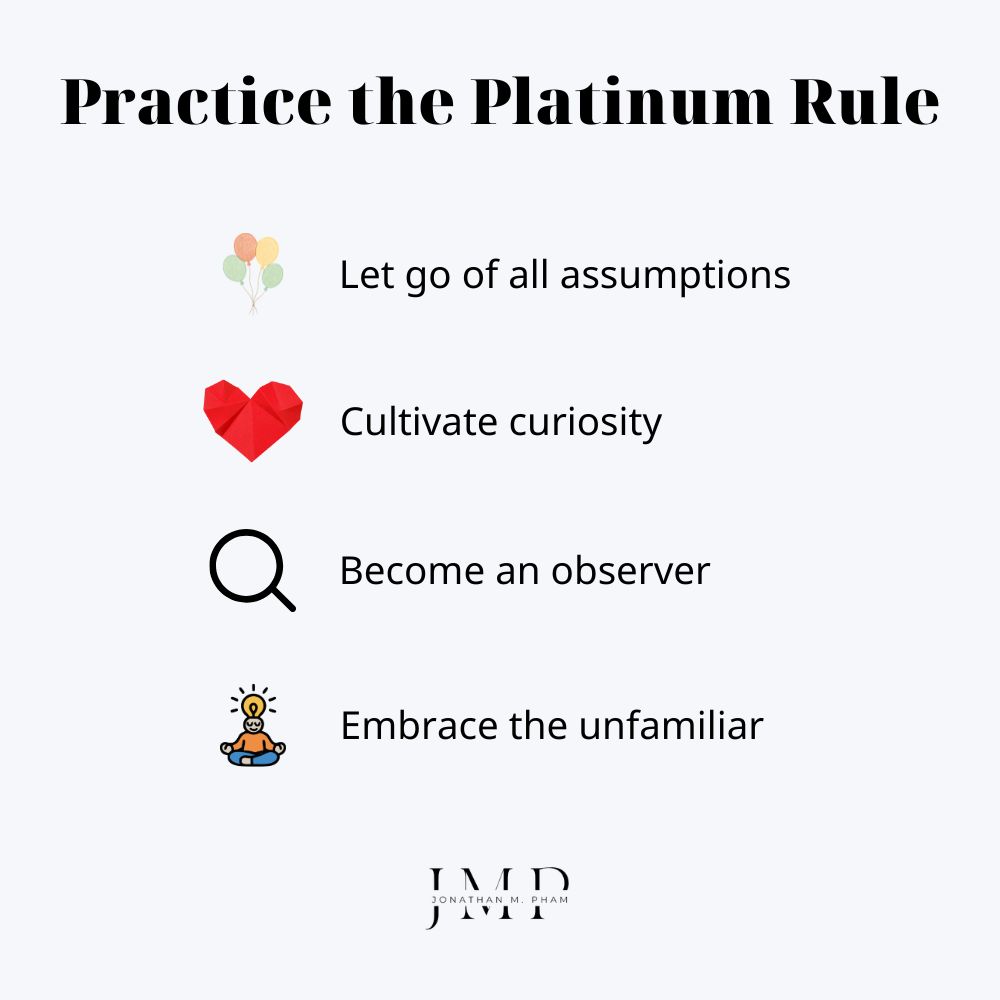
Here is a step-by-step guide to practicing the Platinum Rule in real time.
Let go of all assumptions
Humanity’s default setting is to project ourselves onto the world. When a friend calls us in tears, or a colleague achieves a massive milestone, our instinct immediately rushes in: “What would I want right now?”
The first step of practicing the Platinum Rule is simply catching that reflex – which stats with a mindful pause.
In that brief moment between their circumstance and your reaction, remind yourself that their inner landscape is different from yours.
You don’t need to come up with the perfect response immediately. Just create enough space to drop your assumptions.
Cultivate curiosity
Once you have paused, the next step is to replace your assumptions with curiosity.
Most of us put so much pressure on ourselves to intuitively know what the people around us need. But that’s not a healthy way to apply the Platinum Rule.
Instead, just give ourselves the permission to ask. For example:
- To a stressed partner: “Do you just need to vent right now, or are you looking for solutions?”
- To a new team member at work: “How do you prefer to receive feedback? Do you like it in the moment, or would you rather I send an email so you have time to process it?”
There is immense vulnerability and respect in looking at someone and saying, “I want to support you, but I want to make sure I am doing it in the way that feels best for you.”
Read more: Asking for Help – The Power That Comes From Vulnerability
Become an observer
Of course, not everyone knows exactly what they need, or they may feel too shy to articulate it. This is where mindful observation becomes an act of love.
Pay attention to the unspoken rhythms of the people you come across. Notice what makes them light up, and what makes them quietly withdraw.
If you send a friend a long, emotional text message and they respond with a short, overwhelmed reply, observe that. Perhaps their language of connection is a shared activity rather than deep conversation.
In other words, you should strive to become a non-judgmental student of your loved ones’ reactions.
Read more: Passing Judgment – Why We Must Stop This Destructive Habit
Embrace the unfamiliar
This is arguably the most challenging step. Practicing the Platinum Rule means you will frequently have to show love, appreciation, or support in a language you do not naturally speak.
For instance, let’s say you are someone who processes stress by talking through every detail. If your partner does that by needing two hours of absolute, uninterrupted silence, giving them that silence will feel entirely counterintuitive to you. Your ego will tell you that you are abandoning them.
But you need to realize that your definition of abandonment is actually their definition of safety.
It takes a great deal of maturity to say, “This feels completely unnatural to me, but I am doing it because I know it is exactly what you need.”
That is the moment empathy transitions from merely an idea into a lived reality.
Read more: Embracing Uncertainty – How to Tread the Path When There Is No Map
Platinum Rule vs Golden Rule: Moving from the latter to the former
Challenges of the Platinum Rule (and How to Navigate Them)
As beautiful as the Platinum Rule is in theory, human relationships are inherently messy. When we shift our focus so entirely onto the needs of others, we inevitably encounter a few stumbling blocks.
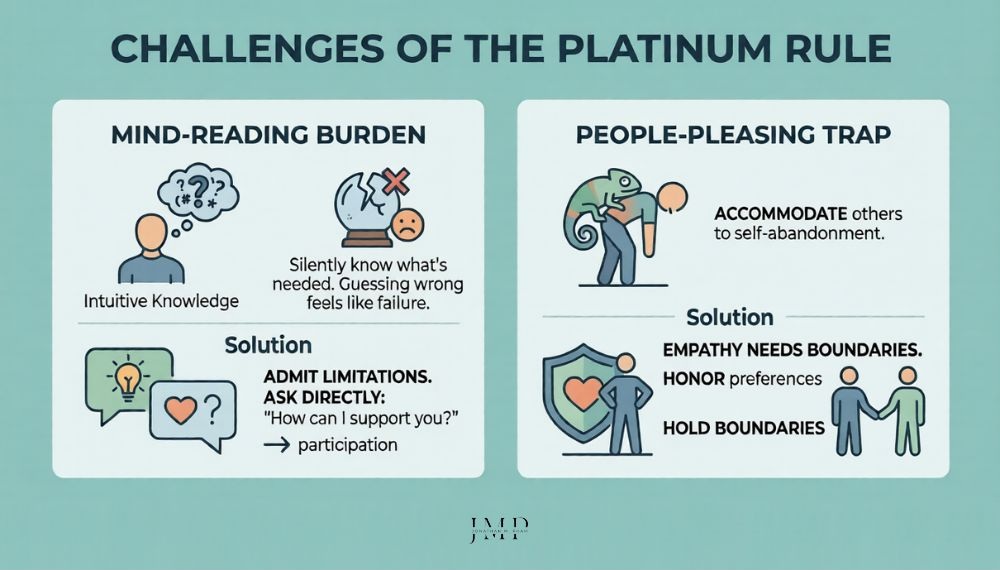
The burden of mind-reading
Most of us, when first deciding to commit to the Platinum Rule, mistake empathy for clairvoyance. We put an immense amount of pressure on ourselves to silently, intuitively know exactly what our loved ones need. As such, we do our best to analyze their sighs, read into their text messages, and try to perfectly orchestrate our responses.
When we inevitably guess wrong—because we are human, not psychics—we feel like we have failed at empathy. We feel guilty for not being attuned enough.
- What to do then:
True connection is a dialogue, not a magic trick. It is perfectly okay to admit your own limitations.
If you are trying to comfort a friend and realize you are totally lost in the dark, the most compassionate thing you can do is name it.
For example, saying, “I love you, and I want to support you right now, but I realize I don’t know exactly what you need. Can you help me understand how to be here for you?” is a profoundly loving act. It removes the guesswork and invites them to participate in their own healing.
The people-pleasing trap
This is perhaps the most critical challenge on any journey of self-discovery. In our earnest desire to accommodate those around us, we run the risk of bending so far that we break.
If the Platinum Rule is “Treat others the way they want to be treated,” what happens when the way they want to be treated violates your own emotional safety?
For instance, what if you have a family member who “wants to be treated” as if their destructive, toxic behavior is perfectly acceptable? What if a colleague “prefers” to communicate through late-night, boundary-crossing phone calls?
If you blindly apply the Platinum Rule here, you slip from empathy into enabling. You become a chameleon, constantly changing your colors to appease others – while quietly losing touch with your own identity in the process.
If you base your identity on having friends, being accepted, and being popular, you may find yourself compromising your standards or changing them every weekend to accommodate your friends.
Sean Covey
- What to do then:
Empathy cannot survive without boundaries. The Platinum Rule is a guideline for delivering love and respect—NOT a demand for self-abandonment.
You can honor how someone wishes to be treated, but only up to the line where your own core values and emotional safety begin. If someone’s preferred way of connecting causes you harm, the most authentic action you can take is to hold your boundary.
You can be deeply compassionate while still saying, “I understand you want to discuss this right now, but I need to step away from this conversation to protect my peace.”
True connection requires two whole, healthy people. You cannot respect someone else’s inner world if you are constantly abandoning your own.
Read more: Emotional Intelligence (EQ) – Key to a More Abundant Life
Moving Beyond the Rules: The Wisdom of Presence
What must we do in order to understand a person? We must have time; we must practice looking deeply into this person.
Thich Nhat Hanh
We are creatures who innately crave certainty. As such, in everything we do – including our interactions with others, most of us naturally look for formulas to make us feel safe.
The Golden Rule, the Silver Rule, the Platinum Rule—all of them provide us with a comforting sense of control. We think, “If I just memorize this framework and apply it correctly, I will finally get this right. I won’t hurt anyone, and they won’t hurt me.”
But human beings are NOT math equations to be solved.
When we hold on to any rule too tightly—even one as beautiful as the Platinum Rule—it may end up becoming a barrier to genuine intimacy.
If we become so obsessed with perfectly executing “how someone wants to be treated,” we risk becoming mechanical. For example, let’s say you meticulously catalog exactly how a loved one wishes to be comforted, but deliver that comfort like a robot checking boxes on a list. In that case, the rule is followed perfectly, yet the spirit of the connection is entirely dead.
Furthermore, any rule can be weaponized if the intention behind it is not pure. The Platinum Rule, stripped of genuine love, can easily become a tool for manipulation. If you are only adapting to someone’s needs to win an argument, close a sale, or control how they perceive you, you are no longer practicing empathy. You are simply wearing a mask.
That’s why at a certain point in life, it is critical that we move beyond the rules entirely.
Rules are training wheels for the heart. They are incredibly useful when we are learning how to ride, but eventually, we have to trust our balance.
At the end of the day, what truly heals, comforts, and connects us is not a perfectly executed communication strategy. It is mindful, undefended presence.
When you sit across from another human being with a pure heart—when you strip away your ego, agendas, and the need to “get it right”—you don’t need to remember a rulebook.
When you are truly present, compassion naturally figures out what to do. You respond to the tears, the laughter, and the silence NOT because a rule told you to, but because you are sharing the moment with them.
Read more: How to Take a Leap of Faith – Trusting Intuition Over Logic

Platinum Rule vs Golden Rule
Final Thoughts
The evolution of empathy is one of the most beautiful journeys we take in this life. It begins with the innocent assumption that everyone’s heart beats exactly like ours (The Golden Rule). As we grow, it deepens into the curious, loving observation of our differences (The Platinum Rule).
And finally, if we are lucky (and brave) enough, it culminates in simply being with one another. We stop assuming, stop managing, and start witnessing.
The next time you find yourself facing someone else’s pain, joy, or confusion, take a deep breath, and remember.
You don’t have to have the perfect, rule-abiding response. Just bring your curiosity, boundaries, and presence.
That is always enough.
Other resources you might be interested in:
- 68 Empathy Quotes: Awakening to Our Shared Humanity
- Destructive Criticism: How to Break This Bad Habit
- Choices in Life: Moving Beyond Right & Wrong Decisions
- Personal Development: A Lifelong Quest
- The World is Not Black and White: Finding Grace in the Grey
Let’s Tread the Path Together, Shall We?

