

 Tiếng Việt
 日本語
日本語
Nietzsche’s Übermensch is arguably one of the most famous—and infamous—ideas in philosophy. To understand it, one has to take a trip back to Europe in the late 19th century.
For centuries, the Western world had largely relied on the traditional Christian moral framework to provide a universal rulebook for life. Christianity—despite its various flaws—played a crucial role in ensuring societal stability by addressing some of humanity’s biggest questions about existence. (e.g. “What is good? What is evil? Why are we here?“)
However, this moral monopoly was disrupted by the seismic intellectual shifts of the Scientific Revolution and the Enlightenment—upheavals that fundamentally transformed humanity’s understanding of the world.
As the 1800s drew to a close, German philosopher Friedrich Nietzsche observed a cultural earthquake. He saw that the absolute authority of the above-mentioned religious framework was cracking under the weight of modern science and secularism—which he captured in a phrase that would shock the entire world:
“God is dead. God remains dead. And we have killed him.“
Today, the quote is often misinterpreted as a boastful atheist slogan. But for Nietzsche, it was actually a warning that stemmed from him recognizing that the external rulebook was gone. Without a divine foundation to anchor our values, he feared society would plunge into nihilism—a terrifying void where life is viewed as entirely meaningless.
To combat this encroaching despair, Nietzsche realized humanity needed a new ideal to strive toward. We needed a psychological and spiritual evolution.
He called this ideal the Übermensch.
Highlights
- The Übermensch (Overman) represents Nietzsche’s vision of humanity’s highest psychological potential: an individual who creates their own values in a meaningless world.
- The Übermensch is NOT about biological superiority or ruling others. Instead, it is an internal psychological journey focused on conquering one’s own passions, insecurities, and weaknesses to achieve absolute sovereignty over one’s mind.
- Nietzsche describes the path to this ideal through three stages: the Camel (cultivating discipline and carrying the weight of tradition), the Lion (rebelling against societal dogmas and “Thou Shalt” commands), and finally the Child (reaching a state of innocence to create new values through pure, life-affirming joy).
- In a world without objective meaning, the Übermensch rejects “herd morality” to forge a personal moral compass. One defining trait of the model is Amor Fati (Love of Fate), the ability to not only endure but fully embrace one’s life—including all its tragedies and suffering—as necessary components of one’s strength.
- Achieving this state requires “living dangerously” by taking psychological risks and seeking solitude. It involves moving away from the “Last Man”—the person who seeks only comfort and safety—to become an “artist of life” who defines success and virtue on their own terms rather than through social validation.
- The Übermensch is a horizon to move toward rather than a finish line to cross. It serves as a continuous call to arms for individuals to “become who they are”—by balancing personal independence with the spiritual maturity to offer authentic, strength-based compassion to the world.
What is the Übermensch?
The Übermensch (frequently translated as the “Overman” or “Superman”) is not a biological superhero. To Nietzsche, he represents humanity’s highest potential: a self-mastered individual who breaks free from traditional dogma to forge their own values and meaning in a chaotic world.
If there is no objective meaning handed down from above, the Übermensch has the courage to stand on the edge of the abyss and declare, “I will create my own meaning“.
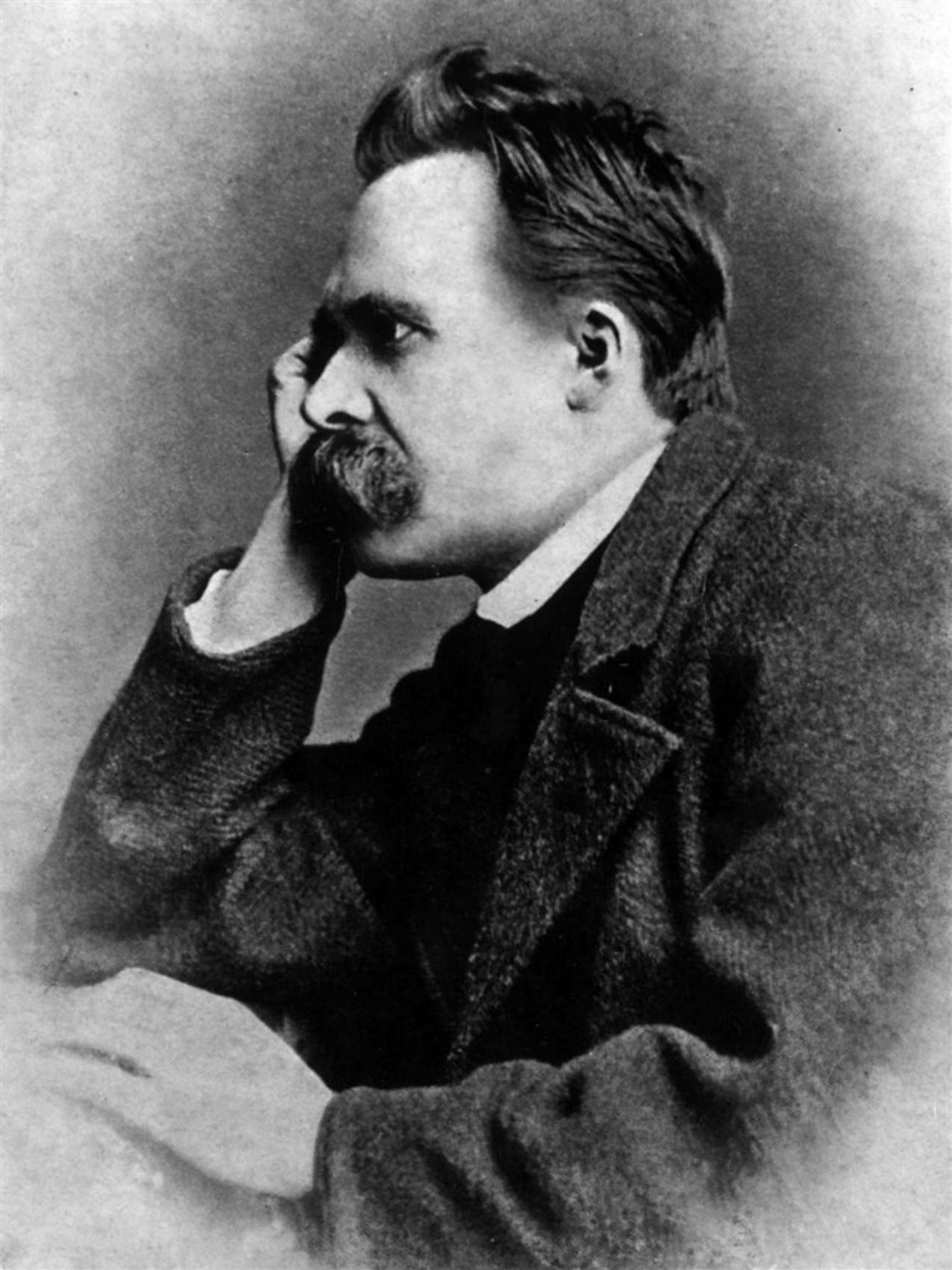
Deconstructing the Myth: What the Übermensch is NOT
Arguably, no philosophical concept has been more notoriously misunderstood and weaponized than the Übermensch. What Nietzsche intended as a radical call for spiritual and personal self-mastery was tragically warped into a justification for totalitarianism, racism, and cruelty.
How did it happen then?
The ultimate hijacking
The “corruption” of the philosophy begins with a historical tragedy. In 1889, Nietzsche suffered a severe mental collapse, spending the last 11 years of his life incapacitated. During this time, his sister, Elisabeth Förster-Nietzsche, took total control of his unpublished writings.
Elisabeth was a fervent German nationalist and a virulent anti-Semite. She heavily edited, spliced, and selectively published her brother’s notebooks to fit her own political agenda. In the 1930s, she cultivated a relationship with the rising Nazi party, essentially making an offering of her brother’s philosophy to Adolf Hitler.
The Nazis took Nietzsche’s metaphors for psychological evolution (the idea that man is a bridge to the Overman) and twisted them into biological racism. They equated the Übermensch with an Aryan “master race” destined to rule over others.
This interpretation was a complete betrayal of the man who actually wrote the books. In reality, Nietzsche:
- Despised anti-Semitism: In his lucid life, he explicitly wrote that he wanted anti-Semites expelled from Germany.
- Hated nationalism: He viewed nationalism as a disease of the weak and referred to the State as “the coldest of all cold monsters”. He even relinquished his Prussian citizenship to live as a “stateless” free spirit.
Modern misconceptions
Even today, outside of political extremism, the Übermensch is frequently hijacked by internet subcultures. Far too often, it is mistakenly equated with the “Alpha Male” who dominates weaker men, aggressively acquires wealth, or asserts cultural superiority.
Alternatively, some have used it to justify radical egoism, believing that because they are “superior,” they are not bound by basic human decency (such as the infamous Leopold and Loeb murder case in 1924) .
Nietzsche would reject all of this. The Übermensch is NOT about ruling over others—but about ruling over oneself. At its core, it is the deeply internal work of pruning your own weaknesses and cultivating your highest potential.
Core Characteristics of the Übermensch
Man is a rope, tied between beast and overman—a rope over an abyss. A dangerous across, a dangerous on-the-way, a dangerous looking-back, a dangerous shuddering and stopping.
Friedrich Nietzsche
If the Übermensch is not a conqueror of nations, how does he actually look like?
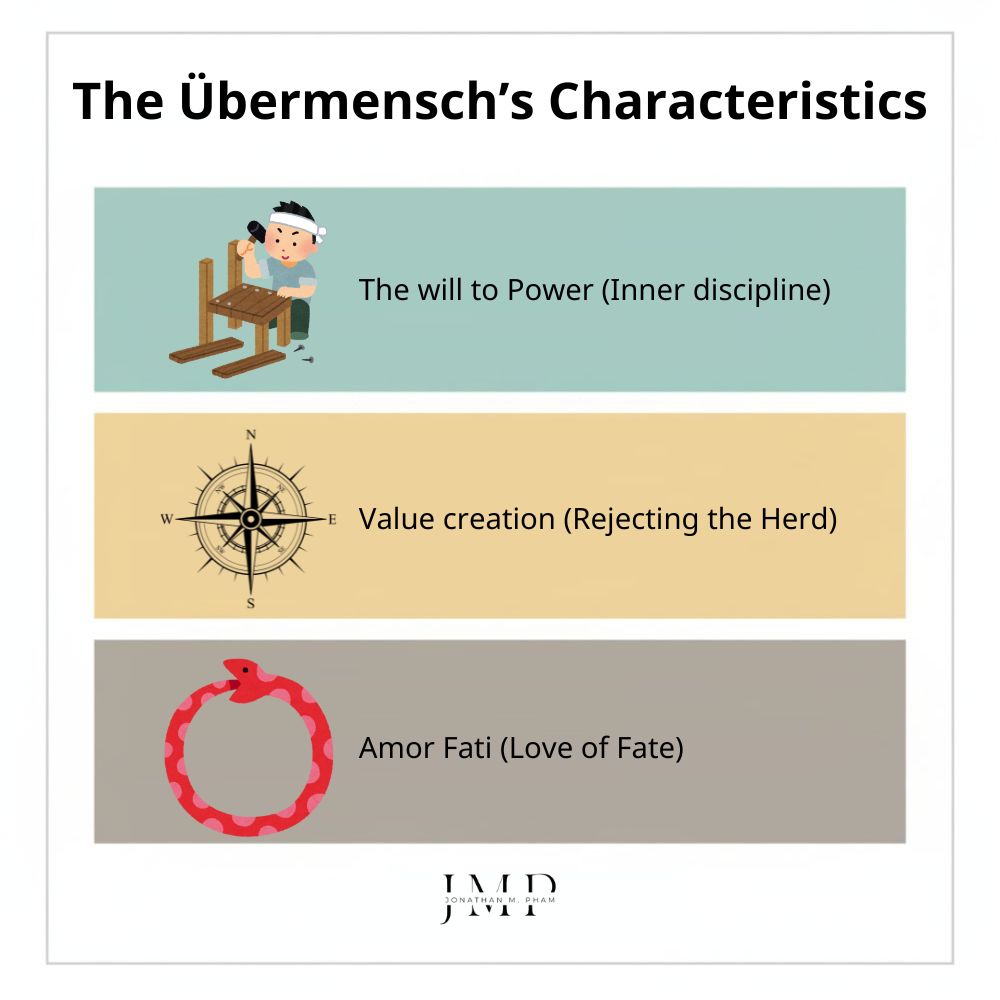
Nietzsche did not provide a rigid checklist, but he did outline the psychological framework required to reach this state. According to him, the Übermensch is built on three core pillars as follows:
The will to Power (Inner discipline)
This is perhaps one of Nietzsche’s most misunderstood phrases. For decades, it has been misread as a desire to dominate others. But in reality, Nietzsche defined the “Will to Power” as the relentless drive to conquer oneself by:
- Mastering one’s own passions
- Overcoming one’s laziness, and
- Silencing one’s insecurities.
To the Übermensch, true power does not mean forcing someone else to do your bidding. Instead, it involves an absolute sovereignty over one’s own mind.
It is the ability to harness destructive energies (e.g. anger, envy, grief, or lust) and channel them into life-affirming creations (e.g. art, philosophy, a business, or physical fitness).
He who cannot obey himself will be commanded. That is the nature of living creatures.
Friedrich Nietzsche
Value creation (Rejecting the Herd)
Because the Übermensch recognizes that objective, universal moral truths no longer hold sway, they understand that they themselves must create their own.
Nietzsche was highly critical of what he called “Slave Morality“—a moral system born from fear, resentment, and a desire to fit in with the “herd”. In slave morality, people label their own cowardice or subservience as a “virtue”—simply because they are too afraid to stand out. They look to institutions, the crowd, or the promise of an afterlife to tell them what is right and wrong.
The Übermensch, on the other hand, operates on a self-authored moral compass. They do not follow rules simply because society deems them “normal.” Instead, they evaluate everything and decide for themselves what is “good” (that which affirms life and enhances vitality) and what is “bad” (that which denies life or promotes weakness).
There is no such thing as moral phenomena, but only a moral interpretation of phenomena.
Friedrich Nietzsche, ‘Beyond Good and Evil’
Amor Fati (Love of Fate)
This is the ultimate test of the Übermensch. How do you respond to the tragedy, pain, and absurdity of existence?
Nietzsche attempted to address the question by posing a terrifying thought experiment called the Eternal Recurrence. He asked: What if a demon were to steal into your loneliest loneliness and tell you that you had to live your exact life—every pain, every joy, every mundane Tuesday—over and over again for eternity?
Most of us, in that situation, would fall to our knees in despair. And yet, the Übermensch embraces life so fully that their answer would be an enthusiastic “Yes!”.
Nietzsche called this radical acceptance Amor Fati (Love of Fate). Rather than merely a stoic tolerance of suffering (FYI, the phrase actually had roots in ancient Stoicism), Nietzsche’s Amor Fati demonstrates a profound love for it. Specifically, the Übermensch looks at their deepest heartbreaks and heaviest burdens—yet he refuses to wish them away.
Why then?
Because he knows that those very struggles are what forged his own strength.
What doesn’t kill you makes you stronger.
Friedrich Nietzsche
Übermensch theory
The Three Stages of the Übermensch
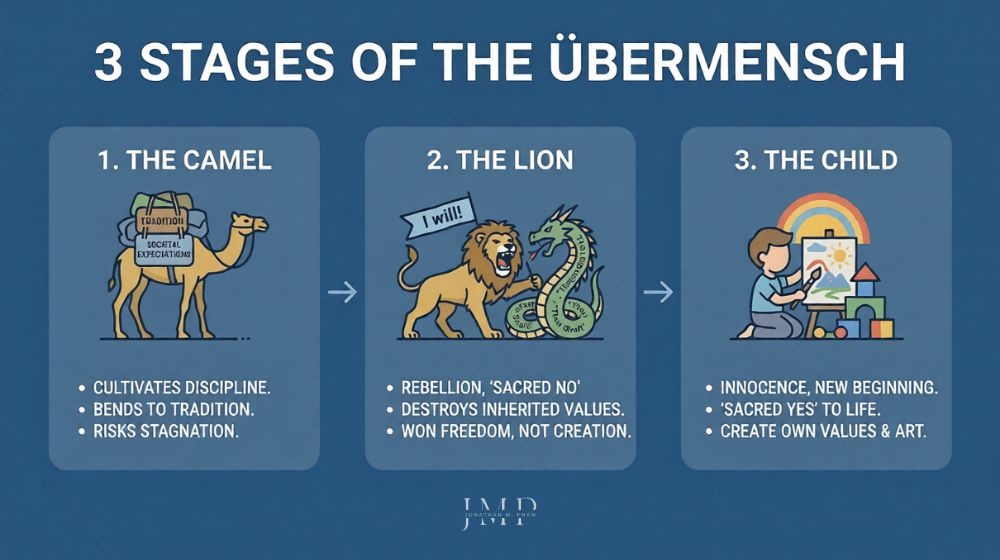
To attain such a level of radical self-mastery, one does not simply wake up one day and decide to be an Übermensch. Instead, one needs to undergo a transformational journey—which was described by Nietzsche in his masterpiece Thus Spoke Zarathustra as comprised of the following three stages:
Stage 1: The Camel
Before the spirit can rebel, it must first cultivate the strength to endure through discipline, humility, and the accumulation of knowledge. In the initial phase, the individual willingly bows to the weight of tradition, education, and societal expectations. Rather than shunning difficulty, they seek out the heaviest burdens—testing their resilience and honoring the wisdom of those who came before.
However, the Camel carries the “baggage” of others, living by values it did not create. To remain a Camel indefinitely is to risk stagnation; without eventually shedding these external impositions, the spirit will inevitably be crushed by the very weight it worked so hard to carry.
Stage 2: The Lion
The transition to the second stage usually occurs following a trigger such as a crisis of meaning, burnout, or a “dark night of the soul”. (i.e. spiritual crisis) To survive, the spirit wanders into the lonely desert and transforms into a Lion, which represents destruction and the “Sacred No“.
In the desert, the Lion encounters a great dragon whose scales are covered in the words “Thou Shalt” (representing the rules, dogmas, and expectations of society). The Lion roars, “I will!” and fights the dragon.
This is the stage of rebellion. The individual rejects the herd mentality and destroys the old, inherited values. However, while the Lion is powerful enough to win its freedom, it is too fierce and destructive to create anything new.
Stage 3: The Child
If you only ever rebel, society is, technically, still dictating your actions (just in reverse). In order to reach the highest stage of human potential, the Lion must, therefore, undergo one final transformation: becoming a Child.
Why then? Because a child represents innocence, forgetfulness, and a new beginning. He is not weighed down by the past (like the Camel) nor consumed by anger and rebellion (like the Lion). The Child simply plays.
In other words, the last phase is about the “Sacred Yes” to life. Having cleared away the restrictive rules of society, the individual is now free to play the game of creation. They create their own values, art, and meaning—not out of spite, but out of pure, life-affirming joy.
The three metamorphoses of the soul’s journey towards the Übermensch
The Existential “A-Team”: Übermensch vs. Other Heroes
If you have been following this series for a while, you might notice that the Übermensch shares some DNA with the other existential heroes we have explored. They all stand at the edge of the “abyss”, isolated from the crowd, facing a world that defies easy answers.
However, they are separated by the ways they respond to that void.
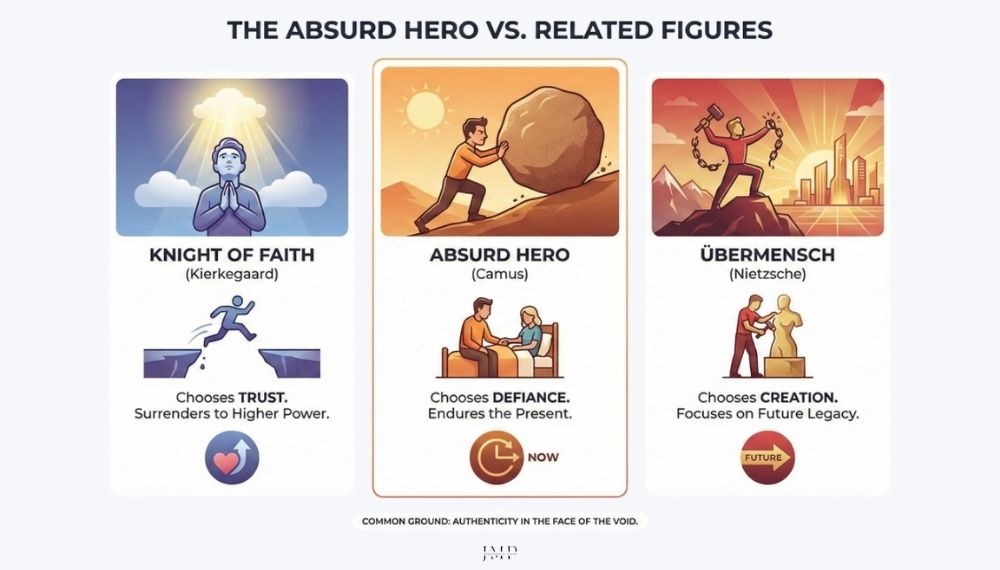
Vs. The Absurd Hero (Albert Camus)
At first glance, Nietzsche’s Overman and Camus’s Absurd Hero seem identical. Both reject the illusion of objective meaning. However, their ultimate goals are fundamentally different.
The Absurd Hero is about enduring meaning. Camus’s hero (like Sisyphus) looks at a chaotic universe, accepts that it is meaningless, and finds a defiant joy in the struggle itself. They do not try to invent a grand new purpose; after all, Camus believed that creating your own meaning was a form of “philosophical suicide.”
Nietzsche’s Übermensch, on the other hand, is all about creating meaning. The Übermensch is an artist of life who actively destroys old values to forge entirely new ones.
Where the Absurd Hero is focused on enduring the present, the Übermensch is focused on the future—on building a legacy and becoming something greater.
Vs. The Knight of Faith (Søren Kierkegaard)
The divide here is even sharper. Both figures require immense courage and require stepping completely outside of universal, societal ethics.
However, the Knight of Faith makes a leap of Trust. They give in to a higher power (the Divine), believing against all logic that the impossible will be given to them.
The Übermensch relies entirely on Will. Nietzsche’s hero looks at a godless universe and says, “I will assert my power. I will create my own meaning”. As such, he is a prime example of supreme self-assertion, whereas the Knight of Faith practices an act of supreme self-surrender.
| Feature | The Absurd Hero (Camus) | The Übermensch (Nietzsche) | The Knight of Faith (Kierkegaard) |
| Core Response | Endurance. Accepts the void and keeps pushing. | Creation. Destroys old values to forge brand-new ones. | Trust. Leaps into the unknown to embrace the Divine. |
| Primary Driver | Defiance. Finding joy in the struggle itself. | Will. Asserting power to become something greater. | Faith. Believing in the impossible despite logic. |
| View of Meaning | Rejects creating meaning. | Actively invents meaning. | Receives meaning through a relationship with God. |
| Posture | The Rebel | The Architect | The Believer |
Examples of the Übermensch in Real Life
The Übermensch is not a mythical figure wielding lightning bolts; it is a psychological blueprint for your best self. It manifests in deeply human moments of fierce independence, honesty, and resilience.
Below are a few instances of how the spirit of the Übermensch looks like in everyday life.
Example #1: The radical career pivot
Think about someone who spends years climbing the corporate ladder because it is what their parents and society told them was “successful”. Eventually, they realize the value they have been chasing is borrowed. So they walk away to become a modest farmer, a carpenter, or a struggling artist.
I experienced a version of this myself. For over six years, I did my best to climb the ladder in the digital industry, eventually becoming an SEO manager at an international agency more than three years ago. At that time, I was earning good money and living a “generous” life by society’s standards. Yet ironically, I could not help but feel a bitter resentment toward my supposed “success”.
Then one day—after lots of reflection—I decided to quit, walking away from the corporate world to research philosophy and the human condition, while sustaining myself through part-time projects.
I admit, at the time, my decision felt more like the leap of a Knight of Faith rather. But if we look at it through Nietzsche’s lens, you can say that it was a radical act of value creation.
I was redefining success on my own terms, willing to look foolish to the “herd” in order to be authentic to myself.
Read more: Are You Living or Just Existing? Let’s Find Out!
Example #2: The unapologetic creator
As mentioned, in the final stage of Nietzsche’s metamorphosis, the spirit becomes a “Child”—a sacred “yes” to life that creates purely for the joy of the game.
We can see this clearly in the artist, musician, or writer who creates without needing validation. For instance, I myself find immense joy in writing about heavy, niche topics like existentialism on my blog. These topics don’t always generate viral buzz; not to mention, they have also been alienating quite a few of my friends.
However, that is entirely beside the point.
The unapologetic creator doesn’t check algorithms or follow trends. If people dislike their work, they simply shrug and keep creating.
Read more: The Curated Self – Why Authenticity on Social Media is Impossible
Example #3: Overcoming severe trauma
Imagine a person who grows up in a deeply abusive environment or falls into severe addiction. The “herd morality” would tell them they are permanently broken, a victim of circumstance deserving only pity.
And yet, this person did not give in. They face their darkest demons, break generational curses, and build a disciplined life. In other words, they conquer their inner chaos and transform their suffering into a source of immense strength.
We determine our own lives according to the meaning we give to those past experiences. Your life is not something that someone gives you, but something you choose yourself, and you are the one who decides how you live.
Ichiro Kishimi, ‘The Courage to Be Disliked’
Example #4: Embracing the worst day of your life
When tragedy strikes—a lost business, a chronic illness, a devastating breakup—most people would wonder, “Why did this happen to me?” or hope for an afterlife where things will be fair.
The Übermensch, however, takes a different approach. They say, “This is MY reality. I will weave this tragedy into the story of my life and use it”.
This is the ultimate test of Amor Fati. It requires looking back at your major failures and heartbreaks—and understanding that you wouldn’t change a single one of them, because they made you exactly who you are.
Read more: Understanding Yourself – Roadmap to a Deeper, More Authentic YOU
How Do You Become an Übermensch?
The Übermensch is NOT a biological endpoint you suddenly arrive at; it is a continuous psychological and spiritual practice. For those who would like to walk this path and transcend the ordinary, complacent existence of the “Last Man” (the antithesis of the Übermensch), here are four essential steps to guide you:
Embrace individuality (Reject the Herd)
Everyone wants the same; everyone is the same: he who feels differently goes voluntarily into the madhouse.
Friedrich Nietzsche
You cannot “become who you are” if you are busy echoing everyone else. As warned by Nietzsche, insanity in individuals is rare, but in groups, parties, and nations, it is the rule.
The first step is to stop outsourcing your moral and life choices to “the Herd”—society, religion, or even your family. Rather, you need to critically evaluate your beliefs and ask yourself:
“Did I choose this, or was it simply handed to me?“
These days, “the Herd” isn’t just traditional religion or authoritarian governments anymore. It also takes the form of social media algorithms, hustle culture, hyper-consumerism, and the pressure to hold the “right” opinions online. Rejecting it means having the courage to step off the autopilot of modern life.
Example:
Think about the classic ‘American Dream’—going to a prestigious college, getting a high-paying corporate job, buying a house in the suburbs, and upgrading your car every three years. The Übermensch would pause to ask: ‘Do I actually want this, or was this desire implanted in me by marketing and peer pressure?’
Rejecting the Herd might look like choosing to live as a minimalist, pursuing a trade instead of a degree, or moving to a quiet town instead of a bustling city—not to be ‘edgy’ or rebellious, but because it genuinely aligns with one’s authentic nature.
Read more: Living in Bad Faith – The Existentialist Guide to Stopping Self-Deception
Live dangerously
Build your cities on the slopes of Vesuvius! Send your ships into uncharted seas! Live at war with your peers and yourselves! Be robbers and conquerors as long as you cannot be rulers and possessors, you seekers of knowledge! Soon the age will be past when you could be content to live hidden in forests like shy deer! At long last the search for knowledge will reach out for its due: it will want to rule and possess, and you with it!
Friedrich Nietzsche, ‘The Gay Science’
Unlike the “Last Man”—who desires nothing but warmth, comfort, and safety—the Übermensch actively rejects false security and chooses to “live dangerously”. However, don’t mistake it for being reckless with one’s physical life.
At its core, it’s about having the courage to take psychological and social risks. Specifically, you must be willing to face the discomfort of alienation, to challenge established norms, and to leave the safety of the “Camel” stage to fight as the “Lion”.
How living dangerously may look like in real life:
- An artist who publishes their deeply personal work knowing it can be mocked by critics.
- An officer who voices a thoughtful, dissenting opinion in a room full of people who blindly agree with each other—risking social friction for the sake of intellectual honesty.
- A person entering a relationship fully, without defensive walls; they are fully aware that there’s the risk of having their heart broken, yet they choose the ‘danger’ of deep connection over the safety of isolation anyway.
Read more: Embracing Uncertainty – How to Tread the Path When There Is No Map
Discover your own hidden values
Given that there is no universal rulebook, it’s up to you to dig deep, find your own path, and confront your own personal “dragons”. What is meaningful for your neighbor might turn out to be “spiritual poison” for you.
One way to determine if something aligns with your internal compass is to pay attention to your energy. When do you feel most vital, alive, and strong? When do you feel drained, resentful, or hollow?
The “dragons” are often the guilt we feel for not wanting what we are “supposed” to want.
Example:
Society tends to place a premium on ‘relentless ambition’ and climbing the social ladder. However, through deep self-reflection, you realize that your highest hidden value is actually ‘tranquil presence’. Honoring that value means turning down a lucrative promotion—because it would steal time from your family.
You have YOUR way. I have MY way. As for the right way, the correct way, and the only way, it does not exist.
Friedrich Nietzsche
Claim your time (Welcome solitude)
You cannot hear your own inner voice over the deafening noise of the crowd. True self-discovery requires profound solitude. As Nietzsche has argued, anyone who does not have two-thirds of their day to themselves is, effectively, a “slave”.
While that exact ratio might be difficult in the modern world, the principle remains: you must carve out quiet, undisturbed time to sit alone in a room and cultivate your inner life.
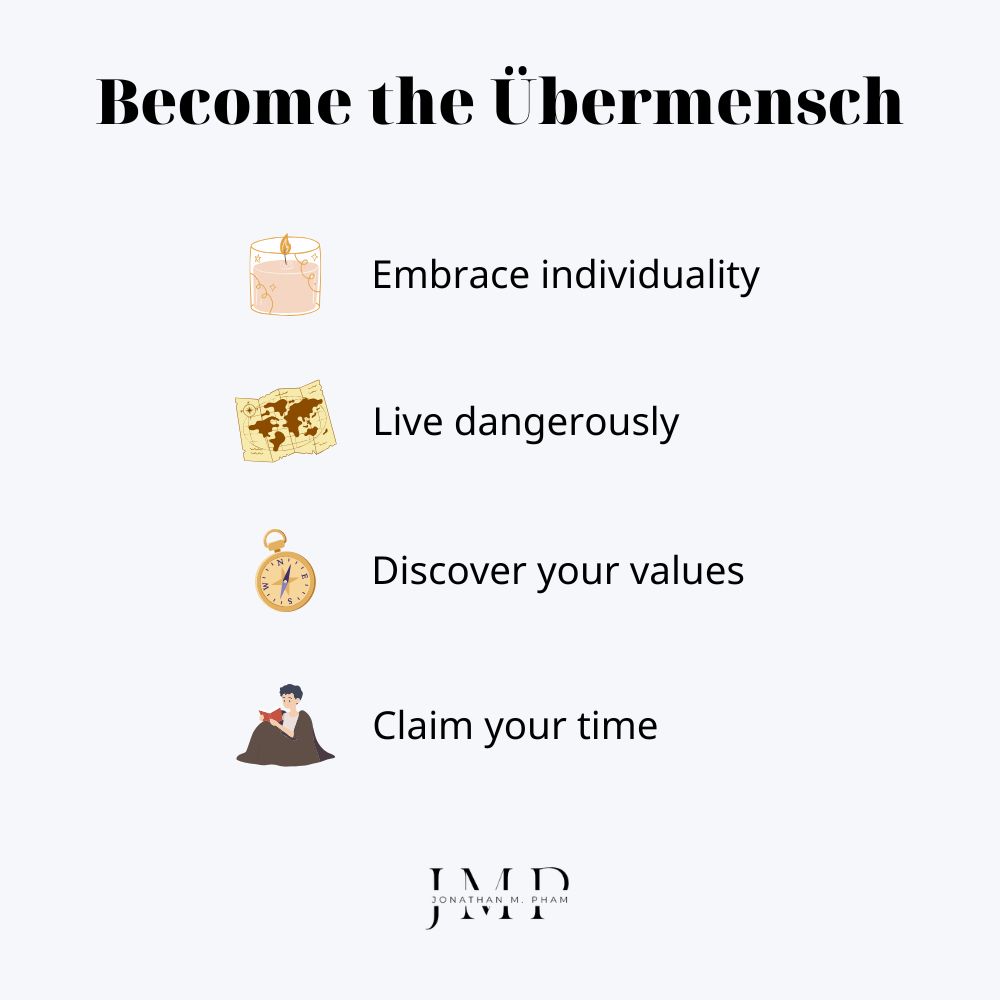
How to become an Übermensch
The Limits of the Übermensch (Plus the Role of Spiritual Maturity)
While the Übermensch is indeed a brilliant blueprint for self-actualization, it is not without its dangers. As a Christian existentialist myself, I find Nietzsche’s outright disdain for qualities like compassion, mercy, and humility to be genuinely troubling.
If adopted recklessly, the Übermensch model can curdle into arrogance, elitism, and a cold narcissism. Hence, I believe we must balance Nietzsche’s fierce independence with spiritual maturity.
Redeeming compassion (Escaping slave morality)
Nietzsche attacked traditional Christianity because he believed it fostered “slave morality”. For my part, I have personally seen it play out in my life: people who use God as a shield to excuse their own weaknesses, or who secretly harbor deep resentment but act “nice” merely because they fear being punished in the afterlife.
That is not true virtue at all; it is simply spiritual bypassing born of cowardice.
That being said, there’s no need to throw away compassion to become an Übermensch. We simply need to make our compassion authentic.
An emotionally and spiritually mature person loves others not out of fear of hell, not to look “holy” to the community, and not from a place of subservience. Instead, they do it unconditionally from an overflowing abundance of their own inner strength.
Power – is when we have every justification to kill, and we don’t. A man stole something, he’s brought in before the Emperor, he throws himself down on the ground. He begs for mercy, he knows he’s going to die. And the Emperor pardons him. This worthless man, he lets him go. THAT IS POWER.
Schindler’s List (1993)
The Continental Shelf
Critics often argue that if everyone acted like an Übermensch—living as a fiercely independent “island”—society would collapse. And yet, I believe true self-mastery does NOT require destroying the community.
If an immature person is a lone, isolated island, a spiritually mature Übermensch acts like a continental shelf. They expand outward, providing the deep, unseen structural support that allows the ecosystems and communities around them to flourish.
Your own self-realization, when guided by authentic virtue, would become the greatest service you can render to the world.
The horizon, not the destination
What is great in man is that he is a bridge and not an end: what can be loved in man is that he is an overture and a going under.
Friedrich Nietzsche
Finally, we should remember that the Übermensch is an ideal, NOT a finish line. Even Nietzsche admitted that there had “never yet been an Overman”.
If you become obsessed with “achieving” the status of the Übermensch, you have already lost the thread.
The Übermensch is an eternal call to arms, a mathematical limit you constantly approach but never fully touch.
The goal is not to become a flawless god. It is simply to heed Nietzsche’s most beautiful and grounding command (which I have chosen as the slogan of my own blog):
“Become who you are.“

FAQs
What is the difference between Nihilism and the Übermensch?
Nihilism is the belief that life is entirely meaningless and without purpose. Nietzsche’s Übermensch serves as a cure for it.
While the nihilist looks at a godless universe and gives up, the Übermensch looks at that same empty universe and rejoices in the freedom to establish their own subjective meaning and values.
What is the Übermensch vs. Christianity?
Traditional Christianity relies on a universal moral code handed down by God, often focusing on the promise of an eternal afterlife. As pointed out by Nietzsche, this created a life-denying “slave morality” that praised meekness.
The Übermensch, conversely, relies on absolute self-determination and radically affirms this earthly existence, refusing to wait for otherworldly hopes to find joy.
Is the Übermensch good or bad?
In traditional terms, the Übermensch operates completely “beyond good and evil”. They reject society’s objective moral rules. However, they possess a strict personal compass.
- To them, “good” is whatever affirms life, vitality, and self-mastery.
- “Bad” is whatever promotes weakness, conformity, or the “herd mentality”.
It is a psychological ideal of excellence, NOT a license to be a cruel tyrant.
Read more: Self-leadership – The Art of Leading from Within
Final Thoughts
At the end of the day, Nietzsche did not write his philosophy so that you would follow him. He despised the idea of having blind disciples.
The Übermensch is NOT a cult to join; rather, it is meant to be a mirror held up to your own potential.
It asks you the hardest question in existence: If all the rules, expectations, and safety nets of society vanished tomorrow, what kind of life would you build?
To follow its path is to engage in a sacred rebellion—i.e. stripping away the borrowed values you have comfortably worn for years, and enduring the dizzying loneliness of standing apart from the crowd.
And most importantly, it requires taking radical, unapologetic responsibility for your own joy and suffering.
As Nietzsche has written:
“I say unto you: one must still have chaos in oneself to be able to give birth to a dancing star.“
Do not let the herd extinguish your inner chaos. Stop apologizing for your uniqueness.
Instead, cast your skin, step out onto the tightrope, and “become exactly who you are.”
Other resources you might be interested in:
- The Shepherd of Being: Guarding the Mystery of Existence in an Age of Noise
- 27 Best Existentialism Books: A Seeker’s Guide to Finding Meaning
- Find the Beauty in Everyday: 8 Tips for Uncovering Joy & Wonder in the Little Things
- Fulfillment in Life: Re-fueling Passion Every Day
- The World is Not Black and White: Finding Grace in the Grey
Let’s Tread the Path Together, Shall We?

