

 Tiếng Việt
 日本語
日本語
Given the rush of our modern lives, silence has, unfortunately, become a rare commodity. Quite often, we are so consumed by the noise of the world—and the noise within our own minds—that we forget one of the most fundamental human needs: to understand and to be understood.
Most of us treat listening as a passive backdrop to the “real” action of speaking. We think of it as merely waiting for our turn to talk. Yet I believe if you are truly honest with yourself, you should realize that’s not the case at all.
In fact, listening is the bedrock of meaningful relationships, a potent catalyst for healing, and an active, vibrant skill.
Let us, together, reflect on the importance of listening, why it is indispensable for one’s personal growth, plus how to do it—not as a tactic to get what you want, but as a practice of mindfulness and love, shall we?
Highlights
- Unlike hearing—which is a physiological, automatic reception of sound—true listening is a conscious “surrender of self” that requires active focus to interpret both verbal words and non-verbal cues (like posture and tone).
- Listening acts as the “soil” for healthy relationships; it dissolves conflict, creates “psychological safety”, and allows for personal growth by identifying one’s own blind spots.
- There are seven distinct types of listening—ranging from informational (learning facts) and critical (evaluating logic) to empathetic (feeling what others feel) and relational (building simple connection).
- Most people fail to listen effectively due to “internal static,” such as the urge to “fix” things quickly, rehearsing a response while the other person is still talking, or allowing emotional triggers to shut down the cognitive brain.
- Listening is, deep down, a “spiritual practice”; it requires physical presence, learning to pause instead of interrupting, and deciding if your spoken contribution will actually add value to the other person’s life.
What Actually Is Listening?
At its core, listening involves an active and dynamic process. It is the conscious act of receiving, interpreting, and deeply resonating with the soul of another person’s message.
True listening demands a surrender of the self. It requires us to go beyond merely registering sound waves to absorbing the complete “communication package.” To be specific, it means observing the non-verbal cues that dance around the spoken words—the subtle shift in a friend’s posture, the tremor in a partner’s voice, or the fleeting expression in a child’s eyes.
Research on interpersonal communication by Adler, R., Rosenfeld, L. and Proctor, R. suggests that decoding these messages is foundational to our existence. When we fail to listen, we open the door to misinterpretation. We breed frustration, erode trust, and create distance in the very relationships we cherish most.
Hearing vs. Listening Differences
Many people use the words “hearing” and “listening” interchangeably; however, they actually represent two different states of being.
Hearing: The biological reflex
Hearing is a physiological process—the passive reception of sound waves by the ears. It is your body’s automatic ability to pick up the hum of the refrigerator, the distant traffic, or a notification chime. As such, it is involuntary.
Example: You are reading a book in a coffee shop. You hear the music playing in the background; the sound waves hit your eardrums, but you aren’t processing the lyrics or the emotion of the melody. You are merely perceiving sound.
Listening: The intentional act
Listening, conversely, is cognitive and intentional. It requires focused attention and a choice.
When you listen, you are striving to understand the meaning behind the sound. You are engaging with the narrative, the nuance, and the emotion.
Example #1: In that same coffee shop, if you close your book to focus on the song, identifying the instruments and feeling the sadness in the singer’s voice, you have shifted from hearing to listening.
Example #2: When your partner speaks to you after a long day, hearing is registering that they are talking while you scroll on your phone. Listening, on the other hand, means putting the phone down, looking them in the eye, and trying to comprehend not just the events of their day, but how those events made them feel.
Listening is not the act of hearing the words spoken; it is the art of understanding the meaning behind those words.
Simon Sinek
| Feature | Hearing | Listening |
| Nature | Physiological, sensory | Cognitive, intellectual, emotional |
| Process | Passive, automatic, involuntary | Active, intentional, voluntary |
| Attention | Minimal or no focused attention required | Requires conscious focus and concentration |
| Focus | Perceiving any and all sounds in the vicinity | Comprehending specific messages, both verbal and non-verbal |
| Involvement | Physical presence of sound | Mental processing, interpretation |
| Outcome | Awareness of sound | Understanding, learning, connection, informed response |
| Skill level | A basic human sense | A learned and cultivated skill |
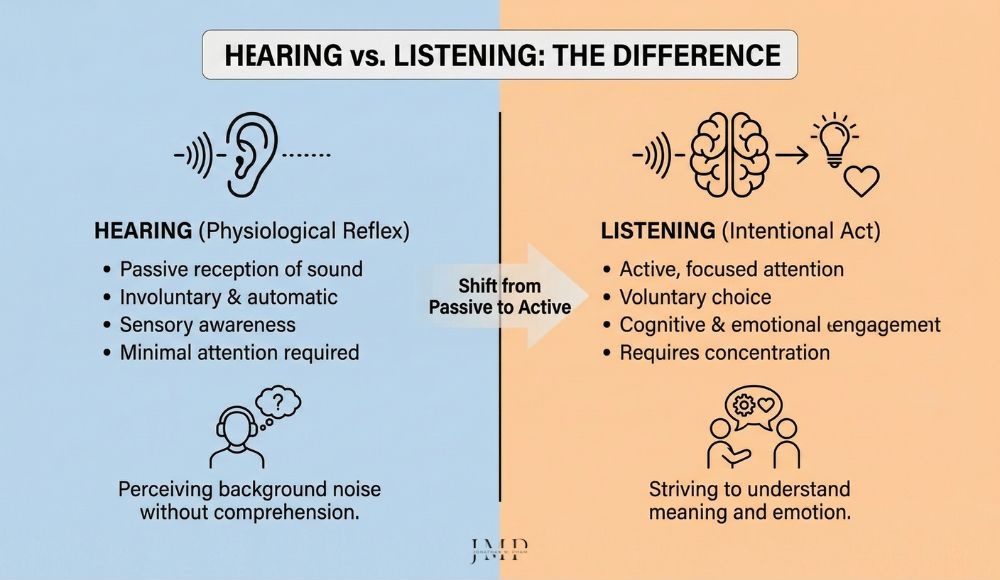
Hearing vs. listening differences
Why is Listening Important?
Why is the skill of listening so vital? Because it is the soil in which trust grows.
Whether in one’s professional or personal life, the importance of listening cannot be overstated.
It dissolves conflict & clarifies intent
How many arguments in your life have stemmed simply from not truly hearing one another?
When we listen deeply, we grasp the heart of the matter. As such, we are less likely to make errors in judgment or take things personally.
- Scenario A (Disconnect)
Imagine a conversation where two friends are “discussing” a problem, but both are waiting to showcase their own opinions. They interrupt, speak over one another, and dismiss input. The result? Frustration, stifled connection, and a feeling of loneliness even while being together.
- Scenario B (Connection)
Now imagine those same friends actively listening. They ask clarifying questions. They paraphrase to ensure understanding (“So what I’m hearing is…”). They validate each other’s viewpoints. The result is a richer exchange where both leave feeling safer and more connected.
It builds “psychological safety”
In the workplace, we call this “culture,” but at home, we call it “sanctuary.” When people feel heard, they feel respected and valued.
Research consistently shows that feeling listened to boosts morale and engagement. In your personal life, this creates a safe harbor where loved ones feel empowered to share their darkest fears and brightest dreams without fear of judgment.
It fuels personal growth
Listening is a tool for continuous learning. Being genuinely open to receiving input—whether it’s feedback from a coach/mentor or a different perspective from a stranger—expands our horizons. It helps us identify our own blind spots (the things we don’t know we don’t know) and reconsider our biases.
Read more: Understanding Yourself – Roadmap to a Deeper, More Authentic YOU
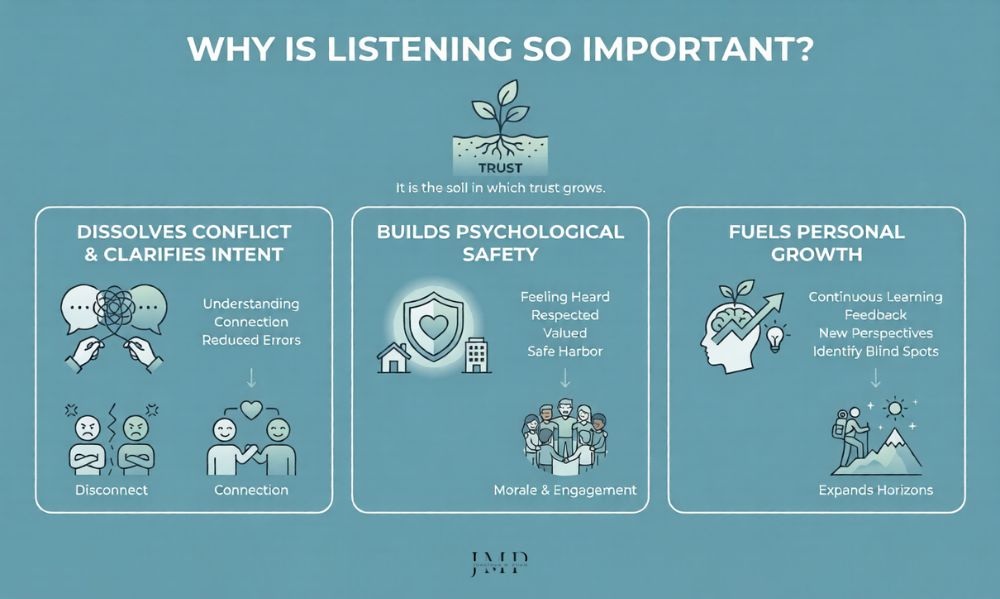
The importance of listening in communication
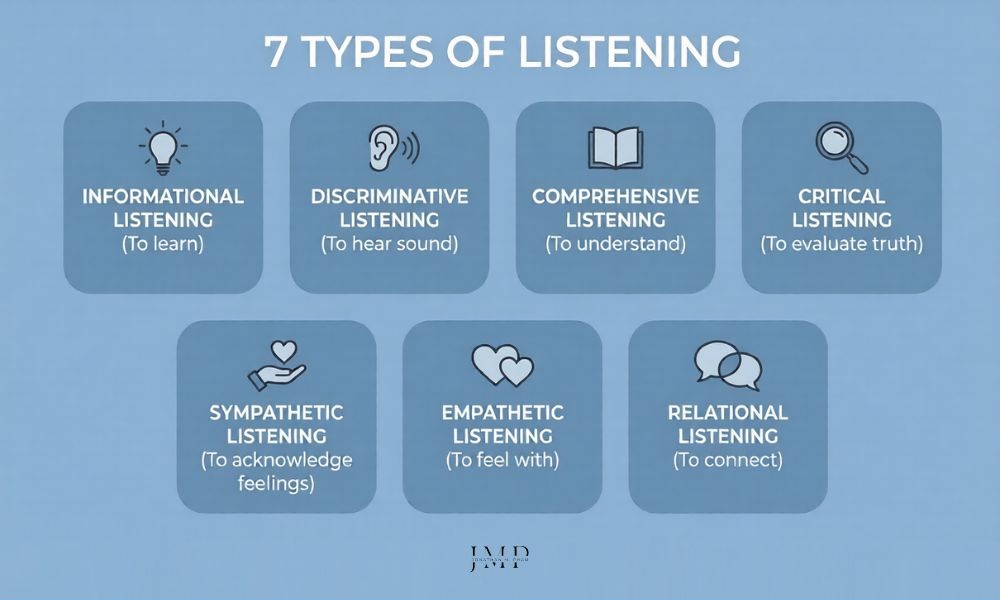
7 Types of Listening
Just as we have different love languages, we also have different “listening languages.” Being a master listener means adapting your style to what the moment requires.
- Informational listening: The goal is to learn. This is the type of listening you use when a mentor is teaching you a new skill – or a friend is giving you directions. It requires concentration and memory.
- Discriminative listening: The most primal form. It is listening to the sound rather than the word. It is noticing the hesitation in someone’s voice when they say “I’m fine,” telling you they are, in fact, not fine.
- Comprehensive listening: This is listening to understand the literal message. It is the bridge of language, ensuring you grasp the vocabulary and the sentence structure to get the whole picture.
- Critical listening: This involves meaningful evaluation. Rather than being “critical” in a negative sense, it is about using logic to assess truth. You use this when listening to the news or a debate, so that you aren’t swayed by flawed arguments.
- Sympathetic listening: Here, we acknowledge feelings. We listen to offer support and show we care. It is the “I’m so sorry you’re going through this” mode of listening.
- Empathetic (Therapeutic) listening: More than mere sympathy, it is the attempt to actually feel what the other person is feeling. It is trying to see the world through their lens, stepping out of your own shoes and into theirs. As such, it is the type of listening that allows the healing of deep emotional wounds.
- Relational listening: The goal here is simply connection. It is the small talk, the sharing of weekend stories, the banter. It strengthens the bonds of friendship and tells the other person, “I am interested in you as a human being.”
Why Do We Often Fail at Listening?
Despite being well aware of the importance of listening in communication, most of us are, unfortunately, so bad at it. Why then?
To put it simply: it’s because we are human. We are creatures of habit.
The “always rushed” syndrome
We live in a culture that worships speed. As such, many feel pressured to come up with quick responses and “fix” things immediately.
When we rush, our attention shifts from understanding to responding. Therefore, it’s easy for us to miss the nuances – because we are already sprinting toward the finish line of the conversation.
Drowning in distractions
External distractions are obvious: the phone notifications, the TV, the noisy café. But internal distractions are just as potent. Our wandering thoughts, our to-do lists, and our anxieties create a wall of static between us and the speaker.
Ignoring the unspoken
Ineffective listeners focus only on words. Yet if you ignore the “unspoken language”—the body language and tone—you will miss the message.
Example: A friend tells you she is excited about her new job, but her arms are crossed, her voice is flat, and she won’t make eye contact. If you only pay attention to the words, you’ll congratulate her. On the other hand, if you are truly attentive to the unspoken, you’ll respond with something like,
“You say you’re excited, but you look worried. What’s on your heart?”
The pitfall of preconceived notions
As human beings, we all carry unconscious biases. Most of us tend to engage in selective listening, hearing only what confirms our existing beliefs and filtering out what challenges them. While understandable, it prevents us from truly seeing the other person; we only see a projection of what we expect them to be.
Emotional hijacking
When a topic triggers a strong emotion in us—anger, defensiveness, or fear—our listening brain shuts down. We stop trying to understand and start preparing for battle. We jump to conclusions to protect our ego, missing the opportunity for resolution.
Read more: Winning at All Costs – Pitfall on the Path to Success
The “What I’ll say next” rehearsal
This is perhaps the most common habit. Instead of being present, we are busy in our own heads, scripting our “clever” comeback or our brilliant advice.
Physically, we are present. But mentally? No.
Read more: Emotional Intelligence (EQ) – Key to a More Abundant Existence
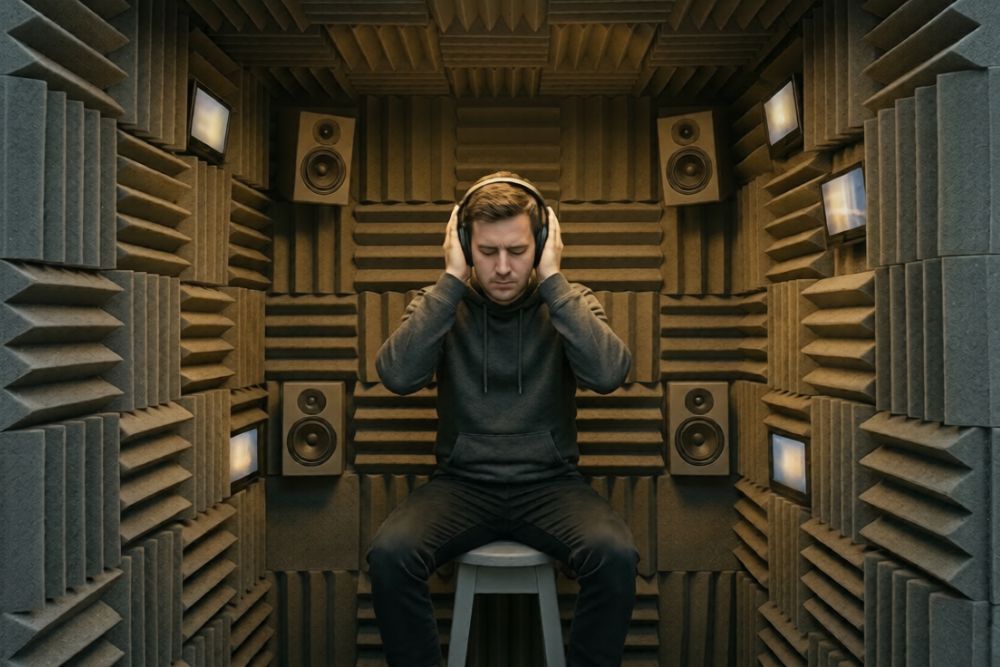
The importance of listening in communication
How to Improve Your Listening Skill: Things All Good Listeners Do
Now that we have reflected on the importance of listening in communication, it’s time to learn how to actually do it in real life.
Becoming a truly effective listener is, at its core, a spiritual practice. It requires what executive coach Dr. Marshall Goldsmith, in his bestseller What got you here won’t get you there, refers to as the willingness to change deeply ingrained behaviors.
Here’s how to begin:
Minimize the noise
Before talking about listening, you must be present first. Make a deliberate choice to focus. Put the phone face down. Turn off the TV. Mentally clear your agenda. Give the person the gift of your undivided presence.
Speak with your body
Our body language speaks volumes. As such, try to orient your body toward the speaker. Maintain soft eye contact. Nod to show you are following.
These physical cues create a feedback loop that makes the speaker feel safe to open up further.
Master the art of the pause
Interrupting is the thief of connection. It sends a message that your thoughts are more valuable than theirs. Instead of that, just wait. Let them finish.
Even when you think you know what they are going to say, allow them the dignity of completing their thought.
Listen with empathy
One simple, yet effective way to cultivate empathy is to ask yourself, “How would I feel in this situation?”
You don’t have to agree with their conclusion to understand their emotion. Validate their experience.
Read more: Platinum Rule vs Golden Rule – How the Principles of Empathy Have Shifted
Invite depth
Ask questions that encourage elaboration. For example: “Can you tell me more about that?” or “What did you mean when you said…?” Doing so demonstrates that you are not just a tape recorder, but an active participant in their journey.
Reflect back
Periodically paraphrase what you’ve heard. “So, it sounds like you’re feeling overwhelmed because…” This technique, often used in therapy, clarifies the message and makes the speaker feel profoundly “seen.”
The wisdom of “Is it worth it?”
Before offering any advice, criticism, or a story about yourself, try to pause for a moment and reflect on this question:
“Is my contribution truly worth it?”
“Will it add value to this human being’s life, or am I just satisfying my own need to be right or to be heard?”
Sometimes, the most powerful contribution is simply your silent, supportive presence.
Read more: 40 Spiritual Lessons – Wisdom for Life’s Journey
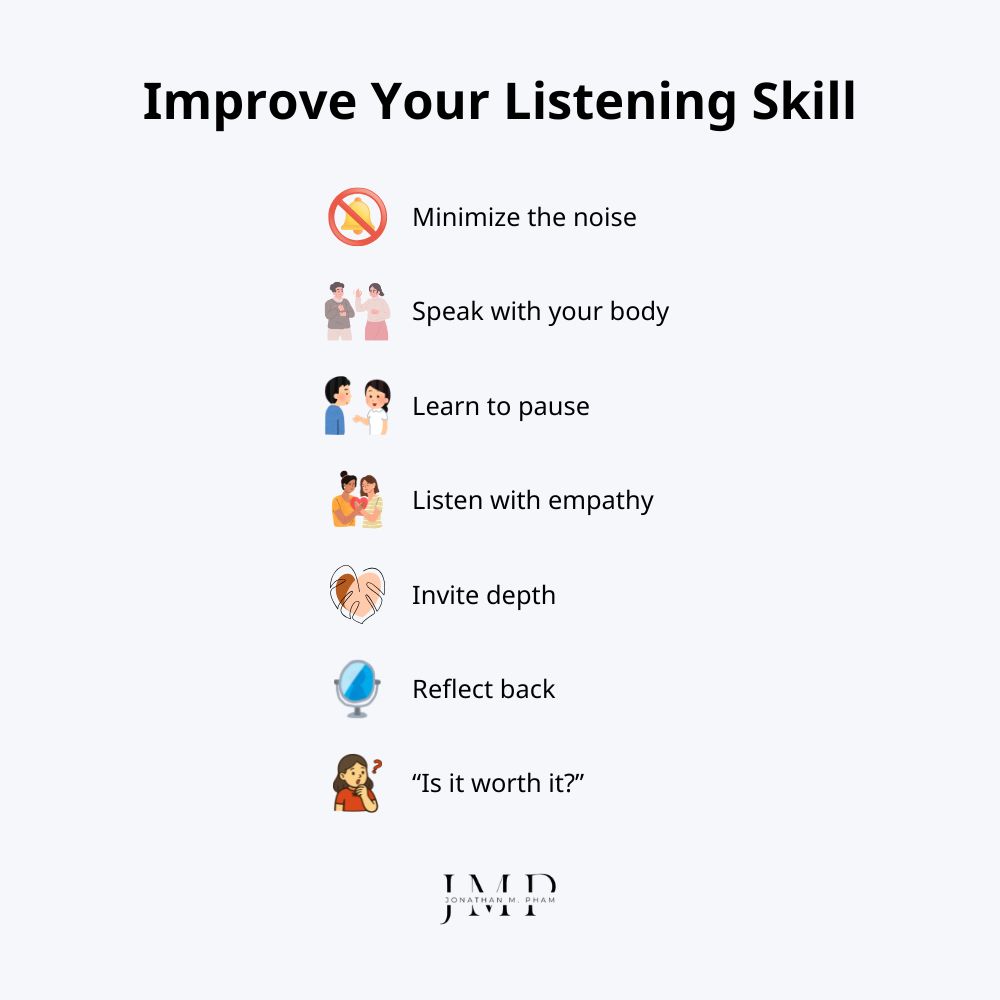
How to improve your listening skills
The importance of listening in communication
Tips for effective listening
Quotes about the Importance of Listening in Communication
For those who are interested, check out a full list of listening quotes here!
The most basic of all human needs is to understand and be understood. The best way to understand people is to listen to them.
Ralph Nichols
The word “listen” contains the same letters as the word “silent.”
Alfred Brendel
Courage is what it takes to stand up and speak; courage is also what it takes to sit down and listen.
William Arthur Ward
Listening is an art that requires attention over talent, spirit over ego, others over self.
Dean Jackson
When you talk, you are only repeating what you already know. But if you listen, you may learn something new.
Dalai Lama XIV
We have two ears and one mouth so that we can listen twice as much as we speak.
Epictetus, Stoic philosopher

The importance of listening
Final Thoughts
Becoming a better listener is not a destination to strive for; it is an ongoing practice of love. It is an investment in your interpersonal intelligence—and a commitment to a life of deeper connection.
By consciously applying the above-mentioned principles, you do more than just hear words—you unlock the hearts of those around you, and in doing so, you expand your own too!
Other resources you might be interested in:
- Not Saying Thank You: Why Do We Often Fail to Express Gratitude?
- Asking for Help: The Power That Comes From Vulnerability
- Self-leadership: Learning to Lead from Within
- Self-coaching: The Art of Being Your Own Coach
- Life Management: How to Design a Life You Love
Let’s Tread the Path Together, Shall We?

