

 Tiếng Việt
 日本語
日本語
I first stared into the “abyss” of life when I was a young man, though I didn’t have the vocabulary for it back then.
It started with a tragedy in my extended family. My uncle took his own life. On the surface, it seemed that his act stemmed from a bitter, escalating conflict with a neighbor.
But looking back, I suspect that was merely the final crack in a dam that had been weakening for years. I strongly believe my uncle was consumed by a quiet despair—an existential crisis that convinced him there was no other way out.
What haunted me most wasn’t just the loss, but the reaction of my religious community. In the days following his death, the air wasn’t filled with compassion or deep reflection on human suffering – but bureaucracy. Neighbors gossiped about whether he would be allowed a “proper” burial in consecrated ground. My uncle’s family scrambled to obtain a “certificate” from a priest proving he had confessed before the end.
I remember watching everything—the obsession with rules over reality, the judgment over empathy—and feeling a deep, cold shiver. If this is all life amounts to, I thought, a checklist of rituals to ensure we don’t get punished, then what is the point?
That question followed me into adulthood. I tried to drown it out by joining the “real world,” but the corporate landscape only amplified the silence.
Years ago, I worked at a medical tourism startup promoting stem cell treatments – which I later learned were unfounded and ethically grey.
The digital media industry – as I figured based on my personal experience – was broken. People churned out shallow, viral content designed to distract people, not inform them.
Then I landed in the coaching industry, hoping to find meaning in human development, only to find an ecosystem of self-proclaimed “gurus” obsessed with vanity metrics and attention-seeking.
Everywhere I looked, I saw the same thing: People treating other people as tools (an I-It relationship) rather than souls (an I-Thou relationship). Managers faking motivation to squeeze out productivity. Colleagues sleepwalking through their days, chasing paychecks to buy things they didn’t need.
So I became cynical. I stopped trusting people. I felt like the protagonist in a movie where everyone else is following a script I refused to read.
And now, I realize I wasn’t alone.
We are living in an age of disruption. Artificial Intelligence is forcing us to ask, “What is the value of human labor?” Global conflicts are shaking our sense of safety. The old systems—religious, political, economic—are fracturing.
If you are reading this, you might be feeling that same cold shiver I felt years ago. You might be asking, “Why am I doing this? Does any of it matter?“
This feeling has a name. It is called Existential Dread.
And while it feels like a curse, I would like to suggest something radical: It might actually be a gift.
It is the sign that you are finally awake.
Highlights
- Existential dread isn’t about “what if I fail”; it’s about “does it matter if I succeed?” It is a deeper questioning of life’s purpose and one’s own freedom.
- Ignoring the dread often leads to “Zombie Mode”—numbing yourself with distractions or falling into cynicism.
- Treating life like a problem to be solved only increases the pain. To deal with existential dread, the most important principle is learning to embrace the uncertainty rather than hunting for “quick fixes”.
- Whether through attention to small details or deep connection, meaning is found in engaging with the present moment, not looking to the distant future.
What is Existential Dread?
When it comes to Existential Dread, people often confuse it with general anxiety or depression. However, they are distinct concepts.
- Anxiety is usually about a specific outcome: “What if I lose my job?” or “What if I fail this test?”
- Existential Dread, on the other hand, involves the underlying structure of reality: “What is the point of the job?” or “Does it matter if I fail or succeed, given that I will die anyway?”
It is the sensation of the ground beneath you dissolving. It is the moment the “autopilot” switches off, and you are left staring at your own freedom and the silence of the universe.

The Existential Crisis Iceberg
To better understand the depth of this feeling, we can visualize it as an iceberg comprised of 4 layers – which correspond to the 4 existential fears/ types of crisis:
- The Tip (The Surface Symptoms): It manifests as Career Stress or Fear of Failure. You might feel burned out, thinking you just need a vacation. You worry about what others think of you. You feel “stuck” in the daily grind.
- The Upper Body (The Passing of Time): Just below the surface lies the awareness of Mortality – the “Mid-Life Crisis” zone. You realize your parents are aging. You notice your own grey hairs. You start wondering about your legacy: “Will anyone remember me when I’m gone?”
- The Deep Middle (The Cosmic Silence): Here, the questions get heavier. This is where The Absurd lies—the conflict between your desire for meaning and the universe’s indifference. You look at the stars and feel small. You look at human history and see a cycle of violence and forgetfulness.
- The Core (Radical Freedom): At the very bottom lies the most terrifying realization of all – You are free. As Sartre said, we are “condemned to be free.” There is no objective instruction manual for your life. You could become a saint or a sinner, a CEO or a monk. The realization that you are entirely responsible for creating the meaning of your life is terrifying.
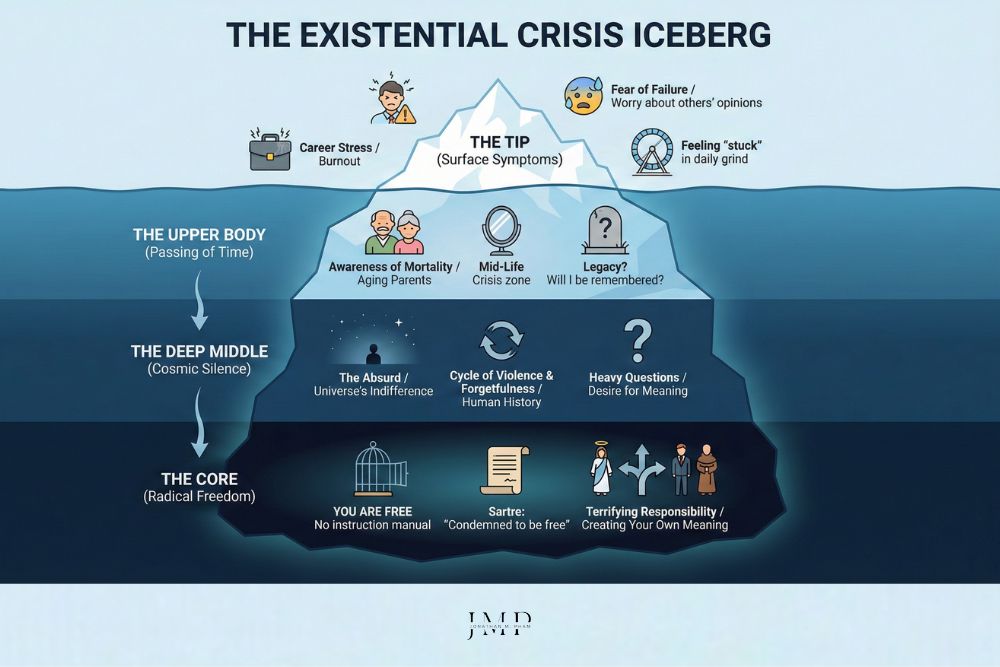
Existential dread symptoms & examples
If you see yourself in this iceberg, please know that it is a documented, perfectly normal human experience. According to research, the younger generations – Millennials and Gen Z – are particularly susceptible to existential dread right now. Not because they are “weak,” but because the traditional scripts (Go to school -> Get a job -> Buy a house -> Retire) have broken down.
You are not mentally ill for feeling this. You are simply looking at reality without a filter.
What Triggers Existential Dread?
Why does existential dread – for some reasons – feel so acute right now? Why are we seeing search trends for “existential crisis” spike?
It isn’t just you. We are living through a perfect storm of triggers that force these questions to the surface.
The success paradox
There is a strange phenomenon I observed during my time in the corporate world: The happier you should be, the sadder you often feel.
We are taught that if we just accumulate enough—enough money, enough status, enough followers—the dread will go away. But it’s usually the opposite.
When you finally get the promotion or the pay raise, you experience a fleeting high, followed by a crushing realization: “Is this it? I’m still me.”
Psychologists call this the Hedonic Treadmill. We run faster and faster, accumulating material success, but our internal baseline of happiness doesn’t change.
The emptiness feels louder in a mansion than it does in a shack – because you have run out of distractions to blame.
The Great Western Disease of “I’ll be happy when…” It is the pervasive mindset whereby we convince ourselves that we’ll be happy when we get that promotion, or drive a Tesla, or finish a slice of pizza, or attain any other badge of our short- or long-term desires. Of course, when the badge is finally in our hands, something comes along that compels us to discount the badge’s value and renew our striving for the next badge. And the next. We want to reach the next level in the organizational hierarchy. We want a Tesla with more range. We order another pizza slice to go. We are living in what Buddha called the realm of the “hungry ghost,” always eating but never satisfied.
Marshall Goldsmith, ‘The Earned Life’

Existential dread meme
The age of disruption
We are also facing an external crisis of value. With the rise of Artificial Intelligence, many of us are forced to ask fundamental questions about our utility. For instance, if an algorithm can write, code, or create art faster than I can, what is my value?
This technological disruption, combined with the rising global conflicts and economic instability, creates a world that is Volatile, Uncertain, Complex, and Ambiguous (VUCA). The old “career ladder” is gone, and standing on the rubble is, to be honest, a terrifying experience for all.
The spiritual void
God is dead. God remains dead. And we have killed him. How shall we, the murderers of all murderers, comfort ourselves?
Friedrich Nietzsche
For many, the traditional containers of meaning—religion, community, extended family—have eroded. In the past, even if life was hard, you knew your place in the village or your standing before God. Yet today, in an increasingly secularized and individualistic society, humanity is left to manufacture our own meaning from scratch.
That, I dare to say, is a heavy burden to carry alone.
Read more: Spiritual Crisis – Finding Light in the “Dark Night of the Soul”
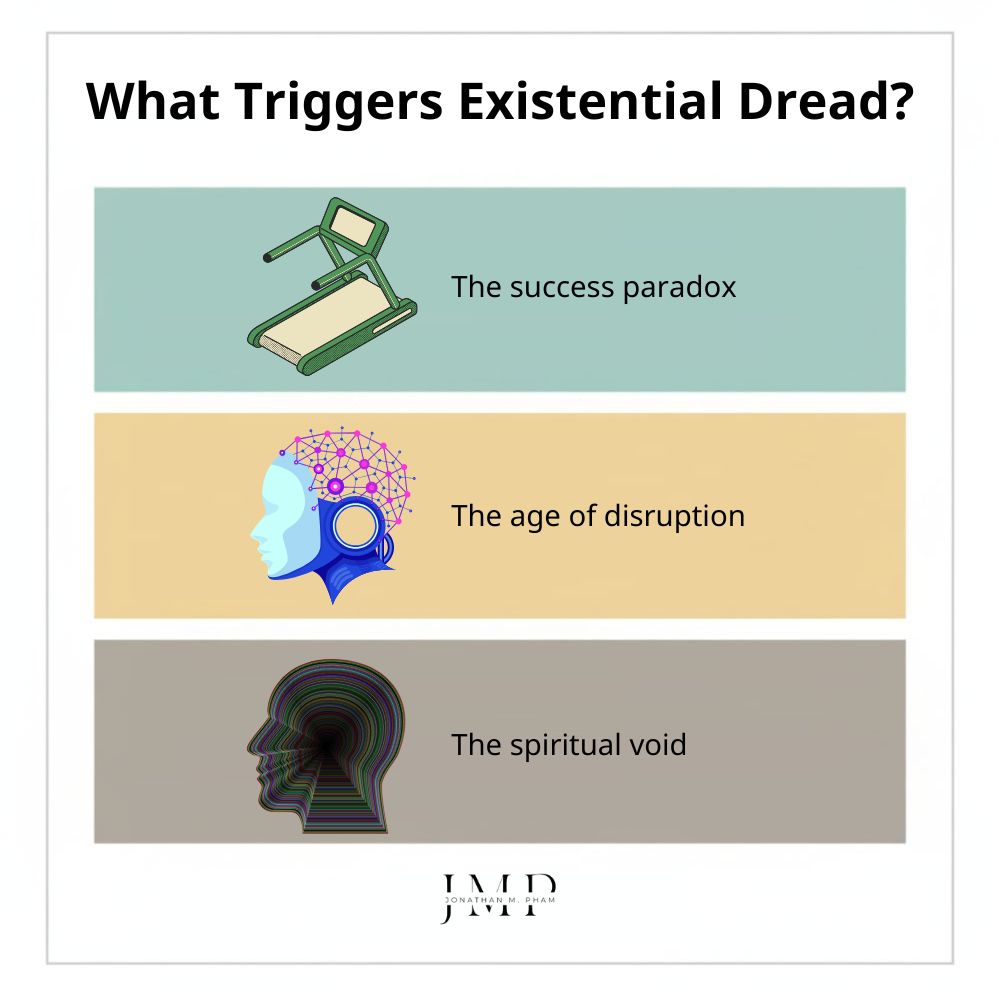
Deal with existential dread
What Happens if We Do Not Deal With Existential Dread?
So, what happens if we feel this dread and simply push it down?
Here is my answer. If you leave it unchecked, it will, over time, mutate into one of the following two dangerous forms:
Apathy (Passive decay)
Let me share with you a personal story to better demonstrate my point.
I once had a friendly talk with my father – who grew up during a period of extreme economic hardship and restricted freedom following my country’s reunification. At that time, most people were concerned only with survival – rather than reflecting on philosophical or existential questions.
And yet, that didn’t stop some from finding solace in their own unique ways.
For example, one prisoner – as my father heard of – was locked up in a small cell, stripped of his freedom, career, and future. By all modern standards, his life was “meaningless.” He had every reason to succumb to despair.
But he didn’t. Instead, he started “herding ants.”
He spent his days meticulously observing the ants that crawled across his cell floor. He saved crumbs from his meager rations to feed them. He created little pathways for them.
To the guards, he probably looked insane. But to him, those ants were a universe.
He forged a relationship with them. He created a daily ritual of care.
In that tiny, restricted space, he found a reason to wake up. He found Meaning.

Deal with existential dread
Now, let us pause for a moment and compare that prisoner to the modern “successful” worker.
We have infinite freedom. We have smartphones, travel, and entertainment at our fingertips. Yet, many of us feel less meaning than the man in the cell.
Even when caught in a seemingly absurd situation, the man still found a reason to enjoy his life. Unlike us – who have everything, and yet feel as if nothing matters.
And when that feeling of emptiness becomes too unbearable, many simply shut down. We stop asking. We stop caring. Instead, we switch to a Sleepwalker/ Zombie Mode state.
Some might fall into the trap of hikikomori (social withdrawal), isolating themselves – physically or mentally – from others. Some might numb the silence with endless Netflix binges, alcohol, or doom-scrolling.
In a sense, we are physically alive, but spiritually dead. We become a spectator in our own life, watching the days tick by with a dull, grey indifference.
Is it a life you would like to live? Ask yourself honestly.
Read more: Are You Living or Just Existing? Let’s Find Out!
Nihilism (Active destruction)
If Apathy says, “Nothing matters, so I’ll sleep,” Nihilism says, “Nothing matters, so I can do whatever I want.”
This is the cynicism I personally see in the corporate world. It’s the manager who exploits employees because “it’s all a game anyway.” It’s the scammer selling fake cures because “morality is a joke.” It’s the bitterness that sneers at anyone who tries to be earnest or kind.
Such an attitude drives one to become an agent of chaos. Because you cannot find light, you try to extinguish it in others. You treat people as objects (I-It) because you have convinced yourself that they—and you—are nothing more than biological accidents.
This is why dealing with existential dread is NOT a luxury at all.
If you do not find a way to transform the dread into growth, it will inevitably twist into either decay or destruction.
Read more: Nihilism vs Existentialism vs Absurdism – A Journey Into the Abyss
Existential fatigue
How to Deal with Existential Dread: A Seeker’s Framework
If you are feeling the dread right now, your instinct is probably to make it go away. You want a pill, a distraction, or a logical answer to solve your problem.
But that is the first trap. Here is the framework that helped me—not to “cure” the dread, but to navigate through it.
Stop trying to “solve” it
Life is not a problem to be solved, but a reality to be experienced.
Søren Kierkegaard
The biggest mistake many of us make is treating our existence like a problem to be solved. In other words, we want the “cheat codes” – quick fixes that can immediately ease the symptoms.
This reminds me of playing video games as a kid, long before the Internet became popular. I would get hopelessly stuck at a certain level, wandering the same corridors, trying every button.
The experience was frustrating, but it was also exhilarating. I was on an adventure.
Then, the Internet arrived. Suddenly, I could look up the walkthroughs. I could read the ending before I began. And I could beat any opponent instantly. As if I had become a god myself!
But after a while, the magic evaporated. The game became boring. I was no longer an adventurer; I was just a robot checking off a list.
We think we want certainty. We think we want to know exactly what happens next.
But as I learned, doing so only trades the thrill of the adventure for the boredom of the outcome.
To deal with existential dread, you must first accept that uncertainty is not a bug in the system; it is the game itself.
Stop looking for the walkthrough. Embrace the maze.
Read more: The World is Not Black and White – Finding Grace in the Grey

Practice the art of small things
When the “Big Picture” feels overwhelming or meaningless, the solution is not to look bigger, but to look smaller. To “find the universe in a grain of sand”.
In his work The Little Book of Ikigai, neuroscientist and author Ken Mogi shares a personal story that, I believe, serves as a perfect demonstration of this principle:
I remember a special chair I encountered in the United Kingdom. For a couple of years in the middle of the 1990s, I was doing postdoctoral research in the Physiological Laboratory at the University of Cambridge. I was lodging in a house owned by an eminent professor. When he showed me the room I would be staying in, he pointed to a chair and explained that it had sentimental value for him: his father had made it especially for him when he was a small child.
There was nothing extraordinary about the chair. To be honest, it was rather clumsily made. The design was not refined, and there were ragged, irregular features here and there. If the chair was for sale in a market, it wouldn’t have fetched much money. Having said that, I could also see, by the glimmer in the professor’s eyes, that the chair had a very special meaning for him. And that was all that mattered. It had a unique place in the professor’s heart, just because his father had made it for him. That is what sentimental values are all about.
This is just a small example, but it is a powerful one. Ikigai is like the professor’s chair. It is about discovering, defining and appreciating those of life’s pleasures that have meaning FOR YOU. It is OK if no one else sees that particular value.
To an outsider like us, the professor’s chair may seem ugly and worthless. But the professor cherishes it. Why then?
Because his father had made it for him.
The “value” wasn’t in the object itself, but in the personal meaning attached to it.
We can apply the sample principle when dealing with existential dread. In my case, whenever I notice that feeling of angst creeping in, I remind myself to stop worry about “My Legacy” or “The Future of Humanity” – and instead to look at my own “clumsy chairs.”
The way I brew my coffee in the morning.
The specific words I use in a blog post.
The way I listen to a friend.
By pouring your full attention into the small details of everyday, you ground yourself in the present. And you will realize that meaning isn’t something you find out there; it is something you generate right here.
Read more: Fulfillment in Life – How to Find Meaning & Passion Every Day

How to deal with existential dread
Shift from isolation to connection (I-Thou)
All real living is meeting.
Martin Buber, ‘I and Thou’
Existential dread thrives in isolation. It whispers that you are a singular, lonely consciousness trapped in a dying body. That’s why the antidote is connection—specifically, moving from an I-It relationship (viewing people as roles/objects) to an I-Thou relationship (viewing people as sacred souls).
Let us reflect on this story told by the Zen master Thich Nhat Hanh to better understand this point, shall we?
In the early 1990s I was on my way to the Omega Institute in upstate New York to lead a retreat when I learned that an old friend of ours was dying in a hospital just north of New York City. His name was Alfred Hassler. He had been director of the Fellowship of Reconciliation.
When Sister Chan Khong and I arrived at the hospital, Alfred was already in a coma. Dorothy, his wife, and Laura, his daughter, were there with him.
When Dorothy and Laura saw us, they were very happy. Laura tried her best to call Alfred back from his coma. “Daddy, Daddy, Thay is here! Sister Chan Khong is here,” she said. But Alfred didn’t come back; he was in a very deep coma.
I asked Sister Chan Khong to sing to him. A dying person has the capacity to hear, even though we may not realize it. So Sister Chan Khong sang the song that begins, “This body is not me, I am not caught in this body, I am life without boundaries, I have never been born, I will never die.” She sang it a second time and again for a third time. In the middle of the third time, Alfred awoke and opened his eyes.
Laura was so happy. She said, “Daddy, do you know that Thay is here? Do you know that Sister Chan Khong is here?” Alfred could not say anything. Looking into his eyes, we felt that he knew we were there.
Sister Chan Khong began to talk to him about the experiences we had working together for peace in Vietnam: “Alfred, remember the time you were in Saigon trying to see the monk Tri Quang? The U.S. had decided to bomb Hanoi the day before, and the Venerable Tri Quang was so angry that he vowed not to see any Westerners, either doves or hawks.”
“When you arrived he refused to open the door. Alfred, do you remember that you sat there and wrote a note that said, ‘I have come as a friend to help stop the war in your country, and not as an enemy. I will not eat anything or drink anything until you open the door for me!’ You slipped the note under the door. You remember that?”
Sister Chan Khong continued to talk to him about the happiness we experienced during the time we were working for peace. It had a wonderful effect. She was watering the seeds of happiness in him.
Alfred’s happiness was made of his intention to serve peace and to end suffering for others. When those seeds of happiness were watered, it restored a balance between the joy and the pain in him. He suffered much less.
At that time I was massaging his feet. I was thinking that when a person is dying he might not be very aware of his body because the body is somehow numb. Laura asked, “Daddy, do you know that Thay is massaging your feet?” He didn’t say anything but looking into his eyes we were sure that he knew we were there.
Suddenly he opened his mouth and said, “Wonderful, wonderful!” After that he sank into a coma again and never came back.
Instead of succumbing to despair, the people in the story – Thich Nhat Hanh, Sister Chan Khong, and Alfred’s daughter – decided to act proactively. They persisted even though their loved one seemed to not respond to their efforts at all. And that was what produced the “miraculous” result in the end.
Even in the face of death and meaninglessness, the connection between two humans can still break through the void.
When you are drowning in dread, go help someone else. Massage their feet – figuratively or literally. Talk to them. Water the seeds of happiness.
As awkward as it may seem in the beginning, you will gradually find that your own dread recedes as the seeds grow.

How to deal with existential dread
Re-anchor your values
When I started this blog, I nearly quit because I was obsessing over “vanity metrics”—traffic, clicks, revenue. These numbers were – due to various factors in play – extremely volatile. Despite knowing that deep down, I was so concerned with making a living out of the blog that I did everything possible to prevent the site’s performance from going down, instead of just “letting it be”.
I suppose you can imagine how it felt then. In fact, my reaction made me end up in a very miserable state.
Eventually, I had to re-anchor by asking myself: “Why am I doing this?”
And it was not difficult for me to come up with the answer: To serve. To share truth. To connect.
Once I shifted my focus from “Getting Clicks” to “Being Helpful,” the existential dread vanished.
After all, everything in life is impermanent. One day, the traffic on my blog will drop to zero. The money I earn will be spent. Even this body I inhabit will return to dust.
If I anchor my meaning to these temporary things, I am building a “house on the sand”. I am guaranteeing my own anxiety – because I am trying to hold onto water with a clenched fist.
But when I anchor myself in Values—like service, connection, and truth—my life will turn to a completely different page.

Think of the cherry blossom. It blooms for a week and then falls. If you look at it with a mindset of possession, you will surely feel dread – because you know it is dying.
But if you look at it with a mindset of appreciation, its shortness is exactly what makes it beautiful.
Our existential dread often stems from the fear that our time is running out. But we have the ability to flip the script.
Instead of dreading the end, we can realize that our anxiety is actually proof of how much we value the experience of being alive.
You fear losing your parents because you love them.
You fear losing your career because you want to be useful.
You fear death because you enjoy the taste of your morning coffee.
By accepting that everything is temporary, you stop trying to “freeze” life and start actually living it. You realize that the goal isn’t to live forever – but to be fully here while you are here.
Precisely because an encounter is ephemeral, it must be taken seriously. Life, after all, is filled with things that happen only once. The realization of the ‘onceness’ of life’s encounters and pleasures provides the foundations for the Japanese conceptualization of Ikigai, and is central to the Japanese philosophy of life. When you take notice of the small details of life, nothing is repeated. Every opportunity is special.
Ken Mogi

How to deal with existential dread
Take a leap of faith
To venture causes anxiety, but not to venture is to lose one’s self…. And to venture in the highest is precisely to be conscious of one’s self.
Søren Kierkegaard
Logic is a powerful tool, but it has its own limits. There are moments in life when the data doesn’t add up, when the pros and cons list ends in a stalemate, and when “common sense” seems to not help at all.
If you rely exclusively on logic to solve your existential crisis, you will remain stuck.
Logic, after all, demands certainty before action. It says, “Show me the outcome, and then I will move.”
But the thing is, life rarely offers 100% certainty. Staying paralyzed in that analysis paralysis is exactly where dread thrives.
Sometimes, the “smart” choice on paper will just result in a spiritual sickness in your gut.
Take my own journey, for example. When I decided to quit my stable, full-time job to work on this blog, logic was screaming at me, saying: “You need the paycheck. You need the security. This is risky!”
If I had listened to it, I would still be in that office, safe but suffocated by dread.
This is what Kierkegaard—the father of existentialism—referred to when he proposed the concept of the Leap of Faith. While it’s true that he viewed it through a Christian lens, the idea – I believe – applies to everyone, regardless of their background.
A leap of faith is not a sign of blind foolishness; it stems from the recognition that passion and authenticity often require us to make “irrational” choices.
It is the moment you decide that the pain of being inauthentic/ living in bad faith is worse than the fear of the unknown. You stop asking for a guarantee of success – and start acting on the guarantee of your own passion.
Now don’t get me wrong: this leap is NOT a magic fix. It often precipitates what mystics refer to as the “Dark Night of the Soul” – the gap between leaving the old shore and arriving at the new one.
You have let go of the job, the relationship, or the old identity, but you haven’t seen the results yet.
You are in the tunnel, and there is no light visible at the end.
- The Dread says: “You made a mistake. Turn back now!”
- The Leap says: “Keep walking. The light only appears after you move toward it.”
In my case, quitting didn’t immediately lead to tangible results. There were sleepless nights and doubts. Yet even in the uncertainty, the existential dread vanished.
Why then?
Because I was finally acting in alignment with my true self. I had no guarantee of the outcome, only the certainty of my intuition.
And that turned out to be enough – for me.
Read more: Choosing Your Life – From ‘Drifting’ to ‘Defining’

How to deal with existential dread as a Christian
Don’t walk alone
Two are better than one, because they have a good return for their labor: If either of them falls down, one can help the other up.
Ecclesiastes 4:9
Existential dread has a unique way of isolating us. It whispers that no one else feels this way, that everyone else has it “figured out,” and that your doubts make you an outsider. This is perhaps the greatest lie of anxiety.
We were created as relational/ social beings; therefore, trying to process the infinite weight of existence in isolation is just a futile effort.
Sharing your dread is not a sign of weakness at all. When you voice your fears to a safe community, you strip the dread of its power. Darkness cannot survive in the light of fellowship.
This step requires more than just social interaction. Specifically, you should aim to seek out:
- Mentorship: Find someone a few steps ahead of you – who has wrestled with these same shadows.
- Fellowship: A small group or a trusted friend/ accountability partner with whom you can be intellectually honest. You need a space where you can say, “I feel empty today,” and be met with love, not judgment.
- Professional guidance: If necessary, don’t be afraid to seek out a counselor or therapist—someone trained to provide a structured, confidential framework for navigating anxieties. These experts will be able to offer specialized tools and an objective perspective to help untangle complex thoughts that you may find overwhelming to process on your own.
Sometimes, you don’t actually need answers. You just need to know you aren’t the only one walking through the valley.
Read more: Healing Your Inner Child – 15 Steps to Unearthing the Happy, Healthy You Within
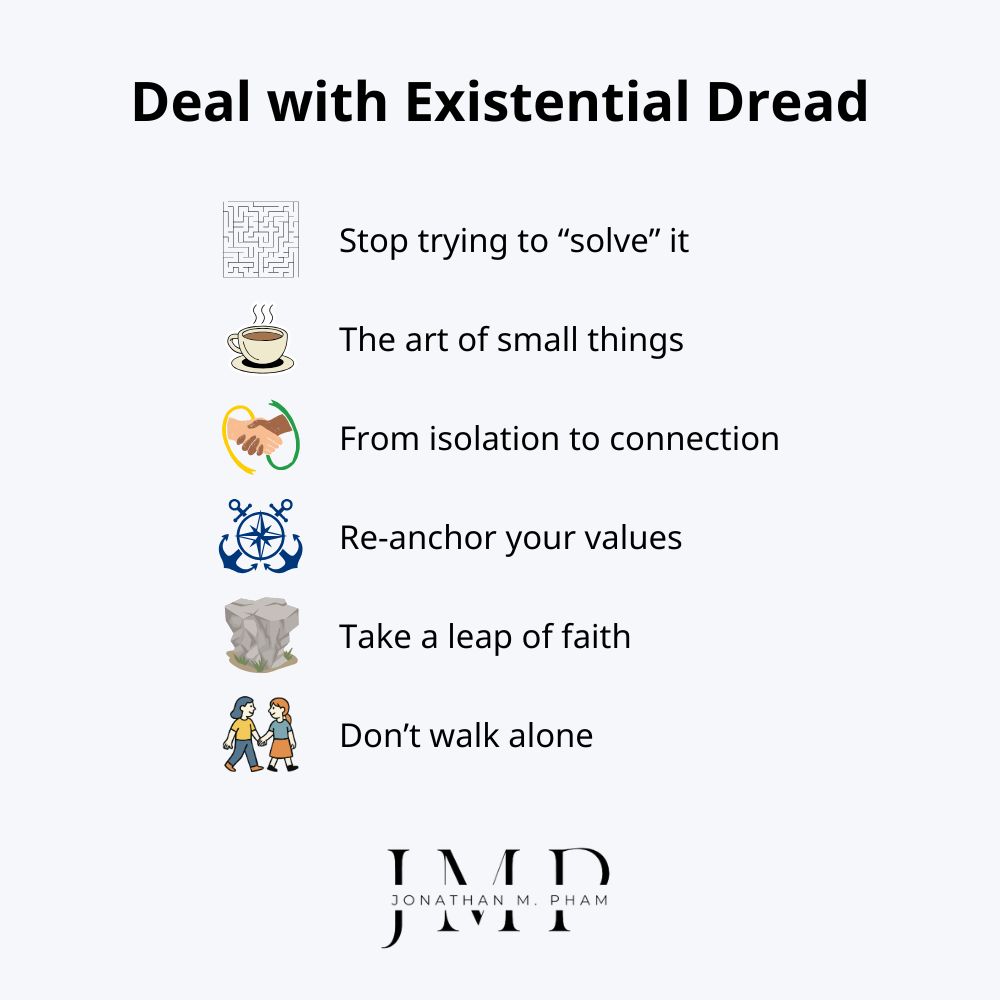
How to deal with existential dread
Helping a Loved One Deal with Existential Dread
One of the hardest things about existential dread is watching someone you love go through it. When a friend or partner confesses they feel empty or that “nothing matters,” our instinct is to rush in with solutions.
We may say something like: “Look on the bright side!” or “You just need a vacation!” or “But you have a great job!”
We try to fix their pain with our own logic. But often, our “solutions” do nothing good for them at all.
We are so attached to our idea of what their life should look like (e.g. “You should be happy”) that we cannot see the reality standing in front of us. (“I am in pain”)
To help a loved one, you must let go of all notions.
Don’t offer solutions. Solutions invalidate the depth of their question.
Just open your heart. Listen. Be a witness. Sit in the silence with them without trying to fill it.
Often, the only thing a person in dread needs is to know that they are not alone in the dark.
What must we do in order to understand a person? We must have time; we must practice looking deeply into this person. We must be there, attentive; we must observe, we must look deeply. And the fruit of this looking deeply is called understanding.
Thich Nhat Hanh
FAQs
Can existential dread be cured?
If by “cured” you mean “made to go away forever,” then no. Existential dread is not a disease like the flu; it is a condition of being a conscious human – a shadow cast by our freedom.
What matters is not to get rid of it (which is futile), but to build a container strong enough to hold it—to transform it from paralyzing fear into fuel for living deeply.
How do I deal with existential dread at work?
When your job feels meaningless, my advice is that you should try to zoom in. Stop being obsessed with corporate mission statement – and start looking at the human beings next to you, as well as the joy that comes from your daily tasks.
You may not be able to change the industry, but you can change the quality of your attention.
Further Resources for Dealing with Existential Dread
Quotes to ponder
Check out more existential quotes here!
He who has a why to live for can bear almost any how.
Friedrich Nietzsche
We can despair of the meaning of life in general, but not of the particular forms that it takes; we can despair of existence, for we have no power over it, but not of history, where the individual can do everything.
Albert Camus
The knowledge that nothing matters, while accurate, gets you nowhere. The planet is dying. The sun is exploding. The universe is cooling. Nothing’s going to matter. The further back you pull the more that truth will endure. But, when you zoom in on earth, when you zoom in to a family, when you zoom into a human brain and a childhood and experience, you see all these things that matter.
Dan Harmon
Books to read
Make sure to give this list of existentialism books a try too!
- Man’s Search for Meaning by Viktor Frankl – The definitive guide to finding purpose in suffering
- Staring at the Sun by Irvin Yalom – A therapist’s guide to overcoming the terror of death
- The Myth of Sisyphus by Albert Camus – Essential for understanding how to live with “The Absurd”
- The Subtle Art by Mark Manson – A modern, accessible take on prioritizing values
Movies to watch
Here is a more comprehensive list of recommended existential movies, for those who are interested.
- Ikiru (1952) – A bureaucrat finds meaning in his final days. A perfect companion to the “Zombie Mode” concept
- The Seventh Seal (1957) – A knight plays chess with Death
- Everything Everywhere All At Once (2022) – A modern look at optimistic nihilism
- Groundhog Day (1993) – How to move from despair to service when stuck in a loop

Deal with existential dread
Final Thoughts
We live in a time of great disruption. The old maps are burning up. The “systems” we trusted are showing their cracks.
It is tempting to look at the abyss and feel small. To conclude that because we are small, we are nothing.
But this is not a reason to despair. Instead, what we should do is waking up.
I am not a psychologist – nor a “guru” either. I am just a seeker who has spent some time in the dark. My only wish is to share about my experiences so far – so that you may reflect back on your own. To act like a voice in the wilderness – a finger pointing to the moon.
If there is one thing I have learned in my life journey, it is that existential dread is NOT the end of the story. Quite the opposite – it is the beginning of a truer, more authentic one.
It strips away the lies. It burns off the “vanity metrics” and the “social masks.” It leaves you with only what is real: Your breath. Your capacity to love. The person standing right in front of you.
So, do not run from that uninvited guest. Invite him in. Let him sit with you. And when he asks, “Does any of this matter?”, do not try to come up with a logical answer.
Look at the “clumsy chairs” you cherish. Look at the people you love. And answer with your life.
Even if God had been silent my whole life, to this very day, everything I do, everything I’ve done… Speaks of Him.
Father Rodrigues, ‘Silence‘ (2016)
Other resources you might be interested in:
- Life Management: How to Design a Life You Love
- Authentic Love: Beyond Possession and Romanticism
- 12 Stoic Principles to Live by in the Modern Life
- Spiritual Purpose: The Quest for the Soul’s Calling
- The Knight of Faith: Believing in the Absurd
Let’s Tread the Path Together, Shall We?

