

 Tiếng Việt
 日本語
日本語
Have you ever woken up at 3:00 AM, stared at the ceiling in the dark, and suddenly felt a hollow ache in your chest?
Not exactly sadness. Not pain either. Just a haunting question – one that rises up when the distractions of the day fade away: “Is this it?“
I myself know that experience quite well.
A few years ago, on paper, my life was “correct.” I had a stable job, a predictable routine, and no major tragedies to complain about. And yet, I felt an indescribable sense of emptiness within.
I was waking up, going to work, eating, and sleeping—repeating the cycle with the precision of a clock. Biologically, I was alive. My heart was beating; my cells were dividing.
But existentially? I was a ghost in my own machine.
I remember specifically my time working as a “Content Officer” for a previous company. Upon hearing the title, you may think of something soul-inspiring, right? Not exactly, unfortunately.
My days were spent mindlessly copy-pasting data to meet a quota of SKUs. To be honest, the job was data entry disguised as a creative role.
The environment was “nice.” The benefits were transparent, the colleagues were friendly, and the corporate ladder was clear. It was safe. It was comfortable.
But I felt like a “mummy.” I was wrapped in layers of routine, preserved in a state of suspended animation.
I obeyed orders, I collected my paycheck, but I had absolutely no “fire” inside.
I was selling the limited hours of my life for safety, terrified to leave because the “real world” outside seemed too risky.
I was existing perfectly. But I had completely forgotten how to live.
Have you ever been in the same boat as me? If the answer is “yes”, I suppose this article is meant for you. And even if it’s “no”, don’t leave yet. Who knows if you will end up in the same situation in the future or not?
Highlights
- Most of us aren’t living; we are just biologically functioning. We mistake “busyness” for aliveness and “safety” for success.
- If you are numbing yourself with distractions, seeking validation from others, or treating relationships as transactions, you are likely just “Existing.”
- Usually, we choose to merely “exist” because it feels safer than the uncertainty of authenticity. We accept the “script” of society to avoid the responsibility of choice.
- Waking up requires facing your mortality, finding your “Flow,” and having the courage to align your actions with your inner truth.
5 Differences Between Living and Existing
What is the difference between living and existing?
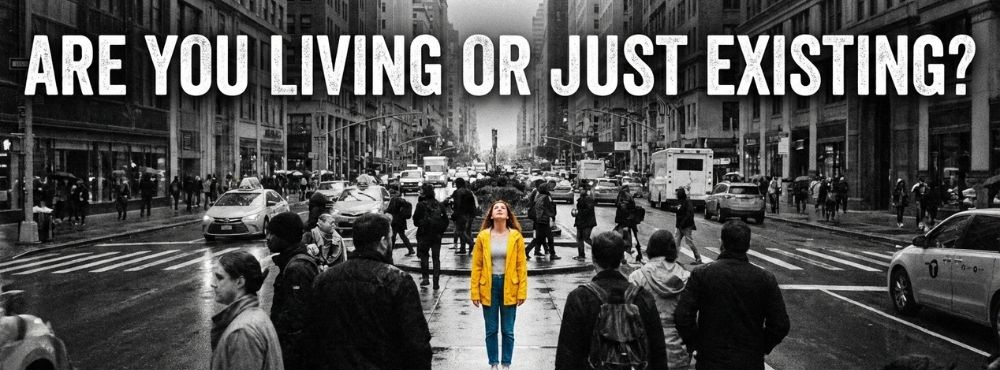
In short, “Existing” is passive – something that happens TO YOU. “Living”, on the other hand, is active; it comes FROM YOU.
-
Connection: Autopilot vs. Presence
Maman died today. Or yesterday maybe, I don’t know.
Albert Camus, ‘The Stranger’
Just Existing: You operate on autopilot. You drive to work and don’t remember the trip. You sit in meetings and nod without hearing a word. You are physically present, but your mind is miles away.
In other words, you become a spectator to your own life, drifting wherever the current takes you.
Truly Living: You practice Intentionality. You are aware of the taste of your coffee, the tension in your shoulders, and the words being spoken to you. Even if a task is boring, you are the one doing it.
-
Coping: Numbing vs. Feeling
Just Existing: You use distraction to numb the silence. In fact, I myself see this everywhere – in the people who cannot sit alone for ten minutes without scrolling through a phone. In the young people who embrace a “YOLO” lifestyle not out of joy, but out of a desperate need to escape their own thoughts—chasing one-night stands, getting drunk every weekend, or losing themselves in video games.
To me, these people aren’t chasing life; they are just running away from reality. From themselves.
Truly Living: You have the courage to face the silence. You allow yourself to feel the full spectrum of human emotion—sadness, anxiety, joy—without immediately reaching for a sedative (digital or chemical). You understand that pain/ suffering is proof that you are alive, not a problem to be deleted.
-
Identity: Conformity vs. Authenticity
Just Existing: You define yourself by external validation. You become what the philosopher Martin Heidegger called “The They“—doing things simply because “that’s what one does.”
For my part, I once worked with a female colleague who dressed very provocatively. When another colleague asked her about it, she grinned and said she did it to “excite the boys.” (and what shocked me further was that the asking colleague nodded in agreement following that response)
I didn’t feel judgment; I felt pity. To me, it seemed that my colleague’s entire sense of worth had been reduced to how much attention she could extract from others. She had, essentially, become a “shell”—a reflection of other people’s desires rather than a person with her own agency.
Truly Living: You define yourself by internal values. You dress, work, and speak in a way that aligns with your Authentic Self, regardless of whether it gets “likes” or approval. You possess the “Courage to Be” (to quote Paul Tillich)—affirming your own being even if it makes you an outlier.
-
Relationships: Transactional vs. Relational
What is hell? I maintain that it is the suffering of being unable to love.
Fyodor Dostoevsky
Just Existing: You treat people as objects or means to an end. Relationships are about what YOU CAN GET—pleasure, status, or networking. Nothing more, nothing less.
When you just exist, you are trapped in the hell of your own ego, unable to truly connect – because you are too busy calculating the ROI of every interaction.
Truly Living: You treat people as “Thous” (to use Martin Buber’s term). You connect with others NOT for what they can do for you, but simply to witness their existence. You practice compassion and vulnerability, knowing that connection is an essential part of life.
-
Time: Waiting vs. Embracing
Just Existing: You are always waiting for “Someday.” You live for the weekend, for the vacation, for retirement. You treat the present moment as a nuisance – an obstacle to be overcome.
Truly Living: You treat the present as the only reality you have. You understand Memento Mori—that death is coming—so you don’t have the luxury of waiting. You find meaning now, even in the mundane.
| Dimension | Just Existing (The “Mummy”) |
Truly Living (The “Seeker”)
|
| Mindset | Passive / Autopilot |
Active / Intentional
|
| Motivation | Fear & Safety | |
| Self-Worth | External (Approval/Status) |
Internal (Values/Authenticity)
|
| Relationships | Transactional (Taking) |
Relational (Loving)
|
| Time | Waiting for the future |
Embracing the Now
|
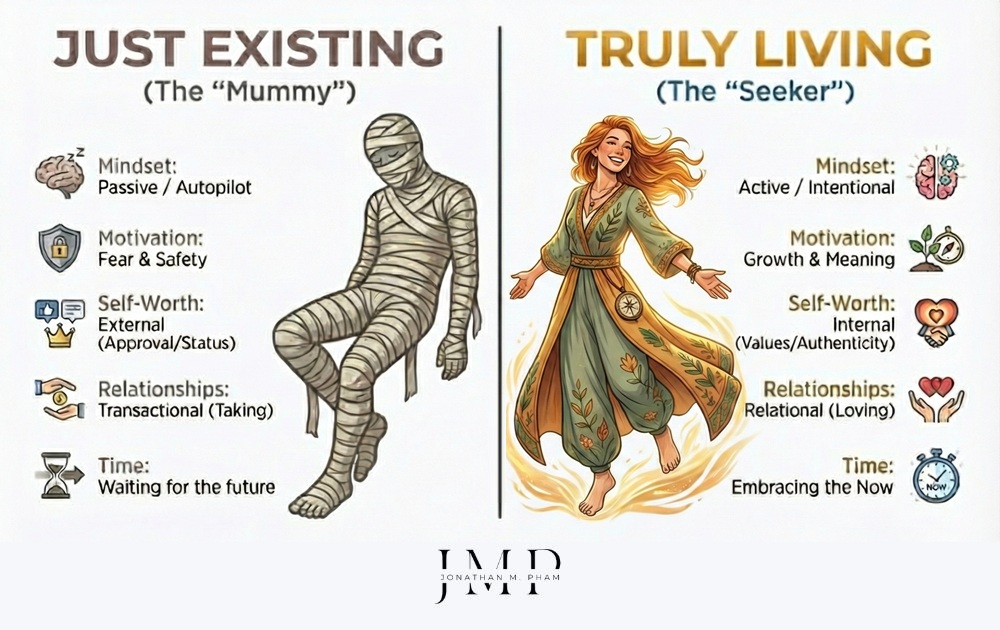
Existing vs living
Why Are Many of Us Not Living, Just Existing?
If “existing” is so empty, why do the vast majority of us choose it? Why is it, seemingly, the default mode of humanity?
The answer is uncomfortable: We do it because it is safe. We do it because it is easy. And above all, we do it because we are terrified of the alternative.
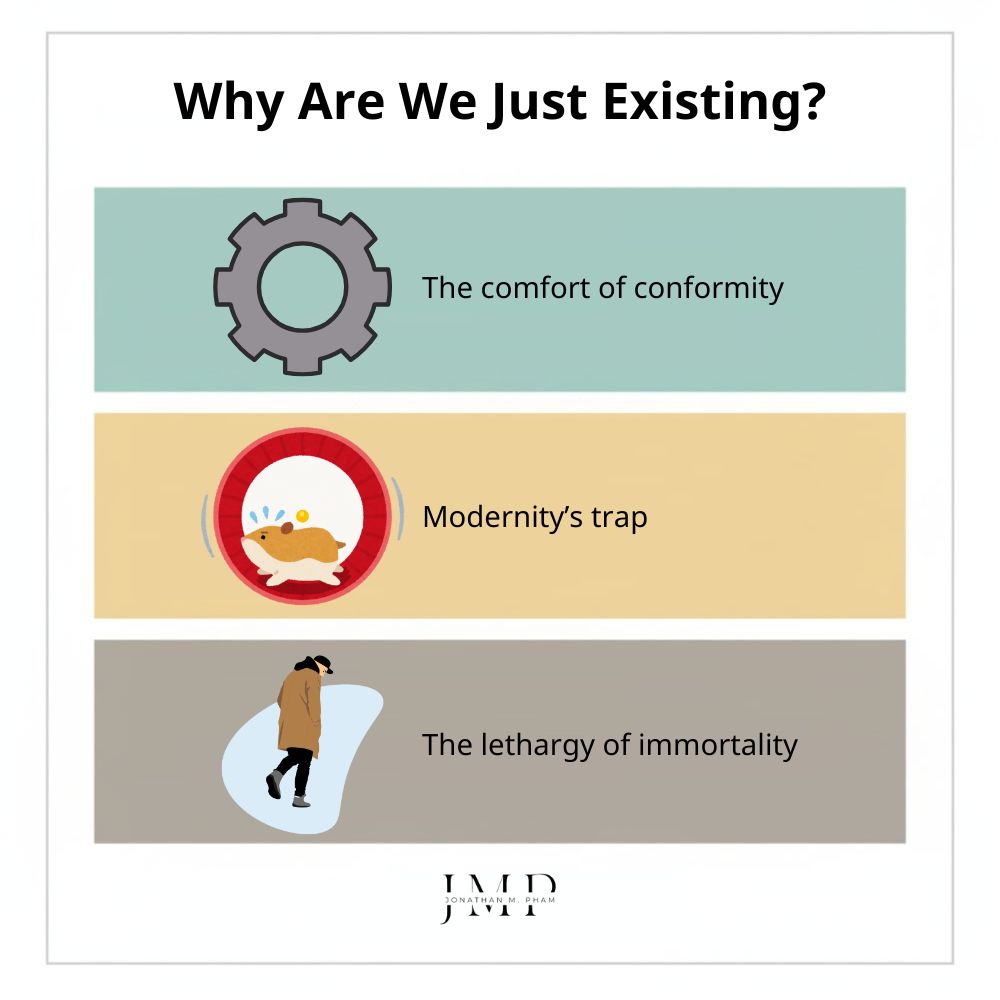
The comfort of conformity
We accept the reality of the world with which we are presented. It’s as simple as that.
Christof, ‘The Truman Show’ (1998)
Most of us are prisoners of comfort. Existing, as boring as it may seem, comes with a script. It tells you exactly what to do: Go to school, get the job, get the mortgage, retire, die.
It’s so tempting to enjoy the safety in conformity. If you follow the script and end up unhappy, you can blame the script (or society, or the economy).
Living, on the other hand, requires you to throw away the script – to make choices that might fail.
I saw this constantly in the corporate world. I knew colleagues who hated their jobs with a passion, yet they refused to leave. The reason was simple – because the misery they knew was safer than the uncertainty they didn’t. They chose the “golden handcuffs” of a steady paycheck over the freedom of the unknown.
Modernity’s trap
The more we pursue material improvement, ignoring the contentment that comes of inner growth, the faster ethical values will disappear from our communities.
Dalai Lama XIV
We live in an era designed to keep us in “Existing” mode. Modern society judges success by accumulation (what you have), not actualization (who you are). From a young age, we are taught that the purpose of life is to become an economic unit—to be “productive.” No wonder many value being “busy” over being “aware.”
I myself have seen people who treat their busyness like a badge of honor. (well, I used to be one among them – for a period) They work 60 hours a week, chasing a promotion or a bigger house, assuming that once they get the thing, they will finally “start living”.
But that is, after all, nothing more than a mirage.
We end up like hamsters on a wheel—running faster and faster, but never actually arriving anywhere.
If you don’t get what you want, you suffer; if you get what you don’t want, you suffer; even when you get exactly what you want, you still suffer because you can’t hold on to it forever.
Socrates
The lethargy of immortality
We know that one day we must die, but usually we picture that day as far in the future… So we go about our petty tasks, hardly aware of our listless attitude toward life.
Helen Keller, ‘Three Days to See‘
This is perhaps the deepest reason why people merely exist: We subconsciously believe we have forever.
After all, we live in a culture that hides death (in hospitals and funeral homes); no wonder many live under the illusion of immortality. We tell ourselves,
- “I’ll write that book when I retire,” or
- “I’ll tell her I love her when the time is right.”
When you think your time is infinite, your choices feel weightless. You feel you can afford to waste today – because there is always a tomorrow.
It is only when the doctor gives a terminal diagnosis, or when a loved one dies unexpectedly, that the illusion shatters. Suddenly, we realize that “Someday” is not a day of the week.
But until that shock comes, most of us simply sleepwalk, treating the miracle of existence as a mundane routine.
How tragic that man can never realize how beautiful life is until he is face to face with death.
Novelist, ‘Ikiru’ (1952)
Are you living or just existing?
A Philosophical Look at “True Living”
For centuries, philosophers have reflected on the difference between living and existing. Many have argued that “True Living” is not about experiencing constant euphoria.
At its core, it is about achieving a specific kind of Ownership.
Heidegger: Owning your “Dasein”
According to the German philosopher Martin Heidegger, most of us live in a state of “fallenness.” Specifically, we fall into the world of “The They” (Das Man). We talk about what they are talking about. We read what they are reading. We shrink back from the responsibility of being a unique individual – because standing alone is not a comfortable experience at all.
To truly live, one must move from “Inauthenticity” to “Authenticity.” This doesn’t mean you have to be eccentric or weird. Rather, what you need to do is to own your Dasein (literally “Being-there”).
- Existing is when you take the job because “that’s what a responsible adult does.”
- Living is when you take the job because you have consciously decided it aligns with your purpose.
The action might look the same on the outside, but the internal posture is completely different. One is compliance; the other is choice.
Sartre: Escaping “Bad Faith”
Jean-Paul Sartre took this further with the concept of “Bad Faith” (Mauvaise Foi), which refers to the lie we tell ourselves that we have to be a certain way—that we have no choice.
Sartre gave an example for this phenomenon by describing a waiter in a café. His movements are a little too precise, a little too eager. As pointed out by Sartre, the waiter is just “playing” at being a waiter. He has reduced himself to a role, an object, a label. He convinces himself, “I am a waiter, this is just who I am,” to avoid facing the reality that he is a free human being who could walk out the door at any moment.
We all do this constantly, right?
- “I’m just a shy person”
- “I have to stay in this marriage for the kids,” or
- “I’m a corporate guy.”
True living is the rejection of these labels. It is when you acknowledge that you are NOT a static object (like a rock or a pen); you are a process. You are constantly becoming.
To live is to accept the responsibility that you are free to redefine yourself in every single moment.
My own life philosophy: Following the “Way” (Dao)
For my part, after going through lots of “Dark Nights of the Soul” in life, I have come up with a simple philosophy: to live is to discover and follow one’s own “Way”. (which is an idea I coined based on the concept of Dao in Daoism, as well as the “Dao”/ “Do” – 道 in East Asian martial arts, religions and spiritual disciplines)
To be clear, following the “Way” means finding and practicing your own “religion”—albeit in a much broader sense than just going to church. It is about tuning into your inner core—your intuition, conscience, subconscious—and acting in accordance with that flow rather than resisting it. About something that allows you to lose your sense of the limited self, while at the same time becoming part of a greater whole.
- For a painter, the Way might be creating arts that evokes deep emotion.
- For a scholar, the Way might be the pursuit of truth.
- For a parent, the Way might be the nurturing of a new life.
The “Way” is not the same for everyone – and yet, it is perfectly possible for you to realize yours.
For example, when I write these articles, or when I study a new language, I enter a state of Flow. Somehow, the “self” disappears. The anxiety about money or status fades away. I am not a cog trying to get somewhere; I am simply part of the “river”, moving where I am meant to go.
If something gives you the same flow experience, then you can be confident that it is your own “Way”.
It is when you decide to stop swimming upstream against your nature to please “The They,” and instead to let the current of your own soul carry you toward the sea.
(If you would like to learn more about this philosophy of mine – especially those who are not quite familiar with East Asian cultures – you can check out my detailed sharing here)
When I speak of a religion of one’s own, I’m not talking about a selfish, ego-centered, loosely patched together spiritual concoction. I’m recommending a courageous, deep-seated, fate-driven, informed, and intelligent life that has sublime and transcendent dimension. It can be shared in a community. It can be accomplished inside or outside a traditional religious organization. It is suitable for pious members of a religious group and for agnostics and atheists.
To be religious even in a personal way, you have to wake up and find your own portals to wonder and transcendence.
Thomas Moore
(Side note: I suppose the East Asian concept of “Dao”/ the “Way” may seem tricky for Westerners to fully understand. After all, “Dao” or “Do” extends beyond what we might call religion into arts, martial arts, and daily activities. You will find it in terms like:
- Bushido: The Way of the Warrior (Samurai code).
- Chado/ Sado: The Way of Tea (Tea ceremony).
- Shodo: The Way of Writing (Calligraphy).
- Judo / Aikido: The Gentle Way / The Way of Harmonizing Energy.
- etc.
The idea, as reflected in the concept of “Dao”, is that any discipline, if practiced with total devotion, can become a spiritual path.
That wisdom is a journey, not a destination.
That disciplines are, often, viewed less as sets of unchanging dogmas and more as practical guides.
And that it’s perfectly fine for one to walk a path paved by different traditions at once)

Difference between living and existing philosophy
How to Start Living Instead of Existing
Knowing the difference between existing and living is one thing; making the shift is another. How do you actually jolt yourself out of the autopilot trance?
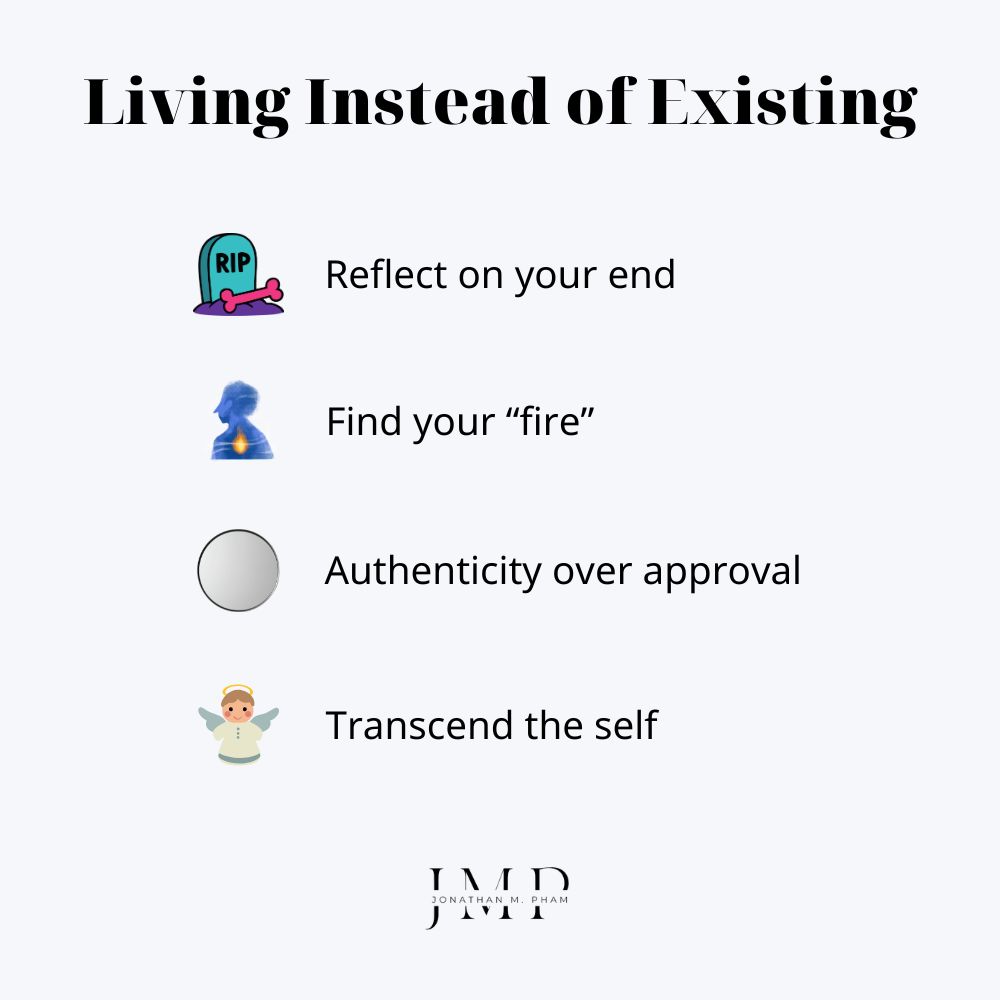
Here are four actionable steps to stop drifting and start steering.
-
Reflect on your end
The physicality of death destroys us, the idea of death saves us.
Irvin Yalom
The greatest cure for lethargy is the realization that your time is finite. You don’t need a terminal diagnosis to wake up, but you DO need to stop pretending you have forever.
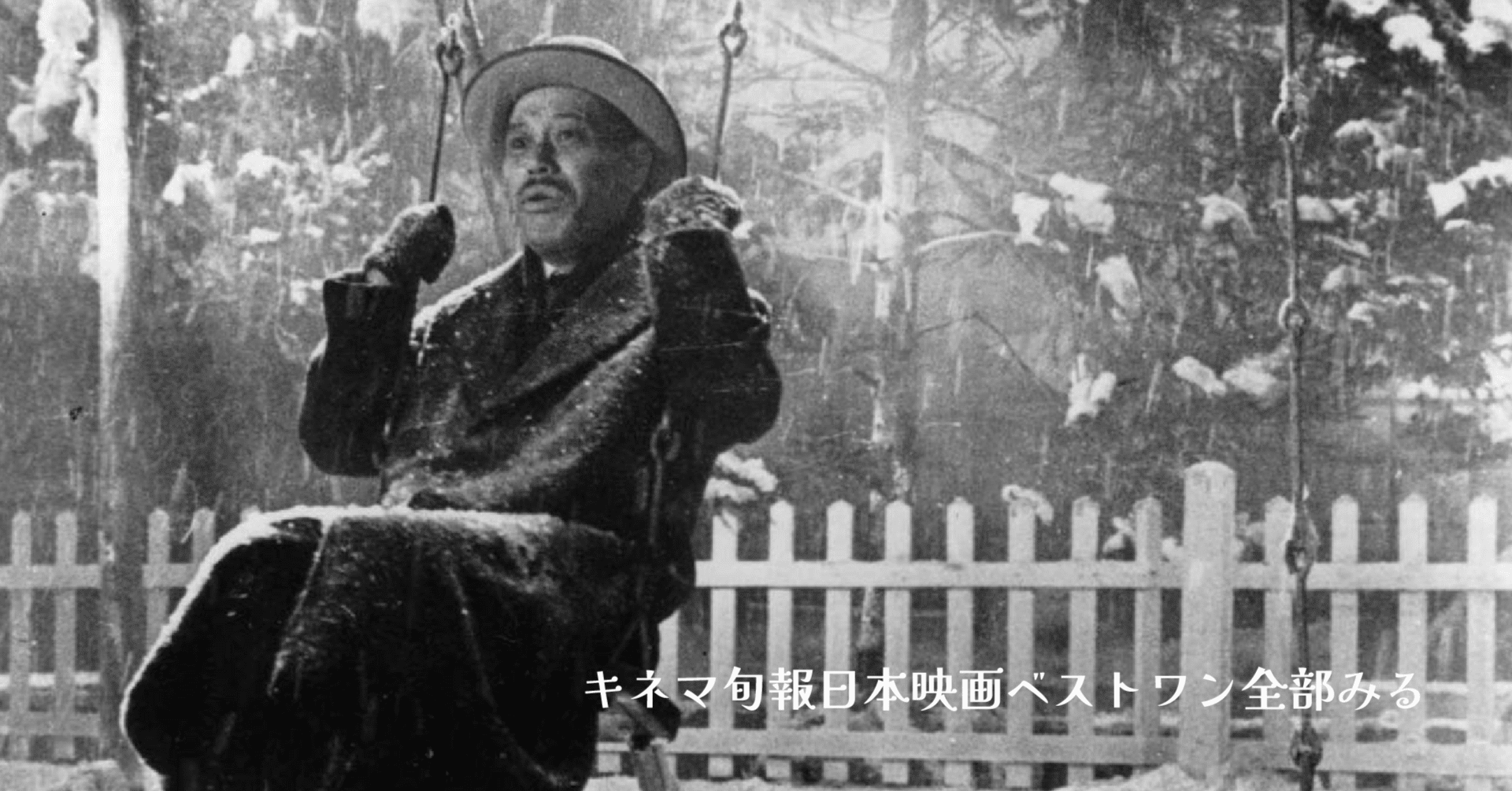
I suppose this lesson is best demonstrated through the story in Akira Kurosawa’s masterpiece Ikiru. The narrative follows Kanji Watanabe, a Japanese bureaucrat who has spent 30 years stamping papers—literally a “mummy in a suit”. He has done nothing wrong, and yet he has done nothing REAL at all.

Are you living or just existing?
Then one day, Watanabe discovers he has stomach cancer and less than a year to live. At first, he falls into despair and tries to numb himself with nightlife and drinking – until he realizes these are nothing more than empty distractions.
The turning point comes when he decides to use his remaining months to do one meaningful thing: build a playground for a poor neighborhood.
Despite the obstructions, bureaucracy, and personal threats, Watanabe pushes through all of them with a calm determination. No longer “existing” as a cog in the machine, he becomes a real “living” human being – one who has found life by facing his end.
You can do the same thing too. Nothing complicated at all. Just ask yourself: “If I knew I had one year left, would I still be doing what I am doing today?“
If the answer is no, you know you are just existing.
If this was the last week of your life, what would you cherish most? How would you live? How would you love? What truth would you tell today?
Tony Robbins
Read more: The Arrival Fallacy – Why Reaching the Top Frequently Leaves Us Empty
-
Find your “fire”
You cannot think your way into living; you have to act your way there. Find the activity that dissolves your ego and places you in a state of “Flow.”
Back in the day, when I decided to quit my stable corporate job in the digital industry, it wasn’t a logical decision on paper. I left a clear career path to pursue… uncertainty. (yes, no joke!) I spent my time learning a new language, researching philosophy, and working on this blog. None of them guaranteed stability at all.
To many people, what I did probably looked foolish. And yet for the first time in years, I wasn’t watching the clock.
Whether I am writing about existentialism or struggling through a difficult Japanese grammar lesson, I feel a “burn” in my soul.
No longer am I a cog in the machine; I am now a creator. A seeker of truth – one who has realized his own “Way” of living.
If you find yourself in the same boat with me, here’s my friendly advice. Identify the tasks where you lose track of time. That is your “Way.” Lean into them, even if they don’t pay the bills yet.
Read more: How to Take a Leap of Faith – Trusting Intuition Over Logic
-
Choose authenticity over approval
To live truly, you must be willing to be misunderstood. For most of us, our tendency to live in “Bad Faith” – in blind conformity – boils down to a fear of judgment. Specifically, many stay in the wrong job or the wrong relationship – because we are terrified of what our parents, friends, or society will say if we decide to break out of it.
The antidote to this problem is to practice the “Courage to be Disliked.” Stop performing for an audience that isn’t watching.
You are the only person you ever have to answer to. The moment you stop managing your reputation is the moment you start managing your life.
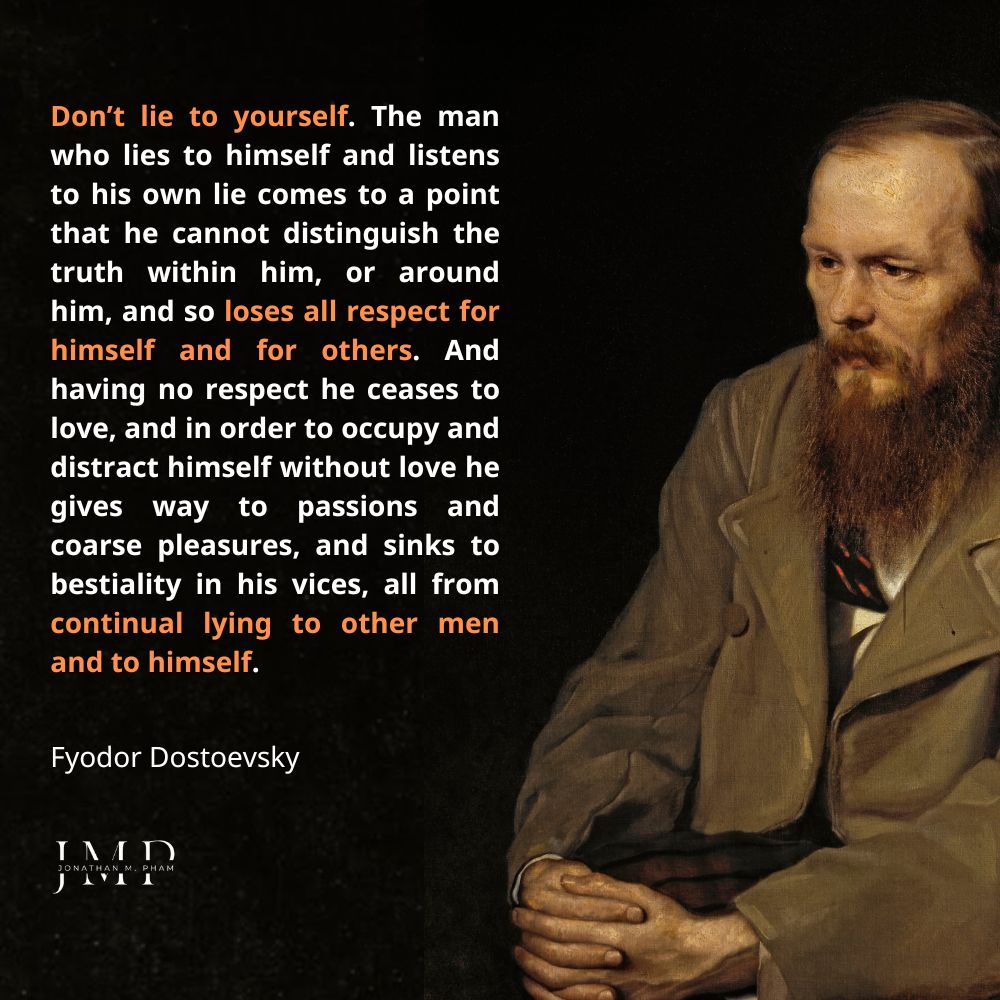
Don’t lie to yourself. The man who lies to himself and listens to his own lie comes to a point that he cannot distinguish the truth within him, or around him, and so loses all respect for himself and for others. And having no respect he ceases to love, and in order to occupy and distract himself without love he gives way to passions and coarse pleasures, and sinks to bestiality in his vices, all from continual lying to other men and to himself.
Fyodor Dostoevsky
-
Transcend the self
While it may sound paradoxical, true living requires that you have to forget yourself – specifically, the self that society has imposed upon you, or you have made up based on expectations/ “common sense”.
If you look closely enough, I believe you will see that the moments of greatest aliveness in your life come from connection with something greater than yourself—with nature, with others, or with the universe/ the Divine.
When you are “Existing,” you are usually trapped in your own head (your worries, status, boredom).
When you start “Living,” you connect to something larger.
To live is to shift the focus from “What can I get?” to “What can I give?” Like Watanabe dedicating himself to building the playground, or a parent finding joy in raising their child, meaning is, quite often, found in the contribution.
If “hell” is the inability to love, then “heaven” is, simply, the active practice of it.
Further Resources
Am I living or just existing quiz
If you are interested, feel free to check out my list of self-reflection questions here!
- If you knew you had exactly one year left to live, would you still be doing what you are doing today?
- When was the last time you lost track of time because you were so engrossed in an activity?
- Are you making choices based on what you want, or based on what you fear losing?
- If your life was a movie, would you want to watch it?
Are you living or just existing quotes
Don’t forget to check out more existential quotes here!
I’m not afraid of dying. I’m afraid I haven’t been alive enough. It should be written on every school room blackboard: Life is a playground – or nothing.
Mr. Nobody (2009)
Life is a daring adventure or nothing at all.
Helen Keller
To be yourself in a world that is constantly trying to make you something else is the greatest accomplishment.
Ralph Waldo Emerson
Books to read
- The Death of Ivan Ilyich by Leo Tolstoy: A short, haunting novella about a high-ranking judge who realizes on his deathbed that his entire “successful” life was a lie.
- Man’s Search for Meaning by Viktor Frankl: The ultimate argument that life is not about pleasure, but about finding a task that demands you.
- The Alchemist by Paulo Coelho: A simple fable about the “Personal Legend” and the danger of ignoring your intuition for safety.
Read more: 27 Best Existentialism Books – A Seeker’s Guide to Finding Meaning
Movies to watch
- Ikiru (1952): As discussed, a great watch about waking up before it’s too late.
- Soul (2020): A modern take on finding the “spark” in the mundane moments of life (the falling leaf, the pizza crust).
- The Truman Show (1998): A metaphor for the comfort of the “Cage” and the courage required to leave the script.
- Into the Wild (2007): A reminder that life is meant to be experienced raw, though it also warns us that “Happiness is only real when shared.”
Read more: 20 Best Existential Movies for the Questioning Heart

Final Thoughts
In the end, no blog post, no philosopher, and no guru can force you to live. You have the free will to remain on autopilot. It is safe. It is comfortable.
But remember this: And then you die.
Death is the only truth that matters. The clock is ticking while you read this sentence. The “Someday” you are waiting for—when you have enough money, when the kids are grown, when you feel “ready”—is never guaranteed.
You are the author of this book. Up until now, maybe society has been holding the pen. Maybe fear has been dictating the chapters. But the page in front of you is blank.
You can choose, right now, to stop existing and start living. You can choose to feel the rain, to speak your truth, and to love without transaction.
Happy reading, and above all—happy living!
Life is brief
Fall in love, maiden
Before the crimson bloom
Fades from your lips
Before the tides of passion
Cool within you
For those of you
Who know no tomorrow.Kanji Watanabe, ‘Ikiru’ (1952)
Other resources you might be interested in:
- Ikigai (生き甲斐) – Finding Your ‘Reason for Being’
- Nihilism vs Existentialism vs Absurdism: A Journey Into the Abyss
- Christian Existentialism: From Dogma to the Ultimate Reality
- 60 Existential Questions: A Daily Toolkit to Explore Life’s Depths
- The World is Not Black and White: Finding Grace in the Grey
Let’s Tread the Path Together, Shall We?

