

 Tiếng Việt
 日本語
日本語
There is a scene in the animated film Spider-Man: Into the Spider-Verse that, I believe, captures the human condition better than most philosophy textbooks.
Miles Morales, a terrified teenager who has just been given powers he didn’t ask for and doesn’t understand, asks his mentor, Peter B. Parker, a question that haunts every single one of us standing at a crossroads:
“When will I know I’m ready?”
He is looking for a sign. A guarantee. A moment of absolute clarity where the fear dissolves and the path forward becomes safe.
And yet, Parker delivers the hard truth:
“You won’t. It’s a leap of faith. That’s all it is, Miles, a leap of faith.”
I believe we are all – from time to time – like Miles Morales. Whether we are contemplating a career change, a marriage, a move to a new country, or a spiritual shift, we are obsessed with “readiness.”
We wait for the perfect amount of money in the bank. We wait for the “right” time in the economy. We wait for the fear to go away.
But if there is one thing I have learned from my own experiences—and from the existential thinkers who walked this path before us—it is that readiness is a myth. The map often ends before the journey is over.
And when the map ends, there is only one option left: You have to leap.
Highlights
- To wait for a time when you feel 100% “ready” is just an illusion – a way to avoid living, nothing more, nothing less.
- A leap of faith isn’t blind recklessness; it is the courageous act of trusting your intuition when logic and data have reached their limit.
- Staying in “Zombie Mode” may feel safe, but it will eventually suffocate your potential. We leap not just to change our circumstances, but to shed our old skin and grow.
- You don’t need to see the whole picture (the puzzle box) to start. By taking “micro-leaps” and trusting the pieces you have, the path will reveal itself over time.
What is a Leap of Faith?
In today’s data-driven, result-obsessed world, the concept of “leap of faith” is, unfortunately, frequently dismissed as being reckless or “blind” – a type of YOLO attitude. Many of us, upon hearing it, imagine someone closing their eyes and running into traffic hoping for the best.
That is NOT a leap of faith; that is stupidity.
Its true meaning, rooted in the philosophy of Søren Kierkegaard, is much more nuanced. Essentially, it refers to the act of bridging the gap between what you CAN KNOW and what you MUST DO.
Leap of faith examples
Let’s say you are a scientist or an explorer. You can gather 90% of the data. You can prepare your ship, map the stars, and calculate the risks. But there is always that final 10%—the “Gap”—that logic cannot cross.
Back in the day, those like Christopher Columbus and Ferdinand Magellan could not “prove” they wouldn’t fall off the edge of the map or die at sea. (in fact, Magellan did, tragically, die) They had a hypothesis, but they had to commit to the voyage before they had the proof.
Similarly, you cannot “prove” a marriage will last before you say “I do.”
You cannot “prove” a startup will succeed before you quit your job.
A leap of faith is the courage to act on Intuition when Logic has reached its limit. It is saying, “I have thought this through as much as I can, the data is incomplete, but my inner voice says ‘Go’.“
At the point where the road swings off (and where that is cannot be stated objectively, since it is precisely subjectivity), objective knowledge is suspended. Objectively he then has only uncertainty, but this is precisely what intensifies the infinite passion of inwardness, and truth is precisely the daring venture of choosing the objective uncertainty with the passion of the infinite.
Søren Kierkegaard

When Should You Take a Leap of Faith?
Obviously, you don’t take a leap on which toothpaste to buy. You do it when you encounter what the economist Russ Roberts calls “Wild Problems“: the big, life-defining choices where spreadsheets are useless because they involve the future YOU—a person who doesn’t exist yet.
Here are three specific scenarios where a leap is usually required:
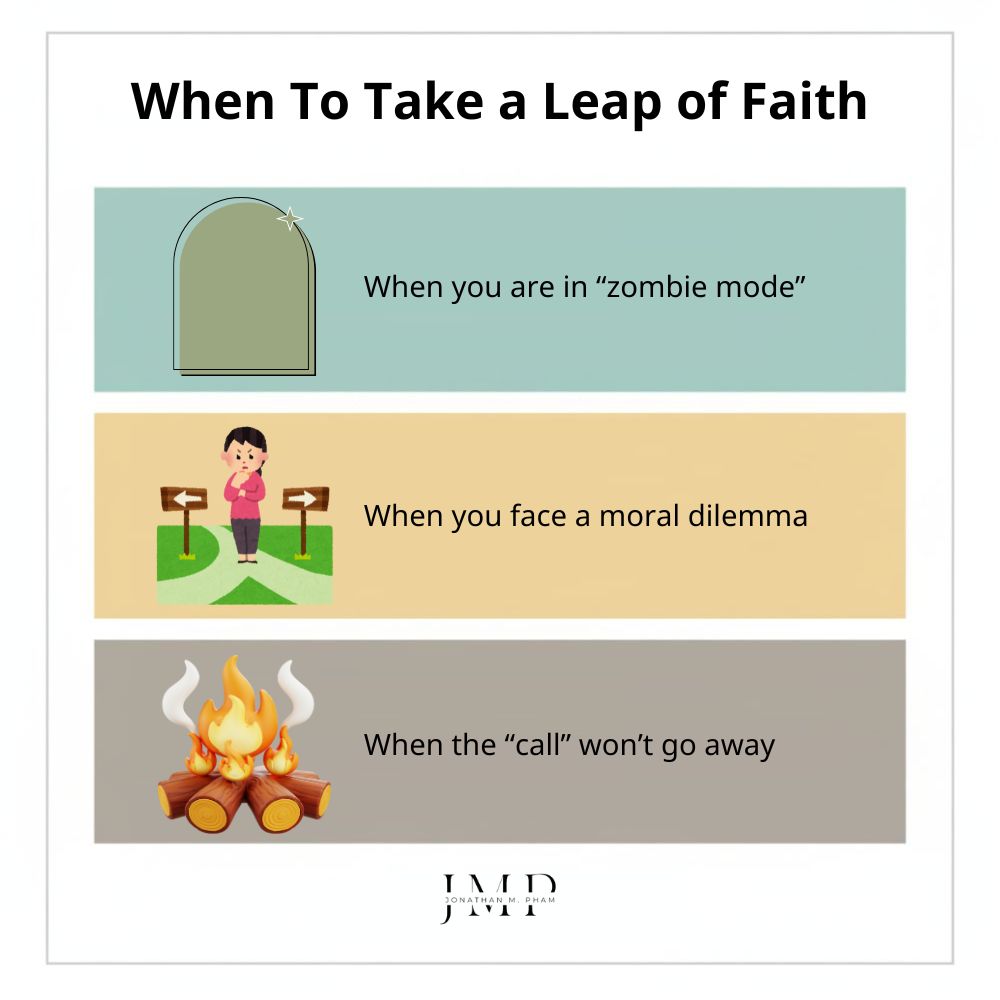
When you are in “zombie mode”
Long ago, when I was still a fresh graduate, I started my career as a Content Officer for a retail company. On paper, the job was safe. The salary was decent (somehow – at least it was stable and guaranteed), and my colleagues were kind.
But the work was soul-crushing. I was not much different from a robot. I spent eight hours a day copying and pasting product descriptions from other websites – because the management didn’t care about quality, only quantity. (after all, they were traditional retailers who had very little idea of how e-commerce and digital things actually work) Like a bureaucrat whose only job is to stamp papers day after day, slowly dying inside, waiting for retirement.
I knew I was stagnating. I knew I wasn’t learning.
My logic said, “Stay, it’s safe money.” But my spirit was screaming.
The Sign: When the pain of staying the same becomes greater than the fear of the unknown, it is time to leap.
When you face a moral dilemma
Sometimes, the leap has nothing to do with career, but your own conscience.
For example, in the movie The Dark Knight, the protagonist Batman is faced with such a situation. The attorney Harvey Dent – a widely respected figure in Gotham City – has fallen to the dark side and committed atrocious crimes, which are sure to destroy people’s trust in authority if revealed. To prevent such a thing from happening, Batman decides to take the blame for Dent’s crimes himself.
Sometimes, the truth isn’t good enough. Sometimes people deserve more. Sometimes people deserve to have their faith rewarded.
Batman – The Dark Knight
Objectively, it makes no sense for a hero like Batman to brand himself a villain. Yet he believes that the truth (that Gotham needs hope more than it needs a clean Batman) is worth the personal cost.
In other words, he trusts his intuition over the immediate optics.
The Sign: When the “logical” or “safe” choice requires you to betray your core values, it is time to leap toward integrity.
Read more: The World is Not Black and White – Finding Grace in the Grey
When the “call” won’t go away
Have you ever had an idea that just won’t leave you alone? Maybe it’s a desire to paint, or to move to a specific city, or to forgive someone who hurt you.
You push it down, but it pops back up like a beach ball held underwater.
Back in the day, when I decided to learn Japanese, I had no rational reason for it. I had no plans to live in Japan. I had no Japanese clients. My friends thought it was a waste of time.
And yet, I felt a magnetic pull toward the language – and the country’s culture as a whole. I followed that pull, and it eventually opened doors to ideologies and philosophies (like Zen) that completely reshaped my worldview.
The Sign: When your intuition is persistent and quiet (unlike fear, which is loud and frantic), it is usually telling you to leap.
Why Take a Leap of Faith?
Let’s be honest: taking a leap of faith is not a comfortable experience at all. Given its inherent scariness – plus the fact that the outcome is not guaranteed, no wonder many shy away from it.
While it’s tempting to assume that staying put is “free,” in reality, it only charges a heavy tax on the soul.
As I have figured – based on my own experiences, here are the three main reasons why we should learn to embrace the leap.
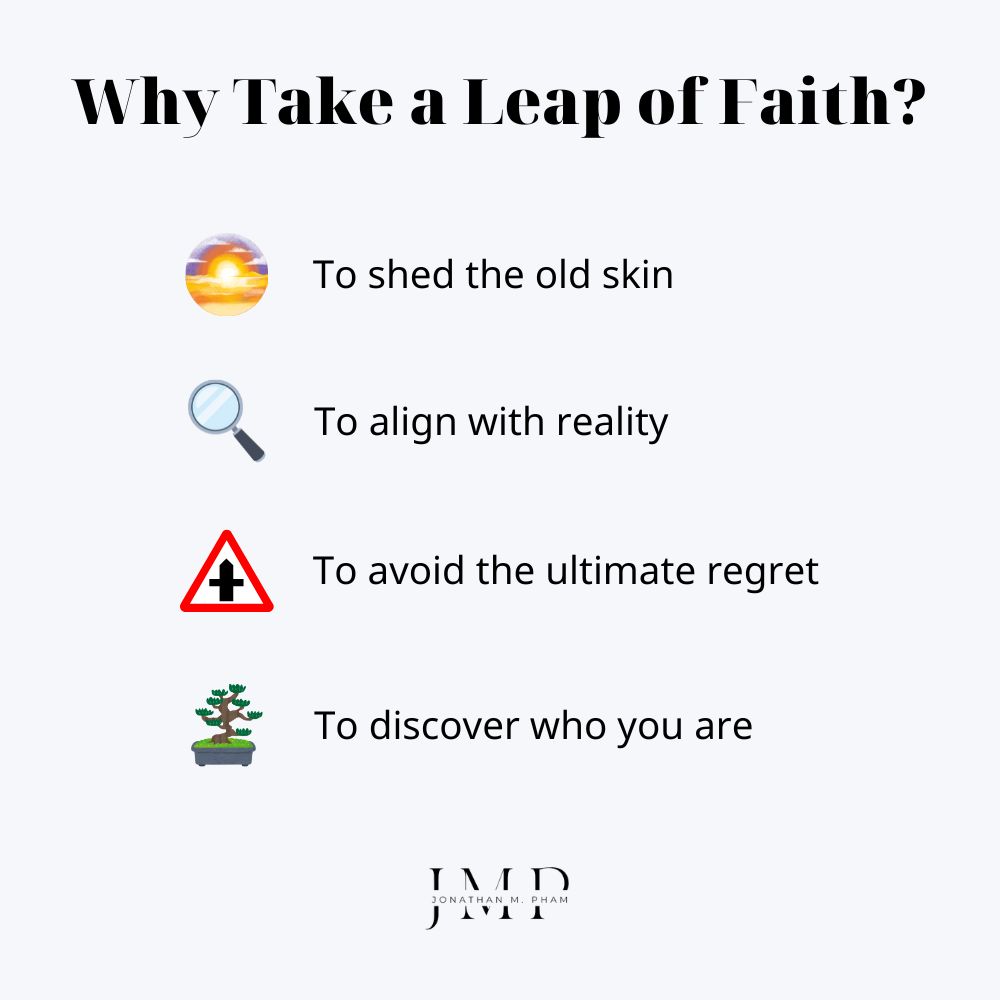
To shed the old skin
There is a biological truth that applies to our spirits: What stops growing starts dying.
Our tendency is to cling to the current identity—our job title, relationship status, “safe” routine—because it feels secure. But as the philosopher Friedrich Nietzsche once observed:
“The snake which cannot cast its skin has to die. As well the minds which are prevented from changing their opinions; they cease to be mind.”
If you are not ready to embrace the new, you suffocate the person you are becoming. Taking the leap is the only way to shed the skin that no longer fits you. It is the choice to trade security for vitality.
It’s just like wearing a pair of shoes that are two sizes too small. At first, they just pinch. You ignore it. But over time, the pinching turns into blistering pain. Eventually, you can’t walk at all.
In my own life, staying in that corporate job felt exactly like those tight shoes. I wasn’t in “danger”—my paycheck was secure—but my curiosity, creativity, and my “inner child” were being crushed.
The “safety” of the job became the very thing that was suffocating my potential. Taking the leap was, therefore, the only way to breathe again.
To align with reality
I donʼt know if we each have a destiny, or if weʼre all just floating around accidental-like on a breeze, but I, I think maybe itʼs both. Maybe both is happening at the same time.
Forrest Gump (1994)
Most of us crave certainty because we think it protects us. We craft detailed five-year plans and refuse to move until we have a guarantee.
But here is the harsh truth: Certainty is an illusion.
We live in a world that is Volatile, Uncertain, Complex, and Ambiguous (VUCA). You can have the safest job in the world and lose it to an AI update tomorrow. You can have the perfect health plan and still get sick.
To “play safe” all the time is to fight against the nature of reality. We are trying to keep a ship in the harbor to protect it from the waves. But as John A. Shedd once commented:
“A ship is safe in harbor, but that’s not what ships are for.”

Just 10 years ago, “learning to code” or “becoming a translator” were seen as iron-clad, safe career bets. And yet these days, with the rise of Generative AI, those “sure-win” paths are facing massive disruption. Meanwhile, choices that were considered “risky” back in the day—like creative endeavors, human-centric coaching, or spiritual counseling—are becoming more valuable, because they rely on the uniquely human touch.
The “ocean” is unpredictable, but only by choosing to sail anyway may you realize your whole potential.
Read more: Meaning of Life – Finding a ‘Why’ to Your Existence
To avoid the ultimate regret
Do you want to take a leap of faith or become an old man, filled with regret, waiting to die alone?
Dom Cobb, ‘Inception’
This may sound a little awkward, but regret is, usually, not a result of failing at a dream. Rather, it comes from succeeding at the wrong thing.
When I was working as an SEO Manager at a digital agency, I had a moment of clarity that scared me more than unemployment. I looked at the people ten years ahead of me—the Directors and the Agency Owners. On paper, they seemed to be successful. They had the status, the salary, and the respect.
And yet, when I looked at their daily lives—the endless “fake optimism,” the obsession with vanity metrics, the disconnect from human depth—I realized something terrifying: I did NOT want any of them.
If I stayed on the “safe” path and worked hard, I would eventually become like them.
As I realized at that moment, staying put wasn’t “playing it safe.” It was guaranteeing a tragedy: the tragedy of spending my one finite life climbing a ladder that was leaning against the wrong wall.
So I leaped – not because I knew I would succeed elsewhere, but because I knew that “success” here would feel like a defeat.
Read more: Are You Living or Just Existing? Let’s Find Out!
To discover who you are
Follow your passion. It will lead you to purpose.
Oprah Winfrey
There is a common misconception that we need to “find ourselves” before we make a move. We assume it’s essential to figure out our identity in a journal, and then take action.
But existentialism (secular and religious alike) teaches us the opposite: You are what you do.
You can’t discover who you are in theory; you can only do it in action.
You can read every book ever written about swimming. You can study hydrodynamics. You can meditate on the concept of water. But until you actually leap into the pool, you are NOT a swimmer. You don’t know if you will love the water or fear it until you are wet.
In my case, I didn’t know I was a “writer” or a “philosophy enthusiast” while sitting in my office thinking about it. I only came up with that identity after I started this blog.
In other words, the act of writing revealed the writer. The act of leaping revealed the wings.
Read more: Understanding Yourself – Roadmap to a Deeper, More Authentic YOU
Taking a leap of faith in love
How to Take a Leap of Faith
So, you feel the stagnation. You know you need to move. But how do you actually do it without paralyzing fear?
Based on my own journey—from that soul-crushing office job to where I am today—here is a framework for taking the leap – not as a reckless gamble, but as a deliberate practice.
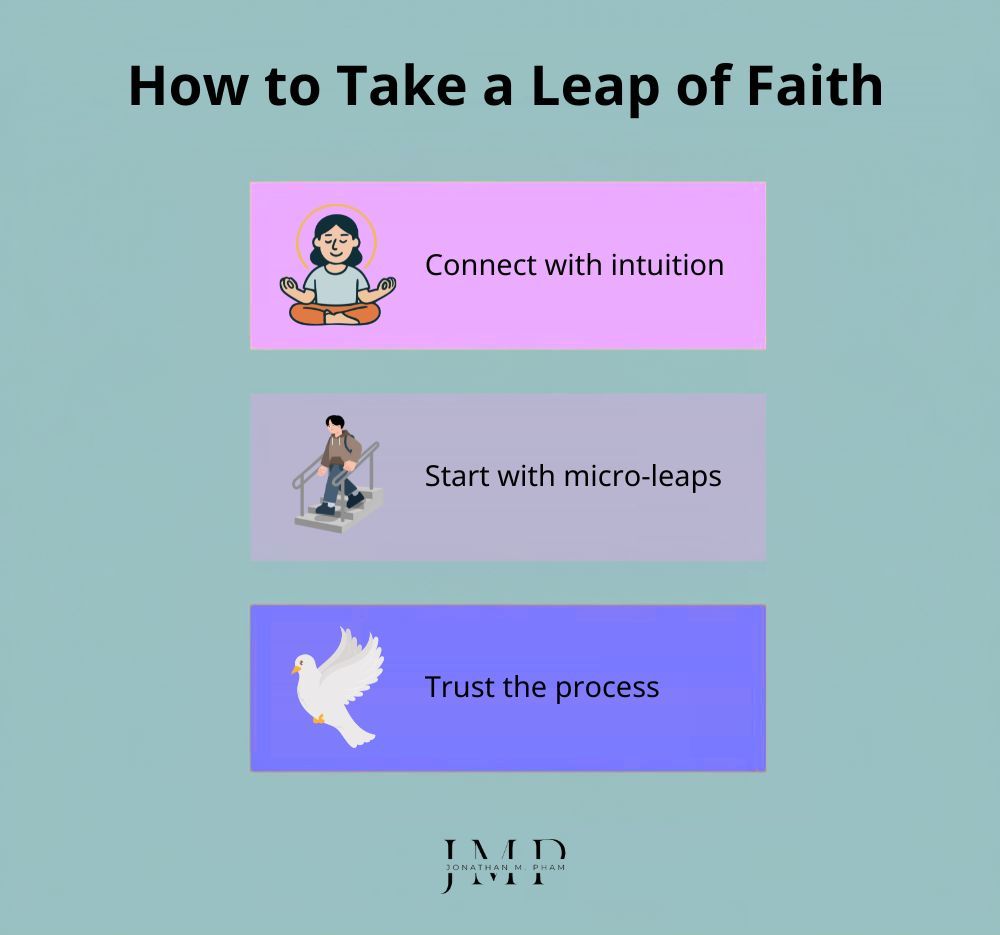
Connect with the inner voice
The first step is knowing what to leap toward.
In my experience, fear is a lousy person. It screams, “What about your pension? What will people think?”
Intuition, on the other hand, is quiet. It doesn’t scream. It’s like a beach ball held underwater—no matter how hard you push it down, it keeps popping back up.
For me, that quiet voice was what lay behind the urge to learn Japanese. As mentioned, that idea made no sense rationally. I had no clients in Japan. I wasn’t planning to move there.
Fear told me I was wasting time that could be spent learning a “useful” skill like coding. But the inner voice kept saying “This is for you“.
And fortunately, I listened to it. Now, that decision has opened the doors to Zen philosophy and many Eastern concepts that form the bedrock of my current worldview.
The Lesson: You don’t need to justify your intuition. You just need to follow it.

Start with micro-leaps
People tend to associate the “leap of faith” with a life-shattering event, like quitting a job or moving to a new country. But if you try to jump the Grand Canyon without training, you will fall.
You need to build your “faith muscle” with micro-leaps first.
Here’s a personal example. When a friend asks me to borrow money, I apply a simple rule: I only lend an amount I am fully prepared to consider a “gift.” I kiss that money goodbye in my mind before I hand it over.
By accepting the potential “loss” upfront, I free myself to act out of generosity rather than fear.
You can apply the same principle too. Try a new movie without being bothered by online reviews. Take a different route home without checking Google Maps.
These acts may seem trivial, but over time, they will train your brain to get comfortable with the unknown. They will teach you that you are able to survive without complete guarantee.
Trust the process
Faith is taking the first step even when you don’t see the whole staircase.
Martin Luther King Jr.
Once you take a great leap, do not expect immediate clarity.
When I finally quit my job to start this blog two years ago, I didn’t have a 10-year master plan. I felt like I was wandering in a maze. Like the character Yugi in Yugi-Oh! – facing the disassembled Millennium Puzzle, having no clue where to start.
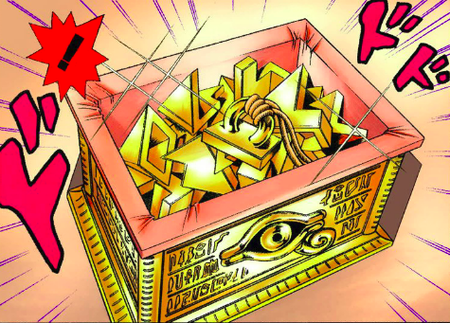
Just like Yugi, I had no idea how the path I chose would end. There were no guidebooks – no guarantee that I had all the necessary resources.
Most people, in such a case, would give up. And yet, this “Yugi” kept fitting pieces together, one by one.
He found a piece called “Writing.” Click.
He found a piece called “Psychology.” Click.
He found a piece called “Philosophy.” Click.

For a long time, these pieces looked random. But as I kept working on them during my last two years, they started to form a picture I could never have predicted: this blog – an embodiment of my identity and future direction.
You cannot take a leap of faith while still being bothered by the desire to know the destination. You just have to trust that if you keep picking up the pieces that feel true to you, they will eventually form a whole.
The joy isn’t in finishing the puzzle; it’s in the thrill of finding the next piece.
Ask and it will be given to you; seek and you will find; knock and the door will be opened to you.
Matthew 7:7
Challenges of Taking a Leap of Faith
I want to be honest with you: Taking a leap of faith does not mean your life will suddenly become a fairy tale. In fact, it may even get harder – before it gets better.
The dark night of the soul
I pray but I am lost. Am I just praying to silence?
Father Rodrigues, ‘Silence‘ (2016)
There will be moments after you leap when the silence is deafening. You quit the job, and the phone doesn’t ring. You move to the new city, and you feel lonely.
Christian mystics call this the “Dark Night of the Soul.” It is the moment when the old security is gone, but the new reality hasn’t arrived yet. You feel abandoned.
And yet, it doesn’t mean you made a mistake (provided you were honest and authentic to yourself in the beginning). Instead, it is very likely to be a sign that you are shedding your old skin.
It is the testing ground where your faith transforms from a “theory” into a “reality.”
Read more: Living in Bad Faith – The Existentialist Guide to Stopping Self-Deception
The moral ambiguity
Sometimes, the leap is difficult because there is no “right” answer. You might face a Trolley Problem in real life: Do I stay in a high-paying job I hate to support my family (Duty), or do I leave to preserve my mental health and look for a different option that MAY still allow me to help my family (Authenticity)?
There is no textbook answer. You cannot look to anywhere—except your own heart.
In such moments, you need to muster a lot of courage—not the kind that stems from certainty, but the courage to make a choice and carry the responsibility for it.
Just like Batman—who accepts being hunted because he trusts his intuition about the greater good. Or like Father Rodrigues in Endo’s Silence novel—who tramples on the fumie to save his Japanese believers, knowing that he will be condemned by the Church for the rest of his life.
When faced with such dilemmas, we leap not because we are guaranteed a happy ending, but because we cannot live with the alternative. The leap becomes the ultimate act of defining who you are.
FAQs
Is taking a leap of faith risky?
Yes. Let’s be honest—there is always a risk. You might quit the job and run out of savings. You might confess your love and get rejected.
But you must weigh that risk against the consequences of stagnation. Is it better to try and fail, or to stay in “Zombie Mode” for the next 20 years, slowly losing your spark?
The leap is not guaranteed to always work, but staying put is definitely guaranteed to “destroy” you.
Read more: Memento Mori – Remember You Are Mortal!
Is a leap of faith “blind”?
Not at all. After all, the philosopher Søren Kierkegaard has asserted that such a leap only comes after reflection. It happens after you have thought about it, gathered the facts, and realized that logic alone can only take you so far.
In other words, it is the sign of an informed trust in your intuition.
What if I fail?
Then you “learn to fly.” (just joking!)
To make it clearer, the goal of taking a leap of faith is not always “success” in the traditional sense (money, status) – but GROWTH. Even if the business fails or the relationship ends, you have shed your old skin.
You are no longer the person who was afraid to jump. You have gained data about reality that the person standing on the cliff edge never had. That, alone, is enough to justify the decision.
Just think about those like Santiago in Paulo Coelho’s The Alchemist. On the surface, his decision to venture into the unknown – to leave behind his sheep flock and venture into Egypt in search of a treasure – might seem futile. (he ended up back to his starting point) And yet, when he was back again, he had changed into a completely new person.
That inner transformation is the real treasure – not the gold he dug up from the ground.

Leap of Faith Quotes & Verses
If you are interested, check out more quotes about uncertainty here!
You must understand that seeing is believing, but also know that believing is seeing.
Denis Waitley
To love means to commit oneself without guarantee, to give oneself completely. Love is an act of faith, and whoever is of little faith is also of little love.
Erich Fromm
Faith does not need to push the river because faith is able to trust that there is a river. The river is flowing. We are in it.
Richard Rohr
You do not need to know precisely what is happening, or exactly where it is all going. What you need is to recognize the possibilities and challenges offered by the present moment, and to embrace them with courage, faith and hope.
Thomas Merton
Only in a leap from the lion’s head, shall he prove his worth.
Indiana Jones & the Last Crusade (1989)
Blessed are those who have not seen and yet have believed.
John 20:29
Even though I walk through the darkest valley, I will fear no evil.
Psalm 23:4
If you have faith as a mustard seed, you will say to this mountain, ‘Move from here to there,’ and it will move; and nothing will be impossible for you.
Matthew 17:20
For now we see only a reflection as in a mirror; then we shall see face to face. Now I know in part; then I shall know fully, even as I am fully known.
1 Corinthians 13:8-12
Final Thoughts: The Invincible Summer
In the end, we are all standing at that chasm. We are all living in an unpredictable world, where disruptions are the norm.
We can spend our precious, limited time waiting for a map that will never arrive. We can wait until we have enough money, enough confidence, or enough “readiness.”
But as Peter B. Parker told Miles Morales: “You won’t.“
There is no perfect time. There is only THIS time.
When I look back at my decision to leave the corporate world, I realize that the bridge didn’t appear because I was special. It appeared because I moved. The act of stepping out was what created the solid ground.
So, I suggest you do the same thing. Listen to that voice within. Trust that you are capable of handling the chaos.
And whenever you feel weary or doubtful, recall these words from the philosopher Albert Camus, who found hope in the midst of his own absurdity:
“In the midst of winter, I found there was, within me, an invincible summer.”
The summer is there. But YOU have to jump to find it.
Other resources you might be interested in:
- Nihilism vs Existentialism vs Absurdism: A Journey Into the Abyss
- 60 Existential Questions to Ask: Explore Life’s Depths
- 27 Best Existentialism Books: A Seeker’s Guide to Finding Meaning
- 20 Best Existential Movies for the Questioning Heart
- 100 Existential Quotes: Rethink One’s Place in the Universe
Let’s Tread the Path Together, Shall We?

