

 Tiếng Việt
 日本語
日本語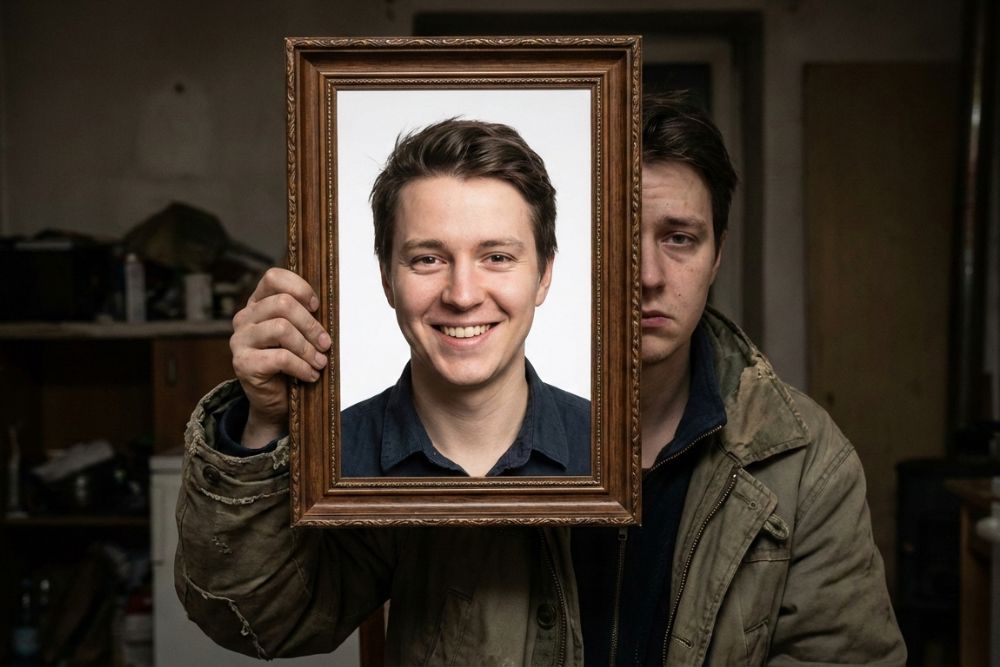
I remember a specific afternoon a few years ago—when I was sitting at my desk, updating my LinkedIn profile.
At that moment, I was in full “career management” mode. I was adding new certifications, tweaking the keywords in my “Skills” section, and polishing my summary to sound as dynamic and professional as possible. I spent an hour crafting the perfect sentence to describe a project that, in reality, had been quite mundane.
When I finally clicked “Save,” I sat back and looked at the result. There was my profile, organized into neat bullet points of achievement. Everything looked perfect.
And yet ironically, looking at that avatar of mine, I felt a gnawing sense of hollowness within. I couldn’t help but ask myself: “Is this me? Is this all there is?”
The person on the screen was efficient, tireless, and always “thrilled to announce” the next big thing. Yet the one sitting in the chair—me—was tired, uncertain, and craving a nap.
Somehow, there seemed to be an uncrossable chasm between the two “entities”.
Now reflecting on that moment, I realized why I was feeling that way: it’s because I was looking at a curated self, not the true Self.
This “curated self” has become a real thing these days. We think we are using social media and online platforms to express who we are, but often, we are simply constructing a character—a digital “statue” that looks like us but has none of our soul.
Highlights
- The “Curated Self” is a synthesized, public narrative—a “Greatest Hits” album of your life that strips away the context of reality. It is a product of our insecurity and desire for conformity (i.e. fear of being an outlier).
- Treating yourself as a fixed “Brand” is a form of philosophical “Bad Faith.” It turns you from a living person into a static object.
- Reclaiming authenticity requires the “courage to be disliked,” shifting from performing for an audience to connecting with humans, and accepting that you are always a work in progress.
What is the Curated Self?
To make it simple, the “Curated Self” is a constructed personal identity. It is a synthesized narrative—the “Greatest Hits” album of your existence, stripped of the context, the boredom, and the pain that make up 99% of actual living.
Think of it as a photo of the latte art without the cold silence sitting across the table. Or as a polished CV that hides the year of aimless unemployment.
The psychology of the curated self
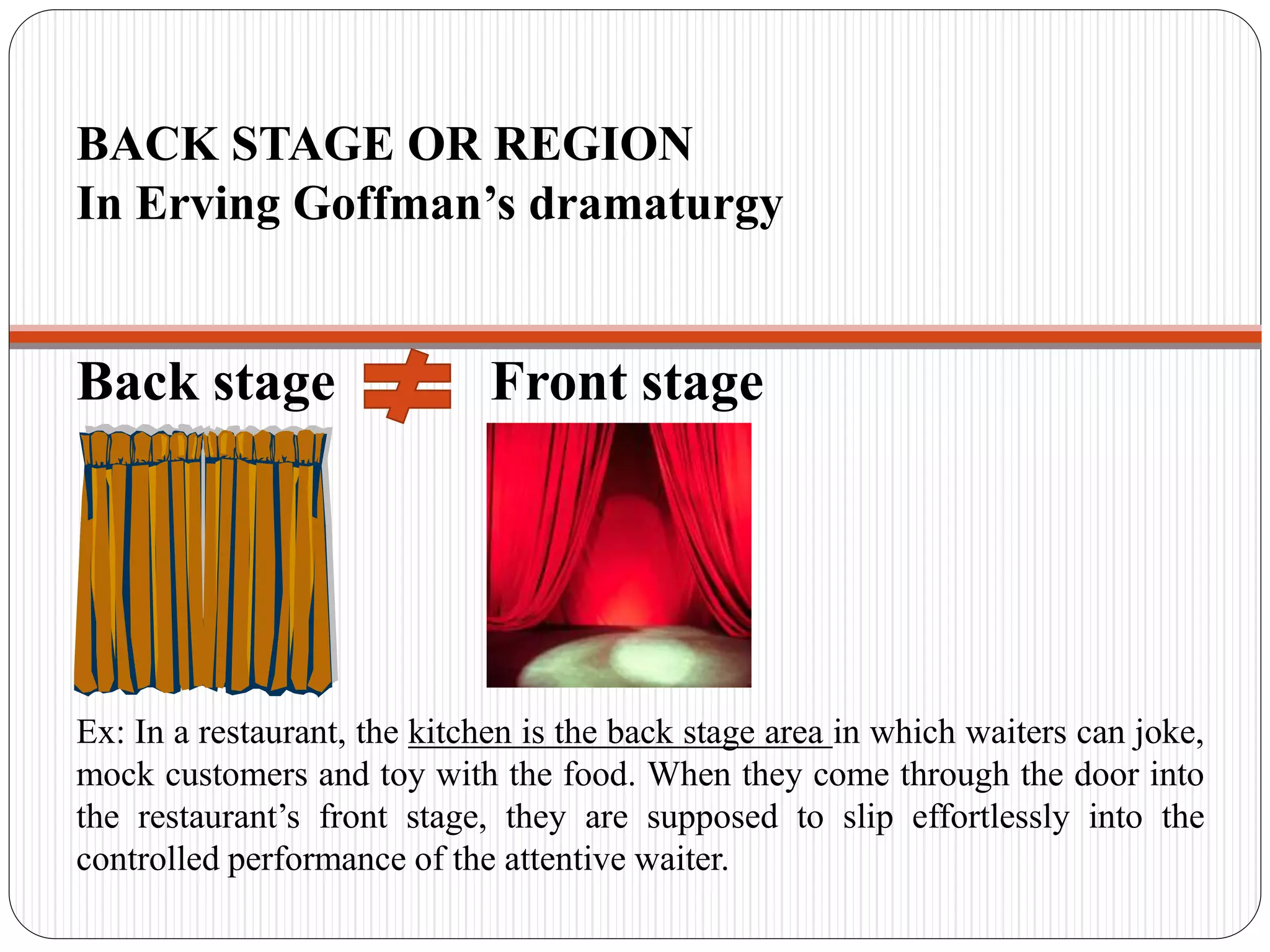
In 1959, long before Instagram existed, the sociologist Erving Goffman published a book titled The Presentation of Self in Everyday Life, in which he argued that human interaction is essentially a theater performance, comprised of two regions:
- The Front Stage: Where we perform for an audience (e.g., being the polite employee or the attentive host).
- The Back Stage: Where we relax, take off the mask, and are free to be our imperfect, authentic selves.
The problem with the digital age is that social media has destroyed the Back Stage. When we carry smartphones in our pockets, we are technically “on stage” 24/7. We start viewing our private moments—a sunset, a dinner, a funny mistake—not as experiences to be lived, but as content to be broadcast.
As a result, we edit our lives in real-time.
Digital self in understanding the self
How algorithms shape our “essence”
In existential philosophy, there is a concept called “existence precedes essence“—meaning who you are is defined through your choices (essence). At any moment, you are free to change.
Unfortunately, the current social media algorithms reverse this. Based on your data, social platforms assign you a fixed “essence”—e.g. a “Luxury Traveler,” or a “Fitness Enthusiast,” or a “Political Activist.” They then feed you content to keep you inside that box—while also rewarding you when you post content that matches that label.
If you try to step out of character—e.g. if the “Fitness Enthusiast” suddenly wants to post about grief or poetry—the algorithm punishes you with low engagement.
Eventually, you stop trying. You get trapped in the essence the machine chose for you—and become a character in your own life.
Social media freeze your freedom to change—because it only feeds you what you WERE, not what you COULD be.
Why We Are Obsessed with the Curated Self
Why do many of us spend hours filtering photos and drafting captions for strangers?
It isn’t simply vanity. If it were just vanity, it would be easy to stop. Rather, the reason has to do with a survival mechanism for our egos.
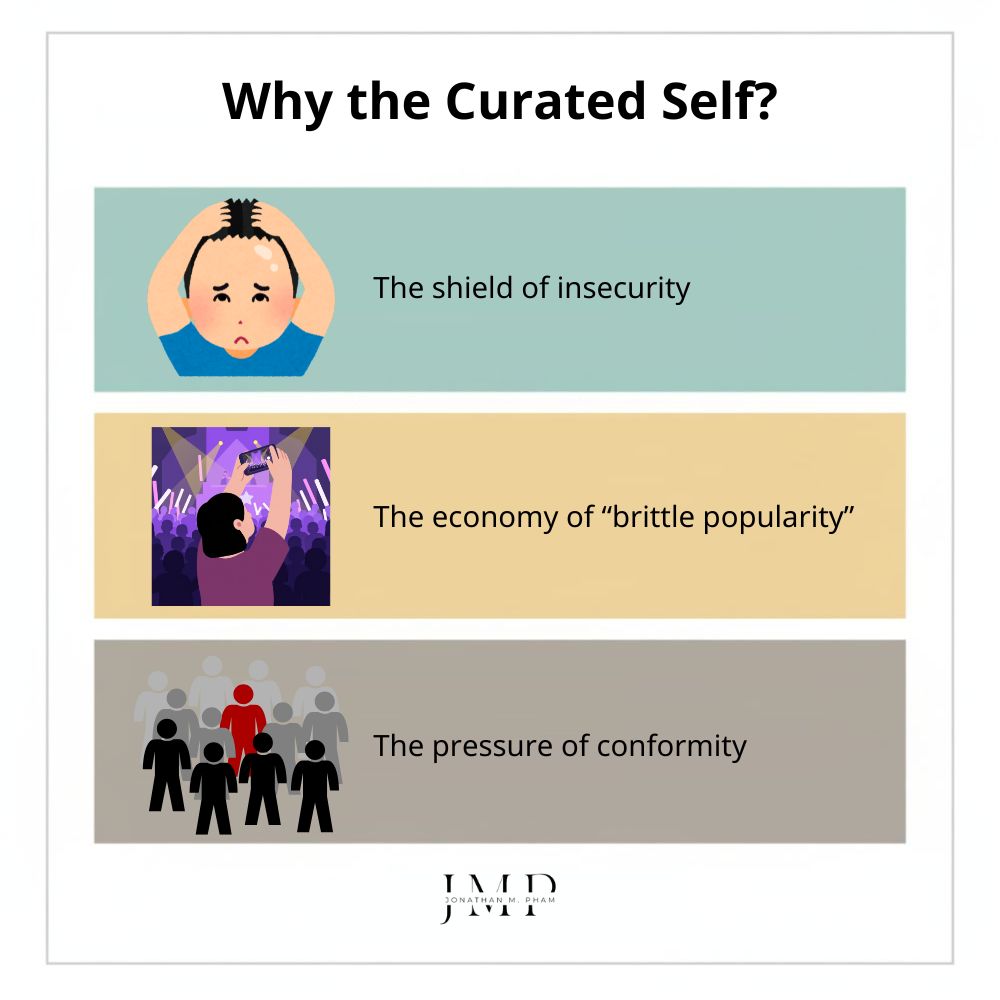
The shield of insecurity
Deep down, we curate our lives not to show off who we are, but to hide who we fear we are not. In light of this, the digital profile becomes a “shield”—a way to control how the world perceives us, protecting our vulnerable inner selves from rejection.
I remember once working with a female colleague who dressed very provocatively for the office. One day, another colleague asked her about it. She grinned and replied, quite openly, that she did it to “excite the boys.”
When I overheard the conversation between them, I could not help but feel a deep sense of pity. It seemed to me that my colleague’s sense of worth had been reduced to how much attention she could attract from others. She had, essentially, become a “shell”.
We do the exact same thing online. We post the achievement, the vacation, or the “hot” selfie—because we are terrified that without the applause, we might not matter.
In other words, we trade our agency for attention.
The economy of “brittle popularity”
There is also a chemical hook. Social media platforms are, basically, engineered to exploit our biology. As Chamath Palihapitiya, a former Facebook executive, once admitted, these platforms run on “short-term, dopamine-driven feedback loops.”
When you post something authentic—like a struggle or a complex thought—you risk silence. On the other hand, when you curate—when you post the predictable, shiny content the algorithm loves—you get the red hearts. You get the “likes.”
But this popularity is brittle—because it is NOT based on who you really are; it is based on the performance you just gave.
The result? You end up feeling like an imposter in your own life, constantly needing to “feed the beast” with more content just to maintain the same baseline of self-esteem.
You are, essentially, drinking saltwater to quench your thirst.
The pressure of conformity
The German philosopher Martin Heidegger once described a state of being called falling into “The They” (Das Man)—which happens when we stop thinking for ourselves and instead adopt the average behavior of the crowd to feel safe.
In the digital age, “The They” is the feed.
- “Everyone else is posting about their morning routine, so I should too.”
- “Everyone else is using this specific filter, so I will too.”
We curate our lives to match the aesthetic of the herd. We tell ourselves we are “sharing our journey,” but in truth, we are only signaling compliance.
We are saying, “Look, I am normal. I am successful. I am one of you.” We sacrifice uniqueness and authenticity for the comfort of belonging.
Curated self psychology
The Trap of the Curated Self
The problem with the Curated Self is that it is, philosophically speaking, a lie. It disconnects us from reality and, ultimately, from each other.
A sign of “bad faith”
The philosopher Jean-Paul Sartre once proposed the concept of “Bad Faith” (Mauvaise Foi). It happens when a human being—who is free, fluid, and constantly changing—pretends to be a static object to escape the anxiety of freedom.
For example, imagine an influencer posing with a coffee cup in a perfectly lit cafe. In that moment, they are NOT a human drinking coffee; they are “playing” the role of a human drinking coffee. They have objectified themselves.
When we curate our profiles, we do the same thing. We treat our Instagram grid as a finished statue—”This is who I am.” We freeze our identity into a set of images and captions.
But the thing is, you are NOT a statue. You are a living consciousness.
By trying to live up to the static image you created online, you trap yourself. You now make choices not based on what you really want – but on what “The Character” on the profile would do.
The “Museum Exhibit” effect
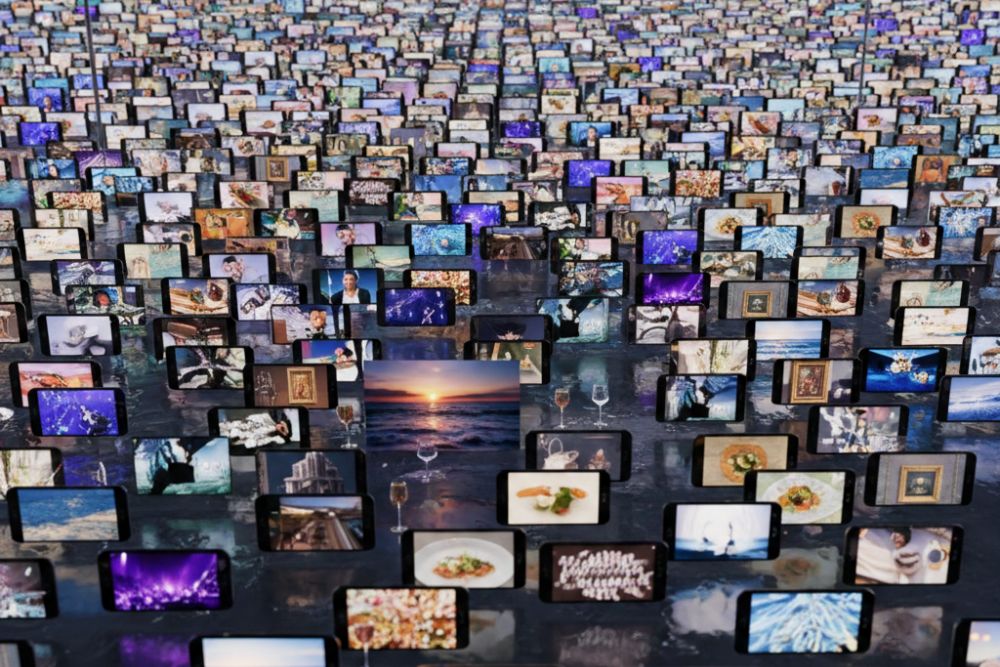
And that’s not all. When curation is prioritized over authenticity, we stop living our experiences and start documenting them.
We have all seen this (or done it) before, right?
- We go to a concert, but we watch it through our phone screen to get the perfect clip.
- We go to a beautiful dinner, but we don’t eat until we get the right angle for the photo.
Life becomes a museum exhibit. We become the curator of our own existence, standing outside the glass looking in, rather than inhabiting the moment.
We trade the reality of the now for a sanitized, digital representation of it to be consumed later.
Why isn’t your digital self really you?
The death of connection
Perhaps the most tragic consequence is what this does to our relationships. The philosopher Martin Buber once distinguished between two ways of relating to the world as follows:
- I-Thou: Relating to another as a sacred, whole being.
- I-It: Relating to another as an object or a means to an end.
Social media is designed to turn us into I-It machines. When we scroll, we don’t see people; we see content. We see tools for our own entertainment or validation.
We compare our “Behind the Scenes” with their “Highlight Reel,” which breeds envy rather than connection.
When we present a false self to the world, we cannot truly be loved, because the love is directed at the mask, not the person behind it.
The result? We end up “connected” to thousands, yet entirely alone.
The man who lies to himself and listens to his own lie comes to a point that he cannot distinguish the truth within him, or around him, and so loses all respect for himself and for others. And having no respect he ceases to love.
Fyodor Dostoevsky, ‘The Brothers Karamazov’
How social media fosters “performance over presence” – by Sherry Turkle
From the Curated Self to the Authentic Self
How do we break the cycle? How do we smash the statue and return to being human?
I’m not saying that you should delete your social accounts (though that might help). What I believe is important is that you should start reconsidering how you relate to the digital world.
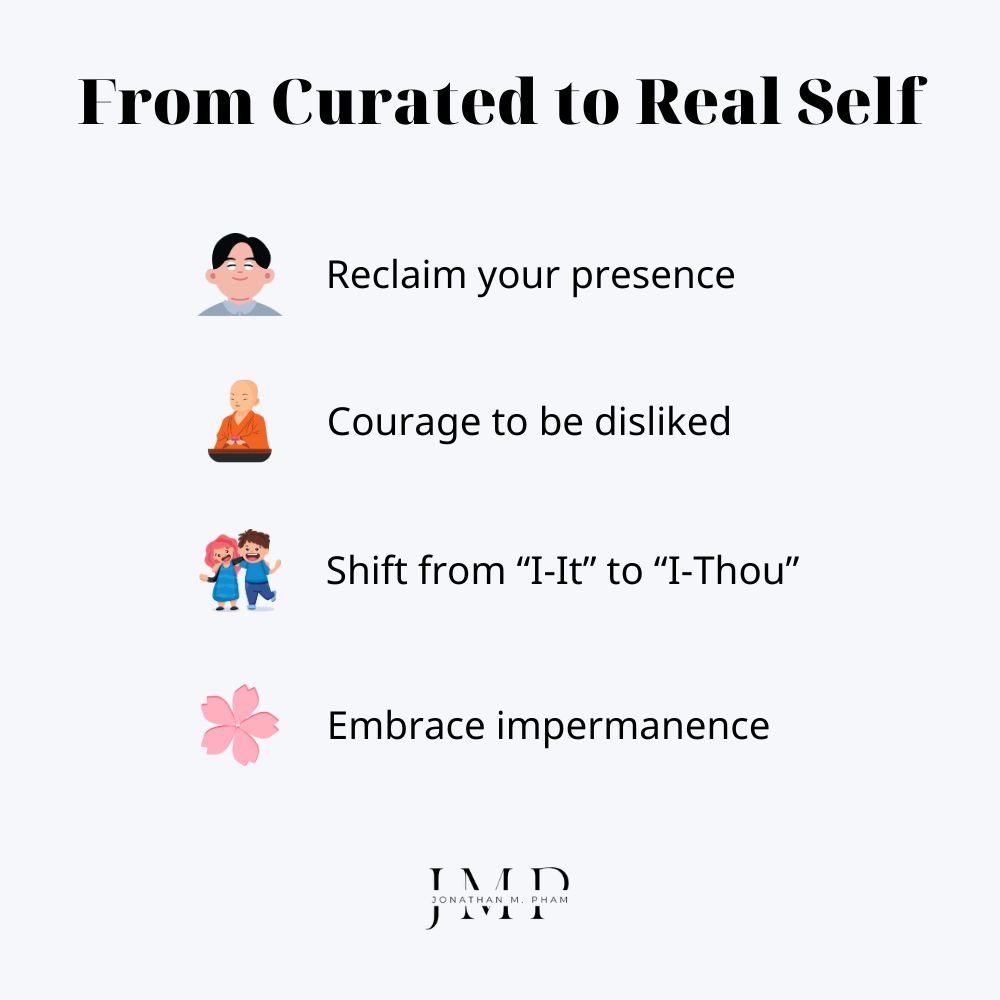
Reclaim your presence
The first step is to stop the constant input. You cannot find your own voice if you are constantly consuming the voices of others. In other words, you should begin with a deliberate digital detox—a clearing of the clutter that drowns out your inner voice.
Speaking of which, I remember visiting a barbershop a while back. I was sitting in the waiting chair, and my hand instinctively went to my pocket to pull out my phone—just to kill the five minutes of boredom.
But then somehow, I stopped and looked up. I noticed something unsettling.
Everyone in the shop—the other customers waiting, the staff taking a break—was holding a phone, head down, immersed in a glowing screen.
Suddenly, I was overwhelmed by a sharp sense of shame. I then decided to leave my phone in the pocket. I just sat there, looking at the texture of the floor tiles and listening to the snip of the scissors.
It felt uncomfortable at first, but I did not regret it at all.
To be authentic, you must relearn the art of solitude. You must be able to sit with yourself, without the crutch of a screen, and be okay with the silence.
Read more: Find the Beauty in Everyday – 8 Tips for Uncovering Joy & Wonder in the Little Things
Have the courage to be disliked
You say that, at present, you notice only your shortcomings, and it’s unlikely that you’ll ever come to like yourself. And then, you said, ‘I’m sure that no one would want to get involved with a guy as warped as me,’ didn’t you? Why do you dislike yourself? Why do you focus only on your shortcomings, and why have you decided to not start liking yourself? It’s because you are overly afraid of being disliked by other people and getting hurt in your interpersonal relationships.
Ichiro Kishimi, ‘The Courage to be Disliked’
As mentioned, we curate because we are afraid of being judged—being negated by others.
However, true authenticity requires the willingness to be misunderstood.
- It means posting something because it is true to you, NOT because it will get likes.
- It means admitting you are struggling when everyone else is posting “wins.”
If you curate your life to avoid getting hurt, you will eventually build a shell so thick that no one can hurt you—but no one can love you, either.
Don’t be afraid of being disliked by others. In fact, it is proof that you are living on your own terms.
Read more: Are You Living or Just Existing? Let’s Find Out!
Shift from “I-It” to “I-Thou”
Mundus vult decipi: the world wants to be deceived. The truth is too complex and frightening; the taste for the truth is an acquired taste that few acquire.
Martin Buber, ‘I and Thou’
Social media trains us to view people as “It”—as followers, engagement stats, or comparison points. As such, we must learn to consciously shift back to “Thou.” Stop searching for meaning in “dead” things—in titles, in past glories, or in the number of views on a post. Instead, look for it in the living.
Examples of how to do it in real life:
- View relationships as horizontal, not vertical. You are NOT above or below anyone in the feed.
- Practice “uncurated kindness.” Send a message to a friend just to say “I was thinking of you,” with no agenda and no public performance attached.
- When you interact online, remember: there is a beating heart behind the avatar.
One’s life has value so long as one attributes value to the life of others, by means of love, friendship, and compassion.
Simone de Beauvoir
Embrace impermanence
The Curated Self is, deep down, just an attempt to “freeze” time. We want to capture the “perfect” moment and keep it forever.
But the truth is, life is not a statue; it is a river.
You are allowed to change. You have the choice to contradict who you were yesterday.
There’s no need to maintain a consistent “Personal Brand” at all—especially if the only reason to do it is to please others or to feed the ego.
By accepting that you are a work in progress—flawed, aging, changing—you release the pressure to be perfect. You can finally just be.
Man is always something more than what he knows of himself. He is not what he is simply once and for all, but is a process; he is not merely an extant life, but is, within that life, endowed with possibilities through the freedom he possesses to make of himself what he will by the activities on which he decides.
Karl Jaspers
Further Resources: Finding the Way Back to Reality
Self reflection questions
For those who are interested, feel free to check out a list of recommended self-reflection questions and journal prompts here!
- If social media didn’t exist tomorrow, how would your life change? Would you feel relieved or erased?
- When you post an update, are you sharing a moment, or are you signaling a status?
- Does the person on your profile match the person looking in the mirror, or are they strangers?
- What is one struggle you are currently facing that your “Curated Self” would never admit to?
Quotes about the Curated Self & the quest for authenticity
Dumplings over flowers.
Better to be a nobody and yet have a servant than pretend to be somebody and have no food.
Proverbs 12:9
To be yourself in a world that is constantly trying to make you something else is the greatest accomplishment.
Ralph Waldo Emerson
Face the facts of being what you are, for that is what changes what you are.
Søren Kierkegaard
What is called self-actualization is not an attainable aim at all, for the simple reason that the more one would strive for it, the more he would miss it. In other words, self-actualization is possible only as a side-effect of self-transcendence.
Viktor Frankl
Additional readings
Be Yourself: Authenticity on Social Media Leads to a Happier Life. https://business.columbia.edu/press-release/cbs-press-releases/be-yourself-authenticity-social-media-leads-happier-life
Authenticity on Social Media vs Curated Content and its Correlation to Happiness. https://www.academia.edu/82288655/Authenticity_on_Social_Media_vs_Curated_Content_and_its_Correlation_to_Happiness
Final Thoughts: It’s Time to Smash the Statue
If there’s one final piece of advice I would like to share with you, it’s this: you are NOT a statue. You are a living, breathing, contradictory human being.
You are allowed to be boring and sad. You are allowed to have a bad hair day and not document it.
The algorithm wants you to be a predictable product. The world wants you to be a shiny object. But there’s no need for you to blindly conform. Just be real.
It is scary to drop the mask and show the cracks, I know. But as the poet Leonard Cohen once wrote:
“There is a crack in everything. That’s how the light gets in.“
Your Curated Self has no cracks, which means it has no light.
So, put down the phone. Step off the stage. Smash the statue. And from now on, start being!
Other resources you might be interested in:
- Memento Mori: A Reminder of Life’s Impermanence & How to Live the Right Way
- Happiness in Life: How to Attain Long Lasting Joy
- Finding Meaning in Suffering: How to Turn Wounds Into Wisdom
- How to Take a Leap of Faith: Trusting Intuition Over Logic
Let’s Tread the Path Together, Shall We?

