

 Tiếng Việt
 日本語
日本語
There is a specific kind of loneliness that drives one to the philosophy section of a bookstore.
I know it well. Not just boredom. It is the feeling of waking up at 3 AM with a question that feels too heavy to carry alone: Why am I here? Does any of this suffering mean anything? If I am free to do anything, why do I feel so paralyzed?
These questions were what brought me to Existentialism. To me, it isn’t a dry academic subject full of complex jargon like Dasein or Mauvaise foi (though we will encounter those terms).
At its core, Existentialism stemmed from conversations between humans who were brave enough to stare into the abyss of life and ask, “Okay, now what?”
A Note on This List: I approach the following reading list as a Christian Existentialist—someone who believes that faith and questioning go hand in hand. However, truth is truth, regardless of the source.
On my own shelf, the atheist playwright Albert Camus sits right next to the devout theologian Søren Kierkegaard. While it’s true they disagree on God, they do agree on the urgency of the human condition.
Whether you are a believer, an agnostic, or a staunch atheist, I hope these existentialism books will serve you as they have served me: not as rulebooks, but as companions for the journey.
Highlights
- The list below goes beyond academic textbooks to include novels, memoirs, and therapy guides that apply philosophy to real life.
- These books bridge the gap between secular and religious thought, proving that the search for meaning is, deep down, a shared human struggle.
- Whether you are a beginner, in the middle of a crisis, or looking for deep theological answers, you should be able to find a specific entry point for you.
Best Existentialism Books for Beginners
If you are new to philosophy – or are currently facing an existential crisis and need clarity rather than density, start here. These books are accessible, engaging, and practical.
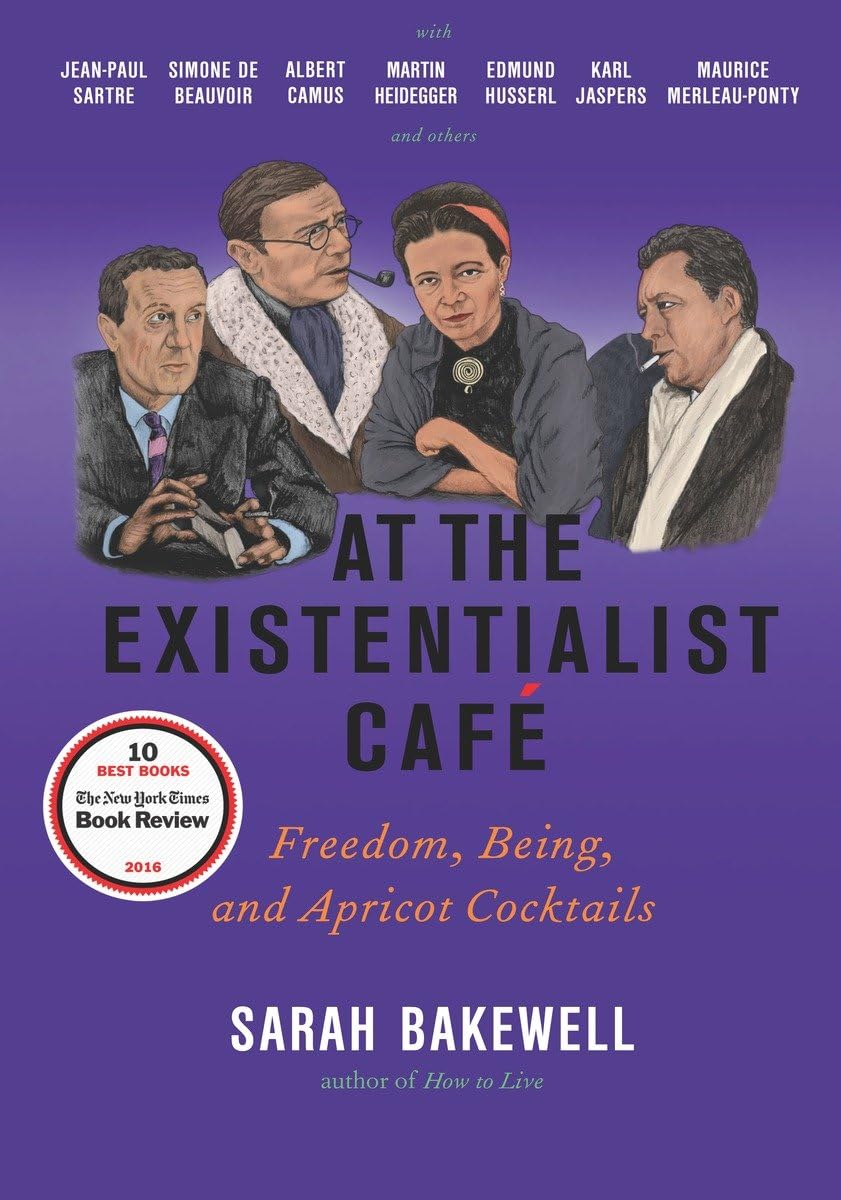
At the Existentialist Café
Author: Sarah Bakewell
Ideas are interesting, but people are vastly more so.
Why I chose this: Philosophy may feel intimidating – especially for newbies. If you try to dive straight into Heidegger, you are likely to bounce off hard.
I recommend starting here, because Bakewell does something brilliant: she humanizes the thinkers. She reminds us that Sartre, de Beauvoir, and Camus weren’t just brains in jars; they were real people drinking apricot cocktails in 1930s Paris, falling in love, fighting, and struggling to make sense of a world on the brink of war.
What it’s about: It is part biography, part history, and part philosophy primer. It weaves the lives of the major phenomenologists and existentialists together, showing how their personal lives influenced their radical ideas.
Personal insight: To me, the book is a reminder that philosophy is something you live. Seeing how these thinkers applied their ideas during World War II prompted me to re-think my own values. To see how ideas survive in the real world – that’s the insight I find most valuable.
Easy existentialism books
Man’s Search for Meaning
Author: Viktor Frankl
Everything can be taken from a man but one thing: the last of the human freedoms—to choose one’s attitude in any given set of circumstances, to choose one’s own way.
Why I chose this: This is, arguably, one of the most important picks when it comes to existentialism books. In fact, I myself revisit it every year.
If existentialism feels “gloomy” or “abstract” to you, Frankl grounds it in the hardest reality imaginable.
If his philosophy could survive the concentration camps, it can survive anything.
What it’s about: Frankl, a psychiatrist and Holocaust survivor, details his experiences in Nazi death camps. But more than just a memoir, it is the founding text of Logotherapy. He argues that our primary drive isn’t pleasure (Freud) or power (Adler), but meaning.
How I apply it: Whenever I fall into the trap of “victim mentality”—blaming my boss, the economy, or my circumstances—Frankl’s voice cuts through. At such moments, I realize that while I cannot control what happens to me, I am fully responsible for how I respond.
Read more: Meaning of Life Books – 15 Reads to Illuminate Your Purpose

Existentialism classic books
The Stranger (L’Étranger)
Author: Albert Camus
I opened myself to the gentle indifference of the world.
Why I chose this: Sometimes, you don’t want a lecture; what you want is a story. This novella is short, punchy, and disturbing in the best way. It captures the specific “numbness” that often accompanies an existential crisis.
What it’s about: The story follows Meursault, a man who seems utterly detached from society’s emotional rules. He doesn’t cry at his mother’s funeral. He kills a man on a beach due to the glare of the sun. And he refuses to lie about his feelings to save his life.
Personal insight: As a Christian myself, I read Meursault as a warning and a challenge. He represents the “Absurd Man”—someone who lives without appeal to any higher meaning.
While I do not agree with his conclusion, I deeply respect Meursault’s honesty – specifically, in refusing to “play the game” or feign emotions he doesn’t feel (a perfect example of resisting “Bad Faith“). Reflecting on his choice has, occasionally, prompted me to question myself: Where am I performing emotions just to fit in?

The Subtle Art of Not Giving a F*ck
Author: Mark Manson
Who you are is defined by what you’re willing to struggle for.
Why I chose this: I know, I know. An orange cover with a swear word in the title? Is this “real” philosophy? Yes, I believe it is.
In his book, Manson essentially repackages core existentialist ideas—responsibility, the inevitability of suffering, and the definition of values—for a modern, digital-native audience.
What it’s about: It’s a reality check. Manson argues that we have a limited amount of “f*cks” to give (emotional energy), and a good life is defined not by avoiding suffering, but by choosing better problems to suffer for.
How I apply it: The book, as I found, is a great read for navigating the “Fear of Missing Out” (FOMO) perpetuated by social media. It taught me that saying “No” to things isn’t a loss; it’s a way of prioritizing what actually matters.
It’s pop-philosophy, sure, but it’s pop-philosophy that gets the job done.
Read more: The Curated Self – Why Authenticity on Social Media is Impossible

Best Existential Philosophy Books
These are the foundational texts. A fair warning: some of these require patience. They are not light beach reads, but they are where the core ideas of freedom, authenticity, and the absurd were first mapped out.
Existentialism is a Humanism
Author: Jean-Paul Sartre
Man is condemned to be free; because once thrown into the world, he is responsible for everything he does.
Why I chose this: If you want to understand Sartre without wading through the 800 pages of Being and Nothingness, start here. This is actually a transcript of a lecture Sartre gave in 1945 to defend his philosophy against critics who called it too pessimistic. It is punchy, defensive, and incredibly clear.
What it’s about: Sartre breaks down the core tenant: “Existence precedes Essence.” In simple terms, there is no blueprint for a human being (no “Essence”) before we are born. We simply show up (Existence), and then we define who we are through our actions.
Personal insight: To me, the book is a wake-up call regarding personal agency. It strips away the excuses. You can’t say, “I’m just a generally angry person” as if it’s a fixed label or identity.
Sartre argues that you are “angry” only because you are choosing to act angrily in this moment. To realize that burden of responsibility is a terrifying experience, but also a remarkably empowering one.

Essential existentialism books
The Myth of Sisyphus
Author: Albert Camus
One must imagine Sisyphus happy.
Why I chose this: This is the definitive text on The Absurd. While Sartre demands we create meaning on our own, Camus asks a different question: Can we live WITHOUT meaning?
It is an essential read for anyone wrestling with the feeling that life is a futile loop.
What it’s about: Camus compares human life to the Greek figure Sisyphus, condemned to roll a boulder up a hill for eternity, only to watch it roll back down. While on the surface it may seem depressing, Camus doesn’t think so. He believes that by accepting the futility—by realizing the rock will always fall—Sisyphus becomes the master of his fate. His defiance makes him happy.
How I apply it: I turn to this essay when I feel stuck in the “grind”—the repetitive, mundane tasks of life that feel pointless. Camus teaches me that I don’t need a “Grand Cosmic Reason” to wash the dishes or finish a report. The act of living, of pushing the boulder with dignity and awareness, has value in its own.
Read more: The Absurd Hero – Finding Happiness in the Struggle

The Ethics of Ambiguity
Author: Simone de Beauvoir
To will oneself free is also to will others free.
Why I chose this: If Sartre is the “Individualist,” de Beauvoir is the bridge to the “Community.” I included this because many people mistakenly equate existentialism with selfish individualism – which is not the case at all.
What it’s about: In her work, de Beauvoir tackles the problem of how to be good in a world without objective moral rules. Her conclusion is this: My freedom is inextricably linked to yours. If I treat you like an object, I am creating a world of oppression that will eventually trap me too.
Personal insight: As someone who values the concept of Interbeing, the book resonated deeply with me. It moved my interpretation of authenticity from “I do what I want” to “I am responsible for the freedom of my neighbor.”
To me, it is a powerful antidote to the toxic narcissism sometimes found in modern self-help.
French existentialism books
Being and Time
Author: Martin Heidegger
The ‘They’ prescribes one’s state of mind and determines what and how one ‘sees’.
Why I chose this: I will be honest – this is probably the most difficult book to read on the list. It is dense, obscure, and challenging. But I still include it because it is the source code. Almost every idea in this article—Angst, Authenticity, Being-in-the-world—started here.
What it’s about: Heidegger explores what it means to “Be” (Dasein). He examines how we are “thrown” into a world we didn’t choose – and how we typically hide from this anxiety by losing ourselves in “The They” (the crowd/society).
How to read it: Don’t try to conquer it in a weekend. I read it alongside a guidebook (and I suggest you do too). But the effort pays off.
The concept of being “fallen” into the distractions of the world helped me realize why I doom-scroll or seek constant noise—I am fleeing the anxiety of my own existence.
Famous existentialism books
Thus Spoke Zarathustra
Author: Friedrich Nietzsche
I say unto you: one must still have chaos in oneself to be able to give birth to a dancing star.
Why I chose this: Nietzsche is the dynamite of the group. While technically a precursor to the existentialists, his work is the fire they all warmed their hands by. I chose Zarathustra because it is written like a mythic poem rather than a dry treatise.
What it’s about: The prophet Zarathustra comes down from the mountain to announce that “God is dead”—meaning the old systems of value have collapsed—and we must now become the “Overman” (or Ubermensch), creators of our own values.
Personal insight: As a Christian, reading Nietzsche is a fascinating exercise. He is a firm critic of faith, accusing Christianity of being a “life-denying” religion.
But what’s interesting is that Nietzsche’s arguments do not offend me. In fact, reflecting on his viewpoint has driven me to ensure my faith is “life-affirming”—that I am not using religion as a crutch to escape the world, but as a way to engage with it more boldly. In the words of Nietzsche, to love my fate. (Amor Fati)

Existentialism vs nihilism books
Religious & Christian Existentialism Books
There is a persistent myth that existentialism is synonymous with atheism. Nothing could be further from the truth than that.
In fact, the very roots of this philosophy are deeply spiritual. The following authors don’t try to explain away the anxiety of life with platitudes; instead, they believe that it is precisely within that anxiety that we encounter the Divine.
Fear and Trembling
Author: Søren Kierkegaard
Faith begins precisely where thinking leaves off.
Why I chose this: If you have ever felt that “logical” religion feels empty, then this is for you. Kierkegaard is widely regarded as the father of existentialism, and here he tackles the most haunting aspect of the spiritual life: the Leap of Faith.
What it’s about: He retells the biblical story of Abraham and Isaac—where God asks Abraham to sacrifice his son—over and over again, from different angles. It is a study in the “teleological suspension of the ethical.” In plain English: sometimes, following the Divine call looks like madness to the rest of the world.
Personal insight: The book has been a great source of comfort when my own life choices (e.g. leaving my stable corporate career to seek truth) don’t make sense on a spreadsheet. But as I figure, faith doesn’t lie in a comfortable safety net. Rather, it is the result of passion – the courage to trust the “absurd” over the “reasonable.”
Read more: The Knight of Faith – Believing in the Absurd

The Sickness Unto Death
Author: Søren Kierkegaard
The greatest hazard of all, losing one’s self, can occur very quietly in the world, as if it were nothing at all.
Why I chose this: While Fear and Trembling is about action, this book is about the state of your soul. It is, in my opinion, the most profound psychological diagnosis of the human condition ever written.
What it’s about: Kierkegaard defines “despair” not just as sadness, but as a failure to be a Self. According to him, we are all in despair—whether we know it or not—until we ground our identity in the Power that created us.
How I apply it: I often use this as a “spiritual mirror.” As described by Kierkegaard, there are different types of despair – including that of not wanting to be oneself (wanting to be someone else) and of wanting to be oneself without God (pride).
Whenever I catch myself trying to establish my identity on fragile things like reputation or success, I’m immediately reminded of the lessons in the book – and of the fact that authenticity only comes when the “self rests transparently” in something that transcends it.

The Courage to Be
Author: Paul Tillich
The courage to be is the ethical act in which man affirms his own being in spite of those elements of his existence which conflict with his essential self.
Why I chose this: Paul Tillich was a theologian who wasn’t afraid of the void. His book is, to me, an essential read for anyone who feels that traditional religious answers don’t quite address the crushing weight of modern anxiety.
What it’s about: Tillich analyzes three types of anxiety: the anxiety of Fate and Death, of Guilt and Condemnation, and of Emptiness and Meaninglessness. His solution is the “God above God”—a faith that persists even when the traditional images of God disappear in the silence of doubt.
Personal insight: There are days when I don’t “feel” religious. Days when the prayers feel dry and the sky feels empty. But as I learned from Tillich, there’s no need to beat myself up on that.
Doubt, as mystics like Thomas Merton have pointed out, is not an enemy – but an element of faith. To continue to exist, to continue to say “Yes” to life despite the anxiety, is itself an act of worship.

Christian existentialism books
I and Thou (Ich und Du)
Author: Martin Buber
All real living is meeting.
Why I chose this: Existentialism may sometimes feel lonely—just you and your internal drama. But Buber, a Jewish philosopher, doesn’t think so. Quite the opposite – to him, meaning is found in the Space Between us.
What it’s about: According to Buber, we engage with the world in two ways:
- I-It: Treating people/things as objects to be used or experienced (Transactional).
- I-Thou: Encountering people/God as a whole presence to be met (Relational).
How I apply it: The book has played a major role in changing how I view “authenticity” – specifically, I cannot find the Divine or myself in isolation. Only when I look into the face of another person and treat them as a sacred “Thou” (rather than a tool for my happiness) may God become part of my life.
It’s a short, poetic read, but it will change every conversation you have for a week after reading it.

Books about existence
Principles of Christian Theology
Author: John Macquarrie
God is not a being, but Being-itself.
Why I chose this (the unconventional pick): This is a bit of a “deep cut.” It’s a hefty systematic theology book, not a standard paperback. Yet I include it because Macquarrie does something incredible: he takes the complex, secular philosophy of Martin Heidegger (Being and Time) and translates it into Christian language.
What it’s about: Macquarrie frames God not as a “super-entity” in the sky, but as “Holy Being”—the very power that lets things exist. He speaks of sin not as breaking a rule, but as “alienation” from Being.
Personal insight: For the intellectual seeker who loves philosophy but struggles with the “Sunday School” version of religion, Macquarrie is a bridge builder. He helped me see that my existential angst and religious faith were actually speaking the same language, just using different dialects.
To sum it up, he gave me the vocabulary to understand my faith intellectually, without losing the mystery.
Read more: How to Know God Book Review
Best Existentialism Novels & Fiction
Philosophy explains the concepts; fiction forces you to live them. These novels don’t just tell you what “Angst” or “The Absurd” means—they put you inside the skin of characters who are drowning in it, to see abstract ideas in action.
Notes from Underground
Author: Fyodor Dostoevsky
I say let the world go to hell, but I should always have my tea.
Why I chose this: This is the book that introduces the original “Anti-Hero.” If you have ever felt a strange, irrational urge to sabotage your own happiness just to prove you are free, you will relate to the Underground Man.
What it’s about: It is a rambling, spiteful, brilliant monologue from a man living on the fringes of society. He rails against the “Crystal Palace”—a utopian idea where science and reason solve all human problems. According to him, a man would rather go insane than be a “piano key” played by the laws of nature.
Personal insight: The book has been a mirror for my own pettiness. It allowed me to realize the danger of “hyper-consciousness”—of thinking so much that you become paralyzed and resentful. From it, I learned an important lesson: intelligence without love or action will only lead to a dark, lonely basement.

Existential horror books
The Brothers Karamazov
Author: Fyodor Dostoevsky
The mystery of human existence lies not in just staying alive, but in finding something to live for.
Why I chose this: If Notes from Underground is the warning, then The Brothers Karamazov is the redemption. It is a massive undertaking, but it is arguably one of the greatest novels ever written about faith and doubt.
What it’s about: The story follows three brothers—Ivan the intellectual atheist, Dmitri the sensualist, and Alyosha the devout novice—as they grapple with their toxic father and a murder trial. The center of the narrative is the famous “Grand Inquisitor” chapter – a debate about whether humans actually want freedom, or if we would rather trade it for bread and security.
How I apply it: I read this as a battle within my own soul. I have an Ivan inside me (who demands logic and justice) and an Alyosha (who seeks to love). As shown in the novel, while Ivan’s logic is strong, it eventually breaks him. It is Alyosha’s active love that survives.

Best existentialism books to read
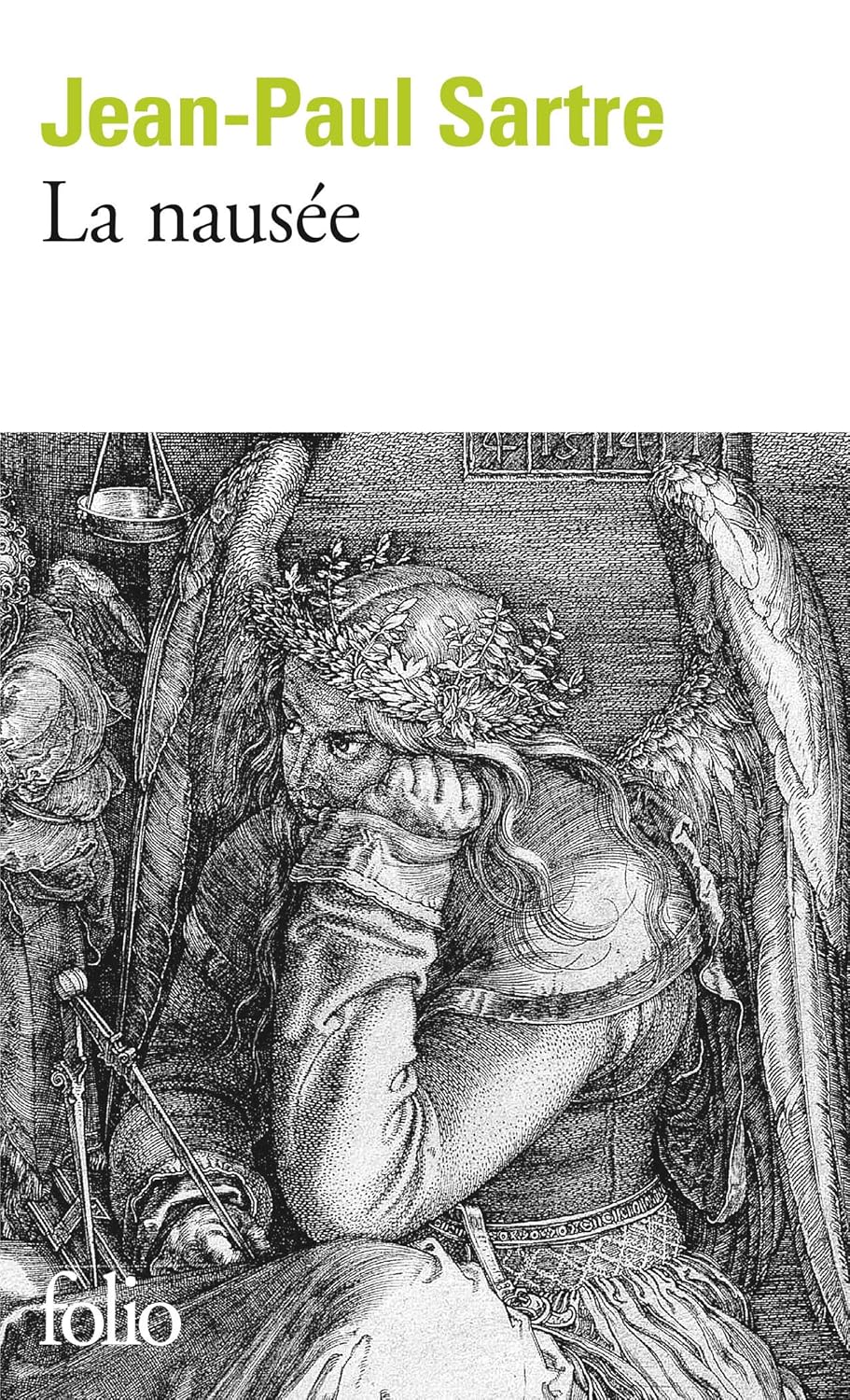
Nausea (La Nausée)
Author: Jean-Paul Sartre
I realized that there was no half-way house between non-existence and this rapturous abundance. If you existed, you had to exist all the way.
Why I chose this: Sartre wrote this novel to demonstrate what existential dread actually feels like physically. It is best read when you are feeling detached from your surroundings.
What it’s about: Antoine Roquentin, a historian, begins to feel a sickness called “The Nausea.” It happens when objects lose their labels. He looks at a chestnut tree root and realizes it isn’t a “root” (a word humans invented); rather, it is a grotesque, overflowing, naked existence.
Personal insight: The book captured a sensation I’ve had during panic attacks—when the world suddenly feels “too much” or “alien.” It’s like when you repeat a word over and over – until it loses its meaning and just becomes a weird sound. Or when you look at your own hand for too long and suddenly it doesn’t look like “yours” anymore—it just looks like a strange biological object.
As I then came to understand, this feeling isn’t a sign of madness at all. It’s just a moment of pure clarity – where the labels drop and we confront existence raw. To quote the Indian philosopher Krishnamurti:
Do you know that even when you look at a tree and say, ‘That is an oak tree’, or ‘that is a banyan tree’, the naming of the tree, which is botanical knowledge, has so conditioned your mind that the word comes between you and actually seeing the tree? To come in contact with the tree you have to put your hand on it and the word will not help you to touch it.
Existentialism novels
The Death of Ivan Ilyich
Author: Leo Tolstoy
Maybe I did not live as I ought to have done?
Why I chose this: Another “wake-up call” book. It is short, haunting, and necessary. It is the literary equivalent of the “Mirror Test”. (which I have mentioned in a detailed article about bad faith)
What it’s about: Ivan Ilyich is a high-court judge who has lived a “perfect” life by societal standards. He did everything right—the right job, the right house, the right friends. But as he lies dying of a mysterious illness, he realizes with horror that his entire life was a lie—a performance for the approval of others.
How I apply it: I try to read this once a year to check my trajectory. It scares me, yes, but in a good way. It asks me: Are you living your life, or are you just decorating a life that looks good to your neighbors?

Existentialist books for late night reading
Kafka on the Shore
Author: Haruki Murakami
And once the storm is over, you won’t remember how you made it through, how you managed to survive… But one thing is certain. When you come out of the storm, you won’t be the same person who walked in.
Why I chose this (the modern pick): Existentialism isn’t just European men in the 1940s. In his work, Murakami brings a modern, dreamlike quality to the questions of identity and fate.
What it’s about: A teenage runaway named Kafka and an old man who can talk to cats. Their paths cross in a metaphysical journey involving libraries, ghosts, and destiny. The story deals with the “split self” and the way our subconscious drives our actions.
Why it’s here: Sometimes existentialism doesn’t have to do with logic at all. Sometimes, the journey of finding oneself is confusing, as if one is in a waking dream. Sometimes, reality is much more porous than one may be willing to admit. Murakami captures that inner struggle better than almost anyone.

Existential sci fi books
Grendel
Author: John Champlin Gardner Jr.
I understood that the world was nothing: a mechanical chaos of casual, brute enmity.
Why I chose this (the unconventional pick): You probably know the story of Beowulf. This book retells it from the monster’s perspective. To me, it is an underrated masterpiece of existential philosophy.
What it’s about: Grendel is a lonely, intelligent monster who observes human civilization from the outside. He watches humans create songs, religions, and kingdoms to cover up the meaningless chaos of the universe. He sees the “bad faith” of society clearly – because he is not part of it.
Personal insight: Grendel, as depicted in the novel, is the ultimate outsider. Reading it made me somehow sympathetic to the “monster.” It touched on a specific bitterness I sometimes feel when I am lonely.
When you are on the outside looking in at happy people, it is very tempting to become cynical—to want to tear down their joy or call it “fake” just because you aren’t part of it.
Isolation, if left unchecked, can easily turn into cruelty.
Read more: 10 Self-help Fiction Books to Rewrite Your Story

Best Existential Psychology & Therapy Books
Existentialism isn’t just about brooding in a café; it is, in fact, an amazingly effective framework for healing. As presented by the following authors (mostly therapists), our mental health struggles often stem not from “brain chemistry” alone, but from our confrontation with the “givens” of existence.
Existential Psychotherapy
Author: Irvin D. Yalom
Anxiety is guide as well as enemy and can point the way to authentic existence.
Why I chose this: If you want to understand the architecture of your own anxiety, this is a must-read. Though technically a textbook for therapists, it is surprisingly readable for laypeople. In a sense, it is the “bible of the field”.
What it’s about: According to Yalom, most psychological stress comes from our confrontation with four “ultimate concerns”: Death, Freedom, Isolation, and Meaninglessness. He breaks down how we develop defense mechanisms to avoid looking at these suns directly.
How I apply it: Whenever I feel overwhelmed, I stop looking for surface triggers (like a busy schedule) and ask: Which of the four concerns is being triggered here? Am I anxious about a deadline, or am I actually anxious about Death (time running out)? Doing so allows me to treat the root, not the symptom.

Existential therapy books
Staring at the Sun
Author: Irvin D. Yalom
The physicality of death destroys us, the idea of death saves us.
Why I chose this: While his textbook is comprehensive, this book is laser-focused on one thing: Death Anxiety. It is shorter, more personal, and deeply comforting.
What it’s about: Yalom proposes that a huge amount of human behavior—from mid-life crises to workaholism—is just an attempt to deny that we are mortal. He introduces the concept of “Rippling”: the idea that while we disappear, the impact of our actions moves outward in concentric circles, touching people we will never meet.
Personal insight: Even though I, as a believer, do have hope for the afterlife, the physical fear of dying is still very real. For many of us, death is viewed as a “bug in the system” – a “failure” of life. But what if we can think of it as the very thing that gives existence its zest?
Scarcity creates value. I love my life – exactly because it is temporary.

Existential books about death
Man’s Search for Himself
Author: Rollo May
The opposite of courage in our society is not cowardice, it is conformity.
Why I chose this: Rollo May is the bridge between American psychology and European philosophy. If you struggle with people-pleasing or “losing yourself” in relationships, this is the book to read.
What it’s about: In his work, May diagnoses the “Age of Anxiety.” He argues that in the modern world, we have lost our center of values. We have become “outer-directed,” looking to society to tell us who we are. The cure is to cultivate the courage to be “inner-directed”—to stand alone if necessary.
How I apply it: The book is my manual for combating “bad faith.” As explained by May, freedom isn’t just letting go of rules; it is the active discipline of choosing oneself daily by asking: Am I doing this because I value it, or because I am terrified of being different?

Existential psychology books
The Denial of Death
Author: Ernest Becker
Man cannot endure his own littleness unless he can translate it into meaningfulness on the largest possible level.
Why I chose this: This is a heavy hitter (it won the Pulitzer Prize), but it explains human civilization better than any history book. It sits at the intersection of psychology, anthropology, and philosophy.
What it’s about: A core argument in the book is that everything humans build—pyramids, skyscrapers, corporations, religions—are “Immortality Projects.” They represent our desperate attempts to create something that will outlast us, so we don’t have to face the terrifying reality that we are just biological creatures who will die.
Personal insight: The book was a massive ego-check for me. It made me look at my own ambitions—my desire to write, to be “known”—with suspicion. Am I doing this out of love and service? Or am I just trying to build a monument so I won’t be forgotten?

Unconventional & “Hidden Gem” Existential Books
Existentialism doesn’t always lie in heavy philosophical treatises. Sometimes you will find its elements in children’s books, silent prayers, or tragic memoirs. These “hidden gems” tackle the same heavy themes of isolation, meaning, and absurdity, but they do it from unique angles.
Silence
Author: Shūsaku Endō
But our Lord was not silent. Even if he had been silent, my life until this day would have spoken of him.
Why I chose this: I believe Silence is a masterpiece for anyone who has ever felt abandoned by God – specifically, the God that Western religions tend to promote. While many existentialists ask “Does God exist?“, Endō proposes a harder question: “Why does He stay silent while we suffer?“
What it’s about: Set in 17th-century Japan, the story follows two Portuguese priests who travel to a country where Christianity is banned and believers are tortured. The protagonist, Father Rodrigues, begs for a sign from God, but hears only the sound of the ocean. He is slowly stripped of his pride, his “Western” savior complex, and his external rituals, until he is forced to make a devastating choice: trampling on the fumie (an image of Christ) to save his Japanese followers.
Personal insight: Initially I didn’t quite “get it”, but over time, reflecting on the story has allowed me to better understand what it means to live in “bad faith”. As I eventually figured, true faith has nothing to do with glory or loud miracles; it’s about finding the Divine in the mud, in the silence, and in the faces of those society rejects.
It is painful to read, but it leaves you with a much more authentic faith – because it has survived the worst.
Read more: Silence Movie Review – A Meditation on Suffering, Doubt, and the Price of Belief

The Little Prince (Le Petit Prince)
Author: Antoine de Saint-Exupéry
It is the time you have wasted for your rose that makes your rose so important.
Why I chose this: Don’t be fooled by the watercolor illustrations. This is a children’s book in disguise; beneath the surface, you will find a profound meditation on absurdity, connection, and mortality.
What it’s about: A pilot crashes in the desert and meets a boy from another planet. Through the Prince’s innocent eyes, we see the absurdity of the “Grown-Up World”—the businessman counting stars he can’t own, the king with no subjects, the drunkard drinking to forget he is ashamed of drinking.
Why it’s here: It teaches the central existential lesson of “Taming” (creating ties). Specifically, meaning isn’t inherent in the object (there are thousands of roses); it is created by the time and love you invest in it.
The book is, I believe, one of the gentlest introductions to existential responsibility you will ever find.

Existential books for kids & young adults
No Longer Human
Author: Osamu Dazai
Mine has been a life of much shame. I can’t even guess myself what it must be to live the life of a human being.
Why I chose this: This is the Japanese counterpart to The Stranger, but far more tragic. It is an essential read for understanding the extreme end of alienation (“The Outsider”).
What it’s about: The protagonist, Oba Yozo, feels utterly incapable of understanding human beings. To survive, he adopts the “clown” persona—always smiling, always joking—to hide his terror of others. The story presents a heartbreaking look at someone living in total bad faith – not out of malice, but out of a desperate need to survive socially.
Personal insight: The book articulates the exhaustion of “masking”—of performing “normalcy” when you feel like an alien inside. It is a dark read, but for anyone who struggles with social anxiety or impostor syndrome, feeling seen by Dazai’s honesty may be, strangely enough, healing.

Existential sci fi
FAQs about the Existential Genre
Reading existentialism books may feel like learning a new language – especially to newbies. Here are answers to some of the most common questions concerning this genre:
What makes a book existentialist?
Don’t get me wrong: it isn’t just about the author being French or depressed. A book is existentialist if it deals with the core conflict of the human condition: we are beings who crave meaning in a universe that offers no clear answers.
If a book wrestles with Freedom (we must choose), Isolation (we are alone), Angst (the dizziness of freedom), or Authenticity (being real), it belongs on this shelf.
Can existentialists believe in God?
Absolutely. This is probably the biggest misconception out there.
While Sartre and Camus were atheists, the father of existentialism, Søren Kierkegaard, was a devout Christian. And there are many other religious existentialists as well (like Buber, Tillich, and myself).
Despite the differences in approach, most of these people all settle on the same premise: that a “Leap of Faith” (or something similar) is the ultimate existential act—choosing to trust in God not because of logical proof, but out of passionate, personal commitment.
What are the pillars of existentialism?
While different thinkers list different themes, the psychotherapist Irvin Yalom summarizes the “Four Ultimate Concerns” that drive our anxiety:
- Death: The inevitability of our end.
- Freedom: The responsibility of making our own choices.
- Isolation: The unbridgeable gap between ourselves and others.
- Meaninglessness: The lack of an obvious, pre-written purpose to life.
What should I read if I’m in the middle of an existential crisis?
Be careful here. If you are currently spiraling or feeling deeply unstable, I would recommend you avoid books that deconstruct reality too aggressively (like Sartre’s Nausea or Dostoevsky’s Notes from Underground). Instead, reach for those that construct meaning.
Viktor Frankl’s Man’s Search for Meaning or Irvin Yalom’s Staring at the Sun are the safest and most healing places to start. They acknowledge the darkness – but point you toward the light.
How do I actually read these existentialism books without getting a headache?
Slowly. These aren’t thrillers. My advice is that you treat them like a conversation. Read a few pages, then put the book down and journal. Ask yourself: “Where do I see this idea in my own life?”
If you get stuck on a complex paragraph (especially in Heidegger or Sartre), don’t freak out. Just move on. Grab the feeling, not just the logic.
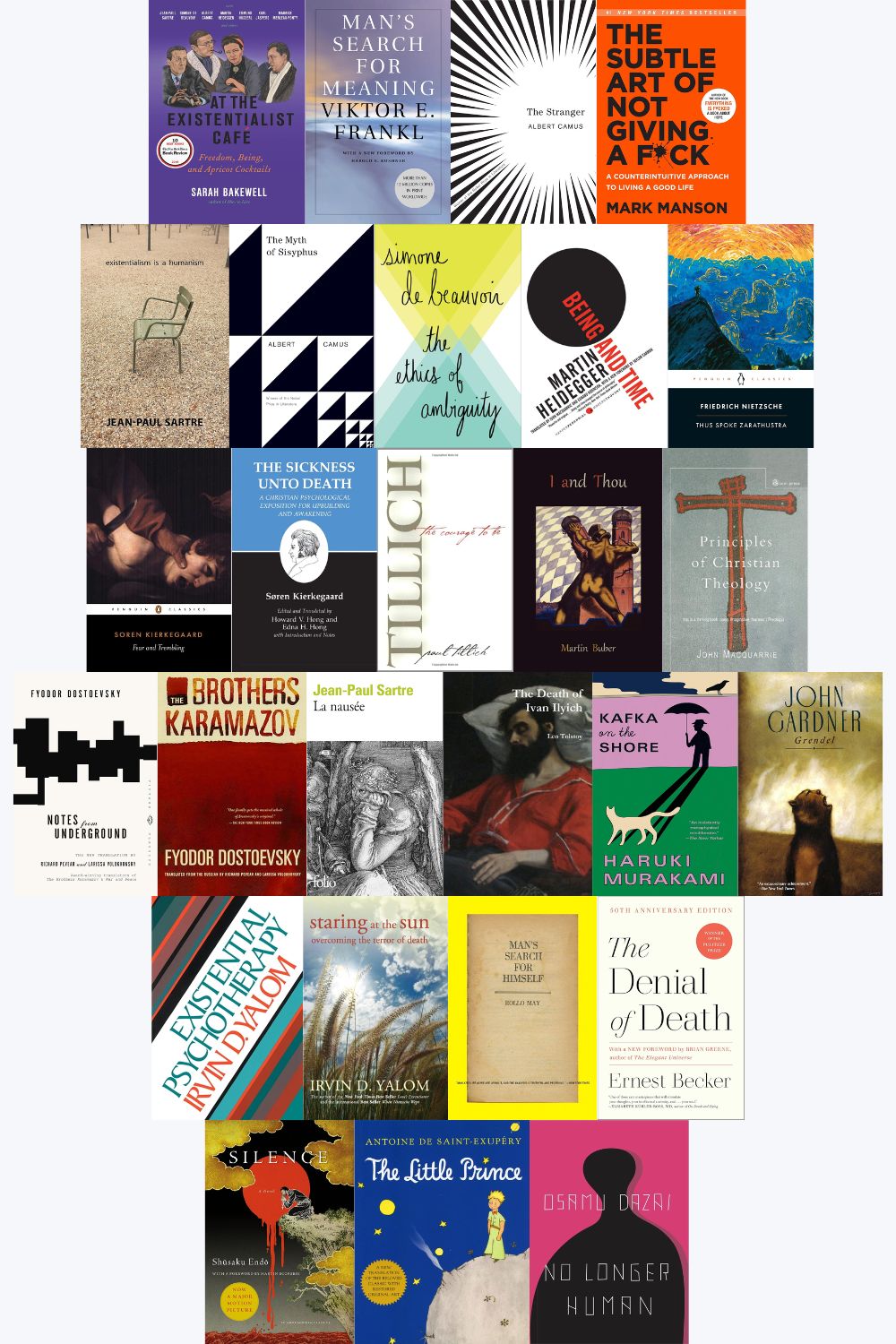
Existentialism reading list & recommendations
Final Thoughts: The Book is Just the Map
If there is one last note I would like to share with you, it’s this: The book is not the territory.
You can read every page of Kierkegaard, memorize every quote by Camus, and underline every sentence in Frankl, but none of it matters if you don’t close the book and walk out the door.
These books are not meant to be worshipped. They are tools—hammers to break the glass of “bad faith,” maps to navigate the woods of anxiety, and mirrors to show you who you really are.
As Franz Kafka once wrote in a letter:
“I think we ought to read only the kind of books that wound and stab us… A book must be the axe for the frozen sea within us.”
Don’t just read to agree. Read to be woken up. Read until you find the sentence that shatters your ice.
And then, when the reading is done, go out and do the brave work of living your own life!
Happy reading!
Other resources you might be interested in:
- 100 Existential Quotes: Rethink One’s Place in the Universe
- 20 Best Existential Movies for the Questioning Heart
- Nihilism vs Existentialism vs Absurdism: A Journey Into the Abyss
- 25 Best Spiritual Books to Read by Theme
- 20 Best Self-discovery Books to Find Your North Star
Let’s Tread the Path Together, Shall We?

