
 Tiếng Việt
 日本語
日本語
On the morning of November 1, 1755—All Saints’ Day—the city of Lisbon was destroyed.
At the time, Lisbon was a devout, wealthy capital. The churches were packed with worshippers.
Then, a massive earthquake struck, followed by a tsunami and fires that burned for days. Tens of thousands died instantly, crushed beneath the rubble of their own cathedrals.
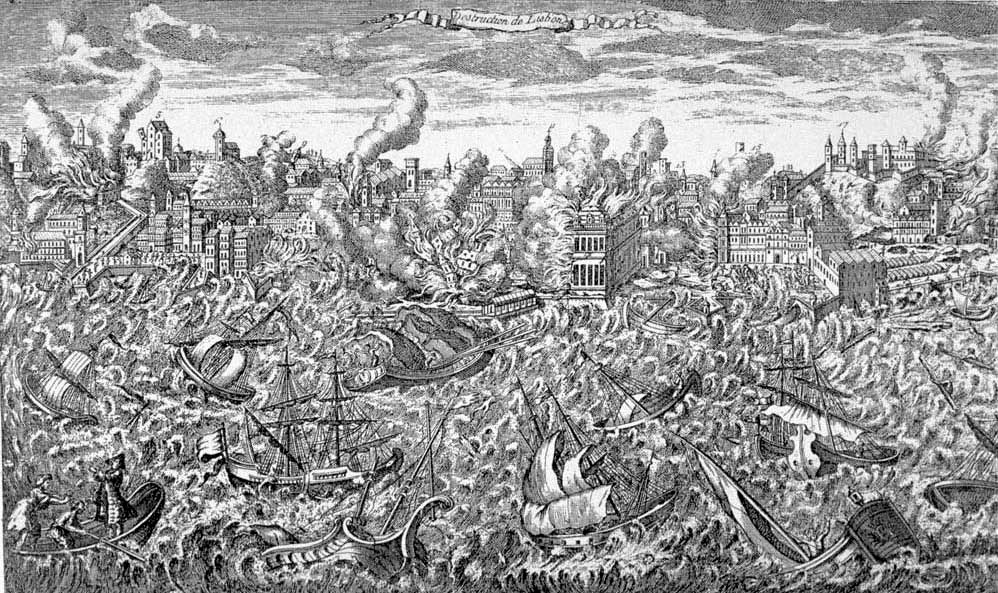
Before that event, the prevailing philosophy in Europe was Optimism—the belief that we live in “the best of all possible worlds”, and that every tragedy is part of a divine, rational plan.
The Lisbon earthquake completely shattered that illusion. Following it, people could not help but look at the rubble and ask: What kind of plan is this? Why did the faithful die while the brothels remained standing?
For the first time, humanity stared collectively into the void and heard no answer.
And that still applies to today’s world. In fact, we all have our “Lisbon moments.” It might be a global tragedy, like a war or a pandemic that takes the innocent and spares the tyrant. Or it might be something personal—a betrayal by a spouse, a diagnosis that makes no sense, or simply the realization that you have spent ten years working a job that leaves you empty.
In these moments, we are confronted with what the philosopher Albert Camus referred to as the Absurd.
Camus made it very clear: The Absurd is not the world itself. The world is just… there. It is indifferent.
The Absurd, therefore, is the confrontation between the human need for meaning and the unreasonable silence of the world.
We cry out, “Why?” And the universe replies with silence.
The tension between our cry and that silence is the Absurd.
Most of us try to escape this tension. We numb ourselves, or we force an explanation (“It’s all part of a plan!”).
But Camus proposed a different path. He suggested we stop running—and instead stare right back at the silence and smile. In other words, we become the embodiment of the Absurd Hero.
Highlights
- The “Absurd” refers to the conflict between the human need for meaning and the silence of the universe.
- Camus’ Absurd Hero accepts that the struggle is futile but finds “victory” in being conscious of it. They live with Lucidity, Rebellion, and Passion.
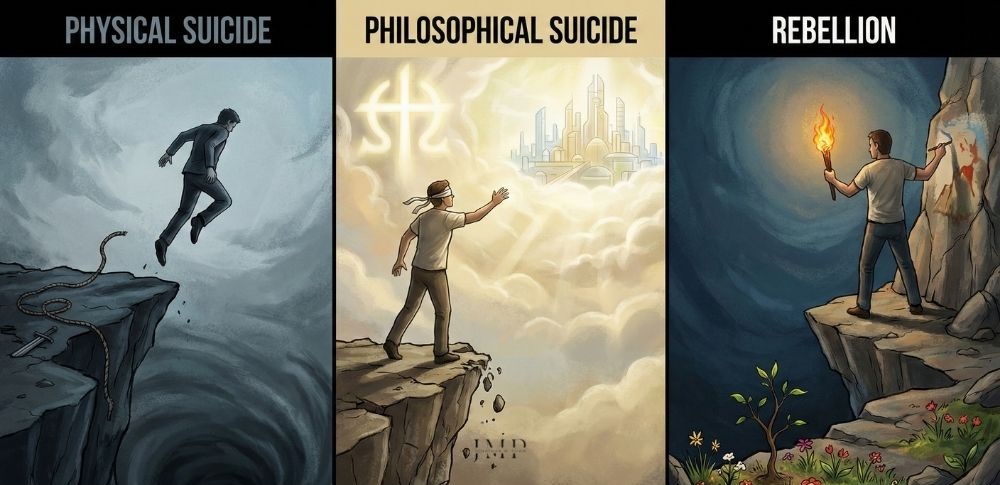
- According to Camus, facing the indifference of the universe, we can either choose Physical Suicide (defeat), Philosophical Suicide (false hope), or Rebellion (the only authentic path).
- Being an Absurd Hero allows us to be free to truly live this life, while also forming authentic bonds with our fellow humans.
Who is the Absurd Hero?
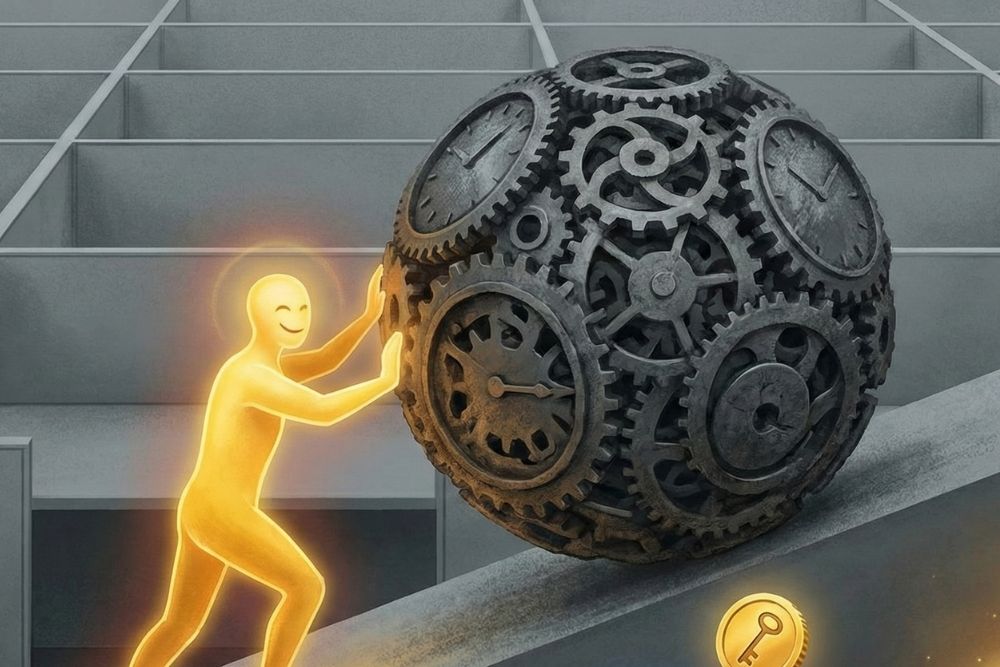
To explain how one may live in this indifferent world without going mad, Camus turned to an ancient myth: the Myth of Sisyphus.
In Greek mythology, Sisyphus was the king and founder of Corinth (then called Ephyra), known as the most cunning and deceitful of all mortals. Due to his sin of cheating death and outsmarting the gods, the Greek gods condemned him to a terrible punishment. Specifically, he had to roll a massive boulder up a mountain. However, just as he reached the top, the rock would roll back down to the bottom, and he would have to start all over again. For eternity.
To the gods, this was the ultimate torture—because it was futile labor. There is nothing more crushing to the human spirit than working hard at something that accomplishes absolutely NOTHING.
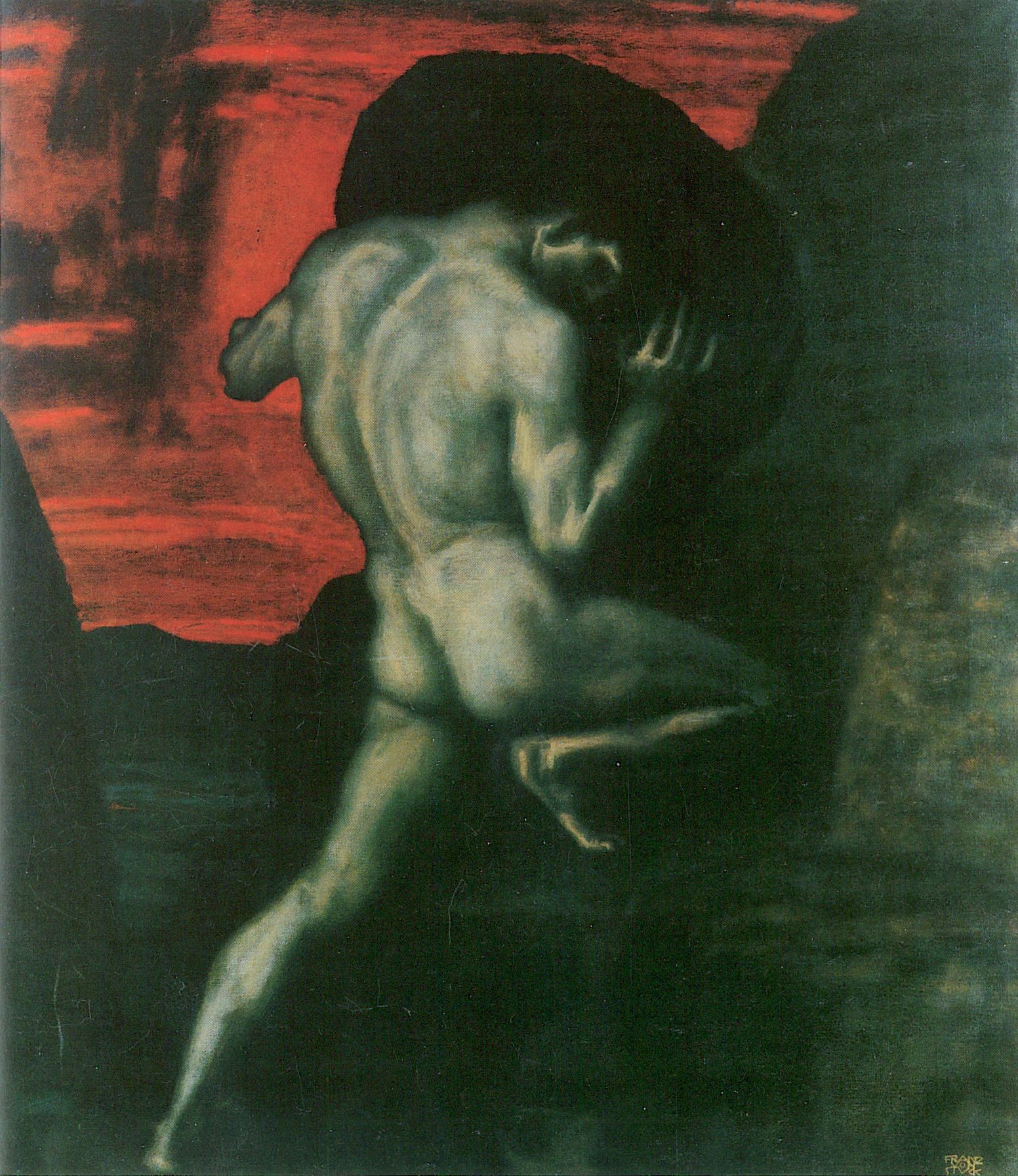
Why is Sisyphus the Absurd Hero?
And yet, Camus saw something else in Sisyphus. He saw a hero.
Why? Because Sisyphus is conscious.
If Sisyphus believed that “maybe this time the rock will stay,” he would be a victim of hope. He would be tortured by the disappointment every time it fell.
But Sisyphus has no hope. He knows the rock will fall. He knows his task is absurd. And yet, he walks back down the mountain to push it up again.
This awareness transforms his punishment into a “victory”. By accepting his fate without resignation, he becomes superior to it.
Characteristics of the Absurd Hero
The Absurd Hero is not someone who conquers the world (like Napoleon) or someone who transcends it (like a saint). They are defined by three earthly traits as follows:
- Lucidity: They refuse to lie to themselves. They admit that life is finite, that the universe is indifferent, and that death is the end. They don’t use “philosophical suicide” (blind faith or ideology) to comfort themselves.
- Rebellion: Despite knowing the struggle is futile, they refuse to be crushed by it. They push the rock because it is their rock. Their act of rebellion is not an attempt to change the universe, but a refusal to let the universe break their spirit.
- Passion: Because they don’t hope for a “better life” in the future (or an afterlife), they are forced to devour the present life. They focus on the quality of the experience—the sun on their face, the taste of wine, the touch of a hand—rather than the meaning of it.
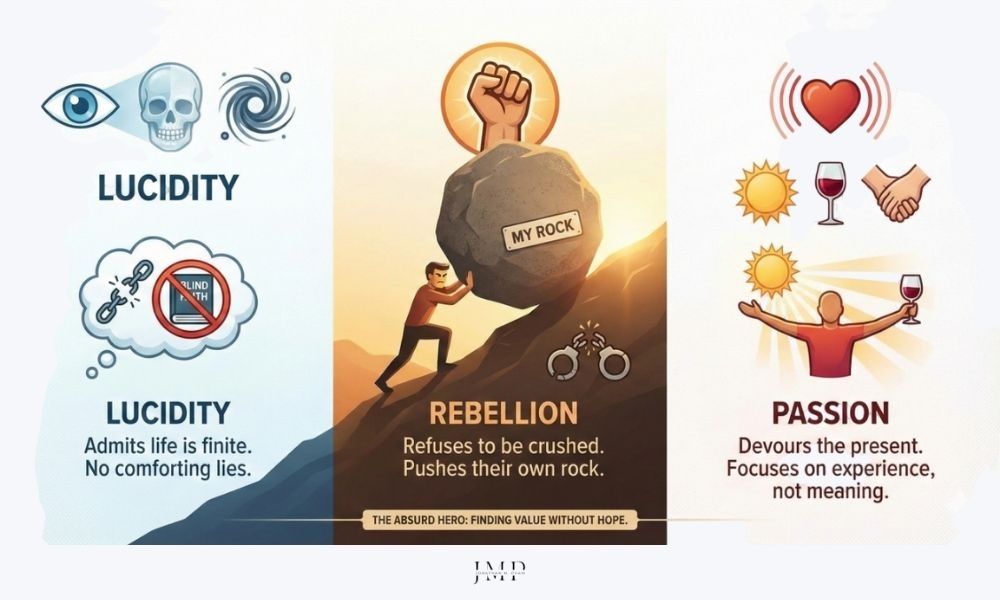
The Absurd Hero archetype
Camus concluded his essay with a line that seems impossible at first glance:
“The struggle itself toward the heights is enough to fill a man’s heart. One must imagine Sisyphus happy.“
He is happy not because he finished the job, but because he owns the job. The rock is his thing.
The Myth of Sisyphus analysis
Is the Absurd Hero Nihilistic? Three Responses to the Void
There is only one truly serious philosophical problem, and that is suicide. Judging whether life is or is not worth living amounts to answering the fundamental question of philosophy.
Albert Camus
Once we accept that the universe is silent—that tragedies the Lisbon earthquake had no hidden purpose, or that our suffering might not be “part of a plan”—we are left standing on the edge of a cliff.
According to Camus, there are only three ways to react to this realization.
Physical suicide (the Escape)
This is the Nihilist’s conclusion. If life has no inherent meaning, they argue, then it is not worth living at all.
Camus rejects it immediately. He argues that suicide is a confession that “life is too much for you.” It resolves the Absurd by destroying the person who is asking the question.
In other words, it is just an act of surrender.
Philosophical suicide (the Leap of Hope)
This is the most common response. We stare into the void, get terrified, and then close our eyes and take a “leap” into a belief system that explains everything away.
- Religious: “God has a plan we cannot understand.”
- Political: “History is moving toward a Utopia.”
- Scientific: “Technology will eventually solve death.”
Camus calls such an act “Philosophical Suicide”—because it kills the questioning mind. It numbs the pain of the Absurd by pretending the silence isn’t there. It replaces reality with a comforting illusion.
(Note: To Camus, even Kierkegaard’s “Leap of Faith” falls into this category—because it relies on the “impossible” to escape the tension of the “actual.”)
Rebellion (the Absurd Hero)
This is, according to Camus, the only way to stay true to reality. The Absurd Hero looks at the cliff and refuses to jump (suicide) and also refuses to close their eyes (philosophical suicide).
Instead, they stay on the edge. They accept that life has no ultimate meaning, but they decide to live passionately anyway. Their mindset is:
“The universe may be indifferent to me, but I am NOT indifferent to it. I will live, create, and love in spite of the silence.“
I rebel; therefore I exist.
Albert Camus
The Hero Comparison: Different Sides of the Same Coin?
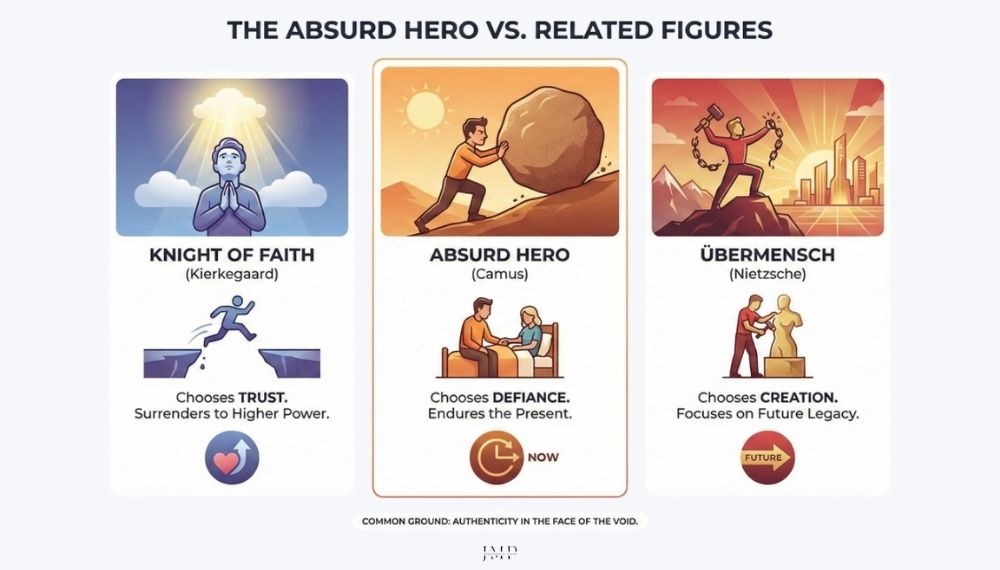
It is easy to confuse the Absurd Hero with other related existential figures. (e.g. Kierkegaard’s Knight of Faith or Nietzsche’s Übermensch) On the surface, they all look like rebels standing against the crowd. But if we look closer, we see they are betting on very different things.
Vs. the Knight of Faith (Kierkegaard)
As discussed in a previous article, the Knight of Faith also faces the impossible. However, the difference lies in the direction of their spirit.
- The Knight of Faith chooses Trust: Imagine a parent whose child is terminally ill. The Knight would say, “Science says there is no hope. But I trust in the Absurd. I believe God will save them.” They find peace by surrendering to a Higher Power.
- The Absurd Hero chooses Defiance: The Absurd Hero looks at the same child and says, “Science says there is no hope. I see no God coming to save us. But I will sit by this bedside, hold this hand, and pour every ounce of my love into these final days.” They find strength not in expecting a miracle, but in refusing to let the tragedy dilute their love.
To a certain extent, they are two sides of the same coin—Authenticity. The Knight looks into the abyss and says, “I believe I will be caught.” The Absurd Hero stares into it and says, “No one will catch me, but I will not fall.”
To Camus, the Knight of Faith is committing “philosophical suicide” by escaping the struggle into a religious hope.
To Kierkegaard, the Absurd Hero is stuck in “infinite resignation”—a noble state, but one that lacks the joy of the miraculous.
Read more: Christian Existentialism – From Dogma to the Ultimate Reality
Vs. the Übermensch (Nietzsche)
Nietzsche’s “Overman” is an artist of life. He wants to destroy old values to create new ones. He is obsessed with becoming something greater.
Camus’s hero, on the other hand, is less ambitious. Sisyphus isn’t trying to build a better rock or a better mountain. He isn’t trying to “evolve.”
- The Übermensch is focused on the Future (building a legacy, creating meaning).
- The Absurd Hero is focused on the Present (enduring the now).
The Absurd Hero doesn’t need to change the world to find it worth living. They just need to feel the sun on their face while they push the rock.
They find “micro-meaning” in the struggle itself, rather than needing a grand legacy to justify their existence.
| Feature | Absurd Hero (Camus) | Knight of Faith (Kierkegaard) | Übermensch (Nietzsche) |
| Core Stance | Defiance | Trust | Creation |
| Reaction to the Abyss | Stares into it without hope, but refuses to give up. | Surrenders to the Absurd; trusts a Higher Power will save them. | Destroys old values to create new ones; seeks to conquer it. |
| Primary Focus | The Present (Enduring the now) | The Divine (Expecting the miracle) | The Future (Building a legacy) |
| Motivation | Finding “micro-meaning” in the struggle itself (e.g., feeling the sun while pushing the rock). | Finding peace through surrender and faith in the impossible. | Ambition to evolve, improve, and become something greater. |
The Absurd Hero Examples
The Absurd Hero is not just a literary figure; it is a posture we can adopt when life corners us.
Example #1: The defiant squire (The Seventh Seal)
In Ingmar Bergman’s masterpiece The Seventh Seal, we meet two characters facing the Black Plague (a symbol of the Absurd) in two different ways.
- The Knight (Antonius Block)
He is tortured by the silence. He begs Death for answers. He is paralyzed because he cannot find a “higher purpose” for the suffering around him.
In a sense, Block is a “Knight of Doubt”—unable to make the “leap of faith” because his reason forbids it, while also unable to be at peace with the void.
I want knowledge! Not faith, not assumptions, but knowledge. I want God to stretch out His hand, uncover His face and speak to me.

- The Squire (Jöns)
Jöns, on the other hand, is the true Absurd Hero. He looks at the plague, the cruelty, and the silence of God, and he shrugs. He accepts that the world is a mess.
But he doesn’t despair. Instead, he saves a mute girl from a rapist. He cracks jokes. He drinks his wine with gusto.


When Death finally comes for him, he doesn’t pray for salvation like the Knight; he stands tall and faces the end with open eyes.
As Jöns demonstrates, one doesn’t require a literal divine command to be a decent man. Rather, one just needs the courage to be human in an inhumane world.
In the darkness you will find no one to listen to your cries or be touched by your sufferings. Wash your tears and mirror yourself in your indifference.

Absurd hero examples in movies
Example #2: The prisoner herding ants
My father once told me a story about a prisoner who was jailed during the “subsidy period” following my country’s reunification. It was a time of extreme scarcity and limited freedom.
The man was locked in a small cell with absolutely nothing—no books, no future, and no hope of release. To everyone, his state was the definition of a meaningless existence.
Yet he refused to let the cell crush him. Despite his desperate circumstances, he didn’t fall into despair.
How?
Every day, he would do this thing called “herding ants.” He observed the tiny insects crawling across the floor. He saved crumbs from his meager rations to feed them. And he created pathways for them.
To the guards, he looked completely crazy. But to him, those ants were a universe.
He created a “micro-meaning” where none existed. He pushed his “rock” not because he expected a reward, but because the act of caring kept his humanity alive.
Read more: Find the Beauty in Everyday – 8 Tips for Uncovering Joy & Wonder in the Little Things

Example #3: A job you hate
Most of us will never face a plague or a prison, but I believe we all—at some points in our lives—have to face the absurdity of a “soul-crushing job.”
I myself experienced this years ago—when I was working a corporate role I actively despised. The tasks were repetitive, the politics were petty, and I felt my spirit draining away with every spreadsheet.
At that time, I could follow either of these two conventional choices:
- Succumb: Become bitter, lazy, and let the job define me as a victim.
- Pretend: Force myself to “drink the Kool-Aid” and fake passion for a mission I didn’t believe in.
And I chose NEITHER of them. Instead, I decided to adopt a “Mercenary Mindset” (a form of Absurd Rebellion)—treating the job purely as a transaction.
I stopped looking for fulfillment in the work. I stopped trying to align my “reason for being” with my employment.
I just showed up, did the work with clinical excellence (because I refused to be incompetent), and then clocked out.
By detaching my identity from my labor, I turned the job from a prison into a tool. The paycheck became the resource that funded my real life—my studies, writing, and the time with loved ones.
It was, essentially, my own act of rebellion: “You can buy my time, but you CANNOT buy my soul.”
Like Sisyphus, I pushed the rock, but I did it with a smile, knowing that the rock did not own me.
Why Embrace the Absurd?
Why would anyone choose this path? Why constantly rebel against a silent universe? Why not just turn to a comforting illusion?
The answer is simple: because illusions eventually break. The Absurd Hero embraces reality not because it is easy, but because—as Camus asserted—it is the only path that offers real freedom.
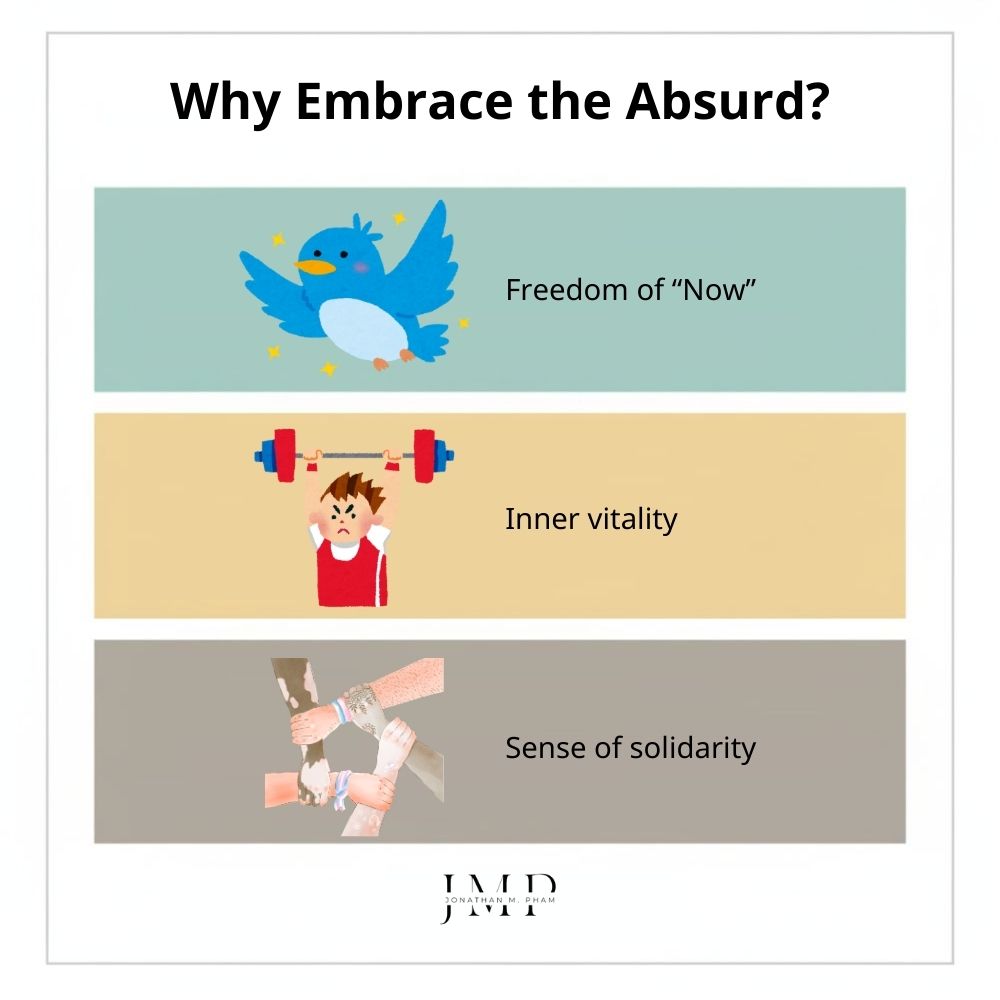
The freedom of “Now”
As long as you are living for a future hope—a promotion, a reward, or a utopian society—you are a slave to the future. You are bargaining with life: “I will suffer now so I can be happy later.”
But the Absurd Hero knows that “later” is not guaranteed. The rock might roll down forever.
By accepting that there is no grand meaning waiting at the finish line, you are suddenly free to enjoy the race. You stop waiting for your life to begin and start living it right now.
You enjoy the coffee not because it fuels your productivity, but because it tastes good.
You love your partner not because they complete your soul, but because they are here, warm and alive, in a cold universe.
The Absurd Hero’s refusal to hope becomes his singular ability to live in the present with passion.
Albert Camus
The “Invincible Summer” (Inner vitality)
There is a strange phenomenon that happens when you stop running from the darkness and decide to face it. Specifically, you discover a reservoir of strength you didn’t know you had.
Camus once wrote:
In the midst of winter, I found there was, within me, an invincible summer. And that makes me happy. For it says that no matter how hard the world pushes against me, within me, there’s something stronger – something better, pushing right back.
This is the core of the Absurd Hero’s power. You realize that the world can take everything from you—your comfort, status, health—but it cannot take your ability to say “I am still here.”
That defiance creates a vitality that “hope” alone can never provide.
Hope is fragile because it depends on external circumstances improving.
Absurd Rebellion is invincible because it comes from within.
The realization that life is absurd cannot be an end, but only a beginning.
Albert Camus
A sense of solidarity
Finally, embracing the absurd makes it possible for us to authentically connect to others. When we stop pretending that the world is perfectly just, we stop blaming ourselves (or others) for every misfortune.
Why?
Because we realize that everyone has a rock.
Look around you. The rock takes many forms:
- It is the scholar who is ignored while the corrupt businessman is hailed as a genius.
- It is the good friend who suffers a sudden illness while the tyrant lives to be ninety.
- It is the betrayal you didn’t deserve, or the grief that refuses to fade.
When you see someone pushing their rock—whether it’s a meaningless job or a tragedy like the Lisbon earthquake—you don’t offer them empty platitudes like “Everything happens for a reason.” You know that’s a lie.
Instead, you offer them something real: Solidarity. You stand beside them and say, “The hill is steep, and the rock is heavy. But I see you pushing, and I am pushing too.”
The Absurd Hero is never truly alone, because the struggle against the silence is the one thing all humans share.
Read more: Embracing Uncertainty – How to Tread the Path When There Is No Map
Can You Be Both an Absurd Hero and a Knight of Faith?
As discussed before, these two heroes represent “two different sides of the same coin.” This bring us to an interesting question: Can you be both?
In a strict philosophical sense, I suppose it’s not quite possible to do so—at the same moment, regarding the same situation.
But psychologically, most of us DO oscillate between the two depending on the day.
- The Situational Absurd Hero: You might take this stance at work. (as I did with the job I shared with you above) You know the daily grind (your “boulder”) is ultimately meaningless, but you push it with a smirk and find joy in the process itself.
- The Situational Knight of Faith: In a deep crisis—like the death of a loved one, a moral crossroad, or a risky life change (like when I considered quitting the corporate world two years ago)—defiance might not be enough. In those moments, you might find yourself acting on a conviction that defies all logic, trusting that a restoration is possible against the odds.
While Camus and Kierkegaard viewed these paths as divergent, the human experience is rarely a straight line. You might be Sisyphus on Monday morning and Abraham on Sunday night.
It’s perfectly OK to switch between the two. There’s no need to confine yourself to any single “label”—any single identity all the time.
To quote Nietzsche, just “become who you are”.
What labels me, negates me.
Søren Kierkegaard
Final Thoughts: Being a Light in the Darkness
In the end, the philosophy of the Absurd is not meant to make us fall into despair. Quite the opposite; it is a philosophy of lucid courage.
It asks us to stop being obsessed with the light at the end of the tunnel—and instead become the light ourselves.
As the director Stanley Kubrick once observed:
“The most terrifying fact about the universe is not that it is hostile but that it is indifferent, but if we can come to terms with this indifference, then our existence as a species can have genuine meaning. However vast the darkness, we must supply our own light.“
Whether you identify as a believer (which, I assume, would lead you to the path of the Knight of Faith) or a skeptic, there is a profound truth here. The universe does not owe us an explanation. It does not owe us fairness. It does not owe us a happy ending.
Yet it does NOT mean we are helpless.
We have the power to face the silence and fill it with our own voice.
We have the power to see the rock rolling down the hill and choose to push it up again—not because we will win, but because the act of pushing proves we are alive.
So, do not fear the struggle.
Prepare for the worst, expect the best, and take what comes.
The rock is heavy, yes. But the summer within you is invincible.
That even in the darkest of times we have the right to expect some illumination, and that such illumination might well come less from theories and concepts than from the uncertain, flickering, and often weak light that some men and women, in their lives and their works, will kindle under almost all circumstances and shed over the time span that was given to them.
Hannah Arendt, ‘Men in Dark Times’
Other resources you might be interested in:
- The Shepherd of Being: Guarding the Mystery of Existence in an Age of Noise
- The World is Not Black and White: Finding Grace in the Grey
- 60 Existential Questions: Reflect on Life’s Depths
- Choosing Your Life: From ‘Drifting’ to ‘Defining’
- Memento Mori: A Reminder of Life’s Impermanence & How to Live the Right Way
Let’s Tread the Path Together, Shall We?

