

 Tiếng Việt
 日本語
日本語
Playing video games was one of my greatest childhood passions. Back then, the Internet wasn’t widely available yet. There were no online walkthroughs to bail me out, which meant I had to rely completely on myself to finish a game.
I remember getting hopelessly stuck at certain points, unable to move forward for days. I had no choice but to figure it out—wandering the same corridors, trying every obscure item in my inventory, and mashing every button in the hopes of a breakthrough.
It was exhausting. Sometimes, I got so mad I wanted to quit or uninstall the game entirely.
But looking back, that frustration was the exact price of the excitement. The friction was the magic.
Then the Internet arrived—and with it came walkthroughs, step-by-step guides, and cheat codes. Suddenly, I could read the entire storyline before I even picked up the controller, and I could easily make myself invincible.
At first, it was an intoxicating rush. I felt like a mini-god, instantly solving ancient riddles and swatting away final bosses as if they were a joke.
But it didn’t take long for the emptiness to creep in. Without the struggle, the games became agonizingly boring. I was no longer an adventurer embarking on an epic journey—just a robot checking off a list.
I was accumulating achievements, but I had entirely lost the experience.
This experience taught me a profound lesson about a trap we fall into every day: the craving for certainty.
Most of us spend our lives wishing for “cheat codes.” We want the guaranteed outcome, the map with no dead ends, the success without the setbacks.
We think we want to skip to the end credits, not realizing that by removing the obstacles, we strip the journey of its meaning. We trade the thrill of the adventure for the boredom of the outcome.
When facing a confusing crossroads, an unexpected failure, or a period of wandering in the dark, our first instinct is to beg the universe for a walkthrough. We demand to know exactly what to do and how things will end.
But there is an alternative: to pause, look at the towering obstacle in front of us, and smile.
Philosophy has a name for this life stance: Amor Fati—the love of one’s fate.
To embrace Amor Fati is to throw away the walkthrough, pick up the controller, and say “yes” to whatever level you are on right now, exactly as it is.
Highlights
- Amor Fati (love of fate) means not just tolerating the struggles and detours of life, but actively embracing them as necessary to forge who you are today.
- Stoics promote this mindset as a way to find peace by trusting the rational universe, while Existentialists use it to embrace freedom and personal power.
- Amor Fati is not the same as giving up or toxic positivity. The idea is that you accept the things you cannot change (facticity) so you can take complete ownership of what you can change (transcendence).
- When a curveball hits, you can calmly confront it by stating the raw facts without complaining, separating what is out of control, and funnel your energy into tangible action.
What is Amor Fati?
Amor Fati translates directly from Latin to “a love of fate”. At its core, it involves a mindset in which one does not merely accept the things that happen in one’s life—including the suffering, the loss, and the contradictions—but actively embrace them as something necessary and, ultimately, beneficial.
When you practice Amor Fati, you realize that every misunderstanding, every confusing detour, and every societal pressure you faced was entirely necessary to forge the exact person you are today. Instead of wishing for your past to be any different, you welcome it as the perfect curriculum for your own self-discovery.
The origins of Amor Fati
As a philosophical practice, the idea of loving one’s fate has deep roots in ancient Stoicism. Back in the day, thinkers like Marcus Aurelius and Epictetus taught their students to align their minds with the natural flow of the universe, finding peace by accepting whatever life handed them.
However, the Stoics wrote in Greek and did not actually use the specific phrase Amor Fati. The exact term was popularized centuries later by the 19th-century German philosopher Friedrich Nietzsche. For Nietzsche, loving one’s fate was not just about finding peace; it was the ultimate test of psychological strength.
My formula for greatness in a human being is Amor Fati: that one wants nothing to be different, not forward, not backward, not in all eternity. Not merely bear what is necessary, still less conceal it—all idealism is mendaciousness in the face of what is necessary—but love it.
Friedrich Nietzsche, ‘On the Genealogy of Morals’
Though separated by nearly two thousand years, the ancient Stoics and the modern Existentialists both landed on the same incredible idea. Though they approached it from completely different angles, both offered us a lifeline when the world turns upside down.

Amor Fati: Love your fate
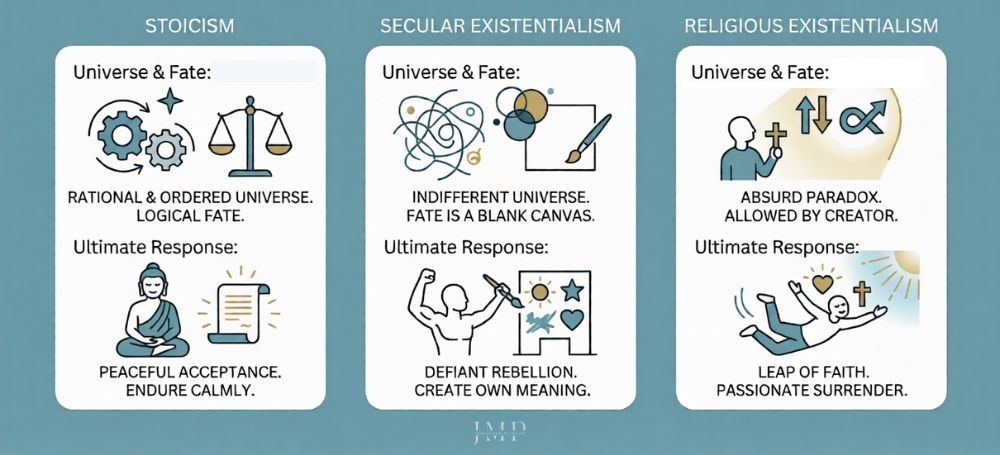
The Three Faces of Fate (Stoicism vs. Existentialism vs. Religion)
At first glance, it might seem like a paradox that philosophers who championed radical freedom would spend so much time talking about “fate.” However, whether you are reading an ancient Roman emperor or a 19th-century rebel, they all realized that we need a way to process the unavoidable suffering in our lives. It’s just that they adopted Amor Fati for completely different reasons, depending on how they viewed the universe.
Let us look at the three primary ways to wear this mindset.
The Stoic view: Logical acceptance
O universe, all that is in tune with you is in tune with me. Every disposition of yours is timely for me. O nature, all that your seasons bring is fruit for me. All things come from you, exist in you, and return to you.
Marcus Aurelius, ‘Meditations’
For ancient Stoics like Marcus Aurelius and Epictetus, the universe was a beautiful, interconnected machine governed by Logos—a divine, rational order. In their view, nothing is truly random; everything happens for a reason.
Because we cannot control what happens to us, the Stoics believed our ultimate freedom lies in aligning our will with nature. They frequently used the metaphor of a dog tied to a moving cart.
- You can either trot along peacefully with the cart, or
- You can dig your paws into the dirt and get dragged kicking and screaming.
Either way, the cart is moving.
Amor Fati, to the Stoics, is a way to find peace and regulate one’s emotions. To use a modern analogy, a Stoic would look at a dark, gloomy day and say,
“I will love this rainstorm because the plants need water to grow“.
The Secular Existential view: Radical affirmation
Life begins on the other side of despair.
Jean-Paul Sartre
Fast forward to the 19th and 20th centuries. Thinkers like Friedrich Nietzsche and Albert Camus did not believe in a grand, rational design. To them, the universe is indifferent, chaotic, and absurd.
In their view, “fate” isn’t a benevolent plan; it is just random, raw reality. And yet, it is exactly this lack of a “script” that makes humanity radically free.
You do not love your fate because it is “good”—nor because it serves a higher cosmic purpose. You love it simply because it is YOURS.
By choosing to embrace the chaos and the struggle, you rob the universe of its power to crush you, and in the process become the master of your own story.
The Secular Existentialist, as such, promotes Amor Fati as a means for personal power and joyful rebellion. Back to the same gloomy day example, an Existentialist would look at the sky and declare,
“I will love this rainstorm because I am going to dance in it“.
The Religious Existentialist view: Leap of Faith
And then there’s a third, equally profound path walked by religious existentialists like Søren Kierkegaard—who sit right in the middle of the previous two views.
They acknowledge that the universe often feels completely absurd, but they trust that it is still authored by God/ a higher power. To them, the unchangeable facts of your life are not random accidents; they are the specific parameters the Creator gave you to work with.
To a religious existentialist, loving your fate means surrendering the tiring need to rationally understand why things happen, and choosing to trust anyway. (which Kierkegaard referred to as the “Leap of Faith“)
One great example for this attitude is the Biblical story of Job, who lost everything and was tempted to curse his fate. Despite never receiving a neat, logical explanation for his miseries, Job simply accepted the overwhelming “mystery” of God and moved forward—refusing to be a victim.
| School of Thought | View of the Universe & Fate | The Ultimate Response |
| Stoicism | Rational and ordered. Fate is a natural, logical part of the cosmos. | Peaceful acceptance. Trusting the “captain of the ship” and enduring calmly. |
| Secular Existentialism | Indifferent and random. Fate is a blank canvas. | Defiant rebellion. Creating one’s own meaning from the chaos. |
| Religious Existentialism | An absurd paradox, but allowed by a Creator. | The Leap of Faith. A passionate surrender to the mystery of existence. |
Read more: The Knight of Faith – Believing in the Absurd
The Existential Paradox: How Can Freedom Coexist with Fate?
Existentialism—whether secular or religious—is known for its strong emphasis on personal freedom. As such, it leads to a question: How can such a philosophy tell people to “embrace” fate ? If we are completely free, shouldn’t we be fighting our fate instead of loving it?
The answer lies in how these thinkers defined freedom. To them, freedom isn’t the magical ability to control the external universe. Rather, it refers to one’s absolute power over how to respond to the universe.
Facticity vs. Transcendence
Between stimulus and response there is a space. In that space is our power to choose our response. In our response lies our growth and our freedom.
Viktor Frankl
To untangle the above-mentioned paradox, we can look to the French philosopher Jean-Paul Sartre, who divided human existence into two distinct parts:
- Facticity (The “Fate” part): These are the unchangeable facts of your life that you did not choose. Specifically, you did not decide your genetics, the era you were born in, your parents, or the fact that a global pandemic happens. It is the hand of cards you were dealt.
- Transcendence (The “Freedom” part): This is your consciousness and ability to project yourself into the future. You cannot choose your starting facts, but you are 100% free in how you interpret them and what you do with them.
Existentialists argue that you cannot exercise true freedom if you are living in denial of your facticity. To change the world, you must first accept the exact state of the world as it currently is.
Only by accepting the board may you become ready to play the game.
Read more: Are You Living or Just Existing? Let’s Find Out!
The ultimate test: The Eternal Recurrence
Friedrich Nietzsche gave us one of the most visceral ways to test if we have truly accepted our facticity. He introduced a thought experiment called the “Eternal Recurrence“.
Imagine a demon steals into your loneliest loneliness and tells you that you must live this exact same life—with every joy, every boring sandwich, and every agonizing pain—over and over again for all eternity.
Would you throw yourself down and curse the demon, or would you say “Yes!”?
If you can look at your life—scars, failures, and all—and not wish a single thing was different, you have achieved Amor Fati. You have turned your finite, seemingly small actions into matters of infinite importance.
By accepting the past and the present completely, you free up all your energy to create the future, rather than wasting it on regret and resentment.
I want to learn more and more to see as beautiful what is necessary in things; then I shall be one of those who make things beautiful. Amor Fati: let that be my love henceforth! I do not want to wage war against what is ugly. I do not want to accuse; I do not even want to accuse those who accuse. Looking away shall be my only negation. And all in all and on the whole: some day I wish to be only a Yes-sayer.
Friedrich Nietzsche, ‘The Gay Science’

The Ouroboros: Amor Fati symbol
Sisyphus & the Happy Rebellion
Albert Camus—despite not identifying himself as an Existentialist—demonstrated this dynamic quite well through his essay The Myth of Sisyphus. In Greek myth, Sisyphus is condemned by the gods to push a heavy boulder up a hill for eternity, only to watch it roll back down every single time. His physical fate is sealed; he cannot stop pushing the boulder.
However, Camus realized that Sisyphus still possesses absolute inner freedom. By consciously CHOOSING to accept his boulder, and by finding joy in the struggle itself, Sisyphus robs the gods of their punishment. He becomes the master of his fate. His internal freedom remains untouched by his external captivity.
For an existentialist, Amor Fati is NOT a white flag of surrender. It is a “battle cry”—the heroic decision to stop fighting against reality, and instead use reality as the canvas upon which one paints their freedom.
The struggle itself toward the heights is enough to fill a man’s heart. One must imagine Sisyphus happy.
Albert Camus

Amor Fati Mindset in Real Life
Before looking at how to systematically practice Amor Fati, we need to understand why it is so crucial for our mental and spiritual survival.
Life guarantees that we will face suffering, mortality, absurd situations, and profound uncertainty. When these moments hit, our default human response is to resist. To “argue” with reality.
This is where Amor Fati comes in—specifically, as a way to shift the inner dialogue. Instead of wasting energy screaming, “Why is this happening to me?“, we are reminded to pause and reflect: “What can I learn from this?” and “What should I do moving forward?“.
It allows us to view existence as a complex tapestry, where we appreciate that both the dark threads and the light ones are entirely necessary to weave its unique design.
To see how it works in practice, I would like us to reflect on these two personal examples of mine—where the philosophy of Amor Fati has helped me transform unexpected obstacles and inner turmoil into sources of strength.
Example #1: The unexpected diagnosis
Recently, I received an unexpected diagnosis of gout, which came as a massive surprise to me. I rarely drink or go to parties, and I could not pinpoint any obvious flaws in my diet, so I suspect it simply had to do with my body’s internal chemistry.
The initial flare-up caused immense pain and essentially immobilized me for several days. It cost me a great deal of time and money, and it severely delayed many of my plans.
As I lay there, it would have been incredibly easy to moan, “Why is this happening to me?” or to wonder if this was some sort of cosmic punishment or bad karma. I could have obsessed over the fact that the illness felt deeply unfair.
But instead of reacting that way, I reminded myself that “fairness” is beside the point.
Instead of wallowing, I decided to simply accept the reality of the situation—despite how absurd it seems—and change my plans. The point, as I realized, was entirely about what I should do moving forward.
I chose to view the illness as a necessary reminder of the fragility of health—as well as the importance of letting go of rigid expectations in the face of uncertainty.
In fact, it has prompted me to go to the gym much more frequently, and served as a vital building block to strengthen my own grit.
Did you ever say Yes to one joy? O my friends, then you said Yes to all woe as well. All things are chained and entwined together, all things are in love.
Friedrich Nietzsche, ‘Thus Spoke Zarathustra’
Example #2: Integrating the Self
For a long time, the narrative of my identity felt like a puzzle built with pieces from two completely different boxes. Growing up, my mother and many teachers perceived me primarily as an “emotional” child. In fact, as a kid, I often felt an intuitive pull toward humanistic values and social sciences—realms typically stereotyped as “soft.”
Yet, as I grew older, a new pattern emerged: the outside world began to describe me as fiercely “analytical.” I frequently found myself dissecting human behavior and the arts not just with a bleeding heart, but with a cool, logical, almost scientific mindset. In a way, I was a “romantic operating with a scalpel.”
The dissonance was deafening. I felt like a walking paradox, caught in the rigid binary of being a “thinker” versus a “feeler.”
However, to practice Amor Fati is to realize that the universe does not make mistakes in how it constructs us.
In my case, if I had easily fit into a predefined societal box, I would never have been forced to search for my own truth.
Then the breakthrough came when I discovered my passion for linguistics and philosophy. These are fields that demand rigorous analytical logic, yet they are entirely devoted to dissecting what it means to be human.
At that moment, I realized I am, by design, exactly what I was meant to be: an analytical thinker with deep empathy.
Every misunderstanding, every stereotype I absorbed, and every moment of agonizing self-doubt was a stepping stone leading me to this exact revelation. My contradictions are my greatest strengths, and I would not change a single moment of it.
Read more: The Curated Self – Why Authenticity on Social Media is Impossible

The Pitfalls: What Amor Fati is NOT
When we first try to adopt the mindset of “loving our fate,” it is incredibly easy to fall into a few psychological traps. As such, we must be very clear about what Amor Fati is not.
It is not passive resignation or apathy
Perhaps the most common misconception is that loving one’s fate means rolling over and giving up. Many people confuse Amor Fati with a sigh of passive resignation: “I guess this was just meant to be, so I won’t even try”. In rigidly disciplining yourself to never wish for things to happen your way, you run the risk of becoming apathetic and inactive.
We need to be clear on this: Amor Fati is NOT an excuse for inaction. What it truly promotes is a radical acceptance of one’s starting point.
On one hand, you accept the reality of the present moment; on the other hand, you are still required to take tangible action moving forward. The only difference is that you learn to do so without being obsessively attached to the end results.
Do everything in your human power, and then wait for the decree of heaven.
It is not forced positivity or delusional thinking
There is a huge gap between Amor Fati and toxic optimism. Loving your fate does not mean you have to wear a “fake smile” and pretend that a tragedy is inherently “wonderful”. It is not the cosmic optimism of claiming “everything happens for a reason” just to make yourself feel better.
Sometimes, life is absurd, painful, and irrational. Relying on too much strict rationality to explain away pain is actually a rejection of the absurdity of existence, which is incompatible with true Amor Fati.
You do not need to experience forced positivity; you simply need to face the messy reality of your situation without regret or denial.
It is not a justification for past mistakes
When we talk about welcoming everything that has happened to us, there is a risk of falling into delusional thinking regarding one’s own flaws.
Embracing the past does not mean you are allowed to justify or rationalize your past wrongdoings and failures. You must absolutely accept that those mistakes happened—because they are now woven into the fabric of who you are—but so that you can take accountability and learn from them. Not so you can dismiss the harm you may have caused.
Read more: Passing the Buck – Why Do We Often Play the Blame Game?
The trap of extreme endurance
This is a problem that I—as an East Asian—frequently observe in my community. In Japanese philosophies, there is a concept known as Gaman, which translates to “enduring the seemingly unbearable with patience and dignity.” While I personally adore the spirit of Gaman, I am also well aware that it has a dark side if not approached with a healthy mindset.
If taken to the extreme, the desire to endure fate can easily turn into a trap. It may prompt you to blindly stay in a toxic environment, an abusive relationship, or a soul-crushing job simply to prove to yourself how much suffering you can withstand.
Amor Fati, as noble of a philosophy as it is, should NEVER become a self-imposed prison sentence.
Read more: Shikata ga nai (仕方がない) – The Japanese Art of Finding Serenity in Acceptance
The ego trap (extreme “Will to power”)
Finally, if we lean too heavily on the radical existentialist side of creating one’s own meaning, there’s the risk of falling into the trap of an extreme “will to power“—which can dangerously inflate the ego, making us believe we are untouched gods who can bend the universe entirely to our whims.
True Amor Fati requires a delicate balance: the humility to accept the massive forces outside of one’s control, paired with the “fire” to act on what is within one’s reach.
Read more: The Übermensch – Nietzsche’s “Overman” & the Sacred Rebellion
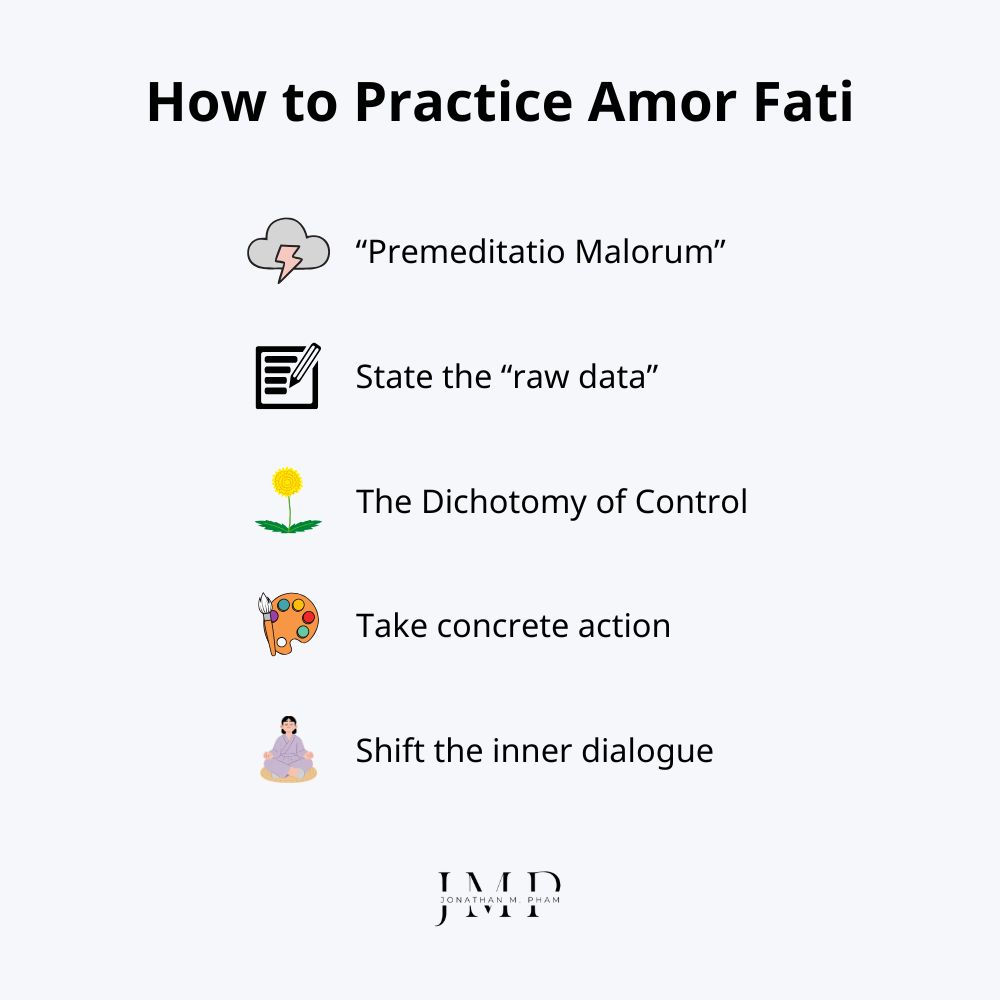
How to Practice Amor Fati
It is one thing to sit in a quiet room and philosophize, but it is entirely another when your flight is canceled, you lose your job, or you receive a painful medical diagnosis. When a curveball hits you, how do you actually stop moaning and start loving your fate?
Because the core of the philosophy is action over complaints, we can take it from here with a simple framework as follows.
Practice “Premeditatio Malorum” (The Premeditation of Evils)
Practicing Amor Fati actually begins before the disaster strikes. Back in the day, the Stoics utilized a daily mental exercise called Premeditatio Malorum—the premeditation of evils.
Don’t get me wrong: Premeditatio Malorum does not mean being a chronic pessimist; at its core, it is an exercise designed to strengthen one’s mental strength.
Think about this. If you start the day expecting everything to go perfectly, the slightest traffic jam will, naturally, feel like a “cosmic injustice.” As such, what you should do is taking a few minutes each morning to anticipate that things might go wrong. To imagine your train being delayed, a coworker being rude, or a project failing.
By mentally rehearsing these curveballs, you strip them of their shock value. When the inevitable friction happens, you wouldn’t be paralyzed by surprise. Your response is simply,
“Ah, there it is. I am ready for it.”
State the “raw data”
When being trapped in a stressful situation, many people’s immediate instinct is to spin a tragic narrative (e.g. “The universe hates me, I’m never going to catch a break, and this ruins everything.”)
To practice Amor Fati, you need to strip away the emotion and write down the cold, hard facts of your current situation. No venting, no emotional storytelling, and absolutely no “why me?”. Just the raw data.
Example: Instead of complaining, “My boss is out to get me and my equipment is sabotaging me,” simply state: “I have a heavy workload this week, and my computer is running slow”.
Read more: Self-coaching – The Art of Being Your Own Coach
Draw the line (The Dichotomy of Control)
Once you have the raw data in place, it’s time to divide the situation into two columns—in order to separate your unchangeable facticity from your freedom.
- Out of control: The project deadlines, the slow computer hardware, or the traffic on the highway.
- In control: Your focus, the exact time you start working, asking a colleague for help, or restarting the router.
You must mentally draw a hard line between these two lists, and actively CHOOSE to let go of the first column—so that it’s possible to own the second.
Take concrete action
Now that you have committed to not complaining, all of that trapped emotional energy must go somewhere. Specifically, it must be funneled into a single, concrete action.
Ask yourself: What is the very first thing you are going to do to move forward? The action does not have to solve the entire problem; it’s just meant to get you out of the role of the passive victim.
Example: “I am going to turn off my phone notifications and work for 45 minutes straight on Task A”.
Shift the inner dialogue
As you take that action, it’s necessary that you reframe the meaning of the event. Instead of wondering “Why is this happening to me?”, ask yourself: “What can I learn from this?” or “What should I do moving forward?”.
If you are stuck in an agonizingly long line at the grocery store, you don’t have to pretend you are thrilled about the delay. That said, you can still change your thinking from “My day is ruined” to “This is an opportunity to practice patience.”
In doing so, you learn to see the obstacle not as something blocking your path, but as the path itself.
It is not events that disturb people, it is their judgements concerning them.
Epictetus
Amor Fati: Love your destiny
FAQs
Is Amor Fati fatalism?
Not at all. Fatalism is passive resignation—the belief that because destiny is pre-written, your actions do not matter, so you might as well give up.
Amor Fati promotes the exact opposite: an active, joyful embrace of reality. By accepting the unchangeable facts of your situation completely, you free up energy to take absolute responsibility for how you respond.
Is Amor Fati positive?
As discussed before, it is not about forced positivity or toxic optimism. Practicing Amor Fati does not mean you have to pretend that painful tragedies are inherently “good,” nor does it require you to believe that “everything happens for a reason”.
Rather, you just need to acknowledge the dark threads of your life without regret, so you can continue turning them into something meaningful.
Is Amor Fati religious?
It can be, but it does not have to. When interpreted from a religious existentialist perspective, it shares striking similarities with the “Leap of Faith”—trusting the specific trials given to one by God.
However, the concept has deep secular roots in ancient Stoicism (aligning with the rational cosmos) and secular Existentialism (creating one’s own meaning in an indifferent universe). As such, we can view it as a psychological tool available to anyone, regardless of their spiritual background.
Amor Fati Quotes
Accept the things to which fate binds you, and love the people with whom fate brings you together, but do so with all your heart.
Marcus Aurelius
A blazing fire makes flame and brightness out of everything that is thrown into it.
Marcus Aurelius
Do not seek for things to happen the way you want them to; rather, wish that what happens happen the way it happens: then you will be happy.
Epictetus
He is a wise man who does not grieve for the things which he has not, but rejoices for those which he has.
Epictetus
Fate leads the willing, and drags along the reluctant.
Originally by the Stoic Cleanthes, translated by Seneca
What doesn’t kill you makes you stronger.
Friedrich Nietzsche
I say unto you: one must still have chaos in oneself to be able to give birth to a dancing star.
Friedrich Nietzsche
There is no fate that cannot be surmounted by scorn.
Albert Camus
We can despair of the meaning of life in general, but not of the particular forms that it takes; we can despair of existence, for we have no power over it, but not of history, where the individual can do everything.
Albert Camus
When we are no longer able to change a situation, we are challenged to change ourselves.
Viktor Frankl
The affirmation of one’s essential being in spite of desires and anxieties creates joy… it is the happiness of a soul which is “lifted above every circumstance.” Joy accompanies the self-affirmation of our essential being in spite of the inhibitions coming from the accidental elements in us. Joy is the emotional expression of the courageous “Yes” to one’s own true being.
Paul Tillich
Be patient toward all that is unsolved in your heart and try to love the questions themselves, like locked rooms and like books that are now written in a very foreign tongue. Do not now seek the answers, which cannot be given you because you would not be able to live them. And the point is, to live everything. Live the questions now. Perhaps you will then gradually, without noticing it, live along some distant day into the answer.
Rainer Maria Rilke
Amor Fati: Love your fate, which is in fact your life
Final Thoughts: Deciding What to Do with the Time Given
Whether you look at life through the lens of Stoicism—trusting the rational, interconnected nature of the universe —or through the lens of Secular Existentialism—finding radical affirmation and freedom in the face of the absurd —or even as a religious thinker taking a Leap of Faith into the unknown, the practice of Amor Fati still serves the exact same psychological purpose.
It tells us to stop fighting reality. To stop wishing for an easier life or a different past, and instead decide that this exact life—with all its pain, beauty, and unpredictability—is exactly the one we want.
To wrap it up, I would like to quote this conversation from Tolkien’s novel The Fellowship of the Ring. When facing a terrifying and seemingly unfair fate, the protagonist Frodo laments to the wizard Gandalf:
“I wish it need not have happened in my time”.
“So do I, and so do all who live to see such times. But that is not for them to decide. All we have to decide is what to do with the time that is given us.”
To me, Gandalf’s response is a perfect embodiment of Amor Fati.
We do not get to choose the era we are born into, the tragedies that befall us, or the initial hand of cards we are dealt. But we DO get to decide whether we spend our lives wishing for cheat codes, or whether we pick up the controller, embrace the struggle, and play the game.
The choice is ours.
Other resources you might be interested in:
- Memento Mori: A Reminder of Life’s Impermanence & How to Live the Right Way
- 20 Stoic Questions for Daily Reflection & Growth
- 60 Existential Questions: Reflect on Life’s Depths
- 40 Spiritual Lessons: Wisdom for Life’s Journey
- Finding Life Purpose: Steps for Living Abundantly
Let’s Tread the Path Together, Shall We?

