

 Tiếng Việt
 日本語
日本語
YOUTH: What do you know about people? Even as you preach neighbourly love, out seeps this ridiculous stew of nihilism! What human love? What antitheses to normal social thinking? You can take those ideas and feed them to the rats in the sewers!
PHILOSOPHER: There are probably two points you have misunderstood with regard to the premise of this discussion. The first one is that you are focusing on the story of Cinderella in her glass slippers, up until she gets married to the prince. Adler, on the other hand, is focused on their relationship after they get married, after the closing credits have passed and the movie is over.
YOUTH: Their relationship after they get married?
PHILOSOPHER: Yes. For example, even if their passionate love leads to marriage, that is NOT the goal of love. Marriage is really the starting point of their love. Because real life will continue, day after day, from that point.
Ichiro Kishimi, ‘The Courage to Be Happy’
How does the above-mentioned conversation feel to you?
Most of us are conditioned to believe that love is a destination—a trophy we win after a dramatic chase. We think that once we find “The One” (the camera we wanted, the job we coveted, the partner we dreamed of), the work is done.
But anyone who has been in a relationship for longer than six months knows the truth: The credits don’t roll after the wedding. That is when the movie actually begins.
The problem is that most of us don’t know how to navigate the movie. We mistake Possession for Love. We approach relationships with a consumer mindset: “Does this person make me happy? Do they fit my image? Do they validate me?” In other words, we treat our partners like cameras or cars—objects to be acquired to enhance our own status or comfort.
But this isn’t love; it is hunger. And hunger is never satisfied for long.
True, authentic love is not about consuming another person. It is about witnessing them.
It is not a feeling you fall into helplessly, but a “task” you step into willingly. A personal choice embraced with courage and passion—every day, every moment.
Highlights
- Authentic love is characterized by non-possession (respecting freedom), an I-Thou connection (seeing the sacred in the other), and a Third Element (a shared purpose or value).
- Our failure to love authentically is typically a result of the ego, feelings of insecurity, and a Pampered Child mindset (i.e. demanding the world serve us/ treat us as the “center of the universe”).
- Genuine love is an active practice. It means being present, patient, vulnerable, and willing to extend kindness without conditions.
What is Authentic Love?
Our tendency is to define a relationship by what it gives us (butterflies, security, validation). True love, however, is defined by what it allows.
At its core, authentic love is the mutual recognition of two freedoms. It is the radical decision to say: “I love you, but I do NOT own you. You are not a supporting character in my movie; you are the protagonist of your own.“
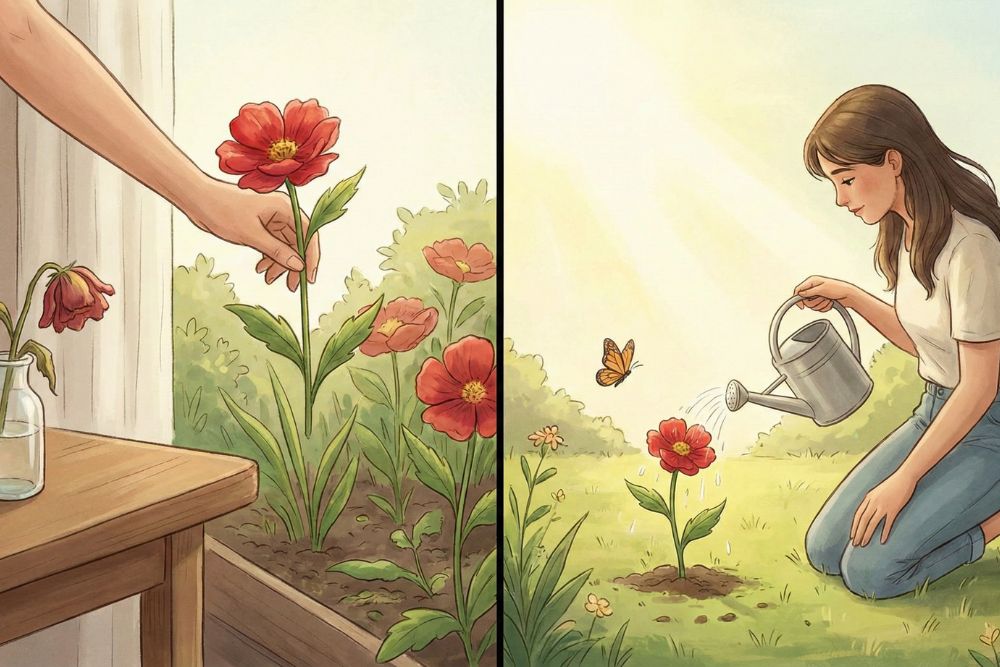
Think of it like this. Imagine you are walking in a garden—and you see a beautiful flower.
- If you “like” the flower, you pluck it. You take it home, put it in a vase, and admire it. But by possessing it, you kill it. It withers and dies—because you removed it from its source of life to serve your own pleasure.
- If you “love” the flower, you leave it there. You water it. You ensure it has sunlight. You appreciate its beauty without trying to make it yours. You want it to thrive, even if that means you can’t carry it around in your pocket.
Most of what we call “romance” is just flower-picking. We try to mold our partners to fit our needs. We are, deep down, not loving them at all.
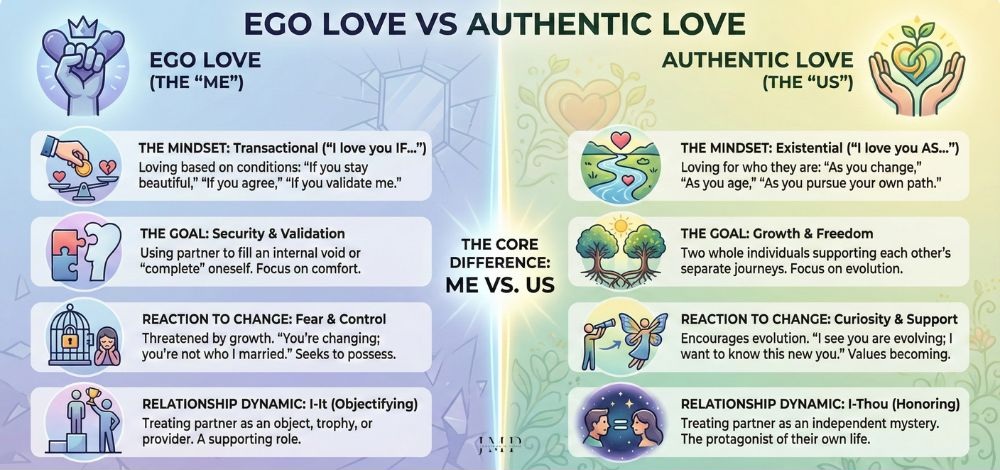
Ego Love vs Authentic Love
How does the difference between these two approaches to love show up in real life?
Usually, it comes down to one question: Is this about “Me“—or is this about “Us“?
Ego love is transactional. It implies, “I will love you if…”
- If you stay beautiful.
- If you agree with me.
- If you make me look good to my friends.
Example: A partner who gets jealous when you start a new hobby or succeed in your career. Why? Because your growth threatens their control. They loved you when you were “small” enough to fit in their box.
Authentic love, on the other hand, is existential. It implies, “I love you as…”
- As you change.
- As you age.
- As you pursue things that have nothing to do with me.
Example: A partner who encourages you to take a risky job opportunity in another city because they know it lights up your soul—even if it makes the relationship inconvenient for a while. They value your becoming more than their comfort.
In this sense, authentic love requires a kind of “death”—the death of the Ego that demands to be the center of the universe. It is moving from the “I” (what do I get?) to the “Thou” (who are you?).
| Feature | Ego Love (Possession) | Authentic Love (Witnessing) |
| The Mindset | Transactional: “I love you if…” (you satisfy my needs). | Existential: “I love you as…” (you are). |
| The Goal | Security & Validation: Using the partner to fill an internal void or “complete” oneself. | Growth & Freedom: Two whole individuals supporting each other’s separate journeys. |
| Reaction to Change | Fear & Control: “You’re changing; you’re not who I married.” | Curiosity & Support: “I see you are evolving; I want to know this new you.” |
| Relationship Dynamic | I-It: Treating the partner as an object, trophy, or provider. | I-Thou: Treating the partner as an independent mystery. |
Ego love vs authentic love
What Does Authentic Love Feel Like?
If we strip away the Hollywood romance, what does real love actually look like?
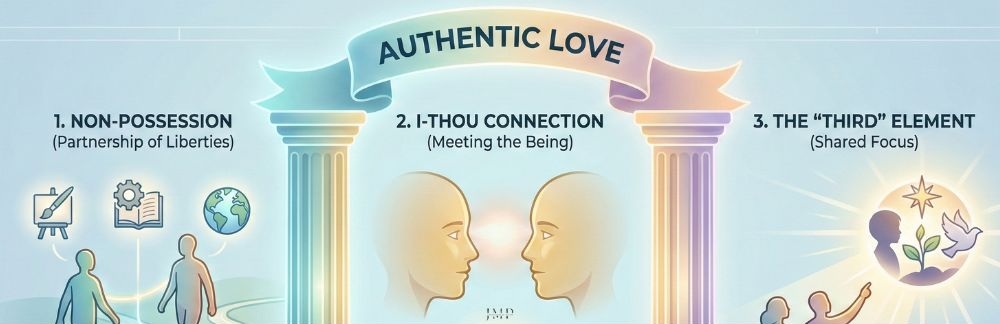
Most existential philosophers—both religious and secular—agree on this point: authentic love isn’t a magical feeling that just “happens.” It is an architecture that you build. It requires three specific pillars to keep it from collapsing into codependency or control.
Non-possession
They were walking side by side, but each was alone.
Simone de Beauvoir
The French philosopher Simone de Beauvoir once argued that the greatest trap in love is the desire to “merge.” We often hear romantic lyrics about two souls becoming one. It sounds poetic, but in practice, it rarely works. Because if two become one, who is left?
Usually, one person owns/ swallows the other.
Authentic love, according to Beauvoir, is not a merger; it is a partnership of two independent liberties—two people who “walk side by side.”
- Inauthentic: You try to act like the other person, adopt all their hobbies, and lose your own friends to “fit” into their life. In other words, you sacrifice your individuality just to “please” them.
- Authentic: You maintain your own “projects”—your career, art, worldview. You respect that your partner has a secret inner world that you will never fully own or understand. And you are okay with that “mystery”. You don’t try to “solve” your partner; you walk with them.
Authentic love must be founded on reciprocal recognition of two freedoms. For each of them, love would be the revelation of the self through the gift of the self and the enrichment of the universe.
Simone de Beauvoir, ‘The Second Sex’
An “I-Thou” connection
To better understand authentic love (and interpersonal relationships as a whole), we can look at a framework proposed by the Jewish philosopher Martin Buber—who distinguished between two ways of relating:
- I-It: This is how we relate to objects. I use a toaster to make bread. I use a cashier to buy groceries. The “It” has a specific function for me.
- I-Thou: This is how we relate to a being. There is no function. No “use.” I am simply meeting you with my whole being.
For example, think about how you greet your partner after a long working day.
- I-It: “Did you pick up the dry cleaning? What’s for dinner?” (You are treating them as a function—a provider or a servant).
- I-Thou: You stop to look them in the eye. You notice they look tired. You connect with the human being standing in front of you before asking for anything.
Authentic love requires a daily shift from transaction to connection—i.e. acknowledging that the person before you is complex and valuable, regardless of what they can do for you.
When two people relate to each other authentically and humanly, God is the electricity that surges between them.
Martin Buber
The “third” element
Despite the differences, both religious thinkers (like Kierkegaard) and secular ones (like Beauvoir) agree that a relationship between two people is unstable if they only look at each other.
If I make you my entire world, and you make me your entire world, we will eventually suffocate each other. We become idols to one another, and no human can live up to the pressure of being someone else’s “God.”
Authentic relationships, therefore, need a “Third” element—a shared point of focus outside of the couple.
- For the Religious: This Third is God. You love each other through the Divine. Your commitment isn’t just to your partner’s fluctuating moods, but to a higher promise you made to the Eternal.
- For the Secular: This Third is a Shared Project or Value—e.g. raising children, fighting for a social cause, creating art, or building a community.
When you have a “Third,” you are not just staring at each other (which leads to criticism and boredom); you are looking together in the same direction. This triangulation gives the relationship stability. It allows you to say,
“We are different, we are flawed, but we are united by this greater purpose we serve together.“
Read more: Authenticity in the Abyss – How to Stay Human in the Mess
What genuine love feels like
Why We Fail to Love Authentically
Many of us claim that love is not difficult. And yet, we so often end up in relationships defined by drama, control, and resentment.
How is it possible? Isn’t love easy after all?
Most of the time, the reason has to do with an unhealed ego, which may manifest in one of the following forms:
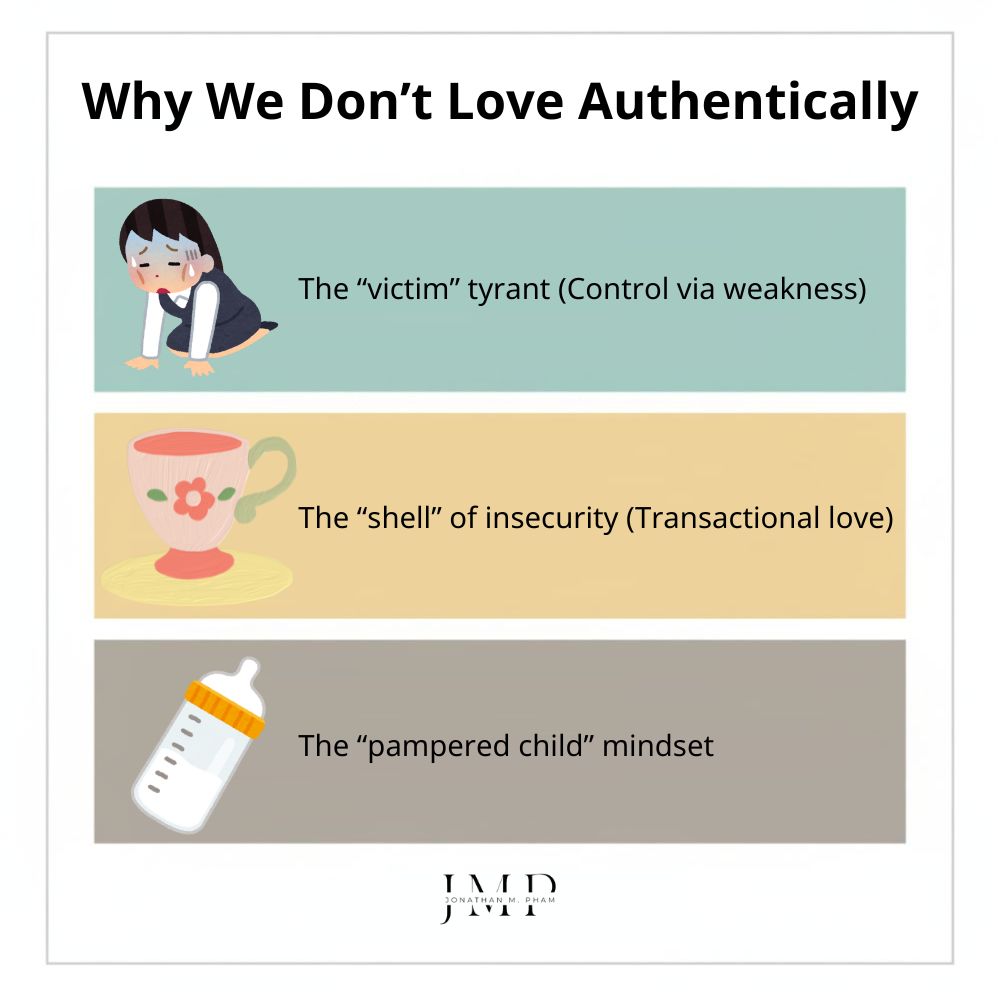
The “victim” tyrant (Control via weakness)
We tend to assume that “abusive” behavior looks like shouting or physical intimidation. But in fact, there is a quieter, much more insidious form of control: the weaponization of victimhood.
I happen to know someone personally who operates this way. Whenever a conflict arises in the family, instead of reasoning fairly, they would retreat immediately into the role of the “oppressed.” They would bring up past traumatic incidents that have nothing to do with the current argument. They would question the other person’s integrity. They would say things like, “I don’t know, maybe I’m just stupid…” to force the other person to comfort them rather than resolve the issue.
This is a tragedy of the Ego. By playing the victim, the person absolves themselves of agency. They refuse to look at the truth or admit their own role in the mess—just so that they can keep holding the entire emotional atmosphere of the home hostage to their fragility.
As long as you are trying to manipulate someone, you cannot truly love them.
Don’t lie to yourself. The man who lies to himself and listens to his own lie comes to a point that he cannot distinguish the truth within him, or around him, and so loses all respect for himself and for others. And having no respect he ceases to love, and in order to occupy and distract himself without love he gives way to passions and coarse pleasures, and sinks to bestiality in his vices, all from continual lying to other men and to himself.
Fyodor Dostoevsky, ‘The Brothers Karamazov’
The “shell” of insecurity (Transactional love)
Authentic love, as discussed, requires two whole people. Yet many times, we enter relationships as “shells,” looking for someone else to fill us up.
I once worked with a colleague who dressed very provocatively. When someone asked her about it, she admitted she did it to “excite the boys.” And unfortunately—as far as I could observe—the men around her fell for it, “babysitting” her and giving her attention.
On the surface, it looked like flirtation. But beneath the surface, it was just a hollow transaction.
- My colleague wasn’t seeking connection; she was extracting validation to fill a void of self-worth.
- The men weren’t offering respect; they were only consuming a visual object.
This transactional mindset is prevalent everywhere today—from social media thirst traps to boardroom power plays. And it is the exact opposite of relation.
As long as you are using the other person to prop up your fragile self-esteem (or using them for sex, status, or money), you are trapped in an I-It relationship. You are not loving them; you are using them.
Read more: The Curated Self – Why Authenticity on Social Media is Impossible
The “pampered child” mindset
It may seem ironic, but the thing is that many of us fail to love because we refuse to grow up.
Alfred Adler once described the “Pampered Child” lifestyle—a mindset formed in childhood where we expect the world to revolve around us.
- “If you loved me, you would do what I want.”
- “If you loved me, you would know why I’m angry without me telling you.”
- “If you loved me, you wouldn’t take that job.”
This is the logic of a child expecting the parent to serve them. While it’s understandable for a baby to react that way (otherwise, they would not be able to survive), it’s completely NOT OK for an adult to keep demanding that others treat them as the center of attention.
The world is not your mother. Your partner owes you nothing at all.
To love authentically, we must accept the responsibility of our own happiness, rather than demanding our partner supply it for us.
For most people, love means, ‘You must do what I want.’ No, love means they can do what they want, and we still love them.
Sadhguru
Behaviors & habits that prevent authentic love
How to Practice Authentic Love
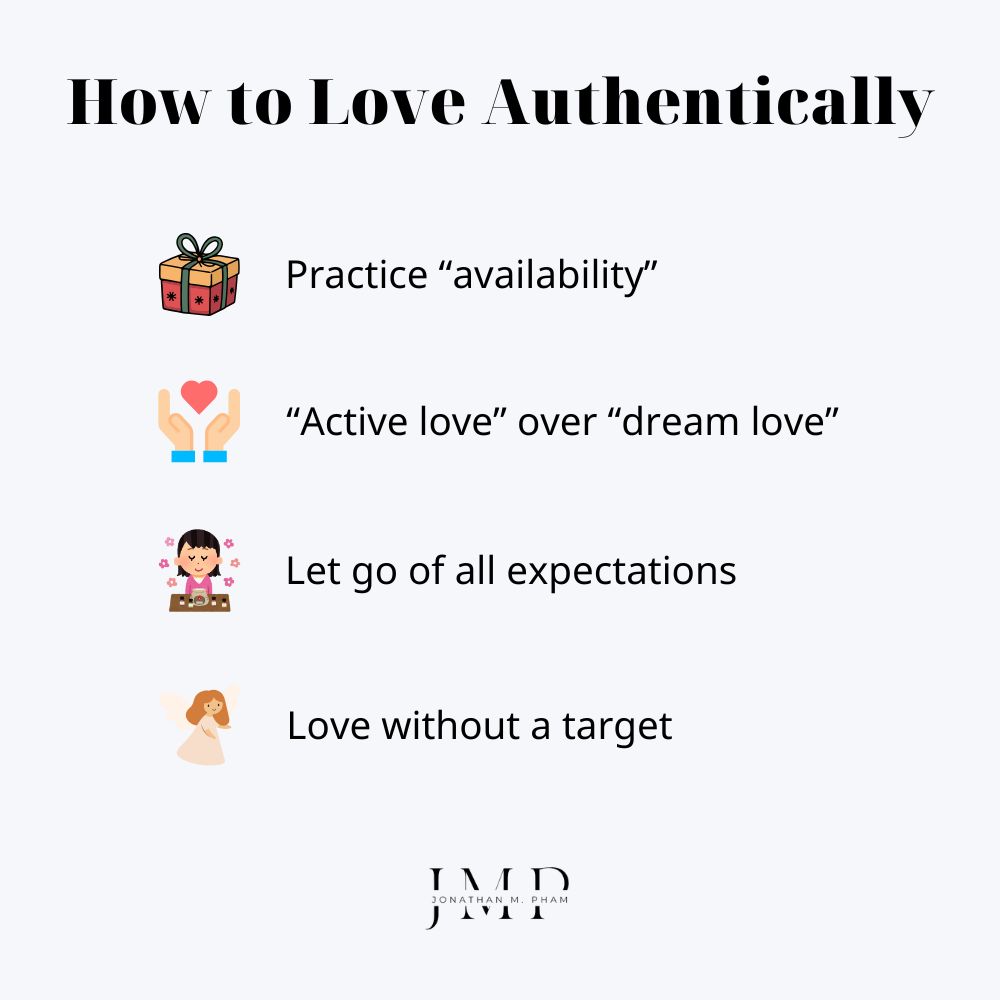
How do we move from the ego-driven need for validation to a genuine love that liberates? Here are four specific shifts you can start making today.
Practice “availability”
According to the French philosopher Gabriel Marcel, most of us are spiritually “unavailable” (indisponible). We are so encumbered by our own worries, schedule, and self-image that we have no room for anyone else. As such, when we listen to our partner, we are, many times, just waiting for our turn to speak.
To love authentically, Marcel proposed that we move from being “occupied” to being “available.”
Think of it this way. Let’s say you are in a living room cluttered with furniture. In order for another person to get in and be with you, you must clear a space. You must offer an empty chair.
The same rule applies to relationships. When you are with your loved one, put down your phone. And more importantly, put down your ego—anything that has been plaguing your mind so far. Say to them, implicitly or explicitly:
“I am here. I am not trying to solve you or fix you. I am simply hospitable to your presence.“
Read more: Are You Living or Just Existing? Let’s Find Out!
Choose “active love” over “dream love”
In his novel The Brothers Karamazov, Fyodor Dostoevsky distinguishes between “Love in Dreams” (which is easy and heroic) and “Active Love” (which is harsh and fearful).
- Love in Dreams: Fantasizing about a perfect future, or loving “humanity” in the abstract.
- Active Love: Loving the real person in front of you who has bad breath in the morning, forgets to do the dishes, and has irrational anxieties.
Authentic love requires us to adopt the latter approach. To be patient enough to to navigate a difficult conversation without shutting down. To be willing do the unglamorous work—cleaning up a mess, listening to the same story twice, extending forgiveness—without expecting a round of applause.
Love in dreams thirsts for immediate action, quickly performed, and with everyone watching. Indeed, it will go as far as the giving even of one’s life, provided it does not take long but is soon over, as on stage, and everyone is looking on and praising. Whereas active love is labor and persistence, and for some people, perhaps, a whole science.
Fyodor Dostoevsky
Let go of all expectations
You cannot love someone you do not understand, and you cannot understand someone if you have set up an impenetrable “wall” of conditions. That’s why you need to stop “managing” the relationship and start “seeing” the person—you and your partner alike—as they are.
- Look deeply: When you are confused by your partner’s behavior, instead of reacting with judgment (“Why are you doing this?“), be curious (“I would like to understand what you are feeling“).
- Be real: There’s no way you can witness another if you are hiding yourself. Drop the mask. Admit when you are scared or wrong. Vulnerability invites vulnerability.
If we are mindfulness, if we are love, we are also ignorance, we are also suffering, and there is no reason to suppress anything at all.
Thich Nhat Hanh
Love without a target
This may be a tricky piece of advice, but you should understand that at its core, love is NOT a reaction to a specific person; it is a way of being.
If you say, “I only love you,” that is not love; that is attachment. If the person leaves or dies, your love collapses.
Authentic love is like light. A lamp does not say, “I will only shine on this specific table.” It simply shines.
To love truly, you should work on becoming a loving person in general. Be kind to the waiter. Be patient with the stranger in traffic. Be gentle with yourself.
When you cultivate a loving state of being within yourself, you bring that abundance to your relationship, rather than begging your partner to manufacture it for you.
Love has nothing to do with someone else. It is all about YOU. It essentially means you have brought sweetness into your emotion. If a loved one travels to another country, would you still be able to love them? You would. If a loved one passed away, would you still be able to love them? You would. Even if a loved one is not physically with you anymore, you are still capable of being loving. So, what is love then? It is just your own quality. You are only using the other person as a key to open up what is already within you.
Sadhguru
How to be authentic in love
Further Resources
Authentic love quotes
If you are interested, feel free to check out my full list of unconditional love quotes here!
What is hell? I maintain that it is the suffering of being unable to love.
Fyodor Dostoevsky
Love does not alter the beloved, it alters itself.
Søren Kierkegaard
The beginning of love is to let those we love be perfectly themselves, and not to twist them to fit our own image. Otherwise, we love only the reflection of ourselves we find in them.
Thomas Merton
A mystery is a problem that encroaches upon itself because the questioner becomes the object of the question. Getting to Mars is a problem. Falling in love is a mystery.
Gabriel Marcel
To love means to commit oneself without guarantee, to give oneself completely. Love is an act of faith, and whoever is of little faith is also of little love.
Erich Fromm
When you love someone, the best thing you can offer is your true presence. How can you love if you are not there?
Thich Nhat Hanh
Self-reflection questions
- Am I trying to “pluck” this person (possess them for my happiness) or “water” them (help them grow for their own sake)?
- When I say “I love you,” am I really saying “I love how you make me feel” or “I love who you are“?
- If my partner changed their career, appearance, or hobbies tomorrow, would I still accept them, or would I feel cheated out of my “deal”?
- What is the “Third Element” in our relationship? What are we looking at together?
Read more: 200 Self-reflection Questions – Toolkit for Life Pilgrims
Authentic love books
- The Courage to Be Happy by Ichiro Kishimi & Fumitake Koga: A profound look at Adlerian psychology, specifically the “Task of Love” and moving from “Me” to “Us.”
- The Art of Loving by Erich Fromm: The classic text that argues love is an art that requires knowledge and effort, not just a sensation.
- I and Thou by Martin Buber: For those who would like to dive deep into the philosophy of sacred connection vs. transactional use.
Final Thoughts: We Are All Part of the River of Humanity
Many of us tend to assume that the goal of love is to build a fortress for two—to lock the doors and say, “It is just us against the world.”
But that is a small, fearful kind of love. Authentic love does not close you off from the world; it opens you up to it.
The Japanese novelist Shūsaku Endō once described this in his book Deep River. According to him, there is a “river of humanity”—a profound current of shared struggle, pain, and hope that connects every single person.
What I can believe in now is the sight of all the people, each carrying his or her own individual burdens, praying at this deep river. I believe that the river embraces these people and carries them away… And I am a part of it.
When you truly love someone—when you witness their wounds, fragility, and freedom without judgment—you learn to love everyone. You realize that the vulnerability you see in your partner is the same vulnerability in your neighbor, in the stranger, and even in your enemy.
So, my final word for you is this: Let go of the glass slipper. Forget the fairy tale of possession. Instead, step into the river.
Walk side by side with the people you love, not to own them, but to experience the miracle that they exist at all.

Other resources you might be interested in:
- How to Take a Leap of Faith: Trusting Intuition Over Logic
- How to Deal with Existential Dread: Confronting the Absurd
- Spiritual Crisis: Finding Light in the “Dark Night of the Soul”
- The World is Not Black and White: Finding Grace in the Grey
- 60 Existential Questions: Reflecting on Life’s Depths
Let’s Tread the Path Together, Shall We?

