

 日本語
日本語 Tiếng Việt
Have you ever looked at your life—one that perhaps looks perfectly fine on paper—and felt a sudden sense of vertigo?
It isn’t just sadness. Not just a bad day. Rather, it is the feeling that the “script” you were handed for existence no longer matches the reality you are living. The values you chased, the religious beliefs you held, and the goals you strove for suddenly seem irrelevant or hollow.
This is what we call a Spiritual Crisis. And it is much more prevalent than you may think.
Highlights
- A spiritual crisis (or “Dark Night of the Soul”) is a distinct phenomenon from clinical depression or a simple crisis of faith. Specifically, it involves a structural collapse of one’s previous worldview.
- Most of the time, such a crisis stems from the dissolution of the “Ego” (False Self) or a mismatch between material success and spiritual hunger.
- While painful, it is often a form of “Positive Disintegration”—breaking down a personality that is too small for your soul so a truer self can emerge.
- The way out isn’t to force old beliefs to work again, but to shift from being a consumer of external authority (priests/gurus) to a producer of internal truth.
What is a Spiritual Crisis?
Meaningless! Meaningless! Utterly meaningless! Everything is meaningless.
Ecclesiastes 1:2
A spiritual crisis (also referred to as a “spiritual emergency/ depression”) can be described as a “collapse of perceived meaning.” It happens when the mind’s conceptual framework—the story of “Who I Am” and “What Life is About“—shatters against reality. When you realize that the things you thought would make you happy (job, dogma, money, status, etc.) suddenly turn out to be meaningless.
Examples of how it may look like:
- The Mid-Life Unraveling: You finally get the promotion or the house, only to stand in the empty living room and realize the hunger in your soul is still there.
- The Loss of the “Good Person” Narrative: You do everything “right” according to your moral code, but tragedy strikes anyway, and you are left wondering if the universe is “fair” at all.
- The Creative Void: You are productive, but somehow the “fire” within is gone. As if you were just existing – like a “mummy”.
- etc.
I myself know this void well. Years ago, I bought the domain for this blog with high expectations, but at that time I had absolutely no direction – no idea where to begin with.
There was no one for me to seek advice from. I was so desperate for clarity that I ended up consulting an AI chatbot and letting it dictate my entire website’s outline.
And I wrote hundreds of “SEO-optimized” articles—”Best X,” “Top 10 Y”—purely to “cheat” the search engines.
On the outside, I was “building a blog.” But deep down, I felt as if I was dying.
I was churning out content I didn’t care about to please an algorithm I didn’t respect. And the more I wrote, the more miserable I became.
I was technically “successful” at generating content, but I didn’t feel content with what I did at all.
It took me a long time to realize that this feeling of misery wasn’t a mistake at all. It was a necessary experience – a warning that My “False Self” (the one who wanted quick success and validation) had to burn down, so that something authentic could eventually grow in the ashes.
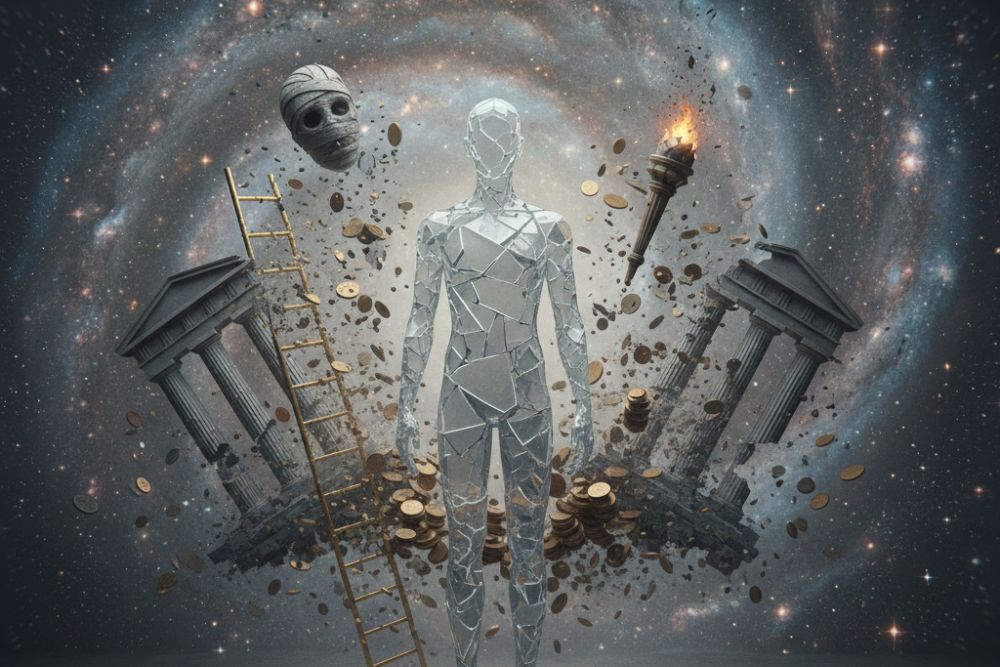
Spiritual Crisis Diagnosis: Depression, Crisis of Faith, or The Dark Night?
Spiritual vs. Clinical depression
We are not human beings having a spiritual experience; we are spiritual beings having a human experience.
Teilhard de Chardin
It is important to make a distinction here. Clinical depression involves a medical condition often involving brain chemistry – and is characterized by lethargy and an inability to function. It requires medical care.
Spiritual depression, however, is existential. You might still be functioning perfectly in the material world—going to work, eating, smiling at neighbors—but deep down, you feel a growing sense of homesickness for a deeper purpose you cannot locate or define.
Somehow, the human experience just feels too small to you.
Crisis of faith vs. The dark night of the soul
In a dark night, with anxious love inflamed, o, happy lot!— Forth unobserved I went, my house being now at rest.
In darkness and in safety, by the secret ladder, disguised, o, happy lot!— In darkness and concealment, my house being now at rest.
In that happy night, in secret, seen of none, seeing nought myself, without other light or guide, save that which in my heart was burning.
That light guided me more surely than the noonday sun; to the place where He was waiting for me, whom I knew well, and where none appeared.St John of the Cross – “Dark Night of the Soul” poem
Many people tend to use “Crisis of Faith” and “Spiritual Crisis” interchangeably, but there is a nuance between the two terms.
- A Crisis of Faith is generally cognitive. You doubt a specific dogma. (e.g., “Is the Bible literally true?” or “Why do bad things happen to good people?”). It is a wrestling match with ideas.
- A Spiritual Crisis (or the Dark Night of the Soul) is experiential. It happens when there is a total collapse of the container of your faith/ belief. Now you start to doubt everything: meaning, reality, the self, and God/ the Ultimate Reality.
The term “The Dark Night of the Soul” comes from the 16th-century Christian mystic St. John of the Cross. However, despite its mystical origin, I believe that the concept is universal and applies to everyone – regardless of their background.
In secular terms, psychologists like Kazimierz Dąbrowski called it “Positive Disintegration.” It is the process where your current personality structure falls apart – because it is too small to hold your growing consciousness.
It feels like death because it is a death—not of you, but of your Ego.
| Feature | Crisis of Faith | Spiritual Crisis / Dark Night of the Soul | Clinical Depression |
| Primary Trigger | Intellectual doubt, contradiction in dogma | Loss of meaning, ego collapse, life transition | Chemical imbalance, trauma, genetics |
| The Feeling | “I don’t know what to believe.” | “Nothing matters anymore.” / “Who am I?” | “I cannot get out of bed.” / “I feel nothing.” |
| The Target | A specific religion or belief system | Existence itself; the nature of reality | The self’s ability to function |
| The Goal | To find better answers/beliefs | To shed the false self and transform | To heal and regain function |
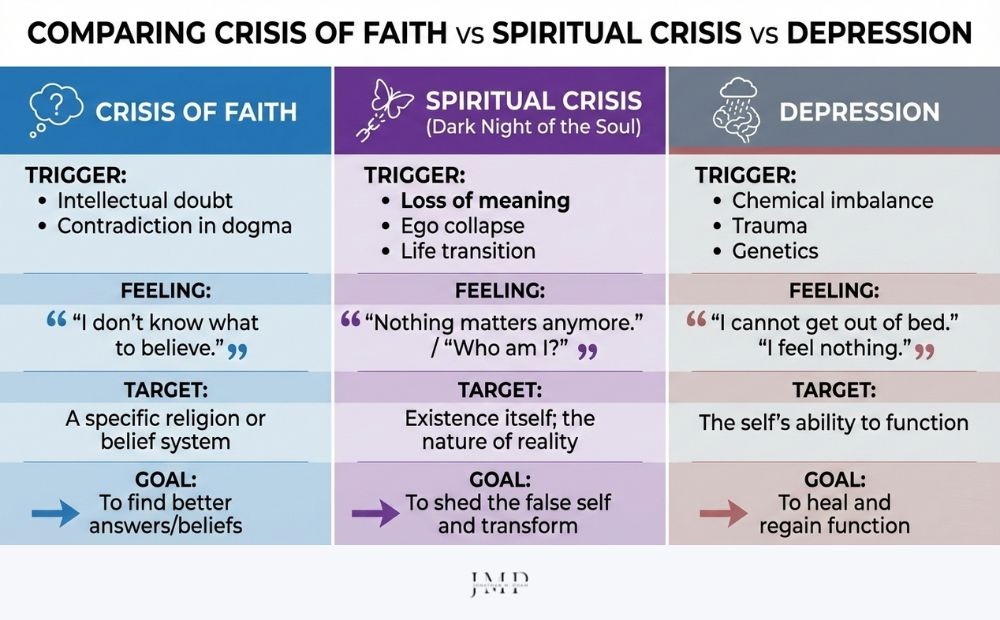
Dark night of the soul explained
My Journey Through the Night: The Collapse of the Idol
I have walked through several “Dark Nights of the Soul”—career collapses, periods of aimlessness—but perhaps the most profound one was the collapse of my worldview foundation.
It began with my career. Years ago, I joined a coaching company – expecting to find wisdom and mentorship. And yet, what I found was a den of egos.
I saw “gurus” who preached humility on stage – but hoarded clients and acted with arrogance behind closed doors.
Somehow, it caused a crack within me. My trust in human authority broke.
I got so disillusioned that I decided to quit after just one year (much shorter compared to my previous jobs). A quite ironic result, given that I initially thought that I would stay there “forever”.
Somehow, I ended up working for a digital agency following that.
If the previous job was arrogant, this one was, I might say, dehumanizing. My so-called manager treated me like a ghost. He shared no vision, built no team spirit, and barely acknowledged my existence – outside of assigning me menial side-tasks without any concrete explanation.
I became like a “zombie”—obeying orders for a paycheck, but feeling empty inside.
And it didn’t help that I also lost my “spiritual” anchor around that time. For years until then, I had been attending a parish led by a priest I had great respect for. He was rare. Unlike the “scribes” who preached dry dogma, he didn’t talk authority. He talked love and humanity.
Then, right at the time when I was going through that career crisis, he resigned due to old age.
The void he left was filled by what I call “machine-gun” preachers. Their sermons were rapid-fire delivery of rules and theological jargon—impressive to the average ear, but utterly hollow to a seeking soul.
This spiritual dryness hit me at the worst possible time.
I went to church seeking hope, but I found only hypocrisy.
I watched neighbors recite the Rosary loudly on the street to signal their piety, only to turn around and scream at their spouses.
I saw business owners who never missed Sunday Mass – but sold low-quality goods at inflated prices on Monday.
And I saw a community that treated Christmas not as a solemn incarnation, but as a backdrop for selfies.
Something inside me snapped. I realized I was surrounded by people who were “religious” but not spiritual at all. They were using God as a badge of righteousness – while their hearts remained hard.
So I became cynical. I stopped going to church. And I viewed anyone who stood on a pulpit—priests, coaches, teachers, gurus—as a fraud.
I felt abandoned, not just by the community, but by the sense of meaning itself.
Struggling with faith
Ironically, it wasn’t a priest who saved me. It was my new manager at work—a devout Buddhist—who joined the company after the one-man-army manager I talked about above left.
This manager was a pleasant surprise to me. He invited me to lunch, shared about his own struggles, listened to mine, and spoke to me about compassion – as well as many other spiritual topics.
It was a shock to my system. Here was a “non-believer” acting more like Christ than the churchgoers.
Slowly but steadily, I realized that God/ Reality cannot be not confined to a building. Until then, I had been clinging to the “Container”—the rituals, the church approval, the “correct” labels. I thought that if I stood in the right building, I would feel holy.
But my Buddhist mentor showed me the “Content”—the actual practice of love and presence.
If the church was dark, it wasn’t an excuse for me to leave – but a call to bring the light. To take action and do what is within my own capacity – rather than complaining about something outside.
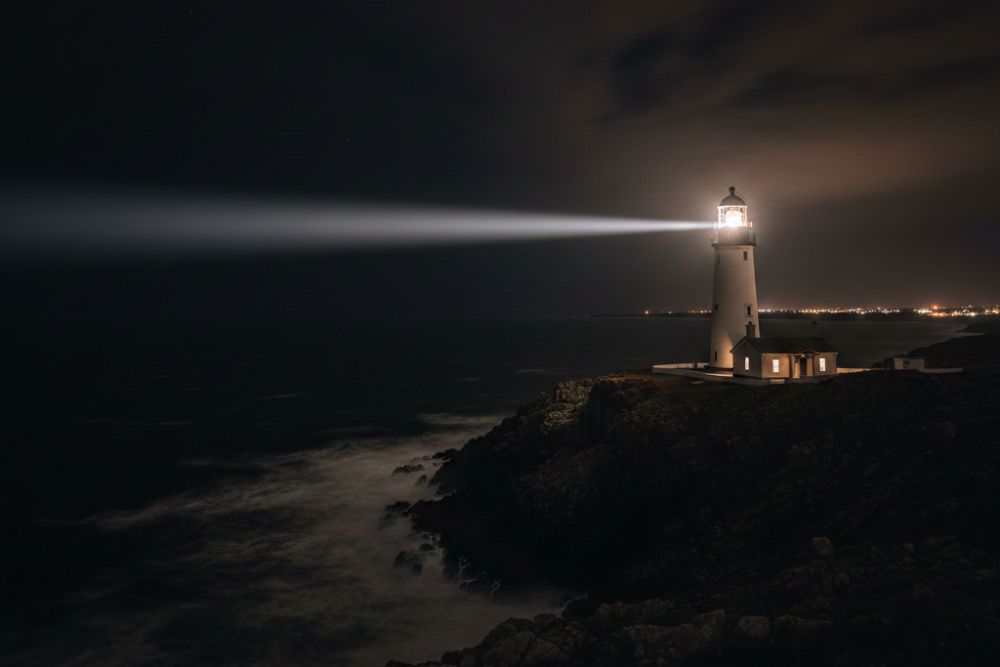
Darkest night of the soul
Today, I have returned to faith, but as a different person.
My faith is no longer borrowed from an external teacher. It comes from within me – a holistic blend of Christianity, Buddhist wisdom, mysticism (to a certain extent), Stoicism, and existential philosophy.
It is stronger now – because it doesn’t rely on the church being perfect. It is a result of my personal choice – to venture into “the objective uncertainty with the passion of the infinite“.
If I ever become a saint — I will surely be one of ‘darkness’. I will continually be absent from heaven — to light the light of those in darkness on earth.
Mother Teresa
Spiritual Crisis Symptoms: How It Feels to Be in the Void
The loss of inner guidance
I pray but I am lost. Am I just praying to silence?
Sebastian Rodrigues, ‘Silence‘ (2016)
It happens when the sense of connection or “flow state” suddenly disappears. For the believer, prayer or meditation feels empty, as if you are talking to a closed door, and you sense no response or presence.
For the secular seeker, the world somehow loses its “magic” or sense of meaningful coincidence (synchronicity). The intuition you once trusted to guide your decisions has vanished. The path forward now feels random and indifferent.
You are left with the suspicion that you are entirely alone in a mechanical universe, with no external force—divine or otherwise—coming to help or steer you.
Therefore I will not keep silent; I will speak out in the anguish of my spirit, I will complain in the bitterness of my soul.
Job 7:11
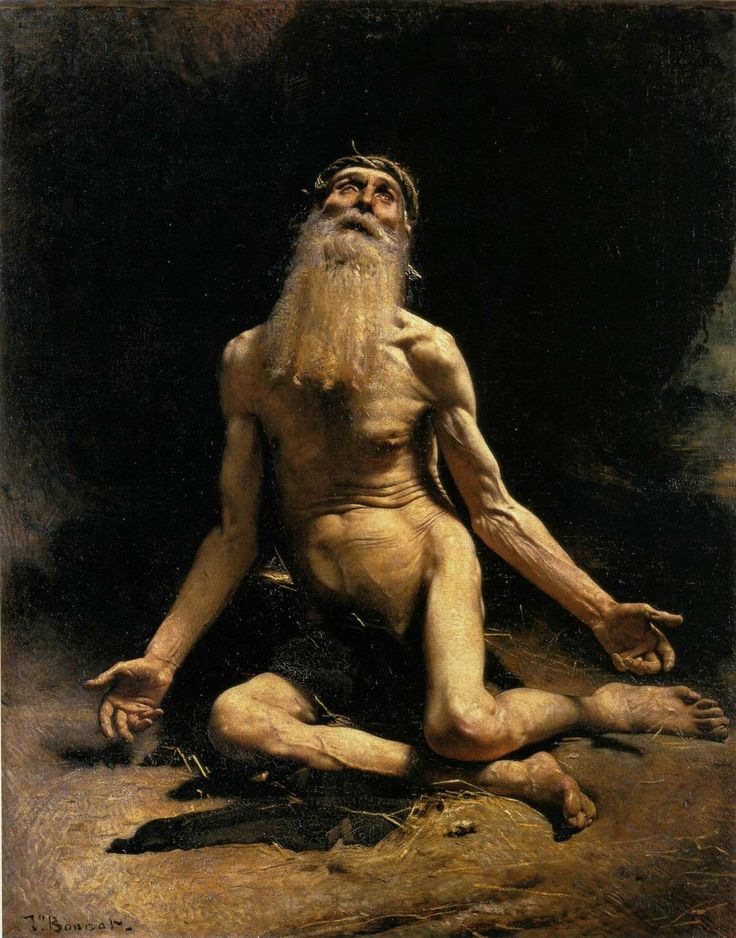
Spiritual crisis in the Bible
Spiritual dryness
It is the absence of genuine feeling. You are still executing the routine of your life: going to work, managing your tasks, and interacting with others. However, you are operating on autopilot, physically present but spiritually dormant.
The activities that once brought you joy and excitement (hobbies, ambitions, music) now feel flat and unengaging. You’ve turned off your inner world to protect yourself from the emptiness you sense in your environment.
I myself experienced this vividly during my time at the digital agency mentioned above. At that time, I was technically a high-performing employee—I met deadlines and attended meetings. But internally, I felt inert.
My tasks were often trivial and lacked context, and there was no shared vision or connection with my manager.
To cope, I simply wrapped myself in the routine. I had subconsciously quieted my soul just to survive the day-to-day work environment.
Disillusionment with authority
I see myself and am filled with loathing and horror. My indifference to men has shut me out from their company. I live now in a world of ghosts, a prisoner of my dreams and fantasies.
Antonius Block, ‘The Seventh Seal’
We are raised to believe that certain authorities—parents, teachers, leaders, or experts—hold all the necessary wisdom. A spiritual crisis often comes when we realize that these “adults in the room” are just as lost, driven by ego, or lacking in solid answers as anyone else. The previous comfort of “trusting the experts” is irrevocably removed.
This hit me hard when I worked in the coaching industry. I joined it seeking genuine mentorship and wisdom from the leaders. However, contrary to my expectations, what I saw was leaders who publicly advocated for humility and service, yet were privately arrogant and overly concerned with fame.
It felt like a betrayal, but it was also a waking up. A reminder that I should stop relying on external titles or positions – and instead take ownership of my own truth.

Spiritual emergency symptoms
What Causes a Spiritual Crisis?
A spiritual crisis isn’t just bad luck. Quite often, it is a structural failure of how we have been living so far.
The dissolution of the ego (False self vs. True self)
Psychologists and mystics alike have proposed that our sense of self is made up of two parts:
- The Ego (False Self): Your survival mask. It cares about safety, status, metrics, approval, and comfort. It loves the status quo.
- The True Self: Your core essence – which cares about meaning, growth, and authenticity.
When the Ego can no longer keep the True Self quiet, a spiritual crisis naturally follows as a result.
That was what happened to me when I just started this blog. At that time, my Ego was obsessed with the “metrics.” I wrote hundreds of articles based purely on what the AI said would rank. I wanted the traffic, quick success, and validation.
But my True Self was miserable. It didn’t care about the keywords alone; it wanted to explore deeper, more philosophical questions.
The crisis hit when I succeeded at the Ego’s game (I had the content, I had the structure) but felt spiritually bankrupt. My True Self effectively went on strike, refusing to write another word of “fluff” until I honored its voice.
The material-spiritual mismatch
Have you ever been through this before? You get the promotion, you buy the house, or you reach a level of stability you once dreamed of. You expect to feel full, but somehow you only feel empty. “Is this it?” you ask yourself.
Many of us assume that if we satisfy our material needs, our spiritual needs will take care of themselves. This could not be further from the truth. Simply – because we are only trying to solve an internal problem with an external solution.
It is like trying to quench thirst by eating salt. Material success satisfies the biological need for safety and comfort, but it does nothing for the ontological need for purpose.
When the noise of the “struggle for survival” quiets down, the silence of the soul becomes too difficult to endure.
Observed hypocrisy
This was the catalyst for my crisis with the Church back in the day. I witnessed a community that had completely compartmentalized their faith. Specifically, I saw neighbors who performed piety on Sundays but practiced cruelty on Mondays. I saw business owners who prayed for mercy but showed none to their customers.
When the cognitive dissonance becomes too loud, the mind snaps. You realize that the “structure” you relied on is hollow.

Spiritual existential crisis
Why the Dark Night of the Soul May Actually Be a Gift
Unless a kernel of wheat falls to the ground and dies, it remains only a single seed. But if it dies, it produces many seeds.
John 12:24
Positive disintegration
When you are in the middle of it, a spiritual crisis may feel like a curse – as if you are losing everything. But in hindsight, it may actually be a necessary transition period, before you are ready to emerge stronger – and wholer.
Think of it like renovating a house. To build a beautiful, spacious new room, you first have to smash down the old, cramping walls. Initally, it may look like a destruction—there is dust everywhere, the roof is open, etc.—but it is actually construction in process after all.
Likewise, your crisis may simply be the sledgehammer taking down the walls of a personality that is too small for your soul – a personality built on fear and compliance rather than your own truth. From there, a stronger, more authentic self may emerge.
For example, think about the “People Pleaser”, whose assumption is “If I make everyone happy, I will be safe.” When betrayed by a close friend, it’s very likely that they will feel terrible, given that their primary defense mechanism is gone. And yet, its destruction also provides them with the necessary space to build a new room called “Self-Respect.”
The shift from external to internal
Only a Christian would see Buddha simply as man. Our Buddha is a being which man can become. Something greater than himself, if he can overcome all his illusions. But you cling to your illusions and call them faith.
Interpreter to Father Rodriguez, ‘Silence’ (2016)
Perhaps the greatest gift of a spiritual crisis – as I have figured myself – is that it forces you to stop being a Consumer of truth and become a Producer of it.
Most of us make the mistake of outsourcing spirituality. We want the priest to tell us what is holy, the boss to tell us we are valuable, and the expert to tell us how to live. In a sense, we want to remain “children” – refusing to grow up and take ownership.
But there’s no guarantee that these external crutches will stay forever. As soon as the priest shown signs of hypocrisy – or the boss acts like a ghost, you will have no choice but to look inward.
Back in the day, one of the greatest problems I faced upon returning to my faith had to do with the sermon quality. As a result, I kept moving between parishes, trying to search for a “perfect” teacher. But seemingly, my expectations could never be truly met.
Eventually, I realized I had to own my journey. Now, whenever I hear a dry, “machine-gun” sermon, I don’t check out. I actively dig for one sentence, one word, or one hidden gem of truth in the mud. And if I truly cannot find one, I think about the message in the scripture on my own—bypassing the priest’s delivery entirely to find the meaning myself.
This shift—from demanding to be served to taking responsibility for my own spiritual nourishment—would never have happened if the “perfect” priest hadn’t left.
There are two ways of spreading light: to be the candle or the mirror that reflects it.
Edith Warton

Dark night of the soul spiritual awakening
Read more: 40 Spiritual Lessons – Wisdom for Life’s Journey
How to Navigate the Night: A Philosophical Guide to Overcoming Spiritual Crisis
When you are in the void, the instinct is to scramble for the light switch. We want to “fix” the feeling immediately.
But the Dark Night of the Soul is not a problem to be solved. You cannot rush the dawn.
Here are five steps to help you navigate the darkness without losing yourself.
Surrender to the darkness
One does not become enlightened by imagining figures of light, but by making the darkness conscious.
Carl Jung
Much of our suffering comes from the resistance to the problem. We think, “I shouldn’t be feeling this,” or “I need to get my old ambition back.” This resistance, unfortunately, only breeds more anxiety.
What’s important is to accept that you are in a “cocoon phase.” A caterpillar dissolves completely before it becomes a butterfly. If it tried to resist that dissolution, it would never transform.
Give yourself permission to not know who you are right now. It is scary, but it is necessary.
How can I find a true answer when I am confused? If my mind is confused, whatever answer I receive will be perverted… It is like a blind man who asks, ‘What is light?’… If I tell him what light is, he will listen according to his blindness, but suppose he is able to see, he will never ask the question ‘What is light?’. It is there. Similarly, if you can clarify the confusion within yourself… you will not have to ask.
Jiddu Krishnamurti
Embrace the “Cloud of Unknowing”
In the 14th century, an anonymous monk wrote a book titled The Cloud of Unknowing. His advice for finding the Divine was radical: stop trying to “understand” everything with your intellect.
When your old beliefs collapse, you enter a state of not-knowing. The Ego hates this. It craves certainty. It wants a clear 5-year plan or a rigid dogma.
But you must learn to sit in the “Cloud.” In other words, you need to get comfortable with saying, “I don’t know.”
- “I don’t know what my career is for anymore.”
- “I don’t know if I believe in the same God I did ten years ago.”
Doubting is not a sign of failure; it just means that you are being honest – and allowing your mind to expand.
The man of faith who has never experienced doubt is not a man of faith.
Thomas Merton
Look for truth in the “wrong” places
In order to arrive at what I cannot understand, I must go by the way I cannot understand.
Thomas Merton
A common mistake during a spiritual crisis is to stubbornly keep digging in the same spot—going to the same church that bores you, or reading the same self-help books that no longer resonate. If your old wells have run dry, you must be willing to drink from new streams.
If Christian sermons feel dry, read Stoic philosophy.
If secular logic feels cold, why not explore Eastern poetry?
Truth is universal, and sometimes you need a different language to hear the same message.
In my own journey, I found that learning about Buddhism didn’t pull me away from my Christian roots. Quite the opposite – it actually gave me the fresh vocabulary I needed to understand Christ’s teachings on attachment and love.
Truth is truth, no matter who speaks it. Even if it comes from one who opposes your ideology. (e.g. think of those like Nietzsche, who was a harsh critic of Christianity back in the day)
I am a finger pointing to the moon. Don’t look at me; look at the moon.
Buddha
Take the “leap of faith”
Eventually, you cannot just think your way out of a spiritual crisis. You have to act. To venture into the unknown (or, in the words of the philosopher Søren Kierkegaard, to take a “leap of faith“) – not out of foolishness, but out of passion and courage: the courage to be disliked, to be real, and to face whatever consequences your authentic decisions may bring.
Think about this. You will never have 100% proof that a new career path will work. You will never have a guarantee that a new relationship will last.
Instead of being paralyzed by “What ifs”, your only option is to move. Take the smallest possible step toward what feels alive, even if it makes no logical sense on your resume.
When I quit my stable corporate job two years ago and dedicated my resources to this blog (as well as my language study and a few other personal agendas), logic screamed that it was a waste of time. I had no clear plan. Yet, I had a “flickering fire”—an intuition. I followed the fire, not the map.
And that small, irrational action was the thread that eventually pulled me out of the labyrinth.
If you stumble about believability, what are you living for? Love is hard to believe, ask any lover. Life is hard to believe, ask any scientist. God is hard to believe, ask any believer. What is your problem with hard-to-believe?
Yann Martel, ‘Life of Pi’
Do Shadow work
A spiritual crisis is, many times, a mirror showing us parts of ourselves we ignored. It is a chance for you to ask yourself the hard questions:
- “Why did I stay in that soul-crushing job for so long? Was it fear of poverty?”
- “Why did I need that title so badly? Was it for validation?”
This is what we call Shadow work – or, in simpler terms, the act of examining the Ego. You leverage the pain of the crisis as fuel to burn away your hypocrisy and fear.
If you skip this step—if you just try to “feel better”—you will likely rebuild the exact same fragile life that just collapsed.
Read more: 60 Existential Questions – A Daily Toolkit to Explore Life’s Depths

Beware of Spiritual Bypassing
Before we move on, a warning. When the pain of the crisis hits, the temptation is to numb it with “toxic positivity” – or, as it is commonly known, to resort to “spiritual bypassing“. It happens when you try to use spiritual beliefs (like “Everything happens for a reason” or “Just pray more”) to avoid facing unresolved emotional wounds.
I cannot say too strongly: Do NOT do this! You cannot heal what you do not feel.
If you try to skip the “Dark Night” by pretending to be happy and holy, you will only become a whitewashed tomb—shiny on the outside, but decaying on the inside.
FAQs
What are the stages of the Dark Night of the Soul?
While every one’s journey is unique, the process often follows a pattern similar to grief or the “Hero’s Journey”:
- The Withdrawal: You lose interest in worldly pleasures and external validation.
- The Void: The “Silence” hits. Old beliefs collapse, and you feel abandoned.
- The Purging: You are forced to confront your shadow—your ego, fears, and attachments.
- The Surrender: You stop fighting the darkness and accept the uncertainty.
- The Rebirth: You emerge with a new, internalized sense of meaning that is no longer dependent on external circumstances.
What should I do when the crisis feels like it has no end?
My advice is that you should stop watching the clock. The Dark Night is not a project with a deadline. If it feels endless, it is likely because you are still resisting the change. You are waiting for your old life to come back.
Things will change when you finally give up the hope of “going back” and accept that the only way is through.
Be patient toward all that is unsolved in your heart and try to love the questions themselves, like locked rooms and like books that are now written in a very foreign tongue. Do not now seek the answers, which cannot be given you because you would not be able to live them. And the point is, to live everything. Live the questions now. Perhaps you will then gradually, without noticing it, live along some distant day into the answer.
Rainer Maria Rilke
Are there examples of real people who went through this dark night?
Absolutely. You are in good company.
- Mother Teresa: Her private letters revealed she spent nearly 50 years in a “dark night,” feeling no presence of God, yet she continued to serve the poor. Her faith was pure will, not feeling.
- Leo Tolstoy: The great author had a massive existential crisis at age 50, hiding ropes to avoid hanging himself because life felt meaningless, before finding a new, radical faith.
- Imam Al-Ghazali: The Islamic theologian left his prestigious teaching post and wandered as a Sufi for years because he realized his intellectual knowledge of God was not the same as knowing God.
Can a spiritual crisis affect my mental health?
Yes. The stress of an identity collapse can lead to anxiety and insomnia.
While the crisis itself is a spiritual process, if you find yourself unable to function in daily life (eating, sleeping, working), don’t be afraid to seek professional mental health support from a certified therapist/ counselor/ spiritual guide.
Read more: 50 Spiritual Questions for Awakening the Soul
Further Resources
Spiritual crisis & dark night of the soul quotes
The dark night of the soul comes just before revelation. When everything is lost, and all seems darkness, then comes the new life and all that is needed.
Joseph Campbell
Without the “dark night of the soul,” the mystic cannot experience the mystery of the ground.
Paul Tillich
I shall conquer untruth by truth. And in resisting untruth, I shall put up with all suffering.
Mahatma Gandhi
That even in the darkest of times we have the right to expect some illumination, and that such illumination might well come less from theories and concepts than from the uncertain, flickering, and often weak light that some men and women, in their lives and their works, will kindle under almost all circumstances and shed over the time span that was given to them.
Hannah Arendt, ‘Men in Dark Times’
Books to read
- For the Thinker: The Wisdom of Insecurity by Alan Watts (On letting go of the need for certainty).
- For the Christian Seeker: The Dark Night of the Soul by St. John of the Cross (The classic manual) or Falling Upward by Richard Rohr (On the “second half” of life).
- For the Existentialist: Man’s Search for Meaning by Viktor Frankl (Finding purpose in suffering).
- For the Mystic: The Cloud of Unknowing (Anonymous medieval guide on contemplative prayer).
Movies to watch
- Silence (2016) – Martin Scorsese’s masterpiece on faith, doubt, and the silence of God.
- Ikiru (1952) – The story of a bureaucrat who realizes his life has been meaningless and frantically searches for purpose before death claims him.
- The Tree of Life (2011) – A visual meditation on the conflict between the way of Nature and the way of Grace.
Final Thoughts: It’s Always Darkest Before the Dawn
In Friedrich Nietzsche’s Thus Spoke Zarathustra, the madman runs into the marketplace proclaiming the death of God. But contrary to what many imagine, this proclamation does not come with pride. It comes with terror.
“And now?” asks the madman. “Is there still any up or down? Are we not straying as through an infinite nothing?“
This is the question that haunts every spiritual crisis. When the old structures collapse, we feel like we are falling.
But if there is one thing I want you to take away from this guide, it is this: You are not falling. You are floating.
The Dark Night of the Soul is not a punishment. It is a chance for you to stop clinging to the driftwood of external validation, rigid dogma, and material safety – and to finally learn how to “swim”. To move your spiritual center of gravity from the outside (what the priest/boss/society says) to the inside (what your True Self knows).
Don’t try to “fix” yourself you so you can go back to being the person you were five years ago. That person is gone. The shell has cracked – so that you may meet the person you are becoming.
Just embrace the silence. Doubt, but also take action. Be a “Mudlark.” Scavenge for truth wherever you can find it.
The dawn is coming. You just have to stay awake long enough to see it.
If you think something is missing from the world, it is because you are here to express it from within yourself. If you think there is no love in the world, express the love inside you.
Miyako Yusa, ‘What you’re looking is within you’
Other resources you might be interested in:
- Christian Existentialism: From Dogma to the Ultimate Reality
- Living in Bad Faith: The Existentialist Guide to Stopping Self-Deception
- The World is Not Black and White: Finding Grace in the Grey
- The Knight of Faith: Believing in the Absurd
- Hiroshima Rages, Nagasaki Prays: A Personal Reflection on Peace & Meaning
Let’s Tread the Path Together, Shall We?

