

 Tiếng Việt
 日本語
日本語
The day was December 25, 2012—Christmas Day! It was the day I went to the cinema for the first time in my life. And the movie was Life of Pi.
I still recall how mesmerizing the experience was, and how one scene, in particular, haunted me long after the credits rolled—even if I couldn’t quite explain why at the time.
The film is based on Yann Martel’s masterpiece, which tells the story of Pi Patel, a gentle boy raised on the spiritual principles of non-violence (Ahimsa). But when his ship sinks and he is stranded on a lifeboat in the middle of the Pacific Ocean, all of his societal conditioning is violently stripped away.
All of a sudden, he is left in the void. And in that void, he is trapped on a small boat with a 450-pound Bengal tiger named Richard Parker.
Initially, Pi is terrified of the beast and tries to isolate him on the raft. But soon enough, he realizes that if he kills him, he will be left entirely alone with his despair. So he does his best to tame the tiger—to establish boundaries while living alongside him.
Then one night, Pi and Richard Parker look over the edge of the boat together. They stare into the nighttime ocean, which has become completely still—a giant mirror reflecting the starry sky.
At that moment, Pi asks the tiger,
“What do you see, Richard Parker? Tell me what you see“.
The camera then dives into the water through the tiger’s reflection. But what it reveals at the bottom of the ocean are unequivocally Pi’s memories—the shipwreck, his mother’s face, his deep, aching grief.
When I first watched that scene, I didn’t quite “get it.” But as I reflected upon it later, I realized it was a visual trick intended to reveal a shocking truth: Pi’s mind and the tiger’s mind are the exact same thing. They share one consciousness.
At that surreal moment, Pi is looking into the mirror of his own soul. He acknowledges that he is capable of both immense grace and savage survival. And in doing so, he is finally embracing his complete self.
This brings us to the topic of authenticity—a word we hear constantly in modern society, yet rarely understand. Many tend to think of it as a flawless morning routine or a perfectly curated online persona. We treat it like a simple life-hack—something that can be distilled into a few inspirational phrases to be printed on coffee mugs and office posters.
But the thing is, true authenticity isn’t a sanitized, peaceful aesthetic.
To be a whole, authentic human being, you have to acknowledge that there is a “tiger” on your lifeboat. To face the messy, contradictory parts of who you are.
Highlights
- Definition: True authenticity is not a static identity to be discovered, but a dynamic practice. It is the continuous act of taking responsibility for your choices, integrating your darkest shadows, and staying open to the world even when it is agonizing to do so.
- The Importance of Authenticity: Without an intentional grip on our own “interface,” we fall into “quiet desperation,” surrendering our freedom to the anonymous crowd. Authenticity is the act of reclaiming our fundamental capacity for Care (Sorge); it is the only way to transform a hollow existence into a meaningful life.
- Understanding the Ego: The Ego is not an enemy to be destroyed, but a “User Interface” (UI)—the psychological framework that allows the infinite awareness within you to navigate and interact with the finite, physical world.
- The Paradox of Action: Even if the “separate self” is ultimately an illusion, the suffering we experience within this shared reality is entirely real. Authenticity requires us to participate in the dream with profound compassion.
- Beware of Modern Surrender: In the modern world, it is incredibly tempting to surrender our authentic freedom to ideologies (the crowd/gurus), digital algorithms (doomscrolling), and the pursuit of a “Flawless Avatar” (perfectionism).
- How to be Authentic: Authenticity is built on action, not calculation. You cannot overthink your way to a true self. You must make choices and accept the consequences despite objective uncertainty.
- From a Wall to a Door: The ultimate expression of an authentic life is vulnerability. It is the transition from using the ego as a wall of defense, to becoming a “Door”—staying human, open, and merciful in the midst of a messy world.
What is Authenticity?
If you ask people what authenticity really means, you are very likely to receive a one-sentence answer:
“Just be yourself.“
Sounds so incredibly simple, right? In fact, it has, to a certain extent, become the golden rule of modern self-help worldwide. And yet, when you actually sit in the quiet of your own room and try to locate this “authentic self” you are supposed to be, things get complicated very quickly.
If you strip away your job title, family role, cultural conditioning, and digital persona, what is actually left?
The problem of the “Self”
No man is an island, entire of itself; every man is a piece of the continent, a part of the main.
John Donne
If we look to the East, particularly to Buddhist and Taoist philosophy, the answer to that question is both beautiful and terrifying: Nothing.
The Zen Master Thich Nhat Hanh once captured this reality when he wrote:
“A flower, like everything else, is made entirely of non-flower elements. The whole cosmos has come together in order to help the flower manifest herself. The flower is full of everything except one thing: a separate self, a separate identity.“
When you look deeply at a flower, you see the sunshine that helped it grow, the rain that watered it, the soil that nourished it, and the time that allowed it to bloom. If you remove those “non-flower” elements—the sun, the rain, the earth—the flower disappears. It has no independent, isolated existence.
We human beings are exactly the same. I am made of my ancestors, the food I eat, the language I was taught, the books I have read, and the people I have loved—a culmination of “non-me” elements. In the most absolute sense, the separation between “I” and the “Universe” is an error in perception.
To put it simply, we are not isolated drops of water; we are the ocean.
And this is where the philosophical friction begins. If the self is merely an illusion—if we are just water—why do we experience life so vividly as a distinct, crashing wave?
Redefining the Authentic Person
When we first discover the above-mentioned spiritual truth, it is incredibly tempting to declare war on the ego. In fact, there are countless ancient texts that describe the ego as a delusion, a “clinging mechanism,” or a glitch in consciousness that causes all our suffering.
Many, upon reading those texts, decide that to become a whole person, we must achieve “ego-death”. We try to meditate it away, starve it, or transcend it. We want to dissolve the wave back into the ocean.
But if there’s one thing I have learned the hard way from my own self-discovery journey, it’s this: the desire to escape the ego is, ironically, the ultimate ego trip. Deep down, it is the ego trying to commit suicide to prove to the world just how “holy” and enlightened it is.
If you completely “escape” the ego, you lose your address in the world—the ability to navigate a reality made up of other individuals. You might feel a fleeting sense of cosmic “oneness” on a meditation cushion, but you still have to pay your rent, set boundaries with toxic people, and advocate for your own needs.
This is where we must introduce a vital synthesis: The Wave vs. Water.
Authenticity is not about destroying the wave to become the water. Rather, it is the realization that you are a distinct wave, but you are made of water.
Acknowledging our interconnectedness (Interbeing) doesn’t stop you from being a distinct, localized expression of the universe. You are a node in a vast network.
The “Ego” that must dissolve is the delusion that you are a solitary, impenetrable fortress. When that thing is gone, the “Self” that remains is the distinct intersection of all your relationships and experiences.
Therefore, it’s time for us to stop viewing the ego as a demon to be exorcised, or a master to be blindly obeyed. Instead, we need to recognize the ego for what it actually is: a necessary fiction. A “Social Interface”—or, to borrow a term from the media world, a User Interface (UI) for the soul.
Let us think about the screen of a computer or smartphone. The icons, the folders, and the trash can aren’t “real”. They are, essentially, visual metaphors designed to help you interact with the invisible, incomprehensibly complex code running beneath the surface. If you delete the UI, the computer still exists, but you can no longer interact with it.
The ego is the exact same thing. It is the psychological interface that allows the infinite, boundless awareness within you to interact with the finite, physical world around you.
To be truly authentic means learning to navigate that interface with intention and grace, instead of letting it silently run the show.
The biggest ego trip is getting rid of your ego, and of course the joke of it all is that your ego does not exist.
Alan Watts

Definition of authentic self
Why is Being Authentic Important?
Dasein [Being-there] always understands itself in terms of its existence—in terms of a possibility of itself: to be itself or not itself.
Martin Heidegger
If the ego is just a User Interface, you might wonder, why can’t we just put it on autopilot and let society click the buttons for us?
The simple answer: without an intentional grip on our own interface, we fall asleep to our own lives.
Back in the day, the philosopher Jean-Paul Sartre captured this predicament perfectly when he declared:
“Man is condemned to be free; because once thrown into the world, he is responsible for everything he does.”
To a certain extent, Sartre was right about the human condition. None of us chose the circumstances we were born into. We are simply “thrown” into a chaotic world without a manual; as a result, we are forced to make our own choices. And with those choices comes responsibility.
To bear that weight of responsibility is not comfortable; no wonder so many of us feel tempted to hand over the steering wheel. We look for a crowd to hide in. We start making decisions simply because “that’s what one does”. We dress how “one dresses,” we talk how “one talks,” and we value what society tells us to value.
Indeed, it feels infinitely safer to adopt a generic, public way of being than to stand alone and forge one’s own path. And yet, this surrender comes at a terrible cost.
When we let the crowd dictate everything we do and think, we lose our authenticity. We become hollow. And before we even realize what has happened, we have already slipped into a state of despair.
In the 19th century, the philosopher Henry David Thoreau saw this happening in his own time and remarked:
“The mass of men lead lives of quiet desperation. A stereotyped but unconscious despair is concealed even under what are called the games and amusements of mankind.”
At its core, human existence is fundamentally defined by our capacity for Care (what philosophers call Sorge). A rock just exists; it never worries about whether it is being a “good” rock, or if it is fulfilling its “rocky” potential. But you and I?
We worry. We wonder what it all means. We care deeply about our world, our loved ones, and our future.
Despite being biological creatures (finite), we have thoughts that can travel to the stars (infinite).
To escape into the “herd”—and forsake the authentic self in the process—may bring temporary comfort, but in doing so, we sacrifice the depth of the human experience.
On the other hand, when you choose to live authentically—when you stop outsourcing your moral judgments, aesthetic tastes, and life’s direction to the crowd—you are actively reclaiming your capacity to care. And it is exactly this capacity—no matter how agonizing it sometimes feels—that makes human life meaningful.
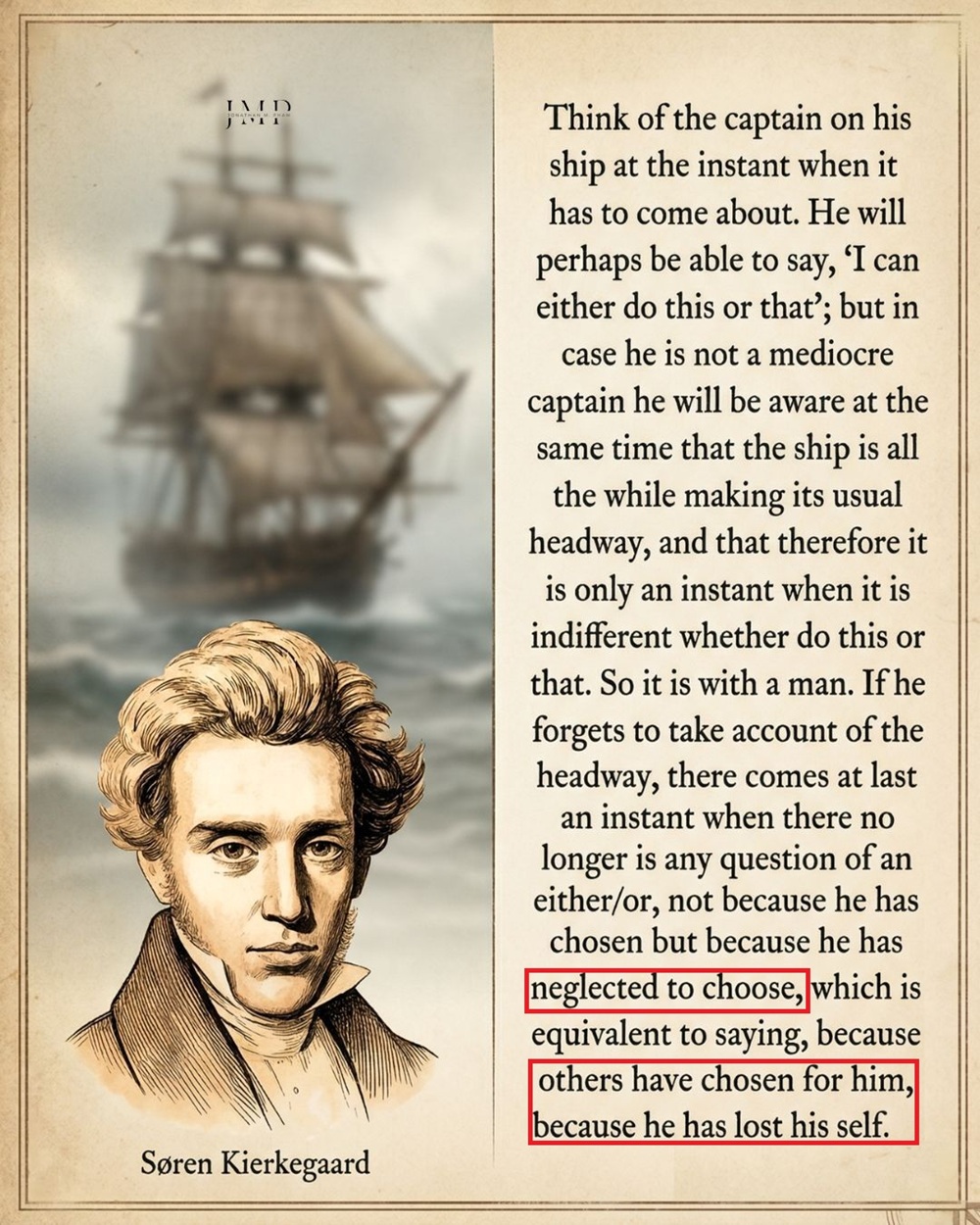
Think of the captain on his ship at the instant when it has to come about. He will perhaps be able to say, ‘I can either do this or that’; but in case he is not a mediocre captain he will be aware at the same time that the ship is all the while making its usual headway, and that therefore it is only an instant when it is indifferent whether he do this or that. So it is with a man. If he forgets to take account of the headway, there comes at last an instant when there no longer is any question of an either/or, not because he has chosen but because he has neglected to choose, which is equivalent to saying, because others have chosen for him, because he has lost his self.
Søren Kierkegaard
Why is authenticity so powerful
Read more: Are You Living or Just Existing? Let’s Find Out!
The Paradox of Authentic Action
You presume you are a small entity, but within you is enfolded the entire universe.
Hazrat Ali ibn Abi Talib
Previously, we established the idea that the ego is just a “Social Interface”—that our sense of a separate, isolated self is, at its core, an illusion. This brings us to a grim question: If that is the case, why should we do anything at all?
If we are just temporary ripples in the cosmic ocean, why not retreat to a quiet mountaintop? Or worse, why not just fall back into the frictionless void of our smartphones? Why care about the political outrage on our feeds, the struggles of our neighbors, or the trajectory of our own lives if none of it is strictly “real”?
This line of questioning is the precursor to a trap modern psychology refers to as “Spiritual Bypassing.” It happens when one uses high-level spiritual concepts—like non-duality, emptiness, or the illusion of the self—to avoid dealing with unresolved emotional issues, psychological wounds, and the responsibilities of human life.
On the surface, it sounds “enlightened”—like someone crossing their arms and saying, “If it’s all an illusion, then your suffering, your rights, and your struggles don’t really matter in the grand scheme of things. Just let it go.”
And yet, a truly integrated view of the world acknowledges an undeniable paradox: while the self MAY be an illusion, the experience of suffering is entirely REAL within that illusion.
The Lucid Dream metaphor
To understand how we must act in this world—and why authenticity is not only possible but necessary—imagine you are fast asleep in your bed, having a vivid, lucid dream. In this dream, you are walking down a street, and you see a person being brutally beaten by a group of attackers.
You know with absolute certainty that you are dreaming. You know that the street, the attackers, and the victim aren’t real. They are all just projections of your own subconscious mind.
Do you stand by, cross your arms, and say to the victim, “It’s okay, don’t cry, this is just an illusion”?
No. You run over and stop the beating.
Why? Because as long as you are in the dream, the pain is the currency of the dream.
To the person experiencing the beating, the pain is absolute. The terror is absolute. The fact that it is happening within a temporary, illusory framework does not negate the visceral reality of the suffering.
This realization is the bridge between deep spiritual philosophy and everyday moral action. Think back to the computer screen metaphor above: just because the files and folders on your desktop are “just a UI” doesn’t mean you shouldn’t care if a virus deletes them.
We do not fight for justice, practice kindness, or strive for authenticity because we believe our egos are the center of the universe. Rather, we do it because we recognize that we are sharing this dream with billions of other “nodes in the network,” and their pain is just as real as ours.
Yes, the separate self might be an illusion. But the responsibility we owe to one another in the messy trenches of this shared reality is deeply real.
Note: For those who are curious, the above-mentioned idea is actually a foundational pillar in several major philosophical, psychological, and spiritual traditions—namely The Two Truths Doctrine (Satyadvaya) of Mahayana Buddhism, Adi Shankara’s Vyavaharika (Relative Reality), among others.

A more holistic understanding of authenticity
If the self is a “Social Interface,” then authenticity is not about digging beneath the code to find a hidden, “real” person. It is about the integrity of the interface itself.
Authenticity is the refusal to use the “illusion of self” as an excuse for dishonesty or apathy. It is the commitment to showing up in this shared reality with a transparent User Interface—rather than using it to manipulate, hide, or check out—and acting with honesty, even when it is uncomfortable.
From this perspective, we are authentic when we:
- Stop pretending that we aren’t affected by the dream, that we have no choice (bad faith), or that our actions don’t impact others.
- Intentionally program our “Social Interface” to reflect our core values, rather than letting the crowd run the code for us.
- Embrace the paradox—acting as if our choices matter infinitely, while knowing that we are part of a much larger ocean.
To be truly authentic is to embrace this ultimate paradox. To engage in the lucid dream: moving through the world knowing that your ego is just a temporary avatar, but choosing to care anyway, because the impact you have on the rest of the network is profoundly “real.”
The courage to be is the ethical act in which man affirms his own being in spite of those elements of his existence which conflict with his essential self.
Paul Tillich

What does authenticity mean
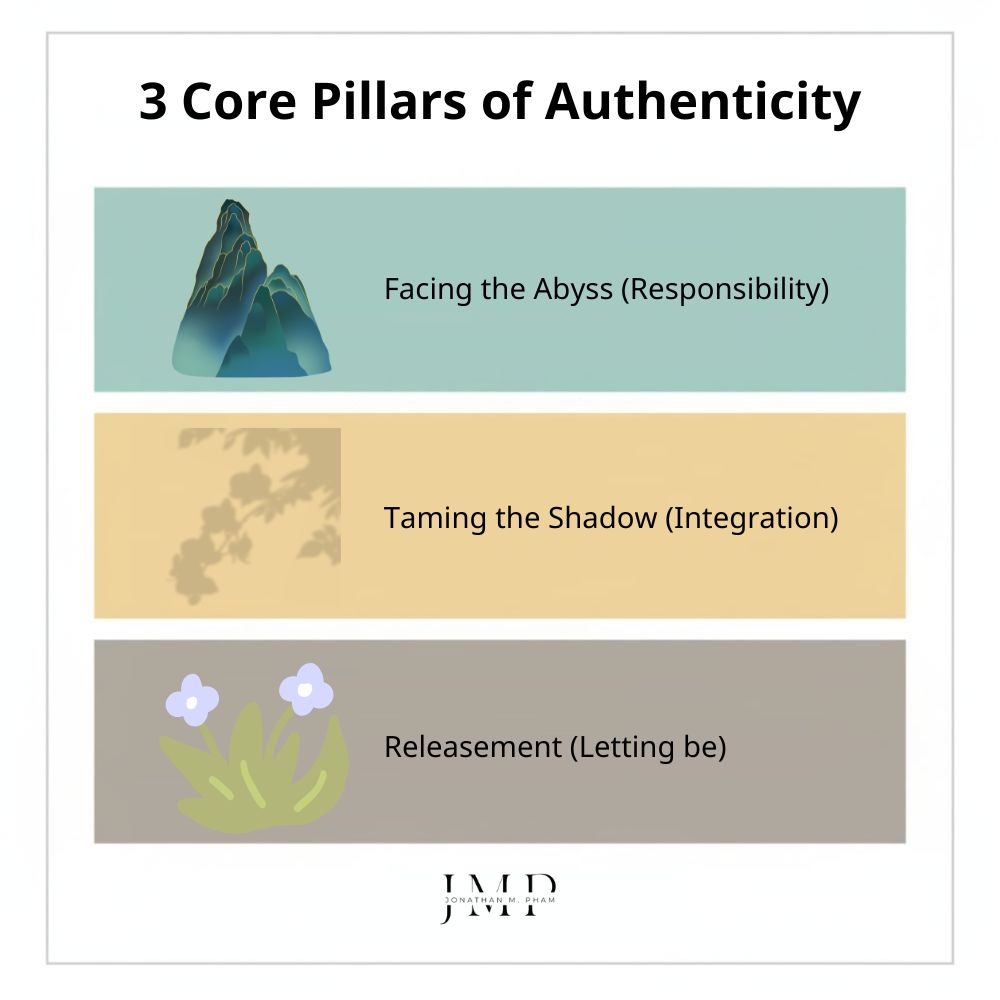
The 3 Core Pillars of Authenticity
If authenticity isn’t a destination we reach by just “being ourselves,” but an ongoing, active practice, what does it look like in real life?
Facing the Abyss (Radical responsibility)
To venture causes anxiety, but not to venture is to lose one’s self…. And to venture in the highest is precisely to be conscious of one’s self.
Søren Kierkegaard
Back in the day, the philosopher Søren Kierkegaard wrote extensively about a psychological phenomenon he called the “dizziness of freedom”. Imagine, he suggested, standing at the edge of a massive, plunging cliff. When looking down into the void, you feel a sudden terror.
If you pay close attention, you will realize it isn’t just the fear that you might accidentally slip and fall. The true terror—the vertigo—is the realization that you could throw yourself off.
In that moment at the edge of the cliff, a terrifying truth dawns on you: you are free. There is no invisible barrier holding you back—no pre-written script you are forced to follow. Rather, you are entirely responsible for your own life, your own choices, and your own ultimate meaning.
That is the “Abyss.” As uncomfortable as it may feel, the only meaningful act is to face it yourself—instead of closing your eyes or running into the comfort of “The They.” (or Das Man, in the words of Martin Heidegger) To embrace self-responsibility. To accept that you cannot blame your parents, culture, or circumstances for the person you are.
Face the facts of being what you are, for that is what changes what you are.
Søren Kierkegaard
Taming the Shadow (Integration)
No tree, it is said, can grow to heaven unless its roots reach down to hell.
Carl Jung
Once we accept responsibility for our existence, it’s time to figure out what to do with the messy, primal parts of our humanity. Or in the words of Carl Jung, to confront and integrate “the Shadow.”
Let us revisit the story of Pi and Richard Parker discussed earlier. From a Jungian psychological perspective, the tiger is a textbook example of the Shadow: the unconscious, animalistic parts of our psyche—the traits we usually find “unacceptable,” like aggression, territoriality, and savage survival instinct. In the case of Pi, Richard Parker represents the boy’s capacity for violence—the horrific things he has to do to survive.
Initially, Pi is terrified of the tiger and tries to isolate him. This is exactly how most of us usually handle our darker impulses—we try to lock them away. To label them as “problematic” and “evil”. To either deny them or despise ourselves for being driven by them. And worse, to project our own feelings onto other people and treat them as “morally inferior”, “inhumane”, etc.—without realizing that the “evil” you see in others also lies within YOU.
If you completely suppress your Shadow—the territorial, aggressive parts of your psyche—you lose the “teeth” needed to navigate a harsh, unforgiving world. What’s more, your Shadow never disappears; it will just re-surface later—much stronger, much more devastating. Before being even aware of it, you yourself have been consumed by your own dark side.

We see this in everyday life all the time. Think of the chronic ‘people-pleaser’ who suppresses their natural frustration to maintain a ‘nice’ persona. Because that anger is never addressed, it festers in the Shadow, eventually leaking out as toxic passive-aggressiveness, sudden explosive rage over something trivial, or deep resentment toward the people they are trying to please.
Therefore, instead of trying to “slay the beast” (as depicted in most stories about “inner demons”), it’s much better to integrate it, by following a simple formula as follows:
- Ego = Boundary
- Integration = The ability to shift that boundary
To integrate/ tame your Shadow is to treat it like a well-trained dog. You care for it and recognize that it has instincts designed to protect you. But you do not let the dog hold the leash. You use its instincts—protection, survival, assertion—only when they are appropriate.
Example: In practice, this means taking a trait like ‘aggression’ and transforming it into ‘assertiveness.’ It is the ability to tap into your “inner tiger” not to attack people, but to demand a fair salary at work, to enforce a strict boundary with a toxic family member, or to stand up for a vulnerable friend. The capacity for destruction is repurposed into the capacity for protection.
To put it simply, you own the tools; the tools don’t own you.
He who fights with monsters should look to it that he himself does not become a monster. And if you gaze long into an abyss, the abyss also gazes into you.
Friedrich Nietzsche
Releasement (Letting be)
Do everything in your human power, and then wait for the decree of heaven.
The final pillar is arguably the most difficult for the modern, hyper-anxious minds to grasp. Not to mention, it seems counterintuitive at first glance—given our previous discussion about self-responsibility.
To better understand it, let us turn to the works of the philosopher Martin Heidegger, who once referred to it using the term Gelassenheit.
Contrary to most people’s expectations, Gelassenheit has nothing to do with passivity or detached indifference. Rather, it means stepping back from the aggressive urge to control, manipulate, and objectify everything.
Usually, we look at the world through the lens of Gestell (Enframing). For example:
- We look at a forest and think, “That is lumber for my house.”
- We look at a social media platform and think, “That is an audience for my brand.”
In other words, we impose our will on reality, trying to force the world into a certain set of neat mental categories.
Gelassenheit—or “releasement”—means letting a thing reveal itself as it is, without forcing it. You let the tree be a tree. You let the person in front of you be a person, not a stepping stone for your own success or a target for your own righteous indignation.
Here are a few examples of what this stance looks like in daily life:
- You let your partner vent about a bad day and listen to them—without immediately trying to ‘fix’ their problem or offer unsolicited advice.
- You love your child for exactly who they are, rather than trying to mold them into the idealized version of who you want them to be.
When we practice Gelassenheit, there will be a fundamental change in our understanding of authenticity. We still act. We still intervene. But we do so with a completely different internal posture. Specifically, we stop acting like the “Lord of Beings”—trying to dominate and optimize the universe—and instead become what Heidegger called the “Shepherd of Being.” (der Hirt des Seins)
A shepherd does not create the sheep, nor do they build the meadow. They simply watch over them, protect them, and keep them in the open.
To be “authentic” in an illusory world is to act effortlessly—in alignment with the “Way” of the world. You do what needs to be done to alleviate suffering, but you surrender your attachment to the outcome.
If we become rich in ourselves, then life will flow through us harmoniously; then possession or poverty will no longer be of great importance to us. Because we lay emphasis on possession, we lose the richness of life; whereas, if we were complete in ourselves, we should find out the intrinsic value of all things and live in the harmony of mind and hear.
Jiddu Krishnamurti
The Challenges of Authenticity in the Modern World
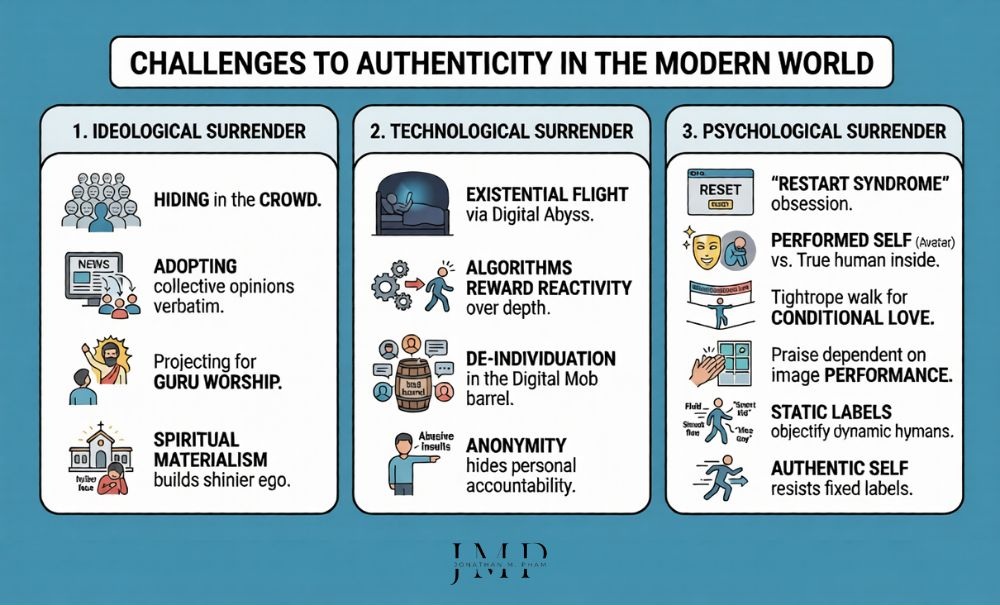
Let’s be honest: living authentically requires a level of moral courage and psychological stamina that most of us simply struggle to maintain on a daily basis. Many times, the weight of the modern world feels so crushing that we end up abandoning our authentic selves just to find a little relief.
Below are a few major traps that threaten our authenticity today.
Ideological surrender: The crowd & the guru
The ‘They’ prescribes one’s state of mind and determines what and how one ‘sees’.
Martin Heidegger
As discussed earlier, embracing our individuality requires us to stand out and forge our own meaning. Because this is terrifying, our first instinct is to look for a “Crowd” to hide in. If we can merge our identity with a massive group, we no longer have to bear the weight of individual choice.
We see this “Institutional Ego” everywhere. In the 19th century, Kierkegaard was known for fiercely criticizing the state church of his time (which he called “Christendom”), noting that people were calling themselves “Christians” simply because they were born in Denmark, not because they had made an authentic, agonizing leap of faith. They had outsourced their spiritual journey to an institution.
The same problem can still be observed today; it happens when people adopt their political opinions verbatim from a partisan news network, or base their entire identity on a corporate job title. “I don’t need to think for myself,” the ego whispers, “because my institution is right.”
Even more insidious is when this surrender takes the form of guru-worshipping or celebrity idolization. Instead of facing the “Abyss” ourselves, we project our need for a savior onto a charismatic leader, a self-help guru, or an influencer. Many elevate them to flawless, god-like status so they can do the heavy existential lifting for us. And if they inevitably fall from grace, we simply pivot to the next anti-guru movement, joining a new crowd of cynics.
The Tibetan Buddhist teacher Chögyam Trungpa coined a perfect term for this trap: Spiritual Materialism. It is the tendency to use spirituality, philosophy, or self-improvement not to confront the ego, but to build a shinier, “holier” ego. To hide one’s lack of authenticity behind a facade of enlightenment, quoting ancient texts while refusing to do the practical work of knowing ourselves.
Since man cannot bear to be left without miracles, he will go and create new miracles for himself… Oh, there will be centuries of free reason, of their science and anthropophagy… Freedom, free reason, and science will lead them into such a maze, and confront them with such miracles and insoluble mysteries, that some of them, unruly and ferocious, will exterminate themselves.
Fyodor Dostoevsky
Authenticity is dangerous and expensive
Technological surrender: The Digital “Abyss” & De-individuation
If most of us remain ignorant of ourselves, it is because self-knowledge is painful and we prefer the pleasures of illusion.
Aldous Huxley
In the past, fleeing into the crowd meant conforming to the rigid social structures of the village or the church. Today, however, that “Crowd” has been mechanized, algorithmicized, and placed directly into our pockets.
The Digital Abyss (Flight from the Self)
Once, I was lying awake at 11:30 PM. The room was dark, save for the cold, blue-white glow illuminating my face. My thumb was moving in a rhythmic, almost involuntary sweep across the glass screen of my smartphone. Up, swipe.
- A hyper-polished influencer telling me how to optimize my morning. Swipe.
- A tragic news story from a continent away. Swipe.
- An advertisement for a brain supplement. Swipe.
I was not really looking at any of it, and yet somehow, I couldn’t look away.
Have you ever caught yourself in this exact moment? It is a strange, out-of-body experience. You are physically present in your bed, but your mind is suspended in a frictionless void.
People often dismiss this “doomscrolling” as a mere byproduct of dopamine loops. But I myself believe at its core, it is an existential flight.
We scroll to numb the background anxiety of our own lives. We stare into the digital “Abyss” so we don’t have to look at ourselves. And this digital void is the “arch-enemy” of authenticity.
The algorithmic “They” (The friction against depth)
Even when we try to be authentic online, the system pushes back. For example, not long ago, I was tired of acting like a “content machine,” writing generic self-help hacks just to chase clicks. I decided to write something deeply authentic on my LinkedIn: a post exploring the Stoic concept of Memento Mori (“Remember you must die”). I wrote about how facing our inevitable end is what strips away the superficial fluff of life and wakes us up to our true purpose.
Yet, when I published it, the algorithm essentially buried the post.
Why? As I figured out, algorithms are designed to reward high-arousal reactivity (outrage, simple hacks, endless success posts), not deep, low-arousal philosophical reflection. They are the modern, mechanized embodiment of what Heidegger called Das Man (“The They”)—the pressure to just do what society does and value what society values.
When you post something people don’t desire to see, you create structural friction. The platforms punish existential depth because it requires users to pause and reflect, rather than react and scroll.
The surest way of ruining a youth is to teach him to respect those who think as he does more highly than those who think differently from him.
Friedrich Nietzsche

De-individuation (The Digital Mob)
In his book The Lucifer Effect, Dr. Philip Zimbardo (drawing from his Stanford Prison Experiment) argued that good people can be induced to commit profound cruelty when placed in a “bad barrel”—an environment that strips away personal responsibility. For instance, in his infamous experiment, college students randomly assigned as “guards” became sadistic, while those assigned as “prisoners” became submissive and broken in just six days.
Social media is the ultimate “bad barrel.” It relies heavily on de-individuation—stripping away our personal accountability by hiding us behind anonymous avatars and the safety of the digital mob. The algorithm rewards us with dopamine when we conform to the outrage of the crowd, and punishes us with social isolation when we step out of line.
When we are de-individuated, it’s just natural that we get disconnected with our authentic moral compass. We become willing to hurl horrific insults at a stranger online—things we would never say to a human face.
The human brain requires activity, challenge. Either that brain is going to be entertained , the entertainment industry is going to take over that brain, as you are being taken over now – sports, cinema, magazines, temples, they are all entertainments – and football, you know, cricket and all the rest of it. Then what is going to happen? Your brain is taken over by the entertainment industry. And it is being done now, of which you may not be conscious of it. And gradually your brain becomes quite dull, if not already. And either you’re going to be entertained, or you turn totally in a different direction, inwardly. If you turn inwardly there is immense, infinite, everlasting security.
Jiddu Krishnamurti

Psychological surrender: The myth of the “Flawless Avatar”
The tragedy of conditional love
We live in an atmosphere of shame. We are ashamed of everything that is real about us; ashamed of ourselves, of our relatives, of our incomes, of our accents, of our opinions, of our experience, just as we are ashamed of our naked skins.
George Bernard Shaw
When I was a kid playing video games, I had a highly frustrating habit: if my character died, I wouldn’t just wait for the respawn timer to tick down. I would rage-quit. I would hit the reset button, wipe the slate clean, and start the entire game over.
For a long time, I thought I was just being “competitive”. Yet looking back, I realize I was obsessed with achieving a “flawless victory.” Because my young brain operated in all-or-nothing terms, a 99% perfect match with a single death was categorized in the exact same mental bucket as a total, humiliating defeat.
This phenomenon—”Restart Syndrome”—is a perfect mirror for how we handle our own egos in the real world.
If you grew up in an environment that heavily praised winning over effort, or in a culture of shame where mistakes were penalized, you likely developed a split within your psyche. To survive, you created a “Performed Self”—an Avatar. This is the version of you that never dies in the video game. It gets straight A’s, pleases the family, never causes conflict, and curates a flawless Instagram grid.
But underneath that Avatar is the “True Self”: the vulnerable human who sometimes fails, gets tired, says the wrong thing, and perhaps wants a life completely different from the one society prescribed.
In a shame-based culture, showing this True Self is dangerous. The community would threaten us with ridicule or ostracization. Hence, we lock our True Self away and send the Performed Self out. We literally stop being authentic because the stakes feel like a matter of life and death.
But this eventually leads to a real tragedy: the tragedy of conditional love.
If you spend your whole life curating a flawless image, you might receive praise, idolization, and respect. But deep down, your brain harbors a dark secret: “They don’t love me. They love the mask I am wearing. If they saw my flaws, they would reject me.”
You cannot feel truly loved or happy if you believe that love is entirely dependent on your performance. It turns life into a constant tightrope walk. You are never actually playing the “game”; you are just afraid of falling off the stage.
Read more: Unconditional Love – Key to Spiritual Transcendence
The trap of static labels
And that’s not all; there’s another danger of the “Performed Self”. As discussed, this Avatar survives by collecting positive labels (e.g. “The Smart Kid,” “The High Achiever,” “The Nice Guy.”)
However, labels are, by their nature, static, while a human being is dynamic. You are a constant flow of choices, always “becoming.”
If I label you a “baker,” I imply that your entire existence is defined by baking. But what about when you are sleeping, loving, crying, or voting?
To label you is to say, “This is who you are, and this is all you will be.” But as a human, you have the capacity to change completely tomorrow. You might be a “baker” today and a “revolutionary” tomorrow.
When you accept a label—even a flattering one—you turn yourself from a free Subject into a fixed Object. You “freeze” yourself in time and hand over your freedom, acting out a pre-written script to satisfy the crowd instead of surprising the world with who you might become tomorrow.
The Avatar loves labels. The authentic self resists them.
What labels me negates me.
Søren Kierkegaard
Less perfection more authenticity
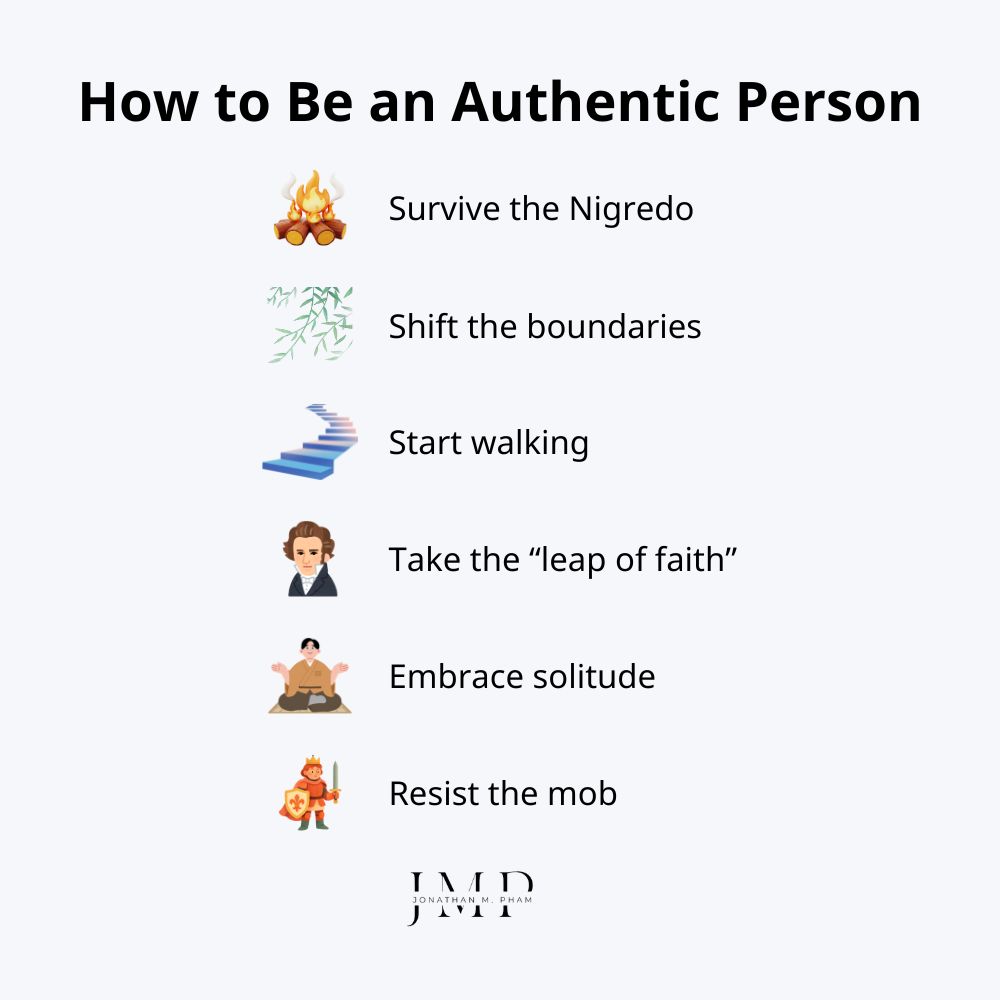
How to Be an Authentic Person
The journey to authenticity requires dismantling our old defenses and learning new ways to act in the world. If we want to reclaim our capacity to care and navigate the “shared dream” with integrity, we must put theory into practice.
Here is a guide to reclaiming your authentic self.
Survive the Nigredo (Let the Avatar die)
When I had nothing to lose, I had everything. When I stopped being who I am, I found myself.
Paulo Coelho
It starts with doing the one thing the ego is most terrified of: voluntarily letting our “Performed Self” take a hit.
In psychological and spiritual terms, dismantling your flawless Avatar is not a peaceful, clinical transition. Quite the opposite: it is brutal, subtractive, and corrosive.
In ancient alchemy, the first stage of transforming lead into gold was called the Nigredo—the blackening, or the rotting. You cannot build an authentic self until you first allow your false self to decompose. Until you undergo what mystics refer to as Kenosis. (self-emptying)

The philosopher Karl Jaspers once talked about a concept called “Boundary Situations” (Grenzsituationen)—experiences such as deep suffering, guilt, or the confrontation with our own flaws, where our everyday world cracks and we realize we are not in control. It is a literal and psychological “shipwreck.”
Just as Pi Patel had his societal conditioning violently stripped away by the sinking of his ship, you too must allow your False Self to shatter in the storm. You must admit that you are just a human being with standard-issue psychological machinery; as such, it’s important for you to drop the illusion of your own absolute “specialness”—and accept your own mediocrity, vulnerability, and flaws.
What this looks like in real life:
Imagine you make a massive, humiliating mistake at work, or you deeply hurt a close friend in an argument. Your internal “algorithm” will instantly try to preserve your heroic narrative. It will urge you to make excuses, blame someone else, or lie to cover it up.
Surviving the Nigredo means resisting that urge. It means looking your boss or your friend in the eye and saying, “I messed up. I was wrong, and I am sorry,” without adding a single caveat.
It may feel excruciating in the moment—like a literal “Game Over” screen for your ego—but that burning sensation is the exact fire required to burn away the mask and forge genuine human connection.
There is a crack in everything. That’s how the light gets in.
Leonard Cohen
Shift the boundaries (The Flexible UI)
Once we survive the Nigredo, the next step is to learn how to properly use our ego. In East Asian languages, there is an incredibly revealing concept called 我慢—pronounced as Wǒmàn in Chinese, and Gaman in Japanese. While the literal translation is “I” (我) plus “slow/arrogant” (慢), the cultural baggage the term carries depends entirely on which border you cross.
- In China (as well as Vietnam and Korea), the term roughly translates to arrogance or ego-inflation. In this case, the ego acts as a wall of pride, pushing outward and declaring: “I am separate, I am better, I am unyielding.”
- In Japan, however, the root concept evolved into a social virtue: the ability to endure the unbearable with silent patience for the sake of group harmony. Here, the ego acts as a shield, pushing inward and declaring: “I will absorb this, I will not break, I will hold the line.”
When I first learned about this difference in terms of interpretation, it totally “blew” my mind. And yet as I thought about it later, I couldn’t help but realize a simple truth:
If we strip away the cultural masks of “good” and “bad,” both are psychologically identical at the moment of action.
Both use the ego to create a rigid, impenetrable wall. Both represent a “refusal to flow.” Pride resists the vulnerability of humility; extreme endurance resists the vulnerability of asking for help.
If your ego is a User Interface (UI), an unauthentic ego is one stuck on a single, rigid setting. It either acts as an impenetrable wall of pride (“I never need help”), or an entirely porous boundary of people-pleasing (“I will endure everything silently to keep the peace”). To be authentic means you must learn to adjust your “settings” based on context.
What this looks like in real life:
Instead of blindly reacting out of habit, you learn to adjust your “settings” based on the situation. You become capable of Gaman (silent, stoic endurance) when your toddler is having a meltdown and the situation requires your patience. But you also allow yourself the Wǒmàn (self-assertion) to firmly say “No” when a toxic employer asks you to work the weekend without pay.
The curious paradox is that when I accept myself just as I am, then I can change.
Carl Rogers
Stop calculating & start walking
There is a famous legend from antiquity about the Gordian Knot. It was an impossibly complex knot tied to an oxcart; prophecy stated that whoever could untie it would rule Asia. For years, the greatest scholars tried to use logic and careful calculation to unravel it, and all failed.
Then, Alexander the Great arrived. He didn’t sit down to study the loops. Nor did he try to untie the knot according to the rules that everyone else had accepted.
He simply drew his sword and sliced the knot in half.
He realized the goal wasn’t to solve the puzzle, but simply to have the knot untied. In cutting the knot, he shifted the problem from the realm of endless complexity to that of decisive action.

Today, many treat authenticity (and many other problems) like the Gordian Knot. We sit in our rooms, paralyzed by existential overthinking. We read endless self-help books, take personality tests, and try to logically deduce our “True Self” before we dare to make a move.
But this kind of intellectual paralysis will get us nowhere. Only by concrete, tangible action may we find ourselves.
To demonstrate this idea, I would like to bring up another ancient story, concerning the Greek philosopher Diogenes of Sinope. One day, the philosopher Zeno proposed a complex mathematical paradox proving that “motion is an illusion.” According to him, to get from point A to point B you must first go halfway, and then half of that, into infinity. Despite how absurd it sounded, Zeno’s argument deeply baffled many famous thinkers at his time—as well as the academics centuries later.
Yet as Zeno defended his idea, Diogenes did something strange. Instead of debating the math, he simply stood up and walked across the room.
His philosophy—as demonstrated through this act—was Solvitur ambulando (“It is solved by walking.”)
What this looks like in real life:
For the authentic person, “cutting the knot” like Alexander—or “walking” like Diogenes— is not a lazy shortcut; it is the realization that you cannot THINK your way into authenticity. Instead, you must ACT your way into it.
If you are paralyzed by a major life choice—a career change, a relationship, a moral dilemma—stop waiting for a guru or a perfectly calculated spreadsheet to give you permission to live. You discover who you are by making a choice, accepting the consequences, and walking forward despite the uncertainty. Despite how irrational you may appear to others.
If “logic” tells you that you are stuck, but you are currently moving, then that “logic” is a waste of time.
If the “crowd” tells you that humanity is hopelessly divided and cruel, but you can walk outside and help your neighbor carry their groceries, then what they say is just a lie. No matter how many people accept it as “common sense.”
He fell to the earth a weak youth and rose up a fighter, steadfast for the rest of his life, and he knew it and felt it suddenly, in that very moment of his ecstasy. Never, never in all his life would Alyosha forget that moment.
Fyodor Dostoevsky, ‘The Brothers Karamazov’
Take the “leap of faith”
Without risk there is no faith. Faith is precisely the contradiction between the infinite passion of the individual’s inwardness and the objective uncertainty. If I am capable of grasping God objectively, I do not believe, but precisely because I cannot do this I must believe. If I wish to preserve myself in faith I must constantly be intent upon holding fast the objective uncertainty, so as to remain out upon the deep, over seventy thousand fathoms of water, still preserving my faith.
Søren Kierkegaard
If “cutting the knot” gets us moving, the next challenge is figuring out how to navigate the agonizing choices we encounter on the path.
In the 19th century, the philosopher Hegel proposed a system of “Both/And” (Synthesis), suggesting that life’s deep conflicts could be neatly resolved by finding a comfortable middle ground. For example, if you are torn between the risky passion of being an artist and the safety of a corporate job, his “Both/And” system would say: just be a “creative executive.” The conflict is resolved; the tension is gone.
But Søren Kierkegaard fiercely rejected this. He argued that the “Both/And” compromise is actually a psychological trick we use to avoid the weight of our own lives.
- To truly be an artist, you must risk the security of the job.
- To truly be a professional, you must sacrifice the artistic whim.
Instead of the “Both/And”, Kierkegaard championed the “Either/Or.” He believed that by trying to keep all your options open—by trying to be “both”—you are actually being “neither.” You are avoiding the defining choice.
Today, we call this the Fear Of Missing Out (FOMO). We want the benefits of commitment without the terror of closing doors. But authenticity requires the pain of sacrifice. The choice itself is what forges a “self.”
Without the pain of choosing, you remain a ghost of potential, just another cog in the system.
What this looks like in real life:
Imagine you are trapped in a cycle of endless dating apps, or paralyzed by deciding which city to move to for a fresh start. The algorithmic world encourages you to keep swiping, to keep browsing, to keep your options infinitely open just in case a “better” option comes along.
Taking the leap of faith means intentionally closing doors. It means:
- Deleting the app and committing to the human being sitting across from you—despite their various flaws.
- Signing the lease in a new city and burning your backup plans.
You will never have 100% of the data required to guarantee you are making the “perfect” decision. As such, you must accept that objective uncertainty, step out over the “seventy thousand fathoms of water,” and choose anyway.
At the point where the road swings off (and where that is cannot be stated objectively, since it is precisely subjectivity), objective knowledge is suspended. Objectively he then has only uncertainty, but this is precisely what intensifies the infinite passion of inwardness, and truth is precisely the daring venture of choosing the objective uncertainty with the passion of the infinite.
Søren Kierkegaard

Embrace solitude
To maintain a transparent, flexible “Social Interface,” it’s essential that you regularly step away from the noise of the crowd.
The Trappist monk and philosopher Thomas Merton spent his life exploring this exact tension. Like Kierkegaard, he recognized that society and its institutions force us to adopt a “False Self”—a mask of labels, possessions, and social roles designed to please the crowd. The result is “Mass Men” who follow rules but have no internal life.
However, true solitude is not misanthropy. It does not require one to hate the world or isolate oneself in bitterness.
At its core, it is about creating a sanctuary where one can reach a level of inner stillness, which then allows one to see the world clearly—without being driven by any pressure or selfish desires.
In the context of our “Social Interface,” solitude is the necessary maintenance of your operating system. If you never unplug from the network, your thoughts will inevitably be hijacked by the network’s algorithms, anxieties, and outrage. Hence, you unplug not to abandon the world, but to remember who you are outside of it.
Only by stripping away the noise of the crowd can you return to the “shared dream” and interact with others as an authentic, deeply caring human being.
What this looks like in real life:
In the modern world, true solitude is terrifying. When you are alone, the distractions fade, and you are forced to finally listen to your own unmet needs, guilts, and fears.
However, you must learn to resist the urge to numb that silence. To go for a 45-minute walk—no phone, no podcast, no destination. To sit on your porch with a cup of coffee and simply watch the trees, allowing the initial wave of digital withdrawal and existential boredom to wash over you.
If you can endure that initial discomfort without reaching for a screen to distract you, the static will eventually clear. You will hit a baseline of peace. You will hear your “True Self” speak—in a quiet, steady whisper.
When society is made up of men who know no interior solitude it can no longer be held together by love: and consequently it is held together by a violent and abusive authority. But when men are violently deprived of the solitude and freedom which are their due, then society in which they live becomes putrid, it festers with servility, resentment and hate.
Thomas Merton
Cultivate the Heroic Imagination (Resist the digital mob)
Finally, authenticity is not something we achieve once and keep forever; it is something we must fiercely protect. Given that the situational forces of the modern world—especially the digital world—are so overwhelming, we cannot just passively hope to remain authentic. We have to actively train ourselves to be what Dr. Philip Zimbardo called “heroes-in-waiting.” To cultivate a “Heroic Imagination.”
Being a hero doesn’t always mean running into a burning building. In today’s highly connected, hyper-algorithmic world, everyday heroism is the radical act of maintaining your individuality in the face of the mob. It means maintaining the integrity of your “Social Interface” when everyone around you is surrendering theirs.
What this looks like in real life:
Let’s say you come across a viral video of a stranger making an embarrassing mistake, accompanied by thousands of comments mocking them. The algorithmic “bad barrel” rewards you with dopamine for laughing, sharing, and joining the outrage. The mob practically begs you to dehumanize the target.
Instead of succumbing to “common sense”—to what the “Crowd” does, you can simply take a breath, recognize that there is a real, breathing human being on the other end of that screen, and say “No.” You can consciously choose to scroll past, or even to speak up against the cruelty.
Remember the Lucid Dream metaphor we discussed earlier? To be authentic, in this case, is to move through the chaotic network of modern life, knowing the pressures and the digital mobs are ultimately illusions, but choosing to care anyway—because the way we treat each other within the dream is undeniably real.
As we learn to resist the crowd, we naturally shift from being isolated, reactive users into active, empathetic participants in the world.
When we are able to act freely, we can move away from the isolated perspective of the problematic man (“I am body only,”) to that of the participative subject (“I am a being among beings”) who is capable of interaction with others in the world.
Gabriel Marcel
FAQs about Authenticity
What is a real-life example of authenticity?
Authenticity isn’t about having a perfectly aesthetic life. As we have covered above, it is about honest integration—acting in alignment with your values, even when it is deeply uncomfortable to do so.
Examples of authenticity in real life:
- Acknowledging a massive mistake at work and apologizing without making excuses, or
- Setting a firm boundary with a toxic family member while maintaining your own inner peace.
What is the difference between integrity and authenticity?
While often used interchangeably, these two terms address two different aspects of the human experience.
Authenticity is about internal alignment. It asks, “Am I being true to my actual, unfiltered internal state?” It requires acknowledging all parts of your “UI”—including your messy emotions, shadow traits, and unique desires—without hiding them behind a Performed Avatar.
Integrity, on the other hand, is about external moral alignment. It asks, “Am I doing the right thing according to my values?” It is the adherence to a moral code, ethical principles, or commitments you have made to others.
If you have only authenticity, you might act out every primal urge (e.g., “I yelled at you because I was just being my authentic self!”). If you have only integrity, you might find yourself rigidly following society’s moral rules while repressing your feelings, leading to the “quiet desperation” of the people-pleaser.
The goal is to integrate both: to honestly acknowledge your inner reality (authenticity) while choosing actions that protect and honor the shared dream (integrity).
| Feature | Authenticity | Integrity |
| Core Focus | Inner Truth (Who am I actually?) | Moral Action (What is the right thing to do?) |
| Primary Goal | Self-awareness and transparent expression. | Consistency in ethics and moral character. |
| The “Shadow” (if unbalanced) | Can be used as an excuse for selfish, impulsive, or destructive behavior. | Can lead to rigid perfectionism, self-repression, and the “Flawless Avatar.” |
| The Ideal Synthesis | “I am honest with myself about my darkest anger, but I choose to act with kindness anyway.” | |
How does the authentic self differ from the performed self?
The “performed self” (or Avatar) is a mask created to survive a shame-based culture; it seeks conditional love by striving for perfection, pleasing everyone, and avoiding conflict at all costs.
The authentic self, on the other hand, is your complete, unfiltered reality. It includes your flaws, exhaustion, and true desires, accepting that you are a vulnerable and complex human being who is always changing—always “becoming.”
Man is always something more than what he knows of himself. He is not what he is simply once and for all, but is a process; he is not merely an extant life, but is, within that life, endowed with possibilities through the freedom he possesses to make of himself what he will by the activities on which he decides.
Karl Jaspers
How do I know if a behavior is authentic or not?
Generally speaking, you can use this table of comparison as a source of reference:
| Feature | Authentic Behavior | Inauthentic Behavior |
| Consistency | Actions match words over time. | Behavior changes based on the audience. |
| Accountability | Owns mistakes without excessive ego. | Blames external factors or makes excuses. |
| Boundaries | Able to say “no” to things that don’t align. | Constant people-pleasing or “yes-man” energy. |
| Listening | Engages deeply; doesn’t just wait to speak. | Performs interest to gain social capital. |
If you seek authenticity for authenticity’s sake, you are no longer authentic.
Jean-Paul Sartre
Is authenticity always a good thing?
If “authenticity” is used as an excuse to be cruel, selfish, or apathetic (“I’m just being real!”), then no. True authenticity is not a license to be rude or harm others. Rather, you develop a transparent “Social Interface” that allows you to navigate the world with integrity, taking responsibility for how your actions impact the people around you.
To be free is not to have the power to do anything you like; it is to be able to surpass the given toward an open future; the existence of others as a freedom defines my situation and is even the condition of my own freedom. I am oppressed if I am thrown into prison, but not if I am kept from throwing my neighbor into prison.
Simone de Beauvoir, ‘The Ethics of Ambiguity’
Aside, we also need to be aware that authenticity requires admitting you are a specific, messy individual who cannot be reduced to a perfect rule. If your entire identity is built on “being a good person” (the Moral Law), then a single failure isn’t just a mistake; it’s a total collapse of your sense of self.
What happens when you suppress your authentic self?
Suppressing your true self leads to what philosopher Henry David Thoreau called “quiet desperation.” Unexpressed emotions and darker impulses don’t magically disappear; they fester in your subconscious “Shadow” and eventually leak out as passive-aggressiveness, sudden rage, or chronic burnout.
Is truth the same as authenticity?
Well, it also depend on how you define “truth”!
Let us look back to the story of Life of Pi. At the end of the movie, the audience is presented with a devastating alternative story, in which there was no tiger on the lifeboat. Rather, Pi was the tiger; he killed the cook to avenge his mother. He invented “Richard Parker” because the truth of the savagery he had to commit to survive would have destroyed his psyche.
This brings up a fascinating question: What makes a story authentic? Is authenticity strictly about objective, factual, ugly reality? Or is it about emotional truth?
In the case of Pi, the “tiger story” MAY be factually false, but it is deeply, spiritually, and emotionally resonating with Pi’s internal experience of his trauma.
Authenticity, if interpreted from this perspective, is not strictly about raw, ugly, objective facts. Sometimes, the way our psyche processes and integrates the darkest parts of our reality—finding a way to hold both our gentle, spiritual nature and our primal survival instincts together—is the most authentic truth of all.
Truth is a pathless land.
Jiddu Krishnamurti

Further Resources for the Authentic Seekers
Authenticity quiz
- When I make a mistake, is my first instinct to own the consequences, or do I immediately look for external factors to blame?
- Do I alter my core opinions depending on the social group I am currently sitting with?
- If I knew I could not post about my current goals or achievements on social media, would I still pursue them?
- Can I sit alone in a quiet room for 30 minutes without reaching for my phone or a distraction?
- Am I acting out of a desire to deeply care for my world, or am I acting out of a fear of being rejected by “The Crowd”?
Read more: 60 Existential Questions – A Reflection on Life’s Depths
Authenticity quotes
Check out a full list of quotes about authenticity here!
Authenticity books
- The Ethics of Ambiguity by Simone de Beauvoir (For understanding freedom and responsibility)
- The Courage to Be Disliked by Ichiro Kishimi and Fumitake Koga (For dismantling the need for the Crowd’s validation)
- The Denial of Death by Ernest Becker (For understanding the “Avatar” and immortality projects)
- No Mud, No Lotus by Thich Nhat Hanh (For the Eastern perspective of Interbeing and suffering)
- Man’s Search for Meaning by Viktor Frankl (For choosing your internal posture in the abyss)
Read more: 27 Best Existentialism Books – A Seeker’s Guide to Finding Meaning
Final Thoughts: From a Wall to an Open Door
When we finally draw the sword, cut the Gordian knot of our own overthinking, and step out of the digital void, we naturally find ourselves standing in the sunlight of the real world. However, the real world is not an empty, peaceful mountaintop. It is crowded, loud, and filled with cruelty and suffering.
When we collide with this not-so-beautiful reality, our ego’s first instinct (which is completely understandable) is to rebuild our walls. We are tempted to retreat into what Nietzsche called “Slave Morality”—reacting to the world’s cruelty with a simmering, bitter moral superiority. We want to label ourselves as the pure “good guys” and everyone who disagrees with us as “evil”.
But true authenticity demands a much more courageous path.
To demonstrate what this ultimate expression of an authentic life looks like, I would like to share a piece of philosophical fiction I recently came across. It imagines a conversation between two titans of 19th-century thought: Friedrich Nietzsche (the ultimate skeptic) and Fyodor Dostoevsky (the champion of radical empathy). They are standing before a brutally realistic painting of a rotting, dead Christ—a representation of a cold, godless, silent universe.
Looking at this stark reality, Nietzsche asks Dostoevsky why anyone would ever choose to show mercy, sneering that “mercy” is just a word people use when they are afraid to be strong.
Dostoevsky shakes his head. “No. A word people use when they’re strong enough to be responsible.”
“Responsible to what?” Nietzsche asks. “A silent heaven.”
“To the person in front of you,” Dostoevsky replies, “when heaven stays silent.”
Nietzsche presses him further, asking if he only chooses mercy to feel clean or pious.
“No,” Dostoevsky answers. “To stop chasing clean. To stay human in the mess.”
Finally, Nietzsche delivers the ultimate nihilistic blow: “And what if caring is a lie?”
And Dostoevsky responds in a truly haunting manner:
“Then let it be my lie. If nothing is promised, I refuse to become empty. I choose mercy. Not because it wins, but because it keeps me human.”
View this post on Instagram
This is the climax of the authentic life. If the universe is devoid of objective meaning, and our egos are just temporary interfaces, we must actively, consciously choose the fiction we wish to inhabit. To say “I choose mercy, not because it wins”.
If we can make this choice, there will be a profound transformation within us. Specifically, we transition from the “Self as Wall” to the “Self as Door”.
A door still has boundaries, hinges, and a lock—it knows where it begins and where it ends. But its fundamental purpose is not to divide, but to be open and receive the world.
To be a Door requires vulnerability. You cannot stay human in the mess if you are obsessed with being perfect.
You do not need to have all the answers, and you definitely do not need to untie the Gordian knot of the universe’s mysteries before you are allowed to live.
You just need to draw the sword, step out of the fog of your own overthinking, and walk into the reality of the present moment.
The universe may be silent. The “Crowd” may be loud. The dream may be filled with pain.
But we are here. We are the wave, and we are the water.
Let us choose to stop chasing clean. Let us choose to open the door.
Let us choose radical compassion, not because it guarantees us a reward, but because it keeps us human.
The eye through which I see God is the same eye through which God sees me; my eye and God’s eye are one eye, one seeing, one knowing, one love.
Meister Eckhart

Other resources you may be interested in:
- Christian Existentialism: From Dogma to the Ultimate Reality
- Amor Fati (Love Your Fate): When Existentialism Meets Stoicism
- The Knight of Faith: Believing in the Absurd
- The Übermensch: Nietzsche’s “Overman” & the Sacred Rebellion
- The Absurd Hero: Finding Happiness in the Struggle
Let’s Tread the Path Together, Shall We?

