Ever since the philosopher Friedrich Nietzsche declared that “God is dead“—signaling the collapse of absolute, unquestioned religious frameworks in the modern world—society has, essentially, fractured into two opposing factions: cold scientism on one side and dogmatic fundamentalism on the other.
Both of these poles, if taken to their absolute extremes, make us less than human.
If we abandon faith completely and limit our worldview strictly to what can be proven in a laboratory or measured by an algorithm, we risk falling into nihilism—treating everyone and everything as mere biological data points.
Yet if we retreat into fundamentalism, we are forced to make an “intellectual sacrifice,” shutting off critical reasoning to blindly submit to authority. Worse, history has shown that blind religious faith is a major cause of fanaticism, division, fear, and severe ego inflation. It drives people to idolize the strict dogma itself, rather than actually worshipping the Ultimate Reality.
Fortunately, there is a “third way” that the modern seeker can turn to in order to escape from both of these traps. Its name is philosophical faith.
📌 Key Takeaway
Philosophical faith, as discussed by Karl Jaspers in his book The Perennial Scope of Philosophy, is a type of faith that stems from the conviction that life has profound meaning grounded in a Transcendent Reality, which can be realized through personal reason and authenticity rather than institutional dogma.
Unlike conventional religious faith, philosophical faith rejects absolute monopolies; it promotes reliance on individual existential wrestling rather than historic scriptural obedience. As such, it serves as an antidote to the modern crisis of meaning—an alternative to both secular nihilism and rigid religious fanaticism.
Instead of taking religious myths as literal facts, philosophical faith reads them as “ciphers” (fingerprints of the divine) that point toward a greater Transcendence. This characteristic makes it a crucial bridge between theology and secular spirituality. Even those who do not believe in a personal God can still appreciate it.
According to Jaspers, reason and faith must work together to prevent the latter from devolving into fanaticism, and the former from freezing into empty calculation.
To practice philosophical faith is not about following a set of rules. At its core, it involves an active state of authentic being (Existenz) triggered by confronting the absolute limits of human life.
What is Philosophical Faith?
Formalized in the mid-20th century by the German psychiatrist-turned-existentialist Karl Jaspers—who built upon the foundations laid by earlier thinkers like Immanuel Kant and Søren Kierkegaard—philosophical faith refers to the deep conviction that:
There is a transcendent reality grounding our existence.
If traditional religious faith claims, “I believe because God revealed it,” and science says, “I know because I can scientifically prove it,” philosophical faith takes a different posture entirely. Essentially, its motto is,
“I believe through my own existential reflection, recognizing a reality greater than myself, even though I cannot empirically prove it or dogmatically define it”.
The Architecture of Philosophical Faith
Originally a psychiatrist before becoming a foundational figure of 20th-century existential philosophy, Jaspers lived through the devastation of World War II and witnessed firsthand the horrors that arose when people blindly followed rigid, fanatic ideologies. In 1948, he published The Perennial Scope of Philosophy, in which he explicitly outlined philosophical faith as a “middle path” that can rescue humanity from both empty nihilism and dogmatic fundamentalism.
To better understand Jaspers’ philosophy, let us take a look at two of his fundamental concepts: The Encompassing and Ciphers.
Das Umgreifende (The Encompassing)
When we move through daily life, our brains are trained to focus on specific, tangible objects. Science is fantastic at this. It allows us to put a cell under a microscope, measure the velocity of a falling apple, or calculate a financial spreadsheet.
And yet, as Jaspers argued, relying on science alone is NOT enough to understand the reality of the universe. Any object we study is simply a tiny piece of the world.
For example, imagine you are standing in a vast, sweeping landscape. You can point to the trees, the mountains, and the river in front of you. But what about the horizon?
You can see the horizon, you know it is there, but you cannot walk up and put it in your pocket. As you move toward it, it moves with you. In other words, it is the boundary that contains everything else.
Jaspers described this using the term Das Umgreifende—The Encompassing. It is the ultimate horizon of existence that surrounds both the observer and the observed.
Philosophical faith, according to him, is the inner certainty that this profound reality exists, even though it can never be captured in a test tube or proven by a mathematical equation. An orientation toward “Transcendence“—Jaspers’ preferred word for “God” or the ultimate source of Being, chosen specifically because it avoids the historical baggage usually attached to traditional religious terms.
Chiffren (Ciphers) & the Fingerprints of the Divine
If we cannot measure or perfectly comprehend this Encompassing reality, how do we interact with it? Does it simply remain a blank void?
The answer is no. Jaspers believed that while humanity can never know the ultimate reality directly, it speaks to us continuously through what he called “ciphers” (Chiffren).
A cipher is a symbol of Transcendence. It can be almost anything: a vibrant sunset that stops you in your tracks, a profound work of art or music that moves you to tears, or an act of selfless love between two people. Even the great myths, stories, and rituals of traditional religions are beautiful ciphers.
In a way, you can think of a cipher as a “fingerprint of the divine” left upon the physical world.
And here is where the difference between religious fundamentalism and philosophical faith emerges. A fundamentalist would look at a cipher (for example, an ancient religious myth or scripture) and take it as a literal, objective, historical fact. They mistake the fingerprint for the finger itself, and therefore fall victim to rigid dogmatism and idolization.
A person with philosophical faith, however, learns to read these ciphers. They allow the sunset, the art, or the scripture to point them toward the mystery of the Encompassing, yet they do not force the symbol into a rigid box of literalism.
They embrace the awe and the meaning it provides, while maintaining a respectful and humble distance from the ultimate mystery.
What Triggers Philosophical Faith: Limit Situations & the “Abyss”
Most of the time, people do not willingly choose to step into philosophical faith. We are far too busy. We cruise through our days on autopilot, entirely consumed by paying the bills, chasing social status, or managing the daily routines.
But eventually, every single one of us hits a wall.
Jaspers called these moments Grenzsituationen, or "Limit Situations". These are inescapable human realities: realizing that we are becoming old, facing a terminal illness, losing someone we love, enduring suffering, being trapped in a sudden moral dilemma, or bearing the weight of inescapable guilt.
In these moments, the daily illusions shatter. Science, logic, and our usual coping mechanisms completely fail us, because you cannot “solve” grief or scientifically calculate your way out of mortality.
The Dark Night & the Zero-point
When our intellect hits its absolute limit, we arrive at the “Zero-Point”. In various spiritual traditions, it is referred to as the “Dark Night of the Soul“—a period of profound desolation where all of our previous certainties and comfortable dogmas vanish, forcing us to stare directly into the “Abyss”.
At this Zero-Point, we have to make a choice. Either we collapse into absolute despair and nihilism, or we make an existential leap into philosophical faith.
By choosing the leap, we find a deeper anchor in the presence of the Encompassing.
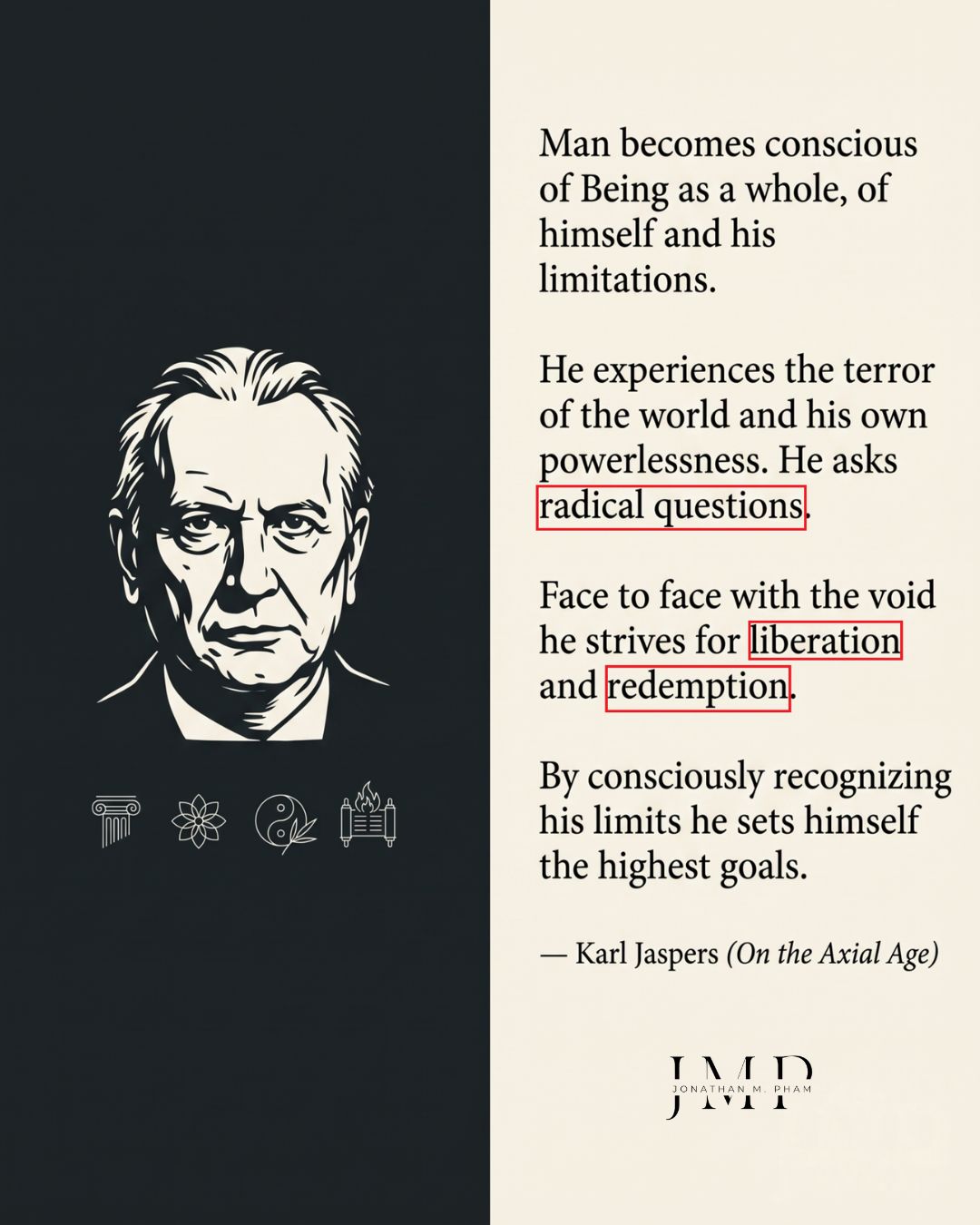
Man becomes conscious of Being as a whole, of himself and his limitations. He experiences the terror of the world and his own powerlessness. He asks radical questions. Face to face with the void he strives for liberation and redemption. By consciously recognising his limits he sets himself the highest goals.
Making this leap results in a change in the very nature of how we live, which Jaspers referred to using the word Existenz. More than just “being alive” or breathing, Existenz means stepping into authentic selfhood—the part of you that refuses to be a mere “cog in a machine”, makes free choices, takes moral responsibility, and actively searches for meaning.
Philosophical faith, therefore, is never just a theory stored in the brain. It is an act of Existenz. The courage to stand at the absolute limit of human endurance, look into the unknown, and still say a defiant “Yes”.
“The courage to be” is the ethical act in which man affirms his own being in spite of those elements of his existence which conflict with his essential self.
Paul Tillich
Philosophical Faith vs. Religious Faith Differences
Religious faith: The yoke of orthodoxy
Traditional religious faith often operates by handing down historical revelations, demanding submission to institutional authority—like a church, scripture, or priesthood—and providing strict doctrines. In essence, dogmatic religion places a period at the end of the sentence. It claims to possess the absolute, exclusive, and final truth about the universe.
While these traditions indeed contain beautiful wisdom, clinging rigidly to them places us under what Jaspers called the “yoke of orthodoxy”. When an institution claims a strict monopoly on absolute truth, it inevitably breeds division, fear, hatred, and fanaticism. Over time, many of its followers fall into severe ego inflation, arrogantly mistaking their own rigid beliefs for the ultimate will of the divine.
Eventually, it leads to a tragic irony: idolization. People end up fiercely worshipping the dogma and the institution, rather than the Ultimate Reality those structures were merely meant to point toward.
Nothing so tends to mask the face of God as religion; it can be a substitute for God himself.
Martin Buber
Philosophical faith: Radical autonomy
Philosophical faith, conversely, replaces the period with a question mark. It prompts people to engage in relentless, open-ended inquiry. Instead of passively accepting truths simply because they were handed down to you by an authority figure, you arrive at them through your own rigorous existential wrestling and reasoning.
Because it requires us to remain humble and open to the unknown, philosophical faith actively promotes reasoning, empathy, personal growth, and ultimately, love.
It is the search for the truth, not possession of the truth which is the way of philosophy. Its questions are more relevant than its answers, and every answer becomes a new question.
Karl Jaspers
A case study: The figure of Christ
To see the difference more clearly, we can look at how both paths view a central historical figure like Jesus. In orthodox Christian faith, Christ is worshipped as the literal Son of God and the exclusive Savior, who offers the one “True Path” to salvation.
Philosophical faith, however, respectfully rejects any claim of exclusive truth as arrogant. Instead, it views Jesus as a “paradigmatic individual”—a profoundly great teacher and a beautiful cipher of Transcendence, but not an exclusive, literal monopoly on the divine.
By removing the demand for exclusive literalism, philosophical faith frees us to deeply appreciate the wisdom of all great traditions without weaponizing them against each other.
To claim either that only Christian miracles are authentic and all the others false, or that they alone are caused by God and all the rest by demons, is a miserable expedient. For it is an arbitrary claim, and hence, the miracles prove nothing. They themselves need to be proven since they receive a stamp of authenticity from the outside.
Simone Weil
Feature
Dogmatic Religious Faith
Philosophical Faith
Authority
Based on historical revelation, scripture, and institutional dogma .
Based on individual reason, autonomy, and personal existential experience .
Posture
Claims exclusive, absolute, and final truth.
Driven by relentless, open-ended inquiry.
Result
Can breed fanaticism, ego inflation, division, and the idolization of rules.
Promotes empathy, growth, radical tolerance, and love.
Philosophical faith vs. Religious faith differences: The question mark vs. The period
Balancing Between Faith and Reason in Philosophy
Given that philosophical faith relies on radical autonomy and subjective experience, the question is: Does this mean we can just believe whatever we want? If we replace dogma with our own inner search, how do we prevent ourselves from drifting into delusion, magical thinking, or irrationality?
This is where we need to strike a balance between faith and reason.
Karl Jaspers used the German word Vernunft to describe a broad, encompassing reason. He insisted that our passionate, existential faith (Existenz) and our logical, critical intellect (Vernunft) must be inextricably bound together. They act as the two wings of the human spirit. If you try to fly with only one, you will inevitably crash.
As we have seen, faith without reason comes with the risk of dangerous fanaticism and superstition. Conversely, reason without faith reduces the mystery of life to a mere biological accident, leaving people stranded in nihilism.
Immanence vs. Transcendence
To understand how these two forces cooperate, we have to recognize the two realms in which humanity simultaneously lives: Immanence and Transcendence.
“Immanence” refers to the physical, measurable universe. It is the realm of objective facts, mathematics, and gravity.
“Transcendence” refers to the ultimate reality beyond the physical—the realm of meaning, spirit, and the Encompassing.
Philosophical faith acts as the bridge between the two. It demands that we live fully and responsibly in the immanent world, respecting its physical laws, while continually orienting our hearts toward Transcendence.
What is meaningful cannot in fact be isolated… We achieve understanding within a circular movement from particular facts to the whole that includes them and back again from the whole thus reached to the particular significant facts.
Karl Jaspers
The critique of Scientism
Because philosophical faith promotes living in the immanent world, it also requires us to be respectful of objective facts. A true philosopher must be fully educated in scientific truths and accept them; genuine faith would never aim to contradict proven science.
At the same time, it also rejects Scientism (or Positivism)—the arrogant belief that only things that can be verified in a laboratory are real.
As discussed, science is magnificent at dealing with the tangible and the probable. It answers the “How”: How do our cells divide? How does gravity work?
And yet, it’s another story when it comes to meaning, which is inherently unquantifiable. Science cannot tell you why you are here. It cannot write a poem, cannot teach you how to act with moral courage, and it certainly cannot tell you how to face your own death bravely.
To sum it up, reason keeps our faith grounded so it does not float away into blind superstition. On the other hand, faith steps in exactly where the limits of empirical knowledge end.
By holding both of them in a loving tension, we protect our minds from dogma while keeping our souls open to the mysteries of existence.
Faith consists in being vitally concerned with that Ultimate Reality to which I give the symbolical name of God. Whoever reflects earnestly on the meaning of life is on the verge of an act of faith.
Paul Tillich
Can You Have Faith Without Religion?
The atheist staring from his attic window is often nearer to God than the believer caught up in his own false image of God.
Martin Buber
The short answer is yes. In fact, philosophical faith is specifically designed for the modern seeker who has difficulty accepting the rigid dogmas of institutional religion, yet still refuses to surrender to cold nihilism.
Now, don’t mistake me. I myself identify as a Christian—specifically, a Christian existentialist. For a believer like me, advocating for faith outside of religion seems contradictory, right? Yet I don’t think so.
True faith, as I have figured, requires deep intellectual honesty. At the end of the day, God—or the Transcendent, the Ultimate Reality—is infinite. The infinite, by definition, cannot be confined within finite human frameworks, human institutions, or human words.
The language, rituals, and scriptures of religions may be incredibly helpful; they provide a vocabulary for the soul. But their role is only to serve as a vessel for us to get in touch with the divine.
To bring up an old Buddhist proverb, “the finger pointing to the moon is not the moon itself“.
In this case, religions are the finger. The Ultimate Reality (God) is the moon.
When we stop reasoning, it’s just natural that we stare at the “finger”—getting obsessed over the doctrines, the rules, and the institutions, while completely losing sight of the reality of the world. This mental trap is exactly the cause of idolization, hypocrisy, fanaticism, and many other contemporary issues.
Because philosophical faith focuses on the essence of the search rather than the form of the religion, it allows for profound moral and spiritual depth outside the walls of any church, temple, or mosque.
Just think about those like Albert Camus. Despite identifying as a staunch atheist who embraced the “Absurd” rather than leaping toward Transcendence, Camus was known for living a life of moral integrity and solidarity with human suffering. In a way, he represented the model of the “saint without God”—a person who lives with heroic empathy, taking full responsibility for their existence without relying on the promise of a reward.
You do not need an institution to have faith. What you need is simply the courage to look at the moon.
Don’t go by reports, by legends, by traditions, by scripture, by logical conjecture, by inference, by analogies, by agreement through pondering views, by probability, or by the thought, ‘This contemplative is our teacher.’ When you know for yourselves that, ‘These qualities are skillful; these qualities are blameless; these qualities are praised by the wise; these qualities, when adopted & carried out, lead to welfare & to happiness’ — then you should enter & remain in them.
Kalama Sutta
4 Steps for Practicing Philosophical Faith
While there is no rigid instruction manual, I believe we can look to the lives and writings of great existential thinkers as a source of inspiration—to see how Jaspers’ framework translates into daily action.
Withdraw from the noise
In the modern world, humanity is constantly bombarded by external authorities telling us what to value, who to hate, and what to believe. Whether it is the 24-hour news cycle, the echo chambers of social media, or the rigid dogmas of an institution, the “crowd” demands conformity.
But a core part of philosophical faith is autonomy. You cannot have an authentic relationship with the Ultimate Reality if you are simply parroting the opinions of a group.
Practically, this means intentionally creating space for solitude—which can be as simple as turning off your phone and taking a walk in nature, or sitting quietly in a room without distractions. Detach yourself from the “yoke of orthodoxy” long enough to ask yourself what you truly believe.
You must become an individual first before you can truly connect with the transcendent.
Belief is no adequate substitute for inner experience, and where this is absent even a strong faith which came miraculously as a gift of grace may depart equally miraculously. People call faith the true religious experience, but they do not stop to consider that actually it is a secondary phenomenon arising from the fact that something happened to us in the first place which instilled pistis into us — that is, trust and loyalty.
Carl Jung, “The Undiscovered Self”
Learn to “let be” & trust
When facing extreme crises or “Limit Situations”—a devastating diagnosis, a sudden job loss, etc.—our immediate instinct is to panic, calculate, and try to force a solution. And yet, instead of listening to that instinct, we should adopt a completely different posture: learning to simply “let be.”
Interestingly, to understand this step, we can look to Martin Heidegger. Historically, Heidegger and Jaspers were close friends who became rivals later in life. While Jaspers advocated for a communicative faith, Heidegger rejected traditional religion and focused instead on a resolute, isolated confrontation with mortality. Despite their rivalry, I believe that their philosophies align—quite surprisingly—on this exact point.
According to Heidegger, modern humans are overly obsessed with dominating the world, treating everything as a resource to be controlled. His alternative was to practice what he called Gelassenheit, or “releasement”. Instead of acting as the lords of the earth, we should try to become “Shepherds of Being“—sitting in silence to listen to the truth of existence and let it unfold effortlessly.
By learning to let go (and stop being concerned with efficiency or perfection), we naturally adopt the meditative posture necessary for philosophical faith to emerge. When we no longer try to dominate reality (Heidegger), we make ourselves open to the “ciphers” of the Transcendent (Jaspers).
If you only withdraw, however, you risk becoming trapped in isolation. True philosophical faith demands that you take your newly centered self back into the chaotic world.
There is probably no better example of this than the French philosopher and mystic Simone Weil. During her life, Weil experienced profound spiritual encounters, yet refused to be baptized into the church—mostly because she recognized that human institutions inevitably create “in-groups” and “out-groups.” To maintain absolute solidarity with the secular outcasts, the doubters, and the suffering, she chose to live permanently on the “threshold” and practiced what she called “unselfish attention”. According to her, giving people one’s absolute, undivided attention when they are experiencing deep suffering (what she called malheur, or affliction) is the highest form of prayer.
In real life, we can do the same thing—in a much simpler manner. When a friend is grieving, just sit with them in silence without offering empty religious clichés (e.g. “Everything happens for a reason”) or trying to “fix” their problem. Love the person in front of you, stand alongside them, and share their burden. Unconditionally.
Creation is, on God’s part, not an act of self-expansion, but a retreat, a renunciation… God denied Himself in our favour to give us the possibility of denying ourselves for Him. This response, this echo, subject to our refusal, is the only possible justification for the folly of love in the act of creation. Religions with this conception of renunciation, this voluntary distance, this voluntary effacement of God, His apparent absence and His secret presence here below … these religions are the true religion, translations of the Great Revelation into different languages. Religions that represent divinity as commanding wherever it has the power to do so are false. Even if they are monotheistic, they are idolatries.
Simone Weil
Embrace the question mark (intellectual humility)
Faith which does not doubt is dead faith.
Miguel de Unamuno
In addition to constant self-questioning, practicing philosophical faith means committing to a lifetime of intellectual humility. Specifically, you must remain open to having your worldview challenged.
If new scientific discoveries contradict your beliefs, you must have the courage (and dignity) to reconsider the “doctrines” and adapt accordingly.
If someone of a different culture or religion has doubts about your own perspective, it’s your job to engage in a “loving struggle” of communication, seeking truth together rather than trying to conquer them.
Philosophical faith is a journey that never truly ends. It requires us to consciously face the unknown, the infinite every day and say,
“I do not know everything, but I still choose to love, to seek, and to live.”
If any man can convince me and bring home to me that I do not think or act aright, gladly will I change; for I search after truth, by which man never yet was harmed. But he is harmed who abideth on still in his deception and ignorance.
In a world that constantly tempts us to surrender our autonomy—either by reducing our lives to cold, verifiable data points or by demanding blind obedience to rigid dogmas—it’s more critical than ever that we adopt a “middle ground”, learning to balance between faith and reason. Through the practice of philosophical faith, we can maintain our individual identity and rational minds without losing touch with the mystery of the universe.
To live with philosophical faith is to adopt the posture that Friedrich Nietzsche called Amor Fati—the love of one’s fate. To willingly look at your life exactly as it is, with all its suffering, limit situations, and unanswered questions, and still say a resounding “Yes!” to it. To accept that life has meaning, even when science cannot objectively prove that.
Treading this path is not easy. It demands that we step away from the illusions of the crowd, engage in vulnerable communication with others, and confront the darkest limits of human existence.
But in taking on the burden, we also discover the true essence of what it means to be alive.
We do not need a monopoly on the truth to love the world. Just look at the endless horizon of the Encompassing, and be brave enough to walk forward.
That is all.
If you call ‘religious’ a man who believes in what I call a Supermeaning, a meaning so comprehensive that you can no longer grasp it, get hold of it in rational intellectual terminology, then one should feel free to call me religious, really.
Hi there! I am a seeker on his path of self-discovery. Since my youth, I have been haunted—and driven—by the fundamental questions of existence: the weight of our choices, the nature of true fulfillment, and the various identities we inhabit. I created this blog to chronicle the insights I have unearthed while navigating the 'absurdity' and beauty of life. My hope is that in reading these words, you will find a reflection of your own struggle—and the courage to 'become who you are.' Please just take what resonates with your soul, and leave the rest behind!