Have you ever directly witnessed or overheard someone shouting that question to another one before?
I certainly have. And honestly, it gives me goosebumps every time I hear it.
We all know instinctively what is being asked. Biologically speaking, the person standing there is perfectly human—flesh, bone, and the standard twenty-three pairs of chromosomes. Yet, the person shouting is not asking for a DNA test or a scientific classification.
Rather, they are questioning the state of the other person’s “core”.
Innately, we feel that being a human being means far more than just occupying a physical form (Homo sapiens); it points to a much deeper layer. One that is philosophical, spiritual, and existential.
These days, the above question has moved far beyond personal conflicts. We are living through an era defined by the rapid AI revolution, hustle culture, and a relentless obsession with metrics. This hyper-productive landscape is triggering a quiet but massive collective existential crisis.
All around the world, people are starting to seriously reconsider what it means to be human.
After all, the anxiety is completely understandable. If an algorithm can paint a picture, write an essay, code a website, and analyze vast amounts of data faster and seemingly better than most of us can, what exactly is our purpose?
If a machine can flawlessly mimic your voice, sentence structure, and daily output, then who exactly are you?
For generations, modern society has encouraged us to tie our identities almost entirely to our work, success, and output. Yet this mindset has resulted in a fragile foundation for a life.
If your identity is tied solely to your productivity, the question is: who are you when you are fired, when you are laid off, or when you reach mid-life and can no longer work at that frantic pace?
If work constitutes your sole identity, who are you when you are simply sitting at the dinner table with your family?
It may sound heartbreaking, but the reality is that we have built a world that tries to turn people into “human DOINGS” rather than “human BEINGS”.
But humanity is not merely a biological status that you passively survive; nor is it a metric of how much you can produce.
To be human is an active state of becoming. It involves a daily, intentional choice to cultivate our core, embrace our vulnerabilities, and remember how to truly live.
📌 Key Takeaway
We are finite biological creatures burdened (and blessed) with an infinite consciousness. Embracing this tension is what gives our lives meaning.
Tying our identity solely to productivity traps us in a psychological prison. True humanity is found in staying true to our “core”, not just chasing a higher output.
To merely exist is to take up space; to be human is to take up responsibility for the world and the people around us.
Our humanity is defined by our relation to others and to the world. We cannot be fully human in isolation.
The Tragedy of the “Human Doing”
To reduce human beings to their utility (“human doings“)—as it is happening on a large scale right now— is to set up a dangerous psychological trap. In fact, we can see it just by looking at the modern corporate world.
Existing, but not “living”
The human brain requires activity, challenge. Either that brain is going to be entertained, or the entertainment industry is going to take over that brain.
Jiddu Krishnamurti
A few years ago, I was working as a “Content Officer” for a previous company. Upon hearing the title, some of you would think of something creative and soul-inspiring, right?
Not exactly.
My days were spent mindlessly copy-pasting data to meet a quota of SKUs. It was literally a data entry job disguised as “content”. Completely robotic. Nothing creative at all.
The same cycle repeated every day—and I stuck to it with the precision of a clock.
Biologically, I was alive. But existentially? I was just a ghost in my own machine. A “mummy” wrapped in layers of routine.
I was obeying orders and collecting my paycheck, but I had absolutely no “fire” inside. The limited hours of my life were being sold for safety.
I was existing perfectly—but had completely forgotten how to live.
This phenomenon of “existing without living” is more than just a personal experience. In fact, it is a structural epidemic in the corporate world.
In Japan, for instance, there is a well-known phenomenon called the madogiwa-zoku (窓際族), which translates to the “window tribe” or “window-sitters”. These are older employees who are no longer considered useful to their company, but due to traditional employment structures, they cannot be easily fired. Instead, they are given a desk by the window and assigned absolutely nothing to do.
On the surface, earning a high salary for zero effort might sound like a dream, or even a “humane” way to treat an aging workforce. Yet for many of these individuals, it is actually a psychological prison. It leads to what is described as “Boreout“—the realization that their skills are obsolete, they are no longer needed, and they have become effectively invisible.
For a generation whose self-worth and social status are inextricably tied to their company, being sidelined is in itself a form of social death. When a worker is moved to the window, their Ikigai—”reason for being”—is stripped away. They wake up, put on a suit, and commute for hours merely to perform the act of “presence”. Surrounded by the silence of their colleagues and a lack of emails, they are constantly reminded of their perceived uselessness. Over time, this chronic under-stimulation leads to a “slow death” effect, increasing the rates of depression, cognitive decline, and physical illness.
The question is: Why don’t these people just quit then?
Here’s the answer. If they leave before the official retirement age, they face a severe drop in their lifetime pension payouts—which essentially forces them to sacrifice their mental health for the family’s financial security. Not to mention, many face a deeply unsettling void because they have no hobbies or friendships outside the office.
Worse, some companies even take advantage of it by placing employees in Oidashi-beya (追い出し部屋), or “Banishment Rooms”. Here, workers are assigned mind-numbing, repetitive tasks—e.g. endlessly searching for errors in an already-checked 500-page manual, or simply sitting in a room to “reflect on their failures”. The deliberate goal is to break their spirit until they voluntarily resign.
As you may see, paying someone to be invisible is NOT humane at all. It may preserve their bank account, but it also completely destroys the person.
It turns them into what is essentially a “living mummy”.
If one wanted to crush and destroy a man entirely, to mete out to him the most terrible punishment … all one would have to do would be to make him do work that was completely and utterly devoid of usefulness and meaning.
Fyodor Dostoyevsky
To survive or to live?
If you were placed in that position—receiving high pay but stripped of all purpose—would you stay for the sake of security, or would you walk away to save your sanity?
As I reflect on this question, I cannot help but recall a masterpiece I saw long ago: Akira Kurosawa’s Ikiru. (i.e. “To Live”) The story follows Kanji Watanabe, a middle-aged bureaucrat who has spent thirty years doing mindless, repetitive paperwork. For decades, he has been physically surviving, but spiritually, he has been “less than a human”—a mummy merely taking up space at his desk.
Then one day, Watanabe is diagnosed with terminal stomach cancer. Forced to confront his imminent physical death, he is struck by the terrifying realization that he has never actually lived. After a desperate search for meaning, he finally discovers his vocation: fighting through the very bureaucratic red tape he helped build to construct a playground for local children.
The scene when Watanabe discovers that vocation, to me, is truly mesmerizing:
The birthday party: In the background, a group of young office workers are celebrating a birthday. They are loud, full of life, and focused on the future.
Watanabe’s awakening: In the foreground, Watanabe is sitting with Toyo, the young woman whose zest for life inspired him. He has just realized that he doesn’t need “more time”—he just needs a purpose.
As Watanabe stands up, his face finally clear and determined, he descends the stairs to leave and begin his work. At that exact moment, the young people in the background burst into a rendition of “Happy Birthday.”
While the song is intended for a young girl in the background, I cannot help but realize that it serves as a subtle hint: that Watanabe is being “born again”—this time as a man of action.
The lyrics “Happy birthday to you” play over the image of a man who is literally dying, yet he is more “alive” in that moment than he has been for the thirty years he spent as a “mummy” at his desk.
What does it mean to be human?
Now, let us go back to the original question. While it may be tempting to cling to a high-paying “window seat” for the sake of security, the choice comes at a grave cost to the human spirit. Biologically, you may be alive and employed, but spiritually, you are missing the very essence of humanity.
Output, efficiency, survival—neither of these are enough to satisfy the soul.
To live as a human being is to touch a much deeper layer of reality. It requires the awakening of something deep inside us—an internal compass that yearns for connection, purpose, and responsibility.
To be Human is to Cultivate the “Core” (心)
In Asian languages, the word for ‘mind’ and the word for ‘heart’ are same. So if you’re not hearing “mindfulness” in some deep way as “heartfulness”, you’re not really understanding it.
Jon Kabat-Zinn
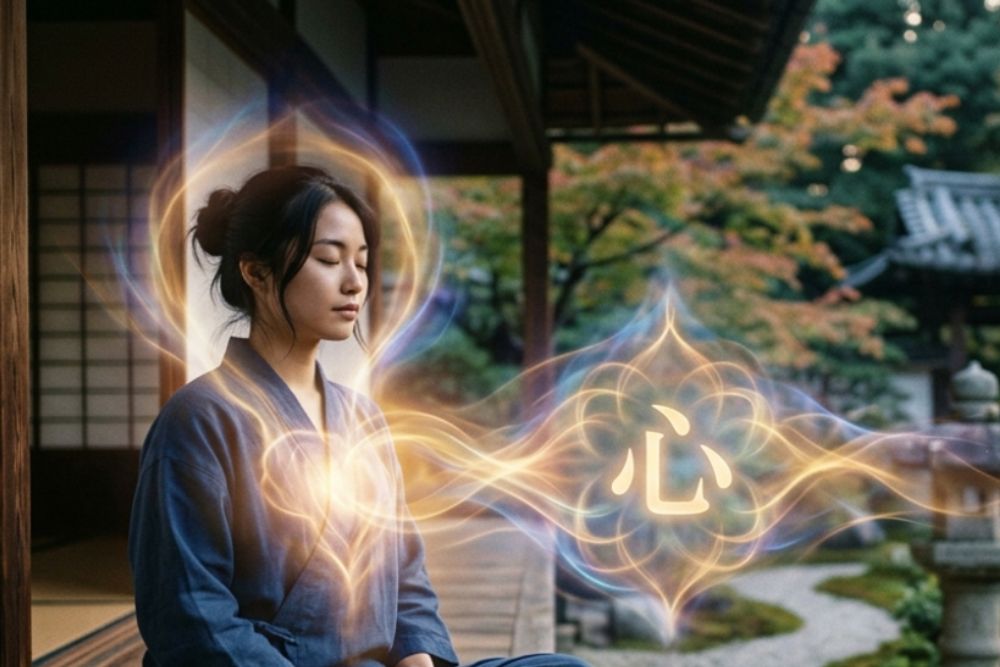
In the Sinosphere countries (China, Japan, Korea, Vietnam, and beyond), there’s a profound concept that, I believe, perfectly captures that essence of the human spirit we have touched upon: the character 心 (pronounced as xīn in China, kokoro in Japan, sim in Korea, and tâm in Vietnam).
The human’s “Operating System”
In English, 心 is typically translated as either “heart,” “soul,” or “psyche”; yet I believe none of them fully capture the nuances of the original term. (“soul” tends to imply a ghost floating inside a machine, while “psyche” sounds highly clinical) Not to mention, Western thought has a long history of separating the “head” (intellect and logic) from the “heart” (emotion and morality); in other words, one can be highly intelligent but completely “heartless”.
On the other hand, 心 in Eastern philosophy is more than just a pumping organ or a fleeting emotion; it is a spatial metaphor for the “center” or “core”. It represents the “Heart-Mind“—the central command center that governs both how we feel and how we think.
To put it simply, 心 is where your deepest intentions, focus, and consciousness actually live.
Because true wisdom requires an aligned Heart-Mind, you cannot be truly “smart” while being utterly heartless. If a person acts with cruelty, they are typically described as “black-hearted” (黑心) or “no-heart, no-lungs” (没心没肺)—meaning they are biologically surviving, but they are completely failing at the act of being human.
The litmus test of humanity
This brings us back to that haunting question: “Are you still human?“. When someone shouts it, they are effectively asking: Is your “core” still intact? Do you still have your Heart-Mind?
The Chinese philosopher Mencius once argued that what separates a human from a beast is not our DNA, but our possession of this core—specifically, the “heart of compassion”. He offered a litmus test as follows: Imagine you suddenly see a toddler teetering on the edge of a deep well. Before logic, before thinking about whether the parents will reward you, you experience an immediate, visceral jolt of alarm and empathy.
If you feel absolutely nothing in that moment, Mencius would say that you lack the “human heart”. (人心) You are missing the very essence that makes you human.
The good news is that everyone is born with this capacity (as Mencius has put it, “Men at birth are naturally good”/ 人之初,性本善). But the bad news is that the modern world constantly tries to bury it. Hustle culture, greed, social media, and the stress of daily survival all act like layers of thick dust settling over our core.
To truly live as a human, therefore, is to actively brush off that dust, so that we may return to our “Beginner’s Mind” or “Original Heart”. (初心)
While the term is rooted in the East, the experience it refers to transcends all cultures. If we strip away the specific languages, we find a “Grand Unified Theory” of the human heart stretching across the globe.
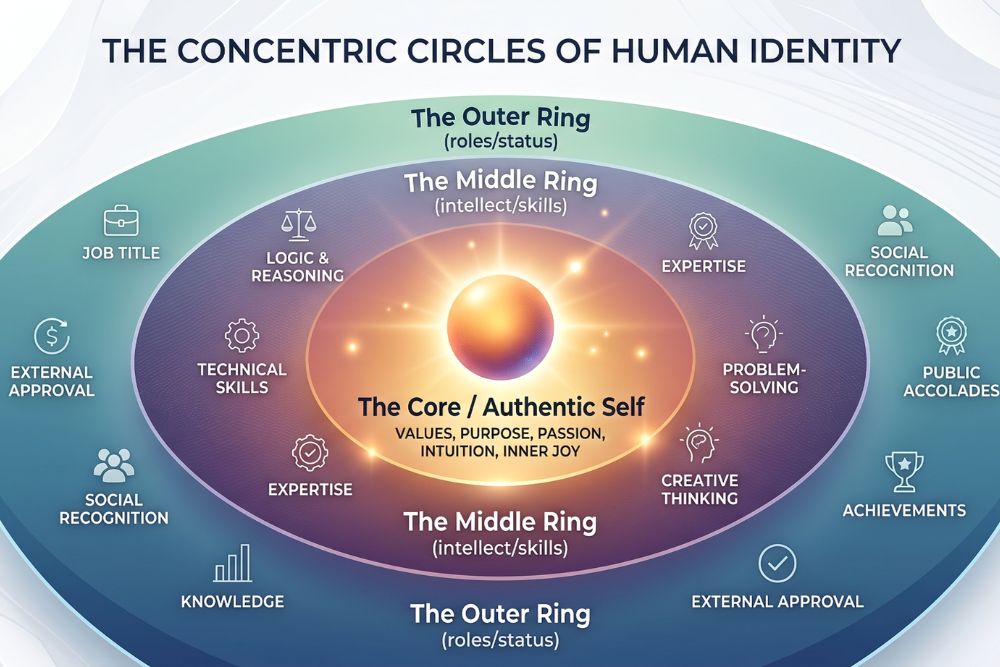
Whether you are looking at Stoicism in ancient Greece, Sufi mysticism in the Middle East, or traditional philosophies across the world, humans are frequently described as a series of concentric circles.
The Outer Ring: Your reputation, job title, clothes, and social status.
The Middle Ring: Your logic, specific skills, and learned knowledge.
The Core: The “Seat of Authenticity” that remains when everything else is entirely stripped away.
This universal core is the biological and emotional “sensor” that anchors us. It is the inner essence that Sanskrit calls Atman, the quality the Romans called Humanitas, and the relational bridge Southern Africa celebrates as Ubuntu. (“I am because you are”)
To be human is to look at another living entity, feel that resonance in your core, recognize, “That is me”, and act from the Center. (心) No matter how chaotic the world is.
What does it mean to be human philosophy
Read more: Being-for-itself – On the Burden & Beauty of Being a Conscious Human
Challenges of Being “Human”: Morality, Language & the Trap of the “Other”
The creatures outside looked from pig to man, and from man to pig, and from pig to man again; but already it was impossible to say which was which.
George Orwell, “Animal Farm”
It is empowering to recognize that we all possess a shared core—a Heart-Mind capable of profound empathy. Yet at the same time, we must also acknowledge a sobering reality: this core is incredibly fragile. If we are not careful, our humanity can be eroded without us even being aware of it.
Regarding this point, I would like us to revisit George Orwell’s novel Animal Farm. In the story, farm animals overthrow their tyrannical human master to establish an egalitarian utopia based on the “Seven Commandments” of justice, equality, and brotherhood. However, as time passes, the intelligent pigs who lead the revolution become intoxicated by power. They slowly succumb to their appetites for comfort and control—symbolized by whiskey, beds, and whips. By the end of the novel, the pigs are already walking on two legs, wearing clothes, and behaving exactly like the cruel humans they once despised.
The spectrum of agency
To me, Orwell’s story serves as a masterful diagnosis of the human condition. Within all of us, there exists a spectrum of agency; specifically, we hold the capacity to be:
The visionary Intellectual Architect (like the pigs),
The incredibly loyal and diligent Provider (like the workhorse, Boxer), or
The Cynical Observer (like Benjamin the donkey, who sees the truth but does nothing because he believes nothing ever changes).
To be truly human is to recognize that we contain all of these capacities, and learn to balance them.
The tragedy occurs when we become “locked” into these roles, losing touch of our complexity and devolving into one-dimensional caricatures. When we stop questioning our own motives and let our appetites override ideals, we experience a moral erosion that breaks our very core.
Language is the house of Being. In its home man dwells. Those who think and those who create with words are the guardians of this home.
Martin Heidegger
One of the most distinctly human things we do is use language to shape our reality. Depending on how we do it, the world can be altered either for better or for worse.
In Animal Farm, the pigs maintain their oppressive control by slowly twisting language.
The final commandment (originally “All animals are equal“) is eventually changed to “All animals are equal, but some are more equal than others“.
The sheep are trained to mindlessly bleat the slogan, “Four legs good, two legs bad,” to drown out any nuanced debate. (ironically at the end, the slogan becomes “Four legs good, two legs better“)
In distorting language, the pigs literally destroy the “house of Being”.
The same phenomenon is playing out in today’s digital age. The modern world—fueled by social media algorithms, political echo chambers, and the 24-hour news cycle—is becoming increasingly polarized and divisive. People lambast each other mercilessly behind screens, falling prey to the “Lucifer effect” where anonymity breeds cruelty. Whether conscious of it or not, most of us are taught to think in terms of “Four legs good, two legs bad“—reducing complex, living human beings into pre-defined essences and rigid labels. Something less than human.
In doing so, we strip away our capacity for critical thought and turn language into merely a tool for propaganda and manipulation.
The ultimate business of philosophy is to preserve the force of the most elemental words in which Dasein expresses itself, and to keep the common understanding from levelling them off to that unintelligibility which functions in turn as a source of pseudo-problems.
Martin Heidegger
The trap named “Us vs. Them”
He who fights with monsters should look to it that he himself does not become a monster. And if you gaze long into an abyss, the abyss also gazes into you.
Friedrich Nietzsche
The tragedy of the pigs (and all other animals in the farm) is that they defined their entire identity in opposition to their “enemy”: the humans. Because their morality was built on who they hated rather than what they valued, they simply filled the vacuum of power and became the mirror image of the oppressor once the enemy was gone.
This is the ultimate trap of modern tribalism. When we become obsessed with ideologies—whether far-left, far-right, religious, or deeply skeptical—we stop seeing the reality in front of us. The people around us are no longer viewed as real human beings; we only care if they belong to the same “Crowd” as us or not. If they praise our “doctrines”, we welcome them; otherwise, we blast them.
In other words, our ability to care for and empathize with others—a core characteristic of humanity—is now replaced with an “Us vs. Them” mentality. The hypnotic chant of the Crowd, as comforting as it may feel, cuts us off the core and prevents us from doing what a decent man would do to the person before them.
When you call yourself an Indian or a Muslim or a Christian or a European, or anything else, you are being violent. Do you see why it is violent? Because you are separating yourself from the rest of mankind.
Jiddu Krishnamurti
The Paradox of Being “Human”
Breaking free from the rigid labels of the crowd and refusing to be a “human doing” is incredibly difficult, largely because human nature itself is deeply unstable and paradoxical.
Finitude vs. Infinitude
Man cannot endure his own littleness unless he can translate it into meaningfulness on the largest possible level.
Ernest Becker, “The Denial of Death”
Here’s the irony: Humans are biological beings anchored in a finite world with an expiration date, yet we possess minds capable of conceptualizing eternity.
Our physical bodies require food, need sleep, and will eventually decay, but our consciousness can ponder the vastness of the cosmos, the abstract concept of justice, and the birth of stars.
Even though our desires, passions, and curiosities know no bounds, we are still trapped within a limited 24-hour day. As such, we have to make choices. And with choices comes anxiety.
Why then? Because to choose one specific path—who to marry, what career to pursue, where to live—is to effectively “murder” a thousand other possible lives we could have lived.
Does that sound a little… disheartening? And yet, I believe that it is exactly this paradox that gives meaning to our existence.
If we were purely finite, we would be no different from any other animal, focused solely on biological survival.
On the other hand, if we were purely infinite, nothing would have value, simply because we would have forever to do everything.
To be human, therefore, is to embrace the tension between our finite nature and infinite potential.
Read more: Immortality Projects – The Psychological Trap of Trying to “Live Forever”
Navigating the Abyss: Kierkegaard and Nietzsche
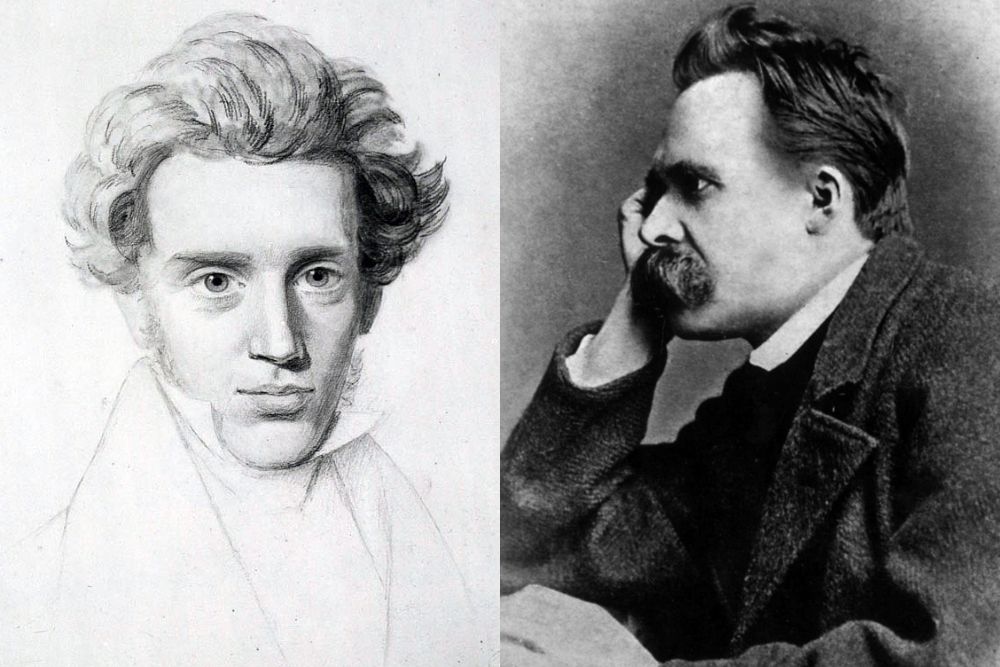
How do we live this paradox without going mad then? I believe we can find the answer by looking to the works of two major existential thinkers: Søren Kierkegaard and Friedrich Nietzsche. Both of them recognized that humans are “synthesis” creatures stuck in the middle, and they offered distinct ways to navigate the burden of our freedom.
Kierkegaard
Kierkegaard believed that leaning too heavily into either side of our nature destroys us. If you focus only on the finite—your career, looks, the daily grind—you become a mere “cog in the machine,” losing your soul to the mundane. But if you retreat entirely into the infinite—living only in detached, daydreaming spirituality—you become a “ghost” who cannot actually function in the real world.
His solution, therefore, was to take the “Leap of Faith“: embracing the utter absurdity of being both mortal and spiritual, and choosing to live with passion anyway.
Nietzsche took a different approach: he proposed a thought experiment called the “Eternal Recurrence”. Imagine a demon visits you in your loneliest moment and tells you that you must live your exact life—every joy, every heartbreak, every boring sandwich—over and over again for all eternity. The question is: would you succumb to despair, or would you say a resounding “Yes!”?
Practicing this mental exercise forces us to sanctify our finite time. It turns our “small” daily actions into matters of infinite importance, challenging us to live a life we would gladly repeat forever.
Read more: The Übermensch - Nietzsche’s “Overman” & the Sacred Rebellion
Despite the differences, both point to the same solution: consciously refusing to let our biological limits dictate our essence, while simultaneously grounding our infinite dreams in the reality of the present moment.
To be human is to actively transcend all fixed labels, and instead engage in a continuous act of creation.
Man is always something more than what he knows of himself. He is not what he is simply once and for all, but is a process; he is not merely an extant life, but is, within that life, endowed with possibilities through the freedom he possesses to make of himself what he will by the activities on which he decides.
Karl Jaspers
Suffering, Mercy, and Responsibility as Part of Being “Human”
Having embraced the paradox of our freedom, it’s time for us to confront a practical question: How do we actually live it out in this “absurd” world—chaotic, unfair, full of suffering?
This is where another ingredient of being “human” comes into play: Responsibility.
The Servant and the Log
There is a classic parable, often attributed to Sufi traditions, that perfectly illustrates the difference between merely existing and truly living as a human being. The story goes as follows:
A wealthy master was hosting a grand wedding feast for his son. Before the event began, he gave his most trusted servant a specific instruction: “Go to the main gate, watch carefully, and tell me exactly how many people attend the wedding today“.
The servant went to the gate, but instead of simply standing and counting, he dragged a heavy, jagged log and placed it directly across the main path leading into the hall. Then, he hid nearby and watched.
For hours, hundreds of wealthy and prominent guests arrived. Some tripped over the log and loudly cursed the “clumsy servants” who had left it there. Others hiked up their expensive robes, grumbling about the poor maintenance, while a few even fell and bruised their knees. Every single person noticed the obstacle because it inconvenienced them, but not a single person stopped to move it. They simply navigated around it and hurried inside to the feast.
Finally, toward the end of the evening, a frail old woman arrived. She stumbled over the log and nearly fell. However, after steadying herself, she did not curse or hurry inside. Instead, she spent several minutes huffing and puffing, using all her limited strength to slowly push the heavy log out of the way so that no one else coming after her would trip.
The servant returned to his master. Hearing the loud music and laughter echoing from the packed hall, the master asked, “So, how many people are at the wedding?”.
The servant replied calmly, “Master, there is only one person at the wedding“.
The moral of the story is as sharp as a knife: To exist is merely to take up space; to be human is to take up responsibility. To consciously care for the well-being of others—and for existence as a whole.
What does it mean to be human?
Taking on the role of the Guardian
This capacity for caring (or Sorge, in the words of Heidegger)—paired with our innate sense of awe and mindful restraint—is the ultimate dividing line between humans, animals, and Artificial Intelligence.
An algorithm can easily calculate the most efficient path around a log.
An animal will instinctively step over it.
And yet only a human can look at the log, know that a stranger might trip in the dark tomorrow, understand what it feels like to be in that person’s situation, and choose to endure temporary physical discomfort to remove the danger.
To put it simply, if other beings mostly only care about whether they COULD do something, humans (Dasein) possess the unique ability to decide if they SHOULD do it.
While AI has the knowledge to generate impressive outputs, only we have the wisdom to decide what to do with them.
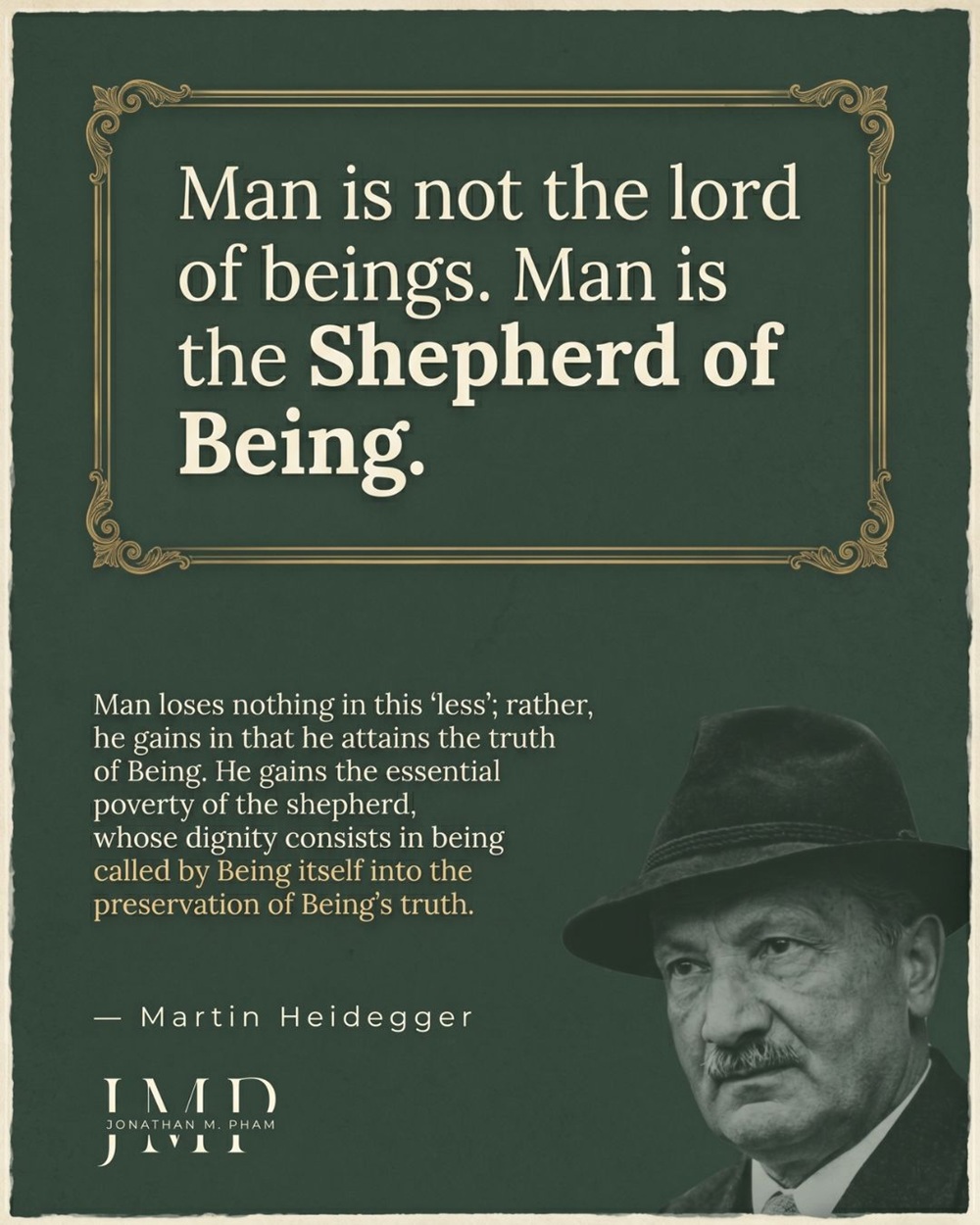
Man is NOT the lord of beings. Man is the Shepherd of Being. Man loses nothing in this “less”; rather, he gains in that he attains the truth of Being. He gains the essential poverty of the shepherd, whose dignity consists in being called by Being itself into the preservation of Being’s truth.
Martin Heidegger
To Be is to Inter-Be
The decision to take responsibility—to consciously move the heavy log out of the path for a stranger—is, after all, not an irrational choice. It stems from the realization none of us exist in a vacuum.
The thread in the web
Humankind has not woven the web of life. We are but one thread within it. Whatever we do to the web, we do to ourselves.
The above texts were once attributed to Chief Seattle (Si’ahl) of the Suquamish and Duwamish tribes, reportedly from a speech delivered in 1854. (though it is now identified as written by screenwriter Ted Perry in 1971) Regardless of its origin, it captures a universal truth about the human condition: we are active participants in a vast, delicate ecosystem rather than isolated “masters” of the planet. Our humanity is fundamentally tied to our empathy for all living things.
If we pollute our environment, we eventually breathe the toxic air that results from what we do.
If we foster division and cruelty in society, we will have to live in the hostile neighborhoods we helped create.
Whatever happens to the ocean, therefore, happens to all of its drops. To survive, we need to actively care for the whole ecosystem.
In the current era—defined by overwhelming news, social media polarization, and seemingly endless crises—the most tempting response is to retreat. To build high walls, lock our doors, and look out only for ourselves.
And yet, if you remain entirely confined within those self-constructed walls, they will eventually crush you.
We see this happening already: the epidemic of chronic loneliness that erodes people’s physical and mental health; the digital echo chambers that, rather than keeping us safe, breed paranoia and sever our ties to reality; and the loss of community resilience when a local crisis strikes and we don’t even know our neighbors’ names.
As tempting as it may seem, withdrawing from the human race is NEVER enough to protect your humanity.
To be fully human requires us to practice what the political philosopher Hannah Arendt called Amor Mundi—a deep ‘love of the world.’ To care for the shared reality we inhabit by committing to the welfare of our neighbors, stewarding the environment, and genuinely ‘being there’ for the person standing right in front of us.
We are individuals, yes, but we are also inextricable parts of a much greater whole.
A person is a person through other persons. None of us comes into the world fully formed. We would not know how to think, or walk, or speak, or behave as human beings unless we learned it from other human beings. We need other human beings in order to be human. I am because other people are.
Desmond Tutu
What defines us as human beings?
Final Thoughts: Where the Angel Meets the Ape
As we have discussed so far, being “human” involves a deeply paradoxical experience. On one hand, we are creatures bound by biology, driven by impulses, and tethered to a finite world. And yet on the other hand, we are also beings touched by something transcendent: we possess minds capable of conceptualizing eternity, hearts capable of deep moral responsibility, and a core capable of immense empathy.
In the words of the author Terry Pratchett, humanity is the place where the “falling angel meets the rising ape”.
To be human is to stand precisely at this turbulent crossroads. To accept our “ape-like” limitations—our physical exhaustion, the need for survival, our inevitable mortality—while simultaneously answering the “angelic” call to cultivate our Heart-Mind (心). To consciously step out of the comforting anonymity of the crowd, recognize the humanity in others, and endure the temporary discomfort of moving the heavy log out of a stranger’s path.
What does it mean to be human?
The next time you feel crushed by the weight of hustle culture, or find yourself slipping into the echo chambers of the modern world, please pause. Place a hand over your chest and feel the rhythm of your own heart.
Remember, you are not an algorithm. Not a metric. Not a “cog in the machine” measured solely by its output.
You are a breathing thread in an interconnected web of existence.
You have the unique capacity—and responsibility—to choose. Choose to cultivate your core. Choose to be the shepherd of your reality. And, above all else, choose to truly live.
In the concentration camps, for example, in this living laboratory and on this testing ground, we watched and witnessed some of our comrades behave like swine while others behaved like saints. Man has both potentialities within himself; which one is actualized depends on decisions but not on conditions.
Viktor Frankl, “Man’s Search for Meaning”
Other resources you might be interested in:
The Curated Self: Why Authenticity on Social Media is Impossible
Hi there! I am a seeker on his path of self-discovery. Since my youth, I have been haunted—and driven—by the fundamental questions of existence: the weight of our choices, the nature of true fulfillment, and the various identities we inhabit. I created this blog to chronicle the insights I have unearthed while navigating the 'absurdity' and beauty of life. My hope is that in reading these words, you will find a reflection of your own struggle—and the courage to 'become who you are.' Please just take what resonates with your soul, and leave the rest behind!