More than 2 years ago, I made a radical decision: walking away from the corporate world—after about 6 consecutive years of climbing the professional ladder. I traded a traditional career path for a life sustained by part-time remote jobs, so that I could dedicate my time to some personal pursuits—which, at that time, included learning a new language and building my own blog.
What followed, as you may be able to guess, was a period of intense, nerve-racking isolation.
For two years, I spent the vast majority of my time in solitude, meeting others only when it was absolutely necessary.
It felt extremely lonely at first; in fact, I thought about returning to the previous path many times. Yet somehow, I managed to stay through until now—for which I am deeply grateful.
Why then? Because it allowed me to see through the illusions I once fell victim to.
During my time in the corporate machine, my cognitive bandwidth was entirely consumed by the relentless demands of the day. Between managing office politics, hitting concrete KPIs, and navigating back-to-back meetings, my brain was continuously occupied.
That corporate environment is, by design, an intentional noise machine. It acts as a buffer against existential dread—as long as you are part of it, you never have to ask yourself the big questions about life. Simply, because there is always another deadline to hide behind.
But when that noise finally died down, something happened.
Stripped of the prefabricated identity of a business card—and left to be completely on my own, I suddenly found myself being flooded with deeply existential thoughts.
To most of my friends out there, the person I have become right now may seem quite strange—a highly philosophical, even somewhat “eccentric” guy who has chosen to tread a separate path. And yet I myself see it differently.
In fact, if it hadn’t been for that radical decision—abandoning the corporate world altogether—I probably wouldn’t have been able to understand the “hustle culture” that quietly permeates modern society.
More than just a toxic workplace trend or a byproduct of a shifting economy, it is, deep down, a type of spiritual sickness. The byproduct of a distorted perspective that treats exhaustion as a badge of honor and burnout as a status symbol—one that conditions individuals to tie their entire identity, self-worth, and dignity to productivity and output.
In succumbing to it, many are—without being even aware of it—devolving from breathing “Human Beings” into mechanical “Human Doings”.
📌 Key Takeaway
- Hustle culture is a toxic mutation of genuine hard work that equates human worth entirely with productivity and output. Fueled by social media slogans that glorify relentless grinding and overwork, this mentality has spread beyond the corporate office into virtually all other domains of life.
- While rooted in the Industrial Revolution, modern hustle culture was amplified by the Silicon Valley tech boom and social media.
- Many individuals fall into the hustle trap believing it brings freedom. People internalize the “boss” mentality, using constant busyness as a shield to avoid confronting their own authentic self.
- Breaking free from the hustle culture requires the cultivation of a perspective that values inner peace, solitude and effortless action over productivity and conventional success.
What is the Hustle Culture?
Before moving further, I would like to make it clear here: rejecting the hustle culture is NOT an endorsement of laziness.
Working hard, in and of itself, is a necessary part of the human experience. When you pour your energy into a craft you love, or when a traditional artisan spends a lifetime perfecting their technique, that effort is deeply meaningful. It is rooted in purpose.
The “hustle” culture, on the other hand, is an entirely different beast. It is the mutated cousin of hard work—fueled by an endless stream of toxic productivity and “toil glamour”. It is characterized by “motivational” phrases and “catchy” slogans we constantly come across on social media:
- “I wake up at 4 AM while my competitors are sleeping.”
- “If you’re not making progress, you’re losing ground.”
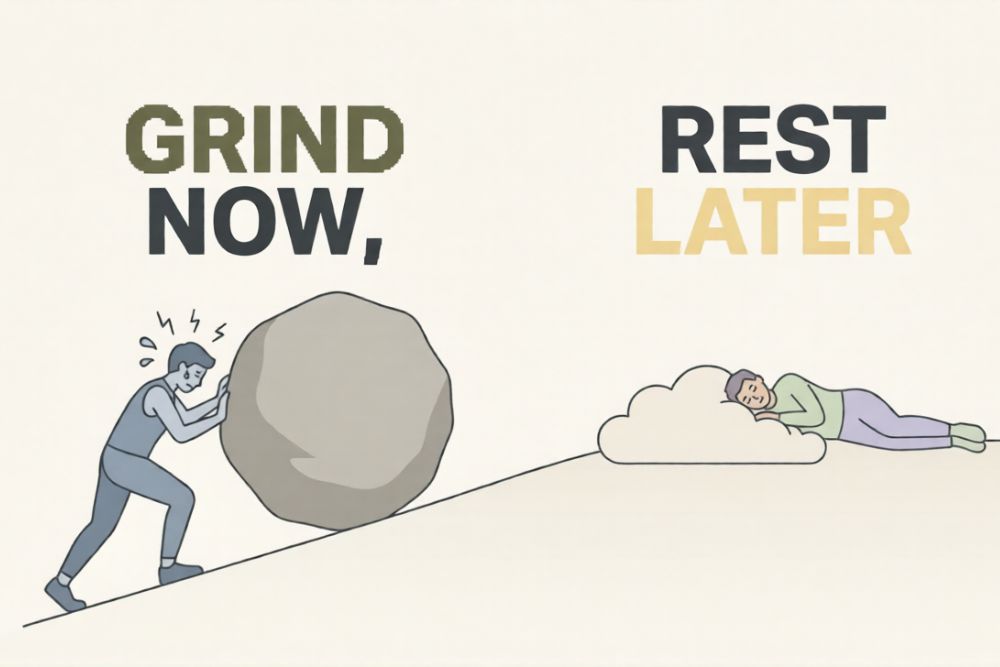
- “Grind now, rest later.”
While genuine hard work asks, “What meaning am I creating?”, hustle culture simply demands, “How much more can I produce?” It convinces you that your intrinsic worth as a human being is directly equal to your productivity.
The Various Faces of the Hustle Culture
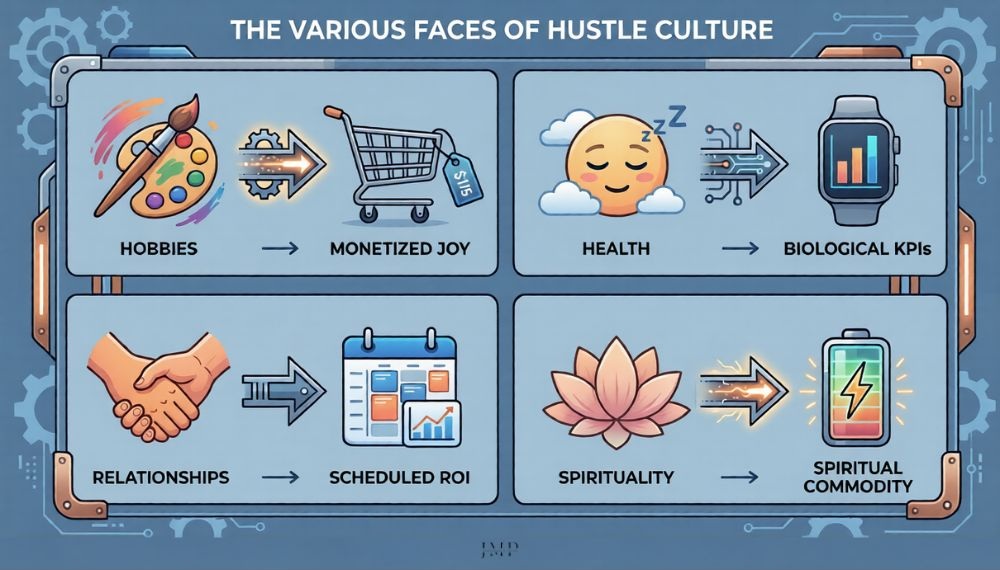
If this sickness had stayed confined to the corporate office, it might have been manageable. Sadly, if we are attentive enough, we should realize the hustle mentality has spilled over into virtually every domain of one’s life.
Personal hobbies
Historically, a hobby was a psychological sanctuary—where one is free to be mediocre, relaxed, and delightfully unprofitable. Hustle culture, however, detests things done purely for joy. These days, many of us are subtly pressured into the “monetization of joy”.
If you enjoy painting, you are told you should be selling your canvases on Etsy.
If you like to bake, you should be launching a weekend catering side-hustle.
The sanctuary is destroyed, replaced by yet another set of metrics and deadlines.
Health & biohacking
Today, health has been hijacked by the hustle under the guise of “biohacking.” Many no longer just rest for the sake of it; we optimize our recovery times using smart rings and sleep trackers. We don’t go for a joyful morning jog; we treat our heart-rate variability and VO2 max as biological KPIs.
In a sense, self-care has been “weaponized” as a productivity hack so that we can be more efficient workers tomorrow.
Read more: 16 Tips for Learning to Love Yourself
Relationships & parenting
Perhaps the most tragic spillover of the hustle mentality is how it commodifies human connection. We “network” instead of making friends. We schedule 15-minute slots of “quality time” with our partners in our digital calendars.
Even parenting is not immune. Children’s innate curiosities are aggressively channeled into “productive” extracurriculars designed to build a competitive resume for future college applications. Love and connection, which are inherently unquantifiable, are forced into the metrics of time management and future return on investment.
Spirituality
When hustle culture meets spirituality, we get what is known as “spiritual materialism”. Instead of offering a refuge from the relentless pursuit of achievement, the modern wellness industry transforms inner peace into yet another commodity to be acquired, optimized, and displayed.
- The mindfulness metric: Meditation is no longer simply about being present; we track our “streak” on mindfulness apps and treat deep breathing as a cognitive performance enhancer.
- Enlightenment as an asset: Yoga and silent retreats are frequently marketed as tools to “recharge” one’s entrepreneurial batteries.
- The cosmic ROI: Manifestation techniques are warped into cosmic business plans, where the universe is treated as a vending machine for material wealth and status.
Read more: Spiritual Crisis – Finding Light in the “Dark Night of the Soul”
The Origin of the Hustle Culture
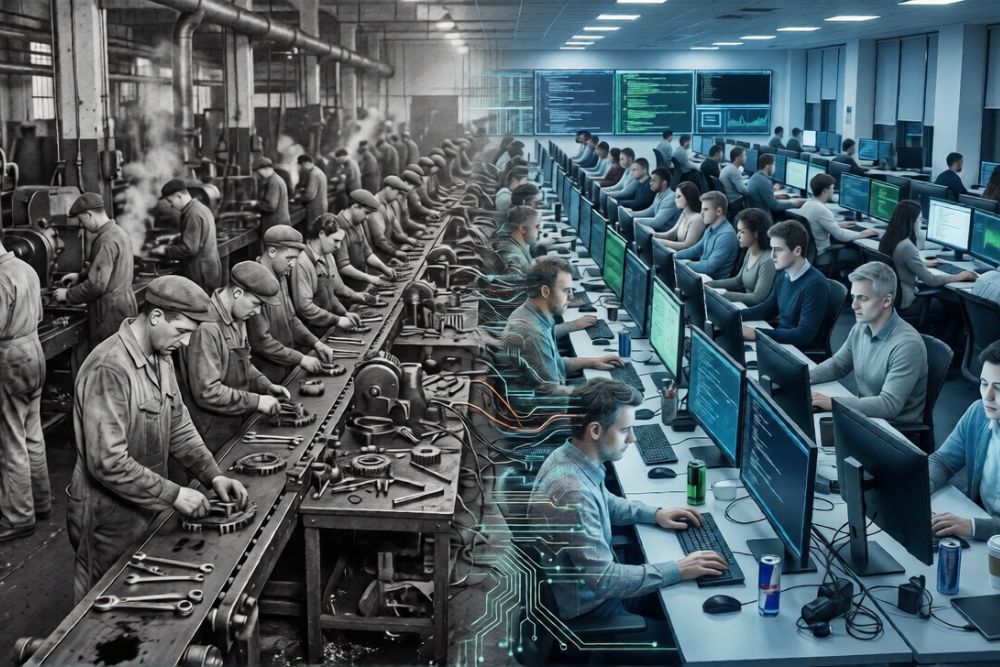
Objectively speaking, the glorification of overwork is not entirely new. Its roots can be traced back to the Industrial Revolution, when humanity first traded the organic, task-based rhythms of nature for the relentless ticking of the factory clock. For the first time, time became money, and output the ultimate measure of a person’s utility.
That being said, the modern hustle culture—the aestheticized brand of toxic productivity we see today—was born much more recently. It is the brainchild of the late 20th-century knowledge economy, heavily amplified by the Silicon Valley boom.
In the early days of the tech era, the cultural narrative around labor drastically shifted. Rather than being viewed simply as a means to put food on the table, work was elevated to a “spiritual calling”. Startup founders working 100-hour weeks in garages were lionized as modern-day prophets. Soon after, the rise of social media and the gig economy democratized this delusion, handing everyone a microphone to broadcast their “grind” and convincing us that the self is a 24/7 enterprise to be managed.
While this evolution took over a century to fully materialize in the West, it hit other parts of the world in a much shorter time frame. In regions like East Asia, societies experienced what sociologists call “compressed modernity”—transitioning from traditional, agrarian lifestyles to hyper-competitive industrial powerhouses in just a few short decades. Without a generational buffer period for the human psyche to process the whiplash, ancient cultural values like filial piety and communal obedience were seamlessly hijacked. They were rebranded into total, unquestioning devotion to the corporate machine.
But human endurance is not infinite. The elastic band can only be stretched so far before it snaps.
In fact, across the globe, we are witnessing a massive psychological recoil. A collective realization is setting in that the utopian payoff promised by the hustle is nothing more than a mirage.
- In China, this exhaustion birthed the “Tang Ping” (Lying Flat) movement—a silent “rebellion” where the youth advocate for doing the bare minimum to survive, actively rejecting the hyper-competitive rat race.
- Similarly, in the West, the phenomenon of “quiet quitting” has swept through the workforce, representing a refusal to sacrifice mental health for the corporate illusion of “going above and beyond.”
The Psychological Traps of the Hustle Culture
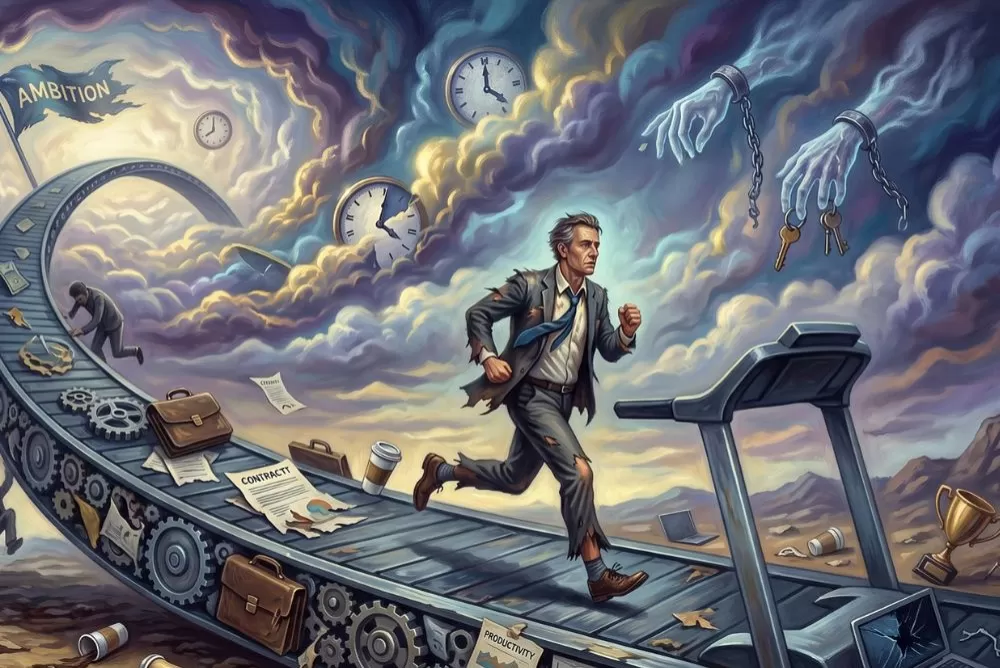
Nobody randomly stumbles into the grind. Far too often, we are just so convinced that the treadmill is actually a path to “liberation” that we end up hailing it fanatically.
The illusion of freedom
I myself was once a victim of the hustle. There was a time when I worked like a madman—juggling a full-time job, two part-time gigs, and learning a new language all at the same time.
That sounds crazy, right? But at the time, I genuinely thought this extreme grind would guarantee me “freedom”—the financial power to buy what I liked, eat where I wanted, and live entirely on my own terms.
But as you might guess, the result was not freedom. Just complete burnout.
I thought I was the master of my life, but in reality, I was acting like a puppet, driven entirely by my own anxieties and unchecked ambitions.
It wasn’t until one rainy afternoon, completely exhausted, that I realized I had finally had enough. That I needed to stop forcing life—and start adopting a contemplative posture. (and in fact, that moment was the catalyst for my decision to quit the corporate world not long later)
The same illusion of freedom, I believe, is currently happening to a lot of people out there. Unfortunately, most have become so numb—or so afraid of losing control, of embracing the uncertainty—that they cannot break free from its grip.
Today as always, men fall into two groups: slaves and free men. Whoever does not have two-thirds of his day for himself, is a slave, whatever he may be: a statesman, a businessman, an official, or a scholar.
Friedrich Nietzsche, “Human, All Too Human”
The self-exploitation propaganda
When you look closely, the underlying rhetoric of modern hustle culture shares a striking structural DNA with the production propaganda of 20th-century authoritarian regimes. Both systems rely on convincing the individual that their worth is entirely tied to their output.
In the past, authoritarian regimes would use hyper-productive citizens (e.g. think about the Soviet miner Alexei Stakhanov) as tools to shame the rest of the populace into working harder.
Today, the modern grind has simply replaced the state-sponsored laborer with the tech CEO or the “grindset” influencer. We are bombarded with figures who brag about 80-to-100-hour workweeks, waking up at 4:00 AM, and sleeping on factory floors. (looking at you, Elon Musk!) In a sense, these “successful” people—widely hailed as “role models” for the younger generations—have reframed extreme exploitation as a moral virtue.
And that’s not all. Here’s the most insidious difference between the two: in an authoritarian state, we work harder because external forces demand it; yet in hustle culture, we become our own warden.
We internalize the propaganda so deeply that we willingly exploit ourselves, tracking our own metrics and optimization on our smartwatches, all while thinking we are chasing personal freedom.
Read more: Objectification – The Anatomy of the ‘Gaze’ & How to Transcend It
Busyness as “bad faith”
Beyond the illusion of control, there is another, much deeper reason. The existentialist philosopher Jean-Paul Sartre once introduced the concept of Mauvaise Foi, or “Bad Faith,” which perfectly explains humanity’s modern addiction to the grind. At its core, to live in bad faith is to hide from the burden of one’s own freedom.
As soon as you pause and step off the treadmill, you are suddenly faced with a terrifying void:
- Who am I if I am not producing?
- What do I actually want to do with this one finite life?
- etc.
Those are overwhelming questions that most people, unfortunately, are not equipped (nor willing) to answer.
Hustle culture offers a convenient escape from them. It provides a pre-packaged script that allows us to use busyness as a shield.
By letting the “script” dictate our choices—just put our heads down, chase the next promotion, and stay perpetually busy—we never have to take responsibility for designing our own authentic existence.
Read more: Are You Living or Just Existing? Let’s Find Out!
Perfection over authenticity
I remember a specific afternoon a few years ago when I was sitting at my desk, updating my LinkedIn profile. I was in full “career management” mode, adding new certifications, tweaking the keywords in my “Skills” section, and polishing my summary to sound as dynamic and professional as possible. I spent an entire hour crafting the perfect sentence to describe a project that, in reality, had been quite mundane.
When I finally clicked “Save,” I sat back and looked at the result. There was my profile, organized into neat bullet points of achievement. Everything looked perfect.
And yet, ironically, looking at that digital avatar of mine, I could not help but feel a gnawing sense of hollowness within:
“Is this me? Is this all there is?”
The person on the screen was efficient, tireless, and always “thrilled to announce” the next milestone. Yet the person sitting in the chair—me—was tired, uncertain, and deeply craving a nap.
Somehow, there seemed to be an uncrossable chasm between the two entities.
It didn’t take long for me to eventually realize why I was feeling that way: I was looking at a curated self, not the true Self. That I was chasing perfection over authenticity.
That’s what is happening in the modern hustle culture. We are all pressured to construct a flawless avatar—a personal brand that operates like a flawless machine. Yet ironically, the more we polish the “mask”, the more the person behind it suffocates.
Read more: Winning at All Costs – Pitfall on the Path to Success
Hustle culture psychology
The Existential Costs of the Hustle Culture
To play the role of the flawless, endlessly productive employee may feel tempting initially, but eventually we will have to pay the toll. And the cost is, sadly, more than just physical fatigue.
Dehumanization
The greatest hazard of all, losing one’s self, can occur very quietly in the world, as if it were nothing at all.
Søren Kierkegaard, “The Sickness Unto Death”
In the 19th century, the philosopher Søren Kierkegaard argued that a human being is a delicate synthesis of the infinite (their spiritual nature and boundless possibilities) and the finite (the concrete, worldly reality). When these two are thrown out of balance, one falls into a state he called “despair.” (or in his words, the “sickness unto death”)
Hustle culture systematically plunges people into this despair—which occurs when a person becomes so consumed by the secular world that their existence is reduced to cold numbers: net worth, follower counts, KPIs, working hours, etc. When that happens, the individual falls into a state of “de-individuation”: losing their own uniqueness and becoming swallowed by the collective machine.
When one’s survival and self-worth are tied completely to productivity, it’s just natural one starts acting like machinery: cold, detached, emotionless.
On the surface, you may function perfectly. Yet deep within, you have become a “fractional human being”—one who has forgotten what it means to actually exist outside of external validation.
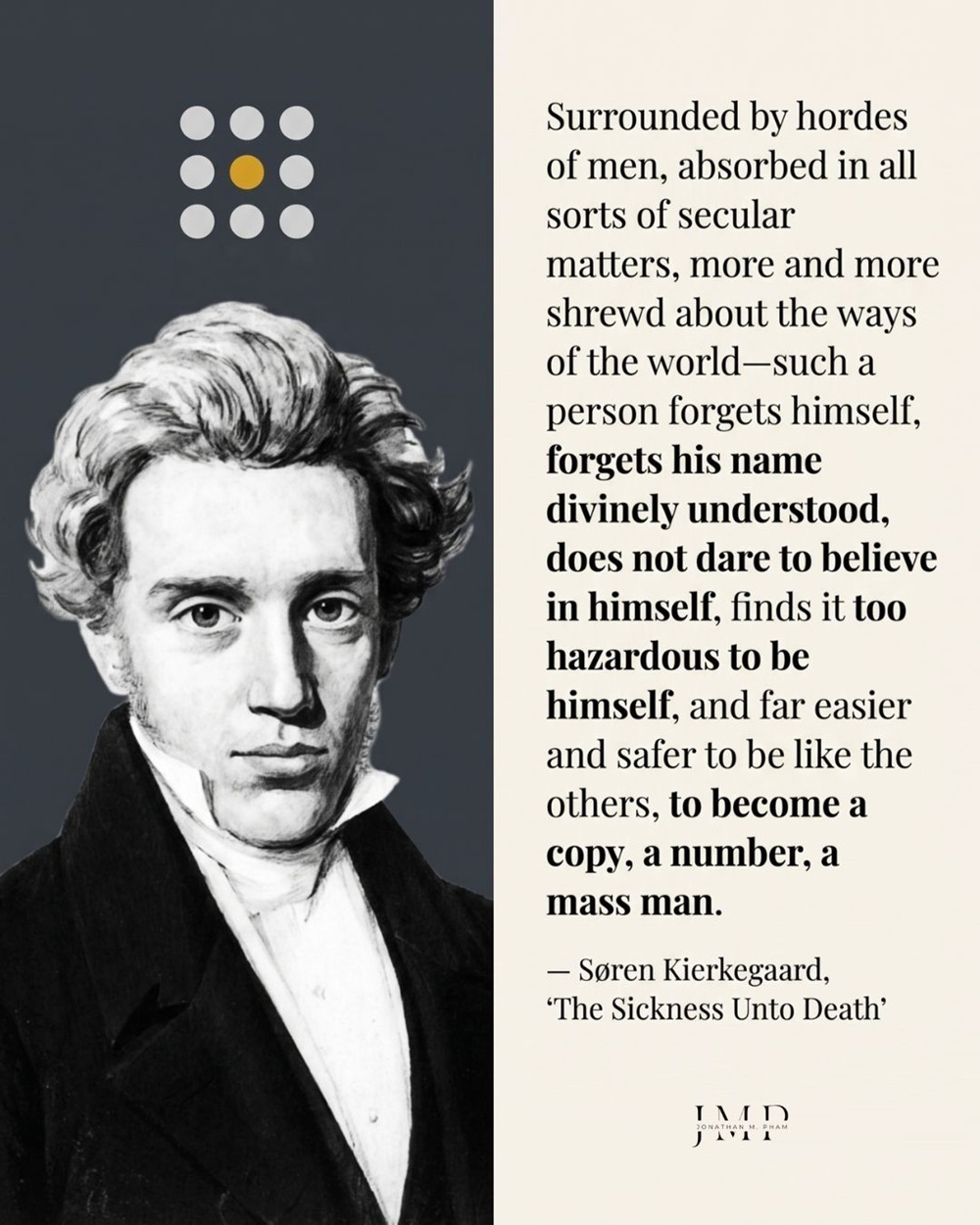
Surrounded by hordes of men, absorbed in all sorts of secular matters, more and more shrewd about the ways of the world—such a person forgets himself, forgets his name divinely understood, does not dare to believe in himself, finds it too hazardous to be himself, and far easier and safer to be like the others, to become a copy, a number, a mass man....
Søren Kierkegaard, "The Sickness unto Death"
Burnout justified: The internalized boss
And that’s not all. According to Kierkegaard, the “sickness unto death” is, at its core, the agonizing state of wanting to die but being unable to. It is the torment of the self trying to destroy itself, yet being hopelessly trapped with itself.
If you look closely, you should see that this unsettling concept perfectly maps onto the psychological anatomy of modern burnout. When your whole self-worth is tied to productivity, you will inevitably hit a wall. You desperately want to escape the pressure of the “hustle,” but you find that you cannot, because you have internalized the boss.
To put it simply, you are simultaneously the slave and the master.
The “death” you crave in this state is simply a moment of rest, a chance to finally stop. But the capitalist conditioning you have absorbed into your own psyche refuses to let you lay down the work.
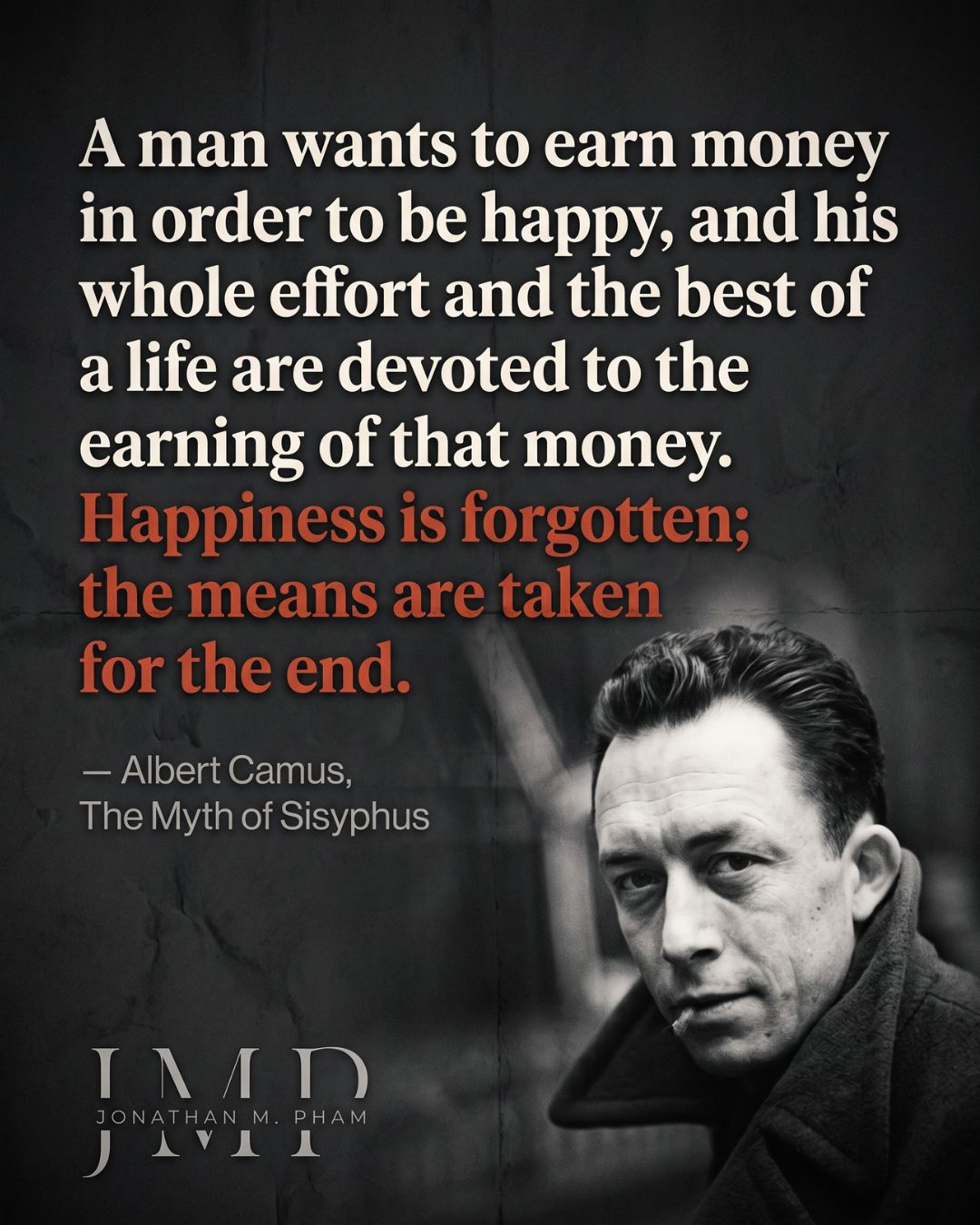
A man wants to earn money in order to be happy, and his whole effort and the best of a life are devoted to the earning of that money. Happiness is forgotten; the means are taken for the end.
Albert Camus, “The Myth of Sisyphus”
Emotional dryness & the death of connections
Hustle culture frequently promises us that if we just work hard enough, we can guarantee a beautiful life for ourselves—as well as for the people we love. Yet at the same time, it systematically strips away the very bandwidth required to emotionally resonate with them.
Authentic human connection is fundamentally inefficient. It requires slow, unstructured, “unproductive” time. But when your nervous system is chronically red-lined by corporate stress, it loses the capacity to sit quietly, listen and connect deeply.
I myself see this paradox constantly among many of my friends—professionals who look successful on the surface, but are inwardly perpetually distracted, constantly irritated, and severely short-tempered. Given that the daily grind has stripped them of the capacity to be truly present with others, they resort to a tragic compromise: “buying connection”. Specifically, they:
- Send expensive gifts to their parents instead of making the time to call them directly.
- Claim they have to work harder to afford elite private schools and luxury vacations for their children.
- etc.
This is the economy of “guilt compensation”. Because they work too much, they substitute genuine human presence with expensive material compensation.
Rather than working hard to fund a life, they are only funding a life to justify the hard work.
Constant endeavor to be something, to become something, is the real cause of the destructiveness and the aging of the mind.
Jiddu Krishnamurti
Why hustle culture is toxic
Hustle Culture & the AI Crisis
For years, hustle influencers convinced us that if we just woke up earlier, automated our workflows, and treated our minds like software, we could achieve ultimate security. And yet, the recent rise of generative AI tools—capable of churning out code, articles, designs, and data analysis in fractions of a second—has completely flipped the script.
Suddenly, the irony is laid bare: by training ourselves to become hyper-efficient processors, we were only preparing for a competition we were destined to lose.
If our entire worth is based on efficiency and output, AI will inevitably trigger our obsolescence.
If we are nothing more than the sum of our deliverables, then a software update can effectively erase our purpose overnight.
The panic we feel when looking at modern AI isn’t just about losing our jobs. It’s the realization that we have built a society where we don’t know how to value a human being who isn’t producing.
Yet, this existential crisis also holds a strange kind of “mercy”. By completely shattering the illusion that human value is tied to speed and volume, technology is stripping away our excuses to keep grinding.
In a sense, the rise of AI has, ironically, become a wake-up call. It forces us to confront a humbling truth: we cannot out-produce algorithms.
If machines can “hustle” better than us, then it’s time for us to stop “running faster”, and instead admit that we were never meant to be machines in the first place.
Idleness, we are accustomed to say, is the root of all evil. To prevent this evil, work is recommended…. Idleness as such is by no means a root of evil; on the contrary, it is truly a divine life, if one is not bored.
Soren Kierkegaard
How to Break Free From the Hustle Culture & Reclaim Your Soul
Once we recognize that the machine is designed to consume us, the question becomes: how do we actually break free?
Escaping the gravity of the grind does not necessarily mean you have to quit your job, move to a cabin in the woods, and completely disconnect from society. (though in my case, I did do something similar, and it was definitely worth it!) Most importantly, it has to do with a “revolution of the mind”: intentionally reclaiming your cognitive space and deciding that inner peace is worth more than productivity.
-
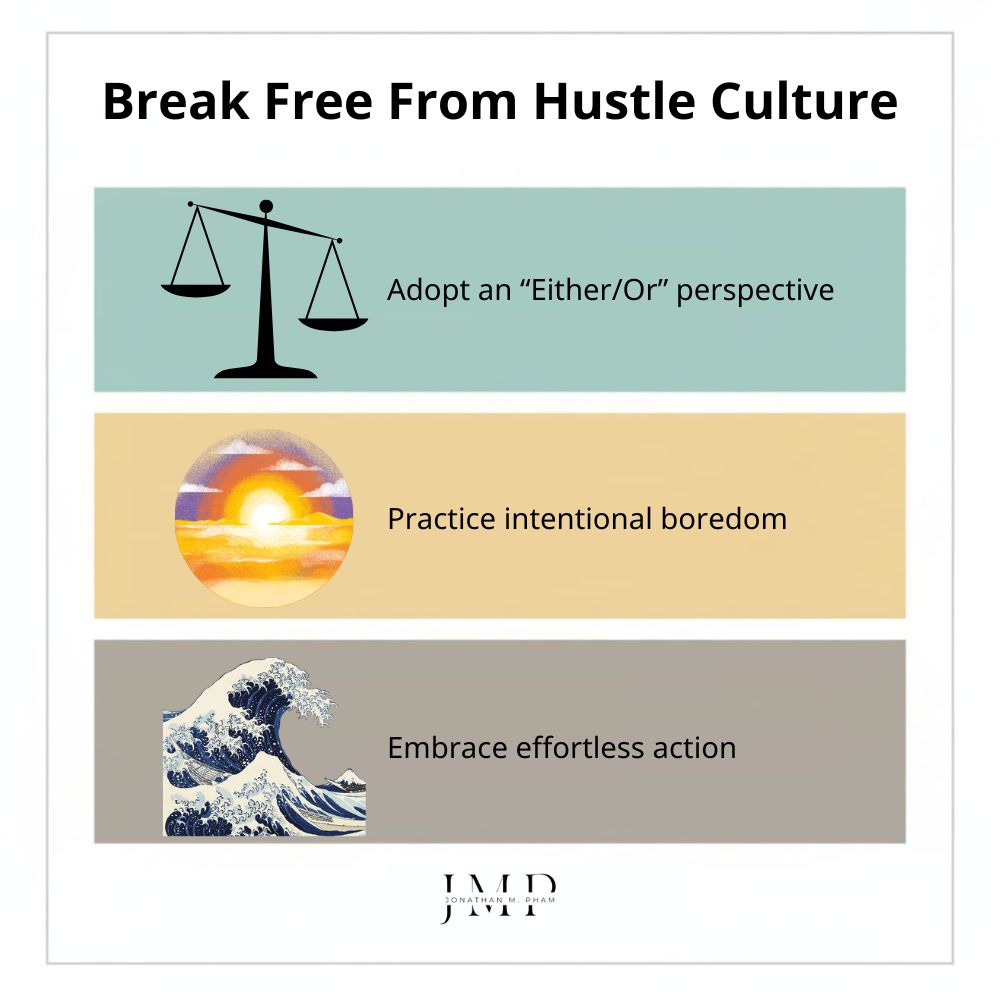
Adopt an “Either/Or” perspective (Learn to prioritize)
As mentioned, modern hustle culture positions constant busyness as a status symbol. It promotes the illusion that everyone else is working 24/7, making millions, staying fit, and reading a book a week.
When you absorb that illusion, FOMO (Fear of Missing Out) inevitably kicks in. You feel like the moment you log off, the market will change, a new trend will explode, or your peers will surpass you.
To combat this anxiety, you turn to the ultimate source of validation and information: your phone. You need to “stay informed” to soothe the panic of falling behind.
And this is where the cycle bottoms out. Driven by FOMO, you open your feeds to check in, but the algorithms are designed to keep you there. Before being even aware of it, you get sucked into a vortex of bad news, hyper-successful influencers, market crashes, and political chaos.
“Just five more minutes…”, you whisper to yourself. And then that “five minutes” becomes two hours, leaving you exhausted and filled with uncertainty in the end.
Does that sound familiar?
It’s a toxic feedback loop, designed to keep our attention permanently hijacked.
The media world constantly demands that we do more, be everywhere, and witness every global tragedy in real-time. It wants us to believe that we can—and should—have a side hustle, a perfect social life, flawless mental health, and up-to-the-minute news awareness all at once.
When the algorithm tries to give you everything, everywhere, all at once, drawing a hard line is often the only way to protect your sanity. In other words, we need to adopt an “Either/Or” perspective—and let go of the illusion that we can multitask our way through existence.
For example, when it comes to resting, you are either entirely on the clock and producing, or you are aggressively doing nothing. There is no gray zone.
Trying to answer “just one email” while watching a movie with your family means you inevitably fail at both working and resting.
Embracing the “Either/Or” mindset requires the acceptance of a fundamental truth: missing out is simply the price of peace. You will leave money on the table, and you will miss out on social accolades. But the trade-off?
You will win your life back.
Read more: How to Take a Leap of Faith – Trusting Intuition Over Logic
-
Practice intentional boredom
If you want to improve, be content to be thought foolish and stupid with regard to external things.
Epictetus
A few years ago, I visited a barbershop to get a haircut. While waiting for my turn, my hand, instinctively, reached out for the phone in my pocket. It was a phantom urge, a muscle-memory reflex seeking a quick hit of dopamine.
But as I was about to pull it out, I suddenly looked around and noticed something unsettling.
Every single person in the room—both the waiting guests and the staff who were on a break—was staring down at a screen.
In that moment, I could not help but feel a strange sense of shame. Immediately, I slid my phone back into the pocket and sat there silently.
To be honest, it felt quite awkward: doing nothing while everyone around was scrolling. And yet, I knew, deep down, that I made the right choice.
We have been conditioned to believe that sitting quietly with our own thoughts is a waste of time, or worse, something to feel guilty about. However, the truth is that our brains desperately need idle time to decompress, process information, and simply rest.
When we constantly look at our screens, the physical world completely fades away. We lose the textures of the room, the rhythm of human murmurs, and the spaces where creativity actually breathes.
We use the smartphone as a pacifier to soothe the slight discomfort of being alone with ourselves.
However, it is precisely within that “awkward” silence—the space where nothing is happening—that the mind heals.
Practicing intentional boredom means resisting the urge to optimize every spare second. It means:
- Standing in a grocery line without checking notifications
- Riding the subway while just looking out the window, or
- Sitting on a porch without a podcast playing in your ears.
When you allow yourself to be bored, you are sending a message to your own subconscious: I do not need to be entertained, productive, or stimulated to have value right now. Over time, it will gradually build a wall against the prevalent hustle mentality.
I have done without electricity, and tend the fireplace and stove myself. Evenings, I light the old lamps. There is no running water, and I pump the water from the well. I chop the wood and cook the food. These simple acts make man simple; and how difficult it is to be simple!
Carl Jung
-
Embrace effortless action
Ultimately, the goal of “rebelling” against the hustle culture is to transition from a life of frantic forcing to that of graceful flowing. Or, as it is referred to in Daoist philosophy, to attain a state of Wu Wei. (無為, which translates to “effortless action” or “non-doing”)
Now don’t assume that to be the same as laziness. Rather, Wu Wei means moving in harmony with the natural flow of the universe, free from all mental friction.
Think of a dog lying in a patch of sunlight, or chasing a ball in the park. The dog doesn’t sit around overthinking its purpose, mourning yesterday’s mistakes, or trying to optimize its afternoon. It exists entirely in the present moment.
Humans, despite being superior to other creatures in terms of intellectual, fail miserably in this aspect. Mostly because we are so preoccupied with constantly categorizing life into rigid mental concepts like “success” versus “failure,” or “productive” versus “wasted” time. We exhaust ourselves trying to micromanage everything.
To practice Wu Wei is to, like the carefree dog, drop all of those labels. By letting go of our obsession with control and output, we align ourselves with the natural pace of human life.
Instead of trying to dominate the moment, we now finally allow ourselves to experience it.
Read more: 8 Tips for Finding the Beauty in Everyday
FAQs
Is hustle culture inherently good or bad?
While passionate effort and the pursuit of mastery are deeply fulfilling parts of the human experience, hustle culture itself is inherently toxic. It crosses the line from purposeful work into performative workaholism. It demands that you sacrifice your physical health, mental peace, and genuine relationships for the sake of endless optimization and manufactured dissatisfaction.
Does hustle culture actually lead to success?
It may lead to superficial markers of success, like a higher tax bracket or an impressive job title; however, it rarely guarantees happiness. In fact, the constant grinding mindset it promotes often traps people in the Arrival Fallacy—the false belief that reaching a specific destination will finally bring lasting joy, only to find the goalposts have moved once they get there.
In prioritizing relentless productivity over well-being, hustle culture frequently trades sustainable, holistic fulfillment for chronic burnout and fractured relationships.
Why do we feel guilty when we are not being productive?
Because we have fully internalized the demands of the hyper-capitalist machine.
As mentioned, hustle culture brainwashes us into equating our intrinsic self-worth with our quantifiable output. When we are conditioned to believe that every second of the day must be monetized, optimized, or filled with content, sitting quietly or enjoying unstructured rest feels like a moral failure.
Read more: Immortality Projects – The Psychological Trap of Trying to “Live Forever”

Final Thoughts: Returning to the “Child”
If hustle culture is the sickness, the cure begins with a fundamental shift in how we view our place in the world. For long, society has taught us to act as the “Lords of the Earth”—viewing our time, relationships, and even our own bodies as raw resources to be extracted, managed, and monetized. We mistakenly believe that being able to dominate the environment and conquer every waking second of our day would grant us freedom.
And yet, how can we call it freedom when we are acting out of a desperate thirst for external validation?
To be truly liberated, we have to stop trying to conquer our schedule or maximize our output. To step back and realize that we do not need to dominate life in order to live it.
Rather, what we need to do is to return to a state of mind free from all the heavy conditioning of the corporate machine. To become what many philosophers refer to as the “Child”—working, creating, and playing strictly for the joy of the moment itself, completely detached from algorithms, performance metrics, and the need for applause.
After all, we were never born to be data points in a tech company’s quarterly report, nor were we built to be self-regulating wardens of our own exhaustion.
When you finally put down the metrics, delete the curated avatar, and step off the treadmill, you will finally be ready to live as yourself. Free from all of the superficialities of the modern grind.
The meaning of life is just to be alive. It is so plain and so obvious and so simple. And yet, everybody rushes around in a great panic as if it were necessary to achieve something beyond themselves.
Alan Watts
Other resources you might be interested in: