A few years ago, I sat at my desk crafting my LinkedIn profile for roughly one hour. I added certifications, tweaked my skills, and polished my summary until I sounded like an “unstoppable professional”.
But when I clicked “Save,” strangely enough, I didn’t feel proud at all.
The avatar staring back at me from the screen was efficient, tireless, and perpetually “thrilled to announce” the next big thing. But the actual person sitting in the chair was being overwhelmed by a chilling sense of alienation and bone-deep exhaustion.
As I thought about it later, I realized that the feeling stemmed from a gap between my True Self and this new “Curated Self.” I was spending energy playing the role of the perfect professional. And in the process, I was slowly forgetting who I actually was.
In the words of the existential philosopher Jean-Paul Sartre, I was living in bad faith. I was dutifully striving for a version of myself that didn’t actually fulfill me in the present. And the result? I devolved from a Human Being to a Human Doing.
Most of us do the same thing every day—treating our life as a mere stepping stone for a better “someday”. Instead of living in the “here and now”, we constantly aim for something more. We tell ourselves that happiness is a destination just over the horizon—that the next promotion or the next achievement will finally bring the peace of mind we are currently sacrificing.
But psychology tells us a different story: the horizon is just an optical illusion.
In our endless chasing of a moving finish line, we are simply falling victim to an insidious mental trap known as the Arrival Fallacy.
📌 Key Takeaway
Coined by Dr. Tal Ben-Shahar, the Arrival Fallacy is the psychological illusion that attaining a specific milestone (like a promotion, high salary, or house) will grant lasting happiness.
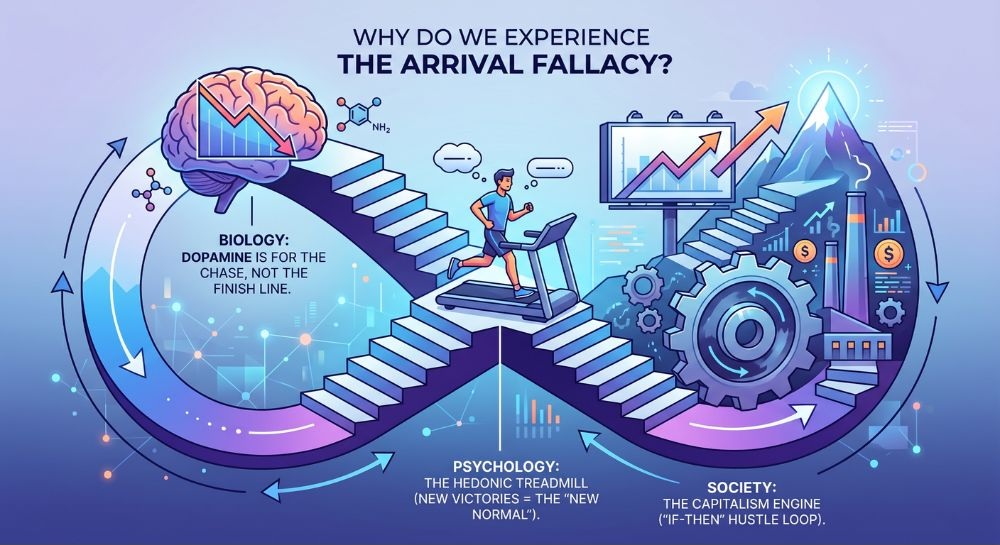
Neurobiologically, dopamine spikes during the pursuit of a goal rather than its achievement, leading to an emotional crash once the finish line is crossed. This internal “hedonic treadmill” is further exacerbated by a modern capitalist “hustle culture” that thrives on manufactured dissatisfaction.
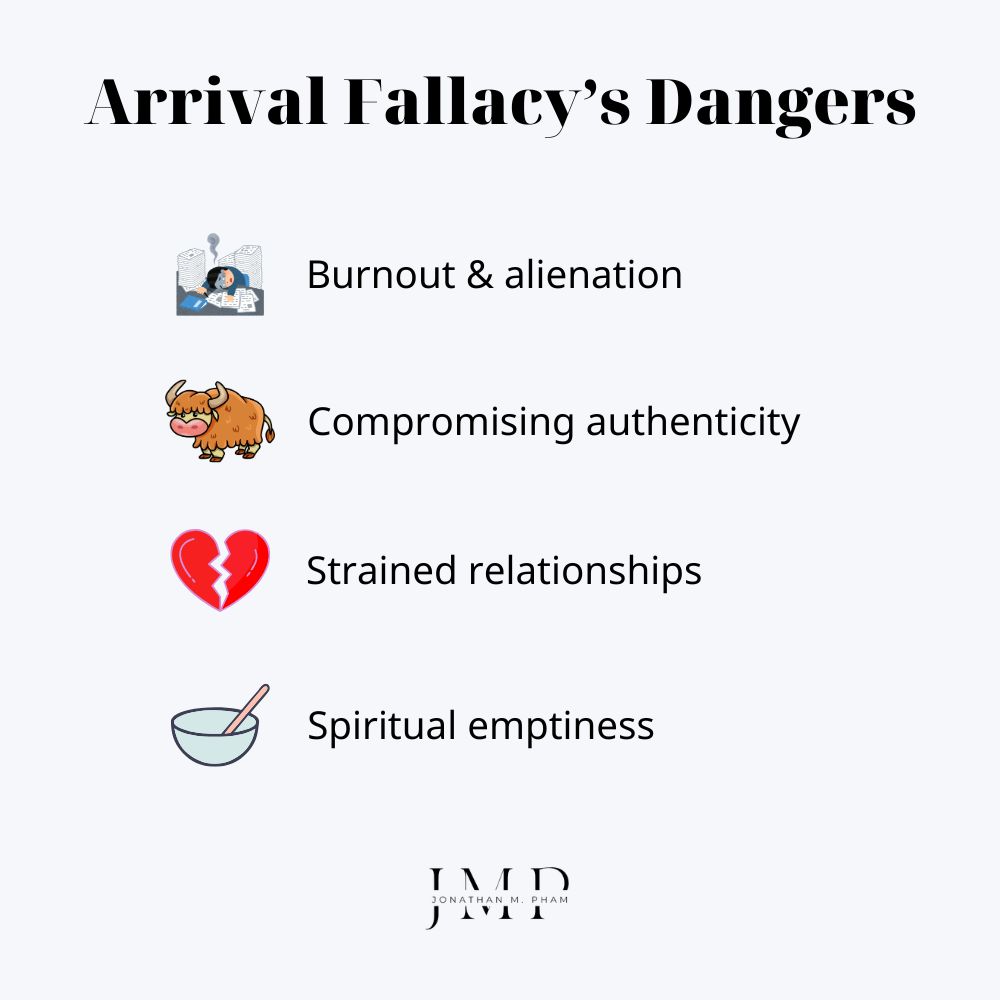
Obsessing over the destination results in severe burnout, a compromise of personal authenticity, strained relationships, and a sense of spiritual emptiness.
Meaning is not found at an optimized or automated finish line, but in the friction and conscious choice to engage with the daily struggle of the pursuit itself.
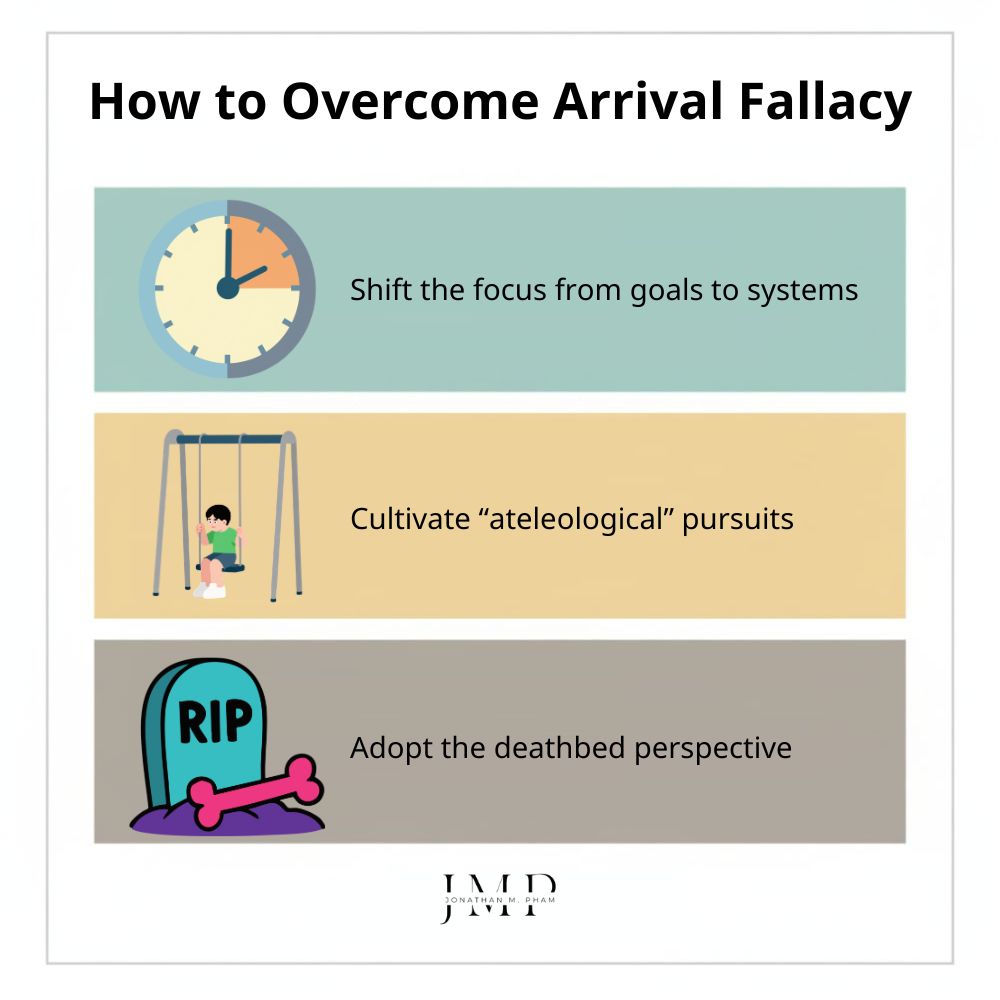
To overcome the Arrival Fallacy, one should shift their focus from outcomes to daily processes, cultivate “ateleological” hobbies, and prioritize immediate presence over future validation.
What is the Arrival Fallacy?
Coined by positive psychology expert Dr. Tal Ben-Shahar, the Arrival Fallacy refers to the illusion that once we attain a specific goal or reach a certain destination—landing a dream job, earning a specific salary, buying a house—we will experience lasting happiness. To put it simply, it is the pervasive “I’ll be happy when…” syndrome.
Most of us spend our whole lives climbing ladders established by society, entirely convinced that the top holds the key to our “salvation.” But the cruel reality is that when we finally “arrive,” the finish line moves, or the satisfaction evaporates much faster than expected.
“I’ll be happy when I get that promotion…”—only to find that the new title comes with heavier stress and the immediate pressure to look for the next step up.
“I’ll be happy when I finally buy a house…”—only for the initial excitement to fade into the mundane reality of mortgages, maintenance, and lawn care.
“I’ll be happy when I hit six figures…”—only to realize that lifestyle creep has caught up, and the new baseline feels exactly like the old one.
The dopamine crashes, the horizon recedes, and instead of lasting joy, we are left facing an existential void.
Arrival Fallacy examples
Why Do We Experience the Arrival Fallacy?
It may sound disheartening, but the uncomfortable truth is that this mental trap is built directly into our neurochemistry—as well as heavily weaponized by the society we live in.
The dopamine deception
From a neurobiological perspective, our brains are wired to trick us. Most of us assume that when we cross the finish line—when we finally grasp the prize we have been striving for—we will be rewarded with a rush of joy, a wave of the “happiness chemical” we commonly call dopamine.
But the truth is exactly the opposite.
As neuroscientist Andrew Huberman has pointed out, dopamine is actually the molecule of motivation, desire, and anticipation. It spikes highest during the pursuit of a goal, not at the moment of achievement.
In other words, the brain is biologically engineered for the chase. As such, what happens the day after you finally get that promotion or buy that house?
The dopamine plummets, of course.
When this chemical driver of focus and energy vanishes overnight, it leaves a neurobiological vacuum. This sudden crash is why so many high achievers experience a profound sense of post-achievement depression. The brain looks around the newly conquered summit, feels the chemical drop-off, and essentially asks: “What now?”
The projection trap
The problem is further complicated by our inherent psychological blind spots. As psychologist Dan Gilbert noted when he coined the term “affective forecasting,” human beings are notoriously terrible at predicting our future emotional states. Specifically, we suffer from an exaggeration glitch: we dramatically overestimate both the intensity and the duration of the happiness a future achievement will bring. We imagine the unadulterated joy of the destination, completely forgetting that life’s mundane realities—paying bills, getting a cold, sitting in traffic—will follow us right across the finish line.
This blind spot leads directly to a phenomenon known as the “Hedonic Treadmill“.
When we experience a major victory, our happiness temporarily spikes. However, humans are remarkably efficient at adapting to new circumstances. Once that flashy new salary or impressive title becomes familiar, the psychological novelty wears off—and our happiness drops right back down to its baseline.
Within months, the hard-won dream job simply becomes the “new normal”—leaving us feeling like we immediately need to conquer a new summit just to feel that rush again.
The Great Western Disease of “I’ll be happy when…” It is the pervasive mindset whereby we convince ourselves that we’ll be happy when we get that promotion, or drive a Tesla, or finish a slice of pizza, or attain any other badge of our short- or long-term desires. Of course, when the badge is finally in our hands, something comes along that compels us to discount the badge’s value and renew our striving for the next badge. And the next. We want to reach the next level in the organizational hierarchy. We want a Tesla with more range. We order another pizza slice to go. We are living in what Buddha called the realm of the “hungry ghost,” always eating but never satisfied.
Marshall Goldsmith, ‘The Earned Life’
Persistent Arrival Fallacy in psychology
The sociocultural engine
If biology builds the treadmill, modern society plugs it in and cranks the speed to the maximum setting. From childhood, most of us are fed a relentless “If-Then” narrative:
If you get good grades, then you’ll get into a prestige college;
If you land the high-paying job, then you will finally be happy.
Modern capitalism fundamentally thrives on this manufactured dissatisfaction. If we were completely content with our current achievements, consumerism would stall. To keep the gears turning, the hustle culture glorifies burnout, bombarding people with toxic mantras like “grind now, rest later.”
This is more than just an individual struggle. Throughout history, whenever humanity collectively celebrated a massive leap in material or technological progress, there were always visionary, “eccentric” thinkers who proclaimed that we were mistaking a faster treadmill for actual human advancement:
During the Industrial Revolution, Henry David Thoreau looked at the frantic pace of factory-era life and observed that men had become the “tools of their tools”—working themselves to death to buy luxuries they didn’t need.
At the turn of the 20th century, Friedrich Nietzsche warned that placing a shallow, singular faith in scientific comfort and efficiency was causing society to sleepwalk into a profound spiritual void.
Most of the luxuries and many of the so-called comforts of life are not only not indispensable, but positive hindrances to the elevation of mankind.
Henry David Thoreau
These days, history is repeating itself at hyper-speed. Humanity has entered an era defined by a dizzying digital landscape and the dawn of the AI revolution. Every day, we are constantly promised that the next software update, the next automation tool, or the next algorithmic breakthrough will finally optimize our lives and grant us the elusive “freedom” we crave.
Instead, the finish line has vanished entirely. Technology hasn’t bought us peace; it has simply blurred the lines between our True Selves and our digital avatars. It forces us to “hustle” harder just to keep pace with the very machines we built.
We are “arriving” at the future faster than ever, only to realize we are more exhausted than when we started.
Read more: Self-identity – A Contemplation on Being & Becoming
The Empty Summits: How Dangerous is the Arrival Fallacy?
Burnout & alienation
I know the dark side of this mental trap intimately, simply because I myself have lived it.
Once, I worked like a madman for a while. I was simultaneously juggling a demanding full-time job, two side gigs, and trying to master a new language—all at once. I bought entirely into the illusion that this extreme, hyper-optimized grind was the price of admission for my ultimate “freedom”—the financial power to live life on my own terms.
But instead of freedom, the only thing I received was absolute burnout.
The breaking point arrived on a rainy afternoon. Sitting at my desk, completely exhausted, a harsh reality washed over me: I thought I was the master of my destiny, but I was actually a puppet. I was being pulled by the strings of my own deep-seated anxieties and endless ambitions.
Most of us falsely believe that if we can just conquer every waking second of the day—if we can control every variable, anticipate every hurdle, and optimize every habit—we will finally be “free”. Yet in reality, we are just building our own cages.
In our obsession with managing a hypothetical “someday”, we completely alienate ourselves from the person sitting in the chair right now.
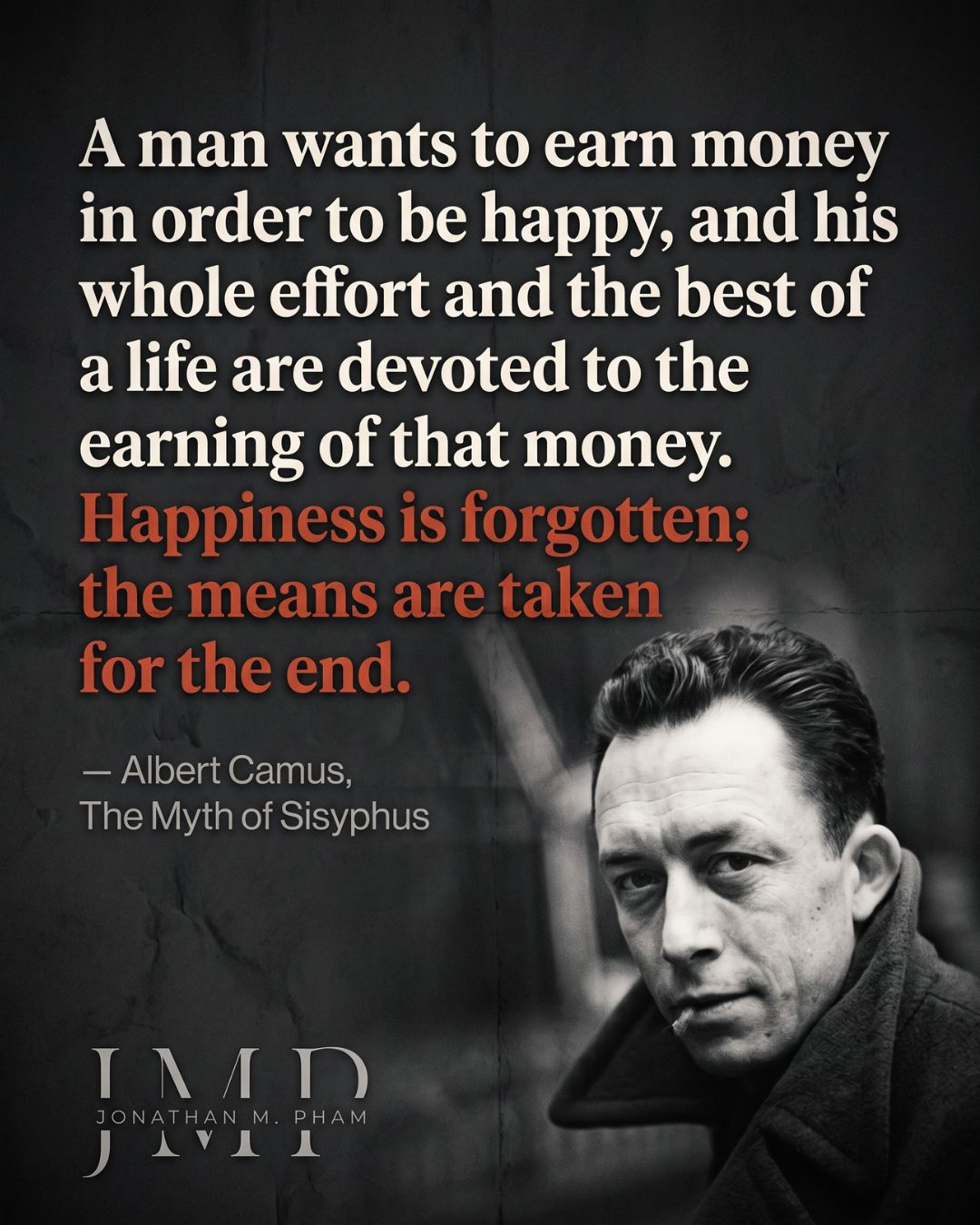
A man wants to earn money in order to be happy, and his whole effort and the best of a life are devoted to the earning of that money. Happiness is forgotten; the means are taken for the end.
Albert Camus
Compromising authenticity
“Can it be that I have not lived as one ought?” suddenly came into his head. “But how not so, when I’ve done everything as it should be done?”
Leo Tolstoy, “The Death of Ivan Ilych”
The Arrival Fallacy is painful enough when you are chasing your own dreams and hitting an empty summit. But it is downright devastating when you finally “arrive” at a destination dictated entirely by society. When you spend decades sweating, sacrificing, and climbing a rigid corporate or social ladder, only to reach the top and realize it was leaning against the wrong wall entirely.
This systemic bait-and-switch is far more pervasive than most people care to admit. In fact, it is the silent engine behind the classic mid-life crisis, the sudden corporate burnout, and the late-stage career pivots that catch many people by surprise.
We fall into this trap because the “Herd Mentality” offers a comforting illusion of safety. Society hands us a pre-packaged checklist of what a “successful life” looks like:
The prestigious degree from a brand-name institution.
The linear career trajectory at a recognizable firm with predictable titles.
The socially validated milestones: the marriage, the zip code, the material markers of upper-middle-class stability.
We tell ourselves, “Once I tick all these boxes, I will feel secure. I will feel complete.”
But because these goals were never aligned with our authentic self, achieving them offers no psychological sustenance.
Real-life examples:
Think about the corporate lawyer who bills eighty hours a week for fifteen years to finally make partner, only to sit in their new corner office and realize they hate the law.
Or the entrepreneur who builds and sells a company for millions, only to find that the financial windfall cannot fill the void of an empty personal life.
There is a scene in Arthur Miller’s play Incident at Vichy in which an upper-middle-class professional man appears before the Nazi authority that has occupied his town and shows his credentials: his university degrees, his letters of reference from prominent citizens, and so on. The Nazi asks him, “Is that everything you have?” The man nods.
The Nazi throws it all in the wastebasket and tells him: “Good, now you have nothing.”
The man, whose self-esteem had always depended on the respect of others, is emotionally destroyed.
And that’s not all. When we become obsessed with “arriving”, the heaviest toll is rarely financial or professional; it is deeply relational.
I myself see this play out constantly among friends and colleagues who have successfully climbed into prestigious, high-earning management positions. Outwardly, they have “arrived”. Yet inwardly, they are perpetually distracted, constantly irritated, and severely short-tempered.
Because the daily grind has stripped them of the capacity to be truly present, they resort to a tragic compromise: “buying connection”.
Some send expensive gifts to their parents instead of calling them directly;
Some justify their emotional absence by working harder to afford elite private schools, luxury vacations, and top-tier healthcare for their children.
Most of them excuse themselves, saying that they must work around the clock because their family’s financial needs are so high. But the reality, as I figure, is exactly the reverse: because they work too much, they substitute genuine human presence with expensive material compensation. Their lifestyle creep artificially inflates their expenses, forcing them to work even harder to maintain the very baseline they created.
        [Work Overtime to Earn More] ──> [Lack of Time for Family]
         ▲                                   │
         │                                   ▼
[Financial Needs Skyrocket] <── [Substitute Presence with Luxury Gifts]
In their attempt to attain “financial armor”, they exhaust their emotional reserves—and end up alienating the exact people they claim to be sacrificing everything for.
You may work for a wonderful company, and you may think that your contribution to that organization is very important. When you are 95 years old and you look at the people around your deathbed, very few of your fellow employees will be there waving good-bye. Your friends and family will probably be the only people who care.
It’s crucial to note that material accumulation itself is NOT the problem. There is nothing inherently wrong with ambition, wealth, or professional success.
The true enemy is the illusion that these milestones will fix a fractured internal life. It is the relentless “doing” mindset that willingly sacrifices peace, mindfulness, and authentic human connection today, all in service of a hollow validation tomorrow.
Spiritual emptiness
It is easy to look at someone chasing money or status and diagnose their Arrival Fallacy. But what happens when we recognize the emptiness of the material world, yet apply the exact same “destination” mindset to our internal or religious lives?
This is the hidden trap of spiritual ambition. The moment we turn “enlightenment,” “sainthood,” or “inner peace” into a “trophy” to be won in the future, we have imported the toxic, achievement-oriented mindset into our souls. “Awakening” (or something similar) is now treated exactly like a corporate promotion.
If we are attentive enough, we would see this play out in several distinct ways:
The Spiritual Over-Achiever: The person who obsessively tracks their meditation minutes, reads every sacred text, attends every retreat, and collects certifications. They are still treating their life as a stepping stone. (“I’ll be happy when I finally clear my karma / master mindfulness / achieve permanent zen.”)
The Perfection Mirage: The believer who represses their real, complex human emotions—anger, jealousy, grief—because they are trying to play the role of a “saint” or an “evolved soul.” In being obsessed with a Curated Spiritual Self, they alienate themselves from their actual internal reality.
The thing is, there is no magical, celestial finish line where your human reality evaporates. Enlightenment isn’t a mystical summit to reach once-and-for-all; it comes when you realize, deep down, the value of the mundane moments of daily life. Of the unglamorous “here and now.”
It may sound like a paradox, but the more desperately you aim to reach a spiritual destination, the further you are kept away from it.
Read more: Spiritual Crisis – Finding Light in the “Dark Night of the Soul”
Why achieving goals doesn’t make you happy
Why an Existential Pivot is Crucial for Getting Over the Arrival Fallacy
Realizing the futility of the Arrival Fallacy is only half the journey. Once we recognize that the finish line is an illusion—and that the summits of wealth, status, or even spiritual perfection will ultimately leave us empty—it’s very tempting to fall into the trap of cynicism and nihilism. After all, if the destination doesn’t matter, why should we bother climbing at all?
The myth of Sisyphus
At this point, I believe it’s helpful for us to look to a tragic figure in Greek mythology: Sisyphus.
Condemned by the gods for daring to cheat death, Sisyphus’s punishment in the underworld is notoriously brutal. He is forced to push a massive boulder up a steep hill. Every single time he nears the summit, the weight slips, the boulder rolls back to the bottom, and he has to walk back down to start all over again. For all eternity.
In a sense, Sisyphus is the mythological embodiment of the Arrival Fallacy. He is trapped in a permanent loop of achieving a goal, only to watch his progress reset instantly.
Faced with this endless loop, modern pop psychology often tries to soften the blow with superficial band-aids. (e.g. to “practice gratitude”, or to “find joy in the hustle”) Yet the reality is, when we are bone-tired and staring at a moving finish line, such advice, quite often, feels like “gaslighting”. Hollow. Inauthentic.
The real solution, as proposed by the philosopher Albert Camus, is far more radical. According to him, rather than tricking ourselves into believing the climb isn’t exhausting, we must fully accept the absurdity of it. We must look at the boulder, acknowledge that it will inevitably roll back down, and choose to push it anyway.
Why then?
Because in that exact moment of conscious choice, we reclaim our agency.
In fully embracing the “meaninglessness” of the destination, we can, ironically, birth our own meaning in the present.
The struggle itself toward the heights is enough to fill a man’s heart. One must imagine Sisyphus happy.
Albert Camus
How to deal with Arrival Fallacy: Enjoy the journey instead of the destination
Finding meaning in the struggle
While seemingly tragic, Camus’s Sisyphus teaches us something modern society is desperately trying to forget: the friction of the pursuit is not an obstacle to overcome—it is YOUR LIFE itself.
Let’s say you want to stand on the summit of Mount Everest—for a moment. Instead of spending weeks trekking, enduring the freezing winds, and slowly acclimatizing your lungs to the thin air, you simply charter a helicopter. You fly straight to the peak, step out onto the snow, and take a selfie.
You have “arrived.” You occupy the exact same geographical coordinates as the seasoned mountaineer. But within minutes, you will gasp for air, collapse, and likely die.
Why? Because your body never underwent the grueling adaptation required to survive at that altitude.
You bought the result, but you bypassed the transformation.
If we can internalize this hard truth, there will come a radical change in our life stance. Rather than viewing the daily work, messy relationships, and the unpolished self as nuisances or mere stepping stones, we would now look at them and gracefully admit:
“This is it. This is the masterpiece.”
The joy isn’t waiting “someday” at the summit. It is found entirely in the dirt, the sweat, and the deliberate choice to push the boulder today.
In a sense, humanity these days has become obsessed with building “helicopters.” With the rapid acceleration of artificial intelligence and hyper-automation, people are constantly being sold a “shortcut” mindset. We are told we can comfortably bypass the “struggle” of writing, thinking, creating, or learning. Just press a button, generate the output, and arrive instantly at the finish line.
But what would happen if we remove all cognitive friction?
Using technology to skip the mess of the creative process may seem convenient, yet it is not without its cost. In doing so, we strip away the very space where growth happens.
We might secure a perfectly optimized result, but we also lose the wisdom that can only be forged in the fires of frustration, critical thinking, and deep focus.
As we didn’t truly “earn” the summits, no wonder we feel so entirely disconnected from the view.
The Arrival Fallacy tricks us into believing that the value of life is found exclusively at the destination. In truth, it is the friction of the pursuit where our humanity resides.
Read more: Will AI Kill Us All? Reflecting on the “Bogeyman” of the 21st Century
How to Overcome Arrival Fallacy: From “Lord of the Earth” to “Shepherd of Being”
For most of our lives, society has trained us to act as the “Lords of the Earth.” This mindset—rooted in what the philosopher Martin Heidegger referred to as “calculative thinking”—drives us to view our time, relationships, and even our own minds as mere resources to be measured, extracted, and optimized. To a Lord, the present moment is nothing more than a waiting room for the future. And it is precisely this transactional life stance that sows the seeds of the Arrival Fallacy.
The antidote is to step down from the throne and embody what Heidegger called the “Shepherd of Being.”
A shepherd does not frantically obsess over the final harvest or calculate the future market price of wool while standing in the pasture. Their sense of meaning lies completely in the present-tense act of tending to the flock. They practice what Heidegger called Gelassenheit (“letting-be”)—engaging with life as it unfolds right in front of them, without thinking about what it can produce for them tomorrow.
Here is how we can integrate the posture of the Shepherd into the modern lives:
Shift the focus from goals to systems
Author James Clear once drew a sharp line between “goals” and “systems”. The former is about a specific result you want to achieve; on the other hand, the latter is about the daily process that leads to that result.
Good for winning once, but causes a drop in motivation afterward.
Sustainable for continuous improvement and repeated success.
If your goal is simply to “become a bestselling author,” the Arrival Fallacy will eventually crush you—because you are legally binding your happiness to a distant publication day. However, if your system is the daily practice of sitting down to write five hundred words, the paradigm shifts entirely.
By falling in love with the system, you no longer have to wait for an elusive “arrival” to permit yourself to feel successful. You win the game every single day you show up to do the work.
Setting goals without the Arrival Fallacy
Cultivate “ateleological” pursuits
Life swings like a pendulum backward and forward between pain and boredom.
Arthur Schopenhauer
According to the philosopher Arthur Schopenhauer, much of human suffering stems from our obsession with teleological goals—activities aimed at a definitive endpoint (like a promotion, a marathon, or a house purchase). The moment these goals are achieved, their purpose vanishes, leaving us stranded in an existential vacuum.
To break the spell, we need to intentionally weave “ateleological activities” into our lives. These are pursuits that have no finish line, no metrics, and no external quotas; they are done strictly for their own sake. For instance:
Walking without a destination or a step-counter goal.
Reading a novel without trying to “extract actionable takeaways.”
Playing an instrument poorly, simply for the texture of the sound.
Spending an unhurried evening laughing with someone you love.
You cannot “complete” a walk, nor can you “win” a friendship. Because these activities have no final destination, they bypass the Arrival Fallacy entirely. They force you to consume the experience in the present tense.
Read more: Immortality Projects – The Psychological Trap of Trying to “Live Forever”
Adopt the deathbed perspective
When caught up in the hustle, many of us frequently convince ourselves that we are making a noble sacrifice—enduring a miserable, hyper-optimized present to build a secure, meaningful future. Yet sadly, this is almost always an egoic lie.
Palliative care nurse Bronnie Ware once shared about her years of counseling patients in the final weeks of their lives, recording their most common regrets. And do you know what didn’t make the list?
No one wished they had spent more hours polishing their LinkedIn profiles. No one wished they had hit their corporate quotas a quarter earlier. No one regretted not sacrificing their youth to a corporate ladder.
Instead, the number one regret of the dying was heartbreakingly simple:
“I wish I’d had the courage to live a life true to myself, not the life others expected of me.”
And the runner-up?
“I wish I didn’t work so hard.”
The deathbed perspective is the ultimate solvent for the Arrival Fallacy. It strips away the “If-Then” illusions we construct to protect ourselves from the present, and forces us to realize that “someday” is a currency that eventually runs out.
When you look at life through the lens of your final hours, the myth of the perfect destination dissolves. And the truth becomes clear: you were never meant to be a Lord extracting value from a future that hasn’t arrived.
You were only ever meant to be a Shepherd—tending to the miracle of existence. Right here. Right now.
Is the Arrival Fallacy the same as the Hedonic Treadmill or Destination Addiction?
While closely related, these terms describe different parts of the same psychological trap. In a sense, we can think of the Arrival Fallacy as the belief, Destination Addiction as the behavior, and the Hedonic Treadmill as the biological reality.
Here is a quick breakdown, including the related Kahneman Focusing Illusion:
Concept
Coined By
Core Meaning
How it traps us
Arrival Fallacy
Dr. Tal Ben-Shahar
The illusion that reaching a specific destination will bring lasting happiness.
We tie our self-worth to a future finish line that is constantly moving.
Hedonic Treadmill
Brickman & Campbell
The human tendency to rapidly return to a baseline level of happiness despite major positive or negative events.
We adapt to our new successes so quickly that the “high” wears off almost instantly.
Destination Addiction
Dr. Robert Holden
A preoccupation with the idea that happiness is always in the next place, the next job, or the next partner.
We live entirely in the future, rendering us chronically impatient and incapable of enjoying the present.
Focusing Illusion
Daniel Kahneman
“Nothing in life is as important as you think it is, while you are thinking about it.”
We grossly overestimate how much a future milestone will impact our overall well-being.
How does the Arrival Fallacy lead to burnout and depression?
Neurobiologically, our brains release dopamine—the molecule of motivation—during the pursuit of a goal. Once the goal is achieved, dopamine levels plummet. If an individual has sacrificed their health, relationships, and authentic self for years to reach that summit, this sudden neurochemical crash leaves behind a profound psychological void, leading directly to post-achievement depression and chronic burnout.
Should we stop setting goals to avoid disappointment?
Not at all. Ambition and goal-setting are healthy. The key is to change our relationship with the goal. Instead of viewing it as a “Finish Line” that will finally validate your existence, treat it as a “Horizon”—a compass point that simply gives you a meaningful direction to walk toward.
The goal provides the trajectory, but the joy must be extracted from the daily walking.
How can I learn to fall in love with the process?
Shift your focus from outcomes to systems. Rather than obsessing over writing a bestseller, focus on writing 500 words a day. And as mentioned, don’t forget to regularly engage in “ateleological” pursuits—activities with no end goal, metrics, or financial incentives, such as taking an aimless walk, playing a game for fun, or having a deep conversation.
Atomic Habits by James Clear (The ultimate guide to shifting the focus from goals to daily systems).
Stumbling on Happiness by Daniel Gilbert (A deep dive into “affective forecasting” and why we are terrible at predicting what will make us happy).
Arrival Fallacy quotes
The journey is the destination.
Dan Eldon
Happiness is not about making it to the peak of the mountain, nor is it about climbing aimlessly around the mountain; happiness is the experience of climbing toward the peak.
Tal Ben-Shahar
There is nowhere to arrive except the present moment.
Thich Nhat Hanh
Final Thoughts
When you finally cross a long-awaited finish line—whether it is acquiring a new level of wealth, landing a major promotion, or reaching a prestigious social milestone—it is incredibly common to feel a sudden sense of emptiness. To look around and think, “Is this it? I’m still me”.
Yet we need to understand that the existential dread we feel in these moments is not a sign of ungratefulness. Rather, it’s just the shattering of a lifelong illusion.
For years, the pursuit of the goal served as a convenient shield against our own internal unrest. The “arrival” simply removes the primary distraction, leaving us standing in the silence, entirely face-to-face with ourselves.
The Arrival Fallacy operates on the false assumption that life is a game that can eventually be “beaten”. It tricks us into living in a permanent “Someday” mirage, thinking that we just need to push the boulder up the hill one more time to finally earn our peace.
However, if we want to survive this trap, it’s time for us to realize that no future milestone has the power to save us from the present moment.
True fulfillment requires a radical shift in our perspective—from treating success as a Finish Line to viewing it as a Horizon.
By its very nature, you can never actually reach the horizon. No matter how far or how fast you walk, it will constantly recede into the distance.
To the “Human Doing,” the idea may sound like a tragedy, a frustrating race that can never be won. But to the “Human Being,” it is a gift to be cherished.
The horizon is never meant to be conquered; it is there to give you a meaningful direction to walk toward.
When we finally stop frantically trying to arrive, we are free to actually live.
At the end of the day, happiness is not a place you can reach; it is simply a manner of traveling.
When you are not making an effort to be happy, then unexpectedly, mysteriously, happiness is there, born of purity, of a loveliness of being.
Hi there! I am a seeker on his path of self-discovery. Since my youth, I have been haunted—and driven—by the fundamental questions of existence: the weight of our choices, the nature of true fulfillment, and the various identities we inhabit. I created this blog to chronicle the insights I have unearthed while navigating the 'absurdity' and beauty of life. My hope is that in reading these words, you will find a reflection of your own struggle—and the courage to 'become who you are.' Please just take what resonates with your soul, and leave the rest behind!