


01
10
October 2026
It has begun.
And now, it's time for me... no, for us, to wait. Three or more hours.
October 1
Come to think of it, t [...]
A long time ago, in a provincial town far, far away…
There was a wealthy, cynical landowner named Fyodor Pavlovitch Karamazov. He lived alongside his three sons: Dmitri, Ivan, and Alyosha.
One evening, the old man was sitting in his dining room, drinking cognac. He looked across the table at his two youngest sons and decided to provoke them.
“Tell me, Ivan: is there a God or not? But seriously. I want to be serious now.”
Ivan, an intellectual haunted by the unreasonable weight of human suffering, possessed an expression that was intensely cold. He looked completely unbothered by the gravity of his own words.
“No, there is no God.”
“And is there immortality, Ivan? At least some kind, at least a little, a teeny-tiny one?”
“There is no immortality either. Complete zero.”
Fyodor chuckled, then turned to Alyosha. Alyosha’s expression was the exact opposite of his brother’s—warm, earnest, and untroubled by Ivan’s logic.
“Alyosha, is there immortality?” the old man asked.
“There is,” Alyosha replied with steadfast conviction.
“Both God and immortality?”
“Both God and immortality. In God is immortality.”
Fyodor threw his head back in raucous laughter, utterly amused by the contradiction between his two children. “H’m! It’s more likely Ivan’s right. Good Lord, to think what faith, what force of all kinds, man has lavished for nothing on that dream!”
Right at that moment, the wooden door to the dining room suddenly burst open, slamming against the wall. A dark, frenzied silhouette stood in the doorway. His military uniform was disheveled, his eyes wild, and his face contorted with a cocktail of rage and jealousy.
It was the eldest son, Dmitri. He was frantically searching for his lover, Grushenka—whose affections he and his father both vied for.
“She’s here!” shouted Dmitri. “I saw her turn towards the house just now… Where is she?”
What followed was pure chaos. Dmitri lunged violently into the room. Fyodor’s smug amusement vanished in a heartbeat; the old man scrambled backward out of his chair in terror, throwing his arms up to protect his face. The bottle of cognac was knocked over, spilling across the floor.
“Hold him! Hold him!”
Ivan and Alyosha leapt up and grabbed onto Dmitri from behind. They were straining with all their might to hold their brother’s frenzy back from destroying their corrupt father.
…
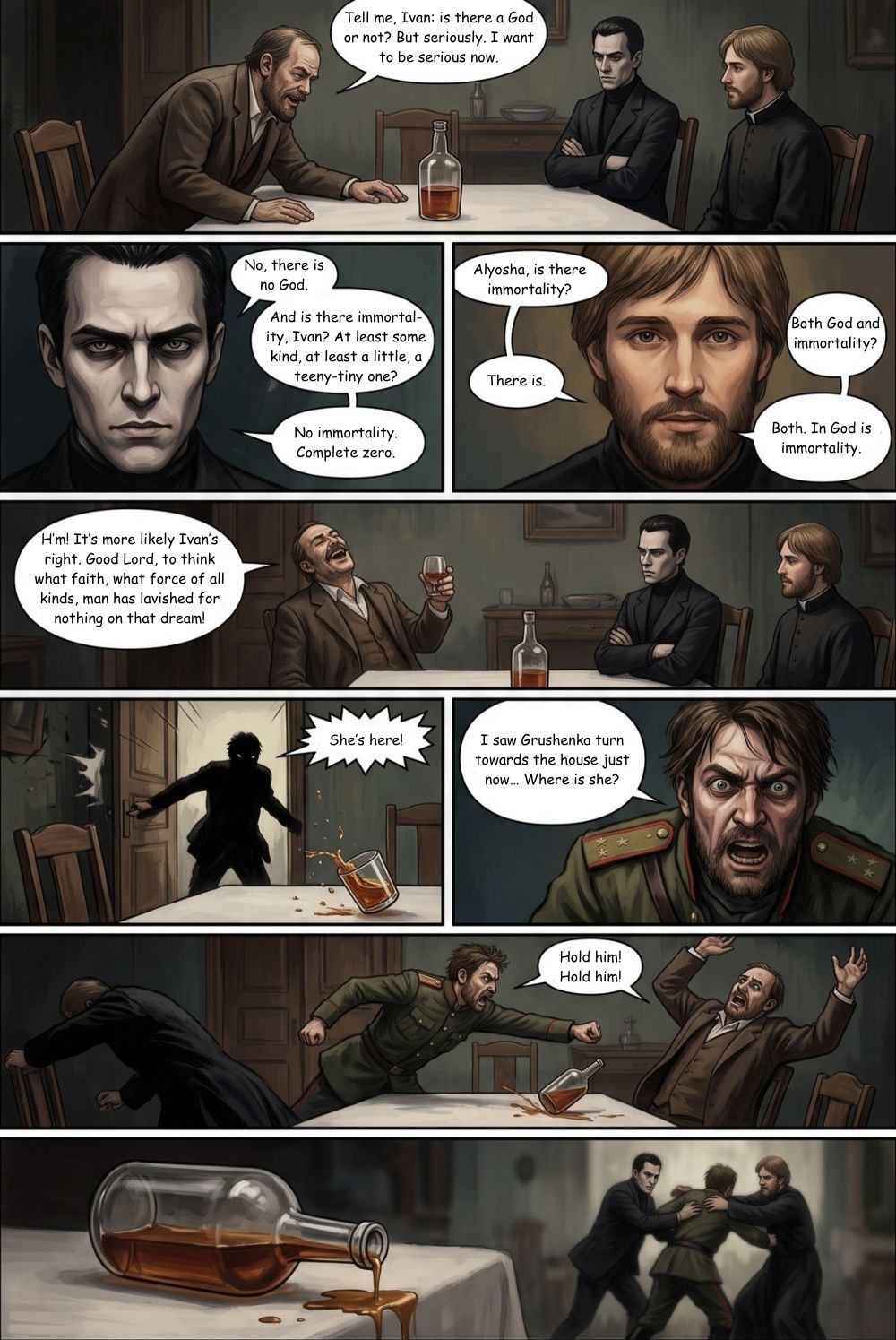
And that sums up what happened in Chapter 8 (“Over the Cognac”) and Chapter 9 (“The Sensualists”) of Fyodor Dostoevsky’s masterpiece The Brothers Karamazov.
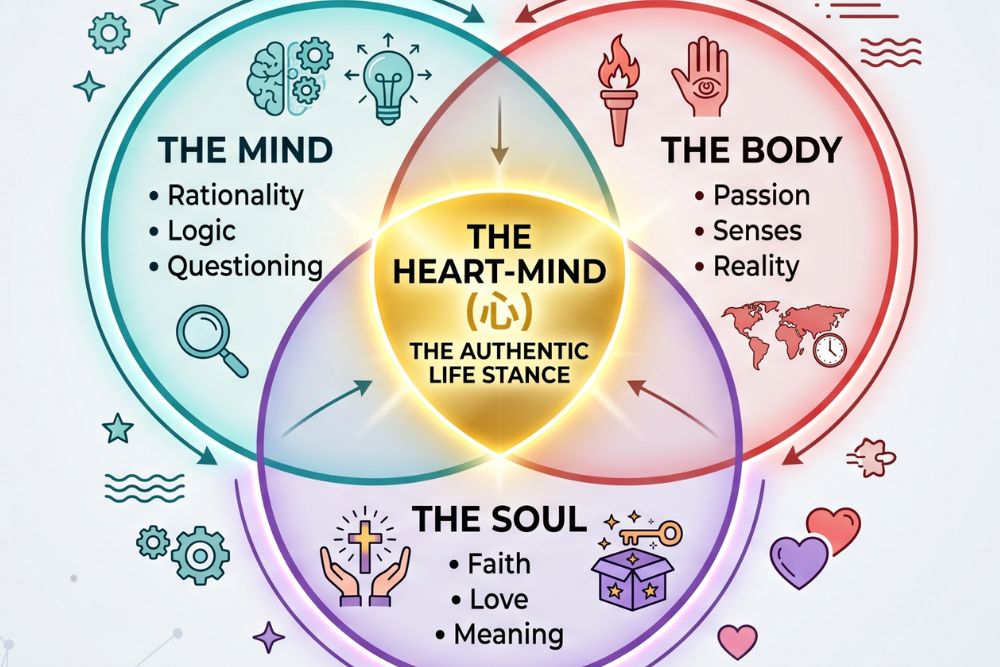
Three brothers. Three completely different life stances.
The middle brother, Ivan, chose Rationalism. He represents the Mind—brilliant, analytical, but haunted by cynicism and the (futile) demand for absolute proof.
The youngest, Alyosha, chose Faith and Love. He represents the Soul—seeking meaning, connection, and grace.
And the eldest, Dmitri, chose Sensualism. He represents the Body—driven by passion, impulse, and the desires of the flesh.
If we look closely at ourselves, it’s easy to realize that we are all a combination of the three brothers. We have an intellect that questions everything, a soul that yearns for transcendent meaning, and a body that simply wants to feel good.
The thing is, most of us live as if only one of these elements mattered.
To survive and thrive in this chaotic world, it’s essential we come up with a holistic personal philosophy that integrates all three brothers—a dynamic life stance that brings the Mind, Body, and Soul into harmony.
📌 Key Takeaway
In philosophy, a personal philosophy is often referred to as a “life stance”—a concept popularized in the 1970s by the British philosopher Harry Stopes-Roe. At the time, Stopes-Roe realized that society lacked a shared, inclusive label that covered both religious belief systems (like Christianity or Buddhism) and non-religious philosophical frameworks (like Humanism or Existentialism). As such, he decided to come up with a term that leveled the playing field—one that didn’t automatically elevate theology over secular ethics, or vice versa.
At its core, a life stance refers to an individual’s relationship with whatever they accept as being of “ultimate importance”. It is the foundational framework of beliefs, values, and principles that guides how one understands the universe, makes choices, and assigns meaning to their life.
Every fully developed personal philosophy generally attempts to answer questions across three major branches of thought as follows:
Example: When looking at a dense forest, a person with a strictly materialist ontology would see biological processes and timber. On the other hand, someone with an animistic or spiritual ontology would realize a living community of interconnected souls.
Example: When trying to understand why a relationship failed, a strict rationalist is likely to create a mental spreadsheet of behavioral psychology data. In contrast, a mystic would meditate on the experience, seeking an intuitive sense of peace or inner truth.
Example: A utilitarian makes ethical choices based on what brings the most happiness to the greatest number of people. A Kantian, however, would base their decisions on absolute moral duties, believing that some actions (like lying) are always wrong, regardless of the outcome.
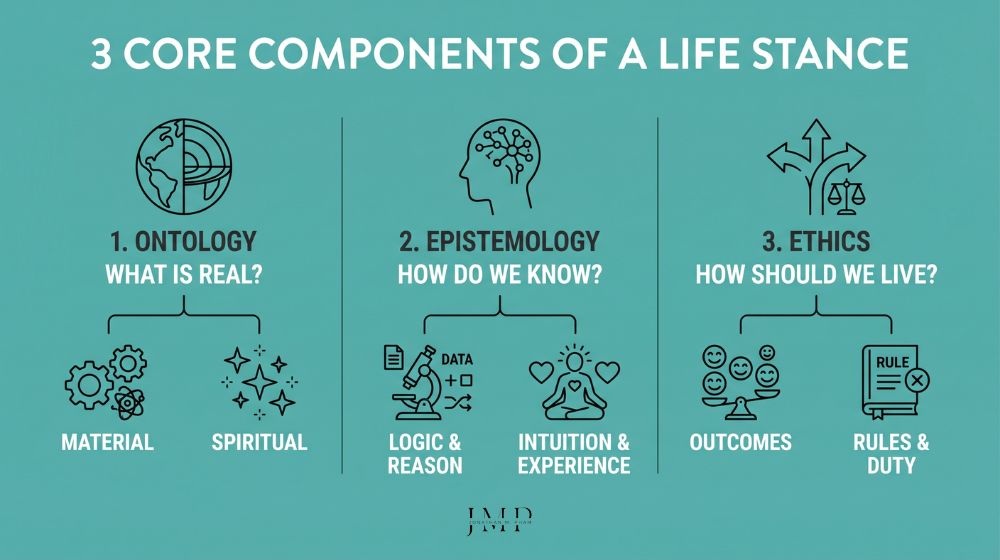
Core components of a personal philosophy
Most people tend to use terms like “core values,” “worldview,” and “life stance” interchangeably. That said, there are slight nuances between them—which can be visualized with a simple metaphor as follows:
Your core values are your compass, your worldview is the map, and your life stance is the actual journey you take.
| Concept | What it represents | Example |
| Core Values (Value System) | The Compass: The individual principles you hold dear. | “I value honesty, compassion, and courage.” |
| Worldview | The Map: How you see and interpret the reality of the world around you. | “I see the world as a harsh and competitive place, but one where human connection matters.” |
| Life Stance (Personal Philosophy) | The Journey: How you act in the world based on your map and compass | “Because the world is harsh (Worldview) and I value compassion (Core Value), I commit to volunteering and practicing unconditional kindness every day (Life Stance).” |
As we can see, a worldview is passive—it is merely how you interpret the world. A life stance, on the other hand, implies an active commitment to applying your beliefs to your daily habits.
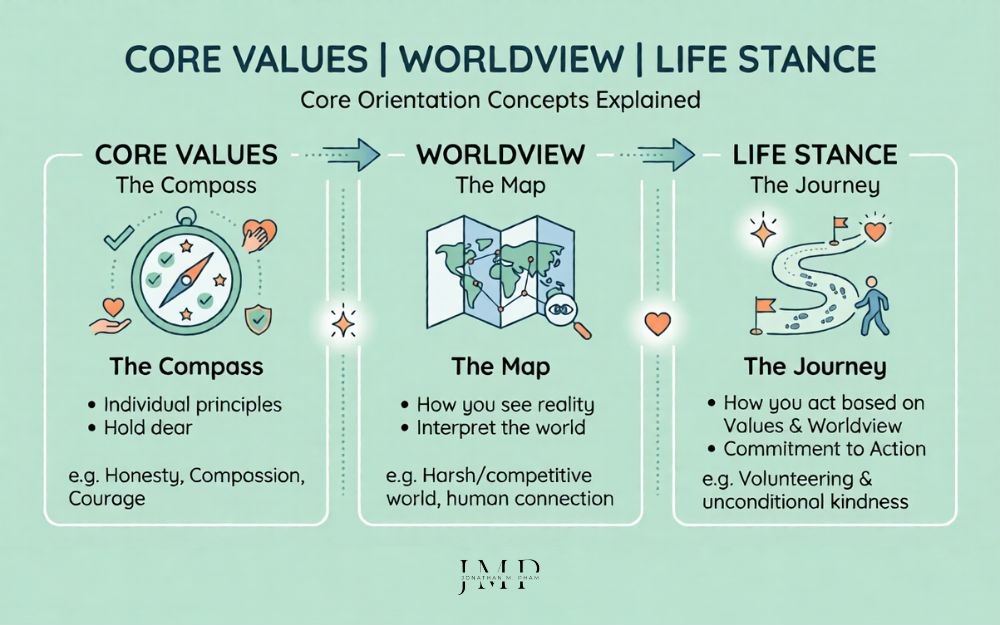
Personal philosophy vs worldview and value system
For millennia, humans have been building and refining frameworks for living. Broadly speaking, they can be categorized as follows:
The good thing is, you do not have to fit neatly into just one of these boxes. As we will explore later, a healthy personal philosophy is typically highly customized—one that allows you to be a “philosophical mutt” who borrows the best tools from various traditions to build a life that is authentically yours.
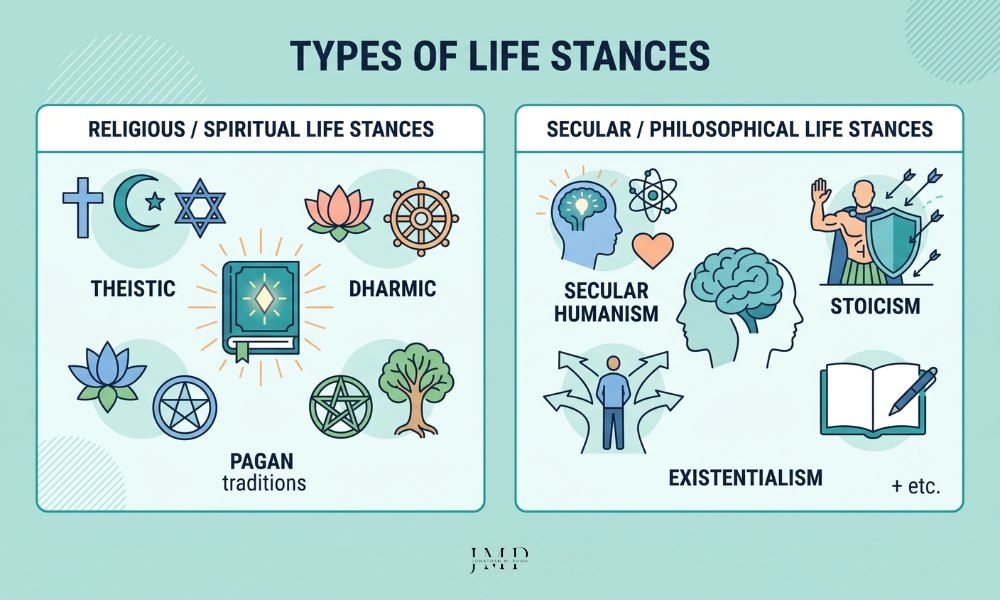
Personal philosophy examples
Many people, upon hearing the term “personal philosophy,” would immediately think of it as a luxury—something reserved for academics in tweed jackets debating abstract theories in ivory towers. But in reality, it’s a critical survival tool for the individual.
Why? Because without one, you would become a passenger in your own life.
He who has a “why” to live for can bear almost any “how.”
Friedrich Nietzsche
Life guarantees a certain amount of suffering. No matter who you are, you will inevitably face adversities: a painful breakup, a sudden job loss, a financial setback, or a scary health diagnosis that comes out of nowhere (like myself, who was diagnosed with gout a few years ago—despite never living an indulgent lifestyle). Without a stable foundation, you would easily end up adrift in anxiety.
A personal philosophy acts as a psychological anchor when these moments hit. While it will not magically make the problem disappear, it provides you with a framework to process it. It gives you a why—whether that is a belief in personal growth, a commitment to your family, or trust in a cosmic order.
And with that comes the strength to make it through the storms.
◆ Example: The unexpected diagnosis
Let’s say someone is diagnosed with a degenerative condition that alters their physical independence. In this situation, it is incredibly tempting to succumb to despair and self-destructive behavior. However, a person whose core philosophy is centered on presence and stewardship toward their family would refuse to let the disease rob them of being an engaged partner and parent.
While the grief of physical loss remains valid, their life stance allows them to channel the remaining energy into emotional connection and adapting creatively to their new normal.
Shall we not, like archers who have a mark to aim at, be more likely to hit upon what is right?
Aristotle, "Nicomachean Ethics"
In the modern world, where people are constantly bombarded with options for careers, lifestyles, investments, and relationships, a new issue has arisen—namely the “paradox of choices”. Without a defined anchor, many become victims of “shiny object syndrome“—chasing whatever is currently trending, only to end up exhausted and unfulfilled.
That’s not the case if one has a personal philosophy though. When you know exactly what is of “ultimate importance” to you, decision-making becomes remarkably simple. Now you can confidently say “no” to opportunities that look good on paper but contradict your core values.
◆ Example: The career crossroads
Imagine you are offered a highly lucrative promotion, but it requires traveling 40 weeks a year. If your implicit philosophy is simply “more money equals more success,” you would likely take it without thinking—and potentially ruin your mental health and family life in the process. However, if your cultivated life stance prioritizes community building and localized roots, you would be able to gladly decline the opportunity without a shred of regret or FOMO (Fear Of Missing Out).
Let no one delay the study of philosophy while he is young, and when he is old, let him not become weary of the study. For no man can ever find the time unsuitable or too late to study the health of his soul.
Epicurus, "Letter to Menoeceus"

We all know the importance of ethics when it comes to living in the world. Unfortunately, the type of “morality” typically practiced—and implicitly promoted by society—is extremely problematic and superficial.
Far too often, people operate on what psychologist Lawrence Kohlberg referred to as “Pre-conventional” morality—where one’s sense of right and wrong is controlled purely by external factors. They do good things either to earn a reward (social praise, promotion, or—in a religious/spiritual setting—heaven) or to avoid punishment (getting canceled, going to jail, hell). In a sense, it’s a very childlike “carrot and stick” ethical framework—one that is susceptible to crumbling as soon as circumstances change.
And that’s not all. This “pre-conventional” morality also gives rise to what philosopher Hannah Arendt called the “banality of evil”—harm committed not with malice, but out of a total absence of independent thought.
◆ Example: The selfish influencer
Recently, I happened to come across a news story about an online influencer who was caught manufacturing and selling fake, chemical-laden food to her followers. When interrogated by the police, the person coldly responded with a shocking excuse:
“It’s just what everyone else does.”
While most people would (understandably) label her as a “monster”, I see something much more troublesome behind that answer: an individual with no life stance. One who has surrendered their own moral agency to the profit-driven “crowd”.
Without an internal compass, one would, like the influencer, be tempted to submerge their identity and accountability into a group, a corporation, or an anonymous online mob—and then justify their harmful behavior simply because everyone else is doing it.
A well-thought-out personal philosophy forces you to step out of the herd and take absolute responsibility for every decision. Whether you are returning a dropped wallet, refusing to sign off on a flawed safety report, or admitting a mistake when burying it would be easier, your action is a result of intrinsic integrity and value alignment. Instead of “What will happen to me if I do this?” your main concern now becomes:
“Who am I if I do this?”
Today’s society is characterized by achievement orientation, and consequently it adores people who are successful and happy… It virtually ignores the value of all those who are otherwise, and in so doing blurs the decisive difference between being valuable in the sense of dignity and being valuable in the sense of usefulness.
Viktor Frankl, “Man’s Search for Meaning”
And here comes what is arguably the most crucial role of having a life stance in the modern world: the defense of human dignity—what the ancient Romans referred to as Humanitas.
In an era dominated by hyper-efficiency, human beings are increasingly subjected to instrumentalism: the tendency to view people purely as replaceable tools to achieve a specific end. Under this lens of utilitarian objectification, it becomes tempting to evaluate everyone by their ROI (Return on Investment)—exploiting labor, dismissing the elderly as societal “burdens,” or viewing friendships as nothing more than networking opportunities.
If you do not consciously define your own belief system, you will inevitably absorb the market’s default philosophy: a blend of mindless consumerism and the belief that one’s worth is strictly tied to their output (viewing people as “human doings” rather than “human beings”).
◆ Example: The corporate manager
Let’s say a mid-level manager is ordered to downsize their department by 15%.
As we can see from the example above, a well-defined personal philosophy serves as a critical “firewall” against dehumanization—one that protects individuals from the weight of the system. At the same time, it also helps protect you from yourself.
Eventually, every single one of us will face a season where we are no longer “productive” by society’s standards—due to retirement, illness, or economic shifts. If your implicit worldview is “I am what I produce,” losing your job or health would break you. But if you have cultivated a worldview that separates one’s intrinsic value from one’s output, you can now face the natural slowdowns of life with grace.
Read more: Will AI Kill Us All? On the “Bogeyman” of the 21st Century
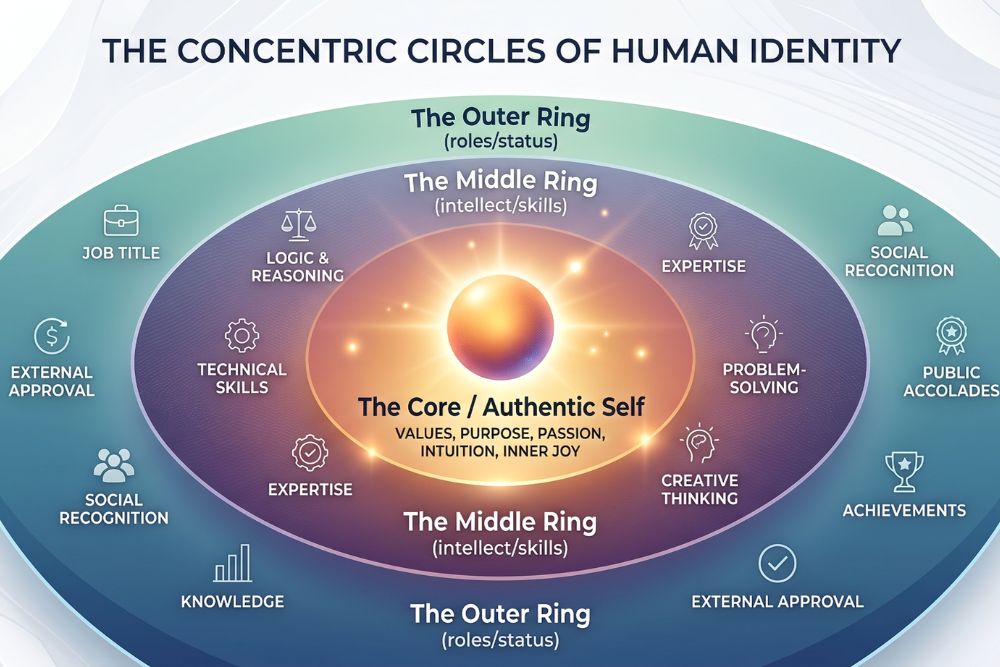
If you label me, you negate me.
Søren Kierkegaard
Human beings naturally love boxes. We love the comfort of putting ourselves and others into neat, easily identifiable categories. It is tempting to read a few books and immediately declare to the world:
The thing is, the human experience is far too complex to be reduced to a one-dimensional caricature. When you adopt a label, three subtle but toxic things happen:
A good life stance, therefore, is not a NOUN you are; it is a VERB you do. An ongoing practice of “becoming”, not a static state of “being.”
Instead of “I am a Stoic,” it is far healthier to say, “I am practicing the art of focusing only on what I can control.”
Instead of “I am a minimalist,” it’s better to declare, “I practice intentionality with my purchases.”
When shifting from a label to a practice, you leave room for authenticity, wisdom and courage.
I was asked in Paris by a newspaper reporter whether I was a Theosophist, whether I was a Hindu, whether I was this or that; and whether everyone must become Theosophists, Hindus and Star members in order to understand what I am saying. I said: You need not become a Theosophist or a Star member at all. And I further added that I was neither a Theosophist nor a non-Theosophist. After all, these are only labels, and there is a much bigger thing behind all labels. It is no good taking shelter behind a label, taking comfort in a movement.
Jiddu Krishnamurti

A robust life stance requires a delicate balance between firmness and flexibility. Otherwise, it is very easy to fall into one of two extremes:
This occurs when your philosophy becomes a rigid set of unbendable rules—which inevitably breeds arrogance, judgmentalism, and a “my way or the highway” mentality. Instead of being willing to take in new evidence, you start viewing those with different stances as “enemies” or morally inferior.
The problem with rigid dogma—aside from separating you from the rest of the world—is that it is incredibly brittle. Like a stiff oak tree in a hurricane, a dogmatic worldview cannot bend to accommodate the unpredictability of life; hence, when a tragedy strikes that doesn’t fit the rules, the entire worldview snaps.
On the other end of the spectrum is Relativism—the belief that “everything is permitted” and nothing objectively matters. While it may sound open-minded at first, without any real boundaries, you would eventually succumb to nihilism, apathy, and the trap of people-pleasing.
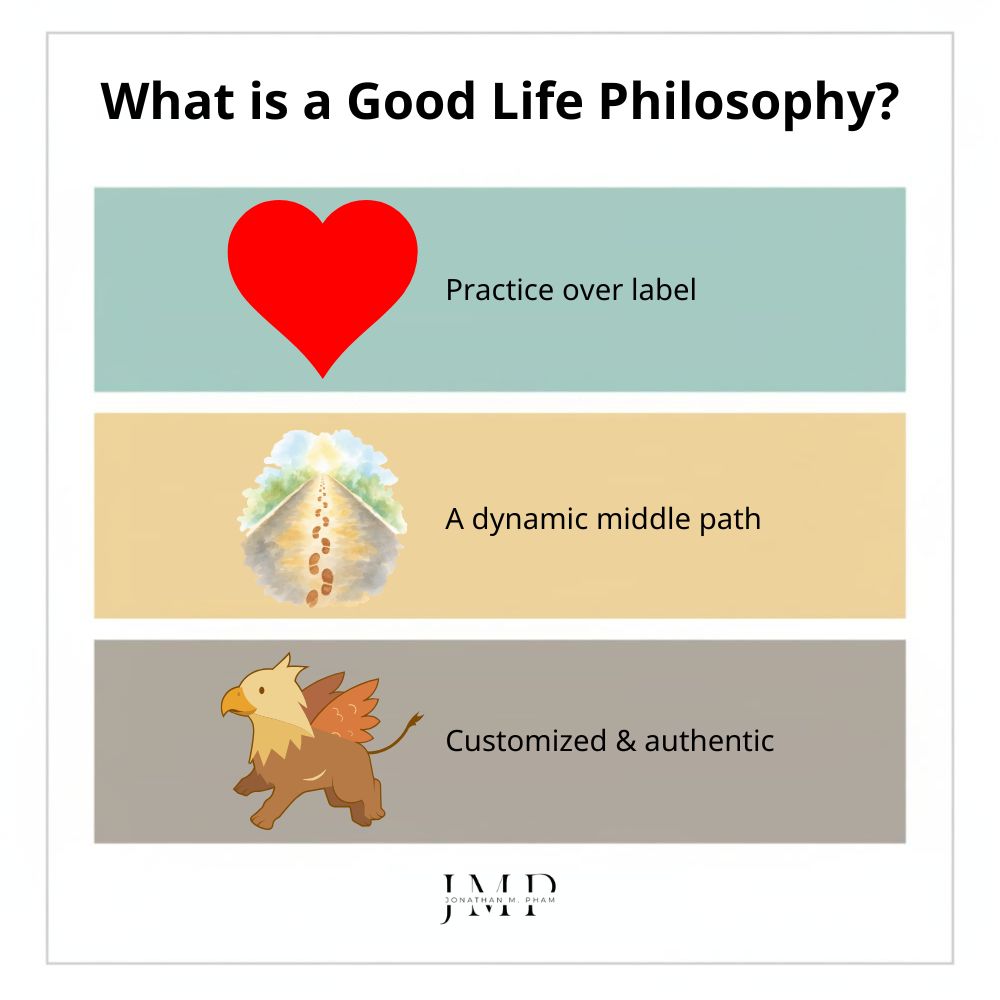
A healthy personal philosophy should walk a dynamic middle path. It should combine a spine made of steel (core values) with a heart made of flesh (the grace and humility to realize you might be wrong, and the compassion to understand others).
Personal philosophy in life
Absorb what is useful, reject what is useless and add what is essentially your own.
Bruce Lee
As hinted previously, you do not need to fit neatly into a single philosophical tradition. In fact, a truly authentic life stance is almost always highly synthesized and customized.
No one else has your specific genetic makeup, childhood upbringing, personal traumas and unique talents. Therefore, borrowing a life philosophy completely from a 2nd-century Roman Emperor or a 19th-century German philosopher without adapting it is a recipe for inauthenticity.
To bring the Mind, Body, and Soul into harmony, you have to be willing to be a “philosophical mutt”—one who studies various traditions, keeps what resonates with their lived experience, and discards what doesn’t. It’s perfectly okay to sync different viewpoints across traditions—even if academic purists might argue the opposite—and apply them flexibly depending on the specific circumstances.
Example: When it comes to surviving the corporate day job without burning out, the disciplined boundaries of Stoicism may prove helpful. Yet when coming home, you can transition to the spiritual warmth of Buddhist mindfulness or Christian charity to connect with your loved ones, while relying on the writings of Albert Camus to make sense of life’s absurdities.
While scholars may assert that certain philosophies (e.g. the Stoic’s deterministic outlook and the Existentialist’s focus on radical freedom) cannot coexist on a whiteboard, I have—based on my own experiences—found evidence for the opposite. In fact, they together can form a truly holistic toolkit for living well.
All in all, if something brings you closer to the truth and allows you to treat others with dignity, don’t be afraid of embracing it and making it your personal philosophy!
The best religion is one that gets you closest to God. It is the one that makes you a better person. I am not interested, my friend, about your religion or if you are religious or not. What really is important to me is your behavior in front of your peers, family, work, community and in front of the world.
Dalai Lama XIV
Most people, when first setting out to define their life stance, tend to look for an off-the-shelf solution. They want to read a book, pick a predefined system, and instantly have all the answers. In fact, I myself used to do the exact same thing—trying to search for a “perfect” system that would miraculously solve everything in life.
As you may be able to guess, I never found it.
You cannot just “adopt” someone else’s life stance; after all, there’s a reason why we call it “personal philosophy”. You have to build your own and cultivate it through intentional efforts.
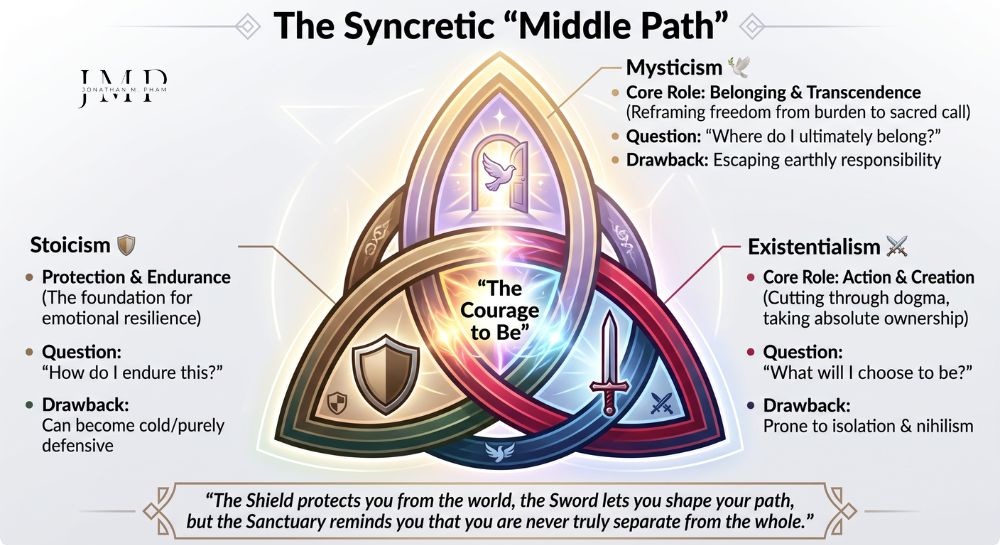
As of now, my stance can be described as a highly customized blend of Existentialism (with a strong focus on the religious side), Stoicism, and Mysticism. (combining both Western & Eastern elements)
When I first began reflecting on life and exploring philosophy a few years ago, Stoicism was the most appealing school of thought to me. It was rational, easy to understand, and provided me with immediate relief. Through practices such as the dichotomy of control—focusing only on what one can change, and accepting what one cannot—I was able to stabilize during a somehow chaotic period of my life.
For all its greatness, I eventually found Stoicism ran a bit cold. It gave me the how to endure life, but not the why.
Then at some point, I happened to stumble upon Existentialism, which has since then become the core part of my personal philosophy. Unlike Stoic thinkers who believed in a rational, orderly universe, existentialists asserted that “existence precedes essence”; in other words, life has no inherent, pre-determined purpose, and humans are free—and burdened—to invent our own meaning.
To me, reading existentialism was like being hit in the face with a bucket of water—a true “wake-up” call. (though I suppose before then, I had already had existential thoughts for long; just that I didn’t have the vocabulary to verbalize them yet) It was shocking, yet also empowering.
To many people out there, existentialism may look rebellious and “edgy”. But to me, it gave me something truly meaningful—namely Passion and Responsibility. It asked me to stop making excuses, take charge of my life, owe every decision, and make every moment count.
That said, the school of thought—especially the secular version—does have its own limitations. If you simply adopt the philosophy of thinkers like Sartre and Nietzsche without any adaptation, it’s very tempting to conclude “It is me against the world” and, therefore, exclude yourself from everyone else. Not to mention, given that secular existentialism generally does not recognize a Transcendent Reality, those who practice it fanatically are susceptible to cold nihilism and materialism.
That is where the final piece of my puzzle—Religious Existentialism and Mysticism—fell into place. By integrating the philosophies of religious existentialists (Søren Kierkegaard, Paul Tillich, Gabriel Marcel, Martin Buber, etc.) with those of spiritual teachers (including Christian mystics, Eastern sages, Zen masters, etc.), I managed to solve the limitations of both Stoicism and Western Existentialism—namely isolation, constant self-reliance, and the dryness of a purely secular worldview. Now, the “Will to Power” is traded for the simple “Courage to Be”—to face life head on serenely, despite its absurdities.
Theoretically speaking, these schools of thought are not quite “compatible” with each other; yet I have found that when applied together, they form a perfect union.
“The Shield protects you from the world, the Sword lets you shape your path, but the Sanctuary reminds you that you are never truly separate from the whole.”
| Dimension | Stoicism 🛡️ | Existentialism ⚔️ | Mysticism 🕊️ |
| Core Role | Protection & Endurance | Action & Creation | Belonging & Transcendence |
| Primary Question | “How do I endure this?” | “What will I choose to be?” | “Where do I ultimately belong?” |
| View of the Universe | Orderly, rational, and indifferent to human preferences. | Absurd, inherently meaningless (“existence precedes essence”). | Steeped in a deeper Ground of Being, divine mystery, or universal consciousness. |
| Key Strength | Emotional stability, inner peace, and the discipline of focus. | Personal responsibility, passion, and authenticity. | Grace, interconnectedness, and relief from cosmic isolation. |
| Primary Danger / Limit | Can become cold, overly rigid, or purely defensive (survival without purpose). | Prone to isolation, burnout, and nihilism. | Risk of dogmatic blind spots or escaping earthly responsibility. |
It’s a synthesized “Middle Path” that I have come up with after years of reflecting and experimenting.
In modern self-help culture, there is a dangerous tendency to promote “toxic positivity”—the idea that we must always look on the bright side and banish negative emotions. To be honest, I once subscribed to that belief, but since pivoting to philosophy, I have come to reject it.
To me, the key to living abundantly is not to “fake it until you make it”, but to bravely confront the darker aspects of human existence—pain, dread, and uncertainty—head-on. To practice the principle of Amor Fati—”loving one’s own fate.”
Life, in my view, can be compared to a video game. While it’s tempting to look for “walkthroughs”, “cheat codes” and “hacks” to easily beat the levels, doing so doesn’t actually help you grow. Without the sweat of trial and failure, you would never attain true maturity.
Cheating may reward you with a brief moment of high; it may make you look “godlike”—but that’s it. You never truly “become god”; just an impostor.
While it may grant you the achievements and rewards, it also denies you the very thing that makes life interesting: Experience.
Hence, instead of attempting to skip the difficult stages or complaining to the “developers”, you simply have to accept the current level you are on—no matter how brutally challenging it is, or how long you have been stuck there. Toss away the walkthroughs. Embrace the suffering; for it is in suffering that wisdom is forged.
Did you ever say Yes to one joy? O my friends, then you said Yes to all woe as well. All things are chained and entwined together, all things are in love.
Friedrich Nietzsche, “Thus Spoke Zarathustra”
Given that facing life’s harsh realities requires so much courage, many people (understandably) look for a way out. These days, the most popular escape route is arguably busy-ness—where people bury themselves in endless tasks, constant productivity, and non-stop schedules.
To me, this relentless grinding is nothing more than a trap. A form of bad faith—lying to and distracting ourselves so we don’t have to reflect on our own existence and “become who we are”.
In joining the modern “rat race”, more and more people are—without being aware of it—turning into what Eastern philosophy refers to as “hungry ghosts”: always consuming, always achieving, but never really content. We treat our time as a resource to be squeezed for maximum financial utility, and other people as NPCs (Non-Playable Characters) or stepping stones for our own ambitions. And the result?
Burnout, dehumanization, loss of critical thought, social isolation, self-alienation, emotional dryness, etc. you name it!
I myself have personally experienced the costs of the “rat race” years ago—while I was at the peak of my professional path. Since then, I have decided to adopt an anti-hustle life stance: one that promotes a slower, more grounded, and minimal lifestyle. To me, cultivating inner wisdom and intentional presence is infinitely more valuable than frantically accumulating wealth, status, or superficial milestones.
Today as always, men fall into two groups: slaves and free men. Whoever does not have two-thirds of his day for himself, is a slave, whatever he may be: a statesman, a businessman, an official, or a scholar.
Friedrich Nietzsche, “Human, All Too Human”
Once, I was an avid gamer who would spend a significant portion of his free time playing video games. While it was definitely not a healthy choice, it also gave me the chance to peek deeply into my own psyche and personal philosophy.
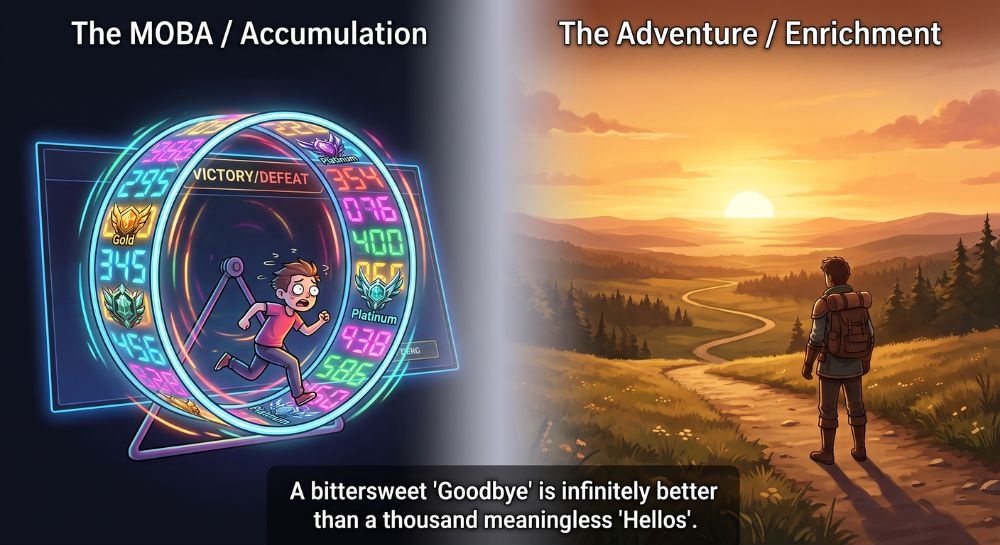
Unlike many other boys who were obsessed with highly competitive MOBA (Multiplayer Online Battle Arena) strategy games like League of Legends or DotA, I found myself taking a different route. I was drawn much more to story-driven adventure games. (e.g. the first 3 Harry Potter games, the Pokemon series, etc.) Despite being fully aware that those games are not as challenging as the MOBA ones (some may even label them as “for kids only”), I still enjoyed the former much more than the latter.
As I reflected on it later, I realized that it was not just about personal preferences. That my gaming taste was actually a metaphor for how I wanted to live my life.
For all its adrenaline-pumping excitement, a MOBA game is essentially an endless cycle of accumulation. Every match is a reset. You spend 40 minutes building power and accumulating rank points, only for it to vanish the moment the “Victory” or “Defeat” screen hits. It operates on an infinite loop where you are just a “function” in a machine, distracting yourself by constantly chasing the next win and rank. (well, I suppose some may disagree, but that’s my personal perspective)
An adventure game, however, is a finite journey. It lacks the adrenaline-pumping, 300-actions-per-minute mechanical difficulty of a MOBA—yet it offers a different kind of challenge: the challenge of the human condition. Of growing with the character, wrestling with complex choices (e.g. whether to sacrifice a beloved companion to save a city or not), and deciding one’s own path.
To me, that is much more meaningful than clicking a mouse faster than your opponent.
For a time, I actually found myself intentionally avoiding finishing adventure games, despite my love for them. The reason was that every time a story wrapped up, I would be overwhelmed by an inexplicable sense of melancholy that lingered for a few following days. I would, therefore, temporarily retreat to the endless loop of MOBAs to avoid the sadness, though I always ended up returning to the adventures later.
Somehow, that “post-game void” was only a thing when it came to adventure games; it never happened when I played a MOBA. And it felt strange to me—not quite emptiness, but a mix of happiness and sadness at the same time. Something bittersweet.
Eventually, I figured out that melancholic feeling is actually a form of Existential Sublimity—what the Japanese call mono no aware (物の哀れ, i.e. the "poignant awareness of impermanence"). It is the realization that something beautiful happened, and now it is over. And it occurred because I was deeply immersed in the narrative.
More than just playing a game, I was co-authoring a personal experience. I was investing my own heart into it, and the return on that investment was a memory that felt very “real.”
A MOBA match is written in water; a great story, on the other hand, is etched into one’s identity.
It’s easy to forget your win-rate from 2023, but you’ll always remember the ending of a game that made you cry.
To prefer the MOBA is to value Immortality.
To prefer the Adventure is to value Meaning.
By choosing the finite story over the endless loop, I was admitting that I would rather have a heart-wrenching “Goodbye” than a thousand meaningless “Hellos”. That I would choose enrichment of the soul over the mindless accumulation of stats.
If more people could adopt such a personal philosophy—embracing life’s bittersweet finitude instead of hiding in endless distractions—I believe many of the modern world’s issues would fade away.
If more of us valued food and cheer and song above hoarded gold, it would be a merrier world.
J.R.R. Tolkien
Back in the day, I decided to pursue a bachelor’s degree in International Business at a prestigious institution in my country. The choice, as I have come to accept it now, was not authentic at all—just an attempt to be “trendy,” to make myself look good, and to protect the “face” of my family. Despite not performing too badly academically, I never felt quite “at home” during my time at university.
Then, after graduation, I somehow ended up in the digital media world. I started as a content writer before pivoting to SEO (Search Engine Optimization) later on. While my job allowed me to cultivate various skills, learn new things, and make a decent living, I was constantly haunted by an intuitive feeling that something was fundamentally wrong.
It took me a really long time to figure out why: the modern business and media world has never appealed to me. In fact, it represents the exact opposite of my “ultimate concern”—namely, humanity. (or as I prefer to call it, Humanitas)
Nowhere was this clearer to me than in the world of SEO and digital marketing. On the surface, the job is about “connecting audiences with information.” Yet behind the curtain, it is an industry built on the monetization of attention.
In this ecosystem, everything—and everyone—is reduced to a metric. Profit is prioritized over truth, and monetization is placed above human dignity.
This twisted worldview does not stop at the media world. In fact, it has become the default operating system of the global economy, where human beings are increasingly being reduced to “human resources,” data points, or KPIs. And the consequence of this exploitative mindset is a gradual loss of the very thing that makes us human: the ability to care. (or Sorge, in the words of Martin Heidegger)
In the name of collective “progress”, modern society is actively making people disconnected from that capacity for caring. From their Heart-Mind. (which East Asian cultures refer to as 心)
While institutions and corporations constantly preach about “synergy” and “harmony”, these too are a facade—because they frequently come at the cost of the suppression of the individual. They demand that individuals put on a plastic smile, conform without questioning, and drown out their own voice to avoid disrupting the machinery of profit.
Once one has seen the sheer absurdity of it all, it becomes extremely painful to keep playing the game. As in my case, I have decided to step away and distance myself from the corporate and digital media world.
Now, most of my day is spent on teaching, doing part-time gigs that allow me to sustain my life without selling my soul to the “rat race”, and—most importantly—on reading, writing, and philosophizing on the human condition.
It is not the glamorous, high-status life that people enjoy showing off on social media. But it is a life where my Heart-Mind may remain intact.
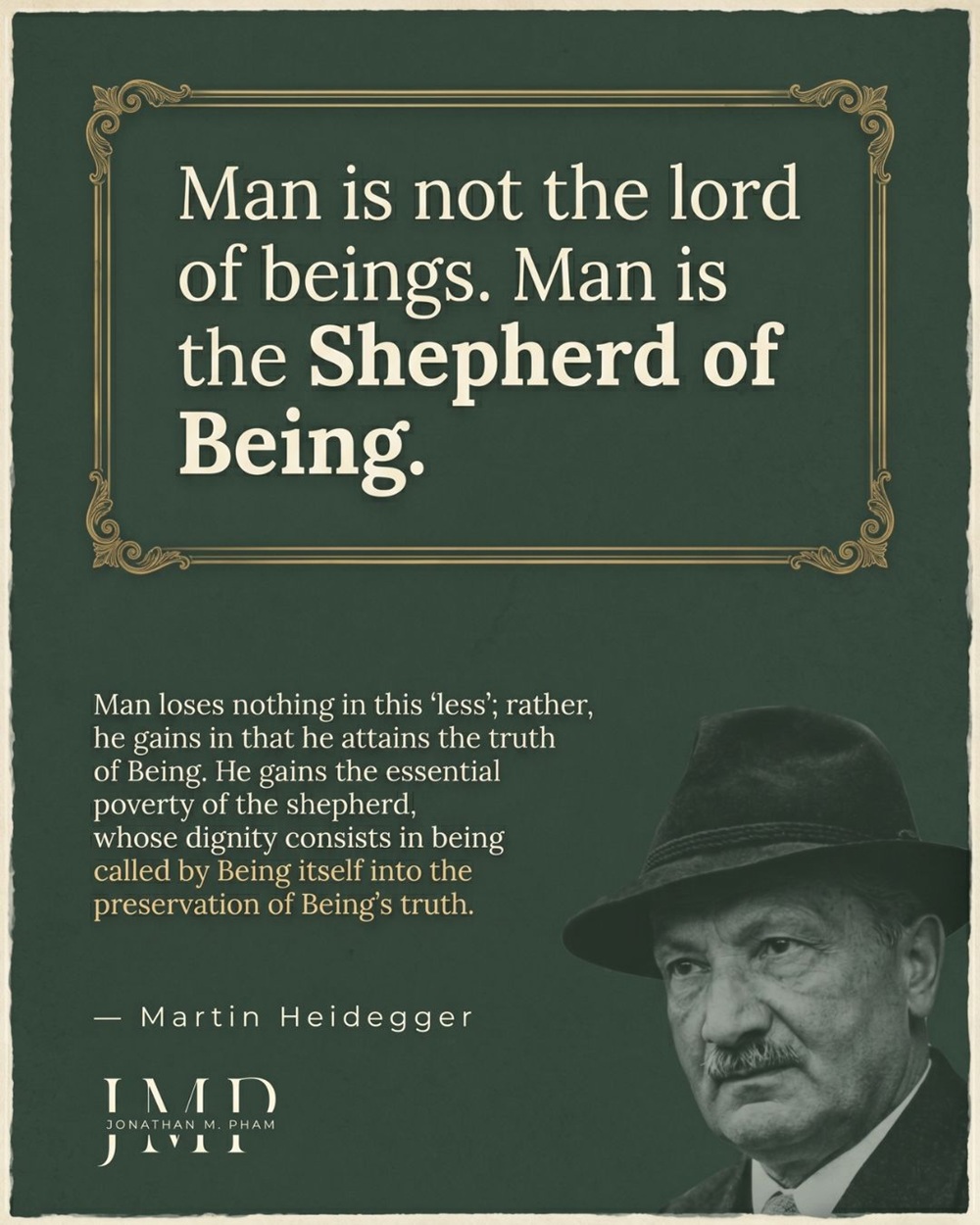
Man is NOT the lord of beings. Man is the Shepherd of Being. Man loses nothing in this “less”; rather, he gains in that he attains the truth of Being. He gains the essential poverty of the shepherd, whose dignity consists in being called by Being itself into the preservation of Being’s truth.
Martin Heidegger
Personal philosophy in life
Life is paradise, and we are all in paradise, but we refuse to see it.
Fyodor Dostoyevsky, “The Brothers Karamazov”
And here comes a very personal part of my personal philosophy: Faith. In a world that has essentially been fractured into two opposing sides (cold scientism on one end and dogmatic fundamentalism on the other), I find myself occupying a rare middle ground—what the philosopher Karl Jaspers referred to as “philosophical faith”. It’s the belief that meaning is grounded in a Transcendent Reality, but it must be realized through personal wrestling, reasoning, and authentic commitment—NOT through a neat, theological instruction manual.
To put it into perspective, think about how people typically react to a life crisis.
To me, faith has nothing to do with the “transactional spirituality” typically practiced by the ordinary individual—i.e., using religion, meditation, or self-help solely to get a “dopamine hit,” manifest wealth, evade personal responsibility, or inflate one’s ego. It goes much deeper than that.
It requires a complete transformation of the psyche—namely, the surrender of the ego’s demand for absolute certainty and control. It asks us to stop using spirituality as an anesthetic (a phenomenon called “spiritual bypassing”), but as a lens to find meaning in the daily struggles.
And above all, it involves a reframed view of the Divine—from an all-powerful man-in-the-sky who demands blind submission and constant applause, to a “God of the Absurd” who is down in the trenches, suffering alongside humanity. From a detached extraterrestrial king to an omnipresent “Force” who can be encountered right in this world, in the “here and now”—provided that our Heart-Mind is open enough to realize it.
Looking up and chanting prayers frantically like many fundamentalists do is, to me, a futile effort, because it cultivates the illusion of separation and traps the individual in their own ego. It reinforces a dualistic mindset: the belief that the Divine is somewhere “up there” in the pure heavens, while humans are stuck “down here” in a corrupt earth waiting to be rescued.
But if the Transcendent is truly omnipresent, then begging a distant deity to magically alter reality so that you don’t have to face it is of no use.
To find God, we have to take action. To silence the mind, pay attention to the reality right in front of us, and find joy in human connection. To turn religion into a verb: an active effort of “being the light” and repairing the world.
When we choose love and kindness in a cruel and unjust world—when there is every logical reason to be selfish, yet we choose to be compassionate anyway—we are already meeting God. Already touching the Ultimate Reality.
When two people relate to each other authentically and humanly, God is the electricity that surges between them.
Martin Buber
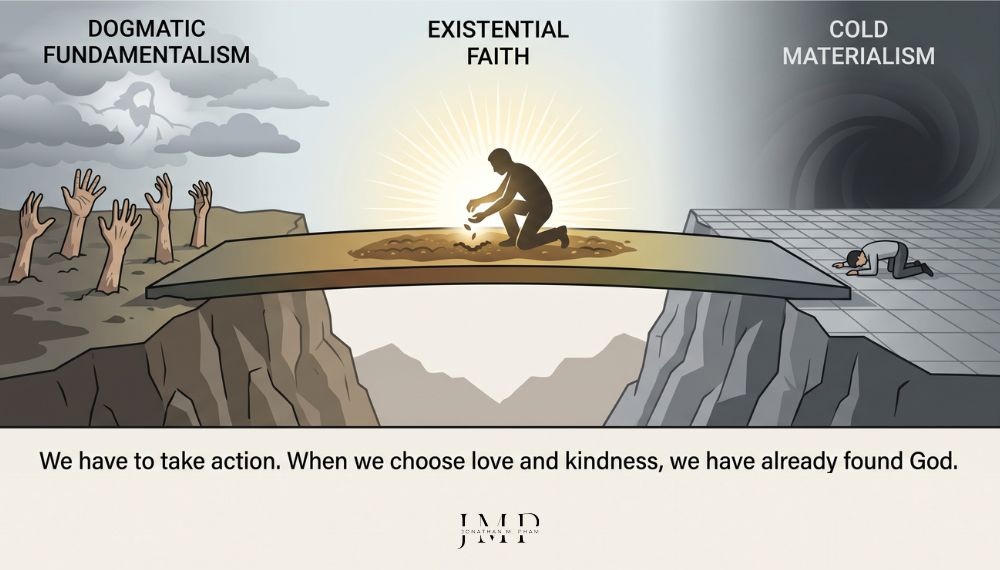
And that kind of sums up the main aspects of my overarching life stance. If you ask me to neatly categorize it using a single word, I suppose it would be tricky to give you an answer, though “Seeker” or “Existential Spirituality” is arguably the closest description.
But as we have established earlier, labels only serve to freeze your identity and feed your ego.
So instead of a rigid category, it’s probably better to summarize my personal philosophy as a daily practice:
“I view life as an ongoing journey where we must maintain a beginner’s mindset, think critically, and remain open to the mystery of existence. Instead of hiding behind dogma and tradition, conforming blindly to the crowd, or surrendering to cold nihilism, I choose to live intentionally and embrace whatever comes my way. I believe that through daily contemplation, self-integrity, conscious decision-making, availability and kindness to others, we can touch a much deeper layer of reality and find meaning in every given moment.“
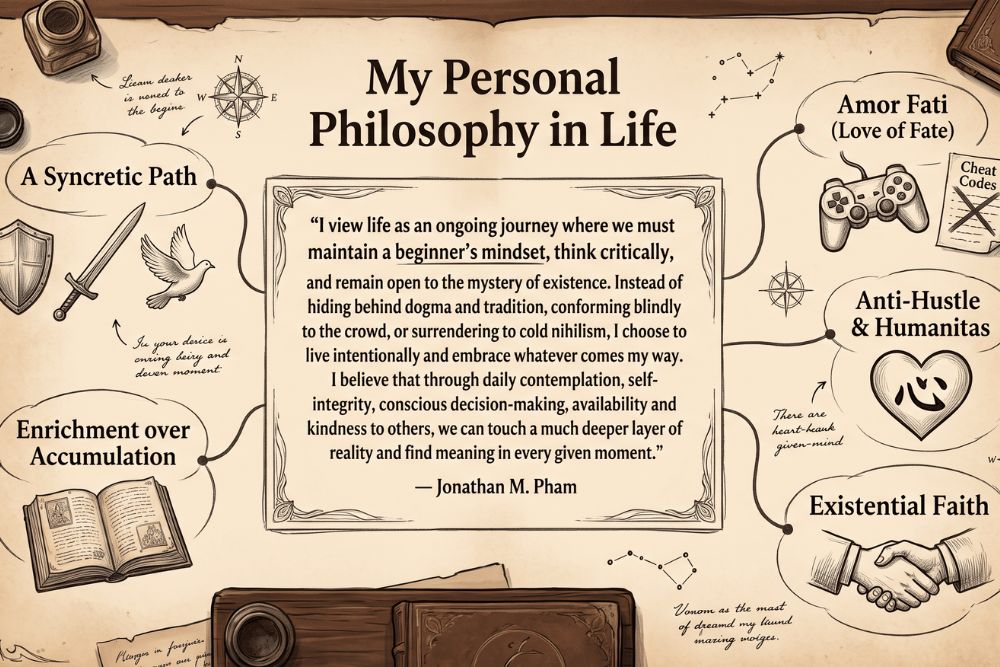
A life stance, as we have touched upon, is not a mathematical formula—a “life hack” into a meaningful existence. Finding your guiding principles requires introspection, honesty, and a willingness to step into the unknown.
Here is how you can begin the journey.
The unexamined life is not worth living.
Socrates
All of us start life operating on a “cultural kit”—a set of beliefs, definitions of success, and moral codes handed down to us by our parents, peers, religions, communities, and institutions. Unfortunately, the vast majority simply accept it without consciously reflecting on whether it makes sense or not. While that is understandable (it conserves our mental energy and protects us from being “ex-communicated”), living an “unexamined life” dictated by others is a recipe for bad faith and existential vacuum.
For a long time, I myself did the exact same thing. I was a passive consumer of “truth,” looking outward to priests, authority figures, and social traditions to tell me who I was and what I should value. The young “me” at that time was purely idealistic; I assumed that everything was either “black” or white”, and that all I had to do was to find the right door to walk through.
But eventually, certain incidents happened, and my naive worldview slowly showed cracks:
Over time, the conflict between my idealistic worldview—my “False Self”—and reality became so unbearable that I finally snapped. I walked away from it all, cynical and disillusioned. I was plunged into a bottomless Void, stripped of my external authorities and inherited labels. And in that void, I found myself contemplating the big existential questions:
“If the worldview I was handed is flawed, what do I actually believe?”
“Who am I when no one is telling me who to be?”
The turning point came from an unexpected place. During this dark period, I happened to have a new manager—a devout Buddhist—who extended more grace, empathy, and genuine love toward me than anyone I had known in my former circles.
Slowly but steadily, I realized I had spent my life clinging to the Container of my inherited beliefs (the labels, buildings, and rituals) while completely missing the Content (actual love, truth, and presence).
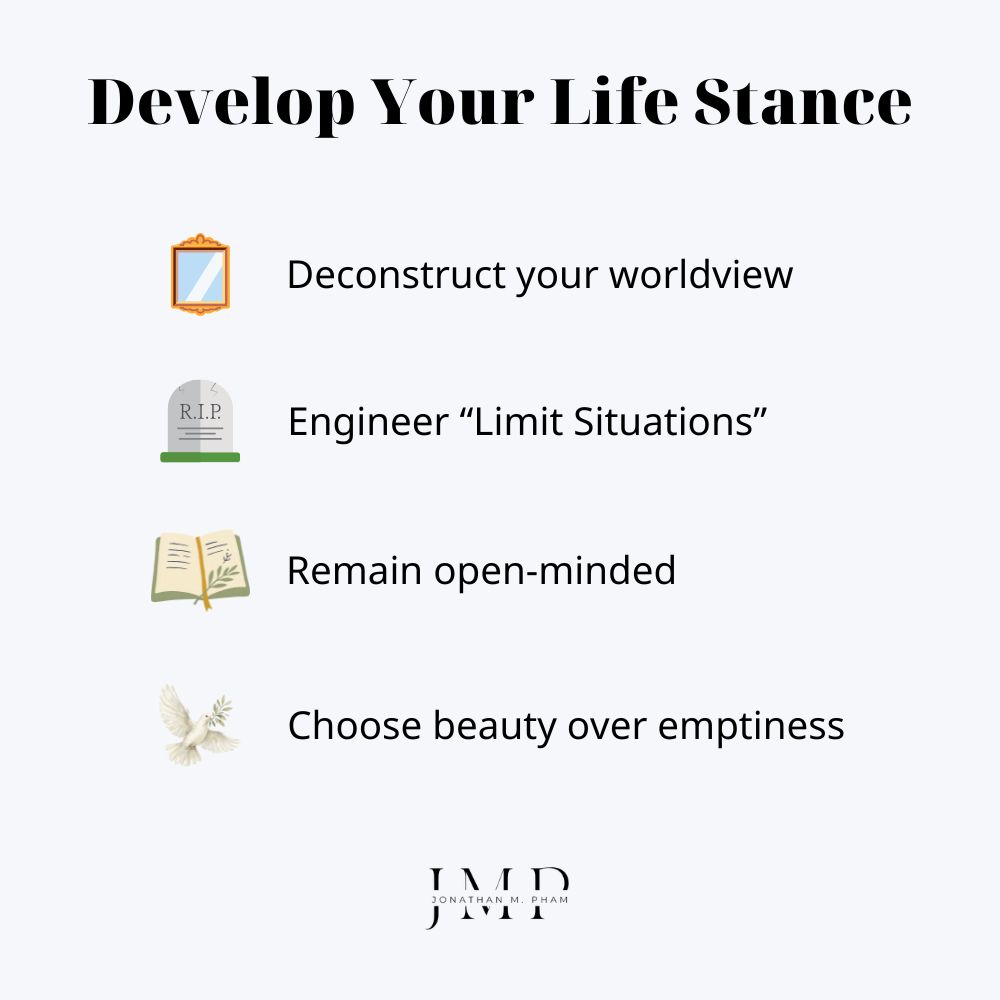
To come up with an authentic personal philosophy, you first need to audit what you have inherited. Start by asking yourself the big questions—not to find an immediate answer, but to see where your current assumptions come from:
Aside, it’s essential that you actively expand your own worldview—specifically, by reading and studying things outside of your comfort zone.
If you are a devout religious believer, read secular existentialists and atheists.
If you are a data-driven materialist, study the teachings of the Eastern sages or the Christian mystics.
The idea is to test what feels true to your soul versus what is merely social conditioning—to let new philosophies challenge you until you figure out what is authentically yours.
In facing the “Abyss” without fear, you will eventually stop living as an echo of society and “become who you are”.
(If you are interested, feel free to check out this article about “spiritual crisis”, in which you will find a more detailed version of my own deconstruction journey)
Read more: Being-for-itself – On the Burden & Beauty of Being a Conscious Human

Man sacrifices his health in order to make money. Then he sacrifices money to recuperate his health. And then he is so anxious about the future that he does not enjoy the present; the result being that he does not live in the present or the future; he lives as if he is never going to die, and then dies having never really lived.
Dalai Lama XIV
In the modern world, people have become remarkably good at avoiding reality. Every day, we numb ourselves with endless scrolling, busy-ness, and consumerism. We take everything for granted—that is, until we are suddenly hit by an extreme life experience: the loss of a loved one, a sudden illness, a near-death experience, or an intense moral crisis.
The philosopher Karl Jaspers called such a moment a “Limit Situation” (Grenzsituationen)—one that shatters the illusions of daily routines. It rips away all anesthetics and forces us to confront the raw reality of existence; at which point the only way out for us is to seriously reflect on our worldview.
The thing is, we should not wait for a tragedy to wake us up. (after all, it’s usually too late then) Our own life stance is something that should be thought about right here, right now. And we can do it by actively engineering our our own “limit situations”:
It’s impossible to find your personal philosophy while scrolling mindlessly on the phone or working 60 hours a week on autopilot. You have to break the “natural attitude” of daily life. Only then may your core values rise to the surface.
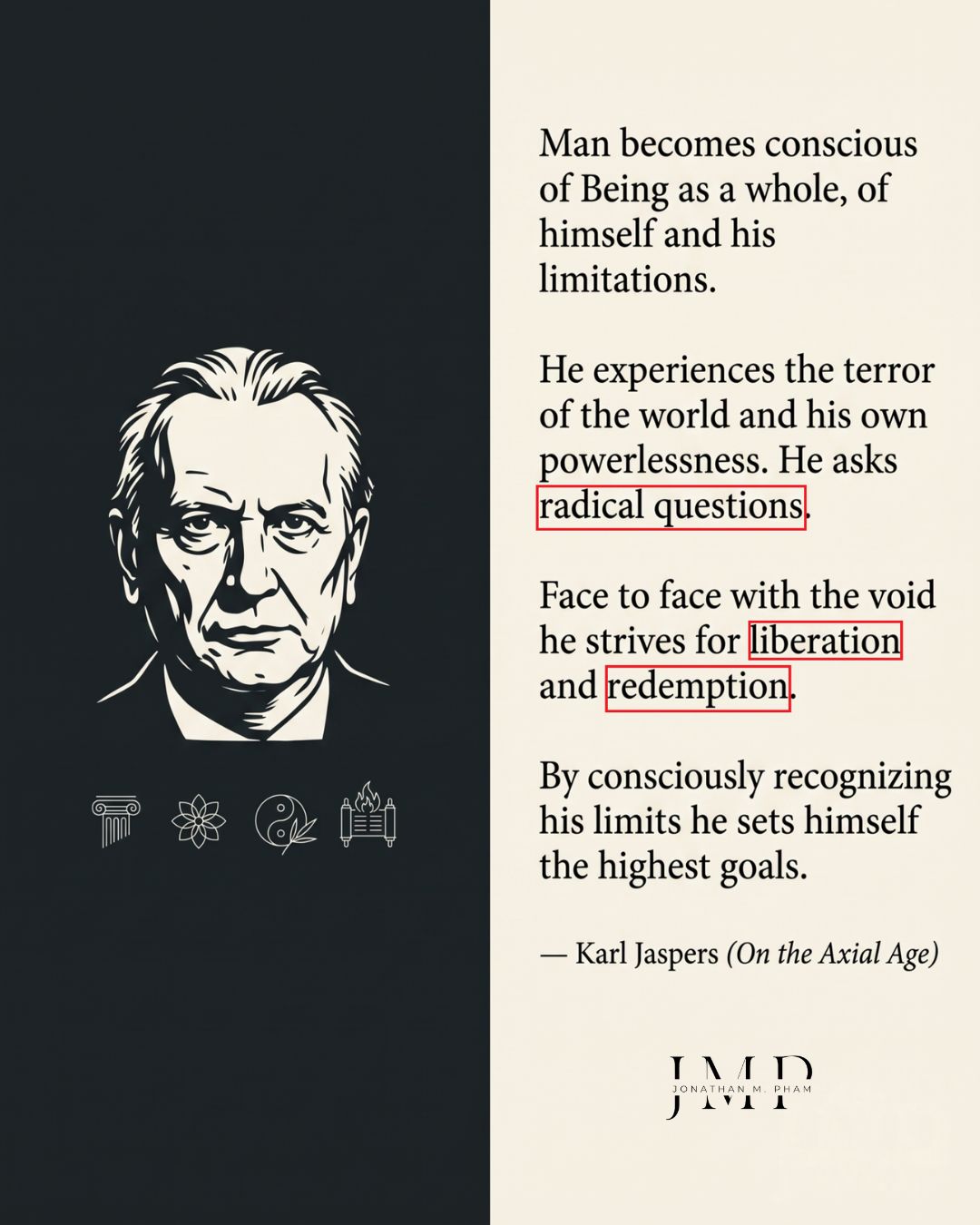
Man becomes conscious of Being as a whole, of himself and his limitations. He experiences the terror of the world and his own powerlessness. He asks radical questions. Face to face with the void he strives for liberation and redemption. By consciously recognizing his limits he sets himself the highest goals.
Karl Jaspers on the Axial Age
The Way (Tao) that can be expressed is not the eternal Way. The name that can be defined is not the unchanging name.
Lao Tzu, "Tao Te Ching"
When you finally find a philosophy that brings you peace, it is incredibly tempting to idolize it. To lock the new worldview into place and become hostile to every other outlook that doesn’t align with it.
But to do so is to essentially mistake the “vehicle” for the “destination”. The “finger pointing to the moon” for the “moon” itself.
The philosopher Immanuel Kant once made a distinction between two realms of reality. According to him, there is the phenomenal world (the world as our limited human minds perceive and structure it) and the noumenal world (the underlying mystery of the universe, which we can never fully comprehend).
While his idea may sound like heavy academic theory, it does give us a very practical takeaway—that is, we should stop being haunted by the pressure to be “right”.
Given that human knowledge of the universe is fundamentally limited—given that there’s always a gap between our perception of reality (phenomenon) and reality itself (noumenon), it does no good to argue that “my way is the only way”. After all, you do not always need objective proof to live your life.
As such, your life stance should be viewed as the best phenomenal map of a territory beyond your comprehension. It’s just a key to understanding reality, NOT reality itself. A way to live, NOT life itself.
You don’t have to empirically prove your own worldview; nor do you have to refute others’. As long as a philosophy allows you to make choices that resonate with your own soul and enrich people’s lives, then it’s a good philosophy.
In other words, what matters is not the “right” belief (one’s stance), but the “right” practice. (one’s life)
Whenever you come across a foreign philosophy or a dissenting opinion, do not immediately act defensively. Ask yourself first:
“Does this make sense? Does this make me a more compassionate person?”
If it does, integrate it. If it doesn’t, let it go.
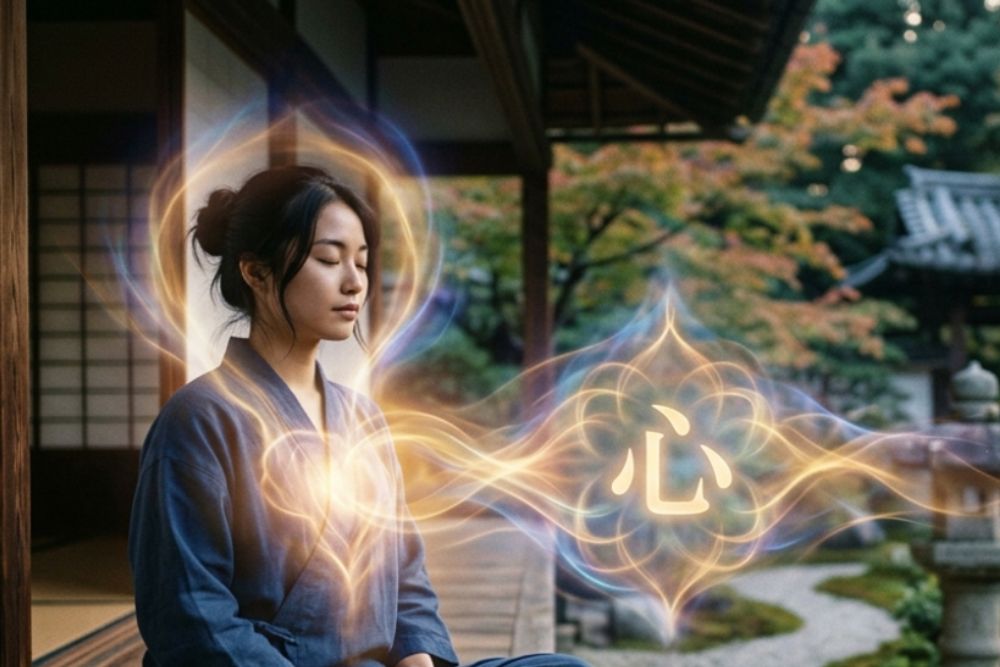
If you can cultivate such an open Heart-Mind (心), there will be a radical change to your life. Not only would you become more grounded, considerate and empathetic towards others, but you would also have the humility and flexibility necessary to learn and adapt.
After all, a personal philosophy that saved you at age twenty (e.g. “Sheer grit and willpower can conquer any obstacle!“) may not be the one that sustains you at age fifty. Rather than viewing it as a sign of inconsistency, take that as proof that you have outgrown the previous “you”. Give yourself the permission to change as you grow older, experience loss, and gain new knowledge.
The snake which cannot cast its skin has to die. As well the minds which are prevented from changing their opinions; they cease to be mind.
Friedrich Nietzsche
Personal philosophy in life
“I have a story that will make you believe in God.”
This bold promise is made near the beginning of Yann Martel’s novel Life of Pi. When I first came across it, I found it rather amusing.
“Well, interesting. Let’s see if it can.”
As I went deeper into the story, something I didn’t expect dawned on me: the story is not meant to prove the existence of the Divine through objective miracles, historical doctrine, or empirical proof. Instead, it frames belief as a personal narrative choice—choosing a truth that elevates the spirit over sterile facts.
At the end of the novel, Pi presents two alternate versions of his survival at sea: one fantastical and vibrant, featuring wild animals (a Bengal tiger, an orangutan, a zebra, and a hyena), and another brutal, starkly realistic version involving human cruelty and cannibalism. When the Japanese investigators struggle to believe the animal story, Pi asks them a piercing question:
“Which story do you prefer?”
They admit the one with the tiger is “better”; to which Pi simply replies:
“And so it goes with God.“

To me, that is exactly how one’s personal philosophy of life should be.
Empirically speaking, we cannot prove that a compassionate life stance is “correct” and a nihilistic, godless one is “wrong”. It’s a personal choice—to limit oneself to objective facts only, or to transcend and take a “leap of faith” despite the absurdities. To succumb to cold realism, or to infuse one’s existence with meaning, wonder, and awe.
Which will you choose?
The same dilemma was presented in the story of The Brothers Karamazov—specifically, through a sparring between Ivan and Alyosha. In the chapter “Rebellion,” Ivan presents his brother with brutal accounts of innocent children being tortured and abused. To him, such senseless suffering is proof that God does not exist, and even if God did, he would gladly “return his ticket”.
To his brother’s argument, Alyosha does not attempt to refute it with syllogisms or theological logic. (because empirically, Ivan’s facts are indisputable) Rather, he offers a response that operates completely outside Ivan’s rationalist trap: he steps forward and softly kisses his brother.
He chooses to “love life more than the meaning of it”; to love it “regardless of logic”. He chooses beauty over emptiness—even when there’s no cosmic guarantee.

Every day, life is asking each of us to make the exact same choice.
There’s no way to mathematically prove that your kindness will save the world. Yet it doesn’t mean you cannot leap into the dark and “be the light of the world” anyway.
If you are able to do so—doing good without the guarantee of a reward—you have passed the ultimate test of life. You have proven that your personal philosophy is truly authentic.
Without risk there is no faith. Faith is precisely the contradiction between the infinite passion of the individual’s inwardness and the objective uncertainty. If I am capable of grasping God objectively, I do not believe, but precisely because I cannot do this I must believe. If I wish to preserve myself in faith I must constantly be intent upon holding fast the objective uncertainty, so as to remain out upon the deep, over seventy thousand fathoms of water, still preserving my faith.
Søren Kierkegaard
How to find & develop your personal philosophy in life
The legendary boxer Mike Tyson once made a candid remark as follows,
“Everyone has a plan until they get punched in the face.“
The same rule applies when it comes to your personal philosophy. It is easy to write a life manifesto in a quiet room; yet it is much harder to actually live by it when you are stressed, provoked, or grieving.
When you consciously adopt a life stance, you will inevitably face a gap between your ideals and reality.
There is a Buddhist parable about an ascetic who spent twenty-five years living in a remote cave, practicing intense meditation and extreme austerities.
One day, the Buddha was walking by a river when he encountered this man. Beaming with pride, the ascetic wanted to show off the reward of his lifelong dedication. He stepped onto the water and walked across the surface of the river without getting his feet wet.
Rather than being impressed, the Buddha asked him how long it had taken him to master this extraordinary skill. When the man proudly replied, “Twenty-five years,” the Buddha sighed:
“That is a pity. For a mere copper coin, the ferryman would have taken you across in five minutes. You have wasted twenty-five years for the price of a penny.“
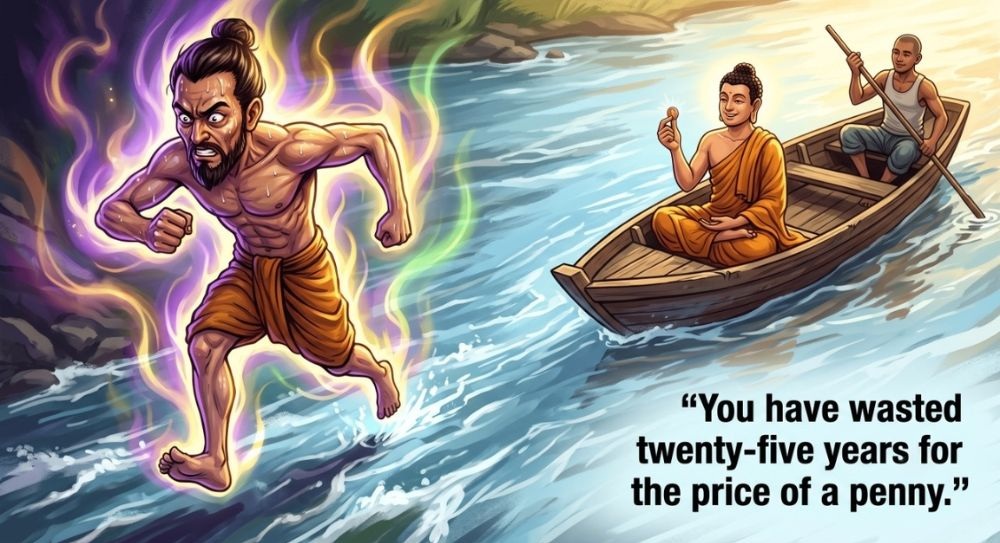
The story serves to highlight the danger of the “ego trap”—also referred to as “spiritual materialism”. It occurs when we become obsessed with the means (the power, the labels, the aesthetic of being philosophical) rather than the end (attaining peace, helping others, and becoming enlightened). When we start using our personal philosophy to feel superior to the “unawakened” masses.
◆ Example: The Internet Stoic
You probably know them; they are the person who regularly quotes Marcus Aurelius on social media, reads all the “right” books, and loudly preaches the “dichotomy of control”. Yet it’s also the same person who gets furious when someone cuts them off in traffic—and screams at the barista when their coffee is late.
If we compare them to an ordinary working-class parent who has never read a single page of philosophy, yet patiently endures hardships and unconditionally loves their family, the question is: Who is the real one?
A life stance is not a badge of honor meant to make us look “deep”. It is not meant to cause us to become detached, arrogant, or caught up within ourselves—but to drive us toward the world.
If your philosophy only inflates the ego but fails to make you kinder, it has become useless.
Love in dreams thirsts for immediate action, quickly performed, and with everyone watching. Indeed, it will go as far as the giving even of one’s life, provided it does not take long but is soon over, as on stage, and everyone is looking on and praising. Whereas active love is labor and persistence, and for some people, perhaps, a whole science.
Fyodor Dostoevsky
It is the duty of the human understanding to understand that there are things which it cannot understand.
Søren Kierkegaard
Another challenge is the temptation to choose the “labyrinth” over the “sword”—i.e. using philosophy as a shield to avoid the vulnerability of actual living.
The Buddha referred to this trap as the “thicket of views“. He compared people who get bogged down in speculative, unanswerable questions to a man shot by a poisoned arrow. Instead of letting the doctor pull the arrow out, the wounded man demanded to know the name, caste, and height of the archer. He wanted to know what kind of wood the arrow was made of, and what kind of bird the feathers came from.
As the Buddha pointed out, the man would die before he got the answers, and the answers wouldn’t have saved him anyway.
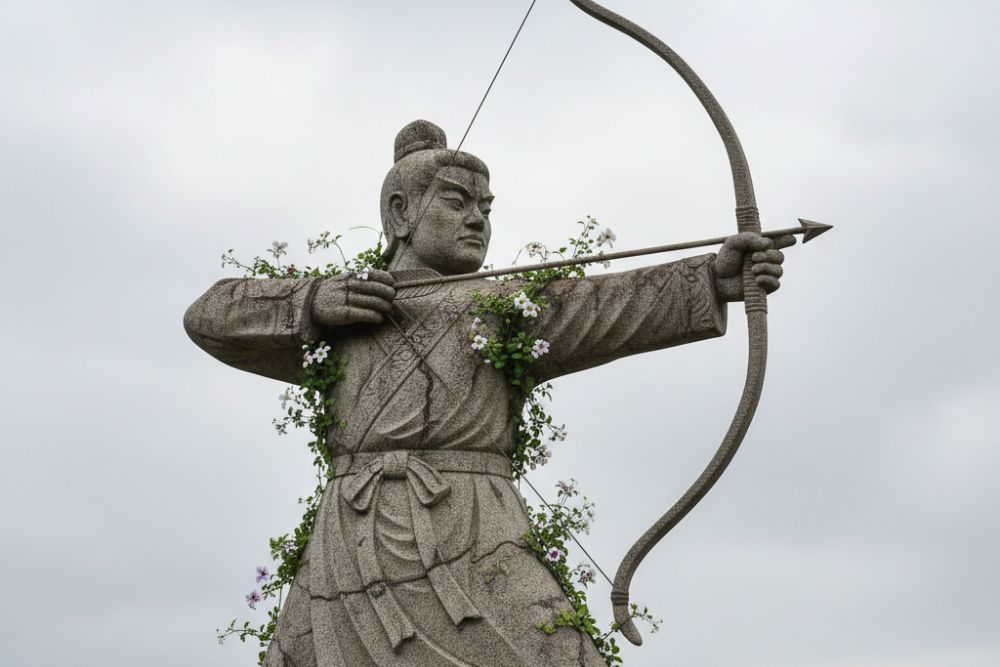
We commit the same error when we choose intellectualizing over action—when we continuously debate the meta-ethics of charity while ignoring the homeless person freezing on the street. If we convince ourselves that a problem is infinitely complex, we could conveniently excuse ourselves from having to act on it today.
This is exactly what happened to Ivan Karamazov. His hyper-rational mind demanded absolute proof and a perfectly just universe. When he couldn’t find it, he broke and suffered from a complete breakdown. He succumbed to the poisoned arrow.
His brother Alyosha, on the other hand, bypassed the thicket completely. He decided to heal himself and those around him through Active Love—taking compassionate action without the need for concrete proof.
◆ From problem-solving to reflective inquiry
To avoid Ivan’s fate, there needs to be a shift in how we consume philosophy. These days, people are frequently sold “pop philosophy”—a space characterized by life hacks, productivity frameworks, and 5-step listicles to cure sadness. In this framework, the human condition is treated like a software bug that needs to be fixed or optimized.
The thing is, life is not a problem to be solved, but a “reality to be experienced”.
Instead of asking, “How do I get rid of this anxiety?” we should ask,
“What is this anxiety telling me?“
When we stop trying to “solve” the absurdity of existence on a whiteboard and start actually reflecting on it, we move out of our heads and back into our hearts.
To teach how to live without certainty, and yet without being paralyzed by hesitation, is perhaps the chief thing that philosophy, in our age, can still do for those who study it.
Bertrand Russell
At the beginning of The Brothers Karamazov, the youngest brother, Alyosha, is hiding behind the walls of the local monastery. He is devoted and pure-hearted, but his faith is somewhat untested. His spiritual mentor, Father Zosima, recognizes it and commands Alyosha to leave the monastery. He tells the young man that his place is not in isolation, but out in the world.
Likewise, a life stance is not meant to be an excuse to retreat from society (a psychological phenomenon known as “spiritual bypassing”). Nor is it meant to make us self-righteous, adopt a “slave morality” mindset and look down on the secular world as “broken” or “lost”. (a trap I frequently see fundamentalists fall into)
Rather, it requires us to look directly at the harsh realities of human existence, and choose to act with compassion anyway.
It’s so easy to distance ourselves from those who commit terrible wrongs and label them as “monsters”. However, have we ever stopped for a moment to reflect on this question?
“What if I had been them?”
If we had been that pirate—born in an impoverished village on the shore of Thailand, raised without love and moral guidance—wouldn’t we have grown up to commit the same atrocities as him?
If we shoot him down, does it really solve the problem? Won’t the kids in that village take his place in the future?
When we really think about it—when we understand that nobody is inherently good or evil, that we are all shaped by shared societal conditions—the illusion of separation collapses. What started as self-righteous anger is now replaced with radical empathy.
Instead of condemning people, we have to accept that “everyone is really responsible to all men for all men and for everything“. Only then may there be hope for the world to be changed.
There is one way for you to overcome these obstacles: take firm hold of yourselves and make yourselves answerable for all men’s sins! This is also the truth, friends! For as soon as one sincerely accepts the idea that he is answerable for the sins of all men, he will realize that that is, indeed, the truth, that he is answerable for everybody and everything. But if you seek excuse for your idleness and impotence by blaming other people, you will end up bloated with Satan’s pride and murmuring against God.
Fyodor Dostoevsky, “The Brothers Karamazov”
There was a time when I felt somehow alienated from my loved ones—specifically following my decision to research philosophy and pivot my self-discovery blog (which I initially wrote from a pure self-help perspective) toward a more existential vibe. When I sat down at family dinners or hung out with friends, I couldn’t help but feel a “disconnect” between my concerns and theirs.
While my mind was occupied with freedom and the nature of Being, they were talking about the daily corporate grind, mortgages, and standard “common sense” topics.
For a while, I experienced a classic “Plato’s Cave” moment. I felt like I had stepped outside into the sunlight, and everyone else was still staring at the shadows on the cave wall. As a result, I was somehow disappointed.
Thankfully, it didn’t take me long to realize that I was falling into a trap. That I was “weaponizing” philosophy and turning it into an excuse to separate me from others.
That’s not what philosophy is about. At the end of the day, the goal is to adopt a lens through which one can inhabit the common world more deeply and meaningfully.
As the Stoics constantly remind us, we are, at our core, social creatures. If your intellectual studies are making you feel less connected to those around you, it is probably worth asking if your philosophy has secretly become a defense mechanism.
◆ The “Double Life” strategy
To protect both my relationships and my intellectual integrity, I eventually decided to adopt a “Bifurcated Life” strategy. Specifically, I learned to separate my life into two channels:
There’s no need to preach your philosophy to your relatives to prove it is real. You can keep your inner fire completely private. You can embody what the philosopher Søren Kierkegaard called the “Knight of Faith“—one who has made an inward spiritual “leap”, but on the outside looks like a completely ordinary citizen going about their daily life.
When you stop treating your loved ones as an audience to be converted or an obstacle to be transcended, you can finally love them precisely where they are.
After all, what is the point of studying the nature of Being if you cannot fully inhabit the ordinary moments of being with the people you care about?

◆ Protecting your Substance
This bifurcation also helped solve another major crisis for me: the pressure to monetize my personal philosophy.
Once, I tried too hard to turn my blog into a sustainable source of income. I was obsessed with writing as many articles as possible, targeting high-volume SEO keywords so that I could increase the site’s traffic (and revenue) quickly.
Eventually, I realized that optimizing my soul for search engines—like what I had been doing by then—was compromising my own integrity. It was leading me straight toward burnout and self-alienation—what Kierkegaard called a “sickness unto death.”
So I decided to stop. And after a period of critical self-reflection, I concluded that my writing is a way for me to live, not to make a living.
If I need to sustain myself financially (Subsistence), I can do something else for now. Like Spinoza grinding optical lenses, Kafka evaluating insurance claims, or Einstein working in a patent office, it is fine for me to have a mundane job to pay the bills, while my philosophical fire burns in the private domain.
By separating how I earn my bread from how I nourish the soul, I inadvertently remove the market’s veto power over my inner world. Now I can simply be and enjoy the experience of philosophizing.
Before enlightenment, chop wood, carry water. After enlightenment, chop wood, carry water.
Zen Proverb
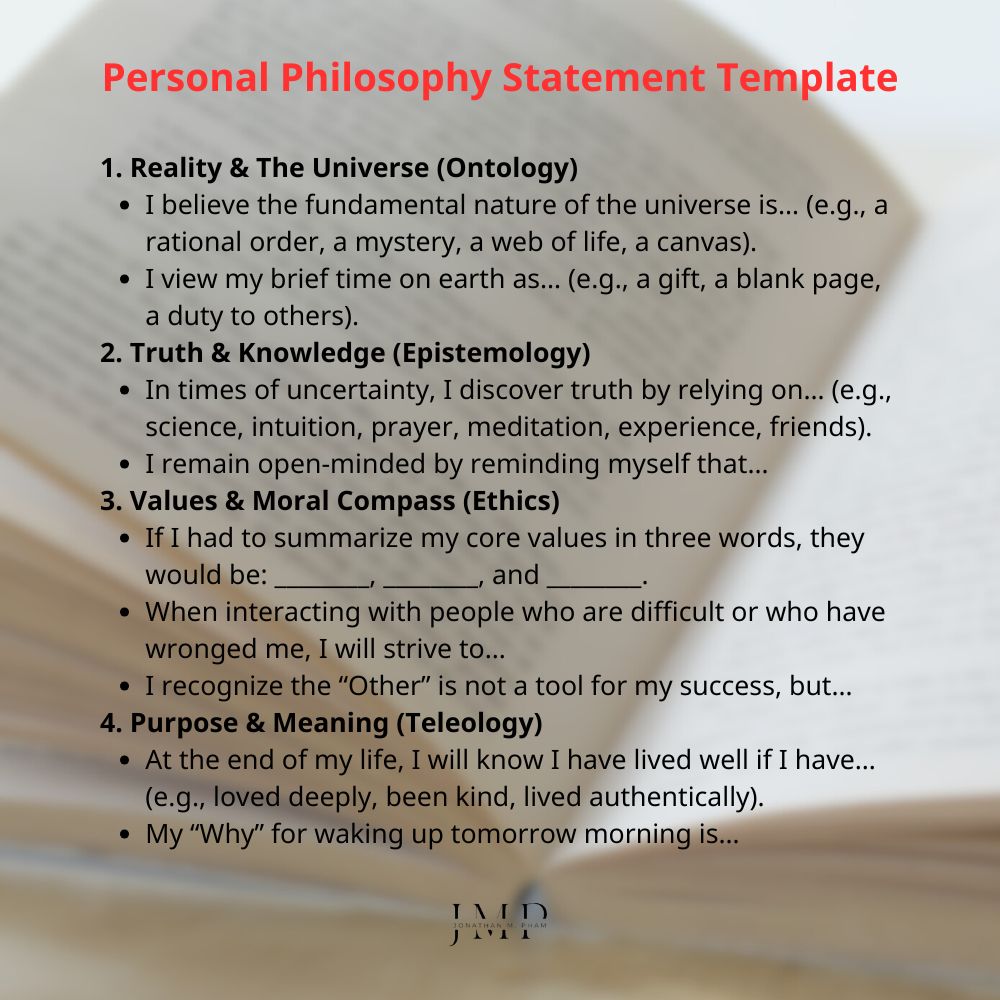
For those who would like a little inspiration, here is a fill-in-the-blank framework based on the core branches of philosophy (Ontology, Epistemology, Ethics, and Teleology). Feel free to copy this down in a journal, take a quiet hour for yourself, and draft your own manifesto:
1. Reality & The Universe (Ontology)
2. Truth & Knowledge (Epistemology)
3. Values & Moral Compass (Ethics)
4. Purpose & Meaning (Teleology)
Personal philosophy statement examples
The ultimate masterclass in personal philosophy. If you want to see an “epic battle” between cold rationalism, chaotic passion, and active love play out in a gripping family drama, this is for you. It is difficult to read, but it will change you.
Written by a psychiatrist who survived the Holocaust, the book proves that human beings are capable of enduring almost any suffering if they can find a “why.” It is the cornerstone of existential resilience.
For the days when life feels like a meaningless grind on a corporate hamster wheel. Camus teaches us how to embrace it anyway and find happiness in the struggle itself.
An exploration of faith, storytelling, and how we choose to frame the reality of our lives. The story is a perfect metaphor for the courage required to “choose beauty over emptiness.”
An introduction to Eastern mindfulness and “Interbeing” as the fix for Western existentialism’s limitations.
Read more: 27 Best Existentialism Books
Read more: 75 Deep Philosophical Questions for the Truth-seeking Soul
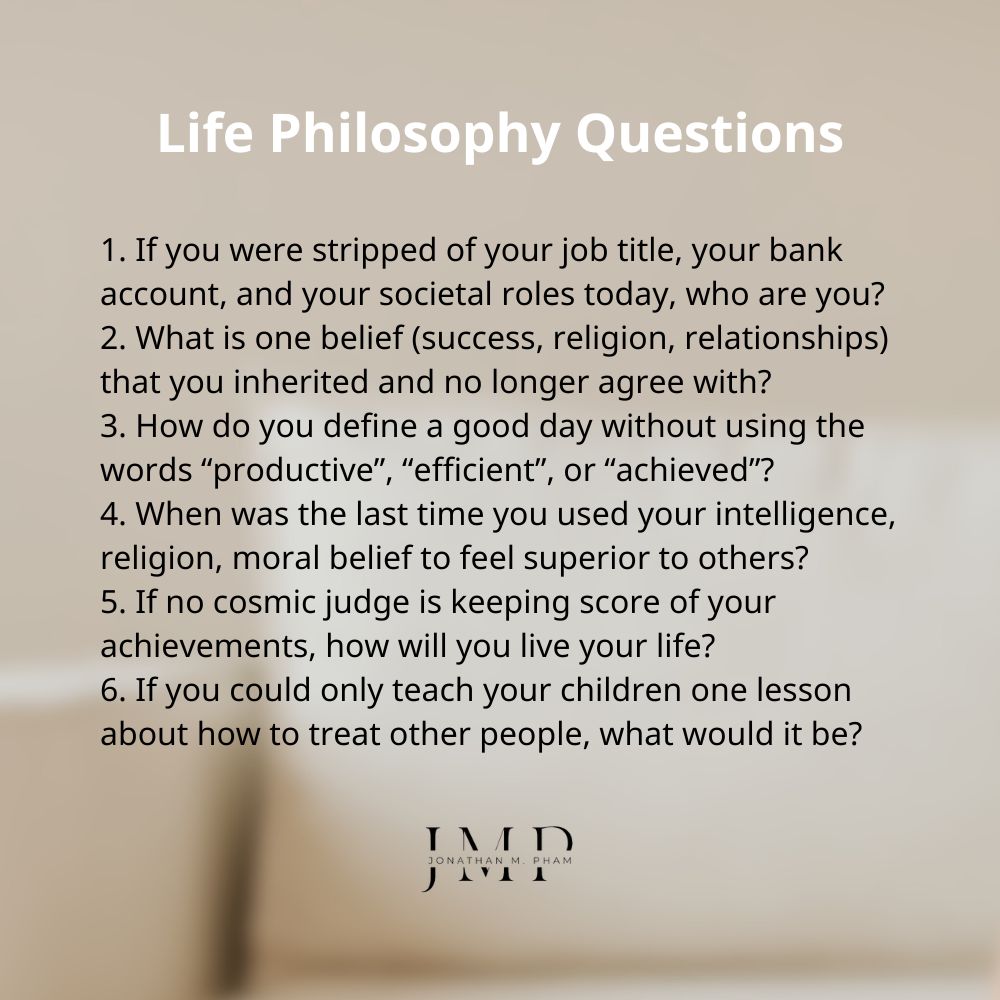
Life philosophy quiz
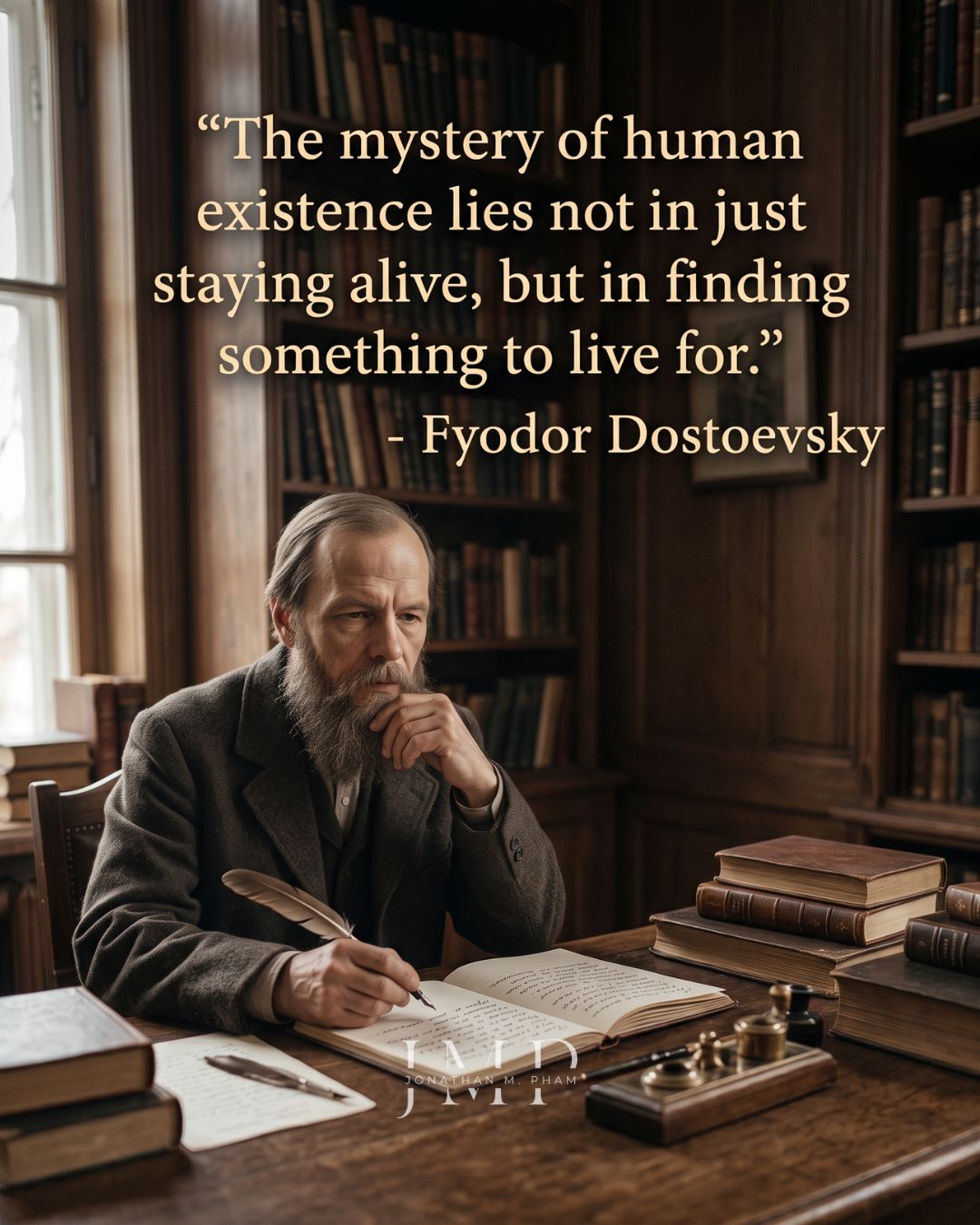
The mystery of human existence lies not in just staying alive, but in finding something to live for.
Fyodor Dostoevsky
Man is a synthesis of the infinite and the finite, of the temporal and the eternal, of freedom and necessity.
Søren Kierkegaard
Ultimately, man should not ask what the meaning of his life is, but rather must recognize that it is he who is asked. In a word, each man is questioned by life; and he can only answer to life by answering for his own life; to life he can only respond by being responsible.
Viktor Frankl
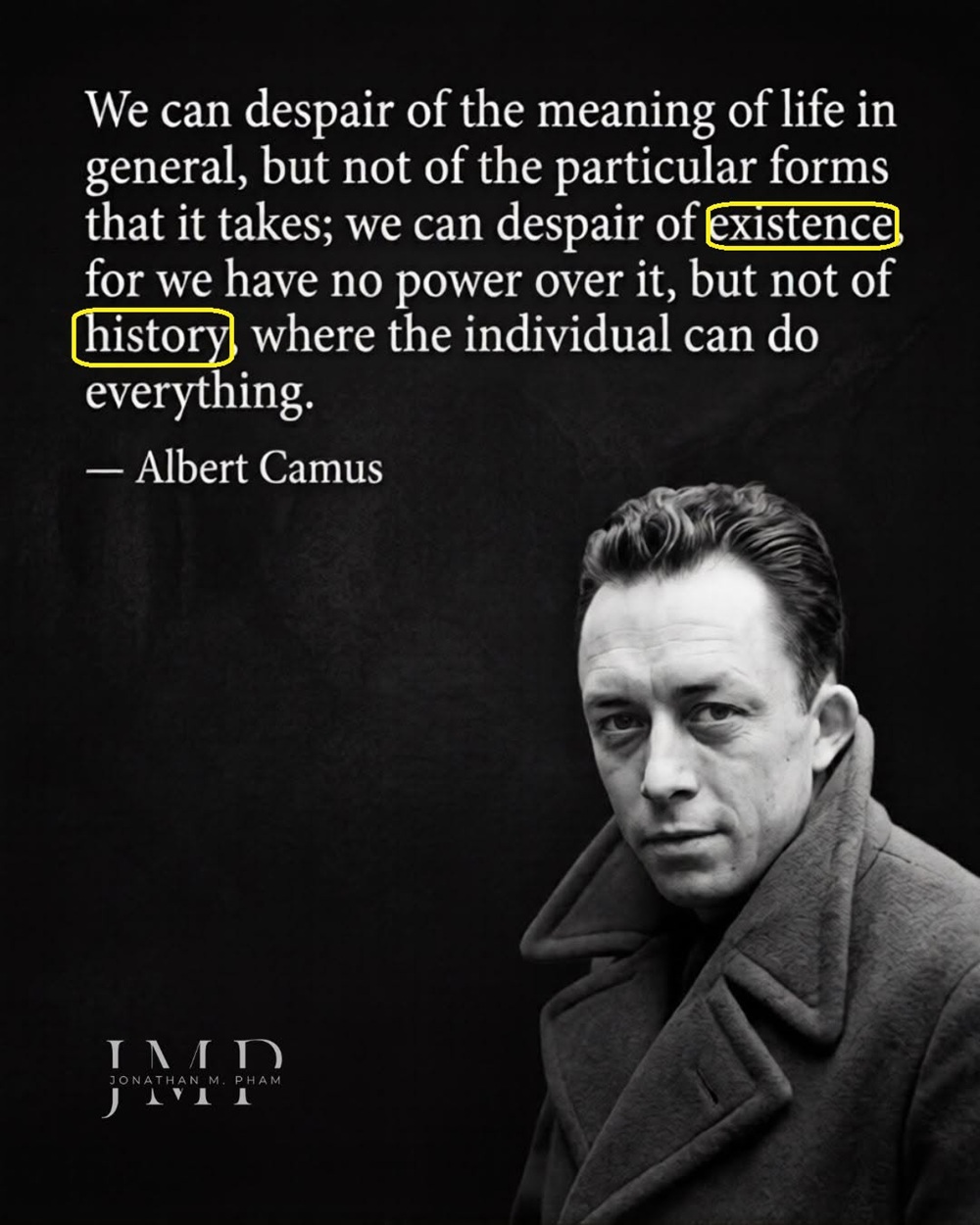
We can despair of the meaning of life in general, but not of the particular forms that it takes; we can despair of existence, for we have no power over it, but not of history, where the individual can do everything.
Albert Camus
Personal philosophy in life
◆ On Action & Presence
We have a tendency to think in terms of doing and not in terms of being. We think that when we are not doing anything, we are wasting our time. But that is not true. Our time is first of all for us to be. To be what? To be alive, to be peaceful, to be joyful, to be loving. And that is what the world needs most.
Thich Nhat Hanh
Waste no more time arguing what a good man should be. Be one.
Marcus Aurelius
One does not become enlightened by imagining figures of light, but by making the darkness conscious.
Carl Jung
◆ On the Search for Truth
Truth is a pathless land.
Jiddu Krishnamurti
Be patient toward all that is unsolved in your heart and try to love the questions themselves, like locked rooms and like books that are now written in a very foreign tongue. Do not now seek the answers, which cannot be given you because you would not be able to live them. And the point is, to live everything. Live the questions now. Perhaps you will then gradually, without noticing it, live along some distant day into the answer.
Rainer Maria Rilke
◆ On Love
What is hell? I maintain that it is the suffering of being unable to love.
Fyodor Dostoevsky
All real living is meeting.
Martin Buber
What can you do to promote world peace? Go home and love your family.
Mother Teresa
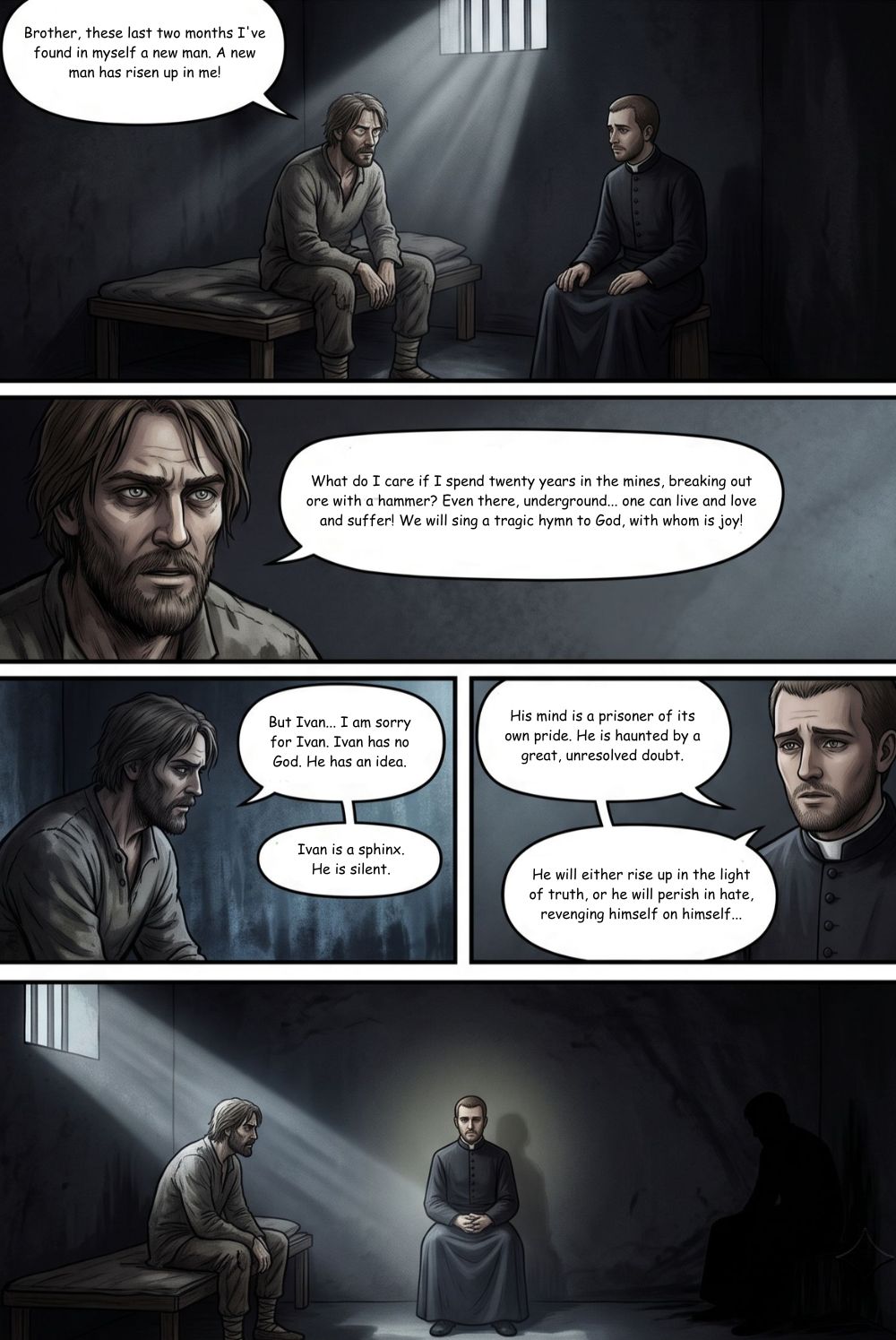
“Brother, these last two months I’ve found in myself a new man. A new man has risen up in me! What do I care if I spend twenty years in the mines, breaking out ore with a hammer? Even there, underground… one can live and love and suffer! We will sing a tragic hymn to God, with whom is joy!“
These are the words of Dmitri Karamazov, the brother driven by the impulsive desires of the Body. By the end of the story, he is wrongfully convicted of a crime he did not commit and sentenced to twenty years of hard labor in Siberia. Yet, ironically, it is in this darkest moment that Dmitri finds his redemption. Stripped of his worldly pleasures and forced to confront the depths of his own soul, he finally accepts his fate and responsibility for the brokenness of the world.
His brother Ivan, on the other hand, descends into madness. He cannot reconcile his rigid theories with the irrational guilt he feels. Because his philosophy is purely cerebral, it offers him no grace and no lifeline. His mind becomes “a prisoner of its own pride,” haunted by unresolved doubt.
“Ivan has no God. He has an idea.“
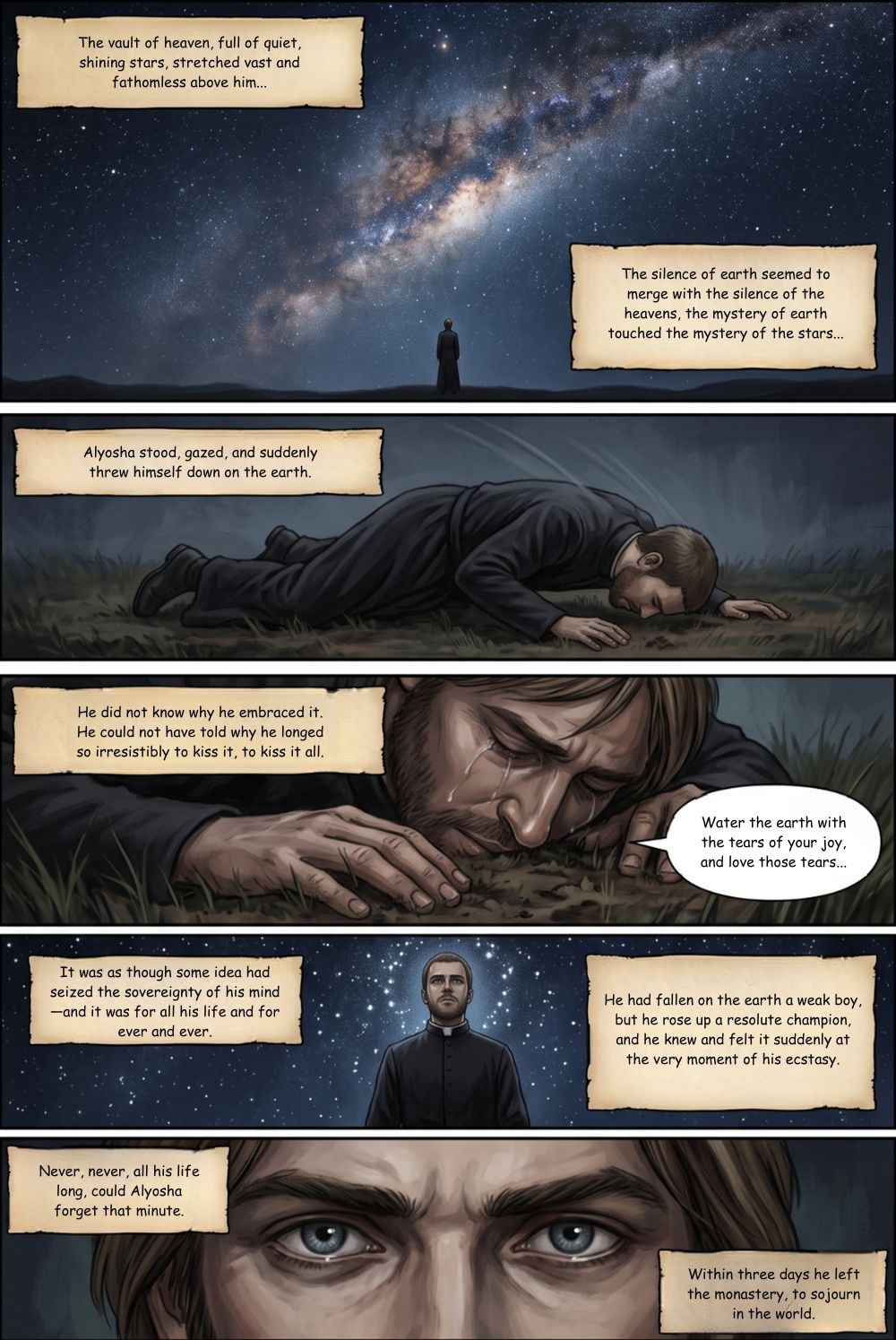
And then there is Alyosha, the young idealist. Following the death of his beloved mentor Zosima, Alyosha experiences a deep crisis of faith—until one night, when he steps out and looks up at the stars.
Without asking for any logical proof, he simply opens his heart to the mystery of existence. Then he throws himself onto the earth, weeping and kissing the ground.
It’s a moment of pure, transcendent ecstasy. In that very moment, he transforms from a sheltered monk into an “engaged mystic”—someone who carries the light directly into the suffering world.
◆ The integration of the Body-Mind-Soul
It’s tempting to conclude that Alyosha’s life stance is the “correct” one. However, my advice is this: you must integrate all three brothers within yourself.
When you integrate these elements, your life stance would cease to be a rigid set of rules. You would stop agonizing over every single moral choice—like a detached “observer” sitting inside your head.
Instead, like a river effortlessly flowing around a rock, you would act naturally from your integrated core—your Heart-Mind. (心)
When your internal values and external actions become one, the conflict of existence would vanish.
Personal philosophy in life
◆ The “Symphony of Silence”
It is true that we live in a world that appears to be indifferent to our suffering. The cosmos will not hand you a neat manual explaining the meaning of your life.
However, instead of viewing the universe’s silence as a scary void, we can reframe it as a call to action. An invitation to speak our own voice—to confront life on our own, just like Sisyphus pushing the rock up the hill with a smile on his face.
It’s very likely humanity would never be able to definitively solve the universe’s metaphysical puzzles, but we shouldn’t be bothered by it anyway. At the end of the day, what matters is to participate in the human experience. To practice what Father Zosima has taught:
“Try to love your neighbors actively and tirelessly. The more you succeed in loving, the more you’ll be convinced of the existence of God and the immortality of your soul. And if you reach complete selflessness in the love of your neighbor, then undoubtedly you will believe, and no doubt will even be able to enter your soul.”
The extraordinary is hidden right here, in the ordinary. We just have to—like Alyosha—be awake. To embrace the dirt, the tears, and the triumphs of daily life.
“He fell to the earth a weak youth and rose up a fighter, steadfast for the rest of his life, and he knew it and felt it suddenly, in that very moment of his ecstasy. Never, never in all his life would Alyosha forget that moment.”
Other resources you might be interested in: