


01
10
October 2026
It has begun.
And now, it's time for me... no, for us, to wait. Three or more hours.
October 1
Come to think of it, t [...]
“Are humans inherently good or evil?”
Nobody would ask such a thing on a sunny afternoon surrounded by close friends.
We rarely ponder human nature when we are falling in love, laughing, or watching a stranger help an elderly person cross the street. The question of whether humanity is fundamentally good or bad is almost never born out of abstract, academic curiosity.
Most of the time, it is born out of pain.
Maybe you just discovered a devastating lie told by someone you trusted implicitly. Maybe you are sitting in the aftermath of a breakup, or you just watched a neighbor do something unnecessarily cruel, or you’ve been scrolling through a relentless newsfeed of global tragedy.
Either way, to really answer the question, we have to address the “elephant in the room” first: What do “good” and “evil” really mean? Or, more specifically, what do these words mean to us on a daily basis?
Far too often, our everyday moral judgments stem from a primitive, self-centered calculation of profit and loss. For example, think about how we view nature: we label the honeybee as “good” because it pollinates the flowers and gives us something sweet, while the wasp as “bad” or “malicious” because it stings us and steals our picnic food.
In reality, neither insect is moral or immoral; both are simply biologically driven to survive.
Humans do the exact same thing to each other. On a micro-level, what humanity casually labels as “good” is simply what is beneficial to us, our ego, or our immediate environment. On the other hand, what we call “evil” is often just whatever causes us harm, discomfort, or loss.
As such, if we would like to truly understand human nature, we have to step outside of this primitive profit-and-loss calculation. To transcend the rigid, black-and-white binary of good and evil—so that we can look at the reality of who we really are.
Highlights
From what I can observe, there are typically two main triggers that push one to wonder if humanity is fundamentally flawed: consuming tragic global news, and experiencing personal betrayal. And somehow, it is almost always the latter that sends us into a true existential spiral.
Why then? Because of proximity and agency.
We are psychologically wired to compartmentalize a tragedy on television. We can rationalize a distant war or a corporate scandal as a “statistical anomaly” or the actions of distant, untouchable villains.
But a betrayal by a loved one—a partner cheating, a friend gossiping, a family member stealing—shatters our immediate reality. It violates our personal sanctuary and makes the daily environment feel intensely unsafe.
When that happens, a profound psychological crisis occurs, primarily because it destroys what psychologists call the “Just-World Hypothesis.”
As human beings, we desperately want to believe that the world is fair. That if we are kind, loyal, and honest, we will be rewarded with the same. Hence, when someone we love chooses to hurt us, it causes massive cognitive dissonance—a painful mental clash between how we think the world should work and how it actually did.
To cope with the overwhelming grief and confusion, the mind tends to deploy the following defense mechanisms:
Grief, anger, and heartbreak are messy emotions. To avoid drowning in them, we retreat inside and reframe our deeply personal hurt into a universal question: “Is humanity inherently evil?”
This acts as an intellectual sedative. It is much easier for the ego to accept the definite conclusion that “people are just biologically wired to be terrible” than to sit with the truth of, “Someone I loved, who knew me intimately, consciously chose to hurt me.”
We categorize people as absolute “Good” or absolute “Evil” to avoid the uncomfortable reality that good people are capable of doing terrible things, and that flawed people are capable of profound grace.
We externalize the crisis to avoid self-blame. Instead of agonizing over “What did I do to deserve this?” or “Was I foolish to trust them?” we project the blame onto the whole species: “What is wrong with humanity?”
When people are repeatedly hurt, they tend to adopt a cynical worldview that “people are inherently selfish and evil.” And yet if you look closely enough, you will find that it is rarely a genuine intellectual conviction. Just a preemptive emotional strike from a wounded idealist who has simply decided, “Never again.”
By expecting the absolute worst from everyone, the person gains a sense of control. If everyone is secretly selfish, you can never be blindsided, disappointed, or made a fool of again. Your walls are impenetrable.
However, maintaining this wall comes at a cost. As we will explore in the coming sections, human beings are actually wired for cooperation. It takes zero energy to act on an empathetic reflex—like catching a door for a stranger or picking up someone’s dropped wallet. But it takes immense, conscious efforts to constantly maintain a bitter worldview.
Given that we are wired to connect, the cynic will inevitably experience moments of pure, undeniable human goodness. At such times, to protect their worldview, they would resort to a psychological loophole called subtyping. Specifically, if someone does something incredibly selfless for them, they would rationalize it as a fluke.
Such a response is mostly meant to protect their tiny remaining roots of goodness without having to lower their guard.
And here’s the thing: even if a person says they have completely lost trust in humanity, the fact that they still wonder “Are humans good or evil?” is more than enough to prove that they have not yet given up.
When asking this question, you are (if you are honest with yourself) quietly looking for permission to heal, to love again, and to keep being a good person yourself.
If you are fully convinced that people were 100% evil, you wouldn’t be reading this article. You wouldn’t even think about it in the first place. You would just isolate yourself and lock the door.
You are asking because, deep down, you still hope for the light.

If you have ever spiraled late at night wondering if humanity is broken, take comfort in the fact that you are in good company. For thousands of years, history’s greatest thinkers have stood exactly where you are, trying to categorize human nature.
Historically, those who attempted to answer this philosophical question were split into two distinct camps: the ones who believed we are born wild and need to be tamed, and those who believed we are born pure and end up corrupted.
In Western moral philosophy, this tug-of-war is best represented by two iconic thinkers: Thomas Hobbes and Jean-Jacques Rousseau.
Writing in the 17th century, Hobbes believed that humans are inherently selfish, fearful, and violent. He argued that in our natural “state of nature”—before laws and civilization existed—human life was “nasty, brutish, and short.” To Hobbes, we are essentially savage animals, and the only reason we don’t destroy each other is because society acts as a cage, keeping our primal fear and pride in check.
A century later, Rousseau argued the exact opposite: humans are naturally empathetic and peaceful. In his view, early humans were “noble savages” who lived in harmony. It wasn’t our inherent biology that made us greedy; our peaceful baseline was corrupted by the invention of civilization, private property, and inequality.

Long before the Western Enlightenment, ancient Chinese philosophers were engaging in the exact same debate, though with a poetic vocabulary.
In the 4th century BCE, Mencius affirmed that human nature is inherently good; that we are all born with innate “sprouts” of virtue, such as compassion. However, just like actual sprouts, these virtues require a nurturing environment to grow. If they are neglected or abused, they wither.
Just a century later, Xunzi countered by asserting that human nature is raw, chaotic, and selfish. To Xunzi, “goodness” is completely artificial: a conscious product of education, rituals, and laws acting as a mold over our chaotic nature—much like using steam and pressure to bend a crooked piece of wood into a straight bow.

Are humans inherently good or evil?
Religion, too, has wrestled with the human baseline.
The early church was defined by a massive debate between Augustine and Pelagius. Augustine won, which resulted in the doctrine of Original Sin—the idea that humans are born inherently stained, flawed, and dependent on divine grace to be good.
Pelagius, who was eventually deemed a heretic, argued that we are born as a Tabula Rasa (a Blank Slate) with total free will, and that we only sin because we copy the bad examples of the society around us.
Islamic theology offers an interesting duality; accordingly, humans are born with Fitrah—an innate state of purity, goodness, and natural alignment with the divine. However, we also possess a Nafs (the ego or lower soul), which inclines us toward selfish passions and base desires.
In this view, we are inclined toward the good, but constantly tested by the gravity of our own ego.
Looking at the above-mentioned arguments, the question for us is: Who was right?
Here’s my answer: both sides are partially right, but the debate itself is flawed.
The reason this tug-of-war has gone in circles for millennia is that it commits a categorical mistake: treating biology as a rigid destiny rather than a fluid spectrum.
In a sense, most philosophers have historically tried to view humans as simple software programs—either hardcoded to be selfish demons or selfless saints. Yet nature doesn’t work in absolutes.
Think of it this way: water is not inherently a solid block of ice, nor is it innately a cloud of steam. Its state depends entirely on the temperature of the environment it is placed in.
Human nature operates the same way. Instead of debating whether people are 100% good or 100% evil, we need to understand that biology provides us with a range of potential behaviors—and our environment plays a crucial role in pulling the trigger.
For centuries, we had to rely on philosophers and theologians to guess at the baseline of human nature. But today, the guesswork is no longer necessary. (well, to a certain extent)
Modern developmental and evolutionary psychology has provided the tools to observe exactly how we are wired before society has a chance to mold us. And the results pose a serious challenge to the cynical worldview.
To figure out if we are born with an innate morality—or if we are just a Tabula Rasa (a blank slate entirely programmed by the environment), scientists realized they had to study the only humans who haven’t been influenced by culture, laws, or the fear of punishment yet: infants.
In a famous series of studies at the Yale Baby Lab, researchers set out to test the moral compass of infants as young as six months old.
They showed the babies a puppet show featuring basic geometric shapes. A red circle tried to climb a hill. A yellow triangle would come up behind the circle and help push it to the top (the “helper”). Then, a blue square would appear and aggressively push the red circle back down the hill (the “hinderer”).
After the show, the researchers presented the babies with the helper and the hinderer on a tray, letting them choose which one to play with.
The results were staggering. Predominantly, the babies reached for the helper. Even when researchers swapped the colors and shapes around to ensure the babies weren’t just biased toward the color yellow or the shape of a triangle, the infants consistently chose whichever shape played the prosocial role.
Other institutions have replicated these findings. A 2017 study from Kyoto University used Pacman-like characters to show infants a “bully” squashing a “victim.” Again, the babies overwhelmingly preferred a “third-party” character who intervened to protect the victim over one who ran away.
These studies strongly suggest that goodness isn’t just a learned behavior we adopt to avoid punishment. In a sense, we are biologically pre-programmed to favor empathy.
But what happens when we grow up? Does the brutal reality of the real world erase this innate prosocial behavior?
Traditional economic models have long assumed that humans are fundamentally driven by rational egoism—meaning, if we can get away with taking free money without consequences, we will always do it.
And yet, a massive global study has shattered this assumption. In the study, researchers deliberately “lost” over 17,000 wallets in 40 different countries. Some wallets had no money, while others contained significant amounts of cash.
If Hobbes’ cynical view of human nature were true, almost all the wallets with cash would have been pocketed. But the opposite happened. In the vast majority of countries, citizens overwhelmingly went out of their way to contact the owners and return the wallets—and shockingly, they were actually more likely to return the wallets that had more money in them.
Why? Because maintaining a self-image as an honest, decent human being heavily outweighs short-term financial gain.
If you still aren’t convinced, here’s another piece of evidence. In a series of economic game studies testing cooperation, researchers found that human beings are wired to cooperate by default. When participants were forced to make fast, intuitive decisions, they acted far more selflessly, choosing to share resources with the group. It was only when researchers gave the participants time to pause, slow down, and carefully reflect that they began to act more selfishly.
Let that sink in. Selfishness, as demonstrated through the above research, is not a default reflex; it is a calculated secondary response. Our instinct—the immediate, unthinking biological drive—is to help the tribe.
So, does that mean Rousseau was right? That we are purely angelic creatures of peace?
Not quite. A defining feature of humanity is our vast moral range.
Compared to other mammals, humans are an evolutionary puzzle. We are uniquely calm in our daily social interactions.
Think about a crowded airport or a busy coffee shop: hundreds of strangers, crammed into a tight space, peacefully waiting in line. If you put three hundred chimpanzees in that same coffee shop, it would turn into a bloodbath in five minutes.
Humans are uniquely adapted for social cooperation. Yet, we are also uniquely lethal, capable of organizing extreme cruelty, torture, and group violence in certain circumstances.
Both cooperation (what we call “good”) and aggression (what we label “evil”) are, at the end of the day, just biological survival mechanisms.
Which brings us to an uncomfortable question. If our biological baseline leans toward empathy, and our instinct is to cooperate… where do all the historical atrocities, cruelties, and modern toxicities come from?
If we aren’t born monsters, how do we become them?
When trying to imagine the source of human cruelty, we almost always picture a “monster”—a cackling, sadistic villain who wakes up every morning with a conscious desire to cause suffering.
It is a comforting thought, in a way. If evil is confined to a few rare, deranged monsters, then the rest of us are perfectly safe. However, history, psychology, and sociology tell a much darker story: tremendous harm does not require “monsters” at all.
In 1961, the philosopher Hannah Arendt covered the trial of Adolf Eichmann, one of the major organizers of the Holocaust. Arendt went in expecting to see a bloodthirsty sociopath. Instead, she found a disturbingly ordinary, mild-mannered bureaucrat.
Eichmann wasn’t driven by passionate hatred; his action was the result of a desire for career advancement and an unconditional obedience to authority. He simply stopped thinking for himself.
This led Arendt to coin the phrase the “Banality of Evil.” She realized that the most devastating atrocities in human history are rarely the work of sociopaths. Many times, they are committed by ordinary people who engage in thoughtlessness, blind compliance, and the total abdication of personal responsibility.
The most dangerous phrase in the human language isn’t “I want to hurt you” but “I am just doing my job.”
Read more: Living in Bad Faith – The Existentialist Guide to Stopping Self-Deception
Psychology backs this up. In the famous (and highly controversial) Stanford Prison Experiment, psychologist Philip Zimbardo placed ordinary, psychologically healthy college students into a simulated prison environment. Some of them were assigned as “guards” and others as “prisoners.” Within days, the “guards” began exhibiting sadistic, authoritarian behavior, while the “prisoners” suffered acute emotional breakdowns.
Zimbardo called the phenomenon the Lucifer Effect. His conclusion was that society spends too much time looking for “bad apples” (inherently evil individuals) while completely ignoring the “bad barrels” (toxic systems). When you place inherently social, highly adaptable humans into a corrupt, high-pressure system that demands cruelty, their behavior will quickly mold to fit the barrel.
To participate in banal, everyday evil, one usually have to lose one’s sense of “I”. (which psychologists refer to as de-individuation) When we are placed in a crowd, put in a uniform, or hidden behind an anonymous internet avatar, our personal conscience hits the pause button. Instead of “Is this right?”, we start asking,
“What is everyone else doing?”
Because our primitive survival brain is hardwired to fear social isolation (in the ancient world, being cast out of the tribe meant being eaten by a predator), most would conform to the herd’s behavior—even if it completely contradicts our authentic values.
Read more: Objectification – The Anatomy of the ‘Gaze’ & How to Transcend It
You don’t need to look at 20th-century history to see the banality of evil in action. Just open your smartphone.
Cancel culture and internet mobs are the modern embodiment of the above-mentioned phenomenon. When someone makes a mistake online, millions of people would rush to participate in a digital pile-on.
For the individual participating, the act is incredibly banal. It requires zero physical effort—just a few keystrokes, a sarcastic meme, or a quick retweet from the comfort of their living room couch. The person often feels entirely righteous, convinced they are acting as the “good guy” punishing a “bad guy.”
However, when that thoughtless act is multiplied by ten million people, it becomes an instrument of devastating cruelty. Nuance is completely erased. Empathy is lost. The target’s humanity is stripped away. In a desperate attempt to purge the world of a perceived wrong, the righteous mob morphs into the exact monster they claim to be fighting.
This brings us to one of the most difficult truths to swallow about human nature: the people who cause the most harm rarely view themselves as villains. In fact, some of the darkest chapters of human history were written by those who were desperately trying to be “pure.”
Read more: What Does It Mean to Be Human?

Are humans inherently good or evil?
If you look closely at history, you will discover an unsettling paradox: the people who cause the most pain in the world are rarely monsters 100% of the time. In fact, some of the most ruthless tyrants had notoriously gentle sides.
How do we reconcile this contradiction? Does it mean that deep down, everybody has a “good core”?
It’s tricky to come up with a definite “yes” or “no”. However, I believe we can take a more nuanced view: those figures were acting out of selective morality.
When historical perpetrators—or even everyday toxic individuals—commit a rare act of kindness, it does not mean they are fundamentally good. Often, these “flashes of decency” are conditional and transactional.
Take the example of Hitler protecting Dr. Eduard Bloch, the Jewish physician who had cared for Hitler’s dying mother. The German dictator spared him from the concentration camps, calling him a “noble Jew.” Yet many argues that his mercy was not proof of a universal moral compass; rather, it was based on the doctor’s utility to Hitler’s own ego, his past, and his internal narrative of being a “loyal, grateful son.” Harming Dr. Bloch, as such, would have caused him cognitive dissonance.
These flashes of decency are actually incredibly dangerous, because they act as a psychological shield. They allow perpetrators to look in the mirror, tally up their “good deeds,” and convince themselves that they are righteous—even while orchestrating or facilitating mass destruction.
But goodness is not a ledger. Holding the door open for someone on your way out of a building that you just set on fire does not make you a good person.
True ethical goodness requires universality—the recognition that all humans have a fundamental right to safety and dignity, not only the ones who serve your interests.
This brings us to a radical psychological concept: attempting to be completely “pure” and devoid of all darkness is actually what creates monsters.
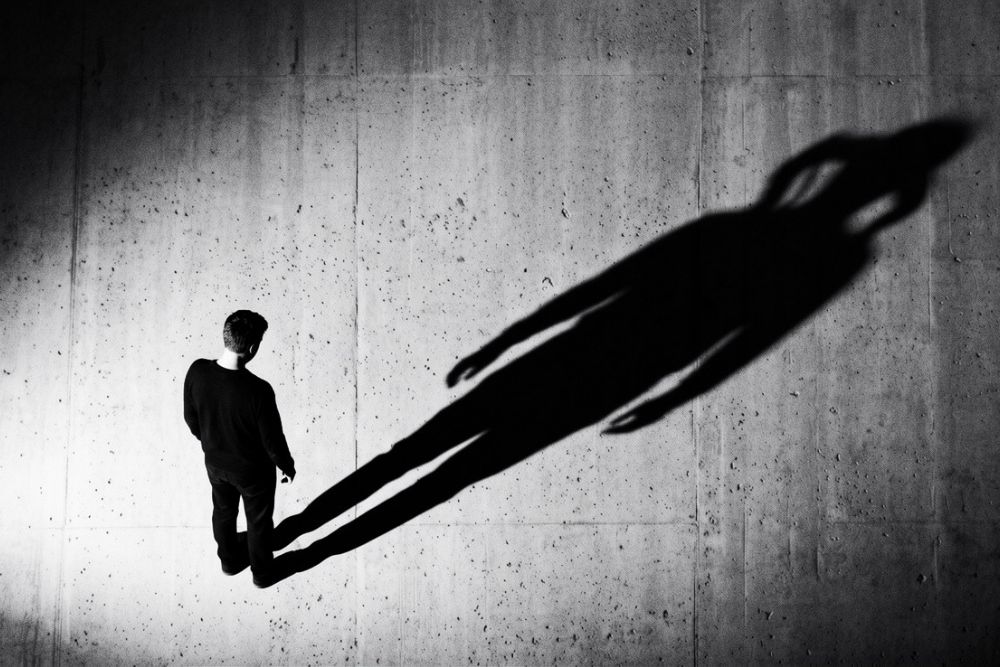
The pioneering psychoanalyst Carl Jung once argued that every human being possesses both light and dark capacities. We all have the capacity for selfishness, aggression, and cruelty. However, society constantly tells us that these traits are “evil” and must be eradicated. So, what do we do?
We deny them. We repress them. We push them down into our unconscious, into a space Jung called the Shadow.
Unfortunately, repressed darkness doesn’t disappear; it only ferments.
When a person or a society tries to be 100% “pure,” their denied Shadow violently projects itself outward onto others. In fact, we can see it through incidents such as the Salem Witch Trials, or the totalitarian regimes of the 20th century. The Puritans and the dictators didn’t view themselves as villains. They believed they were the “ultimate good,” righteously purging the world of an “evil” group.
By refusing to acknowledge their own internal darkness, they became completely blind to their own vicious cruelty.
There’s no need to be a historical figure to experience the destructive power of the Shadow. In fact, you can see it every day in the cycle of the chronic “people-pleaser.”
We all know someone who represses all of their natural selfishness, anger, and boundaries in order to be seen as purely “good” and accommodating. They sacrifice their own needs constantly. That said, because it is biologically impossible to have zero self-interest, the denied shadow begins to leak out.
Eventually, their repressed boundaries turn into quiet resentment. Their unexpressed anger morphs into explosive outbursts or toxic passive-aggression.
By trying to be a harmless, perfectly “good” person, they end up causing intense emotional chaos for themselves and everyone around them.
At the end of the day, a harmless person is NOT a good person. A truly good individual is one who knows they are capable of causing harm, but consciously chooses not to.
In other words, goodness requires the active integration and mastery of the darkness (or evil), rather than its absence.
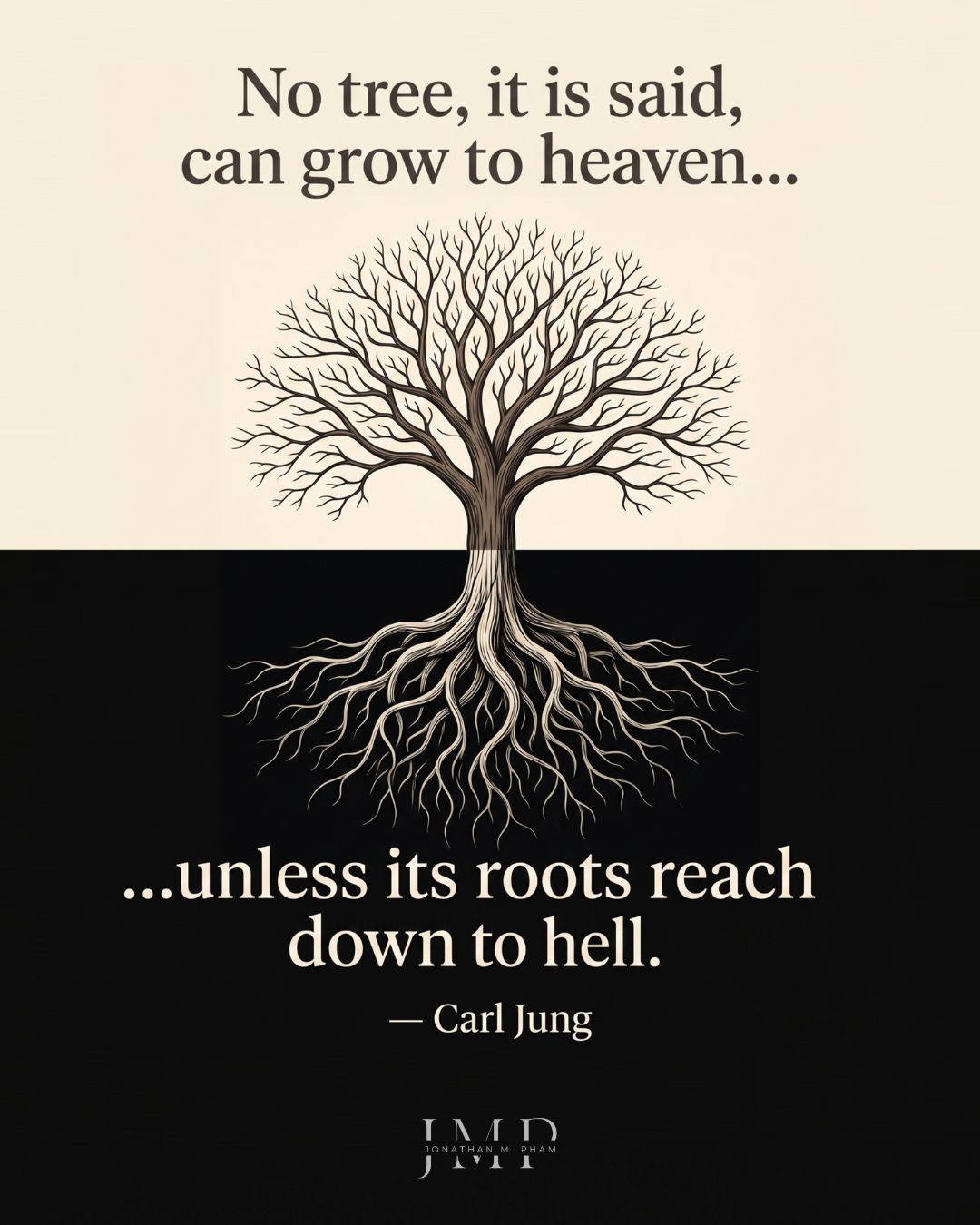
No tree, it is said, can grow to heaven unless its roots reach down to hell.
Carl Jung
We have talked about how everyday people can be molded by their environment, and how trying to be perfectly “pure” may only backfire. Then, what happens when the environment is completely stripped away?
What happens when laws, police, and social expectations vanish overnight?
Pop culture tends to push what is known as “Veneer Theory“—the cynical idea that human civilization is nothing but a fragile mask. Accordingly, if you scratch the surface of a polite society, you will immediately uncover a violent, panicking beast.
Tonight you’re all gonna be part of a social experiment. Through the magic of diesel fuel and ammonium nitrate, I’m ready right now to blow you all sky high. Anyone attempts to get off their boat, you all die. Each of you has a remote… to blow up the other boat. At midnight, I blow you all up. If, however, one of you presses the button, I’ll let that boat live. So, who’s it going to be: Harvey Dent’s most wanted scumbag collection, or the sweet and innocent civilians? You choose… Oh, and you might want to decide quickly, because the people on the other boat might not be so noble.
Joker, “The Dark Knight” (2008)
Perhaps one of the most well-known modern explorations of the Veneer Theory is the ferry experiment in the movie The Dark Knight. In the film’s climax, the antagonist Joker wires two ferries with explosives—one is filled with innocent citizens; the other with convicted criminals. He gives each boat the detonator to the other boat and tells them that the first ferry to blow up the other will be allowed to live. If neither pushes the button by midnight, he will blow up both. His hypothesis is pure Thomas Hobbes:
“When the chips are down, these civilized people… they’ll eat each other.”
It is a terrifying psychological crucible. And yet, what actually happens on the boats serves as a fascinating metaphor for humanity’s true nature.
On the citizen ferry, the flaw of the crowd is exposed. Through a democratic vote, they actually vote to kill the prisoners. Because responsibility is diluted in a crowd (the bystander effect), they feel comfortable condemning others to die.
However, when it comes time to physically turn the key, no individual can bring themselves to do it. The psychological barrier of actively ending human lives proves too heavy.
On the prisoner ferry, the scene is even more striking. A towering, intimidating convict steps up and demands the detonator from the terrified warden.
“You don’t want to die, but you don’t know how to take a life. Give it to me; these men would kill you, and take it anyway. Give it to me. You can tell ’em I took it by force. Give it to me, and I’ll do what you shoulda did ten minutes ago.”
Yet when the warden hands the detonator to him, the convict—surprisingly—throws it out the window into the river.
In the end, the Joker loses. The people on the two boats—despite being forced into such a desperate life-or-death circumstance—eventually refuse to let themselves consumed by the darkness.
Now, some of you may be wondering: “That’s just a movie. What happens in real life when the chips are down?“
When a real-world catastrophe strikes—a massive earthquake, a tsunami, or a terrorist attack—the media often fixates on isolated instances of looting or chaos, which reinforces the myth that humans immediately turn on each other in the dark.
However, modern disaster sociology proves this assumption entirely misguided.
When you study the aftermath of real-life tragedies, from the collapse of the Twin Towers on 9/11 to catastrophic hurricanes, the default human response is almost never bloodlust or savage panic. It is catastrophe compassion.
When the state vanishes and the formal safety nets break, most people do not revert to a “Lord of the Flies” scenario where they instantly become murderous sociopaths.
Instead, we form bucket brigades. We share our severely limited rations. We dig through the rubble with bare hands to pull out neighbors we have never even spoken to before.
In the immediate aftermath of a disaster, the artificial divisions of race, class, and politics evaporate. Those who were strangers hours before suddenly risk their lives for one another.
The crucible of crisis does not burn away our humanity to reveal a monster beneath. Most of the time, it only erases the artificial barriers to reveal the underlying interconnectedness.
I have seen the truth; I have seen and I know that people can be beautiful and happy without losing the power of living on earth. I will not and cannot believe that evil is the normal condition of mankind.
Fyodor Dostoevsky

Are humans inherently good or evil?
As we have discussed so far, human beings are fundamentally wired for connection, yet highly susceptible to toxic environments and the repression of our own shadows. Now, where does that leave us?
It leaves us with a choice.
If we want to heal from the pain that made us ask the question “are humans inherently good or evil” in the first place, it’s critical we change the lens through which we view human behavior.
In Western society, the default way of looking at human nature is through the lens of a Courtroom: placing oneself in the judge’s seat. When someone hurts us, we put them on trial, weigh their actions, and slam the gavel: Guilty. Bad. Evil.
But Eastern philosophical traditions, such as Buddhism and orthodox Hinduism, take a completely different stance on the human condition. They look at humanity through the lens of a Hospital.
In this framework, life is not a trial to determine if you are guilty or innocent. Instead, human failing is treated as a curable illness. Bad deeds are not indicators of a dark, demonic core—just the result of Avidya (ignorance) and delusion.
When a patient in a hospital lashes out in delirium, a doctor doesn’t judge them as “evil.” He recognizes that the patient is suffering from an infection.
When we view humanity as a “hospital”, our main concern would, naturally, shift from condemning people to understanding the root of their spiritual sickness.

A crucial requirement for adopting the above-mentioned perspective is to separate the act from the actor. When we label a person as “inherently evil,” we are doing something dangerous: denying them free will. We reduce a complex human being down to their absolute worst deed. We assume that their actions materialized out of thin air, while ignoring the radicalization, the childhood trauma, or the psychological manipulation that molded them.
As of this point, I suppose it’s helpful to bring up an old adage (which some of you may have already been familiar with):
“Hate the sin, love the sinner.“
It is easy to dismiss it as naive idealism, but deep down, it serves a very practical purpose. Specifically, it protects your own humanity from the moral contamination of dehumanizing others.
When communities get a psychological “high” from public shaming, or from utterly destroying the life of a wrongdoer, it is often just tribalism masquerading as morality. As the philosopher Friedrich Nietzsche once warned:
“He who fights with monsters should look to it that he himself does not become a monster.“
To truly step out of the Courtroom, we also need to change the words we use. At the end of the day, “good” and “evil” are heavily loaded, absolute terms. So, what would happen if we replace them with more functional, compassionate words?
The word “evil” is a thought-stopping label. Once you call someone evil, the conversation ends. However, if you reframe it—”This person is operating out of unhealed trauma,” or “They are acting out of ignorance”—it opens the door to curiosity.
Example: Let’s say a coworker throws you under the bus to get a promotion. If you label them “evil,” you would walk around with a tight chest. On the other hand, if you recognize that their behavior is driven by insecurity, a scarcity mindset, and the trauma of feeling like they are never “enough”—your reaction would change completely.
You don’t have to excuse their behavior, but you can release your hatred.
You can protect yourself while still viewing them with detachment and peaceful pity.
Instead of the dogmatic question, “Is this strict moral rule good?” we can change to “What does this specific situation require for harmony?”
This mindset shift takes us out of the defensive crouch. It stops us from blindly following rigid rules just to prove we are “good people”. Now we can live with conscious presence, acting in alignment with what heals the environment around us.
How have we lived our life so that that young man… has been able to become a rapist? … The family into which [he] was born has been stuck in miserable poverty for many generations. … At thirteen years old he had to accompany his father on the boat… He had no resources of understanding and love.
If we had a gun we could shoot that young man… but would it not have been better to help him to understand and to love?
Last night on the shores of Thailand hundreds of babies were born… If those children are not properly cared for… some of them will become pirates. Whose fault is that? It is OUR fault… We cannot blame only that young man.
If I had been born a poor child who was never educated… I could have become a pirate. … Who is that pirate? He could be me…
All the suffering of living beings is our own suffering. We have to see that we are they and they are us. When we see their suffering, an arrow of compassion and love enters our hearts.
Thich Nhat Hanh, “No Death No Fear”
In short: yes. Modern developmental psychology has made a strong case that infants are born with an innate moral compass. In fact, as demonstrated in the studies discussed above, babies as young as six months old consistently prefer individuals who exhibit helpful, altruistic behavior over those who are unhelpful or aggressive—proof that prosocial behavior is not entirely a learned trait.
In Western philosophy, the 17th-century philosopher Thomas Hobbes argued that humans are inherently selfish and violent, and that a strong society is required to keep our savage “state of nature” in check. Conversely, the 18th-century philosopher Jean-Jacques Rousseau argued that humans are naturally peaceful and empathetic, but become corrupted by the inequalities of modern civilization.
Not quite. That said, it is important for us to distinguish between “selfishness” and “malice”.
Cynics often make the mistake of confusing the two. While humanity possesses survival instincts, our default response in social situations is usually cooperation and empathy.
Absolutely. If we take a look back at history, tremendous harm is rarely committed by sadistic monsters. Due to phenomena like the “Banality of Evil” (blind obedience to authority), de-individuation (losing one’s personal conscience in a crowd), and the repression of one’s psychological “shadow,” perfectly ordinary people are highly capable of facilitating cruelty when placed in toxic or high-pressure environments.
If we step back from our own personal pain and look back at the whole human history, it is clear that we are currently in a monumental transition phase.
Historians often talk about the “Axial Age” (around 500 BCE), a period when human consciousness experienced a massive shift. Guided by figures like Socrates, Buddha, and Lao Tzu, humanity began to move away from primitive, tribal thinking and started to recognize the value of the individual.
Today, many philosophers believe we are living through the “Second Axial Age“, characterized by a new shift in consciousness: from the isolated individual to radical interconnection.
The world is facing unprecedented global crises—from ecological collapse to the rapid rise of AI and deeply enmeshed global networks. While apocalyptic preaching views them as a cosmic punishment for humanity being “evil,” a more transcendent perspective sees it differently. Specifically, the modern chaos is simply the friction of a society outgrowing its old scaffolding.
The crises of our time cannot be solved by one country, one tribe, or one person. As such, they are forcing us to realize that the illusion of separation is becoming impossible to maintain.
Because humanity is so deeply interconnected, we can no longer afford to cling to the primitive, black-and-white duality of “Good vs. Evil.” It’s not enough to just point a finger at a villain and assume that destroying them would fix everything.
Now is the time for us to realize the truth: the line between good and evil runs straight through every human heart, not between nations or groups.
We are a species capable of engineering marvels like heart surgery and space travel. At the same time, we are also capable of extreme cruelty.
To put it simply, people are neither inherently good nor evil. We are only inherently human.
So the next time you are hurt, and you feel that cynical question rising in your throat, remember: you do not have to carry the weight of judging the entire universe.
Your only job is to master yourself. To look at the world—so beautiful, so full of flaws—and choose to act with compassion anyway.
There is no such thing in the world as absolute evil or absolute good. There is good to be found within evil, and plenty of evil to be found within the good.
Shusaku Endo
Other resources you might be interested in: