If you have been following me for a while, you know I spend a lot of time discussing things like mindfulness, freedom, and personal responsibility. However, if I am being completely honest, I have to admit there are many days when I fail to live up to my own philosophy.
For example, just the other morning, I woke up with a clear intention: getting out of bed, stretching my legs, and making a cup of coffee. Yet as soon as I silenced the alarm, my thumb immediately moved to a social media app. For the next twenty minutes, I lay there mindlessly scrolling through feeds of people I didn’t know—and topics I didn’t actually care about.
The strangest part of the experience was the internal split I felt at that moment. Consciously, I KNEW I should stop; I WANTED to stop. On the other hand, it was as if my thumb had a consciousness of its own, driven by a deeply ingrained momentum.
I watched myself scroll until, finally, my internal voice grew loud enough to break the spell. And I tossed the phone aside, feeling exhausted before my day had even begun.
Does that sound familiar to you?
It may look like a really mundane moment. Yet as I recall it, I cannot help but relate to a topic commonly discussed these days: human agency.
This is a core characteristic that separates us from other creatures. If you poke an animal, it reacts on pure instinct. But human beings are different: upon encountering a trigger—be it a glowing screen, a harsh word from a partner, or a wave of fear that comes out of nowhere—we find ourselves in a “gap” where we can pause, evaluate if the trigger aligns with our values, and choose a response.
Unfortunately, that gap is being threatened critically. From infinite-scroll algorithms to frictionless one-click shopping, everything in the modern world is designed to keep people in an autopilot state. And in succumbing to it, many are—without being aware of it—reducing themselves to something less than human.
Highlights
Human agency is found in the fraction of a second between a stimulus and a response.
We often unconsciously surrender personal agency to routines, algorithms, or groupthink, simply because taking radical responsibility for our own lives is deeply unsettling.
Modern technology threatens our autonomy by seducing us into outsourcing our choices, thoughts, and emotional friction to machines.
Rather than asserting a hyper-individualistic “lone wolf” dominance over the world, true agency is about discovering how one’s unique choices harmonize with the larger ecosystem.
The key to reclaiming agency lies in daily micro-decisions—shifting your vocabulary, setting healthy boundaries, and consciously choosing to embrace the struggles of existence.
What is Human Agency?
At its most basic level, human agency is the capacity to make intentional choices and act upon them. As such, it is the difference between being the active author of your story and merely being a passive character dragged along by the plot.
For instance, let’s say you just lost your job due to a sudden economic downturn. While unfortunate, the incident does not dictate what happens next to you. Now, it’s up to you to either:
When talking about human agency, people often end up crashing into a centuries-old debate: Do we actually have a choice, or is everything predetermined by physics, genetics, and society?
If we look at our lives honestly, it’s very challenging to blindly advocate for the former. (and disregard the latter completely) You did not decide the era you were born into. Nor were you able to pick your genetic predispositions, the socioeconomic status of your parents, or the chemical wiring of your brain.
As such, I believe it’s helpful for us to look at the topic through the lens of a philosophical middle-ground called Compatibilism—which can be demonstrated with a simple metaphor as follows.
Imagine you are in a small boat on a fast-moving river. You did not create the river. You cannot control the speed of the current, the jagged rocks, or the sudden downpour. On the other hand, you can either drift passively and let the current slam you into the banks—or you can adjust your angle, read the water, and decide how to respond to the obstacles ahead.
The same rule applies to how one navigates life’s circumstances. We are continually pushed by external forces—unforeseeable tragedies, societal expectations, and even our own biology—but we are never truly helpless. While the river of life are not within your control, your hands are firmly on the oars.
While you cannot impact the macroeconomic climate or the company’s decision to downsize, it doesn’t mean you cannot claim your response to being laid off. Whether your life turns better or worse from now on is up to you.
The 4 Components of Human Agency
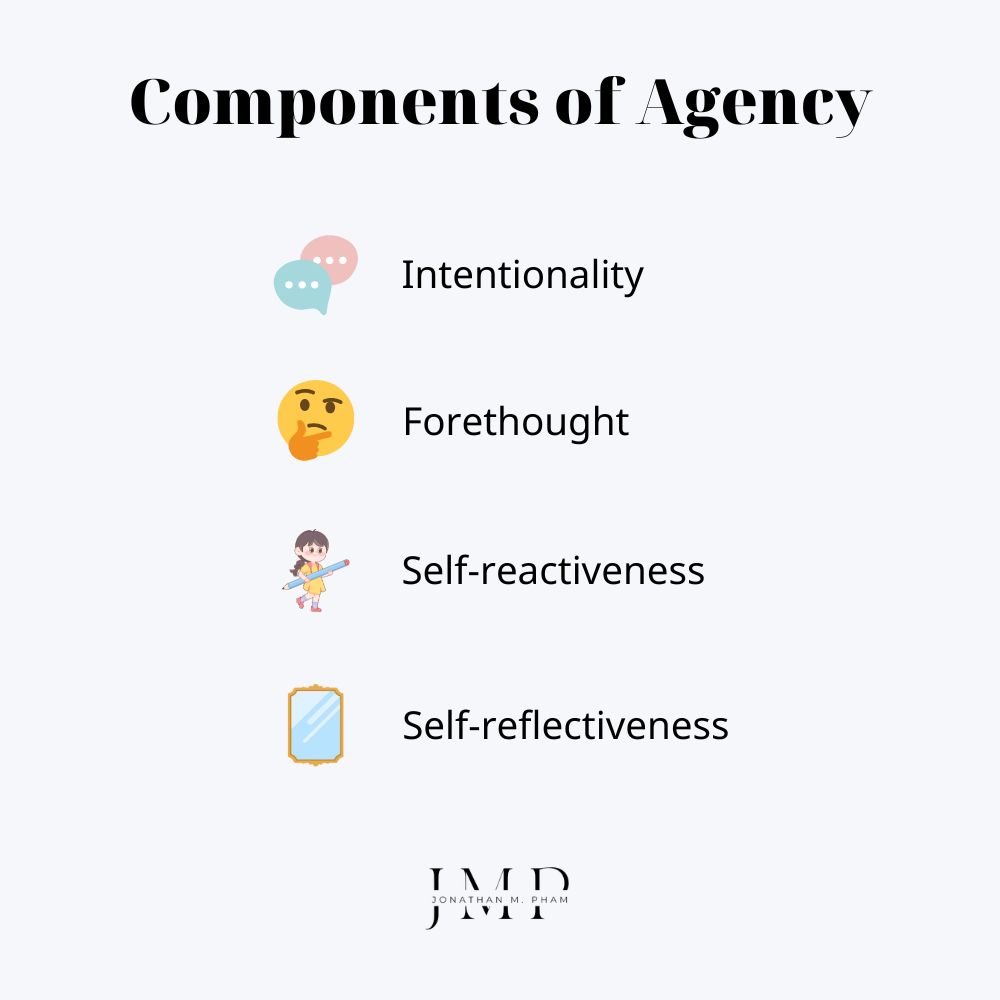
Back in the day, the psychologist Albert Bandura, in his social cognitive theory, broke human agency down into four core pillars as follows:
Intentionality (The courage to commit)
More than just a fleeting wish, intentionality involves a proactive commitment to a direction—the willingness to initiate an action before the environment forces your hand. It is the difference between vaguely wishing your marriage was better, and choosing to sit down at the kitchen table and say, “We need to talk about how we treat each other.” (no matter how uncomfortable it is)
Forethought (Pulling the future into the present)
We are the only creatures capable of projecting ourselves into a future that does not yet exist, and using that vision to guide what we do today. Forethought, as such, serves to give meaning to the current friction.
When you decide to save a portion of your paycheck instead of buying something immediately gratifying, you are exercising agency. You are doing so because you have imagined your “future self”—and concluded that they are a person worth protecting.
Self-reactiveness (The discipline of course-correction)
Intentions mean nothing if they crumble at the first sign of resistance. This is where self-reactiveness—the ability to monitor your own behavior and reshape it on the fly—comes in as a steering mechanism.
When you find yourself in a heated argument, feel a sarcastic remark rising in your throat, pause, and force yourself to soften your tone, you are practicing self-reactiveness. You are overriding an automatic emotional impulse and acting in a way that matches your core values.
Self-reflectiveness (The mirror of the soul)
This is arguably the highest and most difficult level of human agency. It is the capacity to step outside of yourself, look at your own motivations, and ask, “Is this actually who I want to be?”
To pause midway up a grueling corporate ladder and wonder whether you actually value the work you are doing, or if you are just chasing the validation of your parents or society, is an exercise of self-reflectiveness. At that moment, you realize not only are you able to change your actions, but you also have the power to redefine the very meaning of the life you are building.
At a fundamental level, agency is the prerequisite for all human value. Far too often, we tend to measure the worth of our lives by the outcomes we produce, while forgetting that it’s the autonomy behind our actions that really give meaning to them. Without the ability to choose otherwise, our highest virtues would lose their significance.
Think about it this way: if someone is forced at gunpoint to give away their money, we would not call them “generous”. If a partner stays faithful to you only because they literally have no other options, the relationship would be extremely fragile and prone to collapse as soon as circumstances change.
Virtue, love, and personal growth only carry weight because they are chosen. The friction of making a choice is what gives the outcome its value.
The shield against evil
The sad truth of the matter is that most evil is done by people who never made up their minds to be or do either evil or good.
Hannah Arendt
Beyond personal fulfillment, human agency serves as the ultimate moral safeguard. When we abdicate our capacity to think and decide for ourselves, the consequences go far more than just passivity.
The philosopher Hannah Arendt once coined the phrase “the banality of evil.” While studying some of history’s worst atrocities, she realized that extreme darkness rarely looks like a cartoon monster. More often, it arises from total compliance—when ordinary people completely surrender their agency to an authority figure, a corporate protocol, or a societal norm.
A prime example, as observed by Arendt, is Adolf Eichmann, one of the chief architects of the Holocaust. Upon being put to trial, Eichmann constantly defended himself by claiming that he was only a bureaucrat “doing his job”. That he held no personal animosity towards his victim, and that he was just functioning as a “cog” in the state machinery.
Today, we see lower-stakes versions of this “banality” all the time.
It is the customer service representative who denies an essential refund to a struggling customer while shrugging and saying, “I understand your situation, but the computer system literally won’t let me bypass the rule.”
It is the bystander who watches someone be mistreated but stays quiet because “nobody else is saying anything.”
When personal agency is lost, so is conscience—the very compass that keeps our humanity intact.
Despite its importance, most people instinctively try to run away from their own agency. Theoretically speaking, we love the idea of freedom. We celebrate it in movies, write songs about it, and declare it as our ultimate goal. And yet in practice, we rarely live up to what we say and think.
Most of the time, instead of deciding for ourselves, we look for external authorities, rigid routines, or societal expectations to tell us how to live.
Many people routinely stay in unfulfilling jobs, unhealthy relationships, or predictable ruts, even when they truly despise them.
The burden of responsibility
Man is condemned to be free; because once thrown into the world, he is responsible for everything he does.
Jean-Paul Sartre
The philosopher Søren Kierkegaard once discussed a concept called the “dizziness of freedom”, which he demonstrated through a simple example. Imagine you are standing at the edge of a massive cliff. When you look down, you cannot help but feel an overwhelming sense of dread.
While most would dismiss that feeling as merely the fear of accidentally falling, you know there’s more to it. That deep down, you are afraid because you know you are free to jump as you wish. That nothing can stop you, aside from… you yourself.
To stay put, to walk away, or to plunge yourself into the darkness—it’s entirely up to you.
If you apply Kierkegaard’s metaphor to real life, it becomes much easier to understand why people are afraid of embracing agency. Because doing so means admitting that one is fully responsible for everything one does.
If you are unhappy in your career, you can leave it.
If your relationship is toxic, you can end it.
Making those choices means stepping into the unknown—i.e. taking full ownership of the outcome. If you fail, you cannot blame anybody or anything, except you yourself.
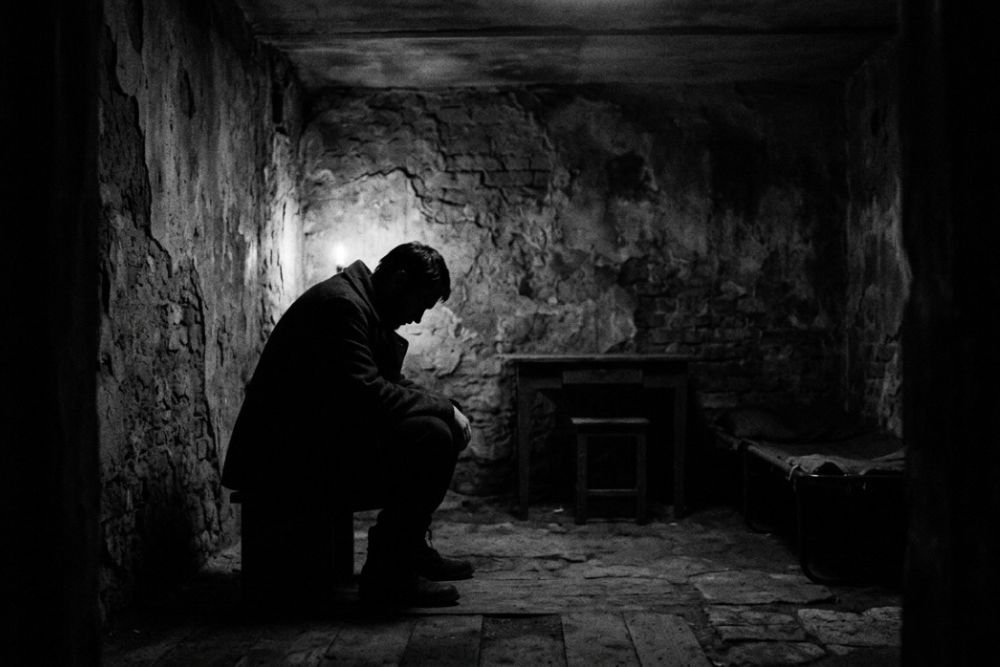
For many of us, that radical responsibility is simply too heavy a crown to bear. To avoid it, we end up building “cages” for ourselves.
Read more: Being-for-itself – On the Burden & Beauty of Being a Conscious Human
The safety of conformity
In Anton Chekhov’s classic short story The Man in a Case, the protagonist is a teacher named Belikov who lives his whole life in a self-imposed prison—”cases” he creates to protect himself from the unpredictable nature of the real world:
Even on warm summer days, he wears a heavy overcoat, dark sunglasses, and stuffs his ears with cotton.
Everything he owns—his watch, pen knife—is kept in its own little case.
His mental life is the same; he only feels safe with strict government regulations and is utterly terrified of any deviation from societal routine.
It is easy to pity Belikov, but upon closer look, aren’t we doing the exact same thing?
To think for oneself, after all, is exhausting; not to mention, it comes with the risk of exclusion. For our ancestors, being banished from the tribe was a literal death sentence—you couldn’t hunt a mastodon alone. Today, a dissenting opinion at the office or a contrarian stance on social media won’t lead to literal starvation, but our nervous systems don’t know the difference. The fear of being ostracized, “canceled,” or deemed unlikable triggers the exact same primal panic.
No wonder many default to the path of least resistance. No wonder we cling to rigid dogmas and echo chambers on the Internet. If the group tells us exactly what to think, we are spared the work of forming our own nuanced opinions—as well as the possibility of being “ex-communicated”.
Bad faith as a coping mechanism
Adopting groupthink is comfortable, yet it comes at the cost of abandoning one’s own freedom and agency. To escape the guilt of such an act, most people frequently come up with excuses. We pretend that we are bound by fixed laws that deny us the power to choose. For instance:
“I can’t start a new career; I’m already forty.”
“I have to yell when I’m angry; I’m just an explosive person.”
“I can’t help scrolling for hours; the algorithm is just too strong.”
The existentialist philosopher Jean-Paul Sartre referred to that tendency as “bad faith” (mauvaise foi)—or, in simpler terms, “self-deception”. In defining ourselves as helpless victims of circumstances, we turn ourselves from conscious subjects into objects with an unchanging essence—like a rock or a table. To admit otherwise would trigger a serious crisis.
Read more: The Curated Self – Why Authenticity on Social Media is Impossible
The Loss of Human Agency in the Modern World
For most of human history, people surrendered their agency when they found themselves under the threat of violence or social exile. Yet today, a new danger has emerged in the form of convenience. In fact, with the rise of Artificial Intelligence and technology, many are willingly outsourcing their own minds to the machine by:
Letting predictive text finish the sentences for them.
Using AI to draft difficult emails to their colleagues.
Asking chatbots to write romantic vows or craft apologies to a partner after a fight.
etc.
The “Banana Ester” illusion
In food science, there is a chemical compound called amyl acetate, which is known for its strong, sweet odor resembling bananas. As such, it is widely used in candies and sodas around the world. However, no matter how perfectly it mimics the flavor, it can never make something taste as good as real bananas—simply because it lacks the complex biology and nutritional truth of the actual fruit.
In a sense, AI can be compared to that amyl acetate compound. In search of perfection and a frictionless existence—free from the hard work of thinking and making choices—many people are delegating their work to the AI. While the output might be extremely polite, grammatically flawless, and highly efficient, it comes at a grave cost; specifically, the gradual erosion of the ability to decide for oneself.
When you rely on an algorithm to apologize to your spouse, you bypass the guilt, struggle and vulnerability required to actually mean it. The apology tastes like an apology, but it has zero nutritional value for the relationship and those involved. On the surface, you may appear subtle and mature, but inwardly, you haven’t undergone the necessary transformation for real growth to occur.
Over time, letting a statistical mirror dictate our choices and words turn us into “mummies”—merely functioning and acting predictably as “programmed”, while unable to judge and form an authentic opinion/ emotion on our own.
Yet, as strange as it may sound, human beings rarely accept the fate of becoming “mummies” quietly. Deep down, we all possess a hidden part that fiercely resists being optimized, predicted, or managed. When life becomes too effortless—when every need is met by an algorithm and every decision is pre-calculated for our comfort—an existential claustrophobia sets in. To escape it, many resort to sabotage, whether to themselves or others.
Over 150 years ago, the Russian author Fyodor Dostoevsky anticipated this exact problem in his masterpiece Notes from Underground. His protagonist, the Underground Man, argued that if scientists and social engineers ever succeeded in creating a “Crystal Palace”—a utopian society where every human action was perfectly calculated and provided for—man would deliberately go mad, smash the palace, or engage in destructive spite.
Why then? To prove he is still a human being with free will, not a “piano key” being played by the laws of nature.
Lack of human agency & depression
Today, technology has become our Crystal Palace. And just as Dostoevsky warned, we are seeing a collective rebellion against this manufactured comfort—where individuals (especially the younger generations) engage in self-sabotage acts for apparently no justified reason, such as:
Picking a fight in a healthy relationship just to see what happens.
Recklessly speeding or drinking too much.
Deliberately procrastinating on a crucial project.
In a sense, those who exhibit such “nonsensical” behaviors are trying hard to assert their own agency—albeit in a twisted manner. Their message is essentially:
“I am the author of my own ruin; therefore, I am still in control.”
And that’s not all. The crisis of agency has also birthed dark corners of the Internet—communities defined by isolation, resentment, and a toxic mix of superiority and self-loathing. Hyper-niche subcultures, such as the “incel” movement or extreme doomer communities, are filled with those who feel left behind by the hyper-optimized modern world. Unable to find their own place in a society that demands perfection, they retreat into echo chambers of despair, convinced that they are intellectually superior to the “ordinary” people who blindly participate in the system—while simultaneously envying the very lives they despise. Their own failure is weaponized and turned into a badge of honor.
Rethinking the output-oriented self
Part of the above-mentioned crisis has to do with a deeply embedded “hustle” mindset. Since the Industrial Revolution, humanity has been conditioned to define ourselves by what we produce: the emails we send, the essays we write, the art we create, the solutions we provide. We assume that the higher one’s output is, the more worthy one becomes.
But is it reasonable to maintain that line of thinking in today’s AI era?
If an LLM (Large Language Model) can produce those exact same outputs in three seconds, and many times do it even better, what is to be of this “biological machine”? Should it be tossed away?
The rise of AI, while presenting numerous threats, is also an opportunity to re-evaluate our understanding of what makes us human. To realize that human beings are more than just output machines; that value is found in the process—in the struggle of bringing something into being—not the final product only.
If we look closely at the destructive behaviors of the Underground Man or the toxic echo chambers of the modern Internet, a common thread emerges: these people are all suffering from a hyper-individualistic view of freedom.
For long, the Western world has been conditioned to equate human agency with the “Lone Wolf” archetype. We are taught that freedom means total independence—the ability to do whatever we want, whenever we want, completely untethered from the expectations of others. To practice personal agency is seen as being able to conquer the environment in accordance with one’s will.
But that mindset comes with a fatal flaw. When freedom is disconnected from empathy and connection, it mutates. If my end goal is simply to exert my own will upon the world, then other people cease to be human beings; they become mere obstacles to overcome, or tools to be manipulated. And the result, as you may have observed in life yourself, is extreme isolation.
To move forward sustainably, now is the time for us to rethink agency—from an individual conquest to a relational one.
The power of effortless action
Many people tend to think of agency as a hammer—striking down barriers to get one’s way. However, Eastern philosophy proposes a different perspective: sometimes, aligning with the natural current of a situation, much like water cutting through rock, would yield a much better impact. (a concept known as wu wei in Daoism)
Now, let’s say you are having a heated argument with a spouse or a colleague.
The “lone wolf” mindset dictates that you must stand your ground, raise your voice, and force the other person to accept your perspective. And yet, doing so usually only breeds more resistance.
A relational perspective, on the other hand, would remind you that you have the power to yield—to pause, soften your tone, and truly listen.
Paradoxically, by choosing not to aggressively assert your own will, you change the entire dynamic of the room. By flowing around the conflict rather than smashing into it, you eventually gain more influence over the outcome.
Agency as a co-creative act
Ubuntu: “I am because you are”.
African Philosophy
At the end of the day, agency is never an individualistic thing, because human beings do not exist in a vacuum. We are all part of a larger whole, deeply woven together.
From a biological perspective, we are creatures dependent on a vast biophysical ecosystem for survival. Without clean air, stable infrastructure, agricultural systems, and the labor of countless invisible hands, our “individual agency” vanishes.
From a societal perspective, our identity and desires are co-created with others. For example, think about your goals: how many of them are actually shaped by a desire for connection, validation, or contribution to a community?
Without our parents, teachers, culture, and peers, we would not have learned how to exercise agency.
Even when we rebel against society, our act is still defined by the very thing we are pushing against.
Whatever choices you make are always intertwined with the well-being of your family, community, and the environment. As soon as we understand—and embrace this inherently relational agency—the burden of freedom would feel much lighter, now that we are no longer carrying it alone.
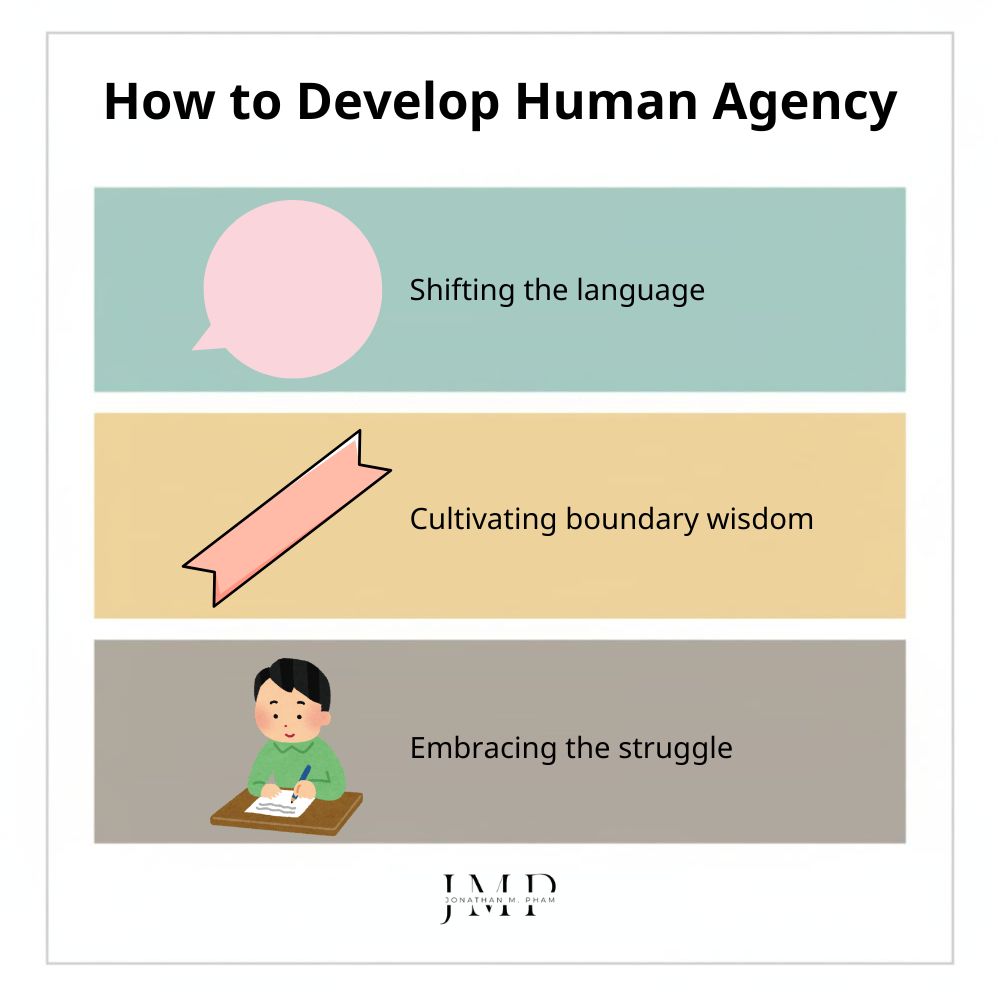
Contrary to many people’s assumptions, cultivating personal agency doesn’t require massive, life-altering leaps such as quitting one’s jobs, moving to a cabin in the woods, and completely unplugging from society. (though these do help under certain circumstances, in the case of certain people) For those who would like to reclaim authorship of their life, you can start with very basic steps as follows:
Shifting the language: From victimhood to ownership
Agency begins with the vocabulary we use every day. For example, pay attention to how often you use the phrase “I have to.”
“I have to go to work today.”
“I have to take the kids to practice.”
“I have to pay this mortgage.”
This is the language of Bad Faith; it subtly tricks the brain into feeling like a helpless victim of circumstances. To move away from it, try changing the narrative to “I choose to.”
“I choose to go to work because I value providing for my family.”
“I choose to take the kids to practice because being an involved parent is important to me.”
The external circumstances haven’t changed, but your internal psychological posture has shifted dramatically. No longer a hostage to your responsibilities, you are now the architect of them.
There is a well-documented psychological phenomenon known as “decision fatigue“. (also called the “paradox of choice”) Having infinite options—as desirable as it may sound—does not make us more free; most of the time, the only thing it causes is paralysis. When you have access to every movie ever made, it’s very likely that you would spend forty minutes scrolling Netflix and watch nothing.
To reclaim personal agency, it’s recommended that you intentionally set healthy limitations, by:
Refusing to care about trivial things (e.g. “What should I wear at work today?”, “What should I have for dinner?”), so that you have the mental energy to make the choices that actually matter.
Consciously leaving your phone in another room to save you the stress of fighting the algorithm’s temptation all evening.
By putting a boundary around your attention, you are actively dictating where your life’s energy goes.
Embracing the struggle
As technological algorithms are optimizing every corner of existence, the most radical act of human agency is to intentionally choose the un-optimized friction of real life. It means:
Resisting the urge to use AI to draft the difficult apology from scratch. Instead, write it yourself. Let the dysfluency of your own words convey your genuine remorse.
Looking at the barista in the eye and making awkward small talk while waiting for your morning coffee.
Sitting silently on the bus and watching the landscape roll by—instead of doomscrolling out of habit—until you arrive at the destination.
Engaging in the vulnerable conversation with your partner rather than withdrawing into work.
Don’t be afraid of the struggle. In fact, that friction is the crucible where the soul is forged—the very proof that you are actively writing your own story.
If you step back and look at the journey of human agency we have discussed so far, it’s understandable if you feel a bit overwhelming. Moving from mindless conformity, through the anxiety of freedom, past the urge to self-sabotage, and finally arriving at a relational co-creation is not something that happens overnight. It is the work of a lifetime.
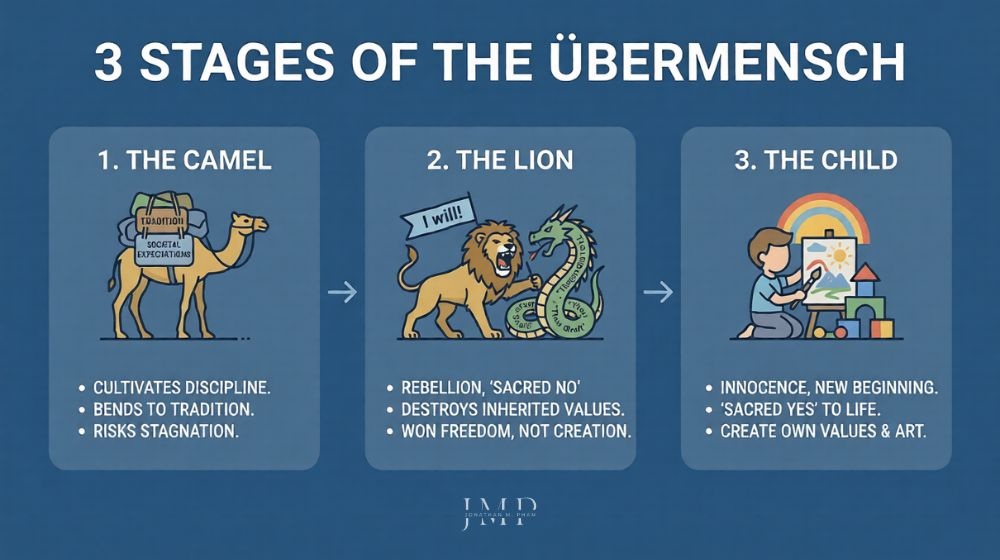
At this point, I suppose it’s helpful to bring up the philosopher Friedrich Nietzsche, who once described the evolution of the human spirit through three distinct stages as follows.
The Camel (Passive compliance)
According to Nietzsche, the spirit begins as a Camel—a beast of burden. It kneels down and willingly takes on the heavy loads, the rules, and the scripts handed to it by society. It operates entirely on the word “should.”
Initially, we all spend time as the Camel: living in “cases” like Chekhov’s Belikov, staying in a soul-crushing job because “that’s just what people do”, or (as in my case) mindlessly scrolling through a social media feed because it is easy. While safe, the Camel is effectively asleep at the wheel of its own life.
The Lion (Spiteful rebellion)
Eventually, the Camel realizes it is carrying a load it never chose itself. Out of this claustrophobia, it ventures into the desert of isolation and transforms into a Lion.
The Lion represents the aggressive awakening of agency. Like the Underground Man smashing the Crystal Palace just to prove he is free, it actively rebels against everything that contains its freedom: societal structures, people’s expectations, media algorithms, etc.
While necessary—after all, we must realize our freedom to claim it—this stage only serves as a stepping stone. The Lion only knows how to destroy what it opposes. It has agency, but it is fueled by spite rather than love.
The Child (Joyful co-creation)
To achieve true, lasting freedom, the spirit must undergo one final metamorphosis: becoming a Child.
Why then? Because a child is not burdened by the past (the Camel), nor is it bitterly fighting against the system (the Lion). He is driven simply by curiosity, playfulness, and the willingness to say “Yes” to life.
This is the peak of human agency. When you become the Child, no longer is your own freedom viewed as a burden or a weapon to wield against others. Now you are able to find pure joy in the moment, in the act of “flowing”, and in the “loving struggle” of your relationships.
To attain the Child’s level of radical ownership is a lifelong endeavor though. It requires daily practice—i.e. pausing for a breath before letting a harsh word slip, choosing to sit with discomfort rather than turning to a screen, or setting a firm boundary when conformity feels much safer. Occasionally, you will inevitably falter and let the autopilot take over.
And that is perfectly acceptable.
What matters is the self-awareness to recognize the drift, and the willingness to deliberately grab the oars once more.
The river will always be there, pushing and pulling you in directions you did not choose. But the oars are in your hands.
How you steer—and who you become in the process—is up to you.
Hi there! I am a seeker on his path of self-discovery. Since my youth, I have been haunted—and driven—by the fundamental questions of existence: the weight of our choices, the nature of true fulfillment, and the various identities we inhabit. I created this blog to chronicle the insights I have unearthed while navigating the 'absurdity' and beauty of life. My hope is that in reading these words, you will find a reflection of your own struggle—and the courage to 'become who you are.' Please just take what resonates with your soul, and leave the rest behind!