



01
10
October 2026
It has begun.
And now, it's time for me... no, for us, to wait. Three or more hours.
October 1
Come to think of it, t [...]
It is one of the strangest paradoxes of the modern human condition that we have never been more intensely networked, yet rarely have we felt so lonely.
Every day, we swim in an ocean of interactions. We are constantly pinged, messaged, followed, and perceived. That said, beneath the surface of this hyper-connectivity lies a collective starvation. Not for communication, but for communion. Intimacy.
Years ago, I found myself working at a medical tourism startup that promoted stem cell treatments. It was an environment I would later realize was ethically grey, built on unfounded promises.
From there, I moved into the digital media industry—a machine that, at least in my experience, was fundamentally broken. I watched people churn out shallow, viral content designed not to provide value, but simply to hijack attention and extract clicks.
Seeking something more meaningful, I then landed in the personal development and coaching industry. I had hoped to find a sanctuary for human growth; yet instead, I found an ecosystem dominated by self-proclaimed “gurus” obsessed with vanity metrics, algorithms, and attention-seeking.
Everywhere, the underlying architecture was exactly the same: People were treating other people as tools. Colleagues were viewed as stepping stones; audiences data points; clients dollar signs. The human soul was reduced to a unit of utility.
It is not a recent phenomenon though. Back in the day, countless thinkers have warned about how society was driving people to forget about each other’s inherent dignity. In 1923, emerging from the mechanized slaughter and dehumanization of the First World War, the Jewish philosopher Martin Buber published his masterpiece I and Thou (German: Ich und Du)—in which he posited a radical idea that challenges the very foundation of Western individualism: Humans do not exist in isolation.
According to Buber, one is not a solitary mind trapped inside a skull, observing a universe of dead matter. Rather, human existence is fundamentally relational. We are forged in the space between ourselves and the world.
Highlights
In his work, Buber argued that humanity navigates existence through two primary stances: the “I-It” and the “I-Thou.”
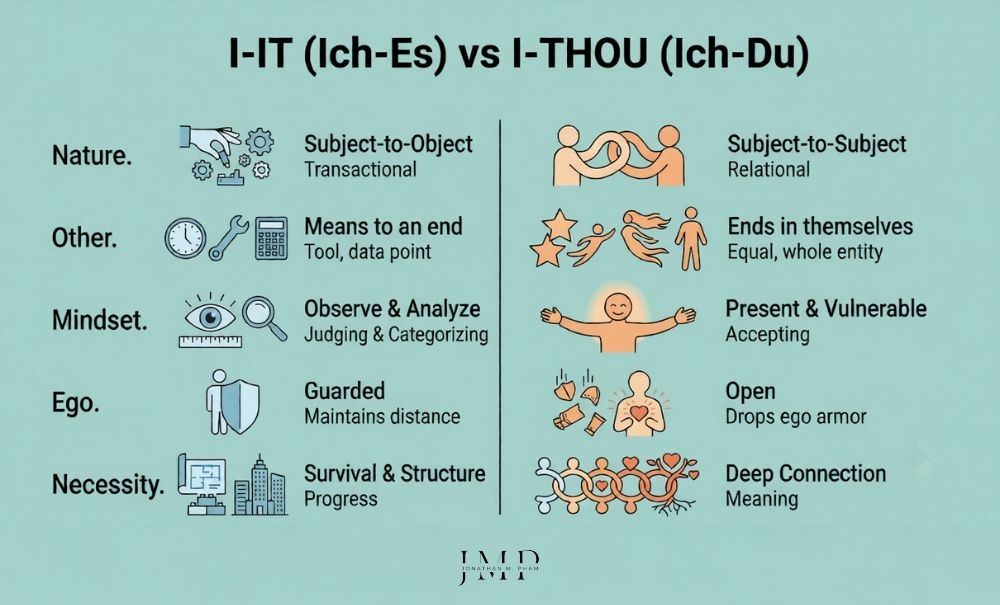
The “I-It” (Ich-Es) relationship is the default mode of modern life—the realm of subject-to-object. When you are in this mode, you stand apart from the world, observing it, analyzing it, and figuring out how to use it. The “Other” is not a whole, sovereign entity—just a means to an end, a data point, an obstacle, or a tool.
Real-life examples:
In the “I-It,” you remain safely behind the ego. You maintain a safe distance, judging and experiencing the world without ever truly touching it.
Note: It is vital to understand that Buber did not view the “I-It” as inherently evil. It is not a moral failure to order a coffee, evaluate a spreadsheet, or navigate rush-hour traffic. The “I-It”, after all, is strictly necessary for human survival. Without the ability to objectify, analyze, and categorize, we would have no science, no economics, no medicine, and no functioning society.
The real tragedy occurs when the “I-It” becomes the only lens through which we view reality. When our entire lives become a series of transactions and utilities, our own humanity begins to shrink as a result.
Without It, man cannot live. But he who lives with It alone is not a man.
Martin Buber
All real living is meeting.
Martin Buber
Then, there is the “I-Thou” (Ich-Du), a subject-to-subject relationship. It happens when you meet the Other not as a tool or a category, but as an absolute equal, a whole entity, and an end in themselves.
In this mode, there is no analysis. All personal agendas are dropped. There’s no desire to get something from the Other, fix or figure them out. You just stand vulnerably in the present moment, meeting them exactly as they are.
This type of encounter, according to Buber, isn’t limited to humans. For instance, imagine walking through a forest and stopping before an ancient tree.
When you look into the eyes of a loved one and suddenly the argument you were having falls away, replaced by an overwhelming awareness of their preciousness—that is the “I-Thou.” In that moment, two entities are entering an unfiltered meeting—without the armor of the ego.
| Feature | I-It (Ich-Es) | I-Thou (Ich-Du) |
| Core nature | Subject-to-Object (Transactional) | Subject-to-Subject (Relational) |
| How the “Other” is viewed | A tool, data point, obstacle, or means to an end. | An absolute equal, a whole entity, and an end in themselves. |
| Mindset | Observing, analyzing, judging, and categorizing. | Present, vulnerable, accepting, without an agenda. |
| Ego state | Guarded; maintains a safe distance behind the ego. | Open; drops the armor of the ego. |
| Human necessity | Essential for survival, structure, and progress. | Essential for true humanity, deep connection, and meaning. |
I-Thou vs I-It: Subject-to-subject vs. subject-to-object relationship differences
As beautiful as it may sound, here is the truth of Buber’s philosophy: Pure “I-Thou” states cannot be sustained permanently.
We all get hungry; we have bills to pay; we have schedules to keep. The transcendent moment of connection would inevitably cool, and we would fade back into the “I-It” world of utility and time. The tree becomes wood again. The loved one becomes the person who forgot to take out the trash.
This is not a failure though. In fact, it is the very rhythm of existence.
We are meant to breathe in the “Thou” and breathe out the “It.” Our suffering today stems from the fact that humanity has forgotten how to inhale. We have built a society so utterly dominated by transactions that most have forgotten how to lay down our armor, step out from behind our labels, and simply meet.
Biologically and spiritually, humans are hyper-social creatures wired for connection. Yet modernization has been increasingly promoting utility over humanity. We have allowed the “I-It” dynamic to metastasize, bleeding out from the realm of science and economics into our homes, friendships, and even our own self-worth.
When the “I-It” becomes the dominant mode of existence, it degrades one’s own soul. How you view the Other ultimately dictates the shape of your own ego.
When you consistently objectify the world, you inadvertently objectify yourself. You shrink your own capacity to feel, wonder, and belong.
Once, I worked with a colleague who would often dress very provocatively. When someone eventually asked her about it, she admitted, quite candidly, that she did it to “excite the boys.” And, unfortunately—as far as I could observe—the men around her eagerly played along, hovering around her desk, “babysitting” her with their attention.
On the surface, the dynamic looked like flirtation, like human interaction. But beneath the surface, it was nothing more than a transaction. A textbook manifestation of the “I-It.”
My colleague wasn’t actually seeking connection; she was only extracting validation to fill an internal void of self-worth. By her own admission, she was using her coworkers as mirrors to reflect back a sense of desirability. On the flip side, the men were simply consuming a visual object, without any genuine respect.
Both parties were trapped in a mutually agreed-upon reduction of their own humanity. They were, essentially, treating each other as tools.
This transactional mindset, unfortunately, is everywhere today. From social media “thirst traps” designed to harvest likes, to boardroom power plays where colleagues are viewed as obstacles to a promotion, we are constantly reducing each other to utilities.
Read more: The Curated Self – Why Authenticity on Social Media is Impossible
When scaled up into the realm of culture and politics, the “I-It” manifests as tribalism. It happens when people retreat into the safety of the “Mass”—an aggregated group of individuals held together by a generally black-or-white ideology. Unlike genuine communities where authentic, intimate relationships are encouraged, the “Mass” is mostly built on a shared anger or a common enemy. Its opponents—who are, deep down, complex human beings capable of pain, fear, and love—are violently stripped of their humanity and slapped with words like “fascist,” “woke,” “snowflake,” or “bigot”.
These labels act as impenetrable screens that prevent us from interacting with the person behind. We discard individuals based completely on their worst output or their clumsiest tweet, leaving absolutely no dialogical space for learning or atonement. Reality is reductively flattened into thought-terminating slogans—into mindless “Four legs good, two legs bad” chants.
Mundus vult decipi: the world wants to be deceived. The truth is too complex and frightening; the taste for the truth is an acquired taste that few acquire.
Martin Buber
The most insidious impact of the “I-It” perspective is how it drives us to “weaponize” morality to feed our own ego. For example, let’s say another person wrongs you, or does something you deem immoral, ignorant, or lowly according to your standards. You look at that person and think, “I would never act like them.”
In that exact moment, you have slipped fully into an “I-It” dynamic. You have reduced the person to their moral failure (“the liar,” “the cheat,” “the ignorant one”), and yourself to an abstraction (“The Moral Person”). They now become a pedestal to prop up your own self-esteem.
The irony is, when operating from a place of moral superiority, we escalate the very problem we are trying to solve. By objectifying the wrongdoer—by refusing to see the flawed human being beneath the action, we become agents of the exact same dehumanization we claim to despise.
In our attempt to defeat the “It-World,” we use its own weapons. We sever connection. We choose ego over empathy.
He who fights with monsters should look to it that he himself does not become a monster.
Friedrich Nietzsche

The I-Thou relationship, according to Buber, is characterized by this thing called Das Zwischen. It refers to the interpersonal sphere—the invisible space where relationship and dialogue happen between two individuals.
To better understand Das Zwischen, it’s helpful to look back at history. For centuries, Western philosophy, known for its strong focus on individualism, has been driven by René Descartes’ realization: “Cogito, ergo sum” (I think, therefore I am). While brilliant, the idea essentially traps human reality inside the echo chamber of the solitary skull; accordingly, you are an isolated mind, and everyone else is just out there, separate from you.
Building on this foundation, the existentialist Jean-Paul Sartre declared, “Hell is other people.” To Sartre, the very gaze of the Other inevitably objectifies us. To be looked at is to be judged, pinned down, and robbed of one’s own freedom.
Buber explicitly opposed that bleak view of existence. For Buber, reality is not “Being-for-itself” (the isolated mind), but rather “Being-for-each-other.” You do not start as a fully formed “I” who then occasionally reaches out to touch the world. The connection comes first.
It is in the meeting, the collision, the space “in-between” that the Self is forged.
I require a You to become; becoming I, I say You.
Martin Buber
When I reflect on Buber’s Das Zwischen, I cannot help but notice its similarities to the Japanese philosophical concept of Ma (間), typically translated as “negative space” or “the space between.” In traditional Western thinking, people tend to fixate completely on the objects themselves—Point A and Point B. We look at the walls, but ignore the room. We hear the notes, but fail to observe the silence.
Ma, however, suggests a different stance. Accordingly, the empty space—which Westerners typically perceive as a void, as “nothingness”—is actually the structural reality that gives form to the positive. Without the pause between notes, a musical piece would never be beautiful. Without the purposeful gap between sliding doors, there would be no passage, no way to transition from here to there.

Buber’s Das Zwischen is much like Ma. When you share an “I-Thou” moment with someone, the relationship is not located in you nor in them. It is the invisible thread connecting the two of you.
By shifting the focus away from our own internal anxiety—and away from judging the other person, we can learn to nurture the fertile space between us.
From there, we arrive at a defining point of Buber’s philosophy. Far too often, when seeking to escape the ego’s isolation, we swing the pendulum too far. We believe that true connection requires entirely dissolving ourselves into the other person, or dissolving into the “All” of extreme mysticism. Our assumption is that loving someone authentically means erasing the lines of where “I” end and “you” begin.
That’s not what Buber proposed. For an I-Thou relationship to take place, there must be an “I” and a “Thou.” It requires distance—a horizontal dynamic between two equal, sovereign individuals. If there are no boundaries, the relationship would turn into enmeshment.
Let us think of it this way: a bridge cannot exist without two distinct shores to anchor it. If the shores collapse into each other, the bridge disappears, and you are left with a puddle.
This is why Buber rejected blind herd conformity. You cannot achieve an “I-Thou” connection by surrendering your individuality to a tribe or a partner. It requires the ability to think critically—and the willingness to assert the authentic self. Your job is to stand in your own truth, your own pain, your own identity, and invite the Other to do the exact same.
It is only when two whole souls face each other with absolute openness that the space of the “In-Between” may finally come alive.
A togetherness between two people is an impossibility, and where it seems, nevertheless, to exist, it is a narrowing, a reciprocal agreement which robs either one party or both of his fullest freedom and development. But, once the realization is accepted that even between the closest human beings infinite distances continue to exist, a wonderful living side by side can grow up, if they succeed in loving the distance between them which makes it possible for each to see the other whole and against a wide sky!
Rilke Rainer Maria
If we look closely enough, we should realize the impact of Buber’s philosophy in various domains of life.
For a long time, the clinical model was deeply entrenched in the “I-It.” A patient was, essentially, viewed as a set of symptoms to be categorized, analyzed, and “fixed” by an expert. The doctor was the subject; the patient was the broken object.
But modern existential and humanistic psychology, heavily influenced by Buber, flipped the paradigm completely. The psychologist Carl Rogers, in particular, established his therapeutic approach on what he called “unconditional positive regard“; accordingly, it’s impossible to heal a human soul by treating it as a mechanical problem. True healing only occurs in the space of an “I-Thou” encounter—when a therapist offers absolute presence, listening without judgment, without an agenda, and without the urge to fix the person.
In the same vein, Gestalt therapy places an emphasis on the “Here-and-Now” dialogue between therapist and client. Instead of analyzing a patient’s past from a detached distance, the Gestalt practitioner engages as a whole person in a real-time relationship.
When we stop thinking of people as projects (an “I-It” dynamic) and simply meet them where they are, we grant them the safety required to grow and change.
There was once a period when I was juggling a demanding, full-time corporate office job with a part-time gig teaching English to teenagers. Logistically, the teaching job should have broken me. The commute was brutally long, the preparation was demanding, and the classroom was often filled with the chaotic energy of rebellious youth.
Yet, against all logic, I found myself thoroughly enjoying it. I would leave the office completely drained, but I would emerge from that noisy classroom energized.
For a long time, I couldn’t articulate exactly why—until I looked at it through the lens of the I-Thou relationship.
The corporate office was, in a sense, a fortress of the “I-It”. Everything there was measured purely by metrics, utility, and optimization.
On the other hand, a classroom full of teenagers was something different. It was a place where I encountered real souls—where the burden of KPIs and resource management completely vanished.
In that shared space, listening to my students’ defiant humor and acknowledging their messy inner landscapes, the transactional boundary dissolved. For a brief moment, we were meeting each other as real I and Thous. And that was exactly what gave me the energy to move forward.
Realizing that has brought about a radical change to my view of professions like teaching and mentoring—especially when it comes to younger generations, who generally desire authenticity and autonomy. It is so tempting for a teacher to assert authority, treating the students as “vessels” to be filled with information or behaviors to be managed. And yet, that line of thinking would get you nowhere.
Education, at its core, is a relational awakening. We cannot inspire growth in others if we think of them as “objects” to be controlled. Only by meeting them as equals—as mysterious “subjects” to be discovered—may we secure the students’ buy-in, unlock their capacity, and give ourselves the “fuel” needed to sustain our work.
The I-Thou relationship does not have to be limited to human beings. In fact, it can be extended to the physical world around us.
In Japanese philosophy, there’s a phrase called Mottainai (もったいない), which is typically translated simply as “What a waste!”. On the surface, it is often used as an environmental slogan to encourage recycling. However, there’s a much deeper layer of meaning behind it.
At its core, Mottainai conveys an aching sense of regret over disrespecting the inherent essence of a thing. It is the recognition that an object—whether it is a bowl of rice, a beautifully crafted tool, or a piece of fabric—has a kind of dignity. Or, poetically speaking, a “divine spirit/ little god” (kami/ 神) residing within it.
To waste the thing for no valid reason, therefore, is to be disrespectful toward the “god”. To violate the relationship between you and the world.
While Buber’s “Thou” is not a spirit living inside the object, the relational stance is remarkably aligned. When you treat your tools with care, when you pause to witness the majesty of a tree without calculating its lumber value, or when you mend a broken piece of pottery instead of throwing it away, you are shifting from exploitation to communion. You are acknowledging that nature possesses a value entirely independent of its utility to you.
In the modern consumer culture—which trains people to view the earth purely as a warehouse of resources to be extracted, used, and discarded (an I-It relationship)—more than ever, humanity needs a shift in consciousness. Metrics and carbon accounting alone are no longer enough for sustainability.
To save the world, we have to love it, and we can only love what we recognize as having an inherent value.
If you have men who will exclude any of God’s creatures from the shelter of compassion and pity, you will have men who will deal likewise with their fellow men.
Francis Of Assisi

Read more: The Shepherd of Being – Guarding the Mystery of Existence in an Age of Noise
As beautiful as our I-Thou encounters are—whether with a friend, a classroom of teenagers, or a forest—they are still bound by the gravity of time. The moment of intimate connection would inevitably cool, and the person standing before us would fade back into an It.
Because humans are conscious beings, we acutely feel that. And deep down, we carry a longing for a connection that does not slip away.
This longing, according to Buber, eventually point us toward the ultimate relational reality: the “Eternal Thou.”
The term “Eternal Thou” was used by Buber to describe God or the Divine. He argued that while all human relationships inevitably oscillate between Thou and It, our relationship with the Divine is the only line of connection that never degrades. God is the ultimate, unfading Presence.
However, there is a catch here: the connection only remains pure as long as we do not drag the Divine down into the It-World.
Unfortunately, this is exactly what much of modern religion and spirituality tends to do. When we reduce God to a rigid doctrine to be debated, or a blind ritual to be mindlessly performed, we lose the Thou.
Worse still is when humans fall into the pious trap of treating the Divine as a “cosmic vending machine.” If we pray merely to bargain for favors, to secure wealth, or to guarantee an outcome, we are engaging in a transactional, subject-to-object relationship. We are trying to extract utility from the sacred. We are treating God as an It.
The Eternal Thou cannot be managed, analyzed, or bartered with. It can only be encountered.
Nothing so tends to mask the face of God as religion; it can be a substitute for God himself.
Martin Buber
The question is: how do we actually encounter the Eternal Thou?
In many spiritual traditions, there is an assumption that to find the sacred, you must turn away from the physical world. As a result, people frequently celebrate the image of the solitary monk who meditates on a mountaintop and severs all ties with humanity to reach enlightenment.
Buber, drawing from his roots in Jewish Hasidic mysticism, proposed a different path. He believed that the world is not a distraction from the Divine. Quite the contrary, it is the very bridge to it.
To close our eyes in isolated contemplation would not bring us closer to God. Simply, because God is hidden right here, in the mundane world.
In a sense, his idea aligns with the concept of panentheism—the philosophical belief that the Divine transcends the universe, yet is simultaneously present within every single part of it. That there are “holy sparks” trapped in the daily fabric of our lives, waiting to be released through intimate contact.
There’s no need to choose between loving the world and loving the Divine. By truly meeting the Other, you are already looking into the face of the Eternal Thou.
When two people relate to each other authentically and humanly, God is the electricity that surges between them.
Martin Buber
This relational lens serves as a cure for a core disease of modern existentialism: humanity’s sense of alienation. If you view the universe purely through the I-It, you are nothing more than a solitary mind observing a dead “museum of things”—a stranger wandering through a meaningless void. Belonging feels like an impossible achievement, a status you must constantly earn through success, conformity, or extraction.
With the I-Thou mindset, that “museum” is transformed into a living matrix. Now, you are an active participant, connected to the people, the earth, and the whole ecosystem. There’s no need to achieve belonging, because you already are—simply by the virtue of your own existence.
And with that renewed perspective comes a radical change in how you approach humanity’s greatest fear: death. In the eyes of the It-World—driven by the fragile ego, death is typically framed as the ultimate tragedy: the erasure of the “I,” the permanent eviction from existence. Yet to one who adopts the I-Thou lens, it’s just a return to where one started. The moment when the temporary “I” merges back into the “Eternal Thou.”
No man is an island entire of itself.
John Donne

Read more: Amor Mundi – To Love the World From an Authentic Heart
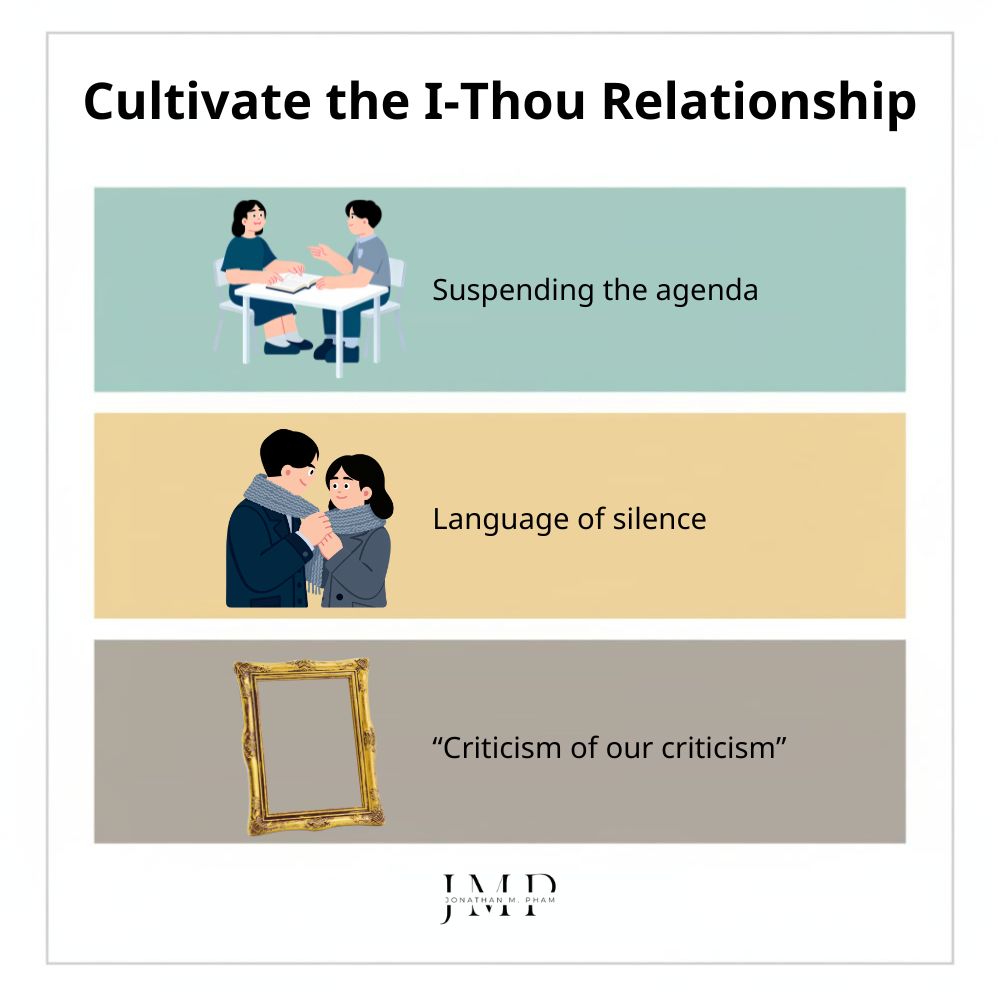
We cannot force an “I-Thou” encounter. It is not a technique to be mastered, nor a button to be pressed. That being said, it’s still possible to cultivate the conditions that make these moments of grace possible—through a few daily practices as follows.
Think about the last conversation you had. As the other person was speaking, were you truly receiving them, or were you silently formulating your own reply?
Most of the time, we enter interactions carrying an invisible backpack of agendas. We want to extract information, to look smart, to win an argument, or to fix the other person’s problem. All of these goals, even the well-intentioned ones, keep us anchored in the “I-It.”
As such, the first step to nurturing an I-Thou relationship is to consciously set down the backpack. Try entering a conversation and, for just five minutes, suspend your agenda completely. Let go of the person’s job title or status in your mind. Stop trying to steer the dialogue. Stop trying to be interesting. Just allow yourself to be interested.
We humans tend to equate communication with talking, and yet there are countless moments when words are of no use at all. For example, let’s say you are sitting beside a dear friend who is grieving a terrible loss. Your instinct—driven by the ego and years of social conditioning—is to search for the “right words” to say. Deep down, you are still viewing your friend as an “It” to be fixed.
But that’s not going to work when the soul is in a state of immeasurable grief.
Instead of trying to offer a cliché, a silver lining, a solution to make the uncomfortable sadness go away, just be a witness. Sit there with the person in silence. Offer your presence without trying to alter their state.
It’s awkward to do in the beginning, but once you lean into the quiet, you would realize that your presence is the greatest comfort you could ever give them, and the need for words simply fades away.
Have you not noticed that love is silence? It may be while holding the hand of another, or looking lovingly at a child, or taking in the beauty of an evening. Love has no past or future, and so it is with this extraordinary state of silence.
Jiddu Krishnamurti
And finally, in order to break the dehumanizing loop of modern tribalism, it’s essential that we practice what Buber called the “criticism of our criticism.”
It is incredibly easy to spot the moral failures of the “Other”—the opposing political party, the rival faction, the stranger on the Internet. In doing so, we reduce complex human beings to mere labels, while elevating ourselves to a god-like status—one who cannot be wrong. And the result? We become the “I”, and they the “It”.
Now, what if we stop for a moment and look at ourselves honestly in the mirror?
Are we holding our own side, our own tribe, and our own ego to the exact same ethical standards we demand of the opponents?
Let that sink in for a moment.
Quite often, when we look past the slogans to see the real human being across the aisle, the “illusion of immunity” is shattered. Suddenly, we realize that we are not immune to the darkness, the fear, or the mistakes that plague them. That “the same blood flows in our veins and theirs”.
There, but for the grace of God, go I.
In the beginning is the relation.
Martin Buber
Love is the responsibility of an I for a Thou.
Martin Buber
The development of the soul in the child is inextricably bound up with that of the longing for the Thou.
Martin Buber
The tie with the Other is knotted only as responsibility.
Emmanuel Levinas
We are here to awaken from our illusion of separateness.
Thich Nhat Hanh
Relationship is the fundamental truth of this world of appearance.
Rabindranath Tagore
We do not find the meaning of life by ourselves alone –we find it with another.
Thomas Merton
Self-actualization is possible only as a side-effect of self-transcendence.
Viktor Frankl
Before wrapping up, I would like to bring up a memorable moment in Victor Hugo’s literary masterpiece Les Misérables. The protagonist, Jean Valjean, is an ex-convict whose soul has been hardened into stone by decades of brutal “I-It” transactions. To him, the world is nothing but cruelty, and he operates entirely through extraction.
After being released from prison and taken in for the night by the kind Bishop Myriel, Valjean repays the hospitality by stealing the Bishop’s silver candlesticks and running away. When the police later catch Valjean and drag him back, he expects to be punished.
To his surprise, the Bishop does the unthinkable. He looks the police in the eye and says that the silver was a gift. After the police is already gone, he turns to Valjean and speaks gently:
“Do not forget, do not ever forget, that you have promised me to use the money to make yourself an honest man.”
In that moment of unconditional presence, Valjean’s “I-It” ego is completely shattered. For the first time, he is met as a “Thou”, and the trajectory of his later life is rewritten as a result.

That’s the staggering power of the I-Thou relationship. When you are capable of looking past the “thief” label, you see that there’s a man down there, buried under layers of dust, hardened by a society that refuses to see him as a Subject. If you are brave enough to brush of the dust and meet him, you will give him a chance of redemption.
After all, none of us are truly “pure”. Like Valjean, we all have our own limitations. From time to time, we all have moments of crisis where standing alone is simply too heavy a burden to bear.
It is exactly in these moments of vulnerability that we rely on the grace of a ‘Thou’—whether it is a lover, a friend, a mentor, a stranger, or the Divine—to remind us of who we are and who we can become. Only through the ‘Thou’ may our hardened shells be broken, and our capacity for love restored.
So the next time you encounter someone hidden behind a label, a mistake, or a wall of defense, remember the Bishop, and offer them your own presence.
And when it is your turn to be the one buried under the weight of the world—when your own strength fails and the “I-It” machinery of life leaves you feeling discarded—remember that you do not have to carry the burden alone.
Let yourself be seen. Let a “Thou” come in and lift you back into the light.
When I am down and, oh my soul, so weary;
When troubles come and my heart burdened be;
Then, I am still and wait here in the silence;
Until you come and sit awhile with me.You raise me up, so I can stand on mountains;
You raise me up, to walk on stormy seas;
I am strong, when I am on your shoulders;
You raise me up… To more than I can be.
Other resources you might be interested in: