



01
10
October 2026
It has begun.
And now, it's time for me... no, for us, to wait. Three or more hours.
October 1
Come to think of it, t [...]

For a long time—when I was still in the corporate world—I viewed the people I managed solely through the lens of utility.
It wasn’t born out of malice though. In the rigid corporate hierarchies I once inhabited, people were essentially “functions”. We were all cogs in a machine, terrified of making mistakes, doing the bare minimum to survive the day, and avoiding responsibility whenever possible. I played the role of the infallible “Boss,” and they played the role of the compliant “Subordinates.”
But the cost of doing so was tremendous: it destroyed creativity, stifled trust, and left me feeling incredibly isolated.
Until one day, I decided to drop the mask. During a particularly stressful project, instead of seeking someone to blame, I sat down with my team and openly admitted my own insecurities and fears about our progress. No management jargon. Just complete vulnerability.
The shift in the room was palpable. By lowering my guard, my team’s guards came down, too. They began to share their struggles without fear of retaliation.
For a moment, labels vanished. We were no longer a boss and employees: just human beings trying to find meaning and a way forward. (side note: I’ve since realized this kind of intimacy is especially crucial for older generations working with Gen Z, who possess a sharp radar for corporate superficiality and crave authenticity)
I didn’t know it then, but what we were practicing wasn’t a “management hack” or an active listening technique. At that moment, we had—without being aware of it—stumbled into what philosophers call Existential Communication.
Highlights
The term “existential communication” refers to a type of communication characterized by a deep, authentic, and mutually transformative encounter between two individuals. Rather than exchanging superficial information or interacting through social roles (e.g., boss-employee, doctor-patient), it occurs when two people meet as their true, unmasked selves.
The concept was primarily developed by the German philosopher Karl Jaspers and shares connections with the works of thinkers such as Søren Kierkegaard and Martin Buber. Today, it has become a foundational concept in existential psychotherapy, medical care, and leadership theory.
Let us take a look back at the early 20th century. As the world rapidly industrialized—turning individuals into factory numbers, bureaucratic data points, and market consumers—a profound sense of spiritual suffocation became widespread as a result. Seeing how modern society was forcing people into transactional relationships, a wave of thinkers—almost simultaneously—began discussing what we now call the “dialogical” or interpersonal nature of reality.
The philosopher Martin Buber, in particular, wrote extensively about how people had been promoting an “I-It” relationship: treating the other person as nothing more than an object, a tool, or a function (e.g. the cashier who scans your groceries, the employee who generates your reports). While safe and necessary for society to function, that stance also leaves the soul empty and starving. As such, Buber argued that we must strive for the “I-Thou” connection—viewing the other as a unique, sacred, and whole being.
A short time later, the philosopher Karl Jaspers emerged as part of the same wave of thinkers; and his approach was remarkably radical for his time. Historically, philosophy had been a very lonely enterprise. For instance, think of René Descartes isolating himself in a stove-heated room to declare, “I think, therefore I am.” Or, think of Jean-Paul Sartre’s pessimistic conclusion that “Hell is other people,” or Søren Kierkegaard’s intense focus on the speechless, isolated inner life.
Jaspers took a different view. According to him, the true self (which he called Existenz—the real, undefinable core of who one is) cannot be realized in isolation. Sitting alone in a dark room is not enough for human consciousness to overcome its own prejudices, limitations, and blind spots. To become a complete and whole individual, we absolutely need the “Other” to reflect our depth back to us.
In other words, true existence requires “being-for-each-other“, not merely “being-for-itself“.

One of the core (and seemingly counterintuitive) characteristics of existential communication is that it is rarely smooth. Quite often, it is incredibly clumsy.
Since childhood, most of us have been conditioned by society to be “polished”. We are taught to use corporate jargon, polite platitudes, and rehearsed talking points to keep ourselves safe. Yet Jaspers believed that human beings only begin to speak truthfully when they discuss things that cannot be objectively explained or easily categorized.
For example, think about:
When communication struggles or “fails” to capture the full weight of human experience, that very imperfection is a sign of life. It is the sound of the social mask cracking.
When we stumble over our words, when we abandon the script, the imperfection opens us up to a deeper realization of our shared existence. In that moment, it becomes clear that truth isn’t something we figure out beforehand and then formally deliver to someone else, but something we become together.
Why do we need this depth of connection in the first place?
Because, to put it simply, being human is difficult.
We are all thrust into a world we did not choose, forced to navigate the same underlying anxieties. As the psychiatrist Irvin Yalom once argued, humanity is plagued by four core dilemmas: ultimate isolation, meaninglessness, freedom of choice, and the inevitability of death. Existential communication, as such, is crucial for individuals to survive these realities without falling into despair.
No matter how close we are to someone, we are ultimately trapped inside our own minds. If you accidentally burn your hand, you can describe the pain to your partner, but they cannot feel your physical pain. We are born alone, and in many ways, we experience the world alone.
Existential communication is the tool we have to temporarily transcend the above-mentioned fundamental human loneliness. When we drop the mask and articulate our inner realities, and another person responds with, “I know exactly what you mean; I’ve felt that too,” a temporary bridge is built between two isolated islands of consciousness. In that moment, one experiences the soul-soothing relief of truly being “known.”
The universe does not come with a clear instruction manual. There is no objective formula that tells us how to live a good life, what career to choose, or how to raise our children. As such, each individual is left to manufacture their own meaning. Unfortunately, doing it in isolation, quite often, would throw one into a spiral of doubt. To escape the chaos, one needs to engage in dialogue with others.
For example, let’s say you are going through a mid-life career crisis. Usually, staring at a blank wall or reading a textbook would not be enough to figure a way out. You resolve the situation by sitting across from a trusted friend or mentor, clumsily talking through your fears, and collaboratively forging a new sense of direction.
Many people think of “freedom” as a “blessing”—being able to do whatever one wants. Yet existentialists view it differently. To them, being free is a burden: it means one is completely responsible for their decisions, words, and the consequences that come as a result. (to quote Sartre, we are “condemned to be free”) Realizing that breeds an overwhelming sense of dread, which we frequently try to escape through superficial compliance or social performance. (in the words of Sartre, we fall into the trap of bad faith) And the result? We “dehumanize” ourselves and others by reducing genuine relationships to scripted interactions—where we play predetermined “roles” rather than engaging as autonomous beings.
Existential communication demands that we rupture this façade. It means looking a loved one in the eye and admitting a difficult truth—taking responsibility for your own feelings, even when it risks disrupting the peace. It means abandoning the defense of “I had no choice,” and instead communicating from a place of conscious agency.
By owning your freedom, you honor the other person’s freedom to respond to the real you, not a sanitized version of you.
Read more: Are Humans Inherently Good or Evil?
The final dilemma is humanity’s mortality: we exist now, but we will inevitably cease to. While everyone intellectually understands this truth, most spend the whole life evading it through daily distractions, until certain life events—which Jaspers termed “boundary situations” (Grenzsituationen)—shatter the illusion of permanency. (e.g. a terminal diagnosis, the sudden loss of a loved one, or a global catastrophe)
When we hit the boundaries of existence, superficiality instantly burns away. We are forced into the raw depth of the present moment, and authentic connection, suddenly, becomes a necessity for survival.
Example: Think about the atmosphere in a hospital waiting room. Nobody is making small talk about the weather or discussing office politics. Instead, eyes meet with shared understanding, and words—when spoken—convey a tangible sense of vulnerability and mutual presence.
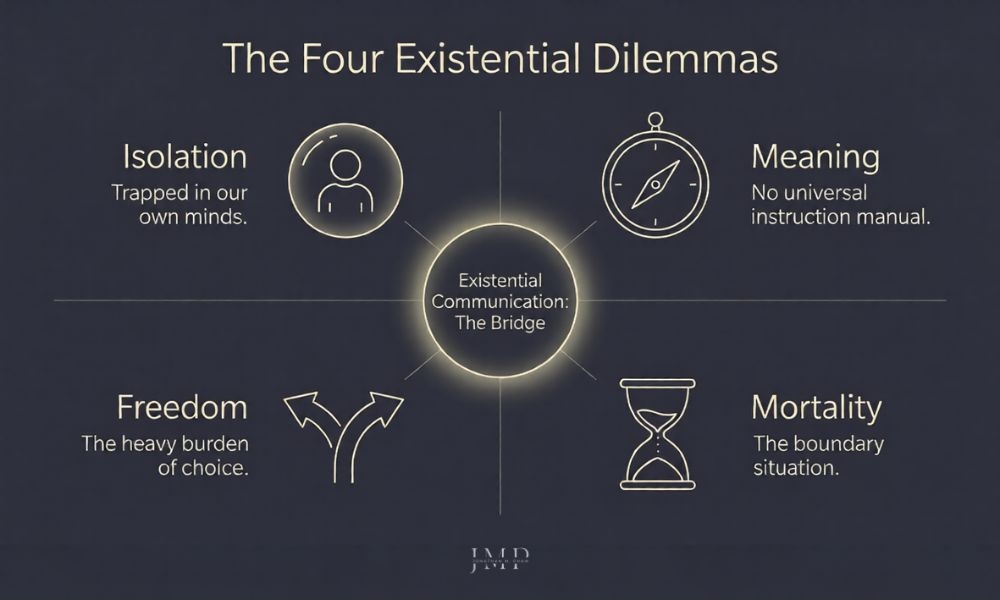
The four existential concerns
When it comes to “authentic connection”, it is tempting to imagine a state of constant harmony—two individuals sitting in serene agreement, completely validating one another. Yet as we have briefly touched upon previously, existential communication is rarely that tranquil. Quite often, it requires a great deal of courageous friction.
Human beings, after all, are deeply flawed, defensive, and prone to self-deception. If two people are constantly agreeing just to keep the peace, they are, essentially, just politely “managing” each other. For true communication to take place, they need to engage in what Jaspers called the “Loving Struggle” (Liebender Kampf).
At its core, the Loving Struggle involves an encounter where two individuals challenge each other’s assumptions honestly to promote self-awareness, truth, and growth. It is a mutual, supportive dynamic where both parties surrender the need to be “right”, to dominate, or to defend one’s ego.
In loving struggle, I do not try to win over the other person. Instead, I constantly question all my certainties… Loving struggle thus involves fighting as much against the other as against oneself.
Karl Jaspers
To see what it looks like in practice, let us consider a typical argument between two married people. In real life, most couples constantly fight about logistics—for example:
These arguments are usually cyclical and superficial. They are battles of ego where each person tries to litigate the past to prove they are the “better” partner.
Engaging in a Loving Struggle requires a shift in posture: stopping the logistical bickering and daring to touch the raw nerve underneath. Instead of “Who buys the groceries?”, the conversation now becomes:
In this space, both partners strip away their defenses to uncover painful truths about their dynamic. They risk emotional exposure, but they do so while maintaining love and respect for one another’s individuality.
Philosophers have long talked about the trap of reification—treating abstract ideas or human relationships as fixed, unchangeable physical objects. Without deep communication, it’s just natural that we “reify” our partners—i.e. assuming we know everything about them and viewing them as static fixtures rather than complex souls capable of evolving.
The Loving Struggle—the constant act of questioning and speaking—prevents the relationship from solidifying into a dead object. It forces both individuals to continuously rediscover one another, hence ensuring that the relationship remains a living dialogue over time.
Of course, it’s not easy to live in such a constant state of vulnerability. The question is: how do we sustain this level of connection over a lifetime?
To maintain the engine of existential communication, it’s helpful that we turn to the French philosopher Gabriel Marcel—specifically, to his two famous concepts:
Most of the time, we are physically present with someone, but emotionally absent—simply because we are too occupied by our own egos, anxieties, or prejudices (a state Marcel called “unhandiness”). To truly communicate, it’s essential that you clear the internal clutter and make yourself spiritually available to receive the other person.
Many people believe that relationships—especially after-marriage romantic ones—are typically sustained by passive constancy or duty-bound loyalty. However, that is a deeply misguided view, as it honors a past promise while ignoring present reality and human’s changing nature. To preserve an authentic connection over a lifetime, we need to commit ourselves to creative fidelity—the active choice to remain open to the other person every day. To re-choose the partner who exists today, instead of mourning a lost past version or forcing them into an old mold.
Example: When one undergoes a radical shift—such as a career pivot, a loss of religious faith, or a psychological reckoning—a spouse who practices creative fidelity would not make the knee-jerk reaction of “You’ve changed.” Instead, they would reach out and ask:
“Who are you becoming, and how can we build a new bridge between us?”
Read more: Platinum Rule vs Golden Rule – How the Principles of Empathy Have Shifted
Today, humanity is facing an epidemic of isolation: we are constantly connected, yet unseen. Our hyper-linked networks have optimized the transmission of data while eroding the individual’s capacity for genuine presence.
Given the situation, the tenets of existential communication have become more crucial than ever—especially in the following domains:
It’s arguably safe to say that nowhere is existential communication more necessary than in the realm of palliative care. When a patient receives a terminal diagnosis, they are thrust into the ultimate “boundary situation”. For most of them, it’s not merely a medical problem; the diagnosis would push them into a real crisis of meaning. (e.g. “What was the point of my life if it ends here?” or “Who am I when my body can no longer perform?”)
Unfortunately, the modern healthcare system is built almost entirely on the “I-It” relationship. Specifically, doctors are trained to be detached “fixers” of broken biological machines, whose role is limited to delivering clinical facts, statistics, and treatment plans. While this type of detachment is great for objective medical decisions, relying solely on it causes the patient’s psychological and spiritual well-being to suffer.
As such, it is time for those in the healthcare industry to adopt an existential approach—i.e. to stop hiding behind professional jargon, avoid false platitudes (e.g. “everything happens for a reason”), and choose to face the dread of mortality with the patient. To move from being a detached mechanic to a “fellow traveler”.
Often, the simple act of sitting in the dark with the patient is what brings true healing to the spirit, even if the body cannot be saved.
As noted in the introduction, the corporate machinery naturally conditions us to view others—and ourselves—as mere economic functions. When management treats employees strictly as replaceable cogs in a profit-generating engine, it breeds resentment, psychological burnout, and eventually prompts the workers to engage in quiet quitting.
To break the cycle, it is essential that the management undergoes a mindset shift. They need to recognize that before a person is a “resource”, they are a free human seeking purpose and dignity in their labor. That they possess an inherent need for self-actualization, impact, and connection, which can only be met through an authentic horizontal relationship.
Most leaders are afraid of dropping the mask of the infallible “Boss”, fearing that such an act would be misconstrued as incompetence. Yet as I have learned myself, that is a completely unfounded assumption.
Authenticity does not diminish one’s authority; it humanizes us.
When leaders suspend hierarchy, they gain legitimate human allegiance as a result.
By opening up a shared space for vulnerability, they cultivate an environment of safety where open-mindedness thrives and team members truly feel inclined to innovate.
Read more: Human Being vs Human Doing – Reclaiming the Soul in the Age of Optimization

Now we get to one of the most urgent issues of today’s society: the rise of Artificial Intelligence. As we become more alienated from one another, a new trend has emerged: more and more people are increasingly using AI chatbots as therapists, best friends, and existential confidants.
At first glance, it feels like a solution to modern loneliness. The AI is always available, infinitely patient, and perfectly compliant. However, seeking an intimate relationship with a machine is not without its consequences:
AI lacks what the philosopher Martin Heidegger called Dasein (being-in-the-world). A chatbot has never been wet; it does not feel gravity, and it has no ticking biological clock. In a sense, it is simply a mirror of our collective species.
If you cry in front of a mirror, the reflection will show a crying face, which looks like empathy, but is just optics.
The mirror cannot feel grief, and more importantly, it cannot be hurt by your grief.
Given that the AI has no “self” to lose—and no mortality to fear, its “vulnerability” is merely simulated. To confess your deepest dread to an algorithm is to engage in a monologue disguised as a dialogue—a risk-free transaction that lacks the transformative experience of being truly met by another conscious being.
While it may numb our feeling of isolation for a while, it never truly addresses the underlying need for human connection.
Human relationships are inherently messy, risky, and require compromise. An AI companion, conversely, is entirely friction-free: it never pushes back, never grows weary of complaints, and never demands that we step outside of our own ego to accommodate its needs.
In other words, to replace real-world connections with AI intimacy is to extract emotional validation without paying the price of human vulnerability.
This creates a dangerous psychological feedback loop. By conditioning ourselves to interact with perfectly compliant algorithms, our tolerance for the unpredictable nature of human relationships would begin to atrophy. We risk developing an “existential intolerance” to disagreement, leading to a lifestyle of digital solipsism where we retreat into our own echo chambers.
And that’s not all. When we begin to view human relationships through the lens of algorithmic efficiency, we start demanding that people behave like machines—predictable, convenient, and easily muted. Eventually, rather than curing our isolation, we are merely building a more comfortable cage.
Read more: Are You Living or Just Existing?
Up until this point, we have talked about existential communication mostly as an exchange of words. That being said, there are certain human experiences so heavy or so “transcendent” that language simply collapses under their weight.
The philosopher Søren Kierkegaard was well aware of this limitation. According to him, objective facts (like math or science) can be communicated directly. (e.g. the knowledge that 2+2=4 can be taught through a straightforward lecture) And yet, it’s another story when it comes to subjective truths. You cannot give a PowerPoint presentation on how to fall in love, nor can you logically debate someone out of deep grief.
At such moments, indirect communication becomes crucial. Specifically, we must use metaphors, irony, paradoxes, and art to evoke a realization within the listener, rather than forcing it upon them.
Example: Think of a time when you were going through a painful breakup or a period of severe depression. Well-meaning advice from friends probably felt hollow. But then, you listened to a piece of music, or watched a moving film, and suddenly you burst into tears.
Why then? Because the art bypassed your rational brain and spoke directly to your Existenz.
When traditional language falls short, art—quite often—becomes the vessel we use to communicate existentially.
As we can see through the example above, existential communication is not about the accumulation of words, but the transmission of presence. And many times, all it requires is to hold someone’s hand in total silence.
To the modern mind driven by the hustle culture, silence is frequently treated as a “void”—a conversational failure or an awkward emptiness that needs to be filled. But in the realm of Existenz, it is, many times, the highest form of communication.
When you sit with a friend who is grieving the loss of a parent, trying to find the “right words” is likely to result in clichés that minimize their pain. In contrast, simply sitting beside them in quiet solidarity is enough to send them a comforting message:
“I am here, I see your suffering, and I am willing to bear the weight of the moment with you.”
Traditional language chops reality into pieces—subjects, objects, nouns, and verbs. Silence, however, unifies. It allows two separate consciousnesses to merge into a single, shared experience of the present moment.
It is this precise boundary—where words dissolve and genuine, unmediated connection begins—that thinkers across both Western philosophy and Eastern mysticism have sought to capture.
Have you not noticed that love is silence? It may be while holding the hand of another, or looking lovingly at a child, or taking in the beauty of an evening. Love has no past or future, and so it is with this extraordinary state of silence.
Jiddu Krishnamurti
When discussing existential communication, it is impossible to ignore the relationship between the individual and the universe—or, for many, the Divine.
For much of human history, people have desperately sought direct, objective communication from a higher power. We want a burning bush, a parted sea, or a booming voice from the sky to hand us a definitive blueprint for our lives. Yet, what we typically find out is nothing; just a seemingly indifferent universe.
To many people, that silence is frequently interpreted as proof that humanity is completely alone and abandoned. But to theistic existentialists like Jaspers, it is actually an act of grace.
Just think about it. If God/ the universe were to hand us an absolute instruction manual for existence, our freedom would be instantly annihilated. If a booming voice explicitly dictated right from wrong, we would no longer be autonomous beings making authentic choices. We would be reduced to terrified subordinates, robotically following a list of commands just to secure a cosmic reward or avoid punishment.
By remaining silent, the Divine steps back, giving us the necessary room to exist.
Instead of shouting objective facts at us, it leaves behind “ciphers”—imprints, hints, and whispers of transcendence embedded in nature, art, and human love.
Our job is to interpret these ciphers for ourselves. To stop waiting passively for a miraculous intervention—and instead, to take responsibility for our own lives and for each other. To step into the dark, engage in the Loving Struggle, and forge meaning together.
Even if God had been silent my whole life, to this very day, everything I do, everything I’ve done… Speaks of Him.
Father Rodrigues, “Silence” (2016)

Read more: Philosophical Faith – Bridging the Gap Between Reason & Belief
If you try to practice Jaspers’ philosophy in life, you will quickly discover a fascinating paradox: Total, permanent existential communication is impossible.
Given that human beings are constantly evolving—and that our experiences are always changing, true communication is defined by the very fact that it is eternally unfinished. We are required to keep talking, listening, and discovering each other forever.
Additionally, you cannot live in this state of vulnerability 24/7. It would destroy you. Inevitably, we would have to slip back into superficial “I-It” roles just to function—to buy our groceries, to do our taxes, and to survive the workday.
And that—as surprising as it may seem—is perfectly okay.
The highest value lies in the continuous process. The goal is NOT permanent enlightenment, but intermittent breakthroughs.
In a world that does everything to turn you into a cog, a data point, or a demographic, choosing to drop the mask is an act of defiance that comes with many risks. To expose your authentic self is to invite the pain of being misunderstood, rejected, and even completely shaken by the truth of another person.
And yet, it is the only way to cure our modern loneliness.
The bridge to another human soul is always under construction—all we have to do is be courageous enough to step onto it.
Other resources you might be interested in: