Has this ever happened to you? Let’s say you are suffering from a frustrating health issue, or stuck in a chaotic life dilemma. You vent to a friend or a family member, looking for a little empathy.
Yet instead of empathy, they hit you with unsolicited advice—in a preachy, matter-of-fact tone.
“You just need to see this doctor,” or “You just need to start taking these supplements, it’s so obvious.“
Even if you know, logically, that what they say is 100% correct, what happens inside your head at that moment?
If you are like most of us (me included), you would instantly bristle. A sudden wall of resistance would go up. You would feel an overwhelming urge to refuse the advice—or, in some cases, even do the exact opposite—just to prove a point. You would literally rather suffer the physical consequences of the health issue than surrender to their instructions.
The question is: Why? Why would we willingly respond in such an “irrational” manner?
It’s tempting to dismiss such a reaction as simply being “childish”, proud, or needlessly stubborn. And yet if we look deeply enough, it actually points to one of the most mind-blowing “mysteries” of human existence.
Psychologist Jack Brehm called this phenomenon Psychological Reactance. According to Brehm, when someone tells you what to do—especially in a commanding tone—the brain doesn’t process the helpfulness of the advice first. Rather, it perceives a threat to your control. As such, it subconsciously employs direct resistance—an evolutionary defense mechanism designed to protect your autonomy.
While Brehm’s theory does provide a very convincing explanation, I myself believe there is a deeper, much more philosophical layer behind humanity’s innate stubbornness.
When you feel uncomfortable with that preachy advice, it’s actually your soul “screaming in rebellion”. It rebels because accepting the suggestion feels like letting someone else dictate your own life. Because it realizes that you are not being treated as a conscious human being capable of thinking for yourself—just a machine with a broken part that needs to be “fixed.”
In the language of existential philosophy, you are defending your nature as a Being-for-itself.
📌 Key Takeaway
Being-for-itself (French: Pour-soi) is the dynamic mode of human consciousness, which, at its core, is fluid, unfinished, and radically free. (“Existence precedes essence“)
This absolute freedom is the cause of “Anguish” (existential anxiety). To escape it, we often slip into “Bad Faith”—pretending we have no choices or hiding behind rigid societal identities.
To exist as a Being-for-itself is to constantly face the threat of objectification from other people—as well as from societal institutions.
While our natural instinct is to rebel against being controlled and objectified, true authenticity requires accepting our unchangeable limits (Facticity) while still taking absolute responsibility for our own choices (Transcendence).
At the end of the day, the ultimate goal is connection. To live authentically requires us to move beyond the isolated mode of Being-for-itself to the interconnected mode of Being-for-each-other.
What is Being-for-itself?
Before defining the concept, we need to first establish how existentialists understand reality—which is radically different from the conventional view. For centuries, Western philosophy had a tradition of binary thinking—i.e. splitting reality in half. (think about Plato’s Two World view or René Descartes’ Mind-Body Dualism) The great Immanuel Kant, for example, argued that there was this physical world, which we can actually see and experience (the Phenomenon); and then there existed a mysterious reality behind the curtain of the universe (the Noumenon, or the “Thing-in-itself”). For Kant, true human freedom existed only in that unknowable realm.
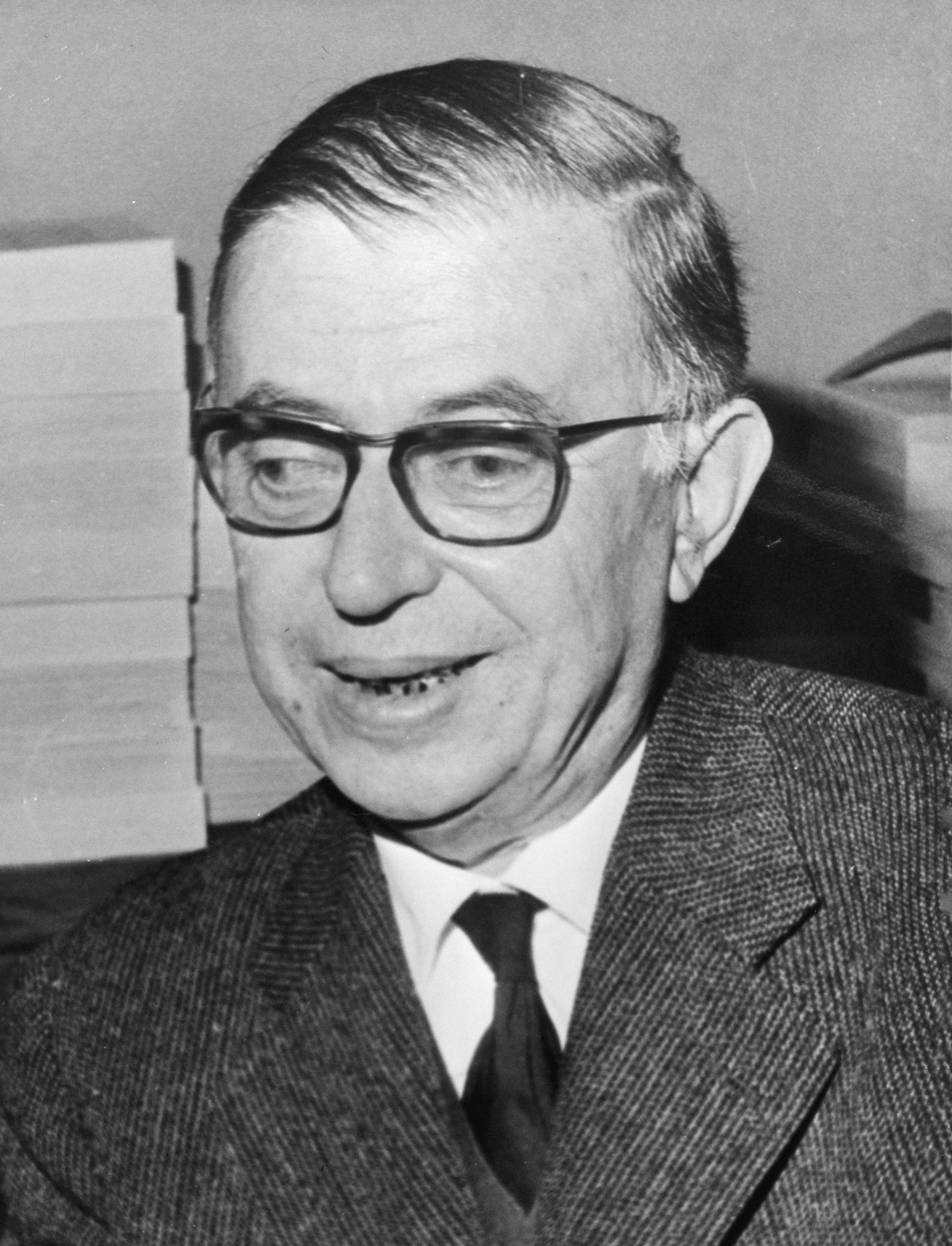
Then in the 20th century, the French philosopher Jean-Paul Sartre looked at Kant’s theory and essentially said: No.
According to Sartre, there is no hidden reality crouching behind the objects of the world. What we experience IS the full reality.
By abolishing the Noumenon, Sartre dragged human freedom out of the mystical clouds and dropped it directly into our conscious experience.
Being-in-itself vs Being-for-itself
Being is everywhere, opposite me, around me… that table which is there is being and nothing more; that rock, that tree, that landscape-being and nothing else. I want to grasp this being and I no longer find anything but myself. This is because knowledge, intermediate between being and non-being, refers me to absolute being if I want to make knowledge subjective and refers me to myself when I think to grasp the absolute. The very meaning of knowledge is what it is not and is not what it is; for in order to know being such as it is, it would be necessary to be that being.
Jean-Paul Sartre, “Being and Nothingness”
In his groundbreaking essay Being and Nothingness, Sartre divided existence into two distinct modes of being as follows:
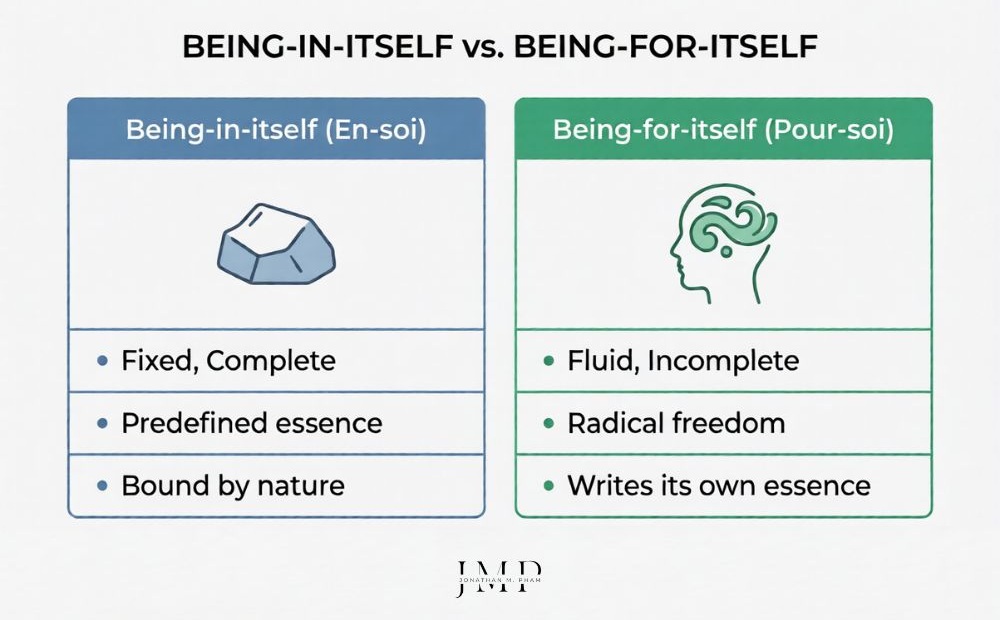
Being-in-itself (En-soi)
The first one is the non-conscious mode of physical, inanimate objects. (e.g. think of a rock, a table, or a paperknife) A paperknife, for instance, is designed with a specific purpose (to cut paper) before it is even manufactured. As such, its essence is predefined—it has no potential to change itself, makes no choices, and therefore does not suffer from anxiety. It doesn’t lay awake at night wondering if it should have been a spoon. It simply is.
Being-for-itself (Pour-soi)
And then we have the realm of human consciousness—which, unlike the rock or the paperknife, is not a fixed “thing.” Specifically, one is not born with a predefined purpose that dictates how one must function.
Rather, human consciousness—the Being-for-itself—is fluid, dynamic, and always incomplete. Its defining trait, as Sartre put it, is a “lack”. A “nothingness”. (Néant)
Now, I know that may sound incredibly bleak—who wants to be a “nothingness”? Yet in existentialism, it is exactly this “nothingness” that serves as the foundation of existence.
Why? Because it means there is a gap between you and the physical world.
If you were completely solid like a rock, you would be trapped in the present moment forever. But because your consciousness is a “lack,” you have the ability to step back. To distance yourself from your surroundings, reflect on the past, imagine what isn’t there, and project yourself into the future.
Man is always separated from what he is by all the breadth of the being which he is not. He makes himself known to himself from the other side of the world and he looks from the horizon toward himself to recover his inner being.
Jean-Paul Sartre
Being-for-itself essay
How consciousness works: The Red Cube analogy
To make it easier to understand, think about how you look at a red cube sitting on a desk.
Physically, your eyes can only see one, two, or maybe three sides of the cube at any given moment. Yet, your mind doesn’t register a flat, broken shape; it perceives a complete, 3D, 6-sided cube.
How then? Because your consciousness (the for-itself) is NOT a passive camera recording data.
It actively retains the memory of the back of the cube and anticipates the bottom of the cube. It synthesizes time and space into a meaningful whole.
The cube itself remains completely static (in-itself), yet your awareness is constantly moving and projecting across time.
To put it metaphorically: you are a verb, not a noun.
Feature
Being-in-itself
Being-for-itself (Human Consciousness)
Nature
Fixed, solid, complete
Fluid, dynamic, incomplete
Essence
Essence precedes existence (purpose is predefined)
Existence precedes essence (you exist first, then define yourself)
Relationship to Time
Trapped in the present
Constantly dragging the past and projecting into the future
Freedom
Absolutely none. Bound by the laws of nature
Radical, inescapable freedom
Being-for-itself vs Being-in-itself
On the surface, being a dynamic consciousness—a Being-for-itself capable of thinking and free to decide on its own—may seem like a miraculous gift. But as we are about to see, this mode of existence comes with a taxing psychological weight.
The Fragility of the Being-for-itself: Why Being Human Hurts
Man is condemned to be free; because once thrown into the world, he is responsible for everything he does.
Jean-Paul Sartre
It may seem overly dramatic for Sartre to have used the word “condemned” when discussing human freedom. And yet if we look closely enough, he actually had a point here.
To exist as a free, conscious human being—a “nothingness” with no predefined script—means that you are solely and fully responsible for who you become. That there’s nobody and nothing you can blame—except you yourself.
And with that realization comes this feeling which existentialists call Anguish (or Angst)—which is radically different from the standard, everyday fear.
The vertigo of possibility
Now, let’s say you are hiking and standing at the edge of a steep cliff. Fear is a completely rational response to an external danger. In this case, it is the thought: “What if the wind blows too hard, or the rock crumbles beneath my feet, and I fall?”
Anguish, on the other hand, is internal. It stems from the awareness that nothing is forcing you to step back. That you could choose to jump. That there is no biological programming, no law of the universe that physically prevents you from throwing yourself off the edge.
Your survival, therefore, requires a conscious choice, made by you, right now.
Existential freedom & the burden of being-for-itself
Sartre called this the “vertigo of possibility”—the realization that at any given moment, your life is entirely in your hands. You could:
Quit your job tomorrow;
Pack your bags and move to a new country;
Either destroy your marriage, or finally commit to it.
Nothing is stopping you—except your own will.
Because “existence precedes essence,” you are never a finished product. Every single day, you are forced to wake up and invent yourself all over again.
Bad faith as a coping mechanism
Living in a constant state of Anguish is psychologically demanding. Most of us simply cannot (or do not want to) bear that weight 24/7. As such, our tendency—which is completely understandable—is to look for a place to put it down. To pretend that we are not a fluid Being-for-itself, but a fixed Being-in-itself bound by extenal rules.
Sartre called such an act of self-deception Bad Faith (Mauvaise Foi). According to him, people usually slip into Bad Faith in one of the two following ways:
Fleeing into Facticity(Pretending we have no choice)
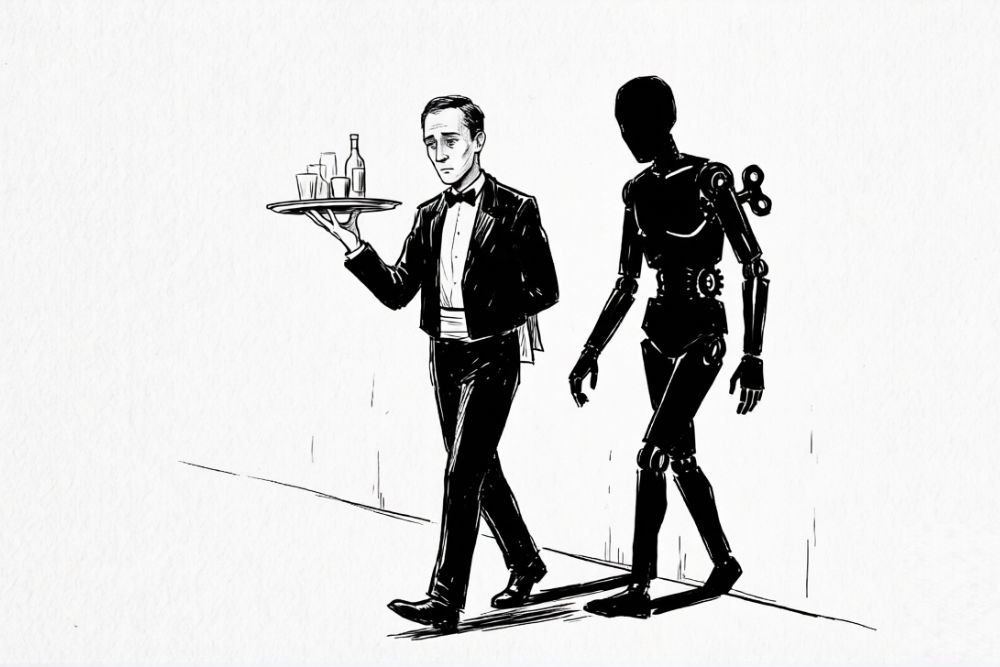
This happens when we use the concrete facts of our situation (Facticity) as an excuse to deny our freedom. An example is a waiter in a Parisian café, who—as observed by Sartre—moves a little too rigidly. His gestures are overly eager, his voice a little too formal. He is intensely “playing the role” of a waiter, trying to convince himself that his identity is as fixed as an inkwell on a desk.
Why? Because it is much safer to believe “I am just a waiter” than to face the truth (which is unsettling) that he could drop his tray, walk out the door, and upend his life.
Real-life examples: Have you ever stayed in a miserable job or a toxic relationship and told yourself, “I have no choice. I’m just a mid-level manager. I have a mortgage. This is just how my life is“? While mortgages and job titles are real facts (facticity), assuming they completely erase your capacity to choose is Bad Faith. That you are only pretending to be a determinate object, not an author capable of rewriting the story.
Fleeing into Transcendence (Pretending we have no constraints)
This is the exact opposite, which occurs when we ignore our physical reality, past actions, and concrete limitations—when we act as if we were purely spiritual, ungrounded beings.
To demonstrate the above-mentioned tendency, Sartre used the example of a flirtatious woman on a first date. When her date takes her hand, she is forced to make a decision: to either pull away and reject him, or to leave it there and accept his advance. Both choices are definitive; both are risky.
To avoid the anxiety of making a concrete choice, the woman decides to leave her hand in his, but completely detach her mind from it. She engages in lofty intellectual conversations—as if the hand resting on the table was only a fleshy object that had nothing to do with her.
Real-life examples: This is the driver behind the modern “spiritual bypassing” phenomenon. It’s the person who consistently acts selfishly or harms others, but avoids taking responsibility by saying something like, “I am just pure consciousness. The material world is an illusion. I am not my actions.“
By fleeing into the abstract, they avoid the burden of real-world consequences and accountability.
Read more: Burden of Choice - On the Paradox of Infinite Freedom
The impossible goal: “In-itself-for-itself”
At the end of the day, both forms of Bad Faith point to the same desire.
Deep down, the being-for-itself is driven by a “lack”. What it wants more than anything is to be secure and complete like the in-itself—while still retaining the conscious awareness of the for-itself. To be a finished masterpiece that gets to proudly look at itself, while also maintaining the capacity to keep painting.
Philosophically speaking, a being that is perfectly complete, fundamentally unchangeable (in-itself), yet entirely self-aware and free (for-itself) is the very definition of God.
Sartre argued that this synthesis—the “In-itself-for-itself” (en-soi-pour-soi)—is a logical impossibility. You cannot be a static object and a radically fluid consciousness at the exact same time.
And yet in reality, most of us spend our whole lives striving for this paradoxical state of being. We end up getting caught between two unsustainable extremes: craving total stability, while also refusing to give up our own freedom.
On one hand, we frequently hide behind rigid identities, professional titles, social roles, strict dogmas, or excuses like “This is what I am.” (sinking into the in-itself)
On the other hand, we reject all commitments, deny all labels, and keep every door open so we never become “fixed.” (floating in the for-itself)
To be both an “in-itself” and “for-itself” simultaneously is, logically speaking, an impossible dream; yet it is the fundamental drive of human consciousness. (which Sartre called the “desire to be God“) Given that we are condemned to reach for an absolute state that cannot exist, Sartre concluded with a rather melancholic observation:
“Man is a useless passion. It is meaningless that we live, and it is meaningless that we die.”
Being for itself in existentialism
Read more: Immortality Projects – The Psychological Trap of Trying to “Live Forever”
The Challenges of Existing as a Being-for-itself
In an ideal world, our journey as a Being-for-itself would be a completely private project. We would wrestle with our own choices and learn to accept our dynamic nature in peace.
But in reality, none of us live in a vacuum. The moment we step out into the world, our isolated consciousness inevitably collides with that of others—as well as with massive institutional machines designed to strip away our humanity.
The threat of the Other: “The Gaze”
Let us briefly return to the opening story about receiving unsolicited preachy advice. How can a diagnostic tone induce such an irrational response? Why does it feel almost like an existential attack—an insult to one’s own worth?
Because the other person is deploying what Sartre called the Gaze (Le Regard).
In their mind, they are capturing your vibrant consciousness and freezing it into a fixed, manageable object. They look at you and label you as “clumsy,” “sick,” “stubborn,” or “naive.” Your Being-for-itself is treated as if it were a broken Being-in-itself that needed to be debugged.
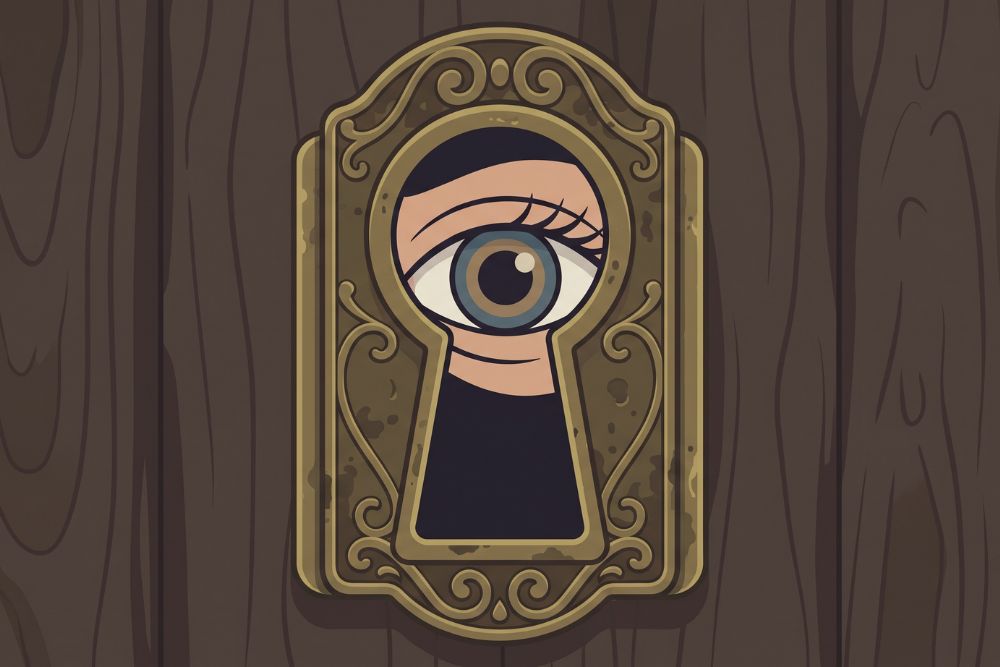
To illustrate the visceral power of the Gaze, Sartre offered a famous phenomenological example: the Keyhole Experiment. Imagine you are standing in a hotel hallway, kneeling down and looking through a keyhole out of curiosity. (or jealousy) In that moment, you are pure for-itself. You aren’t thinking about yourself; your consciousness is fully absorbed in the act of looking.
Suddenly, you hear footsteps behind you in the hallway.
In a split second, your reality shatters completely. You feel an immediate rush of shame.
Why? Because you instantly realize how you exist in the mind of the person walking down the hall.
In their consciousness, you have been frozen into an object: “a creep,” or “a voyeur.” You have been captured and defined from the outside.
Based on the above-mentioned thought experiment, Sartre came up with an infamous (and frequently misunderstood) remark as follows:
“Hell is other people.“
It isn’t that people are inherently evil. It’s just that their gaze has the power to reduce our existence into an object (a being-in-itself) in their world.
When you are alone in a room, you are undisputedly the center of your own universe. Your consciousness is free to flow, perceive objects and project into the future. That being said, the moment another person enters the room, your world shifts off-center.
Suddenly, you transition from a Being-for-itself into a Being-for-others (Pour-autrui)—a dimension of existence created by others looking at and judging you, over which you have no direct control.
Institutional dehumanization
If we are attentive enough, we should see that the problem of objectification does not stop at the individual. In fact, it has been adopted and constantly promoted by large-scale institutions. And the consequence—as we are seeing right now—is systemic dehumanization, where complex humans are essentially turned into “cogs in a wheel”. (beings-in-itself)
Example #1: The corporate machine
Modern corporate structures are engineered to treat people as replaceable cogs. In fact, we can see it just by looking at the language formalized in corporate vernacular: “Human Resources,” “Headcount,” “FTE (Full-Time Equivalent),” and “Human Capital.”
These words subtly strip away individuality; they reframe living conscious agents as raw materials to be optimized, depleted, and replaced. Roles are documented into rigid SOPs (Standard Operating Procedures) so that if “Cog A” drops out, “Cog B” can be slotted in with minimal friction. The system actively suppresses our nature as a Being-for-itself—because irreplaceability is a risk to the machine.
Example #2: Dogmatic institutions
In Dostoevsky’s masterpiece The Brothers Karamazov, the character Ivan Karamazov tells the tragic story of Richard the Genevese—a wretched, neglected man who commits murder and is sentenced to death. The problem, as Ivan points out, is the absurdity of the religious community’s treatment of Richard. Specifically, systemic philanthropists and pastors swoop in, convert him, and celebrate that his abstract soul is “saved in Christ.” Yet, in a grotesque display of institutional hypocrisy, they still drag him to the scaffold to coldly execute him.
“This Richard was an illegitimate child… given to some shepherds on the Swiss mountains. He grew up like a little wild beast among them… He longed to eat of the mash given to the pigs… But they wouldn’t even give him that, and beat him when he stole from the pigs.
…He was caught, tried, and condemned to death. In prison he was immediately surrounded by pastors, members of Christian brotherhoods, philanthropic ladies… They taught him to read and write… and expounded the Gospel to him… till at last he solemnly confessed his crime. All aristocratic and well-bred society of the town rushed to the prison, kissed Richard and embraced him; ‘You are our brother, you have found grace.’ And Richard does nothing but weep with emotion, ‘…now even I have found grace. I am dying in the Lord.’
‘Yes, Richard, die in the Lord; you have shed blood and must die. Though it’s not your fault that you knew not the Lord, when you coveted the pigs’ food… but you’ve shed blood and you must die.’
…At the scaffold they call to Richard: ‘Die, brother, die in the Lord, for even thou hast found grace!’ And so, covered with his brothers’ kisses, Richard is dragged on to the scaffold… And they chopped off his head in brotherly fashion, because he had found grace.”
By elevating Richard’s repentance as a divine triumph—while ignoring the structural neglect that drove him to crime, the religious community reduces a suffering human being into a mere instrument for moral self-congratulation. He is granted humanity only on the condition that he accepts his role as a pious sacrifice.
Unfortunately, this is exactly what is happening in the world right now. Not only limited to dogmatic religious institutions, it has become the underlying operational mode of modern secular, political, and social systems.
Politics: In geopolitical conflicts and nation-building, individuals are routinely flattened into “collateral damage,” “demographic threats,” or “strategic casualties.” Political factions strip people of their personal narratives; they treat human lives as necessary sacrifices to validate an ideological paradigm or protect geopolitical balance.
Healthcare & public welfare: In heavily bureaucratized public administration, human crises are quantified into metrics, priority scores, and budget line items. Patients suffering from complicated personal traumas are sorted via standardized diagnostic algorithms—essentially, they are turned into rigid classifications so the institution can manage “throughput.”
Social media & the Experience Economy: Modern digital platforms compress human consciousness into engagement metrics, user profiles, and algorithmic data points. Our personal choices, grief, and self-expression—the core of Being-for-itself—are monetized as predictable consumer behavior (Being-in-itself); multi-dimensional identities are reduced to “data commodities” for advertisers.
When bureaucratic, corporate, or dogmatic institutions adopt a macro “God’s-eye view” of humanity, the individual inevitably shrinks to zero. Systems cannot operate efficiently if they have to honor the chaotic nature of a Being-for-itself. As such, they turn humans into Beings-in-itself—i.e. crushing them, physically or ideologically, until they believe they are nothing more than meat, bone, and output.
Read more: The Curated Self – Why Authenticity on Social Media is Impossible
Hustle culture as systemic bad faith
The question is: Why do so many of us willingly participate in this machine? Even when fully aware of its dehumanization, why do many still tolerate—or even actively defend—the system?
Because it offers a tempting bargain: the fallacy of stability.
Hiding behind a prestigious title (“Founder,” “Grinder,” “VP“) grants us the illusion of being a complete and impressive object in the eyes of society. A perfect statue to be looked up to. A respectable Being-in-itself-and-for-itself. To put it bluntly, a literal “God”. No wonder most people are so eager to hail the modern “Hustle Culture“—defining one’s identity completely by one’s output, metrics, and professional titles.
That is, until a sudden disruption occurs—when one, out of the blue, receives an automated mass-layoff email after years of loyal service, or when severe burnout forces the body to shut down.
In an instant, when the system acts purely in its self-interest, the illusion evaporates. You are forced into a painful crisis of meaning—the realization that you have spent years acting in Bad Faith, pretending to be a loyal “cog in a machine”, only to be reminded (albeit too late) that you are actually a fragile, yet free human being.
How the Being-for-itself Pushes Back (for Better or for Worse?)
The human spirit, as it always was, hates suppression. When faced with the pressure of the Other’s Gaze and the institutional machines trying to flatten conscious individuals into Beings-in-itself, it may give in for a while—that is, until the toxicity of blind conformity becomes too much to endure. At that point, the soul would “rebel“—sometimes in a very irrational and destructive manner.
Choosing suffering over logic
Long before Sartre wrote about the Being-for-itself, the Russian author Dostoevsky captured this burning need for autonomy in his short novel Notes from Underground—in which the protagonist (the Underground Man) mounts a furious defense against the “rational egoists” of the 19th century. During that era, scientists and philosophers were arguing that humanity could be entirely figured out. That if we could map out the laws of nature, biology, and psychology, society could be perfectly organized. That people would always act in their own best, most logical interest.
To this collective optimism, the Underground Man essentially says: Absolutely not. According to him, a human being would literally destroy their own well-being just to prove they have the freedom to do so.
“Advantage! What is advantage? What if it so happens that a man’s advantage, SOMETIMES, not only may, but even must, consist in his desiring in certain cases what is harmful to himself and not advantageous.”
This ties us back to the unsolicited advice example in the beginning. As paradoxical as it may sound, most of us would deliberately choose to do something illogical or unhealthy—like refusing to see a doctor when we know we should, or staying up until 3 A.M. even when knowing we have to work the next day—simply to break the machine.
By sabotaging our own “best interests,” we are proving to the universe that we are not a fixed piano key, but free and unpredictable Beings-for-itself.
The quest for authenticity
When your friend tells you to “just take the supplements” or “go to the doctor” in that diagnostic tone, your brain registers a threat. It sees the “Gaze”—someone trying to reduce you to a logical equation, a broken in-itself that just needs a quick fix.
To the outside world, your refusal to take the advice looks like pure pride, irrationality, or self-sabotage. But internally, it is actually a declaration of independence.
That you would rather choose suffering on your own terms than accept comfort on someone else’s.
That you are the author of your own life, and you cannot be optimized.
Sartre’s existentialism, Brehm’s psychological reactance, and Dostoevsky’s Underground Man—they all describe the exact same phenomenon: the inherent need to protect the for-itself. To reclaim authenticity.
That being said, rebelling is not the long-term solution. While it may preserve your dignity for a while, living your whole life as an Underground Man—constantly fighting everyone and everything—is a recipe for a lonely and bitter existence.
While it may prove that you are free, it doesn’t teach you how to live well with that freedom.
Read more: Human Agency – From Autopilot to Conscious Creation
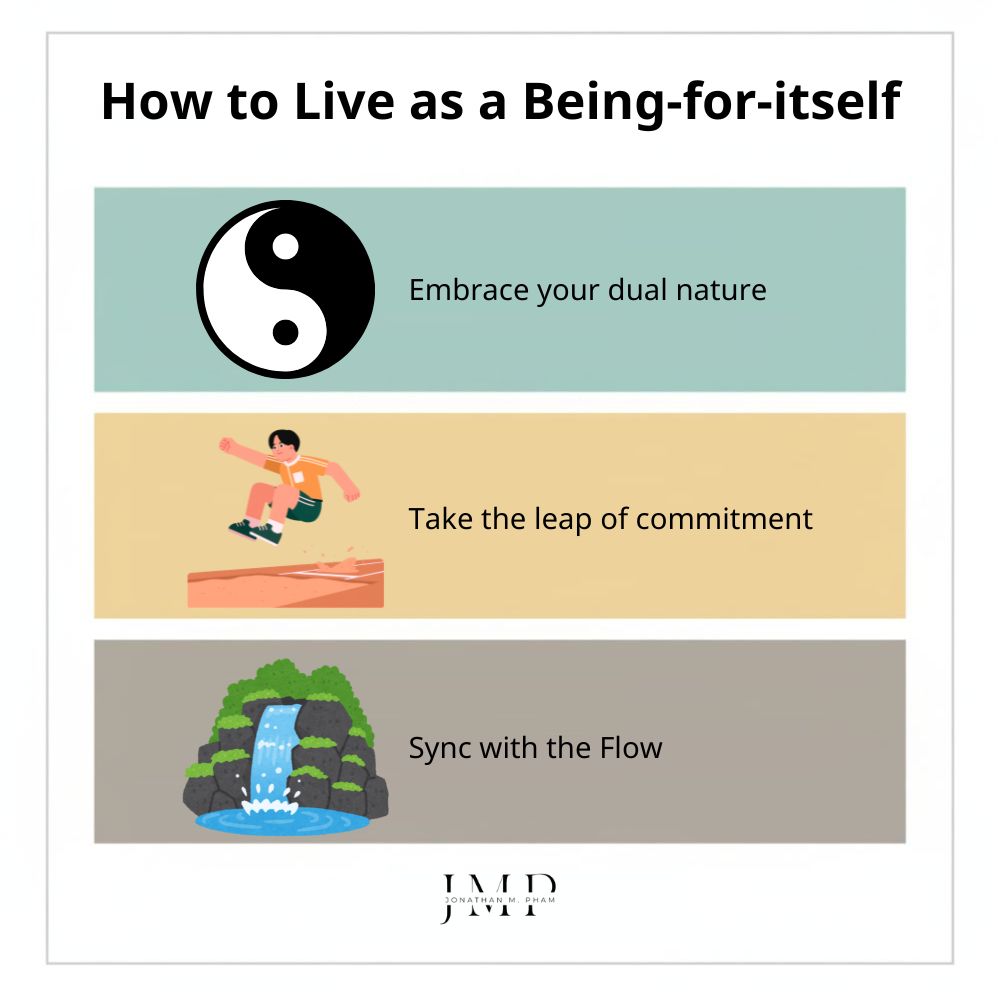
How to Live as a Being-for-itself
Embrace your dual nature (Facticity & Transcendence)
Face the facts of being what you are, for that is what changes what you are.
Søren Kierkegaard
As discussed, bad faith happens either when you pretend you have no limits (Fleeing into Transcendence) or no choices (Fleeing into Facticity). The antidote—authenticity—is to practice holding both truths at the exact same time. To embrace the dual nature of your existence.
Facticity: You are, in the words of the philosopher Martin Heidegger, “thrown” into a world you didn’t choose. Your existence is bound by biological limits, a specific upbringing, societal constraints, and past traumas.
Transcendence: Despite those unchangeable circumstances, you retain absolute responsibility for how you interpret and react to them.
What it looks like in practice:
Let’s say you are diagnosed with a chronic physical illness. At that moment, it’s tempting to either:
Flee into Transcendence: Ignore the doctor, refuse treatment, and tell yourself, “My mind can conquer anything.” (which would only harm your body)
Flee into Facticity: Collapse into despair, “My life is over. I am a sick person now. I have no future.“
But the real solution is to look in your eyes and say:
“Yes, I have this condition, and it limits my physical stamina (Facticity). But how I choose to live with it, the meaning I extract from it, and how I treat the people around me despite my pain—that is entirely up to me (Transcendence).“
You do not pretend the walls of the maze don’t exist. At the same time, you take absolute ownership of how you navigate them.
Read more: Amor Fati (Love Your Fate) – When Existentialism Meets Stoicism
Take the leap of commitment
If you accept that you are a fluid “nothingness”, there is a very real risk of succumbing to decision paralysis. Specifically, if you can do anything—and no choice is guaranteed to be the “right” one, it becomes extremely tempting to just sit on the sidelines of life and keep all doors open.
But staying uncommitted is, at the end of the day, just another form of Bad Faith. You cannot simply think your way into becoming a real self; only tangible action can make it happen.
Living as a for-itself means making a passionate “leap” of commitment in a world where nothing can be known with 100% certainty. You need to accept that you are a verb—and verbs require action.
What it looks like in practice:
Whether it is committing to a vocation, a loving relationship, or a creative project, it’s essential that you choose with your whole heart. When you marry someone, or switch career paths, there’s no magical crystal ball to ensure you won’t get hurt. And yet, don’t let that discourage you from taking the leap anyway.
To venture causes anxiety, but not to venture is to lose one’s self…. And to venture in the highest is precisely to be conscious of one’s self.
Søren Kierkegaard
Sync with the Flow
Western existentialism, for all its brilliance, is heavily focused on the isolated individual. It frames life as a constant act of self-assertion: I choose, I act, I rebel, I define myself.
But as we saw with the Underground Man, constantly flexing your for-itself against the world is a recipe for disaster. To follow the hyper-individualistic prescription of those like Sartre—owning one’s radical freedom and creating one’s own meaning out of the blue—is very likely to leave one feeling isolated and fatigued.
This is where I believe we should look to Eastern philosophy. Long ago, traditions like Daoism have proposed that most of the conflict in life comes from our own ego fighting the natural flow of reality—rather than only from others trying to control us. The solution is to soften the edges and practice Wu Wei. (無為, typically translated as “effortless action” or “non-doing”)
What it looks like in practice:
Let’s go back to that moment when your friend gives you unsolicited advice. The hyper-vigilant for-itself would immediately bristle, lash out, or even deliberately sabotage itself just to prove it cannot be controlled. Doing so would consume a massive amount of emotional energy and achieve nothing.
But with Wu Wei, the urge to fight back vanishes. When the preachy advice comes, you don’t engage in an ego battle. You simply smile, say, “Thank you for your perspective,” let their words wash past you, and then calmly go do whatever you feel is best for yourself.
When the overthinking friction of the isolated self is gone, you actually allow yourself to become truly liberated.
It is man’s pretence that because he has choice he is free. Freedom is pure observation without direction, without fear of punishment and reward. Freedom is without motive; freedom is not at the end of the evolution of man but lies in the first step of his existence. In observation one begins to discover the lack of freedom. Freedom is found in the choiceless awareness of our daily existence.
Jiddu Krishnamurti
From “Being-for-itself” to “Being-for-each-other”
While Sartre did an arguably amazing job at diagnosing the human condition, his solution, I believe, is too one-sided. In fact, for the typical person exposed to his philosophy, they are very likely to fall into the trap of hyper-individualism. To conclude that “It is me against the world” and hence adopt a “survival of the fittest” life stance.
That, to me, is a flawed interpretation of what it means to be free.
If you spend your whole life building a fortress around your Being-for-itself, you might be able to protect your own autonomy, but at what cost?
Your own soul becomes suffocated. Simply, because humans are social creatures wired for connection—and ultimately transcendence.
As such, to live authentically is to move one step further. To leap beyond the isolated Being-for-itself to the interconnected Being-for-each-other—without compromising one’s individuality in the process.
The ethical dimension: My freedom is tied to yours
Sartre himself stated, “In choosing myself, I choose man.” He understood that individual freedom carries the weight of universal responsibility. Yet it was his lifelong partner, Simone de Beauvoir, who really fleshed out the ethics of human connection.
In her book The Ethics of Ambiguity, Beauvoir argued that freedom is not a solitary endeavor—that “my freedom is inextricably tied to yours.”
If I demand absolute freedom for myself, yet at the same time treat other people as tools, my own freedom is a sham.
As long as I am surrounded by people who are enslaved, objectified, or treated as mere “cogs in a machine”, I remain complicit in a society that refuses to acknowledge the inherent dignity of the individual.
To genuinely embrace your for-itself, therefore, requires you to actively recognize and fight for the for-itself of others. To turn authenticity into a shared project.
The I-Thou relationship
One cannot talk about moving from Being-for-itself to Being-for-each-other without discussing Sartre’s “Gaze”. In fact, this is a very tricky part of the transition process. How do we interact with people without objectifying them—or being objectified in return?
It boils down to how we perceive ourselves and each other: whether as an object (an “It”) or an individual (a “Thou”).
Back in the day, the philosopher Martin Buber—a Jewish existentialist—argued that we relate to the world in one of the following two ways:
The “I-It” Relationship: This is the equivalent of The Gaze—treating another person as a tool, a label, or a problem to be solved. We perceive them purely for their utility (e.g., the cashier, the boss, the annoying person giving me advice). In this mode, their fluid consciousness is frozen into a fixed in-itself.
The “I-Thou” Relationship: This involves a vulnerable encounter between two conscious individuals. In the “I-Thou” mode, you do not diagnose, categorize, or try to manage the other person. You simply meet them where they are.
What it looks like in practice:
Let’s look at how Buber’s philosophy changes our daily interactions. Far too often, we view those closest to us—whether it is our long-term partner or a family member—as an “It”. We assume that we know exactly who they are, how they will react, and what their flaws are. Without being aware of it, we reduce them to merely a role: the provider, the caretaker, the complainer.
To step into “Being-for-each-other,” you need to consciously drop that mental file and look directly at the person sitting across the dinner table. To realize that they—just like you—are a dynamic, unfinished Being-for-itself. That they have:
Secret fears they haven’t spoken aloud;
Dreams they haven’t yet discovered, and
The ability to wake up tomorrow and become someone completely new.
When you refuse to flatten people into a predictable object, you give them the psychological safety to drop their Bad Faith. And in doing so, you create a mutual recognition where your own freedom is validated.
While it was Jean-Paul Sartre who made the term “being-for-itself” a cornerstone of existentialism, he did not invent it. The concept actually has deep roots in German philosophy; aside, many other thinkers have explored similar ideas about self-awareness, freedom, and consciousness, even if they used different vocabulary.
G.W.F. Hegel (The Originator): Sartre borrowed the terms in-itself (an sich, raw potential) and for-itself (für sich, conscious actualization) directly from Hegel, who argued that self-awareness requires recognition from another conscious being—the origin of Sartre’s concept of “the Look.”
Martin Heidegger (The Predecessor): Defined human existence as Dasein (“Being-there”)—the only entity that cares about and questions its own existence. His idea directly paved the way for Sartre’s “being-for-itself.”
Simone de Beauvoir (The Feminist Application): Applied the concept to gender dynamics. She wrote extensively about how men historically claimed the active role of the Subject (for-itself), while forcing women into the passive, objectified role of the Other (in-itself).
Søren Kierkegaard (The Spiritual Precursor): Defined the self not as a fixed “thing,” but as an active process of relating to oneself—balancing current reality with future freedom. His idea closely mirrors Sartre’s dynamic view of consciousness.
How does Heidegger’s Dasein differ from Sartre’s being-for-itself?
While both thinkers explored human existence, they started from different places. Sartre’s Being-for-itself focuses mostly on the radical freedom of human consciousness—how we are separated from the physical world by a gap of “nothingness.”
Heidegger, on the other hand, hated traditional terms like “consciousness”, which prompted him to coin the concept of Dasein (which literally translates to “Being-there”). According to him, human beings are never truly isolated observers; we are always already embedded in a context, a culture, and a shared world. (a state he referred to as Being-in-the-world)
Can a being-for-itself ever become a being-in-itself?
If we strictly follow Sartre’s atheistic existentialism, the answer is no—at least not while you are alive. In this framework, the only time you truly become an in-itself is at death, when your consciousness stops and you become a fixed historical fact.
However, other traditions offer a completely different view:
Eastern Philosophy (Buddhism & Advaita Vedanta): Within these traditions, the “gap” of the for-itself (the ego) is actually an illusion. Through spiritual enlightenment, one can dissolve the boundary between the isolated self and the universe (realizing No-Self or Brahman). You don’t become a “rock,” but you achieve a state of complete, peaceful unity where the conflict of the for-itself vanishes.
Religious Existentialism: Thinkers like Kierkegaard suggest that by making the ultimate “leap of faith” and aligning one’s will with the Divine, one’s finite human existence would become anchored in eternal reality. Rather than losing our own consciousness, we find the solid grounding (the in-itself) we inherently crave.
What is being-itself?
It is easy to confuse Sartre’s terms with the theology of Paul Tillich, which belongs to a different framework.
Being-itself (Tillich): The Christian existentialist concept of God. For Tillich, God is not a “highest being” sitting in the clouds dictating our lives, but Being-itself—the infinite ground of reality that sustains all things and resists non-being.
Sartre argued the “In-itself-for-itself” (God) is impossible. Are there counterarguments?
Yes, absolutely. Sartre defined God as a being that must be completely fixed and complete (in-itself) while simultaneously being totally fluid and conscious (for-itself). Because he viewed these as mutually exclusive, he declared God an impossibility—to which theologians and philosophers have come up with robust responses:
The False Dichotomy: Classical theology argues that God is not a mashed-up combination of a rock and a human mind. God is Actus Purus (Pure Act) or Being-itself—a completely different category of existence that transcends Sartre’s human-made boxes.
The Incarnation: For Christian philosophers, Sartre’s “impossible synthesis” is the literal definition of Christ—a being who possessed a fully human consciousness (acting in time) while remaining fully united with the divine nature. What Sartre calls a logical failure, theology calls a profound “mystery.”
Process Theology: Sartre assumes God must be static. Process theologians, on the other hand, believe that God is actually dynamic, relational, and evolving alongside the universe. That God can be perfect in love and responsiveness without being an unchanging object.
Being-for-itself Quotes
Man is always something more than what he knows of himself. He is not what he is simply once and for all, but is a process; he is not merely an extant life, but is, within that life, endowed with possibilities through the freedom he possesses to make of himself what he will by the activities on which he decides.
Karl Jaspers, “Man in the Modern Age”
Man is a synthesis of the infinite and the finite, of the temporal and the eternal, of freedom and necessity.
Søren Kierkegaard, “The Sickness Unto Death”
Dasein is an entity which does not just occur among other entities. Rather it is ontically distinguished by the fact that, in its very Being, that Being is an issue for it.
Martin Heidegger, “Being and Time”
Self-consciousness exists in and for itself when, and by the fact that, it so exists for another; that is, it exists only in being acknowledged.
G.W.F. Hegel, “Phenomenology of Spirit”
Final Thoughts: The Courage to Be Human
Now is the time for us to come full circle—and return to the opening scenario.
The next time you are venting about a struggle, and a friend gives you clumsy, preachy advice you didn’t ask for—remind yourself to pause. Observe that familiar spike of psychological reactance. Feel your inner Underground Man wanting to lash out, but don’t do anything. Just watch.
Then, do your best to look past the person’s tone—deep into their psyche.
If your heart is open, it’s not difficult to realize that at the end of the day, your friend is also an anxious, flawed Being-for-itself. Just like you, they themselves are trying to find their own place in an unpredictable world.
When they give you that preachy advice, it’s very likely that they are projecting their own fears onto you. That they are only looking for a fleeting sense of control amidst the chaos by “fixing” your problem.
With that insight, you now don’t have to resist them. Instead, extend grace to them. Forgive them for being messy.
And more importantly, extend that same grace to yourself.
You don’t have to be God. There’s no need to achieve the synthesis of the In-itself-for-itself.
What you need is simply the “courage to be.” To accept your own limits, embrace your fluid nature, and move forward into the unknown future anyway.
In doing so—in dropping the desire to prove your own freedom and resting in our shared humanity—you may, ironically, be able to touch a much deeper “ground of being”. And from there, life would throw through you harmoniously.
Hi there! I am a seeker on his path of self-discovery. Since my youth, I have been haunted—and driven—by the fundamental questions of existence: the weight of our choices, the nature of true fulfillment, and the various identities we inhabit. I created this blog to chronicle the insights I have unearthed while navigating the 'absurdity' and beauty of life. My hope is that in reading these words, you will find a reflection of your own struggle—and the courage to 'become who you are.' Please just take what resonates with your soul, and leave the rest behind!





.jpg)