A few years ago—out of the blue—I decided to start learning Japanese. Honestly speaking, the language was of no practical use to me at the time. Yet, because I had no particular endgame in mind—no upcoming trip, no corporate ladder to climb, no technical internship to secure—I found myself able to enjoy the experience to its fullest.
During that journey, I couldn’t help but notice a fascinating paradox. In the beginner classes (N5 and N4), the room was packed with attendants, and the air hummed with excitement. Whenever a new course started, there were always eager faces who showed up every day—who enthusiastically chatted about manga, anime, and the allure of Japanese pop culture.
But as the weeks wore on, the novelty began to wear off. The brutal reality of the language set in: thousands of vocabulary words to memorize, complex grammatical structures to decode, kanji characters that looked strikingly identical to each other, etc. As I progressed to the higher levels (N3 and beyond), the seats became emptied, one by one. The "enthusiasts" gradually vanished.
That is just a very ordinary example of a rising phenomenon in today’s society. Far too often, we launch into something—a new fitness regimen, a passion project, a startup idea—fueled by a blazing fire of enthusiasm. But the moment the initial spark dims and the endeavor stops being entertaining, our immediate instinct is to abandon ship. When the entrepreneurial dream crashes into a mountain of logistical issues, or when a hobby demands the sacrifice of our precious rest, we fold.
This is especially true when it comes to interpersonal relationships. In fact, it is a major driving force behind the current alarming divorce rates, the normalization of casual hookup culture, and the chronic unhappiness that plagues so many couples. The moment the honeymoon phase ends and the unglamorous work of truly loving another human being begins, we bail.
To be fair, that is only one side of the coin. On the opposite end of the spectrum are those who never leave. They chain themselves to a dead end—an unfulfilling relationship, a soulless career, an outdated worldview—purely out of guilt, fear, or a sense of duty enforced by their culture and/or religion.
If we really think about it, these two extremes both share the same roots: the desire for control.
When we run at the first sign of difficulty, we are trying to control our comfort. We refuse to be vulnerable to the pain of growth.
When we stubbornly stay in a situation out of obligation, we are trying to control our safety. We are too afraid of facing the uncertainty that comes with change.
In both scenarios, commitment is viewed as a cage—something we must either escape at all costs or resign ourselves to without questioning.
The question is: Is there a way out then? Must we choose one side and accept its inherent flaws?
In reality, there is a third path—one that allows the individual to remain steadfast to a choice without feeling suffocated by it. A path where commitment actually becomes the very foundation for liberation to take place.
It is called "creative fidelity."
📌 Key Takeaway
Creative fidelity, a concept proposed by the philosopher Gabriel Marcel, is the practice of honoring lifelong commitments—to a relationship, a cause, a principle, or the truth—through active presence and continuous adaptation.
According to Marcel, true freedom is a result of the choice to repeatedly show up and renew one's promises over time. To participate in life rather than detaching oneself and keeping all options open.
We should learn to stop viewing our loved ones and passions as "problems" to be solved—and instead embrace them as "mysteries" to be experienced. To let go of the desire to possess—and instead adopt an open, receptive posture.
Because human beings are perpetually changing, creative fidelity gives us permission to rewrite the rules of our commitments so they reflect who we are today, without losing the core essence.
In times of darkness, we do not have to rely on ourselves alone. Like singing in a choir, a partner or community can help carry the burden for us until we are ready again.
What is Creative Fidelity?
The term "creative fidelity" (fidélité créatrice) was originally introduced by the French philosopher Gabriel Marcel—a prominent 20th-century thinker and a leading voice in Christian existentialism. He was writing during a time when Europe was emerging from the rubble of the two World Wars, which had caused many philosophers to adopt a somewhat bleak view of human existence.
The most famous voice of the era was arguably Jean-Paul Sartre, a secular existentialist known for championing the idea of radical freedom. According to him, a defining trait of humanity is “nothingness” (néant), meaning we do not come with a fixed nature or predefined destiny. (“Existence precedes essence”) There is no external authority to dictate who we are; as such, our job is to continuously define ourselves through our own choices and take full responsibility for them. (a state of existence called “being-for-itself”) At any point in life, we are totally free to take a new path and reinvent ourselves. (in other words, we are always “becoming”; one is not the same person one was five years ago, and will undoubtedly be different five years from now)
Given this reality, Sartre and his contemporaries concluded that making a lifelong promise (like a marriage vow) was practically impossible—a form of "bad faith". (i.e. lying to oneself to deny one’s own freedom) While some people may find such an idea shocking, we have to admit there’s a kernel of truth in it. After all:
How can you tie down your identity when you are destined to change?
How can you bind your unknowable future self to a promise made by your past self a decade ago?
Doesn't a lifelong vow force you to act like an object rather than a living human being?
While agreeing with Sartre’s diagnosis of the human condition, Marcel decided to adopt a more nuanced and compassionate lens. According to him, humans are incarnate beings—meaning we are not isolated minds floating in a vacuum. Rather, we exist in physical bodies, embedded in real-life situations, and intricately bound to the people and the world around us.
Our freedom, therefore, is inherently relational. To sever all ties and refuse to commit—just so we can keep all options open—does not actually liberate us. (in fact, it is exactly what leaves modern people feeling hollow and alienated) Only through communion with others may we be truly free.
Based on this premise, Marcel proposed a solution for maintaining lifelong commitment: creative fidelity. It’s true that you cannot predict your future feelings. You cannot say for sure you will always feel the same butterflies for your partner, or the same burning passion for your vocation. Feelings are, after all, impermanent; they come and go like the weather.
That being said, you can still promise your presence. You can guarantee your willingness to live out the consequences of your past choices. Even as circumstances change, you can still actively show up, adapt and breathe new life into your original promise, day after day.
Essentially, to practice creative fidelity is to look at your partner, your calling, or your community, and say:
"I do not know who I will be in ten years, and I do not know who you will be. But I commit to being present with you, and creating our shared reality, as we both evolve."
Creative Fidelity by Gabriel Marcel (original title: Du Refus à l'Invocation) (pdf link here)
Constancy vs. Creative Fidelity
Here’s the catch: Fidelity is not the same as Constancy.
In our everyday language, we tend to use these two words interchangeably, but philosophically and emotionally, they are worlds apart. The latter is merely an act of holding on; the former, on the other hand, is about staying true.
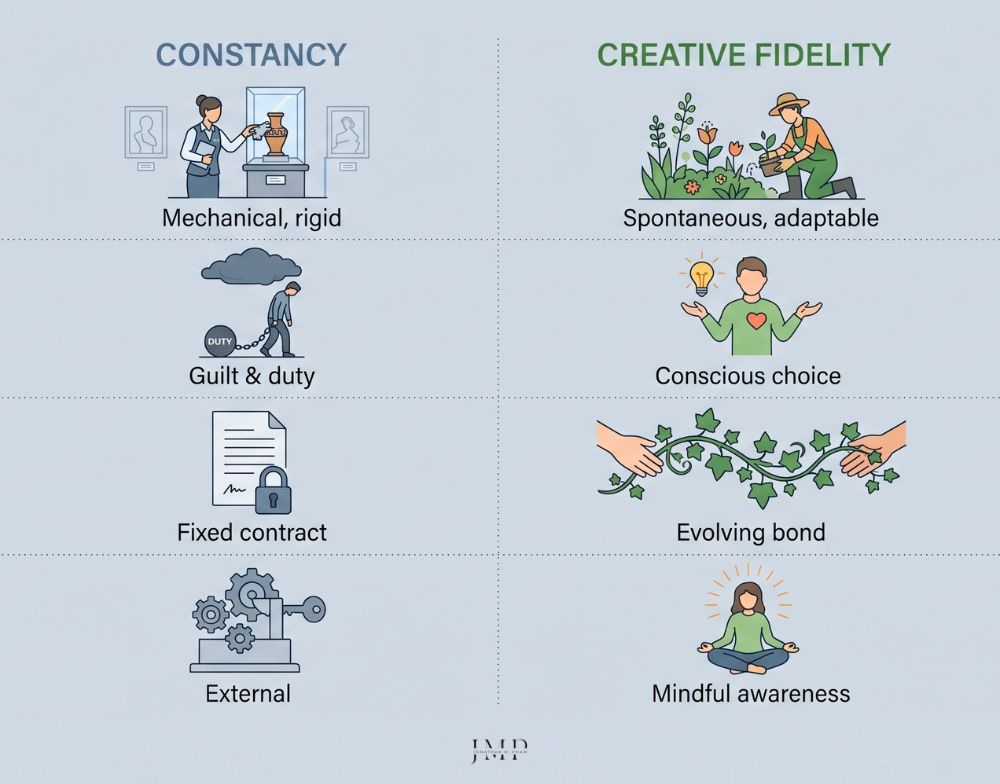
Constancy (The objective state)
Constancy involves a mechanical adherence to a past vow. It treats a commitment like a fixed object—an uncompromising legal contract. When you act out of constancy, you are typically driven by external machinery: a sense of “duty”, guilt, social pressure, or fear of change. You go through the motions because you feel you have to.
If constancy were a profession, it would be a museum curator. A curator's job is to protect an artifact from the elements, ensuring it remains untouched and unchanging behind a pane of glass. It is a noble job for preserving history, yet a terrible way to treat a living human being, a passion, or a spiritual journey. Simply, because it honors a dead idol.
Creative fidelity (The existential state)
Creative fidelity, on the other hand, is spontaneous and highly subjective. Rather than blindly repeating what you did yesterday because "that's what we've always done," you continuously translate your original commitment into a new language that fits your current self and circumstances. It is, therefore, an ongoing promise of presence—a personal choice to remain open and attuned to the moment.
If constancy is the museum curator, creative fidelity is the gardener. A gardener does not try to freeze a tree in time. They understand that the garden will look different in winter than it does in spring. As such, they water, prune, and adapt to the changing seasons so that the living organism can continue to thrive.
No two beings, and no two situations, are really commensurable with each other. To become aware of this fact is to undergo a sort of crisis. But it is with this crisis in our moral awareness as a starting-point, that there becomes possible that cry from us towards the creative principle, and that demand by it on us, which each must answer in his own way.
Gabriel Marcel, "Man Against Mass Society"
Constancy
Creative Fidelity
Nature
Mechanical and rigid
Spontaneous and adaptable
Driver
Driven by guilt, duty, or fear of change
Driven by presence and conscious choice
View of Commitment
A fixed contract
An evolving bond
Foundation
External moral machinery
Internal, mindful awareness
Metaphor
Preserving an artifact in a museum
Tending to a garden
Is Creative Fidelity a Paradox?
At first glance, the term itself may sound like an oxymoron. After all, “fidelity” implies staying the same, while "creative" implies change. Then how come the two can coexist?
In reality, it makes perfect sense when you realize that you are being faithful to the essence of the bond (the love, truth, shared purpose) while being creative with the form (how that love or purpose is expressed in the moment).
Life, after all, is never static; and neither is human experience. As time passes—as we age, face crises, change careers, and expand our perspectives—new realities emerge. If you stubbornly repeat old routines because “they worked before”, you would inadvertently destroy the very thing you seek to preserve.
Below are a few examples of how creative fidelity looks like in practice:
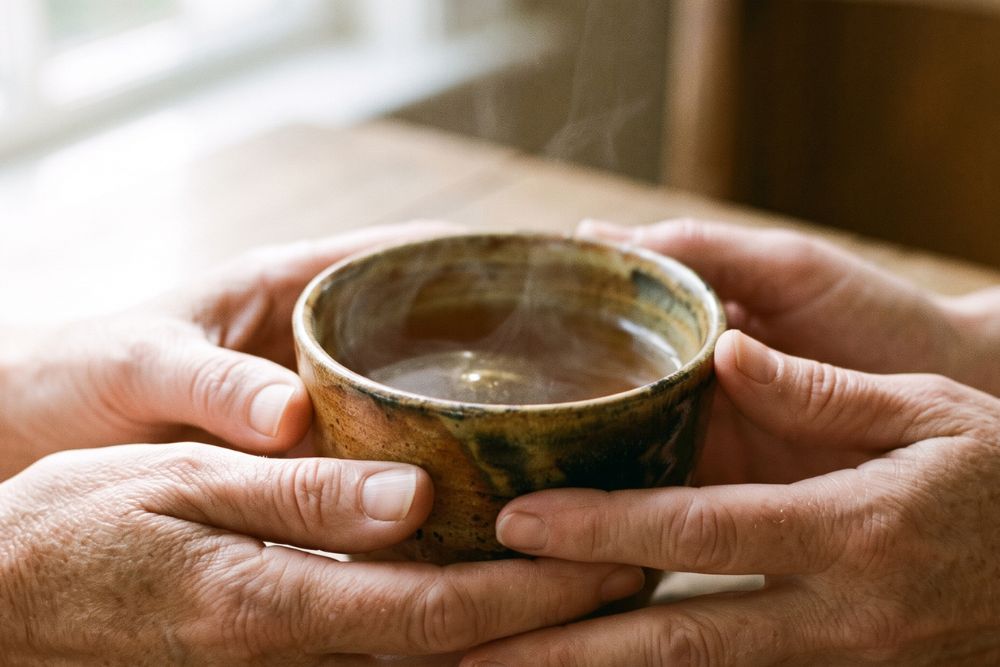
In relationships: At age twenty, a couple may express their love for each other through spontaneous late-night road trips; yet at age seventy, their bond is reinforced simply with moments of drinking tea and reading together. The essence—their commitment to each other—remains, but the form evolves to match the human condition.
In institutions: Let's say an organization dedicated to "fostering community" started as a local neighborhood gathering in the 1990s. Decades later, it expresses that same mission through digital networks or social programs. Adapting the format makes it possible to keep the core vision alive and relevant to the audience.
In personal values: Being faithful to your core value of "integrity" or "health" demands different choices when you are single versus when you are raising a family or facing an illness.
Let us go back to my experience of learning Japanese. From a pure Sartrean perspective, it’s technically possible—and completely justifiable—to give up along the way and pivot to a new direction. (e.g. a new language/ hobby/ pursuit) To declare that "I am just exercising my freedom. This is no longer useful or fun for me!"
To be fair, there are times in life when we should walk away from something without hesitation—when we know for sure it’s of no use to continue staying with it. But that depends a lot on whether we know for sure.
And from my own experiences—based on observing myself and others—I highly doubt it.
Most of the time, when we feel frustrated with something and want to give up on it, it is, deep down, just us trying to flee from the discomfort of the plateau. We assume we are reclaiming our own agency by choosing to leave, but in reality, that decision is usually driven by impulses, which in turn is dictated by external circumstances.
In that case, is it possible to claim we are really “free”?
Are we still operating within a cage, without being aware of it?
You sensed that you should be following a different path, a more ambitious one, you felt that you were destined for other things but you had no idea how to achieve them and in your misery you began to hate everything around you.
Fyodor Dostoyevsky, "Netochka Nezvanova"
Let us think about it. And from there, let us recall Marcel’s view of freedom.
From his perspective, we can say that creative fidelity is not something self-contradictory at all. It’s not a cage you force upon yourself.
On the contrary, it is an act of freedom—one that comes from inner clarity, when you are attuned to your own inner landscapes. When you have attained a certain level of self-understanding. When you know which is important to you.
Rather than constraining possibilities, it is the very mechanism that keeps possibilities open.
The obscurity of the external world is a function of my own obscurity to myself; the world has no intrinsic obscurity.
Gabriel Marcel, "Being and Having"
Core Principles of Creative Fidelity
Fidelity is the active perpetuation of presence, the renewal of its benefits—of its virtue which consists in a mysterious incitement to judge and to choose.
Gabriel Marcel
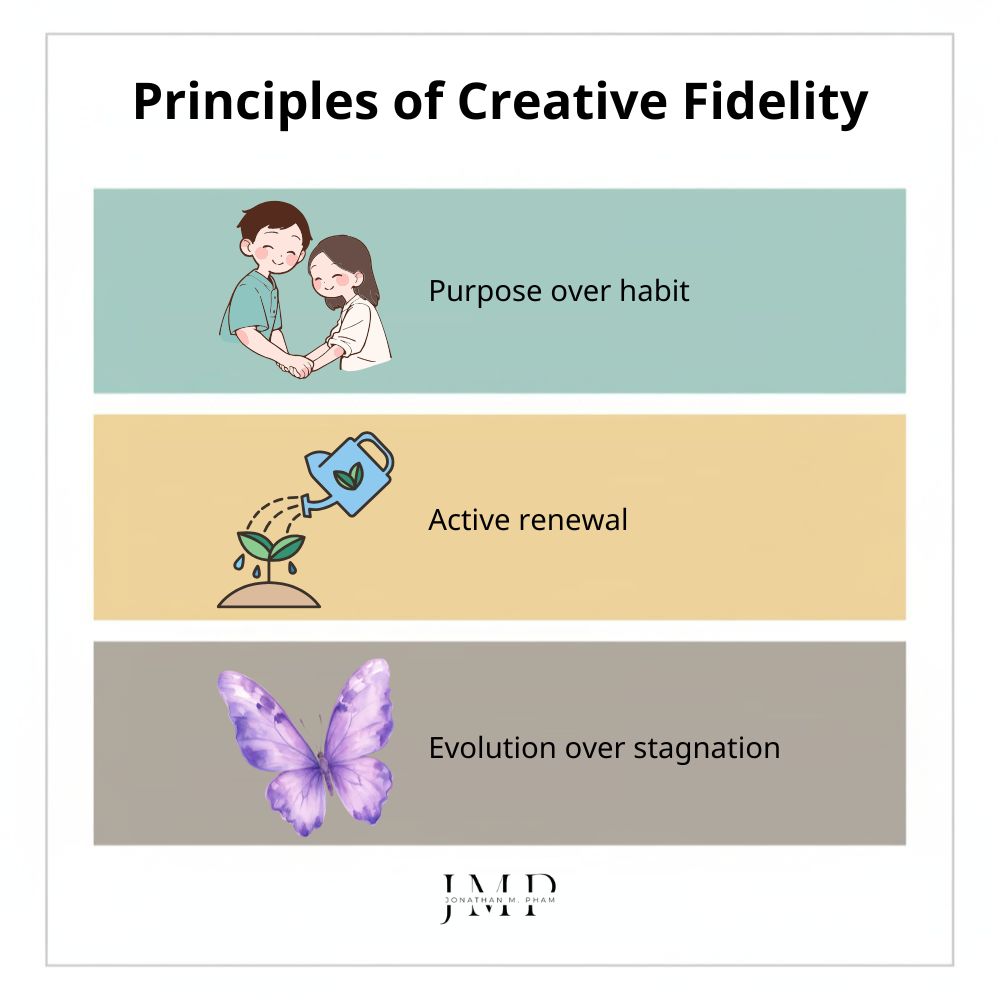
Purpose over Habit: We must regularly pause and ask ourselves if our daily actions are still serving their intended purpose, or if they have devolved into thoughtless repetition.
Example: Are your weekly "date nights" actually deepening your connection, or have they become just another chore on the calendar you trudge through?
Active Renewal: It’s impossible to rely on the momentum of a promise made five years ago. Our job is to consciously re-commit to our goals, projects, and loved ones in the present tense. To wake up and silently decide "I choose you again today, exactly as you are right now."
Evolution over Stagnation: It’s about the courage to let go of an idealized past and live out the consequences of our choices as we grow.
Example: Accepting that your post-partum body or post-burnout career capacity is different, and creatively finding new ways to adapt to the current reality rather than beating up on yourself for not being who you once were.
The Anatomy of Creative Fidelity
You cannot “force” yourself to be faithful through sheer willpower or a set of habits. Creative fidelity, at its core, requires a shift in inner posture—how you orient yourself toward the world.
In his framework of concrete philosophy, Gabriel Marcel broke this shift down into a few dimensions as follows.
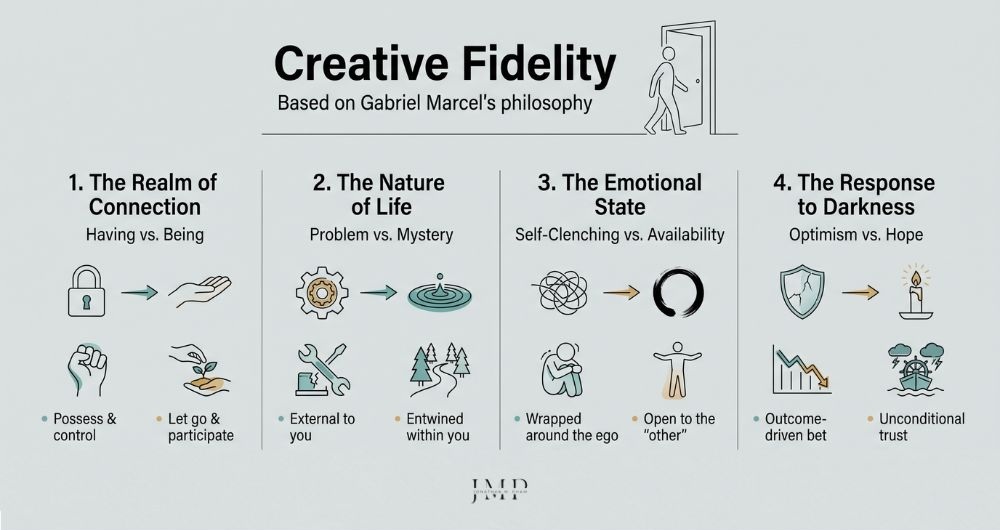
Being vs. Having
One might therefore say that there is a hierarchy of choices, or rather invocations, ranging from the call upon another which is like ringing a bell for a servant to quite the other sort of call which is really like a kind of prayer.
Gabriel Marcel
Let us pause for a moment and think about the language we typically use to describe our lives:
“I have a spouse”;
“I have a degree”;
“I have a career”;
Most modern people, as Marcel argued, are conditioned to operate in the realm of Having (Avoir)—characterized by the desire to possess, control, and measure objects. While not inherently problematic, that mindset becomes dangerous when applied to things that cannot actually be possessed: credentials, opinions, identities, and above all, other human beings.
When a relationship is dictated by this Having mindset, the underlying emotion becomes fear—specifically, the fear of loss. We view the other person as an asset—an extension of our own ego. This is where jealousy, toxic attachment, and many other damaging behaviors are born.
If you view your partner as someone you "have," you will unconsciously try to police their behavior and control them, so that they don't leave.
If you view your career as a status you "have," any professional setback feels like a fatal blow to your sense of self.
How can we expect real love/passion to take place and flourish then?
Practicing creative fidelity means stepping out of the realm of Having into that of Being (Être). It happens when you let go of the desire for ownership and instead learn to participate in the experience.
You do not "have" a marriage like you have a car; you participate in the daily act of loving your spouse.
You do not "have" a creative calling; you inhabit the creative process.
When you release the need to control the people you love—or the outcomes of your endeavors, the anxiety of loss would transform into appreciation. Now you can simply show up, open-handed, ready to be part of whatever you have committed yourself to.
Having (Avoir)
Being (Être)
Core Focus
Possession, control, and measurement.
Participation, presence, and experience.
View of the "Other"
Assets or extensions of the ego.
Independent souls to commune with.
Emotional Result
Breeds fear, anxiety, and jealousy.
Fosters appreciation, inner peace, and connection.
Mystery vs. Problem
A problem is something which I meet, which I find completely before me, but which I can therefore lay siege to and reduce. But a mystery is something in which I am myself involved, and it can therefore only be thought of as a sphere where the distinction between what is in me and what is before me loses its meaning and initial validity.
Gabriel Marcel, "Being and Having"
Humanity is currently living in an era of the "Technocratic Society", where everything is constantly reduced to a series of data points and metrics to be optimized. We track our sleep cycles, we read "life-hack" articles on how to maximize productivity, and we search for 5-step frameworks to communicate with our partners.
The consequence of this mindset is that many have, without being aware of it, turned into the "Functionalized Man"—who view themselves and others merely as machines with inputs and outputs. (“Human Doings”) In our eyes, every difficulty in life is framed as a Problem—an obstacle to be analyzed and "solved" using the “right” technique.
But human life, according to Marcel, is NOT a problem, but a Mystery.
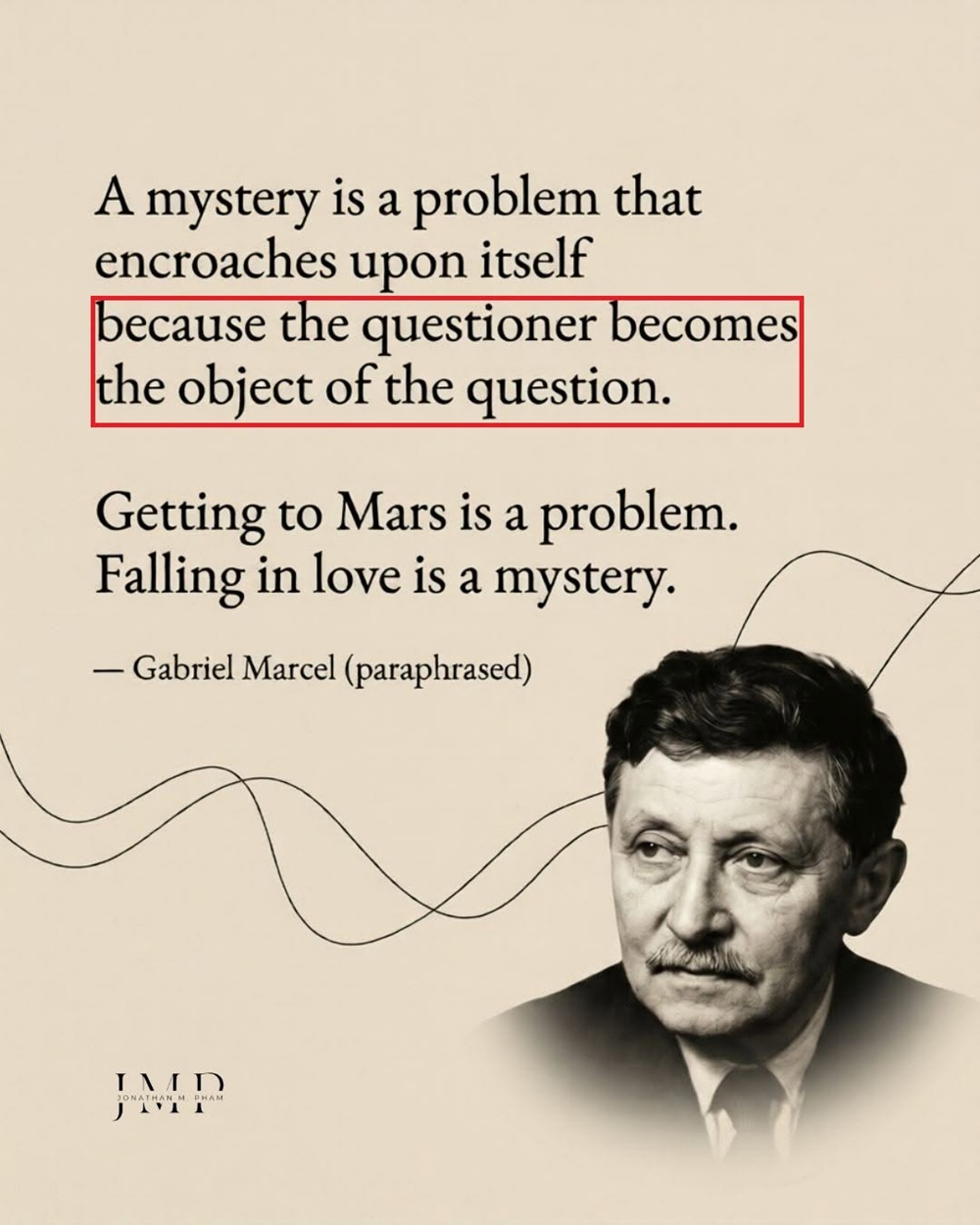
A problem is external to you. You can stand back to observe it, break it down and fix it.
A mystery, on the other hand, is something that engulfs you. You cannot detach yourself from it because you are inherently entwined within it. There’s no way to "solve" a mystery; you can only experience and traverse it.
Examples of Problem vs Mystery:
Assembling a wooden crib is a problem; you read the manual, use an Allen wrench, and the job is done. Raising the child who sleeps in that crib is a mystery; there is no definitive manual, and the process will change you just as much as it shapes the child.
Fixing a broken router to get the WiFi working is a problem; it requires troubleshooting and resetting. Healing a partner’s deep-seated resentment is a mystery; it takes patience, vulnerability, and the willingness to wade into emotional depths that cannot be neatly "rebooted."
Prescribing antibiotics for an infection is a problem; it relies on medical science and biology. Sitting with a patient as they confront their own mortality is a mystery; it touches upon the very meaning of human existence.
Most of the time, when we hit a rough patch in a relationship or a long-term passion project, our instinct is to view it like a problem. And the moment we realize it cannot be "fixed" with a quick hack or a communication technique, most feel inadequate and give up.
Creative fidelity requires us to adapt our perspective and look at life’s commitments for what they truly are: mysteries. Instead of trying to "solve" our loved ones or life's purpose as if they were broken machines, we need to have the courage to enter into an intimate relationship with them.
How can I test the initial assurance that is somehow the ground of my fidelity? This appears to lead to a vicious circle. In principle, to commit myself I must know myself, but the fact is I really only know myself when I have committed myself.
Gabriel Marcel
Problem
Mystery
Nature
External to you; can be observed from a distance.
Engulfs you; you are completely involved within it.
Approach
Can be calculated and solved with technique.
Must be lived and experienced.
Worldview
Life is a machine to be fixed (I-It mindset).
Life is a reality to be encountered (I-Thou mindset).
Availability vs. Self-clenching
The characteristic of the soul which is present and at the disposal of others is that it cannot think in terms of cases; in its eyes there are no cases at all.
Gabriel Marcel
Have you ever noticed what happens to your body when you feel stressed, threatened, or anxious? Your shoulders hike up toward your ears. Your jaw tightens. Your fists close.
According to Marcel, we humans frequently do the same thing spiritually and emotionally—a state he called Crispation (Self-clenching). When we are wrapped up in our own egos, anxieties, past traumas, and opinions, our souls cramp up. We become absorbed in our own internal noise. In this state of Crispation, commitment is impossible, because we are too busy defending our own pride. There is no room left within us to let anyone or anything else in.
To practice creative fidelity, it’s essential we adopt an open inner posture—which Marcel referred to as Disponibilité (Availability). In this state, you are willing to be present, receptive, and attuned to the needs of the "other"—whether that other is your spouse, child, community, or even your art. You allow the reality of the present moment to touch you and call you into action.
When I first read Marcel’s Disponibilité, I couldn’t help but notice striking similarities between it and Eastern philosophy of mindfulness—particularly the Zen concept of the "beginner’s mindset" (Shoshin) and the Taoist principle of Wu Wei (effortless action). In Eastern traditions, as long as the mind is cluttered with expectations, preconceptions and the need for self-protection, one cannot perceive reality clearly—and therefore will act out of confusion. Only when we drop our defenses and observe things as they are without judgment—only when we “empty the cup” may we “wake up” and become whole.
When we remain fully present and open to the moment, life’s commitments would no longer be a burden. Our daily acts of devotion—to our partner, our vocation, or the community—would become spontaneous: a result of seeing the world so clearly that the right “choice” would emerge naturally. (a state some thinkers refer to as "choiceless awareness")
A really alive person is not merely someone who has a taste for life, but somebody who spreads that taste, showering it, as it were, around him; and a person who is really alive in this way has, quite apart from any tangible achievements of theirs, something essentially creative about them.
Gabriel Marcel, “The Mystery of Being, Vol. 1”
Self-Clenching (Crispation)
Availability (Disponibilité)
Inner State
Wrapped around the ego.
An open spiritual posture (an "empty cup").
Response to Reality
Defensive and resistant to the moment.
Receptive, mindful, and willing to be affected.
Nature of Action
Commitment feels like a forced duty.
Commitment becomes a spontaneous response.
Hope vs. Despair
The moment we decide to practice Availability, we need to accept a difficult truth: we will be hurt.
When you open yourself up to another person, a belief, or a creative calling, you are stepping into the unknown. And in that unknown, you will inevitably encounter periods of darkness, suffering, and uncertainty. There will be days when the honeymoon phase feels like a distant memory, or when the passion project you poured your soul into faces a catastrophic failure.
This is where the ultimate test of creative fidelity takes place: the choice between Hope and Despair.
For long, the topic of Despair has been a cornerstone of existentialism. The Danish philosopher Søren Kierkegaard, widely considered the “father of existentialism”, described it as a "sickness unto death"—a spiritual collapse in which one feels utterly alienated and severed from meaning.
In Marcel’s view, despair is an experience of captivity. It happens when we conclude that we are trapped in a dark room with no way out—that a relationship is permanently unfixable, that our creative well has run dry, or that the world is fundamentally broken. In this state, every piece of empirical evidence points to defeat, and withdrawal looks like the only logical option.
When faced with this darkness, society typically tells us to just "be optimistic." It bombards us with motivational quotes and slogans of toxic positivity. (e.g. “Look on the bright side!”, "Everything happens for a reason!", “Fake it until you make it!”, etc.) But in Marcel’s philosophy, this brand of optimism is cheap and only keeps people trapped.
The solution in such moments of crisis, as Marcel proposed, is Hope (L'Espérance); specifically, Hope as a phenomenological reality.
Optimism belongs to the realm of Having. It is an intellectual bet that things will turn out the way you want them to. (e.g., "I am optimistic the stock market will bounce back," or "I am optimistic this therapy will fix our marriage in three weeks.") It demands a specific outcome; as such, it is inherently fragile and will shatter the moment the facts turn against you.
Hope, on the other hand, belongs to the realm of Being. You do not need hope when the sun is shining and everything is going your way. Hope only awakens in the face of trial, tragedy, and captivity. It is an active, heroic refusal to surrender to the darkness.
Because it does not rely on a specific outcome, hope frees us from the anxiety of control. It is, at its core, an unconditional trust in the fundamental goodness of life. It is akin to a captain who steers their ship directly into the howling wind—not because they are certain the ship won't sink, but because they know the voyage itself is worth the risk.
Here’s an example to better visualize this difference between these two postures. Let’s say you are sitting in a hospital waiting room while your partner undergoes a risky surgery.
Optimism says: "I know the surgery will be 100% successful and everything will go back to normal next week." If the doctor returns with bad news, the optimist’s worldview collapses.
Hope says: "I do not know what the outcome will be, but I trust in the enduring strength of our love. Whatever happens, we will face it. This illness is not the end of our shared story."
The only genuine hope is hope in what does not depend on ourselves, hope springing from humility and not from pride.
Gabriel Marcel
In addition, another defining trait of Marcelian hope is its choral and intersubjective nature. Whereas conventional Western thoughts tend to think of hope as a solitary act, Marcel believed it is inherently relational. Instead of “I hope that I achieve X", it is voiced as follows:
"I hope in Thee for us." (Je l'espère en toi pour nous)
It is precisely this shared hope that allows creative fidelity to take roots. When two people are walking a long road together—in a marriage, a friendship, a partnership—there will be days when one person loses their strength. When you are completely hollowed out and pushed into the captivity of despair by the burden of your circumstances.
In those moments, you do not have to conjure hope out of thin air. Your partner can hold the hope for you. They look at you, in all your brokenness, and say,
"I know you cannot see the way forward right now. But I see you. I hope in you, for us. I will hold the light until you are ready to open your eyes again."
And years later, when they are the one who falls into the dark, you do the same for them.
It is very much like singing in a choir: when you run out of breath, the person next to you sings your note so the melody doesn't break, trusting that you will catch your breath and join in again soon.
The choice to practice creative fidelity does not come from the naive assumption that things will always be easy. What drives it is the belief that together, we are infinitely greater than the obstacles we face.
Hope is essentially the availability of a soul which has entered intimately enough into the experience of communion to accomplish in the teeth of will and knowledge the transcendent act.
Gabriel Marcel
Optimism
Hope
Realm
Belongs to Having (Avoir).
Belongs to Being (Être).
Nature
An intellectual calculation or bet on a specific outcome.
An active, heroic trust in the goodness of the journey.
Reaction to Crisis
Fragile; shatters when empirical facts turn negative.
Resilient; only awakens in the presence of darkness.
Focus
Individualistic ("I expect X to happen").
Relational and choral ("I hope in Thee for us").
Creative fidelity in philosophy
Read more: Amor Fati (Love Your Fate) - When Existentialism Meets Stoicism
The Importance of Creative Fidelity in Today's Age
I communicate effectively with myself only insofar as I communicate with others.
Gabriel Marcel, "Du refus à l’invocation" (later quoted by Pope Francis in his 2020 encyclical Fratelli Tutti)
If we take a close look at the world around us, it is hard not to feel a sense of unease. Humanity is living in an era of unprecedented technological connection, yet we are simultaneously facing an epidemic of chronic alienation and isolation.
Why is this happening? Because, consciously or not, we have normalized the objectification of almost everything—and everyone.
Just think about the modern dating landscape: people swipe through endless faces on a screen as if they were shopping for cereal in a grocery aisle. Or, about how easy it has become to "ghost" a friend (rather than engaging in an honest conversation with them), or how quickly we hop from one job to the next the moment we feel slightly bored or under-appreciated.
These phenomena are the result of the Having mindset we discussed earlier, which views everything as disposable. If an app, a career, or a human being stops functioning the way we want them to, we toss them out and look for an upgrade.
Over time, the result is hyper-individualism and nihilism. People become so afraid of being tied down by others that many abandon ship at the first sign of conflict. No wonder isolation has become the defining mood of our time—a natural consequence of a society that refuses to commit.
And yet, that is only half of the story. On the other side of the spectrum is a different kind of captivity: toxic collectivism and dogmatism. In many traditional cultures and religious communities, "duty" is hailed above all else. You stay in the marriage, you keep the job, you uphold the tradition—no matter how soul-crushing it becomes—simply because it is what is expected of you. (I myself can personally attest to the prevalence of this obligation-driven perspective as a Catholic growing up in an East Asian society deeply influenced by Confucianism—a shallow version of Confucianism centered so much on law enforcement and social control rather than inner awakening)
On a pragmatic level, one could argue that such a framework is highly effective; it preserves order, maintains relationships, and ensures a certain degree of social harmony. But philosophically and spiritually?
I believe it is fundamentally misguided.
Why? Because it prioritizes abstract ideologies and the stability of the "system" over the lived experiences of the individual. It tells people to honor a past promise while ignoring the present reality and their evolving human nature.
In this framework, the underlying emotional drivers—whether one likes to admit or not—are fear, guilt, and inertia. There is no place for love and presence.
While such a mindset can preserve the form of the bond, it does nothing to the essence. And the result is terrifying: a “whitewashed tomb”—shiny on the outside, but decaying on the inside.
While that framework may have worked in the past, using it as a moral foundation for today’s world is akin to a traveler who keeps carrying a boat on his shoulders after he has crossed the river. It only weighs people down and keeps them trapped in ignorance. It tells people what to do, but not how to be.
This is where the practice of creative fidelity comes into play—a “middle path” that rescues us from both extremes.
A solution to chronic alienation: Creative fidelity rescues us from the void of nihilism by requiring us to plant our roots. It reminds us that we are not isolated consumers of life, but active participants in its Mystery. That true freedom is found in communion with others, not in running away from them.
A protector of personal authenticity: At the same time, creative fidelity acknowledges the constantly changing nature of human beings. By focusing on the essence of a commitment rather than its outer shell, it gives you permission to rewrite the rules of engagement so that they reflect who you, your partner, and your calling are today.
If hyper-individualism says, "Drop the boat the moment it gets heavy," and dogmatism says, "Carry the boat even when there's no water," the motto of creative fidelity is essentially:
"Let us take the wood from the old boat and build something new that serves the journey ahead."
Practical Applications of Creative Fidelity in Life
Let us now take a careful look at how Marcel’s philosophy of creative fidelity translates into daily realities.
In romantic relationships
No doubt the solitary consciousness can achieve resignation [stoicism], but it may well be here that this word actually means nothing but spiritual fatigue. For hope, which is just the opposite of resignation, something more is required. There can be no hope that does not constitute itself through a "we" and for a "we".
Gabriel Marcel
For long, the default societal view of romantic relationships has been rooted in duty-bound constancy: grit your teeth, be stoic, and stay no matter what. The underlying issue—emotional unavailability—is rarely addressed; no wonder so many couples end up in chronic unhappiness. On the outside, they seem to be living together in harmony, but spiritually, they already checked out long ago.
Due to the lack of presence, the interaction becomes highly self-centered, whether overly or subtly. This is something I can bear witness to, based on my observation so far:
I have seen people who grow frustrated and distant the moment their partner falls ill, struggles with depression, or can no longer "perform" their usual duties in the household.
I have seen spouses who constantly bring up past traumas or mistakes, weaponizing them to maintain the upper hand in arguments, or habitually comparing their partner to someone else’s.
I have seen individuals who obsessively police their loved ones' behavior ("You have to do this, otherwise people will look down on you, and you will lose face!"), when—let’s be honest—what they really mean is, "Otherwise, I will lose face."
I have seen people who demand constant check-ins from their partner and monitor their interactions with others. They convince themselves (and everyone around them) that their “jealous” behavior is proof of how much they care, while in reality (as it’s not hard to see) they are acting out of insecurity and the desire for ownership. (ironically, their actions only push their partner further from them—a self-fulfilling prophecy at its finest)
If we look closely, all of those scenarios share the same roots: treating one’s partner as an object to be possessed. An asset meant to function flawlessly and reserved for oneself only. A mirror meant to reflect one’s own ego. A means to an end, driven completely by the Having mindset.
How can you call it a “relationship” when it’s all about you?
For an intimate bond to persevere through life’s hardships, it’s essential that you shatter the mirror and view the person before you as a window—an opening to something infinite. That you stop “loving in dreams” and instead participate in a form of “active love” (to quote Dostoevsky)—where the two of you are constantly “dancing together on a moving river”, without being bogged down by any expectations of how the other person “should” be.
When your partner shifts careers, you adjust how you support them.
When your partner goes through a season of grief or illness, you adapt your love language to meet them where they are.
After all, life is impermanent; so are us human beings. A hundred years from now, neither you nor your partner will be here. Your bruised egos, your arguments over who left the dishes in the sink, your anxieties about social status—none of them matter in the grand scheme of things.
It’s a sombering truth to confront, yet if we can truly internalize it, there will be a radical change in how we relate to each other. Now we can gently let go of petty resentments and cherish the “mystery” of the person sitting across from us right now, while we still have them.
Three hundred years into the future. What will you be like? What will I be like? Where will you be? Where will I be? …
Looking at the future, we see that the other person is very precious to us. When we know we can lose them at any moment, we are no longer angry. We want to embrace her or him and say: "How wonderful, you are still alive. I am so happy. How could I be angry with you? Both of us have to die someday, and while we are still alive and together it is foolish to be angry at each other." …
When we first married, our love was great. We thought that if we did not have each other we would not be able to live one more day. Because we did not know how to practice impermanence, after one or two years our love changed to frustration and anger. Now we wonder how we can survive one more day if we have to remain with the person we once loved so much. We decide there is no alternative: we want a divorce. If we live with the understanding of impermanence, we will cultivate and nurture our love. Only then will it last. You have to nourish and look after your love for it to grow.
Thich Nhat Hanh, “No Death, No Fear”
◆ The boundary of fidelity: Knowing when to leave
By now, some of you may be wondering: “Does it mean I must stay forever, no matter what happens? If my partner becomes abusive or detached, am I forced to "adapt" to their cruelty?”
The answer is No.
We should not confuse creative fidelity with martyrdom. The former, as mentioned, is an act of freedom and inner clarity; NOT an excuse for dogma or gaslighting. It is meant to help people navigate “generative friction”—an inevitable result of two evolving human beings trying to understand and coexist with each other. However, when a bond has structurally rotted—when mutual respect has eroded and been replaced with abuse, manipulation and/or betrayal—staying is an act of cowardice.
In such cases, graceful dissolution may actually be the highest act of fidelity—specifically, fidelity to the truth, to one's own soul, and to the core essence of love.
Just as a wise traveler does not carry a boat on their shoulders long after they have crossed the river, a faithful heart knows when a structure has served its purpose and when it is time to lay it down to honor the truth of the present moment.
The other, in so far as he is other, only exists for me in so far as I am open to him, in so far as he is a Thou. But I am only open to him in so far as I cease to form a circle with myself, inside which I somehow place the other, or rather his idea; for inside this circle, the other becomes the idea of the other, and the idea of the other is no longer the other qua other, but the other qua related to me.
Gabriel Marcel
While romantic love is typically the most intense arena for creative fidelity, Marcel’s philosophy extends far beyond it. Humans are, after all, relational beings; we are intricately woven into a vast web of interpersonal connections: parents and children, siblings, childhood friends, teachers and students, mentors and mentees.
Yet, in almost all of these dynamics, we frequently fall into the same trap of objectification: reducing the other person to an “image”. A statue. A role.
We expect our childhood best friend to act the same way they did when we were teenagers—to give us the same free time, embody the same carefree attitude, and share the same hobbies. The moment they enter adulthood and shift their priorities, we feel betrayed.
Many teachers/mentors (especially the older, more senior ones) operate out of a Having mindset; they demand unquestioned loyalty and expect the mentee to become a carbon copy of themselves. They forget that their role is to nurture people into their own unique potential—even if that means the student eventually outgrows the mentor, disagrees with their methods, or ventures into a new field.
It’s arguably safe to say that the problem is particularly prevalent when it comes to intergenerational dynamics. If you spend enough time listening to older generations, you will likely hear a familiar lament about the loss of the “good old days”:
Many elders point to the evolving slang of the youth as a degradation of language.
They cannot understand the youth’s refusal to perform traditional rituals as they were passed down. (for example, the grueling and—let’s be honest—highly performative three-day cooking preparations for lunar festivals)
They criticize the youth’s shift away from unquestioned obedience. Many take personal offense when a “junior” attempts to reason or argue with them. ("How dare they talk back to me?")
They lambast the youth’s unconventional life choices—such as delaying marriage, choosing a nomadic lifestyle, or pursuing independent creative paths rather than strapping themselves to the lifelong “salaryman” track.
I will be honest: I myself once bought into the same nostalgia. There is indeed a certain amount of comfort in looking backward, in wishing that things stayed the way they were. But as I have grown older—and engaged deeply enough with philosophy, my perspective has shifted.
When we look into these intergenerational conflicts, what the older generations are typically demanding is Constancy. They want the youth to act as “museum curators” of tradition—to use the same honorifics, endure the same rituals, and yield to authority as they once did.
But culture is a living organism, not a museum exhibit.
Just like how a language has to adapt and accept new vocabulary to survive (this is something I can personally resonate with, based on years of both learning and teaching foreign languages), our family traditions, cultural values, and interpersonal expectations operate by the same principle. Given that the younger generations grow up in completely different circumstances (e.g. they live in a globalized digital age and therefore are presented with opportunities/challenges/psychological needs the elders could never have fathomed), it’s ridiculous to tell them to “stick to the old ways”, which only suffocates them and creates unnecessary suffering for both sides.
When we demand constancy in our connections—whether with our children, friends, or students—we are worshiping a dead idol. We are prioritizing abstract ideology and social optics over empathy. We are forcing the infinite Mystery of human development into a Problem to be “solved”.
To practice creative fidelity in interpersonal connections means to let go of the phantom of who a person used to be, or who we think they ought to be, so that we can embrace the real human being sitting right in front of us. Only then may the relationship be rooted in love and have a chance to survive the passage of time.
If I treat a ‘Thou’ as a ‘He’, I reduce the other to being only nature; an animated object which works in some ways and not in others. If, on the contrary, I treat the other as ‘Thou’, I treat him and apprehend him qua freedom. I apprehend him qua freedom because he is also freedom and not only nature.
When applied to professional life, creative fidelity can fundamentally reframe how we view our job—from a burden to be either endured or tossed aside to a practice ground for personal growth and human connection.
Let me share a personal story here. Currently, alongside my pursuit of philosophy and writing, I work as a part-time consultant for the marketing team of a company where I once worked full-time. For a while, as I drifted further away from the corporate & digital media world to focus on my personal agendas, I found myself caught in a complex dynamic with this job.
The marketing team is comprised mostly of junior members with very little experience; not to mention, the business operates on an old-fashioned B2B model, in a niche that works starkly different from the more “mainstream” ones. In that environment, the sales team has too much of a voice; and marketing members are frequently pressured to be an extension of sales. To deliver “tangible” results within as low of a budget as possible.
Far too often, these juniors would reach out to me with random trivial questions that I knew they could have solved on their own (whether by Googling, reading materials, or using AI tools)—or they would request a meeting with no clear agenda. Many times, the moment their messages popped up, I found myself hit with a wave of resentment. I felt like they were wasting my time for no reason. And above all, I hated these interactions because they reminded me of my previous life in the corporate world, of the absurdities I had been through, and of a past self I was trying to leave behind.
My reaction was, to be honest, a textbook example of Marcel’s Crispation. I was wrapping myself in my own ego and treating these young professionals as a "Problem" to be solved and dismissed.
But one day, after some careful reflection, I realized there was another path for me. Instead of viewing my junior team members as an obstacle to my own peace, what if I looked deeper into their own psyche?
What if behind those seemingly trivial questions was not really a desire for an answer, but for reassurance? That they were looking for a human voice—the guidance of one who has been through the “fire”—so that they could soothe their own anxiety, even just for a brief moment?
Even if I couldn't fix the absurd hierarchical structure above them, wasn't the fact that I was there to listen and offer comfort more than enough?
That realization was a crucial turning point for me. Following it, I started showing up without being bogged down by preconceptions or judgments. Instead of being caught up in the KPIs, the tactics, and whether my advice was of any "practical" use to the company's bottom line, my concern shifted to the humans in the room. To guiding them how to think critically, manage their workplace anxieties, and reclaim their own autonomy when facing unreasonable demands from others.
I wasn’t aware of it back then, but what I did was an example of creative fidelity in action. From the experience, I have learned a few crucial lessons as follows:
You don’t always have to quit a job to find freedom. Sometimes, liberation comes from reinventing how you occupy the role.
You can bring your "new self" into an "old commitment." There’s no need to amputate the person you are becoming just to fulfill a contract you signed years ago. You can adapt the form of the work without compromising the essence of your humanity.
In my case, as soon as my inner posture changed, the part-time job suddenly transformed from a burden to bear to a source of meaning—specifically, the meaning derived from being an accomplice of my fellow workers. What once felt like a cage became the very thing that taught me what it means to be truly free.
Truth is always new; it is to see the same smile, and see that smile newly, to see the same person, and see that person anew, to see the waving palms anew, to meet life anew.
Jiddu Krishnamurti, "The Book of Life"
Read more: Asking for Help - The Power That Comes From Vulnerability
In creative works & personal pursuits
When I first launched this blog, my intent was, to be honest, highly transactional: generating a source of passive income. While I did care about building an audience, it was secondary to the goal of making money online. At that time, being driven by the desire to acquire "quick wins" and game search engine algorithms, I churned out a stream of soulless surface-level listicles ("Top 10 Ways to X" or "Best Y").
After a year or so, a shift occurred within my internal landscape. The formulaic listicles, while seemingly helping me achieve what I set out for, suddenly felt so hollow. For some reason, I found myself craving something “real”. I wanted to write long-form, deep-dive essays that tackled the bigger questions of life and human existence.
When I eventually decided to pivot the blog to reflect this change, the consequences were immediate—and brutal. Because the old SEO tricks didn’t work with the new direction—and because the topics I attempted became much denser (many of which put me in direct competition with established academic sites), my traffic took a hit—and so did my revenue. Not to mention, the writing process itself went from a breezy exercise to a laborious endeavor that demanded careful word choice, deep thought, and emotional vulnerability.
Suddenly, I found myself caught in a dilemma, torn between two masters: the Master of Money and the Master of Truth.
From a purely rational perspective, serving the former was the obvious choice. Any outsider looking at my sinking metrics would have told me to either revert to the old listicles or abandon the project completely. And I won't lie—there were many days when I seriously considered quitting.
But to force myself back into that old mold just to maintain revenue would have been a betrayal of who I was becoming. It would have meant honoring a dead version of myself.
In the end, I remained faithful to the blog, but I did so by creatively adapting its purpose. I stripped away all external metrics—traffic, ranking, revenue—and redirected my focus toward the experience of writing, thinking, and philosophizing itself. I willingly accepted the loss of my original audience in exchange for the insight and self-transformation that the new format allowed.
As painful as it was, by letting the blog “evolve”, I allowed my writing practice to remain a reflection of who I was becoming.
That’s what it means to practice creative fidelity in one’s personal pursuits—whether it is writing a book, working on a piece of art, or pursuing any other passion. Many people make the mistake of assuming that to be "faithful" to a project, one needs to stubbornly stick to the original blueprint. But doing so only suffocates the very life force behind it.
When you find yourself at a crossroads like me, try following a few tips as follows:
Identify the core: Before adapting, pause and define 1–2 foundational elements of the endeavor. What is the emotional anchor or true purpose? (For my blog, as I figured out, what I TRULY cared about was the experience of writing and self-discovery, not the “passive income”)
Innovate on the medium: Do not be afraid to adapt the format/style so it fits your present context, audience, and maturity. For instance, a painter can switch from oils to digital art; a musician can shift their genres; a writer can consider abandoning listicles for essays. The form changes so the core intent can survive.
Balance respect and invention: Treat your original idea with respect—but do not turn it into an artifact. Remember, you are the gardener, not the museum curator.
Read more: The Curated Self - Why Authenticity on Social Media is Impossible
In religious & spiritual life
There is an order where the subject finds himself in the presence of something entirely beyond his grasp. I would add that if the word “transcendent” has any meaning it is here—it designates the absolute, unbridgeable chasm yawning between the subject and being, insofar as being evades every attempt to pin it down.
Gabriel Marcel
Now, here comes an interesting part, written from the perspective of a believer himself. As discussed, we humans frequently fall into the trap of objectifying others. (and even ourselves) But what many people are not consciously aware of is that many times, we do the same thing to the Divine too.
If we take an honest look at how religion is practiced today, it is not difficult to see that it is largely operated through the lens of the Having mindset. In this framework, faith is reduced to a transactional contract, and God a supernatural vending machine. The underlying assumption is:
"If I recite the right prayers, perform these rituals, and adhere to the moral codes, I will acquire peace, prosperity, or a guaranteed ticket to the afterlife."
Without knowing it, we have reduced God to an abstract concept—a “Problem” to be solved, managed, and (ironically) debated and defended against others. No wonder people’s spiritual life grows dry, and many undergo a devastating crisis of faith when tragedy strikes. The moment the "vending machine" fails to dispense the desired outcome, the believer’s worldview shatters. Some abandon ship completely; others double down on dogmatism and aggressively police others' behavior in an attempt to regain a sense of control and moral superiority.
As I myself have figured—and as many mystics and religious existentialists (Marcel himself included) have argued, the Divine cannot be reduced to an "It" or an abstract "He." There’s no way to prove or disprove the existence of God through intellectual arguments alone.
Rather, God is, in the words of Marcel, the "Absolute Thou" (Absolute Toi). An infinite Mystery to be experienced and participated in.
Just as you cannot fully "know" your spouse by reading their resume, you cannot know the Absolute Thou only by memorizing theological doctrines. Only through an intimate personal relationship—one rooted in ongoing communion, not past declarations—are you able to reach out and touch the Transcendent.
For that to happen, however, you need to understand that a spiritual journey is never static. The way you relate to the Divine at age twenty will inevitably change as you grow older. There will come seasons of spiritual dryness (what mystics refer to as the "Dark Night of the Soul"), where the Divine seems to be non-existent—and the comforting emotions you once relied on completely vanish.
If your faith is bound only by Constancy, you will likely try to artificially manufacture those old feelings, or mindlessly recite prayers out of fear, guilt, or habit.
If you practice creative fidelity, however, you adapt the form of your devotion to honor the current reality. (e.g. an authentic lament instead of a performative praise) You accept the silence and let your faith evolve.
The French philosopher and mystic Simone Weil once warned people against the act of begging God to fix their problems or demanding an emotional experience. (a habit that, based on my own observation, is unfortunately very popular among typical believers) According to her, the ultimate sign of spiritual maturity is Attention—a state in which one is willing to simply wait in the void (l'attente de Dieu) without trying to prematurely fill it with their own preconceptions and/or desires.
I myself find Weil’s Attention to share the same spirit as Marcel’s Disponibilité. In moments of darkness, you do not demand that the Absolute Thou proves Himself to you; nor do you fake your feelings to look "pious" to the people around you.
What you do is simply showing up and saying:
"I cannot feel You right now, but I am still here. I am paying attention."
By doing so, you are voluntarily stepping out of the realm of Having into that of Being. And in that state of pure awareness—stripped of all certainties and transactional demands—genuine insight may actually take roots.
Being is—or should be—necessary. It is impossible that everything should be reduced to a play of successive appearances which are inconsistent with each other… or, in the words of Shakespeare, to “a tale told by an idiot.” I aspire to participate in this being, in this reality—and perhaps this aspiration is already a degree of participation, however rudimentary.
Gabriel Marcel, "On the Ontological Mystery"
Transcendence and hope
※ A Note on Institutional Fidelity: Interestingly enough, the concept of creative fidelity is so influential that it has actually found its way into the highest levels of religious institutions. For instance, Pope John Paul II released an apostolic exhortation in 1996 titled Vita Consecrata, in which he explicitly called upon religious orders to practice "creative fidelity" (fedeltà creativa)—to take their original spiritual roots and adapt them to serve the "signs of the times."
Creative Fidelity: A Commitment That Transcends Death
The practice of creative fidelity, as discussed, allows us to nurture a relationship authentically and sustainably through the changing seasons of life. Yet no matter how beautiful or resilient the bond is, there’s one reality we cannot fail to admit: it will eventually be severed by death.
Or will it?
Let’s be honest for a moment. Death spares nobody. We cannot determine when or how it comes to each of us, but we know for sure it will. One day, our beloved partner will be no more—and so will us. One day, we will not be here to sustain our passion projects.
One day, my blog’s traffic will drop to zero. My server will expire. And the world will carry on—as if nothing ever happened.
To realize that is to undergo a sort of crisis. Why should we commit to something or someone in the first place, given that nothing lasts in the grand scheme? How can we endure the heartbreak that comes when someone we love dearly passes away—when something we pour our soul into eventually crumbles to dust? How can we continue living then?
From a radically detached or nihilistic view, it makes sense to ask such questions—until we see that such a reaction is still rooted in the Constancy mindset.
It is true that death is the ultimate limit of human existence—the great eraser that seemingly invalidates all of our efforts. Yet, it does not mean that commitment is futile. In fact, through the lens of creative fidelity, it becomes totally possible to transcend death.
Regarding this, Marcel once offered a very moving insight as follows:
"To love a person is to say: Thou shalt not die."
At first glance, it may sound like a poetic exaggeration—a naive denial of biology. But Marcel was not talking about physical immortality. He was pointing to an existential truth: when you truly love someone—when you step out of the realm of Having and participate in the mystery of Being with them—you touch something eternal.
Because creative fidelity entails an ongoing promise re-created in the present, it does not collapse when the physical form is gone. The bond you share is a spiritual reality, and spiritual realities are not bound by the limits of space and time.
In other words, when a loved one departs, it’s not necessarily the end of your relationship with them. Just the time for it to change its form.
Here is how creative fidelity allows our commitments to transcend mortality:
Embodying their essence
Instead of worshiping the past and wallowing in old memories, you do your best to preserve your loved one’s legacy. You take the "seeds" of who they were—their kindness, courage, unique sense of humor—and plant them in your own life.
By living out their values every day, you are actively breathing life into their essence. They continue to walk through the world, but now, they do it through you.
Changing the conversation
Rather than wondering, "What did they say to me ten years ago?" ask yourself, "What would they say to me today, knowing the person I have become?"
Because you are still growing, the dynamic between you and them continues to evolve. You still consult them in your heart. You still let their love challenge, guide and comfort you in new ways.
Transforming pain into empathy
The sorrow of loss can easily turn us inward, making us bitter and closed off (Crispation). But with creative fidelity, we can turn our grief into a bridge to others. We can channel the love we had for the person we lost into compassion for the people who are still here.
By continuously re-creating the bond in each and every moment, we prove that time does not have the final say.
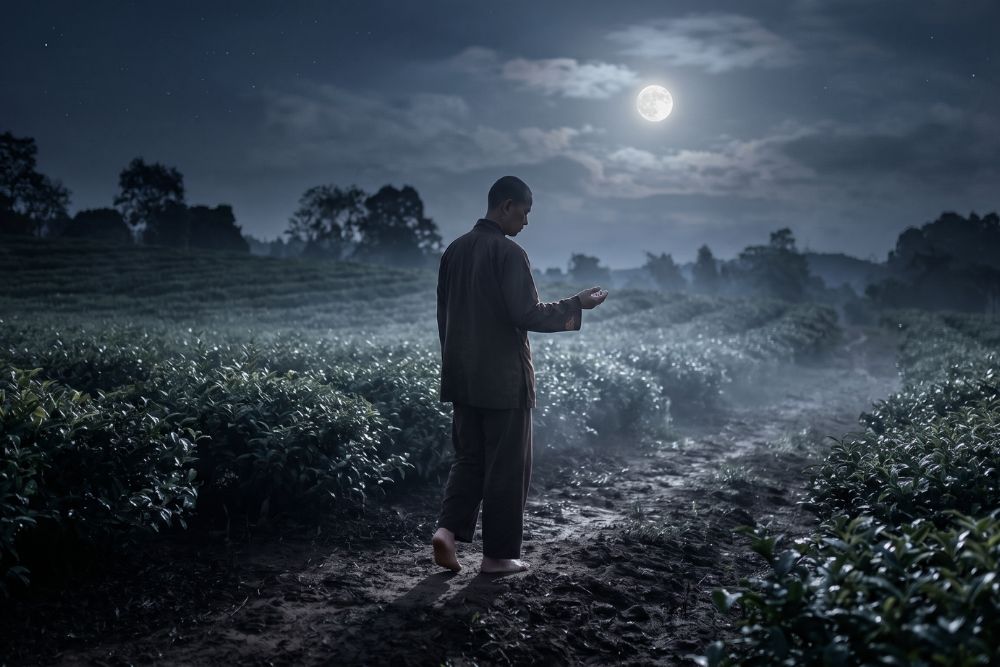
The day my mother died I wrote in my journal, "A serious misfortune of my life has arrived." I suffered for more than one year after the passing away of my mother. But one night… I dreamed of my mother. I saw myself sitting with her, and we were having a wonderful talk… It was so pleasant to sit there and talk to her as if she had never died. When I woke up… I felt very strongly that I had never lost my mother… I understood then that the idea of having lost my mother was just an idea… that my mother is always alive in me.
I opened the door and went outside… Walking slowly in the moonlight through the rows of tea plants, I noticed my mother was still with me. She was the moonlight caressing me as she had done so often, very tender, very sweet... wonderful! Each time my feet touched the earth I knew my mother was there with me. I knew this body was not mine but a living continuation of my mother and my father and my grandparents and great-grandparents…
From that moment on, the idea that I had lost my mother no longer existed. All I had to do was look at the palm of my hand, feel the breeze on my face or the earth under my feet to remember that my mother is always with me, available at any time.
Marcel once described humanity as Homo Viator—meaning "man the traveler," the wayfarer, or the pilgrim. Accordingly, to be human is to be on a journey, constantly in process, always growing and seeking meaning.
Unfortunately, the modern hustle culture constantly pressures people to live as Homo Faber—meaning "man the maker," or the toolmaker. In this mode of existence, life is viewed as a construction site. We are conditioned to believe that we need to "build" a marriage, "build" a career, or "build" an identity, put a roof on it, and declare the job finished.
As discussed, it is this one-dimensional, destination-obsessed mindset that has been giving rise to countless issues these days.
Now is the time for us to reclaim our identity as Homo Viator. To acknowledge that we are perpetually on a journey—that we are always moving, encountering new landscapes, and evolving.
If we can adopt the lens of a traveler, the way we understand commitment would completely transform. For long, we have been told that commitment and freedom are mortal enemies. That to make a promise is to hand over the keys to personal autonomy—to lock ourselves in a cage of obligations. As a result, most do their best to keep all options open and refuse all ties, believing that doing so would make us “free”—while in reality, it only entraps us.
Think about it this way. A seed floating aimlessly in the wind is technically “free”. It is capable of landing anywhere, yet until it actually embeds itself into the earth, it can never grow into a tree.
Likewise, commitment is not necessarily the end of freedom. With the practice of creative fidelity, it actually becomes the very soil in which liberation takes roots.
By actively choosing to show up day after day for your partner, your calling, or your spiritual life—by consciously adapting your promise in every moment—you are giving your life the depth required to reach upward.
It’s true that things are always changing. There’s no guarantee that a bond we are part of today is still the same a few years from now. But that’s not the point.
What matters is what you are doing right here, right now. Are you open enough for another one to come in? For the “light” to shine through your soul? For you to participate in the Mystery of existence?
Unconditionality is the true sign of God’s presence.
Hi there! I am a seeker on his path of self-discovery. Since my youth, I have been haunted—and driven—by the fundamental questions of existence: the weight of our choices, the nature of true fulfillment, and the various identities we inhabit. I created this blog to chronicle the insights I have unearthed while navigating the 'absurdity' and beauty of life. My hope is that in reading these words, you will find a reflection of your own struggle—and the courage to 'become who you are.' Please just take what resonates with your soul, and leave the rest behind!