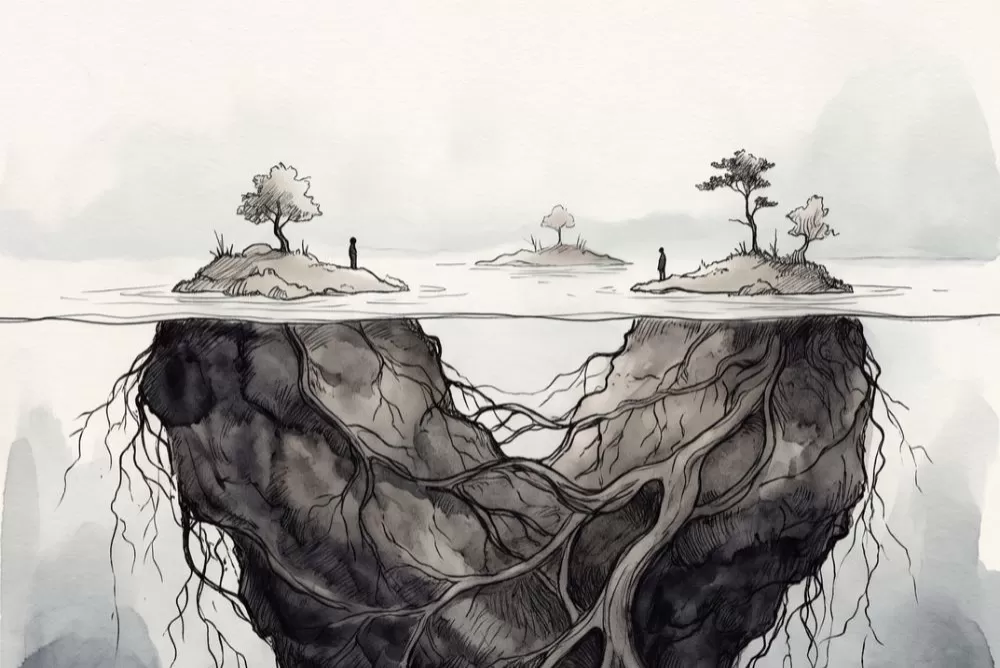
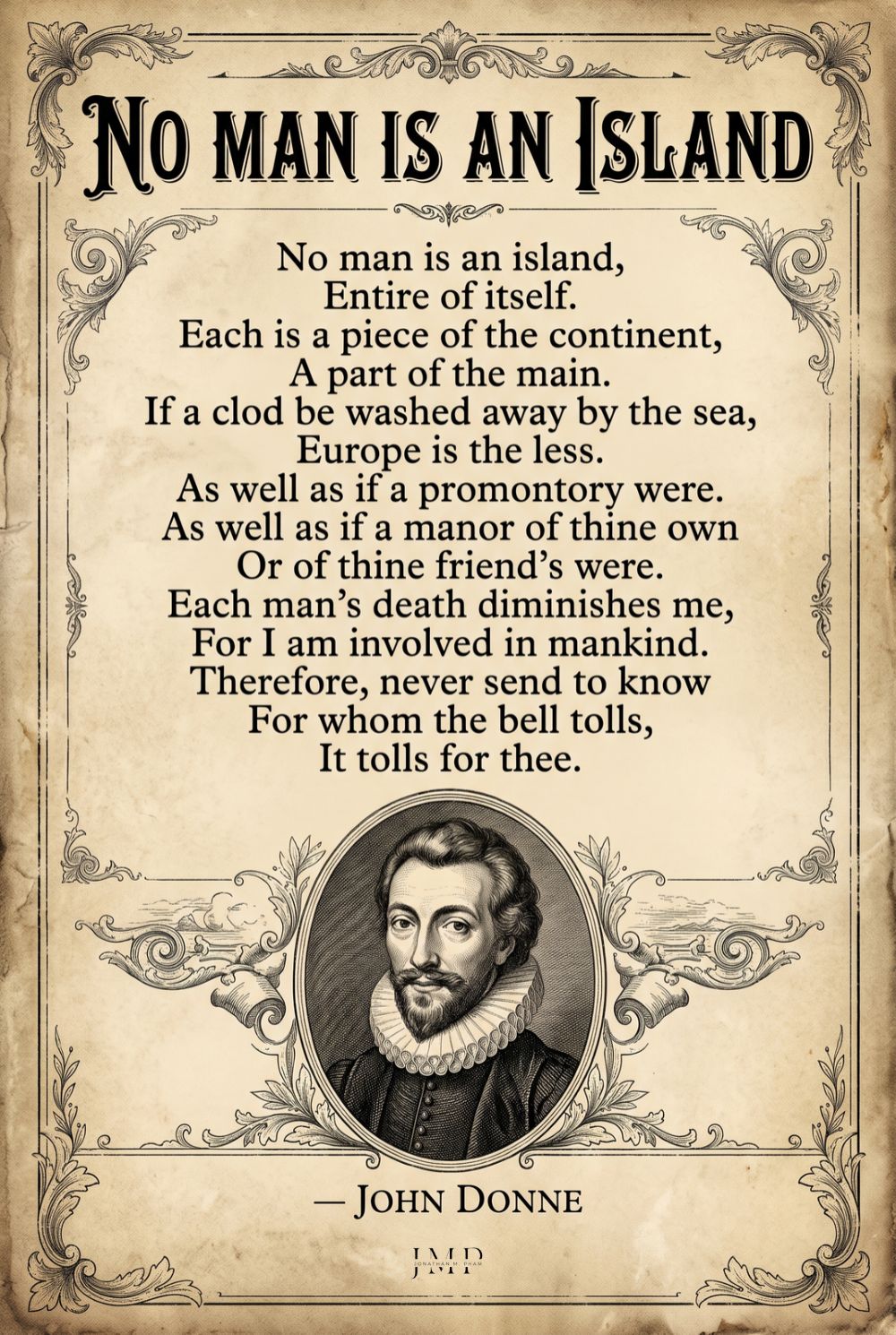
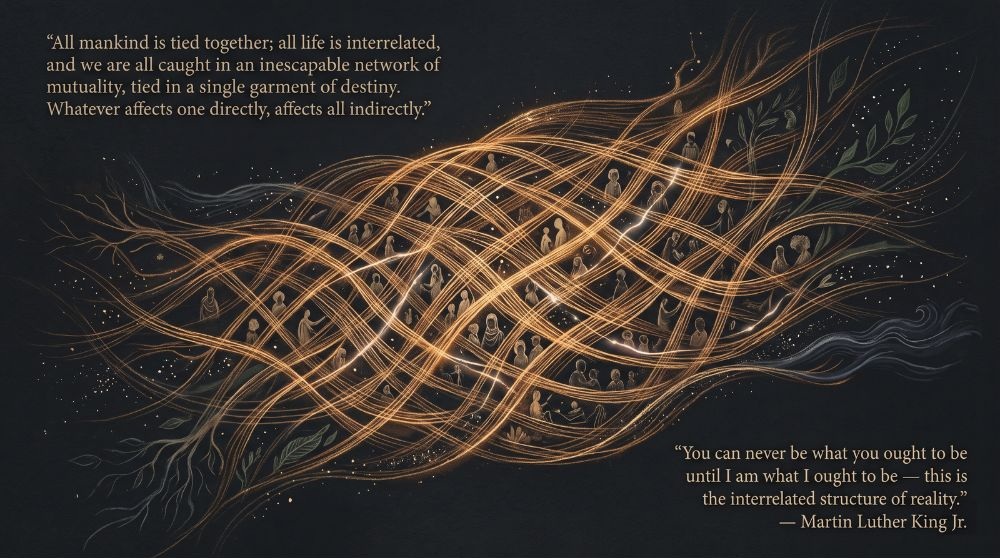
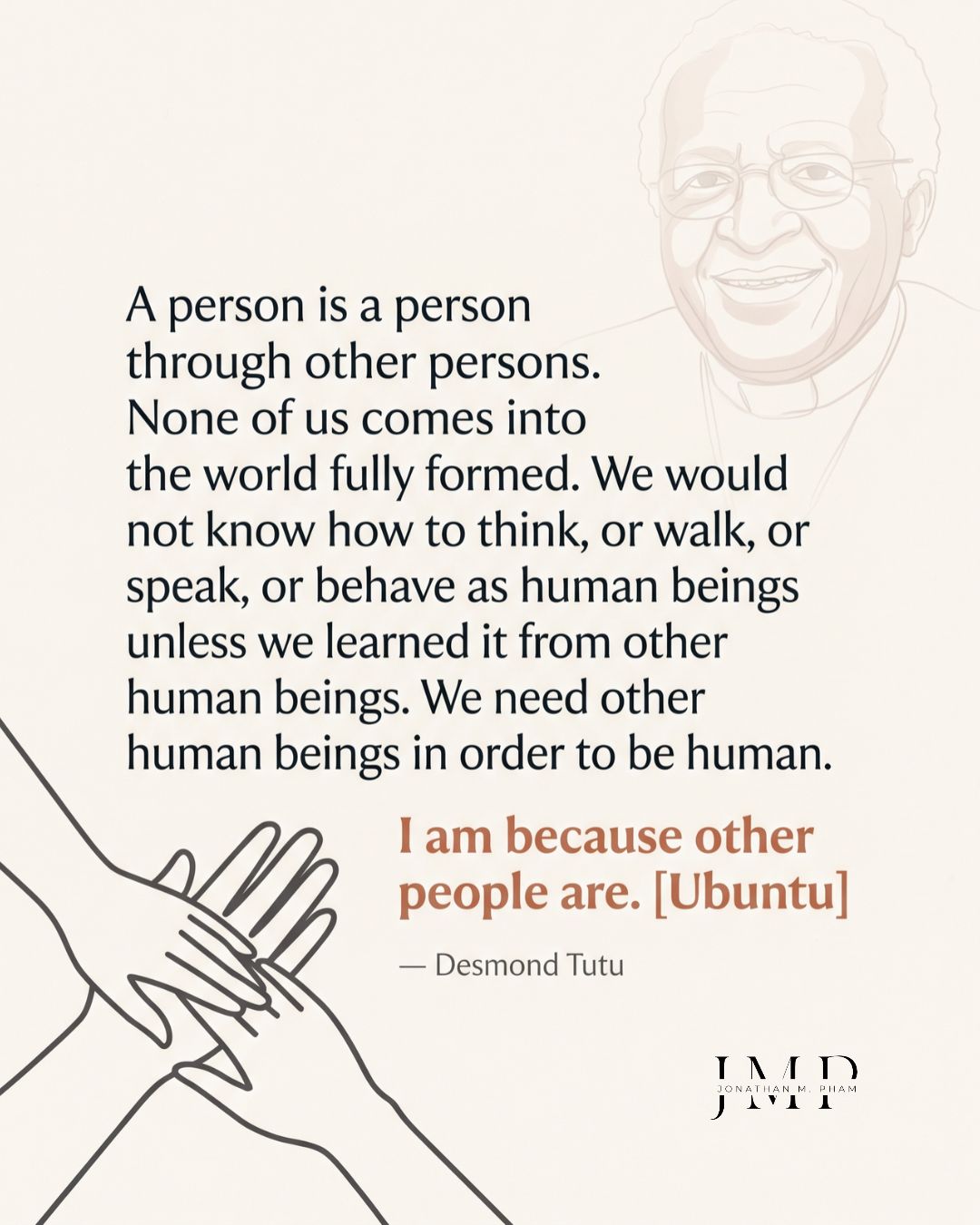
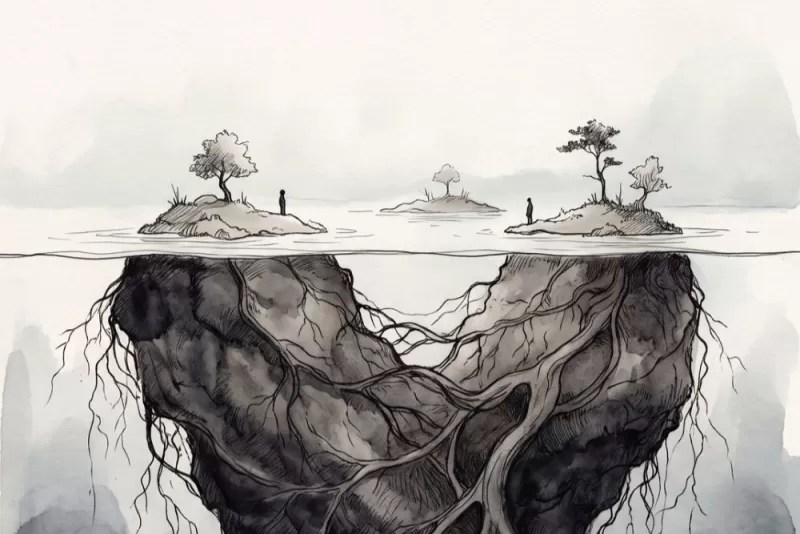
“No man is an island, Entire of itself. Each is a piece of the continent, A part of the main. If a clod be washed away by the sea, Europe is the less. As well as if a promontory were. As well as if a manor of thine own Or of thine friend's were. Each man's death diminishes me, For I am involved in mankind. Therefore, never send to know For whom the bell tolls, It tolls for thee.”
Years ago, I stumbled upon a news article detailing the horrors of a genocide in another country. What kept lingering in my mind was the author’s inclusion of those haunting lines:
“No man is an island”;
“Each man's death diminishes me”;
“It tolls for thee”.
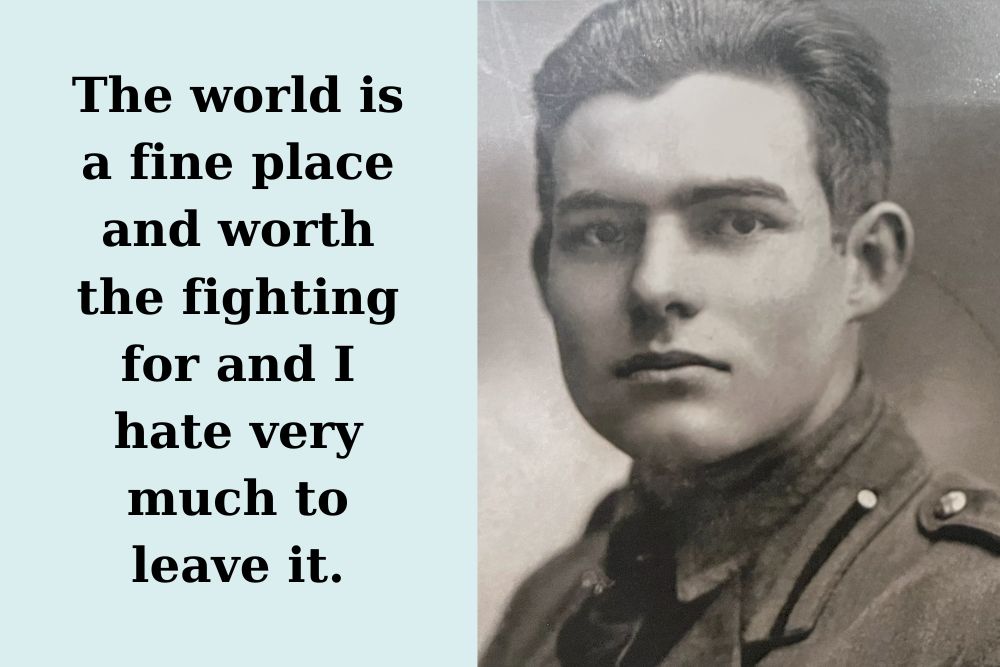
Not long after, I picked up Ernest Hemingway’s For Whom the Bell Tolls—and there, on the opening epigraph page, those words stared back at me again. Curiosity sent me digging. As I soon discovered, the passage was originally written as a prose meditation by the 17th-century English poet and cleric John Donne, later excerpted by Hemingway to frame his novel’s central theme: our shared humanity and duty to one another.
I have to admit, I was deeply moved both times I encountered those lines—and even more so when I read Donne’s full meditation—even though I didn’t yet fully grasp their philosophical weight.
Why does the suffering of strangers—people we have never met, in lands we have never walked—tug at something so fundamental within us? That question has kept bothering me since then.
If you have been reading my blog for a while, you know that existentialism lies at the heart of my personal philosophy. In the eyes of most people, existentialism often appears as an intensely individualistic school of thought. (this is especially true if you view it through the lens of a collectivist culture like East Asia) We are taught that the group naturally supersedes the individual; as such, existentialists’ constant emphasis on personal freedom, authenticity, and self-creation is frequently perceived as an act of solitary rebellion—akin to isolating oneself as a detached "island."
Given that, how can a self-identified existentialist like me find resonance in the words “No man is an island”?
It makes sense to ask such a question, until we recognize an important distinction: existentialism does not mean hyper-individualism. While it does champion the individual's freedom and responsibility, many of its thinkers also insisted that the self only discovers its values inside a shared environment.
The philosopher Martin Heidegger, in particular, once described human existence as "Being-in-the-world" (In-der-Welt-sein). None of us exist in a vacuum. Our identity is inherently intertwined with our relationships, cultures, and shared environments. Only through connection to others may we arrive at our own core values and meaning.
To put it another way, interconnectedness is the nature of our existence.
And here comes the tricky part. When it comes to interconnectedness, it’s not simply a matter of “We” over “I”. To live as “beings-in-the-world”, we need to continuously strike a balance between individualism and collectivism. To stay true to our authentic self, while at the same time recognizing the invisible threads that bind us all together.
Now, let us take a step back and reflect on what it means, shall we?
📌 Key Takeaway
At its core, interconnectedness means that nothing in existence—no person, living organism, or even subatomic particle—stands completely apart from the web of life. This is a truth that philosophy, science, and spirituality all converge on.
Like ingredients in a soup, interconnectedness preserves individuality rather than erasing it.
Recognizing the interconnected web of factors behind every personal achievement dissolves the ego without diminishing the value of hard work.
Cruelty begins when we shrink people into labels—replacing genuine curiosity and empathy with an "us vs. them" mentality.
To embody the philosophy of interconnectedness is to practice patience, be attentive to each other, and care for existence through every daily act.
Deconstructing the "I" (Why Hyper-Individualism Is an Illusion)
Beyond the binaries
Back in the day, when I was still in high school, we had to study a Civic Education textbook that—let’s be honest—oversimplified the whole history of human thought into a battle between two sides: Materialism (everything is just physical matter) versus Idealism (everything starts in the mind). Thinkers whose ideas were complex and nuanced were flattened and shoved into whichever corner suited the curriculum. (e.g. Feuerbach labeled as a “metaphysical materialist”; Hegel a "dialectical idealist”, etc.) Everything in the universe, we were taught, had to belong to a side: mind or matter, inner or outer, black or white.
The teachers called it “philosophy”, but looking back now, I can see clearly it was nothing but dogma.
Surely, it made teaching—and passing the curriculum—a breeze. At the same time, it came at a price: the conditioning of the mind. Once people have been trained to slice reality into two isolated halves, they will inevitably carry the same dualistic mindset straight into every domain of life—many times without even being aware of it:
Mind versus Body: The body is treated like a mechanical vehicle meant only to haul the brain to work. Too much time is spent in the office, while very little on self-care.
Self versus Group: We assume that honoring one’s own freedom means sealing oneself off from the rest—and that belonging to a community means erasing one’s voice to keep the peace.
Winners versus Losers: The world is divided into "us" vs "them," good people vs monsters. Nuance is erased; another person is either an “in-group” ally or an “enemy”, an “obstacle” to be eliminated.
As I have concluded after a long time of reflection, both sides of the argument—the hard materialist and the strict idealist—actually agreed on one assumption without ever questioning it. Both believed that reality is made of isolated, self-contained building blocks. They were only arguing over what those bricks were made of: dead atoms bumping around like billiard balls on one side, or detached consciousness dreaming up a world on the other.
Either way, everything starts out alone.
Now, what if we rethink that starting assumption? What if the basic unit of reality isn't a standalone thing at all, but a relationship?
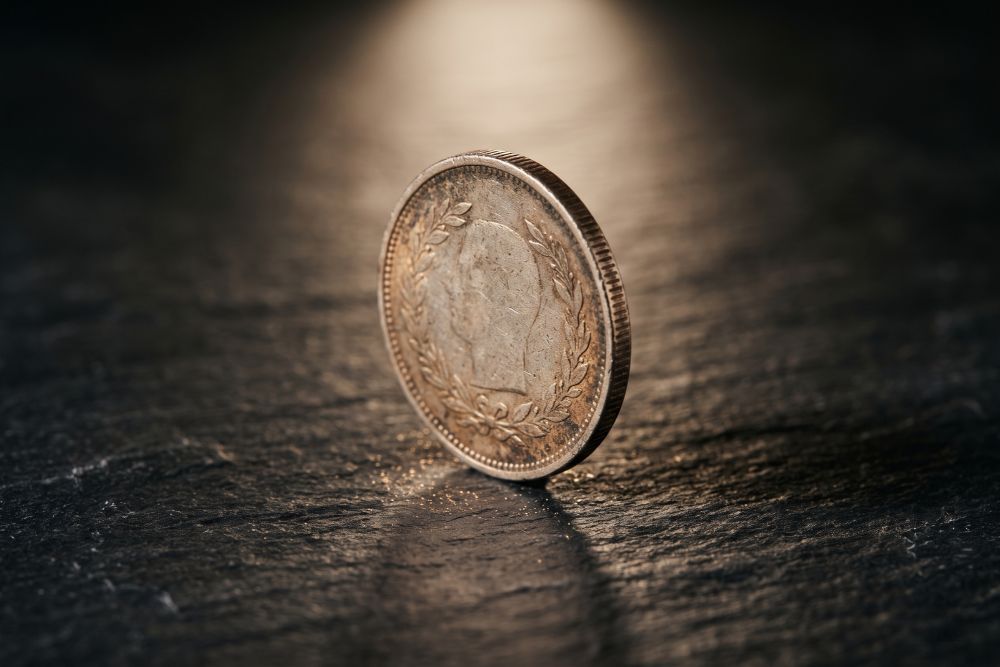
To make it simple, let’s say you are holding a coin in your palm. If someone asks, "Is this coin fundamentally Heads or fundamentally Tails?", how would you respond to them?
The answer is neither—because Heads isn't a separate piece glued onto Tails, nor does one side magically create the other. They are two faces of one same coin, depending on which angle you are looking from.
Interconnectedness
In philosophy, this coin-like view of mind and matter is known as Neutral Monism. When we push that insight one step further—recognizing that relationships, rather than isolated objects, are the basic fabric of reality—the old tug-of-war between mind and matter dissolves:
From the outside, we describe reality as matter—neurons, electrical pulses, bone and skin.
From the inside, we experience it as mind—the color red, the warmth of being recognized, the sting of embarrassment.
Matter isn't dead stuff mysteriously spitting out thoughts, and mind isn't a ghost floating inside a skull. They are two ways of encountering one shared process.
You cannot experience the world without a consciousness to perceive it. At the same time, you cannot have a thought or feeling without a body, a history, and a world giving it shape.
Does that sound a bit like a type of unfounded mysticism? In reality, we can observe it just by looking at nature.
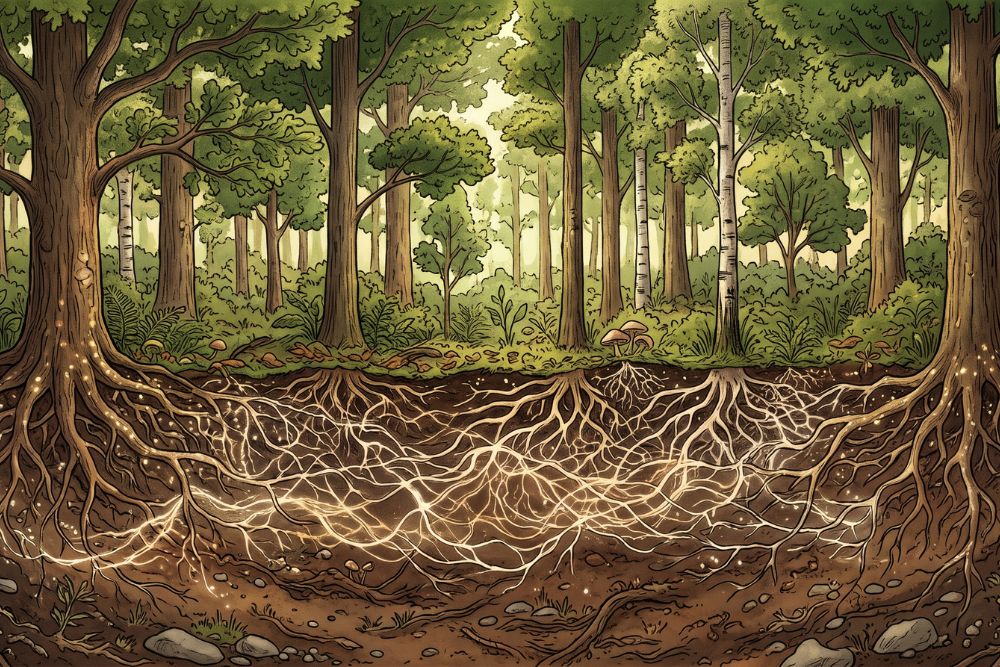
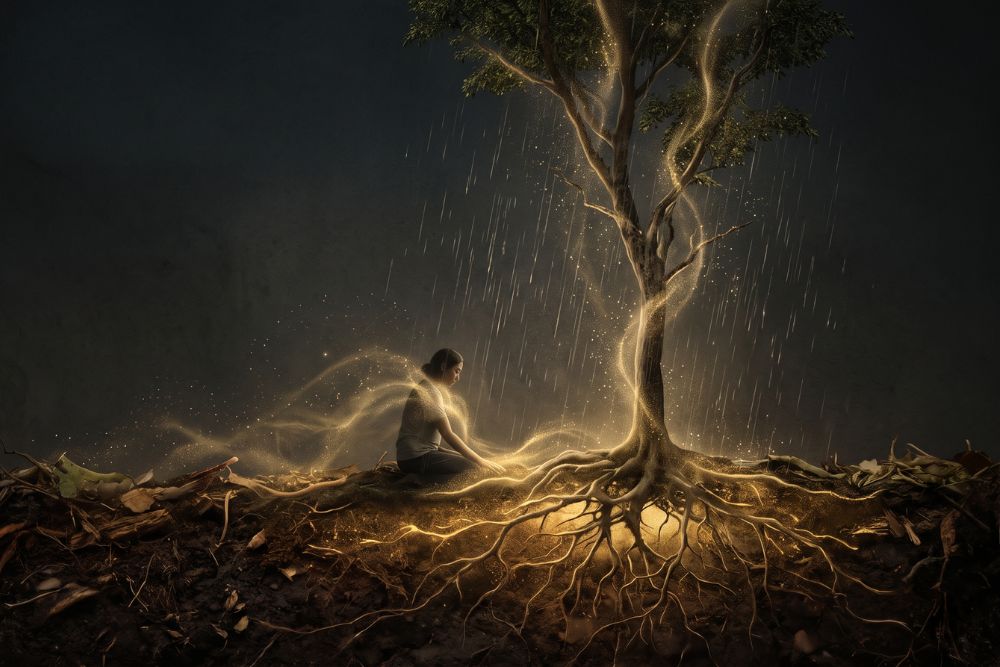
Take a forest, for instance. From above, trees look like solitary pillars competing for sunlight. Underground, however, their roots are woven together by networks of mycorrhizal fungi—commonly dubbed the "Wood Wide Web". Every root system is entangled with fungi and surrounding plants, trading carbon and nutrients in a continuous subterranean exchange.
Interconnectedness of nature
Even at the subatomic scale, modern relational physics suggests that tiny particles don't carry fixed, independent properties; their states only take shape the moment they interact with another system.
Of course, an electron interacting with a photon isn't the same thing as a human heart feeling empathy. That said, both point toward the same underlying truth: isolation is an illusion. Nothing in this universe—not a tree, not an atom, and not a human soul—exists all by itself.
Given that reality, how should we understand this thing called “I” then?
Let’s say you pick up a hammer to fix a loose floorboard in your house. While you are driving the nail in, you normally don’t think about the hammer at all. You don’t stop to contemplate its steel head or admire the grain of its wooden handle.
In a sense, the hammer practically disappears into your own arm. It becomes an extension of your consciousness, linked to everything around it: the hammer hits the nail, the nail fastens the floorboard, the floorboard seals the house, and the house shelters your family from the rain.
Now, what happens if the handle suddenly snaps?
The rhythm breaks. You stop mid-swing, stare down at the tool in your hand, and only now do you notice it as an isolated object—a splintered stick and a lump of cold iron.
A century ago, the German philosopher Martin Heidegger used the same metaphor to expose a mistake at the heart of Western thought. Long before him, thinkers like René Descartes ("I think, therefore I am") had essentially split the world in two: an isolated mind locked inside a skull, staring out at a world outside itself. Traditional philosophy looked at reality the way we stare at that broken hammer—treating everything as detached objects and wondering how they ever connect.
Heidegger flipped that picture upside down. Human existence—what he called Dasein ("being-there")—is never an observer watching the world like water in a glass. From our very first breath, we are Being-in-the-world. Just as the hammer only makes sense in a chain of nails and timber, your existence is possible because it is part of a web of language, culture, and other people surrounding you.
In everyday speech, though, most people still talk as if we were standalone individuals. We like to say:
Yet the moment you remember how deeply you are woven into your surroundings, those clear-cut statements start becoming questionable.
If you say "I am an introvert," where does that trait actually live?
Drop yourself into a noisy room of strangers, and you shut down;
Put yourself across a table from one trusted friend, and you are very likely to talk until midnight.
If you really think about it, your silence was never something that appeared out of the blue. The house you grew up in, your culture, the ways your nervous system learned to feel safe—all of them played a crucial role in shaping your behavior.
Interconnectedness of biology and culture in humans
So when you say "That’s just who I am," pause for a second and ask: what is that "who" actually built out of?
Look closely enough at yourself, and the walls will begin to turn transparent.
The Zen master Thich Nhat Hanh once captured this reality with a metaphor as follows:
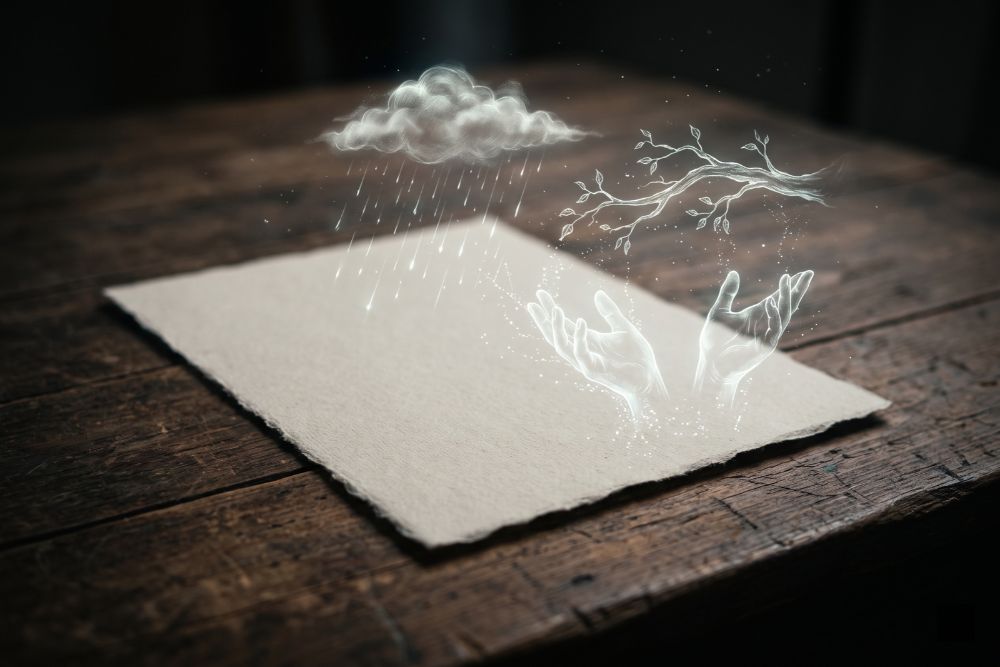
"If you are a poet, you will see clearly that there is a cloud floating in this sheet of paper. Without a cloud, there will be no rain; without rain, the trees cannot grow; and without trees, we cannot make paper. The cloud is essential for the paper to exist. If the cloud is not here, the sheet of paper cannot be here either. So we can say that the cloud and the paper inter-are."
To put it another way, a piece of paper is made fully of non-paper elements.
You and I are built the same way. Every breath in your lungs was just exhaled by a tree outside your window. Your habits, your language, the iron in your blood, even the personal insecurities that keep you awake at night—all of them arrived from your parents, ancestors, strangers, food, and the weather.
Interconnectedness of life
※ Note: Long before modern ecology, Eastern philosophy has captured this insight through concepts like dependent origination (pratītyasamutpāda)—the teaching that everything arises in dependence on countless causes and conditions—and Indra’s Net, an ancient metaphor depicting the cosmos as an infinite web of jewels where every single jewel reflects all the others.
Interconnectedness Buddhism
We are "nothing"
Let us follow that thought one step further. If a sheet of paper is made completely of clouds, rain, trees, and human labor, what happens if you peel all of those borrowed elements away?
Nothing is left. There is no "paper-core" in the center.
Likewise, if you peel away your language, your memories, the air you borrow every four seconds, the food that built your bones, and the people who shaped your heart—what is left that belongs strictly and independently to "you"?
Deep down, at the core, we are empty. Or, to use a word that often makes people flinch, we are nothing.
That word—nothingness, or what Buddhism calls Śūnyatā—is probably one of the most misunderstood ideas in philosophy. People, especially Westerners, usually associate it with nihilism: a cold void where nothing is real, nothing matters, and the only logical way to live is to detach from life like an ascetic. (pessimists like Arthur Schopenhauer drifted very close to that conclusion!)
But in reality, nothingness IS interconnectedness.
Let us think of it this way. If you possessed a permanent, self-contained core that needed nothing outside itself, you would be an airtight brick. Nothing could enter you, and nothing could leave. You wouldn’t be able to learn a word, change your mind, or feel a stranger’s heartbreak.
In other words, it is precisely because you are "empty" of an isolated self that the whole universe can flow through you and keep you alive.
You try to become detached… But you have not really solved the problem, which is the fear of being nothing… After all, you are nothing. Strip yourself of your titles, your qualifications, your profession and qualities, your houses, properties and jewels, and what are you? Knowing inwardly that there is an extraordinary emptiness… and being afraid of it, you depend, you are attached… You are not concerned about another, you are only concerned about yourself…
Why not accept the obvious… that you are nothing? Not that you SHOULD be nothing, but that you are ACTUALLY nothing. When you do accept it, there is … neither attachment nor detachment. You simply don’t possess, and then there is a beauty, a richness, a blessing that you cannot possibly understand as long as you are afraid of emptiness.
Jiddu Krishnamurti
Nothingness as interconnectedness: To be nothing is to be everything
"If nothing exists, what hurt?"
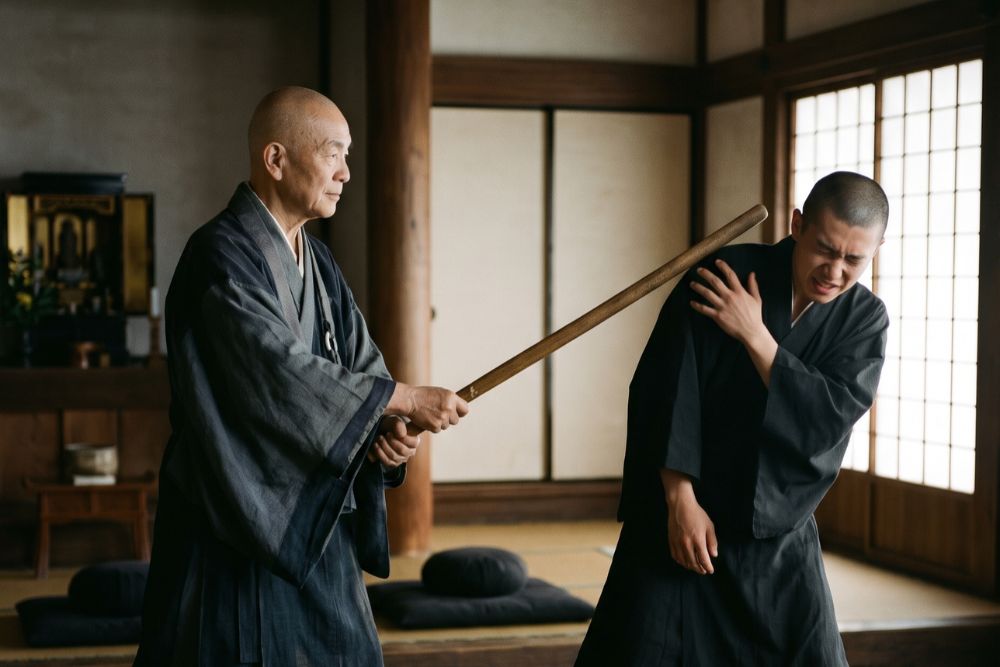
An old Zen story tells about a Zen student who went to his teacher and proudly announced that he had finally understood emptiness.
"There is no mind," he declared. "No body. No self. No Buddha."
The teacher listened in silence. Then, without warning, he raised his wooden stick and struck the student across the shoulder.
The student jumped back in pain. "Ouch!" he cried.
The teacher looked at him and asked: "If nothing exists—what hurt?"
Interconnectedness
Let that question sink in for a moment.
Emptiness, as the Zen master showed, is never the same as non-existence. It doesn’t mean your grief, pain, and memories aren't real.
Its true meaning is simply that nothing exists by itself. Just as a cup can only hold tea because it is hollow inside, you are real because you are open to everything else.
Pain still hurts. Joy still breaks your heart wide open. Your life is no less precious for being woven out of other lives—in fact, that is the only reason you exist at all.
Before I studied Zen, mountains were mountains and rivers were rivers. While I was studying Zen, mountains were no longer mountains and rivers were no longer rivers. But once I reached enlightenment, mountains were once again mountains and rivers were rivers.
Qingyuan Weixin
The myth of the self-made island (Interdependence over Meritocracy)
For those living in East Asia (and parts of South Asia—based on my own knowledge), you are probably familiar with this phenomenon. Following every exam season—or a major academic competition, the headlines would light up with the same sensationalized news: a top-scoring student from an impoverished rural town who studied 12 hours a day. Throughout the year, the same type of news would emerge from time to time, albeit in a different form: a "self-made" entrepreneur who started from nothing, slept beneath an office desk, and built an empire through sheer willpower. (this applies to the Western world too, unfortunately)
Whoever the person is, the media almost always depicts them as solitary heroes—those who conquered impossible odds completely on their own. A “role model” to be applauded and emulated.
Watching these stories play out year after year, I can’t help but think of them as nothing more than modern-day Stakhanovs.
In 1935, a Soviet coal miner named Alexey Stakhanov became a national legend overnight after reportedly mining 102 tons of coal in a single shift—fourteen times his daily quota. The Soviet press lauded his extraordinary willpower and dedication—all while failing to mention the team of support workers hauling timber behind him, the pre-checked equipment, the cleared tunnels, and the state machinery staged to guarantee his record.
The same applies to the “success stories” widely hailed in modern society—just that instead of posters on factory walls, they run through social media feeds designed to sell courses/hacks, stoke envy, and keep everyone running faster.
Every time a spotlight shines on a solitary champion, an invisible eraser sweeps across the background. Gone are the parents who worked double shifts so that the child could stay at a desk uninterrupted. Gone are the teachers, the public libraries, the paved roads, the stable electricity grid, and the stroke of luck that happened to land them in the right room at the right moment.
The media routinely portrays success as a solo act—and as far as I can see, that narrative hurts far more people than it inspires. In fact, I have seen its disastrous impact too many times:
Parents who launch into tirades at their kids after reading such news;
Teenagers who burn themselves out just so they can get a certification that “glorifies” the family;
People who suffer perpetually from Impostor Syndrome and self-loathing;
Cram schools that benefit heavily from exploiting people’s insecurity and desire for status.
The political philosopher Michael Sandel has a name for this: the Tyranny of Merit. On the surface, meritocracy sounds wonderfully fair: anyone can rise if they work hard enough. Compared to an old world ruled by royal bloodlines or family bribes, a society that rewards talent and effort feels like real progress.
Yet Sandel points out a dark shadow stitched directly into that promise. When we convince ourselves that the winners earned every inch of their climb all by themselves, we have effectively signed off on a brutal rule for everyone else: if you are struggling, you have only yourself to blame.
Once a society buys into this myth of the self-made island, it fractures from both the top and the bottom:
At the top, it breeds arrogance. When high achievers believe their rank, salary, or elite degree is 100% self-authored, gratitude dries up. It becomes remarkably easy to look down on those who fell behind and assume that they simply lacked discipline.
At the bottom, it breeds shame. When the cultural baseline for respect is an extreme outlier, then healthy human effort begins to feel like a moral failure. As reality has proven, when it comes to high-stakes exam cultures (e.g. China’s Gaokao or South Korea’s Suneung), young people are continuously burdened by a sense of personal worthlessness, which eventually causes many to succumb to despair, engage in self-destructive behavior like suicide, or check out of the race altogether.
Across society, it hides what actually holds us up. When we measure human value strictly by test scores or bank balances, we devalue the caregivers, delivery riders, sanitation workers, and aging parents whose daily labor keeps the whole house standing.
Today’s society is characterized by achievement orientation, and consequently it adores people who are successful and happy and, in particular, it adores the young. It virtually ignores the value of all those who are otherwise, and in so doing blurs the decisive difference between being valuable in the sense of dignity and being valuable in the sense of usefulness.
If one is not cognizant of this difference and holds that an individual’s value stems only from his present usefulness, then, believe me, one owes it only to personal inconsistency not to plead for euthanasia along the lines of Hitler’s program, that is to say, “mercy” killing of all those who have lost their social usefulness, be it because of old age, incurable illness, mental deterioration, or whatever handicap they may suffer.
Viktor Frankl, “Man’s Search for Meaning”
Now, I’m not saying that we should give up on hard work, ambition, or personal responsibility. Effort still matters. No amount of good luck will be enough to write a book, heal a relationship, or build a craft if you refuse to show up and put in the hours.
That said, what I would like us to do is to rethink how we view the outcome.
If you truly understand that everything is interconnected—that there’s an invisible crowd standing behind every "individual" triumph (the farmers who grew your morning rice, the ancestors who constructed the language you think in, the mentors who caught you before you quit, the luck of being born healthy enough to try), there would be very little chance for arrogance to take root. Simply, because you know without those unseen hands, you wouldn’t have been able to get where you are now.
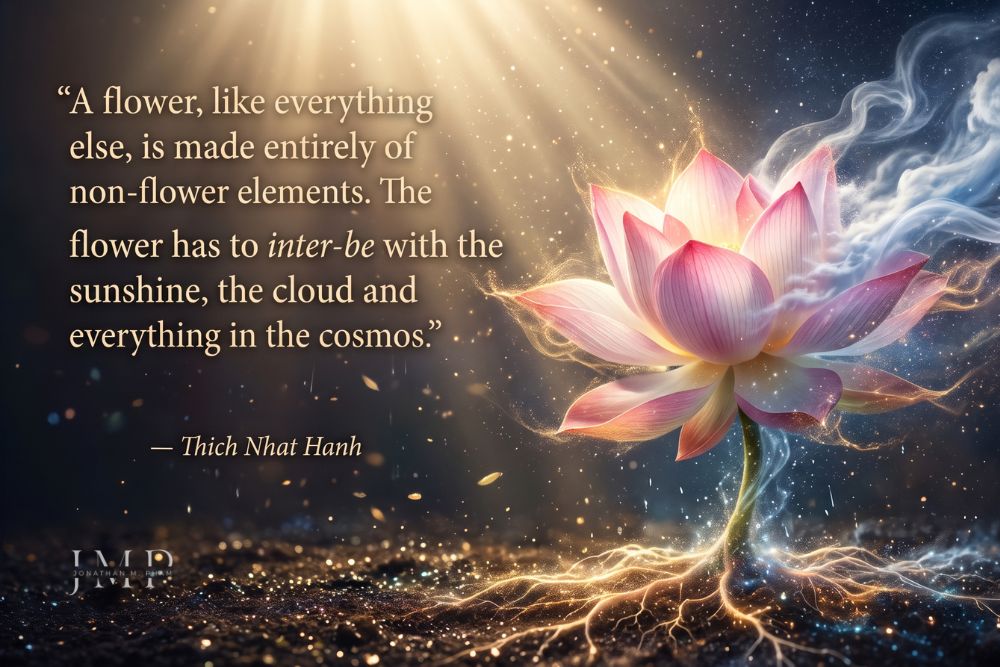
The whole cosmos has come together in order to help the flower manifest herself. The flower is full of everything except one thing: a separate self, a separate identity. The flower cannot be by herself alone. The flower has to inter-be with the sunshine, the cloud and everything in the cosmos...
Inter-being is not being and it is not non-being. Inter-being means being empty of a separate identity, empty of a separate self.
Thich Nhat Hanh, "No Death No Fear"
Interconnectedness of life
What Does "We" Really Mean? (Interconnectedness Without Losing Oneself)
Given that the "I" is not a detached island to begin with, does it mean we are supposed to surrender our individuality altogether? That we should shrink into the crowd and do whatever people demand of us?
Not at all. To see why, let us look closely at what "We" actually means.
The space in between
Imagine holding a ceramic teacup in your hands. What actually makes it useful?
Most of us tend to only look at the clay, the glaze, or the curve of the handle. Yet if the potter had sculpted a solid sphere of ceramic with no hollow in the middle, it couldn't hold a single drop of tea.
Its usefulness, therefore, lies in its empty space.
The same is true of music. A symphony only exists because notes begin and end. If there is no deliberate silence between the notes, what you end up with is not a melody. Just a bunch of noises.
As we have briefly touched upon above, Western thought has, for most of its history, treated concepts such as “silence” and “emptiness” in a somewhat negative light. That said, if we look to the East, specifically to the Japanese concept of 間 (pronounced as Ma), we find a very different perspective.
Normally, 間 (Ma) is translated as "space," "pause," or "the interval between things." However, it is not the type of awkward void that needs to be filled up. Rather, it serves as a bridge between two entities—a presence that gives shape, depth, and meaning to what surrounds it. It is:
The silence that lets music stay music;
The open room inside a cup that lets it receive water;
The intentional pause in a conversation that gives your words time to reach the other person’s mind and heart.
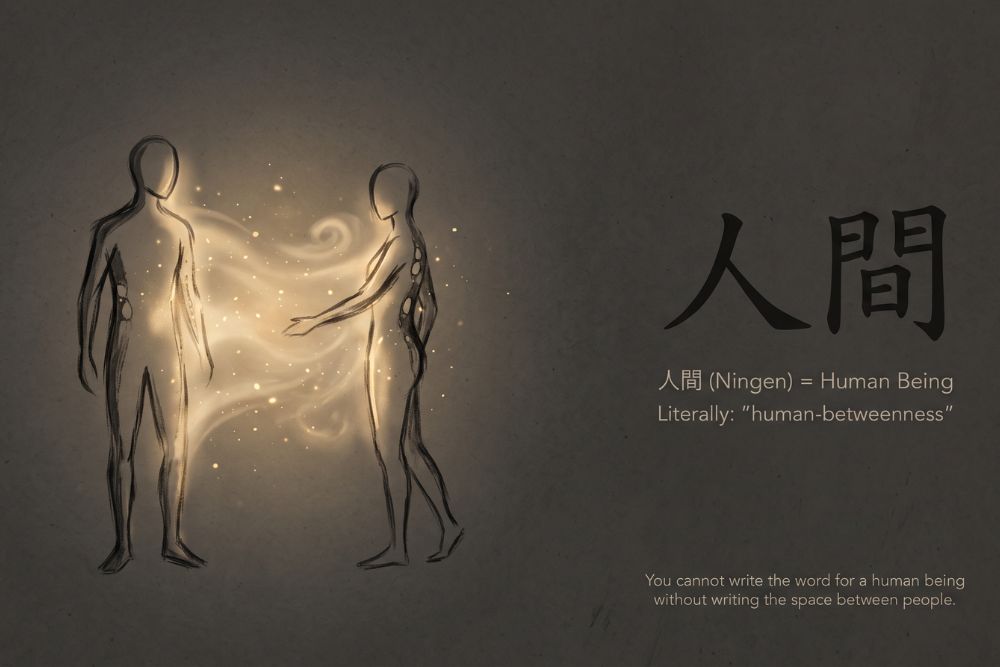
And here comes an interesting part—something that stopped me in my tracks when I first learned it. In Japanese, the word for a human being is Ningen (人間). It is built from two characters placed side by side:
The first character (人, pronounced as hito) means person.
The second character (間) is Ma—that space between discussed above.
Put them together, and we end up with what translates literally as "human-betweenness."
Read that again slowly. You cannot even write the word for a human being without writing the space between people. Strip away that relational space—seal off the gaps, eliminate the vulnerability that lets someone else's voice reach you—and what you end up with is not a stronger individual. Just a solid ball of clay that cannot hold anything.
Even within ourselves, it is our own internal “gaps”—our hesitation, grief, willingness to admit "I don't know"—that create room for love and empathy to enter. Without “emptying” ourselves first—without giving room for others to be what they are (as they do the same for us), we would not have what it takes to constitute our humanity. (ningen-sei, 人間性)
Interconnectedness
Harmony is not sameness
The nail that sticks out gets hammered down. (出る杭は打たれる/ Deru kui wa utareru)
And here, we arrive at a crucial aspect of the “We”—which, unfortunately, is quite often misunderstood. (those who grew up in a family, workplace, or toxic collectivist environment would know what I mean) In too many places, "We" is frequently used to silence dissent and turn people into “cogs in a machine.” We are taught to prioritize the collective interest over personal needs—to maintain harmony in all cases. And what does it translate to in reality?
Usually, it means shrinking oneself to fit the mold: never disagreeing, never setting a boundary, smoothing down every sharp edge until everyone thinks, speaks, and moves in lockstep.
But that’s a serious distortion of what it means to care for the group. Traditional philosophies, which were inherently humanistic, have been stripped of their core relational mechanisms and turned into a tool to enforce uniformity. While useful for preserving the institution, it does nothing at all in terms of cultivating harmony—simply because harmony requires individuality.
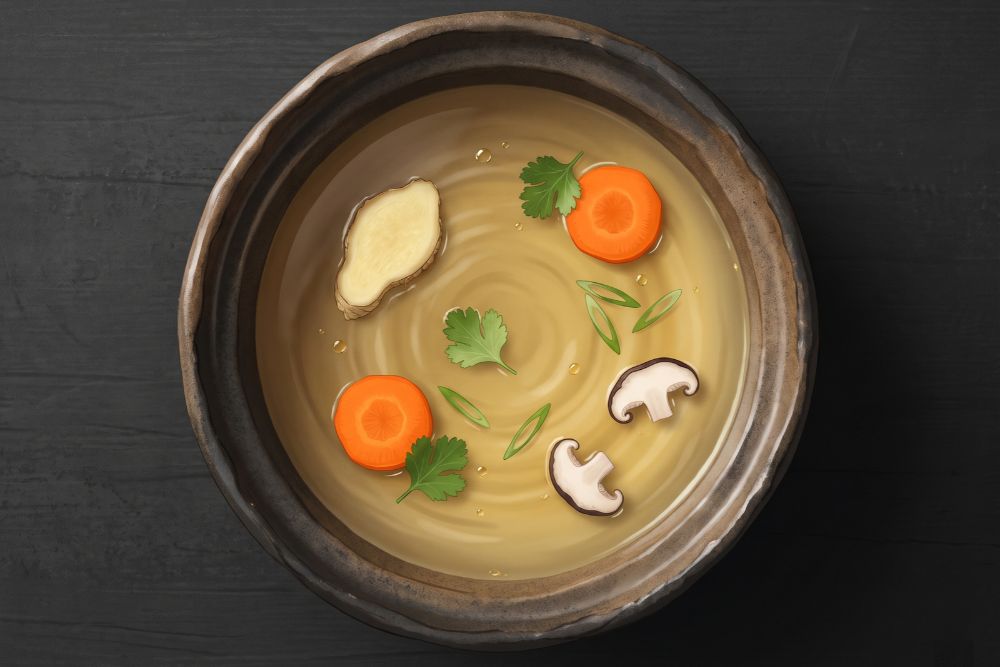
Let us think of it this way. A pot of soup is made up of multiple ingredients: carrots, broth, ginger, salt, and herbs. Each ingredient keeps its own character and flavor—and because there is room (Ma) for them to meet and mingle in the water, together they create something richer than any one of them could ever pull off alone.
Interconnectedness
The same principle applies to human existence. On one hand, we admit our inherently interconnected nature; on the other hand, we need to understand that connection requires difference. For two people to truly meet, there first have to be two real authentic individuals who are open to each other—and enough room between them to hear each other's distinct voices.
To shame someone for setting an honest boundary under the name of “We”—or, on the other side, to erase one’s own voice just to “keep the peace”—therefore, is a grave violation of the principle of interconnectedness. In doing so, we destroy the very “betweenness" (Ma) required for us to form a greater whole.
What is meaningful cannot in fact be isolated... We achieve understanding within a circular movement from particular facts to the whole that includes them and back again from the whole thus reached to the particular significant facts.
Karl Jaspers
The trap of fusion (Interconnectedness vs. Codependency)
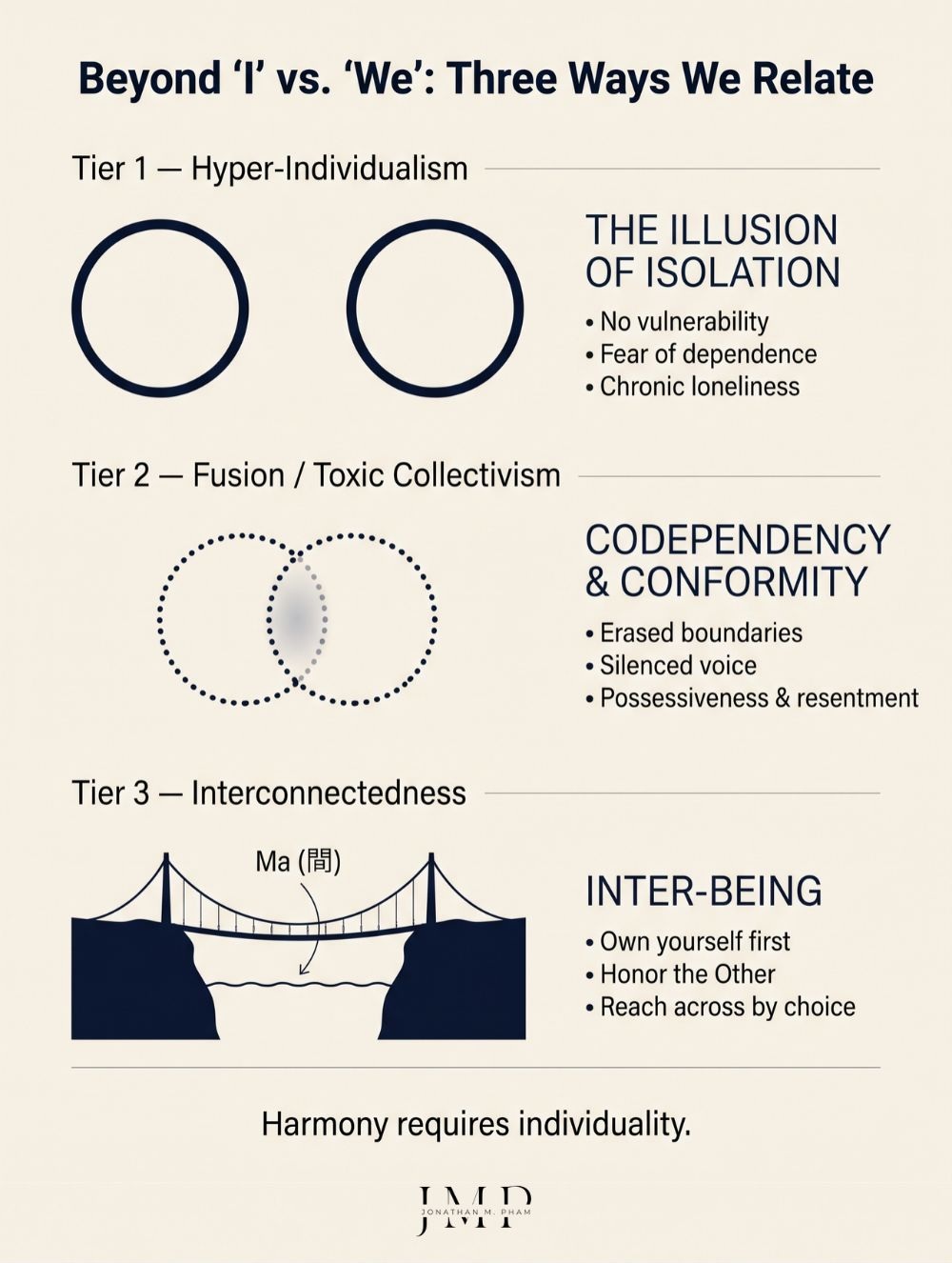
Many people enter relationships haunted by a perpetual fear of being alone. To escape it, we try to melt into the other person completely. We mirror their moods, swallow our authentic feelings that clash with theirs, and reshape our whole schedule around keeping them happy—hoping that if the gap between the two disappears, so will the insecurities within.
That reaction stems from a misguided understanding of the human condition. According to the psychiatrist and existential thinker Irvin Yalom, people frequently confuse two different experiences:
Everyday loneliness: Missing company on a Friday night, or wishing you had someone to call after a hard day at work. Other people can heal that.
Existential isolation: The fundamental truth that no matter how much someone loves you, nobody can step inside your skin and live your life from behind your eyes. We walk into this world alone, and at the very end, we walk out of it alone.
Because we mistake the latter for the former, we try to cure it with fusion. We expect a partner, a friend, or a child to be our shelter: Complete me. Think like me. Don't ever make me feel that gap between us.
In modern psychology, this tendency is recognized as codependency. And as tempting as it looks amid today’s loneliness epidemic, codependency is the exact opposite of true interconnectedness: it tries to erase the self rather than relate through it.
When you cling to someone mainly to avoid your own solitude, you are, in reality, only using them as an emotional bandage. And because nobody on earth can carry the weight of another person's existence forever, that kind of fusion almost always curdles into possessiveness or resentment.
Fusion eradicates anxiety in a radical fashion—by eliminating self-awareness. The person who has fallen in love, and entered a blissful state of merger, is not self-reflective because the questioning lonely I (and the attendant anxiety of isolation) dissolve into the we. Thus one sheds anxiety but loses oneself.
Irvin D. Yalom, "Love's Executioner"
It’s just like what happens when you are afraid of losing something. In that moment, your whole posture tightens. You close your fingers around what you think you own.
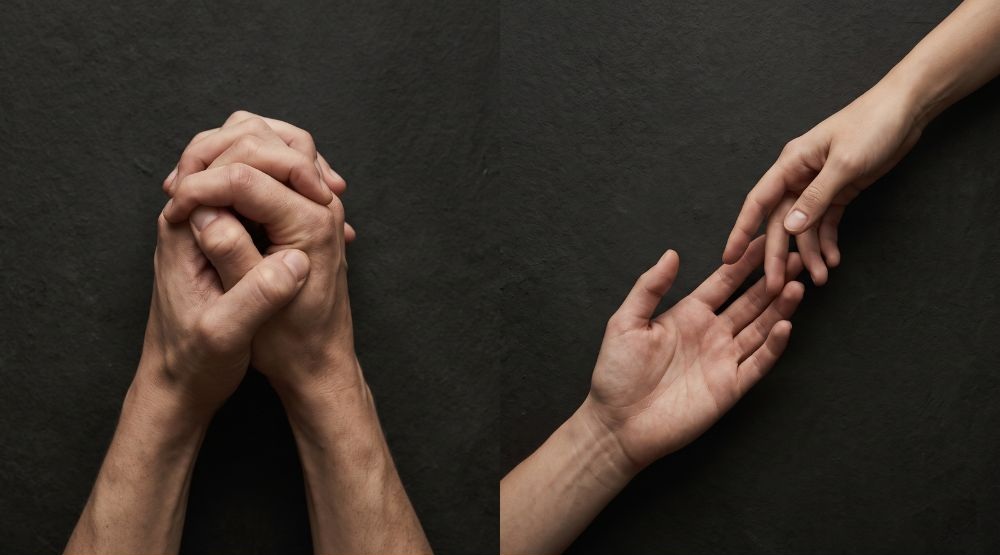
The irony, of course, is that a clenched fist cannot receive a gift, and it cannot take someone else’s hand. Only when you deliberately relax your fingers into an open palm—making your true self available and vulnerable—can an encounter happen.
It is in accepting our fundamental alone-ness—while still choosing to reach out to others—that a relationship may take root.
Loneliness epidemic: Codependency vs. Interconnectedness
A bridge needs two shores
Here’s a simple metaphor. Imagine a suspension bridge crossing a river. What do you think makes the bridge stand?
The answer: because there are two separate shores, each anchored in its own ground.
Pull one shore away, or collapse the two banks into a single muddy swamp, and there is nothing left for a bridge to hold onto.
Mature love—real interconnectedness—works the same way:
You face your own shore first. You learn to sit with your own solitude without treating it like an emergency. You become solid enough to stand on your own feet, honest about who you are and where your boundaries lie.
You honor the other person's shore. You let them remain a whole, mysterious individual you will never fully own or decode—someone free to surprise you, disagree with you, and walk beside you by choice, not by obligation.
And then you reach across the gap. Not out of panic nor the desire to swallow them whole, but because two distinct souls have chosen to share the view.
When you stop demanding that someone else erase your loneliness, you are finally free to love them as they actually are.
Years ago, when I was still a teenager, I happened to come across the following parable.
The disciples were absorbed in a discussion of Lao Tzu’s dictum: “Those who know, do not say; Those who say, do not know.” When the master entered, they asked him what the words meant. Said the master, “Which of you knows the fragrance of a rose?” All of them indicated that they knew. Then he said, “Put it into words.” All of them were silent.
(Source: Anthony De Mello, ‘One Minute Wisdom’)
That’s what happens when we stop at labels. No matter how descriptive a label is—no matter how commonly people use it—it can never be a replacement for the real thing. For the experience of coming into direct contact with it.
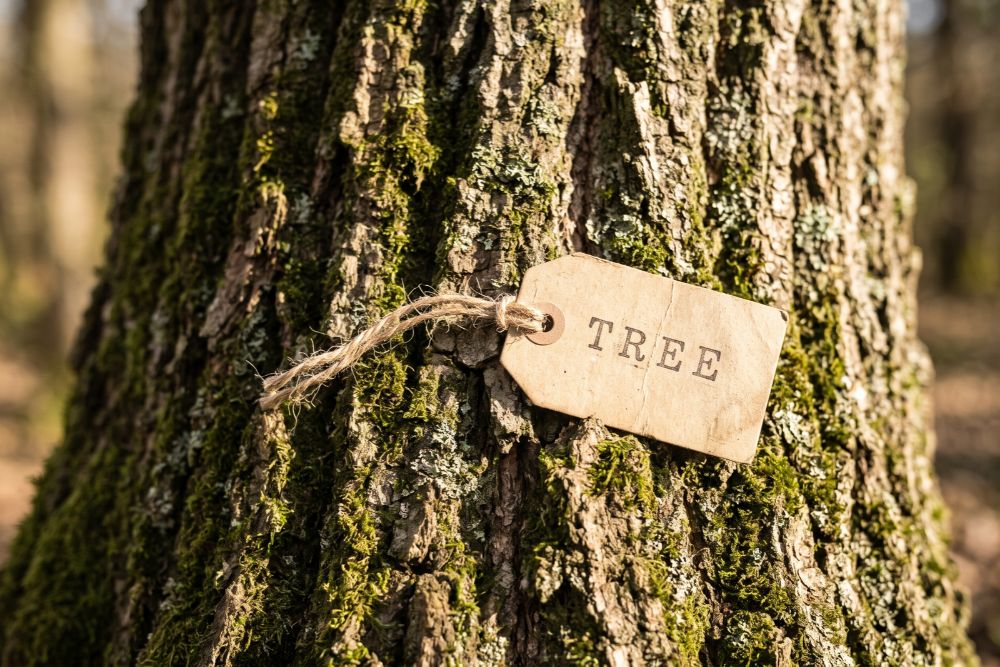
As adults, most of us are caught up in so many preconceptions that rarely do we ever stop to contemplate the world the way a kid does. When we see an oak tree while walking down the street, our instinctive response is to think:
"Tree. Got it. I know what it is."
But have you ever asked yourself: What does an “oak tree” mean? What makes it different?
Can you describe its jagged cracks, the soft green moss clinging to the shaded side, or the way afternoon light flickers across its leaves?
The word "water" can never quench your thirst, and the word "oak tree" cannot help you feel its rough bark. Knowing the name of something is not the same as truly knowing it.
If you have never eaten a tangerine, however much the other person loves you and wants to help you understand what a tangerine tastes like, they will never succeed by describing it. The reality of the tangerine goes beyond ideas.
Thich Nhat Hanh
After all, the brain loves labels because they allow it to save energy. If you had to examine every chair, doorknob, and traffic light from scratch, you wouldn't make it out the front door by noon.
For sorting groceries, mental shortcuts are indeed essential. But it’s another story when it comes to real human beings, who are far too complex to be captured within any single definition.
Deep down, we are all aware of that fundamental truth; yet in reality, we rarely embody it. Most of the time, when interacting with someone else, our immediate instinct is to slap a label onto them. And the consequences are disastrous:
In politics, labels erase nuance. The moment you categorize someone as "left" or "right," "progressive" or "conservative", you stop looking for common ground and listening to what the other person is actually saying. Your only goal is to win against them.
In daily life, labels steal surprise. Call someone "the eccentric one," "the difficult coworker," "the rich kid," or "just like their father," and you essentially freeze their essence. Whenever they try to grow, soften, or act out of character, you barely notice it—because your eyes are still trapped inside a prison the mind built for itself.
It is very hard to be cruel to someone when you are truly paying attention to them—when you look at their face, hear the tremor in their voice, imagine their childhood, and feel how much of a burden they are carrying. But as soon as you shrink them down to a label, it becomes surprisingly easy to mock, dismiss, or write them off.
Unfortunately, this is what happens frequently in modern society. Social media algorithms thrive on sorting people into camps of "heroes" and "villains" based on a single sentence. Even in ordinary conversations, we are trained by hustle culture to size people up by their job title, school, or income within seconds. And the result is a strange paradox: we can be surrounded by hundreds of acquaintances, yet feel completely alone—because nobody has paused long enough to meet the real person underneath the tag.
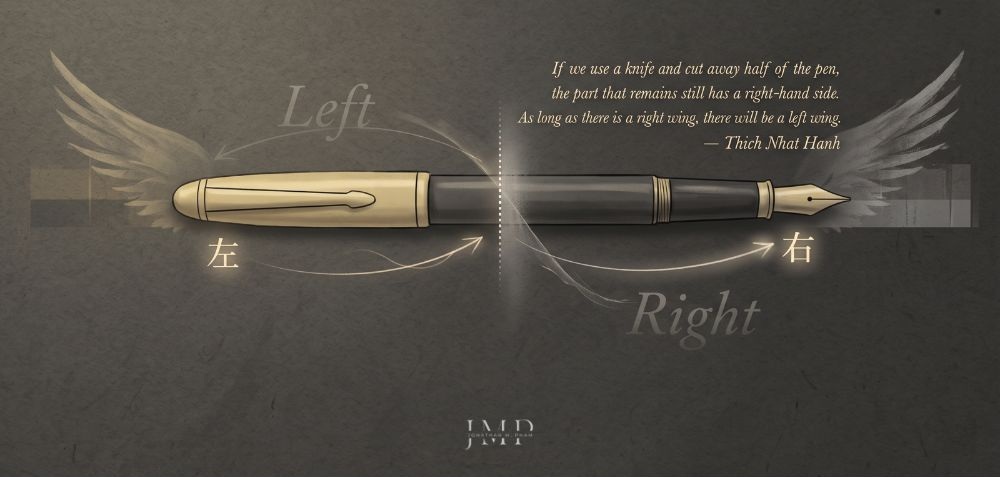
We have an idea of being that is the opposite of not being. These ideas are no more solid than ideas of right and left.
Look at a pen. Can we remove totally its right-hand side? If we use a knife and cut away half of the pen, the part that remains still has a right-hand side.
Political parties of the right and the left are immortal-they cannot be removed. As long as there is a right wing, there will be a left wing.
Therefore those on the left of the political spectrum should desire the eternal presence of those on the right. If we remove the right, we have to remove the left at the same time.
Thich Nhat Hanh
To live in harmony with each other, it's essential we move beyond all labels and be truly attentive to others. And for that to happen, we can start with these practices:
Catch the reflex before it speaks: Notice the half-second when your mind whispers, "Oh, they're just one of those people," and let that thought sit there without treating it like a verdict.
Ask one honest question: Instead of guessing what a relative, coworker, or stranger believes based on a remark they made, ask them "What made you see it that way?"—and listen without rehearsing your comeback.
Put the phone face-down: Give the person sitting across from you ten minutes of complete presence, without the need to reach for a screen.
Now I’m not saying that we should pretend differences don’t matter, or that we should ignore harm when someone acts unfairly. If a colleague repeatedly takes credit for someone else's work, if a friend crosses a boundary, or if a policy hurts vulnerable people, we have every right—and duty—to name it clearly. But what I believe is that we can speak out and hold each other accountable without letting a label—or a mistake—have the final word on who a person is.
It's a bit embarrassing to have been concerned with the human problem all one's life and find at the end that one has no more to offer by way of advice than 'Try to be a little kinder.'
Aldous Huxley
The Sacredness of the Ordinary (Interconnectedness in Spirituality)
When you start living this way—when you intentionally slow down and be open to the Other, something unexpected happens. Specifically, there will be a radical change to how you understand reality and approach every daily experience.
Listening to the silence
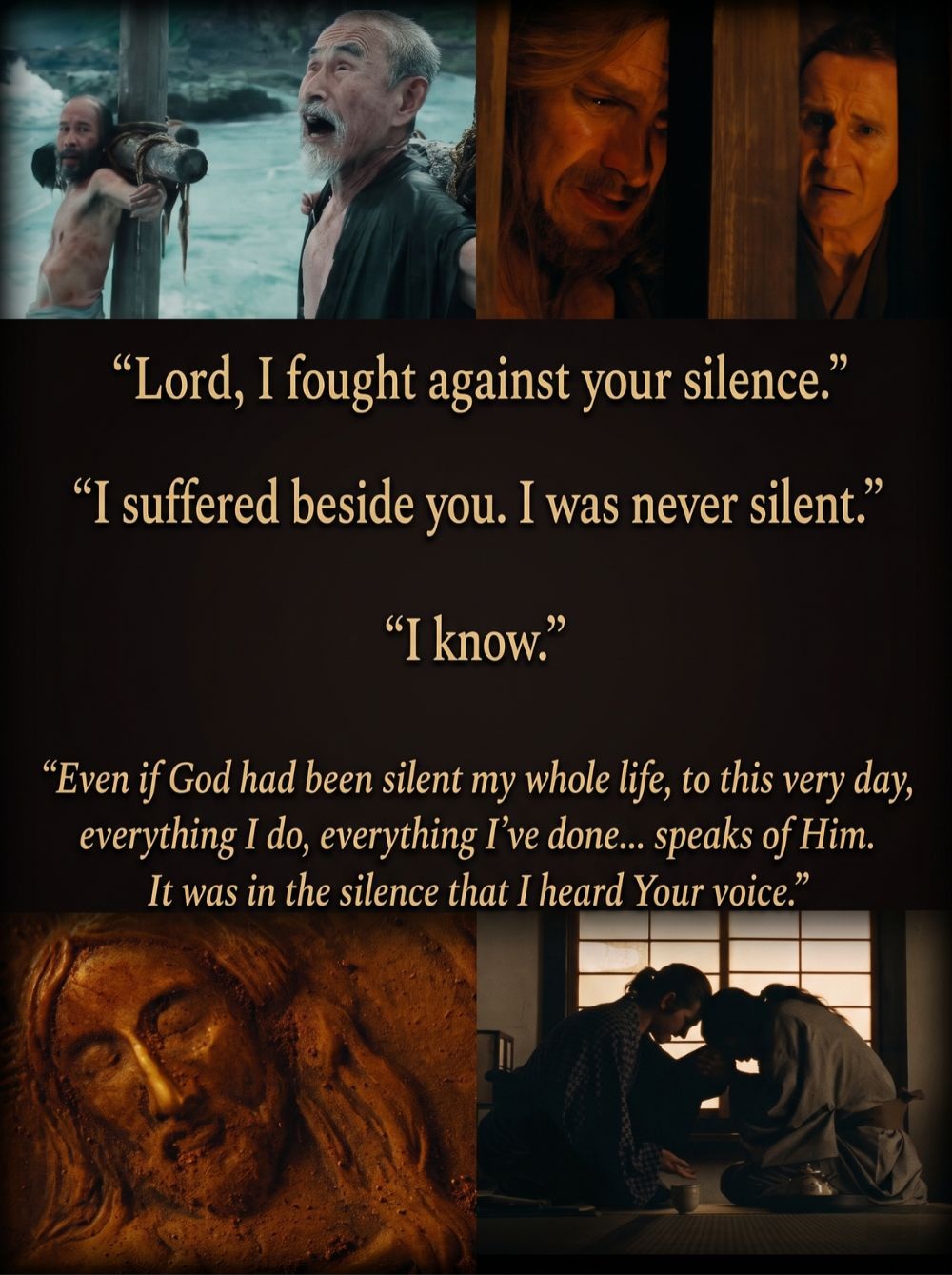
In Martin Scorsese’s film adaptation of Shūsaku Endō’s novel Silence, a young Portuguese Jesuit named Father Sebastião Rodrigues was sent to 17th-century Japan. He embarked on the journey with a sense of heroic certainty, expecting a grand spiritual battle and the chance to become a martyr himself.
Contrary to his expectations, what Rodrigues saw was impoverished peasants tortured and killed for their faith—while the sky above remained silent. He begged for a sign, a miracle, a voice from heaven to tell him why suffering was allowed to continue.
And he received no answer. Only the sound of rain, waves, and human weeping.
Years after he was forced to renounce his faith in public—stripped of all titles, living in obscurity—something inside him shifted. Listening one last time to the emptiness he spent decades fighting, he suddenly came to a realization: he had never been alone.
“Lord, I fought against your silence.”
“I suffered beside you. I was never silent.”
“I know.”
"Even if God had been silent my whole life, to this very day, everything I do, everything I've done… speaks of Him. It was in the silence that I heard Your voice."
I didn’t quite “get” it when I came across those lines the first time, until recently—following a few crucial turning points in my life.
If you had asked me about my own practice of praying in particular—and my spiritual stance in general—a few years ago, I probably would have described something fairly conventional: sending requests upward to an invisible deity.
“Please fix this problem for me.”
“Please protect the people I love.”
“Please give me X, Y, or Z."
It’s what the typical believer—or SBNR (spiritual but not religious) person—often does, right? But the thing is, we cannot truly understand reality—and be transformed internally—if we only stop at that surface-level form of spirituality.
In my case, as I went deeper into philosophy, existentialism, and mysticism—and began to internalize how deeply woven we are into everything around us—my view of God (or the Ultimate Reality, depending on what you prefer to call it) slowly shifted as a result.
Rather than a man-in-the-sky waiting to be reminded of our troubles down below, I began to see God as the very ground holding everything together—not separate from the world, but permeating through every atom of it. Not “up there” behind the clouds, but in the rain feeding the tree outside the window, the warmth of a friend's hand, and the air moving through my lungs.
Interconnectedness in spirituality
As soon as that change in perspective occurred, the previous way of praying suddenly felt over-transactional and strangely unnecessary to me. If the divine isn't a monarch sitting outside the universe, then what’s the point of begging for special favors? Isn’t it very much like a wave asking the ocean to be “wetter”?
Now, I find myself praying far less; specifically, praying in the conventional discursive way. Instead of asking for the odds to be “in my favor”, I have decided to focus more on being mindful, cultivating inner stillness, and opening myself to those around me.
If I ever pray now, it is mostly for the “courage to be”. To say "yes" to life as it actually is, miseries and all. ("Thy will be done") To practice something akin to the Trappist monks’ Centering Prayer—releasing all anxious, egoistic thoughts and being absolutely still, so that one can become fully receptive to reality.
Attention, taken to its highest degree, is the same thing as prayer. It presupposes faith and love. Absolutely unmixed attention is prayer.
Simone Weil
The truth is here
Much of Western thought is arguably shaped by a discomfort with silence—specifically, the silence of the universe. We assume that if there is meaning, there should be a clear voice answering us back. So when life shatters that expectation—when an innocent child falls ill for no reason, when a faithful person’s pleas go unanswered, when evil acts go unchecked—people tend to fall into either dogmatism ("You just didn't pray hard enough") or nihilism ("The sky is empty; nobody is coming for us, and nothing matters").
But what if that very silence is the voice of the universe itself?
What if we stop gazing upward, and instead start looking down at the earth under our feet? At the person standing in front of us?
What if we stop drawing a wall between the "Sacred" and the "Ordinary"?
Interconnectedness
For centuries, people have largely been trained to believe that holiness lives only inside special rooms—temples, churches, mountaintop monasteries. Maybe that's why someone can feel so peaceful kneeling in a sanctuary on Sunday morning, yet snap with bitterness or indifference the moment they walk through their front door on Sunday afternoon.
It is strangely easy to chase transcendent feelings inside a monastery; but it’s another story when it comes to sitting down at the kitchen table and mending the bruised relationship with your partner.
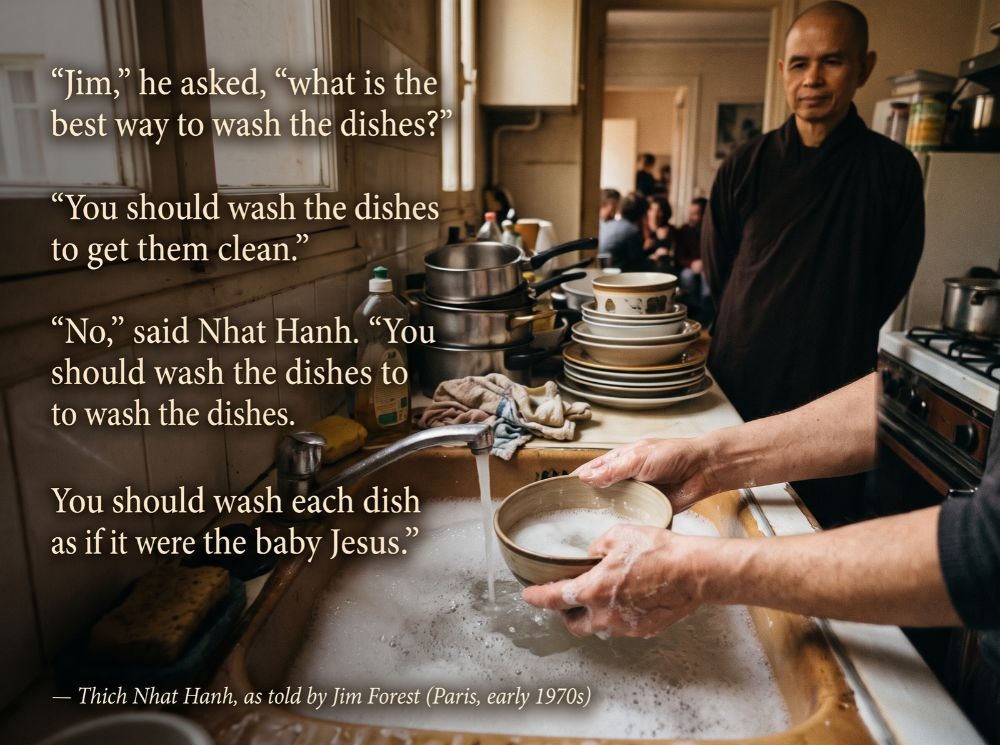
One evening, I was with my Vietnamese friends in a cramped apartment in the outskirts of Paris in the early 1970s. At the heart of the community was the poet and monk, Thich Nhat Hanh. An interesting discussion was going on in the living room, but I had been given the task that evening of doing the washing up. The pots, pans and dishes seemed to reach half way to the ceiling in that closet-sized kitchen. I felt really annoyed. I was stuck with an infinity of dirty dishes while a great conversation was happening just out of earshot in the living room.
Somehow Nhat Hanh picked up on my irritation. Suddenly he was standing next to me.
“Jim,” he asked, “what is the best way to wash the dishes?”
I knew I was facing one of those very tricky Zen questions. I tried to think what would be a good Zen answer, but all I could come up with was,
“You should wash the dishes to get them clean.”
“No,” said Nhat Hanh. “You should wash the dishes to wash the dishes.”
I’ve been mulling over that answer ever since — more than three decades of mulling. But what he said next was instantly helpful:
“You should wash each dish as if it were the baby Jesus.”
Perhaps we ourselves can do the same thing too. As long as we are truly mindful—mindful in the sense of being “heartful”—there’s no need to retreat somewhere to find holiness, because it is right here. In the daily chores. In the cramped kitchen. In an ordinary afternoon.
If you can adopt such a radical life stance, a few things will happen:
Your daily acts—brewing tea, fixing a loose hinge, or listening to a friend—now become meaningful on their own. There’s no need for a massive achievement to make your day worthwhile. The care you pour into your ordinary work is already enough.
You no longer feel the need to despair of impermanence. On the contrary, the fact that nothing lasts forever is exactly what makes every encounter unique, every passing moment precious. Now you can cherish the bittersweet tug you feel when watching late-afternoon light fade across a wall, seeing your parents grow old, or catching cherry blossoms before a storm scatters them.
The mundane stops being “mundane”. You don't need to wait for future milestones to start living, because your life is happening in this moment—in the steaming bowl of rice in front of you, in the breeze before the rain, in the stranger holding an elevator door for you.
Our true nature is the nature of no birth and no death. We do not have to go anywhere in order to touch our true nature. The wave does not have to look for water because she is water. We do not have to look for God, we do not have to look for our ultimate dimension or nirvana, because we are nirvana, we are God.
Thich Nhat Hanh, “No Death No Fear”
※ Note: For those interested in exploring further, Japanese aesthetics has an entire vocabulary dedicated to this way of living—including concepts like kodawari (wholehearted devotion to even the smallest craft), wabi-sabi (finding beauty in imperfection and transience), mono no aware (the bittersweet awareness of impermanence), and ichigo-ichie (treasuring every encounter as once-in-a-lifetime). You can read more about them here.
Water back into the ocean
In 1959, near the end of his life, the psychiatrist Carl Jung sat for a BBC television interview and was asked a blunt question: "Do you believe in God?"
Jung paused for a moment, smiled slightly, and gave a somewhat mind-blowing answer:
"I don't need to believe. I know."
What he meant wasn't certainty over a dogma—but direct experience. He was drawing a line between believing an idea because it sounds comforting, and knowing something because you have personally felt it in your own skin. (e.g. you don't need to debate whether fire is warm once you have held your hands near the flames)
Belief is no adequate substitute for inner experience, and where this is absent even a strong faith which came miraculously as a gift of grace may depart equally miraculously. People call faith the true religious experience, but they do not stop to consider that actually it is a secondary phenomenon arising from the fact that something happened to us in the first place which instilled pistis into us — that is, trust and loyalty.
Carl Jung, “The Undiscovered Self”
I mention this story because up until now, everything we have discussed—Heidegger’s hammer, Interbeing, Ma, the universe’s silence—could, to some of you, sound like a bunch of abstract ideas pulled from philosophy books. To be honest, I once worried about that myself too. Was I drawn to interconnectedness only because I wanted life to feel less lonely?
Then came April 3, 2026.
That afternoon, as usual, I was blogging and philosophizing. I was sitting in deep contemplation on the ideas of oneness and being—when suddenly, something gave way inside my chest.
It happened without warning. I wasn't trying to force any particular feeling. Yet all at once, I was hit by a sensation so vivid it literally brought tears to my eyes: an overwhelmingly peaceful happiness, arriving side by side with a total sense of emptiness.
I didn't have to guess what it was. Immediately and intuitively, I knew—deep in my bones, even before I had the formal words for it—that this was what mystics across centuries meant by “union”: the moment the boundary between the self and the rest of existence dissolves.
A Zen master may probably call my experience satori (a flash of insight). A secular reader may deem it as a shift in consciousness or a neurological spell. A contemporary thinker may refer to it as non-dual awareness—the recognition that the "observer" and the "observed" are a single experience. Whatever name you prefer to use, the mark it left on me was undeniable.
“I think I finally got it—after a long time of contemplation! What it feels like—being a water back into the ocean.
Actually, I have felt it many times already; just that I was not aware of it yet.
Until this afternoon, when I had an ‘aha!’ moment… When I realized this is exactly what I have been reading about!
The fan may keep spinning for a while, but that does not really matter.
What matters is that I have finally connected the dots together! Which means moving forward, even if the fan may still spin from time to time, it will know that there’s something out there. Something greater than itself.”
(06:55 PM GMT+7 – April 3, 2026)
Non-duality & oneness
Coming home
The air was filled with a big noise and I tried to move. I felt the heaven was going down upon the earth and that it had engulfed me. I have really touched God. He came into me myself, yes God exists, I cried, and I don’t remember anything else.
You all, healthy people, can’t imagine the happiness.… I don’t know if this felicity lasts for seconds, hours or months, but believe me, for all the joys that life may bring, I would not exchange this one.
Fyodor Dostoevsky
Usually, upon hearing the word "empty," we tend to associate it with negative states like sadness or hollowness. But as I have mentioned, it was not what happened to me that afternoon—in that specific moment.
It felt so empty, sure, but at the same time intensely happy. As if I had just woken up from a long slumber. As if a “third eye” had been opened for me.
All the background noise I had been carrying every hour—“Am I doing enough? What do people think of me? What if I lose what I have?”—suddenly went quiet. Following that instant, a profound sense of belonging unmistakably surged within me.
I have to admit, though, that experience didn’t turn me into a “saint” (not yet); that was why I wrote "the fan may keep spinning for a while" in my journal. If you flick off the switch of a ceiling fan, the blades will keep turning on old momentum for a few minutes before stopping.
Likewise, the realization of interconnectedness does not immediately put an end to one’s old habits, anxieties, and petty impulses. Even after you have glimpsed into the whole, the ego will keep rising from time to time.
The difference, though, is that you are no longer fooled into thinking the spinning blades are all there is.
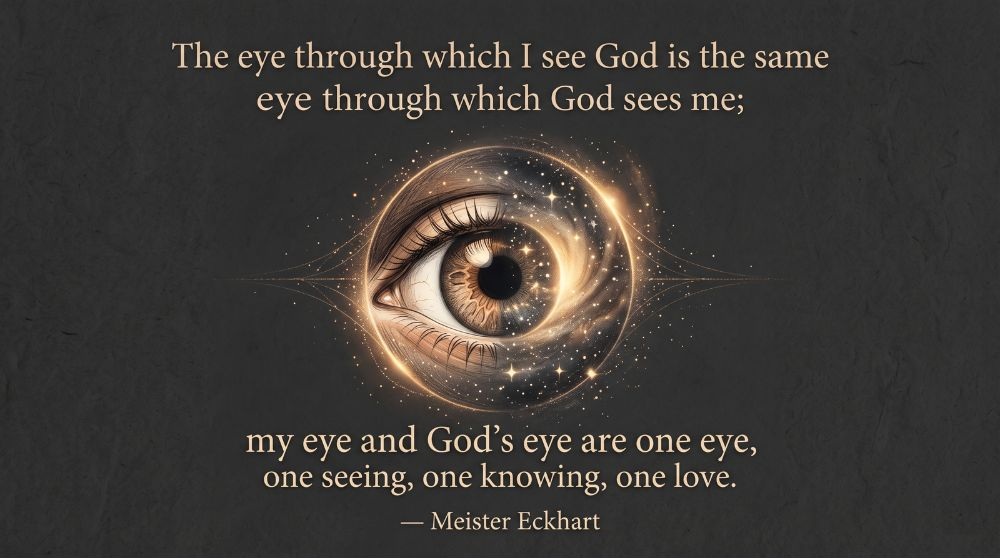
The eye through which I see God is the same eye through which God sees me; my eye and God's eye are one eye, one seeing, one knowing, one love.
Meister Eckhart
Interconnectedness
Climbing back down the mountain
St. Teresa of Ávila once described her ecstatic vision of being visited by an angel (which I find to share striking similarities with what happened to me) as a "pain so great, that it made me moan; and yet so surpassing was the sweetness of this excessive pain, that I could not wish to be rid of it."
And I have to admit, at that moment, I didn't want my "mystical" experience to be over.
That afternoon, even when the sensation was still overwhelming me, I found my mind brimming with questions: “Is this state meant to be chased forever? Could lingering there too long be good or not?”
A peak experience, like what happened to me that day, is just like standing on a 20,000-foot mountain summit. From the top, the view is breathtakingly wonderful. You see how the valleys connect, how the rivers run, how trivial your worries are against the horizon.
Still, nobody can build a kitchen and raise a family at 20,000 feet. There isn't enough air up there. If you refuse to go back down, you are essentially committing escapism. Over time, it will make you lose touch with the real people at the bottom.
The purpose of climbing the mountain is to see the truth clearly. After that, you have to return to the world and live that truth. To wash the dishes, answer emails, listen attentively, and be gentle to everyone around you.
In the center of the shopping district, I was suddenly overwhelmed with the realization that I loved all these people, that they were mine and I theirs, that we could not be alien to one another even though we were total strangers. It was like waking from a dream of separateness, of spurious self-isolation in a special world…
If only we could see each other that way all the time. There would be no more war, no more hatred, no more cruelty, no more greed.
Thomas Merton, “Conjectures of a Guilty Bystander”
One nation in the sky
And here comes a somewhat sensitive section—one that concerns religion. For most of history, various organized religions have asserted that “God is universal,” that “there is only one God for all.” In theory, what they preach sounds really nice and uniting—very similar to the idea of interconnectedness we have discussed so far.
But in reality, many of them spend so much energy building walls instead of bridges.
In Yann Martel’s novel Life of Pi, there is a funny scene that goes like this. Young Pi has recently begun practicing Hinduism, Christianity, and Islam all at once. One afternoon on a seaside promenade, his Catholic priest, his Muslim imam, and his Hindu pandit happen to cross paths. Within minutes, the three men begin to shout insults at each other’s scriptures and traditions—each insisting his own path holds the sole key to salvation.
“Hindus and Christians are idolaters. They have many gods.”
“The word of God? To that illiterate merchant of yours in the middle of the desert?”
“The proof of how bad Islam is, is how uncivilized Muslims are.”
Later that day, Pi’s mother tries to talk sense into him:
"Father and I find your religious excited energy a bit of a mystery."
"It is a Mystery."
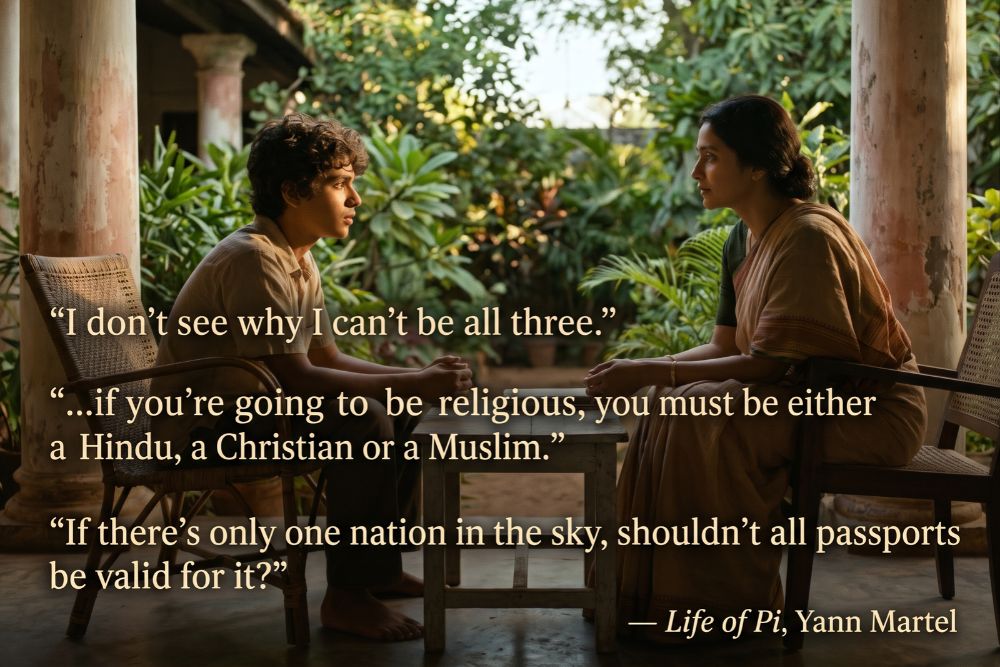
"Hmmm. I don't mean it that way. Listen, my darling, if you're going to be religious, you must be either a Hindu, a Christian or a Muslim. You heard what they said on the esplanade."
"I don't see why I can't be all three. Mamaji has two passports. He's Indian and French. Why can't I be a Hindu, a Christian and a Muslim?"
"That's different. France and India are nations on earth."
"How many nations are there in the sky?"
She thought for a second. "One. That's the point. One nation, one passport."
"One nation in the sky?"
"Yes. Or none. There's that option too, you know. These are terribly old-fashioned things you've taken to."
"If there's only one nation in the sky, shouldn't all passports be valid for it?"
For my part, I find that innocent question of Pi points toward a way of understanding the Ultimate Reality that philosophers and theologians call Panentheism—literally, "All in God."
One ocean, different scales
For centuries, people have generally been limited by two options when it comes to the nature of the divine:
Classical Theism places God outside the world—like an architect inspecting a building from across the street. That picture easily turns faith into turf wars, while at the same time making it challenging to explain what appears to be the universe’s complete silence.
Pantheism (commonly attributed to the philosopher Baruch Spinoza) claims that God is the physical universe ("God is All")—which unfortunately prompts many to deem the cosmos as nothing beyond physics and chemical equations.
Between those two extremes, however, lies a third path—long echoed by mystics and increasingly embraced in modern thought—called Panentheism, which acts as a bridge between Theism and Pantheism. Accordingly, the universe lives inside the divine, and the divine breathes through every leaf, atom, and human heart—while still remaining larger and deeper than the sum of its parts.
To better visualize this perspective, let us think back to the ocean metaphor for a moment. Look at the sea from a satellite, and you will see an impersonal system of chemical water, gravity, and weather patterns. Now wade ankle-deep into the surf at dusk: a single wave curls right over your feet and touches you directly.
The same water—encountered at two distinct scales.
Interconnectedness
That helps explain why two sincere seekers can describe the same reality in very different tongues. One steps back and calls that infinite ground of being the Tao or Emptiness. Another steps into the surf and meets it personally—as Christ or Krishna. Different passports; same sky.
Hindus, in their capacity for love, are indeed hairless Christians, just as Muslims, in the way they see God in everything, are bearded Hindus, and Christians, in their devotion to God, are hat wearing Muslims.
Yann Martel, "Life of Pi"
"By their fruits ye shall know them"
Of course, skeptics and religious scholars will likely (and fairly) push back here:
“Wait—aren't a Buddhist meditating on emptiness and a Christian praying in church having two totally different inner experiences shaped by their own cultures?”
Probably, yes. Our upbringing, language, and the cultural metaphors we are exposed to do shape the trail we travel up the mountain. A climber ascending the icy north face will see blizzards and crampons; another one ascending the forested south face will write about pine needles and mud. Their personal experiences look nothing alike.
Over a century ago, the American philosopher and psychologist William James offered a grounded way out of this debate. Instead of arguing over unprovable metaphysical roots, he proposed an empirical test as follows: (for which he actually drew inspiration from a Biblical passage)
"By their fruits ye shall know them, not by their roots."
When we stop checking people’s beliefs and simply watch how they live after they climb back down the mountain, the surface differences start looking remarkably small:
The ego shrinks. Across traditions, people touched by this realization grow noticeably less defensive, less obsessed with status, and less brittle when insulted.
Compassion stops being a chore. Whether they call it Karuna or Agape, they find themselves strangely unable to walk past someone else’s suffering unmoved.
Fear loosens its grip. Because they are no longer caught up within themselves, both the terror of death and the urge to hoard things begin to fade.
There’s no need to be bothered by the label of your own “passport”. At the end of the day, what matters is whether it allows you to be gentler, steadier, and more attentive to the one standing beside you.
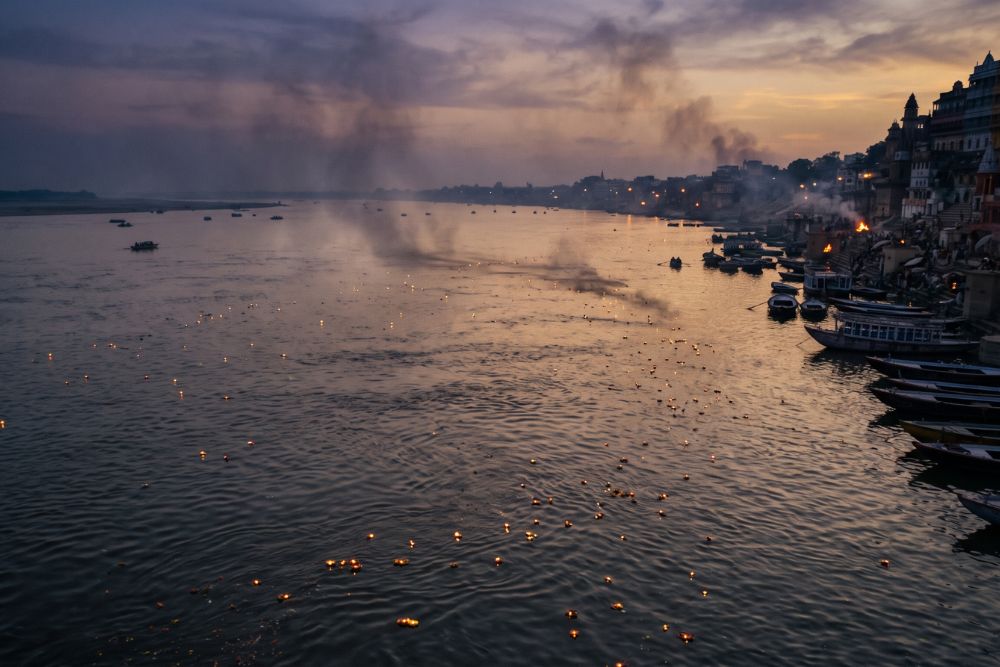
The Ganges swallows up the ashes of every person as it flows along, rejecting neither the beggar woman who stretches out her fingerless hands nor the murdered prime minister, [Indira] Gandhi. The river of love that is my Onion [God] flows past, accepting all, rejecting neither the ugliest of men nor the filthiest […]
A river of humanity […] so deep I feel as though it’s not just for the Hindus but for everyone.
Shūsaku Endō, "Deep River"
Interconnectedness in spirituality
Where Does Evil Come From? (Breaking Our Shared Humanity)
If interconnectedness lies at the heart of our existence, the question is: why does evil exist? Why, then, do many human beings willingly treat one another with such shocking cruelty?
How come a human heart can turn cold enough to actively try to destroy another life?
“How much” is a human?
This may sound appalling, but technically speaking, a human body isn't worth very much. Break us down into raw chemical ingredients—carbon, nitrogen, calcium, trace iron, and a whole lot of water—and the market value of our parts comes out to roughly twenty dollars.
On paper, destroying twenty dollars’ worth of organic matter shouldn't feel much different from smashing an old wooden chair. But does that apply to reality?
Imagine being handed the power—and the choice—to take another human being’s life right in front of you. What do you feel at that moment?
I believe that almost instantly, an invisible weight will drop into your chest.
Even if you don’t claim to be religious, even if nobody else is watching, something deep inside your gut recoils—as if you are breaking a law of nature. As though some built-in boundary is holding your hand back—unless you are willing to cross a line and turn into a “beast”.
“Whenever we kill, we kill a part of ourselves”
Where does that invisible weight come from then?
Part of the answer, of course, has to do with biology. Humans, after all, are social creatures relying on groups to survive; if harming one another felt nothing, our species would have wiped itself out a hundred thousand years ago. As shown by research, there are specialized mirror neurons inside one’s brain that quietly simulate another person's distress inside one’s own nervous system. When you see someone in pain, your brain naturally "simulates" that pain.
To harm someone face-to-face, therefore, means you must endure the psychological blowback of witnessing their pain. Your brain resists this because it feels like self-inflicted harm. Poetically speaking, it is not much different than killing yourself.
To look at another human being and treat them as "killable" or worthless, you first have to numb your own capacity for empathy. You can't amputate someone else’s humanity without hacking away at a living piece of your own. And in doing so—in declaring that the life in front of you is just cheap meat—you silently confess that you yourself are nothing more than cheap meat, too.
In light of this, it’s arguably safe to say interconnectedness is much more than an abstract idea, but something hardwired into human neurobiology and psychology.
The Face of the Other
The philosopher Emmanuel Levinas once proposed a concept called the “Face of the Other”. He argued that the moment you actually look into another human being’s face—meeting their eyes, seeing their fragile skin and feeling their vulnerable breath—the person’s very existence issues a silent command, without the need for any rulebook or religious decree:
"Thou shalt not kill."
To end someone’s life is not to discard twenty dollars’ worth of chemicals, but to extinguish a whole universe of perception, memory, and potential. The "weight" you feel, therefore, stems from the realization that you are attempting to delete something that is, for all intents and purposes, infinite.
Interconnectedness
In nature, predators kill without hesitation because they only act out of their biological instincts. But human beings are “blessed”—or “condemned”—with the ability to consciously reflect on our actions.
A beast—or a machine—can end a life without hesitation because it has no "self" to carry guilt or regret. As such, when you feel that intense pressure in your chest, you are actually experiencing the most vivid proof of your own humanity: the clash between a purely physical body (worth only $20) and the infinite "I am" that refuses to treat life as disposable.
The recognition of the life of every man as sacred is the first and only basis of all ethics.
Leo Tolstoy, "The Kingdom of God is Within You"
The slow erosion of humanity
The propagandist's purpose is to make one set of people forget that certain other sets of people are human.
Aldous Huxley
Given everything we have discussed so far, how come countless people have ended up committing unimaginable atrocities? Why are there so many “monsters” recorded in history?
Most of us like to imagine that such “monsters” are born as a completely different species, without a conscience from day one. While neuroscience has concluded that a small fraction of people are indeed born with blunted fear and empathy circuits, the reality is that most "beasts" weren't born that way. They unmade themselves, one small step at a time.
Here is what the process looks like, according to psychologists who study war criminals and authoritarian regimes:
First, it starts with twisting the language. Real human beings are referred to as "vermin," "parasites," or "collateral." To kill them is essentially to “get rid of a problem”.
The next stage is routine. The first time someone crosses a moral line, the recoil inside their chest is agonizing. The second time, there is slightly less left alive to feel the sting.
Eventually, the person reaches a point of "moral anesthesia." Out of fear, ideology, ambition, or blind obedience, the ego contracts so tightly around itself that the weight disappears altogether. By the time they carry out their worst acts, the human being they once were has already been traded away.
When reading stories about criminals, most of us like to tell ourselves we could never walk down that path. Yet if we are not careful, the same instinct—to shrink another person down—can show up in our life too, many times in a very “noble” manner.
I happen to personally know an elder, who is also a dogmatic purist believer. During a conversation one day, she brought up the women who stand along a road near where we live at night selling sex. Without blinking, she referred to them as "succubi" (note: in my native language, the word she used literally translates to "female demons")
Something inside me tightened immediately.
"You shouldn't speak of them that way," I said. "They are still human beings."
Her face hardened. "Obviously they are succubi," she snapped back, visibly irritated. "What else could they be?"
I could see in her eyes she wasn't interested in talking at all. So I stepped back and let her continue on her own.
Later, though, I remembered she had once used that same derogatory label for women who dressed a little "immodestly" by her standards. And I recalled how she constantly policed those living in the house opposite hers.
According to rumors, the mother in that house was having an affair with a married man, and the daughter (still in her teenage years) regularly brought her “boyfriend” home—both of which the elder deemed “wicked” and “immoral”. As such, she kept a tireless watch on their front door. Whenever the boy arrived or the daughter stepped outside, she observed their every move, then hurried off to gossip with those in her inner circles—lamenting how "sinful" they were and calling the teenager foolish and “cheap”.
Turning tragedy into entertainment
And here’s another story. Another day, I was scrolling through LinkedIn when a post stopped me in my tracks. It was written by a connection of mine—someone who regularly published reflections on philosophy and spirituality, and had (as far as I know) even written and translated some philosophical books himself. In his post, he commented on recent chaotic incidents—including the Russia–Ukraine War—and concluded: (translated literally from my own native language)
“The film is just about to get interesting.”
I stared at the screen in disbelief. People were dying. Parents were burying their children. Families were being forced to flee bombed-out towns in the freezing dark—and someone out there, who built his reputation around spiritual wisdom, was treating their agony like a thrilling plot twist?
As I paid closer attention to his writing afterward, I couldn’t help but notice a subtle pattern I had previously missed: a dogmatic, authoritative, top-down voice—that of an “expert” lecturing from above to an ordinary crowd below. And I started wondering: is this really philosophy, or something else?
Different symptoms, one sickness
Reflecting on these two experiences eventually made me arrive at a conclusion. While seemingly unrelated to each other, they both point to the same “sickness”: moral superiority. The two people were using their beliefs not to love, but to look away from reality and assert their own ego. Both were turning living people into abstractions.
When the elder labeled the sex workers "succubi" and the teenager a walking "sin," she was reducing complex human beings into cartoon villains. It is so much easier to condemn a “demon” than to take into account someone else's poverty, loneliness, or desperation.
In the same way, calling an ongoing war "a film getting interesting" turns suffering families into plot devices. It is a prime example of “spiritual bypassing”—using lofty ideas as a shield so you don't have to feel ordinary human heartbreak.
In both cases, self-righteousness was disguised as virtue.
You can memorize every holy scripture, or translate a bunch of dense philosophical books, and still keep a wall of ice around your heart. In fact—as far as I can see—the more you become attached to religious rules and philosophical jargon, the more you are likely to cross your arms and judge from a distance.
Why? Because you only love an idea of humanity, not the real flawed humans before you.
Because you haven’t spent enough time looking inward—and humbled yourself in the process.
Because you are so obsessed with “changing the world” instead of “changing yourself”.
Now, I’m not saying we should become apathetic and refuse to make any moral judgment at all; realistically, that isn't possible. When someone commits undeniable harm, our job is to speak up. However, what matters is how we do it: not with self-righteous disgust, but with understanding.
Read more: Slave Morality - The Hidden Shadow of Conventional Ethics
The comfort of “us vs. them”
Not long ago, while traveling with two of my loved ones, I overheard them talking in shock about a news story. Apparently, an online influencer had just been caught for manufacturing and selling fake "chicken floss"—stuffed with cheap fillers, industrial chemicals, additives, and meat scraps. The thing my loved ones found most unsettling about the incident was not the act itself, but how coldly the person answered when being interrogated by the police:
"It’s just what everyone else does."
As my loved ones remarked on how anyone could say such a thing so casually—how "corrupted" people had become, I found myself sitting there in silence, caught in a turbulent inner state. If it had been a few years earlier, I probably would have joined their discussion and shaken my head:
"Humanity is rotten. Society is beyond saving."
Yet in that moment, something was holding me back.
Upon hearing a story like that, we instinctively want to frame the wrongdoer as a malice-driven “monster”—totally foreign to normal people like us. It’s so tempting (and understandable) to react that way, until we stop to seriously think about what has created that “monster” in the first place.
I cannot say for sure what it was in the case of that influencer, but if I have to bet based on her response ("It’s just what everyone else does"), I would say it was thoughtlessness. That she saw competitors cutting corners, wanted quick money, and numbed her conscience to follow the “crowd”.
That, I dare to say, is the real cause of much cruelty in daily life. Not malice, but a refusal to think for oneself.
As for the rest of us—those who are comfortably positioned to judge the wrongdoer—how should we respond in such a case then?
Should we call the person a “monster” and shrug that "society is doomed"?
The thing with that kind of reaction is that it draws a neat chalk line across the floor: decent US on one side; and rotten THEM on the other. Once that line is drawn, we get to walk away feeling clean.
But have we ever paused for a moment to think: did that influencer appear out of the blue? Or did they grow inside our world—a world that constantly demands the cheapest price tag without asking who pays the hidden cost? A culture that worships fast wealth and online clout?
We feel disgusted by the person’s excuse, but aren’t we doing the same thing? Aren’t we invoking the same phrase every day: "Well, everyone else is doing it"?
"I am the pirate"
Years ago, during the refugee crisis following the Vietnam War, the Zen monk Thich Nhat Hanh received news about a twelve-year-old refugee girl who had been assaulted by a sea pirate on a small boat in the Gulf of Siam and threw herself into the ocean.
For most of us, reading such news would cause pure outrage—the desire to make the pirate “pay for his crime” and shoot him on sight. And yet, Nhat Hanh asked himself (and everyone) a haunting question:
“How have we lived our life so that that young man… has been able to become a rapist?”
Think about this. Imagine being born into generations of grinding poverty, forced onto a boat at thirteen with no education, no shelter, and no experience of genuine love. Under those conditions, who could swear with certainty that they wouldn't have acted the same way?
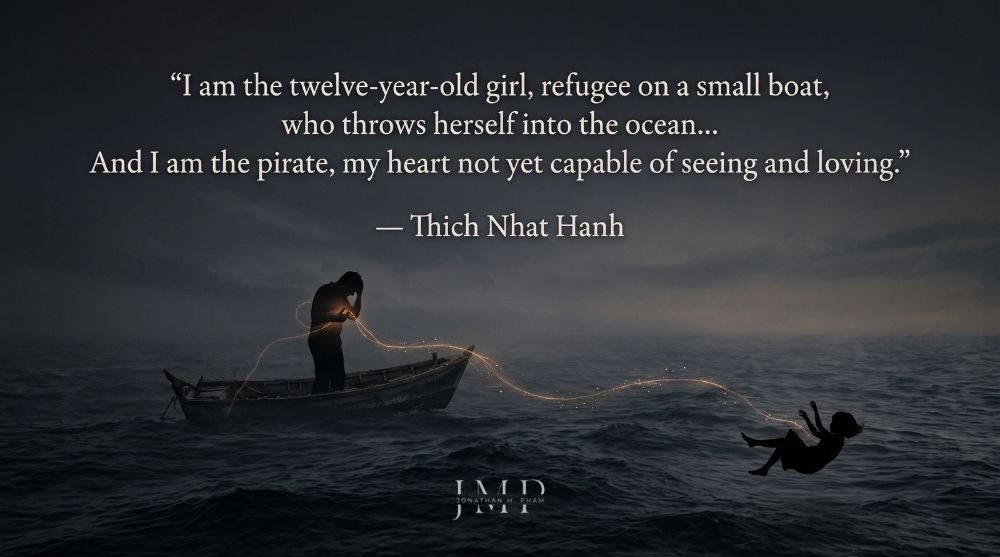
"I am the twelve-year-old girl, refugee on a small boat, who throws herself into the ocean after being raped by a sea pirate;
And I am the pirate, my heart not yet capable of seeing and loving."
Interconnectedness
From outrage to compassion
Let us be crystal clear here: understanding the conditions that create a wrongdoer is never the same as excusing the wrong. Fake food must still be pulled off the shelves; crimes must face the law; vulnerable people must be defended. Acknowledging that a fire started because of dry wood and careless sparks does not mean you let the house burn down.
What needs to be re-evaluated isn't moral accountability, but the illusion of our own moral superiority.
When you trace the whole chain of cause and effect—from the person who poisoned the food, to an economy that rewards material wealth over truth and character cultivation—it becomes obvious that you are not much different from the wrongdoer. You were only fortunate enough to receive the conditions—a caring family, a good book, a timely warning—that helped your conscience stay awake.
Once you see that whole ecosystem, the way you respond would change from the inside out. Online outrage burns hot for a few days, lets everyone feel virtuous for a moment, and leaves the conditions that keep producing "pirates" completely intact.
For the world to truly change—even if it takes time and effort—what we need is not outrage, but compassion. The compassion to see through people’s psyches (and yours too), so that you can:
Refuse to sleepwalk: Questioning the "everyone else does it" mindset in your own work, purchases, and daily habits.
Nurture better soil: Cultivating small pockets of honesty and warmth in your immediate circle—so fewer hearts grow up starved of love in the first place.
Darkness cannot drive out darkness: only light can do that. Hate cannot drive out hate: only love can do that.
Martin Luther King Jr.
The Miracle of Solidarity
Across the previous section, we have stared into some very dark corners of human nature. If those were the whole story of our species, there wouldn't be much reason for hope.
Yet as history has shown, something astonishing happens whenever a real-life crisis strips away our everyday mask.
When the lights go out
I have seen the truth; I have seen and I know that people can be beautiful and happy without losing the power of living on earth. I will not and cannot believe that evil is the normal condition of mankind.
Fyodor Dostoevsky, "The Dream of a Ridiculous Man"
In many Hollywood movies, the script for what happens in a disaster is almost always the same. The power grid fails, the police sirens fade, the store shelves empty—and within forty-eight hours, civilized people become Lord of the Flies savages, hoarding bottled water, smashing windows, and turning on their neighbors in panic.
Cynics call this the "veneer theory": the idea that humans are naturally selfish, and only laws and locks can keep us behaving decently. This belief is so prevalent in pop culture that many people mistake it for the truth about humanity.
But is it, truly?
When real-world sociologists study what actually happens after disasters like earthquakes, floods, and blackouts, the Hollywood script falls apart almost every time. When the lights go out, most people don't turn into monsters. They turn toward each other.
For example:
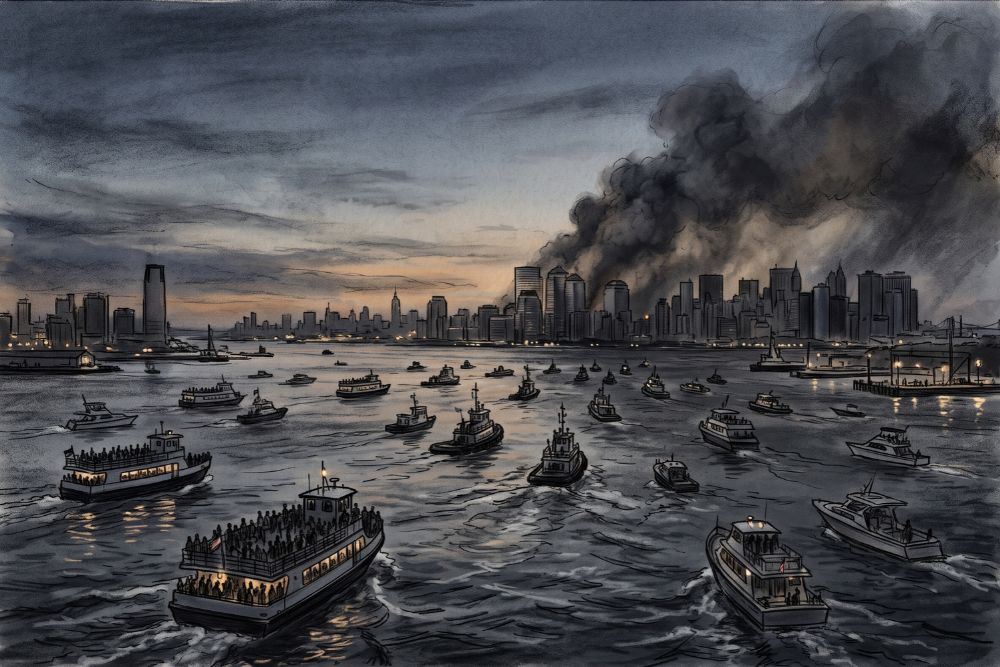
On the morning of September 11, 2001, hundreds of thousands of commuters were trapped at the southern tip of Manhattan with bridges and tunnels shut down. The U.S. Coast Guard put out a radio call for any available boats. Within minutes, hundreds of civilian captains—ferries, tugboats, fishing vessels, pleasure yachts—turned their bows toward the burning towers. Working side by side with no central script, strangers evacuated nearly 500,000 people in nine hours—the largest maritime rescue in human history.
Likewise, disaster researchers have documented the same pattern from the 1985 Mexico City earthquake to the quakes in Turkey and Syria in 2023. Before the arrival of official rescue teams, ordinary people—without heavy machinery—had already formed bucket brigades to clear debris by hand. Many willingly crawled into highly unstable voids in collapsed structures to drag survivors to safety.
Interconnectedness of societies
Historian and writer Rebecca Solnit, who spent years documenting this phenomenon in her work A Paradise Built in Hell, found that during catastrophes, communities repeatedly experience a surge of spontaneous mutual aid—sharing dwindling food, setting up makeshift kitchens, and risking their lives for those whose names they didn't know an hour earlier.
Given that, why are so many of us convinced that chaos and looting are the norm?
Mostly, it has to do with what sociologists call "elite panic." Viewing a crisis from afar, authorities and media networks frequently project their own fear of losing control onto the public. A handful of broken storefront windows get looped on television screens for days—far higher ratings than footage of neighbors carrying soup to elderly residents—while armed guards get sent to protect property instead of supporting the lifesaving communities already at work.
Why do we help each other?
The reality of what happens following a disaster raises a question: how come strangers suddenly become brothers and sisters the moment the ground starts shaking?
Because a catastrophe acts like a lightning flash that burns away artificial walls:
Social barriers vanish
On a normal Tuesday, we walk past each other walled off by status, class, political tribes, busy schedules. But a flood or an earthquake doesn't check anyone’s job title or bank balance.
When trapped in a stairwell, a doctor, a street vendor, and an office worker all face the same reality: we are weak, and we need each other to make it through the night.
Our survival instinct kicks in
Under acute stress, human beings don't only default to "fight or flight." As documented by psychologists, there’s another biological response called "tend and befriend"—a surge of bonding hormones like oxytocin that pushes us to shelter the vulnerable, pool resources, and stay close to the group.
For hundreds of thousands of years, a lone human couldn't survive winter or predators. Helping the person next to you was how you survived.
In that sense, the acts of goodness observed after a disaster do not magically appear out of nowhere. They manifest when all of the distractions and status games are stripped away.
In that moment, what is revealed underneath is the interconnected baseline that has been there all along.
Whoever you may be who are reading these lines... think of your duties—not your supposed duties as a landowner to your estate, as a merchant to your business, as emperor, minister, or official to the state, but of your real duties, the duties that follow from your real position as a being called into life and endowed with reason and love.
Leo Tolstoy, "The Kingdom of God is Within You"
Let suffering crack us open
One heart is not connected to another through harmony alone. They are, instead, linked deeply through their wounds. Pain linked to pain, fragility to fragility. There is no silence without a cry of grief, no forgiveness without bloodshed, no acceptance without a passage through acute loss. That is what lies at the root of true harmony.
Haruki Murakami
We talked about how a disaster has the power to knock down the invisible walls between people. But in reality, you don't need a large-scale crisis to “wake up”. Sometimes, all it takes is a personal wound.
When everything in life is running smoothly—bills paid, schedule full—it is remarkably easy to stay self-contained. That said, when something unexpected breaks our stride—an illness, a humbling failure, a heartbreak—the glossy shell we have long hid behind fractures.
And oddly enough, it is often through those very cracks that light finally gets in.
In Akira Kurosawa’s masterpiece Ikiru (literally, "To Live"), the story follows Kanji Watanabe, a Japanese low-level bureaucrat who has stayed in a meaningless government job for 30 years. Nicknamed "the Mummy" by his coworkers, he spends every workday in the same dull cycle: stamping forms, passing petitions from desk to desk, and going home at the end of the day.
Then one afternoon, he gets diagnosed with terminal stomach cancer and is informed that he has roughly six months left to live.
The shock shatters his sleepwalking trance. Panic-stricken at having wasted his whole life, Watanabe tries drowning his fear in neon nightlife—only to end up emptier than before. In desperation, he reaches out to Toyo, a young clerk who recently resigned from her office job to work in a small toy factory.
Sitting across from her in a tea shop, the dying old man begs her to tell him her secret:
“Why are you so alive?”
To which Toyo looks completely baffled. She then reaches into her purse, pulls out a tiny mechanical toy rabbit, winds the key, and sends it hopping across the table toward him.
"All I do is make these little things. Making them, I feel like I'm playing with every baby in Japan. Why don't you try making something too?"
Those words hit Watanabe hard. In that moment, he realizes: he doesn’t need any grand achievements; nor does he need to cling to the people under his own roof. (including his son Mitsuo, who has been solely preoccupied with his inheritance and knows nothing of his father’s dire situation) To contribute his remaining days to cultivating others’ joy—that is more than enough to live.
With the toy rabbit in his arms, Watanabe marches back to City Hall. He bows to the bureaucratic officials, endures their mockery, and pours every ounce of his last strength into advocating for a petition from neighborhood mothers—draining a mosquito-ridden swamp to build a small children’s playground.
Near the end of the film, on a freezing winter night, a policeman finds Watanabe sitting alone on a swing in that finished park, singing a song to himself. He is dying—yet for the first time in thirty years, he is no longer alone.
His own suffering, which originally plunged him into despair and isolation, has ironically led to his eventual “awakening”. Thanks to it, he has discovered a “We” much stronger than bloodline.
Most of us instinctively treat pain as a humiliation—a flaw to hide behind closed doors so nobody sees how vulnerable we are. Yet if we can let our own wounds soften us—instead of turning us bitter, something extraordinary would happen.
Instead of locking us inside a dark room convinced that nobody on earth could ever understand what we carry, our fragility can become the very bridge that lets us recognize—and answer—the hidden fragility in someone else.
You think your pain and your heartbreak are unprecedented in the history of the world, but then you read. It was Dostoevsky and Dickens who taught me that the things that tormented me most were the very things that connected me with all the people who were alive, or who ever had been alive. Only if we face these open wounds in ourselves can we understand them in other people.
James Baldwin
Interconnectedness of the world
Read more: Limit Situations - What to Do When Life Hits a Boundary
Grief as proof of connection
If you have ever lost someone you loved, you know how terrible the experience is. To wake up at six in the morning with a strange weight in your chest, and forget—for a half second—that the person is no longer here to hear the story you would like to tell them. Many times, out of the desire to comfort us, people give us well-meaning advice that, ironically, only makes us feel more forsaken. (“Don't cry—everything is temporary!” or “They are in a better place now!")
But what if we reframe our view of grief—that it is proof that we were never alone?
If human beings were self-contained islands side by side, losing someone wouldn't hurt at all. One island would simply be washed away, and the one beside it would remain unchanged.
Grief hurts precisely because each individual’s existence is woven together across thousands of hours. The way you drink your morning coffee, the jokes only the two of you understood, the safety of knowing someone on earth cared whether you got home safe—all of that lived inside the shared space (Ma) between you.
When someone passes away, that ache in your chest is the living outline of the space they used to fill.
The cloud in the teacup
At the same time, the realization of interconnectedness makes it possible to soften the hardest terror inside death—the fear that the people we love (and eventually we ourselves) simply fall off a cliff into absolute nothingness.
In his book, Thich Nhat Hanh offers us a striking way to perceive reality. Imagine looking up at a cloud drifting across the summer sky. A few hours later, the sky is clear, and the cloud is nowhere to be seen. If you only stare at the sky, it is easy to weep for your lost cloud and believe it has gone forever.
But in reality, the cloud never fell out of existence. When the air cooled, it transformed into rain falling onto a hillside. The rain soaked into the earth, fed the roots of a tea bush, and filled the leaves plucked for harvest. Later that evening, when you sit at the kitchen table holding a steaming mug of tea, the cloud is right there inside your cup—in a new form.
Nothing in this universe comes from absolute nothing, and nothing ever vanishes into absolute nothing. Forms change; the stream continues.
Interconnectedness of life
The same principle applies to the people you love. Your parents, your teacher, your best friend—nobody who touched your life ever vanishes into zero.
Just look down at your own hands when you cook a meal without having to check a recipe. Or, listen to your own voice when a phrase of encouragement slips out toward a struggling friend—words you didn't invent, but were passed down to you years ago.
In these moments, it becomes obvious that your loved one is still here—hidden in your patience, courage, and character as a whole.
The day my mother died I wrote in my journal, "A serious misfortune of my life has arrived." I suffered for more than one year after the passing away of my mother. But one night… I dreamed of my mother. I saw myself sitting with her, and we were having a wonderful talk… It was so pleasant to sit there and talk to her as if she had never died. When I woke up… I felt very strongly that I had never lost my mother… I understood then that the idea of having lost my mother was just an idea… that my mother is always alive in me.
I opened the door and went outside… Walking slowly in the moonlight through the rows of tea plants, I noticed my mother was still with me. She was the moonlight caressing me as she had done so often, very tender, very sweet... wonderful! Each time my feet touched the earth I knew my mother was there with me. I knew this body was not mine but a living continuation of my mother and my father and my grandparents and great-grandparents…
From that moment on, the idea that I had lost my mother no longer existed. All I had to do was look at the palm of my hand, feel the breeze on my face or the earth under my feet to remember that my mother is always with me, available at any time.
Thich Nhat Hanh, “No Death, No Fear”
Returning to the World (How to Practice Interconnectedness)
Now that we have covered the topic of interconnectedness from many angles, it’s time to put all of these reflections to the test.
I have to warn you though: this is where things get tricky.
To ponder the nature of existence in a meditation room is easy. To embody it in ordinary life is another story altogether—because it means learning to co-exist with the imperfect human being standing three feet away from you. The one who snores, sneezes, leaves dirty dishes in the sink, and—whether intentionally or not—constantly challenges your patience.
The sneezing neighbor
There is an irony I have noticed in myself—and in almost everyone drawn to deep ideas. It is so easy—even intoxicating—to love "humanity" in the abstract. When you sit in your room reading philosophy or reflecting on interconnectedness, your heart can swell with genuine tenderness for the entire human family. You feel patient, generous, even noble.
Then you step out of the room.
Suddenly, you are sharing space with an actual human being: the roommate who forgets to take out the trash for the third week in a row; the partner who snores like a freight train at two in the morning; the relative who chews loudly, sneezes without covering their mouth, has morning breath, and speaks in a grating voice.
And strangely enough, the more passionately someone falls in love with "humanity" in general, the quicker they seem to lose patience with the noisy human standing in front of them.
Over a century ago, the novelist Fyodor Dostoevsky captured this comedy—and tragedy—in his novel The Brothers Karamazov, through a confession from an old doctor:
“The more I love humanity in general, the less I love man in particular. In my dreams, I have often come to making enthusiastic schemes for the service of humanity, and perhaps I might actually have faced crucifixion if it had been suddenly necessary; and yet I am incapable of living in the same room with anyone for two days together, as I know by experience.
As soon as anyone is near me, his personality disturbs my self-complacency and restricts my freedom. In twenty-four hours I begin to hate the best of men: one because he’s too long over his dinner; another because he has a cold and keeps on blowing his nose. I become hostile to people the moment they come close to me.
But it has always happened that the more I detest men individually, the more ardent becomes my love for humanity.”
We laugh when we read that—because it hits far too close to home. How many of us would dream of saving the world, yet feel a flash of murderous irritation because someone kept blowing their nose across the room—and disrupting our "meditation" as a result?
If we think about it, there are a few very human reasons explaining that ironic paradox:
Abstractions never threaten you. "Humanity" is an airbrushed mental daydream. It doesn't leave wet towels on the sofa, play videos out loud on the train, or interrupt you when you are exhausted. Loving an ideal requires zero patience, zero discomfort, and zero sacrifice of your ego.
Distance breeds romance; proximity brings conflict. It is effortless to feel compassion for suffering strangers ten thousand miles away—whose lives are typically portrayed as very touching stories by the media. Then, you meet real people, who come with real body odor, real annoying habits, and real assumptions—all of which violently ruin your fantasies of how humans should behave.
If we expand the discussion beyond a secular setting, the same phenomenon applies to spiritual practices too. You can effortlessly profess your reverence for God, Christ or the Buddha when surrounded by incense or peaceful music. Yet the instant you come home and a neighbor lets their dog mess up your lawn, a slow driver in the parking lot delays you, or a stranger cuts ahead of you in line, all that serenity evaporates in three seconds.
Look no further
Most of us, in such moments, instinctively treat the annoying person beside us as an interruption—something standing in the way of our own peace or higher ideals. “If only everyone around me were quieter, tidier, and a little more considerate, then I could finally live out interconnectedness!”
Yet look closely, and you will see that you are still caught up in an illusion. That you haven’t seen the truth yet.
The sneezing neighbor, the forgetful roommate, the coworker with that irritating voice—they are not an obstacle blocking your philosophical pursuit. They are the practice itself.
Grand gestures of love—dying for mankind, donating a fortune, writing sweeping essays about universal brotherhood—sound impressive on paper, until we realize they rarely happen in daily life. What shows up is the invitation to stay calm in the middle of a conflict—to let an insult slide without keeping score, to forgive someone for being clumsy, to take the trash out without murmuring “I’m doing a favor for you”.
To practice patience, humor, and tenderness in the presence of noise, bad breath, and unwashed dishes—that is what it means to embody the philosophy of interconnectedness. Only then—without being attached to any “noble” idea—may the “I” be softened enough to find its place in the “We”.
We talk about social service, service to the people, service to humanity, service for others who are far away, helping to bring peace to the world; but often we forget that it is the very people around us that we must live for first of all.
If you cannot serve your wife or husband or child or parent, how are you going to serve society? If you cannot make your own child happy, how do you expect to be able to make anyone else happy? If all our friends in the peace movement or of service communities of any kind do not love and help one another, whom can we love and help?
Are we working for other humans, or are we just working for the name of an organization?
Thich Nhat Hanh, “The Miracle of Mindfulness”
Whose neighbor am I?
Has this ever happened to you? Let’s say you are walking down the street when you spot an elder struggling with spilled groceries. You glance at them, then speed up lightly thinking:
"I’m running late; surely someone behind me will help."
Now imagine if that elder was someone you personally know—a relative, the parent of a friend. In that case, even if you were indeed in a hurry, would you still act the same way? Would you run past them without a second thought?
If not, why then?
When it comes to interpersonal relationships, most of us want to draw a hard line between those in our circle—family, countrymen, people who share our beliefs and/or ideologies—and those who sit outside, so that we can ignore them without any pangs of conscience. Without knowing it, we have already slipped into the trap of tribalism—of separating us from them.
And this, as we have touched upon, is the very antithesis of interconnectedness. In succumbing to it, without ever asking why, we create a gap between our own philosophy and practice in reality.
In the Gospel of Luke, a religious scholar reaches out to ask Jesus this question: "Who is my neighbor?" Instead of handing him a clear-cut definition, Jesus tells a brief story as follows.
A traveler going down the road from Jerusalem to Jericho is ambushed by robbers—he is beaten, stripped, and left half-dead in a ditch. Soon, a Priest walks down that road. He sees the bleeding man, crosses to the far side, and keeps walking. Next comes a Levite—another religious figure respected by people. He looks over, crosses to the opposite side, and hurries on too.
Then a third traveler rides up: a Samaritan. To the Jews at the time, Samaritans were bitter rivals—outsiders whose faith and customs were despised.
Yet the Samaritan stops. He climbs down, pours oil and wine on the stranger’s wounds, bandages them, lifts the man onto his own donkey, brings him to an inn, and pays out of his own pocket to make sure he is cared for.
After finishing the story, Jesus asks the scholar: "Which of these three do you think was a neighbor to the man who fell into the hands of robbers?"
Look at how the perspective has been flipped. The original question was "Who is my neighbor?", but now, it essentially becomes "Whose neighbor am I?"
"Who is my neighbor?" puts you in the judge’s chair. From this angle, connection is a membership card to be verified before you decide whether someone deserves your attention.
"Whose neighbor am I?" hands the responsibility back to you. Accordingly, you don't get to draw a border around who matters. The moment someone in trouble crosses your path, you know you and the person are connected to each other.
Interconnectedness
Most of us will never stumble across a mugging victim in a desert canyon. Still, from time to time, life will present each of us with a similar incident:
A friend who suddenly sends shorter, flatter messages than usual;
A stranger who accidentally drops a stack of papers in the rain;
A coworker who eats lunch alone at their desk week after week;
An elder hesitating at the edge of a busy crosswalk, while everyone else rushes past;
A junior member who asks for a quick meeting over something they could have handled on their own;
Someone in a group conversation who gets talked over twice and stops trying to speak;
A friend who laughs off a setback with "I'm fine, really," though their voice tells a different story.
In such moments, who will we act like? The Priest, the Levite, or the Good Samaritan?
Will we excuse our inaction by passing the buck or blaming the circumstances? (e.g. “I am too busy”; "They probably just want space" ; “They have wronged me in the past”; “They still owe me a favor”; “I can’t stand their voice”; “They are outsiders”)
Let that sink in for a moment.
It’s true that you cannot save everyone on earth. And in fact, you don't have to.
Your only responsibility is to notice who happens to be lying along your road today—and refuse to cross to the other side. To be fully aware and answer the moment right in front of you, rather than hiding behind a wall of assumptions.
All mankind is tied together; all life is interrelated, and we are all caught in an inescapable network of mutuality, tied in a single garment of destiny. Whatever affects one directly, affects all indirectly.
For some strange reason I can never be what I ought to be until you are what you ought to be. And you can never be what you ought to be until I am what I ought to be — this is the interrelated structure of reality.
Martin Luther King Jr.
Global interconnectedness
A silent spring
Without a sense of the inherent sacredness of the world—of every tiny bit of life and death—we struggle to see God in our own reality, let alone to respect reality, protect it, or love it. The consequences of this ignorance are all around us, seen in the way we have exploited and damaged our fellow human beings, the dear animals, the web of growing things, the land, the waters, and the very air.
Richard Rohr
In 1962, a marine biologist named Rachel Carson published a book called Silent Spring, which set off a storm across America. For years after World War II, chemical companies and governments had been celebrating a synthetic pesticide called DDT—spraying it liberally across farmlands, forests, and suburban neighborhoods under the illusion that humanity was finally conquering nature. Bugs died, crops looked clean, and everyone went on with their day.
But Carson looked closer and traced an invisible thread nobody saw—or wanted to see.
Rain-washed chemicals didn't stay inside the fence where they were sprayed. Trickling off Midwestern fields into rivers and oceans, tiny doses entered microscopic plankton, multiplied inside small fish, concentrated further inside larger predators, and worked their way into the bodies of bald eagles and songbirds—eventually thinning their eggshells until chicks couldn't hatch.
As Carson warned, if people left this unchecked—if we kept acting as "masters" standing outside nature rather than participants inside an interconnected ecosystem—we would be heading toward a literal "silent spring," where mornings would arrive without a single bird singing in the trees.
Following the book’s publication, Carson faced ferocious backlash. Chemical giants poured fortunes into mocking her; they called her hysterical, unscientific, and an enemy of human progress. Yet despite the smears—and despite having to battle terminal cancer herself at the time—Carson stood her ground. She simply couldn't bear to watch our living home poisoned by human arrogance.
In the end, she was proven right. Following the 1972 U.S. ban on DDT, species like the bald eagle, peregrine falcon, and brown pelican made dramatic recoveries.
Interconnectedness of all things
If we look at Carson’s story in light of everything we have discussed so far, there is very little excuse left for clinging to the "man is an island" myth. Just like a single butterfly effect rippling through a weather system, nothing we pour into the world disappears into nowhere. A chemical sprayed on one farm shows up in the fat reserves of Arctic wildlife thousands of miles away; a throwaway plastic habit clogs a river downstream; a careless convenience bought cheap here rests on someone else's shoulders across the ocean.
Given that every action is capable of rippling outward that far, it’s essential that we make concrete changes to how we live every day, by:
Letting go of blind greed and the desire for "more, faster, cheaper".
Staying willing to engage in dialogue with others, rethink our assumptions, and change course when necessary, instead of hiding behind "this is how we've always done it."
Being more thoughtful in our daily routines—such as wasting less food and water, repairing things instead of throwing them away, and choosing sustainable practices at home and at work.
Read more: The Shepherd of Being - Guarding the Mystery of Existence in an Age of Noise
Ripple effect
Loving an imperfect world
There exists a solidarity among men as human beings that makes each co-responsible for every wrong and every injustice in the world, especially for crimes committed in his presence or with his knowledge. If I fail to do whatever I can to prevent them, I too am guilty.
Karl Jaspers, "The Question of German Guilt"
I have to admit something here, though. When I first read stories like Rachel Carson’s—when it dawned on me how much unintended damage a single habit or industry could ripple outward across the whole system—my mood sank.
“Everything is connected, everything is wounded? What difference, then, can one ordinary life possibly make?”
It’s easy to slide into despair following that realization. That said, we can pivot to another stance that the philosopher Hannah Arendt called Amor Mundi—which literally means "love of the world.” To look at our imperfect home exactly as it is, rather than wishing to escape to a spotless utopia elsewhere. To know every flaw it carries, how small these two hands are, and still choose to mend what sits within our reach anyway.
The world may indeed be “broken”. It’s natural to feel a pang of guilt or sorrow when you look at its current state. But don’t let it freeze you into doing nothing. Channel it into movement instead.
Plant a tree whose shade you may never sit under;
Speak up kindly in a meeting when everyone else looks away;
Mentor a younger person whose future you won't control;
Tend your own small garden with care, even when nobody is clapping.
Interconnectedness
There’s no need to wonder how much of an impact your act can produce; after all, most meaningful change doesn’t come immediately. In the case of Carson, she died of cancer in 1964—eight years before the U.S. finally banned DDT. She never lived to see the eagles return to the sky. And yet that didn’t prevent her from acting anyway.
You can do the same. Take the leap even when everything is still in the dark—when nothing is guaranteed. Love this imperfect world enough to leave your small patch of it a little better than you found it.
The world is a fine place and worth the fighting for and I hate very much to leave it.
Ernest Hemingway, "For Whom the Bell Tolls"
Frequently Asked Questions About Interconnectedness
What does interconnectedness mean?
Interconnectedness is the recognition that nothing in the universe exists completely on its own. Every human being, living organism, and moment is woven into a vast web of relationships—shaped by nature, language, culture, and the unseen actions of others.
Examples of interconnectedness:
Mycorrhizal networks: Underground fungal threads connect forest trees, allowing them to share nutrients, water, and chemical distress signals.
The water cycle: Water evaporating from a tropical ocean falls as rain on distant crops, feeds a river, and eventually returns to the sea.
Your morning coffee: A single cup relies on farmers in one hemisphere, cargo ships, roasters, packaging factories, and the local barista.
Language and thought: Words coined centuries ago in dead languages still shape how you name your emotions and frame ideas today.
Gut microbiome: Trillions of bacteria inside your digestive tract regulate your immune system, metabolism, and even your mood.
Pollination: Bees and butterflies rely on wildflowers for nectar, while those plants—and the animals that eat them—depend on insects to reproduce.
Global supply chains: A rare-earth mineral mined on one continent powers a microchip designed on another to run the phone in your pocket.
The butterfly effect: Subtle shifts in ocean temperatures in the Pacific can trigger droughts or heavy snowfall thousands of miles away.
Social contagion: Habits, moods, and ideas ripple outward through social circles, subtly influencing people you have never met.
Stellar nucleosynthesis: The iron in your blood and calcium in your bones were forged inside dying stars billions of years ago.
What is the difference between interconnectedness and interdependence?
While often used interchangeably, interdependence emphasizes mutual reliance between separate parts (such as bees needing flowers and flowers needing bees to survive). Interconnectedness, on the other hand, goes deeper to describe the underlying unity itself—the reality that we are already part of one another before we even begin interacting.
What is interconnectedness in spirituality?
In spirituality, interconnectedness is the belief that all beings, nature, and the universe are bound together as a single, unified whole rather than separate parts.
Oneness: The boundary between "self" and "other" is seen as an illusion; everything shares the same fundamental essence or source.
Mutual impact: Because everything is linked, every thought, action, and intention ripples outward to affect the entire web of existence.
Compassion: Recognizing yourself in others naturally dissolves the illusion of isolation and makes empathy a lived reality, not just a moral rule.
Read more: 101 Interconnectedness Quotes
The Great Conversation Continues
Before wrapping up, I would like to share a somewhat peculiar experience of mine. Many times, while working on articles like this one, I find myself sitting alone in my room at night, for a few days in a row. Just me, a glowing screen, an open notebook, and—occasionally—a cup of coffee. Nobody else.
And strangely enough, I often don’t feel isolated at all.
Every once in a while—while wrestling with the ideas in my mind—I feel as if the thinkers, poets, monks, and witnesses of the past are standing right behind my shoulder. John Donne, Thich Nhat Hanh, Dostoevsky, along with thousands of unnamed people who came before me—all are there, lending me their strength.
Once, I caught myself wondering: Is that really happening, or is it just an illusion of the ego? And almost immediately, another thought followed behind it:
“Even if it is only a trick of the mind, isn't it still a lovely way to think?”
Does it really matter whether those voices are literally hovering in the room? If picturing them there enlivens my mind, gives me the courage to confront difficult questions, and makes me gentler toward those around me, should I not hold onto it?
Interconnectedness
After all, the deeper you look into human thought, the harder it gets to pretend that any idea belongs to one solitary mind.
Over two thousand years ago, the Roman playwright Terence sighed that "nothing has been said that has not been said before."
Centuries later, Ralph Waldo Emerson remarked "every book is a quotation… and every man is a quotation from all his ancestors."
Even Isaac Newton, when he wrote "If I have seen further, it is by standing on the shoulders of giants," was borrowing a metaphor already spoken five hundred years earlier by a medieval teacher named Bernard of Chartres.
None of us starts from zero. Every sentence we put together is based on a language shaped by millions of long-gone strangers. Every question we ask in the dark is an echo of someone else’s emotional landscape.
Everything is entwined together. All are in love.
Tomorrow morning, the world will still be noisy. There will still be unwashed dishes in the sink, annoying neighbors down the hall, and moments when you fall short of your best intentions. Even then, there’s no need for you to lose hope.
Even when the room grows quiet and the path ahead is shrouded in mist, you can still take a breath and smile—knowing you were never an island, and you never had to walk alone.
A person is a person through other persons. None of us comes into the world fully formed. We would not know how to think, or walk, or speak, or behave as human beings unless we learned it from other human beings. We need other human beings in order to be human. I am because other people are. [Ubuntu]
Hi there! I am a seeker on his path of self-discovery. Since my youth, I have been haunted—and driven—by the fundamental questions of existence: the weight of our choices, the nature of true fulfillment, and the various identities we inhabit. I created this blog to chronicle the insights I have unearthed while navigating the 'absurdity' and beauty of life. My hope is that in reading these words, you will find a reflection of your own struggle—and the courage to 'become who you are.' Please just take what resonates with your soul, and leave the rest behind!