6 years ago, I happened to come across a famous parable, which struck me deeply at the time and has stayed with me ever since. The story goes like this:
A learned professor visits a Zen master to inquire about the nature of Zen. The master welcomes him and begins to serve tea. He pours the hot tea into his visitor's cup until it is full, and then, he simply keeps on pouring.
The professor watches the tea spill over the brim, run down the table, and pool onto the floor until he can no longer restrain himself.
"Stop! It is overfull. No more will go in!"
The Zen master stops pouring, smiles gently, and replies,
"Like this cup, you are full of your own opinions and speculations. How can I show you Zen unless you first empty your cup?"
In many ways, modern life demands that we become like that professor. From the moment we enter school, we are conditioned to fill our mind to the brim. We are taught to hoard knowledge, acquire prestigious titles, and build identities around what we know. To worship the "Expert"—the person who has all the answers, never hesitates, and constantly projects absolute confidence.
But there is a hidden cost to that expertise-driven mindset: it robs us of the ability to embrace uncertainty, an inevitable part of life. Instead of seeing the world with open eyes, we now fill it with assumptions, try to “categorize” everything into neat boxes, and listen only to reply, correct, or defend rather than to understand. And the result is devastating: the loss of presence, the denial of learning, constant anxiety, perpetual alienation (both from ourselves and others), among others.
Fortunately, there’s an alternative to it, as the Zen master in the story said: “emptying the cup”. Specifically, we can choose to adopt a “beginner’s mindset”: setting aside all assumptions and the need to be “right”, so that we can finally be able to touch reality.
📌 Key Takeaway
- The beginner's mindset (Shoshin) is not willful ignorance. It is a trans-rational mindset—the conscious choice to drop assumptions and experience life as it is, without the burden of expectations.
- Most people are conditioned by society to hoard knowledge and build identities around being "right" (the "expert" trap), which is the cause of rigid thinking, cognitive biases, and alienation from reality.
- Shoshin shifts the focus from the outcome (teleological) to the process itself (autotelic). By removing the performance pressure, it fosters sustainable intrinsic drive and cultivates authentic relationships.
What Is the Beginner’s Mindset (Shoshin)?
In Zen Buddhism, the beginner's mindset is typically referred to as Shoshin (初心). The concept is said to have originated from 14th-century Noh theater—where playwright Zeami Motokiyo was known for advising, "Shoshin wasuru bekarazu" (初心忘るべからず, meaning "never forget the beginner's mind"). It later became popularized in the West by the Zen monk Shunryu Suzuki, who made an observation as follows:
"In the beginner's mind there are many possibilities, but in the expert's there are few."
At its core, Shoshin is the practice of approaching the world without preconceptions. It is the ability to look at a subject, a person, or a problem as if you are experiencing it for the very first time, regardless of how much prior knowledge or mastery you possess.

Shunryu Suzuki
Characteristics of the beginner’s mindset
To cultivate a beginner’s mind is to cultivate a specific set of internal attitudes as follows:
- Curiosity over certainty: A true beginner is driven by a desire to understand reality, not to prove a point. When you don't assume you already know how something works, you remain open to new angles and truths.
- Humility (Leaving the ego at the door): The expert demands to be right; the beginner, on the other hand, is comfortable being confused. With Shoshin, you learn to separate your self-worth from your accumulated knowledge.
- Dropping the "shoulds": We tend to look at the world through the lens of how things should be, based on our past experiences. The beginner's mind, however, lacks these expectations; as such, it is positioned to see and accept things as they are.
- Surrendering the "gaining mind": As Shunryu Suzuki taught, Shoshin is about absolute presence—finding beauty in imperfection and the ordinariness of simply being. For that to happen, we have to let go of the need to constantly extract value, achieve a goal, or prepare for the future.
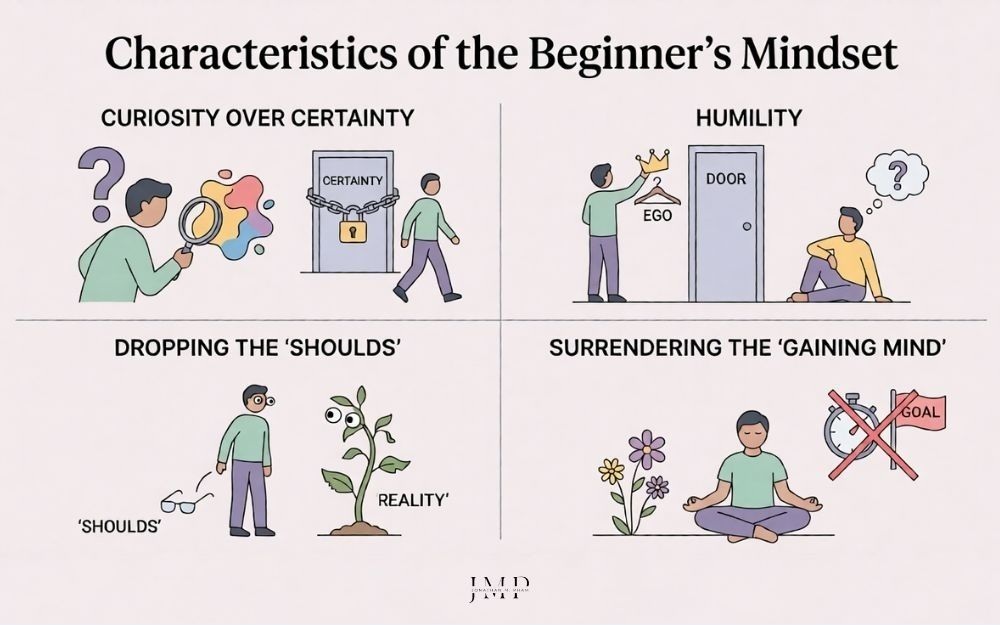
Beginner's mindset examples
An existential stance, not a productivity hack
It is easy to mistake the beginner’s mindset for a "life hack" meant to boost creativity or workplace efficiency. But Shoshin is basically a life stance; it speaks to how one relates to reality and truth.
If we look at it closely enough, what appears to be an Eastern concept actually shares striking similarities with foundational ideas in Western philosophy. Socrates, in particular, was known for building his whole philosophy on the premise of ignorance ("I know that I know nothing.") To him, the so-called "experts" of his time suffered from the illusion of knowledge; they mistook familiarity for understanding. By actively confronting them and asking radical questions, he stripped them of all certainty and laid the foundation for real wisdom to take roots.
Similarly, in the 20th century, the phenomenologist Edmund Husserl promoted a practice called Epoché, or "bracketing." Husserl believed that to understand the essence of anything, we first have to suspend all of our biases, past memories, and conceptual baggage. For instance, if you would like to truly see a tree, you have to mentally "bracket" all the botanical data and linguistic labels you associate with it, and simply look at the "thing-in-itself."
In this light, Shoshin is the daily application of Epoché. It means refusing to let the ghosts of past knowledge haunt the present experience.
Zen is not some fancy, special art of living. Our teaching is just to live, always in reality, in its exact sense. To make our effort, moment after moment, is our way. In an exact sense, the only thing we actually can study in our life is that on which we are working in each moment.
Shunryu Suzuki, "Zen Mind, Beginner's Mind"
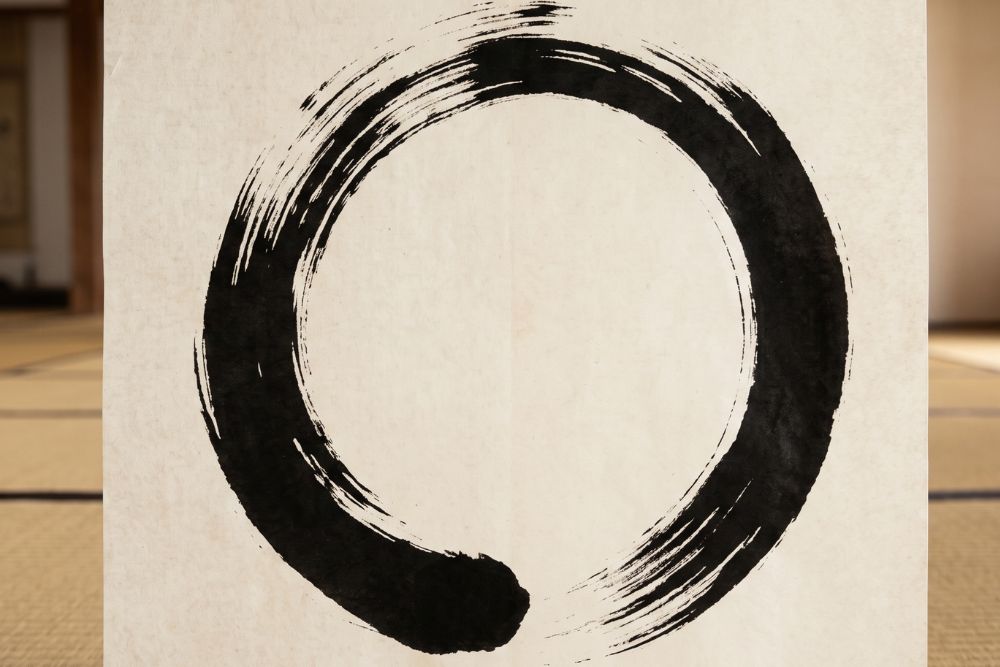
Beginner’s Mindset Psychology
The "triad of experience"
To better understand the concept of the beginner’s mindset, let us look at the journey of learning through 3 stages as follows:
- The Novice (Unconscious freedom)
You probably have heard of the term "beginner’s luck", which happens when a novice achieves unexpected success upon their first attempt at a complex task. Usually, it’s because the person operates without performance anxiety and the fear of failure; they rely on pure intuition.
That said, that type of “luck” is fleeting; as soon as the novice learns the rules, expectations set in, and performance typically drops before improving through deliberate practice.
- The Expert (Unconscious rigidity)
As competence is acquired over time, we fall into the "Curse of Knowledge" and lose the ability to remember what it feels like not to know something. (An example is the 1990 Stanford "tapper and listener" experiment, where participants who tapped a well-known song on a table were shocked when listeners couldn't guess the melody. The tappers "heard" the song clearly in their heads, completely forgetting that the listeners only heard disconnected, random taps). The expert relies on jargon, skips steps, gets easily frustrated, and falls into tunnel vision.
*Note: This is something I can personally resonate with based on my years of working as a part-time English teacher. Early in my career, I constantly struggled to "walk the mind" of my students. I would often find myself taken aback by their slowness to grasp a concept or their "unconventional" ways of thinking. This occasionally caused me to grow impatient—sometimes expressed outwardly, sometimes silently directed at myself later. Because I had mastered the language, I had forgotten what it felt like to be confused by it.
It took deliberate effort to slowly "decondition" my mind over time. And the breakthrough came when I became a beginner myself again—when I decided to start learning a new language (Japanese). Experiencing firsthand the vulnerability of stumbling over basic grammar and unfamiliar expressions cracked my empathy open. It allowed me to deeply understand what it felt like to be in my students' shoes, which then translated to much better teaching experiences.
- The Master (Conscious receptivity)
This is where Shoshin emerges. The Master makes the intentional choice to bridge the gap. They retain the capability and muscle memory of the expert, but actively adopt the perspective of the novice.
When you know everything, you are like a dark sky. Sometimes a flashing will come through the dark sky. After it passes, you forget all about it, and there is nothing left but the dark sky. The sky is never surprised when all of a sudden a thunderbolt breaks through. And when the lightning does flash, a wonderful sight may be seen. When we have emptiness we are always prepared for watching the flashing.
Shunryu Suzuki
| State |
Mindset |
Relationship to Rules |
Reality Filter |
| Novice |
"I don't know anything." |
Ignorant of the rules. |
|
| Expert |
"I already know this." |
Bound by the rules. |
Filters out the unexpected.
|
| Master |
"What else is there to learn?" |
Transcends the rules. |
Observes what is actually there.
|
The "second innocence"
From a philosophical standpoint, the beginner’s mindset (Shoshin) can be compared to that of a child—free from all mental rigidities and societal conditioning. However, there’s a major caveat here: if an actual child mostly operates from a pre-rational perspective (they are innocent, but they are not aware of how the world works yet and therefore lack wisdom and agency), those with Shoshin are trans-rational. They have learned the rules, mastered them, and then consciously let them go to return to a state of openness.
Such people, therefore, are in a state of "Second Innocence". They choose to be a Child again, after having carried the weight of the world.
When I was ten, I read fairy tales in secret and would have been ashamed if I had been found doing so. Now that I am fifty, I read them openly. When I became a man I put away childish things, including the fear of childishness and the desire to be very grown up.
C.S. Lewis
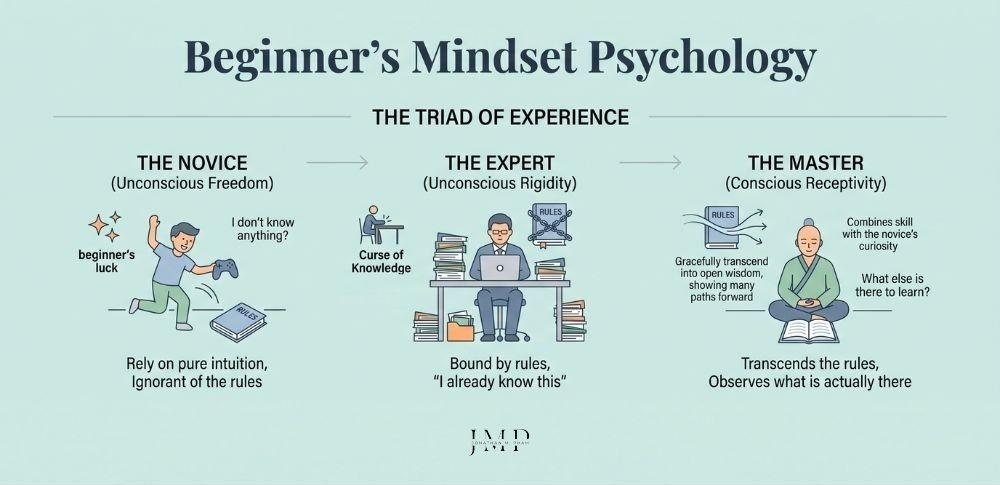
Beginner's mind sociology
The Value of the Beginner’s Mindset (Shoshin)
Rewiring the brain
The beginner’s mindset is more than a philosophical idea; there’s actually solid scientific evidence that supports its adoption. And it has to do with how the human brain works. (specifically, with a mechanism known as neuroplasticity)
As individuals learn and master skills, the brain prioritizes metabolic efficiency. To save energy, it builds automated neural circuits (utilizing the Default Mode Network) and relies on predictive coding. Instead of taking in new sensory information, it simply guesses what will happen next based on past patterns and actively filters out anything that contradicts its expectations. The result is a structural bottleneck; we stop experiencing the world and start living in our own predictions instead.
Adopting a beginner’s mindset helps break this automated loop. When you intentionally approach a situation without assumptions, you suppress the brain's "top-down" predictions. You force your mind into "bottom-up" sensory processing, which means you are actually perceiving things in the present moment.
When you allow yourself to be surprised—to have your expectations challenged by reality—your brain releases BDNF (Brain-Derived Neurotrophic Factor), which acts like a fertilizer for the brain, promoting the development of new neural pathways and dendritic spines. In this light, the practice of Shoshin literally helps keep the brain alive and growing.
Fostering intrinsic, authentic drive
Those who are attached only to the result of their effort will not have any chance to appreciate it, because the result will never come.
Shunryu Suzuki
These days, under the influence of the modern hustle culture, people often talk about things like "motivation" and "burning with passion". On the surface, these sound inspiring, yet beneath them lie significant pitfalls:
- Volatility: Motivation and passion are emotional states; as such, they are inherently fleeting and unreliable. Relying on them to complete daily work means productivity plummets the moment initial excitement fades or fatigue sets in.
- Burnout: The idea of "burning" with passion is frequently taken literally. It encourages individuals to glorify overwork, ignore boundary setting, and neglect rest, eventually leading to severe mental and physical exhaustion.
- Guilt & inadequacy: When passion naturally ebbs, people conditioned by hustle culture typically interpret this decline (which is normal) as a personal failure or a lack of discipline, creating a cycle of guilt and chronic self-doubt.
- Misplacement of focus: Long-term success and growth rely on consistency, sustainable habits, and clear systems—qualities that lack the drama of "burning passion" but produce lasting results.
Shoshin offers a much more sustainable path. When you adopt a beginner’s mindset, a few things happen:
- The performance tax is removed: You engage in an activity purely for the joy of the process, NOT for accolades, status, or out of the fear of failure.
- It invites the "Flow" state: Without an obsession with rigid outcomes, you can fully immerse yourself in the experience of learning, making the journey rewarding regardless of how long it takes.
- It reconnects you with your core values: By filtering out the noise of external expectations ("Will I look smart? Will I fail? What will others think of me if I don't reach this milestone?"), Shoshin helps align your efforts with what genuinely moves your soul.
◆ Example: Me learning Japanese
Speaking of which, I am reminded of me four years ago, when I decided to start learning Japanese—a choice that, rationally speaking, made no sense at all. I wasn't working for a Japanese company at the time, had no immediate plans to travel there, and wasn't quite obsessed with Japanese anime or pop culture. (though as of now, I realize my subconscious was likely being drawn to Japanese philosophy—namely to Zen, ikigai, kodawari, mono no aware, and many other concepts)
Because I had no clear personal agenda that I had to conquer at all costs—no certificate to chase, no job to secure—I was completely free to experience the joy of learning on my own.
That was not the case with many of my friends and classmates, who studied Japanese solely to pass the JLPT, enroll for technical internship, or land specific promotions. Because their eyes were locked on the finish line, they became disconnected from the journey itself. When learning became difficult and began intruding on their daily lives, the process suddenly felt like a punishment to them.
This difference was most visible when I reached N3 level. (which, as far as I know, is also the level that causes most students to drop out) The grammar became notoriously complex; the vocabulary demanded intense sacrifices of my time—which could have been used for working or recreational activities. Had I been relying on external pressure, I probably would have quit. (like many of my friends, who started out with excitement but then stopped out of frustration)
But somehow, I managed to stick until now, mostly because I actively reminded myself of how it felt in the beginning (the thrill of deciphering the grammar points, the childlike wonder of seeing complex concepts captured in a single kanji, etc.) and of the fact that there's no deadline pressuring me—that I'm technically free to decide the progress on my own.
By anchoring my thoughts that way, I turned N3 into a playground and prevented myself from burning out/getting disappointed.
As long as you think, "I am doing this," or "I have to do this," or "I must attain something special," you are actually not doing anything... when you do not try to do anything special, then you do something. When there is no gaining idea in what you do, then you do something.
Shunryu Suzuki

Assume a beginner's mindset
Establishing sustainable authority
We live in a rapidly changing world. In such an environment, the beginner’s mindset has become an absolute necessity for anyone in a position of authority—be it a teacher, a mentor, a parent, or a business leader.
Traditionally, society has taught us that authority is rooted solely in "knowing things." The leader or the teacher is supposed to be the infallible expert in the room—one who holds the keys to all the right answers. But nowadays, the rise of technology has made it possible for anyone to access infinite information. In other words, authority based on being the "gatekeeper of knowledge" is obsolete.
If you keep clinging to the expert mindset, you will inevitably lose people's respect and fall out of touch. On the other hand, if you can let go of the need to be the "omniscient one," several shifts would occur in how you lead and interact with the world:
- Psychological safety is fostered: When a leader or teacher admits, "I don't know, let's figure this out together," it gives others permission to take risks, ask questions, and communicate openly without fear of humiliation.
- True rapport is cultivated: Modern individuals don’t want to blindly obey an authority figure who dictates from a pedestal. They seek companions—guides who are authentic, transparent, and value their independence.
- We learn to be more patient: As in my case, as soon as I learned to adopt the beginner's mindset, there was a radical transformation in my teaching experiences. I could walk into a classroom with genuine excitement. No longer did I feel insulted by seemingly "stupid" questions or frustrated with slow progress.
- Learning becomes reciprocal: Today, junior members are capable of mastering certain things much faster than seniors. Shoshin allows us to happily learn from those we are supposed to be leading, hence preventing our own stagnation.
A certification is only half the journey. Just because we hold the knowledge or the title does not mean we have "arrived". We only truly become the teacher, leader, or master when we "wake up" and consciously choose to embody the beginner every single day.
Even though you try to put people under control, it is impossible. You cannot do it. The best way to control people is to encourage them to be mischievous. Then they will be in control in a wider sense.
To give your sheep or cow a large spacious meadow is the way to control him. So it is with people: first let them do what they want, and watch them. This is the best policy.
To ignore them is not good. That is the worst policy. The second worst is trying to control them. The best one is to watch them, just to watch them, without trying to control them.
Shunryu Suzuki
Helping resolve the challenges of modern times
This is particularly relevant when it comes to problems such as the AI crisis. As I have figured, much of the current panic surrounding AI comes from experts feeling their identities threatened (e.g. professors worrying about losing their status in the eyes of students), which causes them to adopt dogmatic stances that don't make a lot of sense if we really think about them. For example, I recently came across an online video where the speakers labeled AI with derogatory terms like "psychopath."
But calling lines of code a "psychopath", I believe, is a categorical mistake; AI, after all, has no intent, agency, or personal grudges. The real issue is not the technology itself, but rather that we are wielding godlike technology with pre-conventional morality.
The solution, therefore, has to start from our own perspective first. Specifically, we have to look at technological advancements with calm curiosity—not as a monster (like the anti-AI camp) or a savior (like the tech moguls and billionaires), but simply as a mirror exposing our already fragmented society. Instead of wondering "Will AI destroy me?", try asking:
"What is this teaching us about what it means to be human?"
A mind full of preconceived ideas, subjective intentions, or habits it not open to things as they are.
Shunryu Suzuki
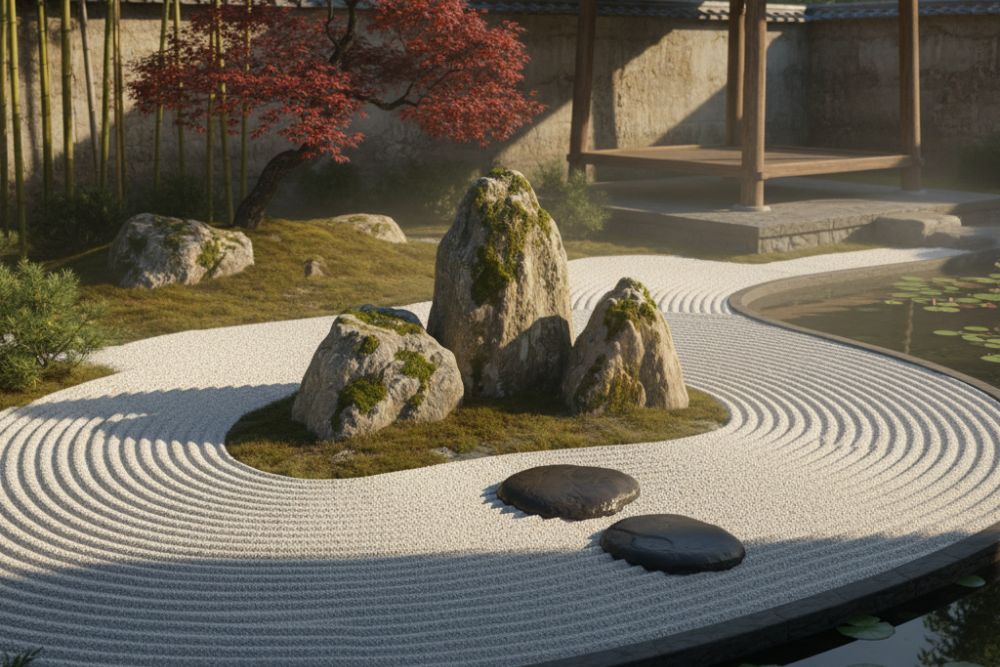
Common Obstacles to Cultivating the Beginner's Mindset (Shoshin)
As beneficial as it is, adopting the beginner’s mindset is easier said than done. And the reason is that it requires us to dismantle the various psychological defenses and societal conditioning that have been ingrained in us since childhood.
The ego barrier
The primary challenge has to do with the human ego. By design, the ego’s main job is self-preservation. As we grow older and accumulate knowledge, it begins to build an identity around being an "expert." It ties our self-worth directly to our competence and the ability to have the "right" answers.
When you operate under the ego’s influence, encountering something you don't know—or worse, being proven wrong—feels like a personal failure rather than a normal part of the learning process. To protect ourselves from the awkwardness of looking “incompetent”, we shut down alternative perspectives and retreat into what we are familiar with.
This defensive stance gives rise to a host of cognitive biases that actively block learning:
- Confirmation bias: Instead of looking at reality with openness and curiosity, we actively seek out only the information that protects our pre-existing beliefs and validates our "expert" identity.
- Hindsight bias: We conveniently forget our own past ignorance. We look at a subject we have mastered and think, "This has always been obvious," which destroys the ability to empathize with those who are currently struggling to comprehend it.
- Overconfidence bias: We inflate our own abilities. Ironically, true masters are usually the quickest to admit the limits of their knowledge, while those with average ability are often the most overconfident.
To practice Shoshin, it’s critical that we decouple our identity from our knowledge. We need to realize that saying "I know nothing about this yet" is NOT a threat to our value as human beings.
Emotionally we have many problems, but these problems are not actual problems; they are something created; they are problems pointed out by our self-centered ideas or views.
Shunryu Suzuki
Social conditioning
Pleasure is not different from difficulty. Good is not different from bad. Bad is good; good is bad. They are two sides of one coin. So enlightenment should be in practice. That is the right understanding of practice, and the right understanding of our life. So to find pleasure in suffering is the only way to accept the truth of transiency.
Shunryu Suzuki
Now, let’s say you are holding an apple. Before you even bite into it, your mind has likely already done a mountain of hidden background work: Gala. Crisp. Sweet. Snack.
Within milliseconds, an object rich in texture and aroma gets compressed into a neat conceptual box.
That’s just how most of us operate, instinctively—without even being aware of it. From a young age, we are taught that to understand something, we must name it, measure it, and file it away. (the modern coaching and self-help industry, with all of its theories and personality tests, doesn’t help either) It’s indeed a useful survival skill—it keeps us from having to relearn what a door handle or a crosswalk is every single morning.
But efficiency is the enemy of learning.
There is a massive difference between conceptual knowledge and direct experience. When we look at a sunset and immediately think, "Classic warm palette, high contrast, perfect for a photo," we are not actually experiencing the sunset—only our own internal filing cabinet. We are living in our past memories and/or future projections, not reality itself.
If it were just about fruits and sunsets, it wouldn't matter much. But the thing is, we apply the same filing system to people, work, and even to ourselves. In a sense, society has trained us to equate speed of judgment with intelligence—to praise those who have quick answers and clear-cut opinions. Over time, it inevitably breeds the belief that because we have a label for something, we fully understand it. And the consequences of that misguided assumption are disastrous:
- Dogmatic thinking: We rely on past playbooks to tell us what works, while labeling new or unorthodox ideas as "unrealistic" or "inefficient" before even giving them the chance to be tested. Even when there’s clear evidence right in front of us, we refuse to update our beliefs—about politics, art, or human nature—accordingly.
- Broken relationships: Conditioning causes us to file everyone into static folders. (e.g. "She's always passive-aggressive," or "He never really listens.") When a long-term partner or old friend speaks, instead of really paying attention to them, we simply play back a recording of every past interaction—and then wonder why the relationship sucks.
- Instrumental living: We treat every experience, object, and person as a means to an end—a tool to be used or optimized. A walk in the woods now means "getting 10,000 steps"’; a new hobby becomes a side hustle or something to post online for validation. Life is deprived of its intrinsic joy and turns into an endless checklist to complete.
- Resistance to what is: This is arguably the greatest cost of conditioning; it leaves us with an idea of how a day, a career, or a conversation should go. Because we expect reality to fit neatly into our pre-existing conceptual boxes, we panic and fall victim to unnecessary suffering whenever life turns out messy. (as it always does)
Now, I’m not saying that you should forget everything you have learned or pretend that you don't know what an apple is. What’s important is the willingness to suspend your filing cabinet long enough to notice what’s actually there. To catch yourself in the act of judging—and take a brief pause before the label takes over.
Do you know that even when you look at a tree and say, ‘That is an oak tree’, or ‘that is a banyan tree’, the naming of the tree, which is botanical knowledge, has so conditioned your mind that the word comes between you and actually seeing the tree? To come in contact with the tree you have to put your hand on it and the word will not help you to touch it.
Jiddu Krishnamurti
Idolization (The cult of personality)
Given that we are hard wired to fear ambiguity, our natural instinct is to seek out those who project absolute confidence—the “experts” who promise to give us the answers to everything and save us from the work of figuring life out on our own. No wonder idolization has become the norm in today’s world.
This is particularly prevalent in niches such as the coaching and self-improvement industry, where it’s not uncommon to come across blatant marketing slogans like "Coached by the best to be the best." In a sense, the coaches, teachers, and leaders have been turned into “gurus”—idols to be worshipped rather than humans to be learned from.
The thing is, that’s not what real coaching is about: facilitating and guiding the person’s self-discovery until the coach is no longer needed. A true coach/teacher is meant to make themselves obsolete, NOT to become a revered “idol”.
Sadly, there’s a gap between theory and reality. To a certain extent, the “guru model” has become the dominant force in the industry. And the result is a toxic psychological environment for everyone involved:
- For the "expert": The “guru” traps themselves in an echo chamber. Because they have marketed themselves as "the best," it becomes tricky to admit a mistake or show vulnerability. Their inner shadow grows dark with imposter syndrome, and they surround themselves with sycophants who pay to validate their brilliance.
- For the learner: They are stripped of their critical inquiry. When you idolize a teacher, you naturally start filtering everything through the lens of, "What would the master think?" As soon as they inevitably fail to replicate the guru's "flawless" success, they fall into a spiral of shame and toxic positivity, pretending everything is fine while outsourcing their own intuition.
The Buddhist monk Linji once made a stark instruction to his disciples as follows:
"If you meet the Buddha on the road, kill him."
Of course, he didn't mean it literally. What he was saying is that you must destroy any idol or external authority you have elevated in your own mind. While respecting the teacher, you should treat them as a “finger pointing at the moon” only, not the “moon” (truth) itself.
Not to be attached to something is to be aware of its absolute value. Everything you do should be based on such an awareness, and not on material or self-centered ideas of value.
Shunryu Suzuki
Gaslighting (The weaponization of Shoshin)
Finally, we cannot fail to address how the beginner's mindset can be easily manipulated. Like "corporate stoicism" (the idea that you should just repress your stress and work harder) or "McMindfulness" (using meditation apps just to squeeze more productivity out of employees), Shoshin is sometimes co-opted by toxic institutions and authority figures. Specifically, it’s not uncommon for leaders to invoke the concept to gaslight people and invalidate their hard-won experience:
"You need to approach this with a beginner's mind."
=> What they actually mean: "Drop your boundaries, ignore your legitimate critical feedback, and accept my authority without challenge."
The thing is, authentic Shoshin is self-directed—a personal choice to stay curious and open. It can never be imposed externally.
Having a beginner's mind is not the same as being gullible, docile, or willfully ignorant of abuse. It asks us to look at reality as it is, without bias. And many times, that means recognizing when a system or a leader is already broken.
There is no particular way in true practice. You should find your own way, and you should know what kind of practice you have right now.
Shunryu Suzuki

Adopting a Beginner's Mindset: Steps for “Emptying the Cup”
For those who would like to step out of the expert trap and reclaim the joy of the beginner, here are a few ways to begin shifting your perspective.
-
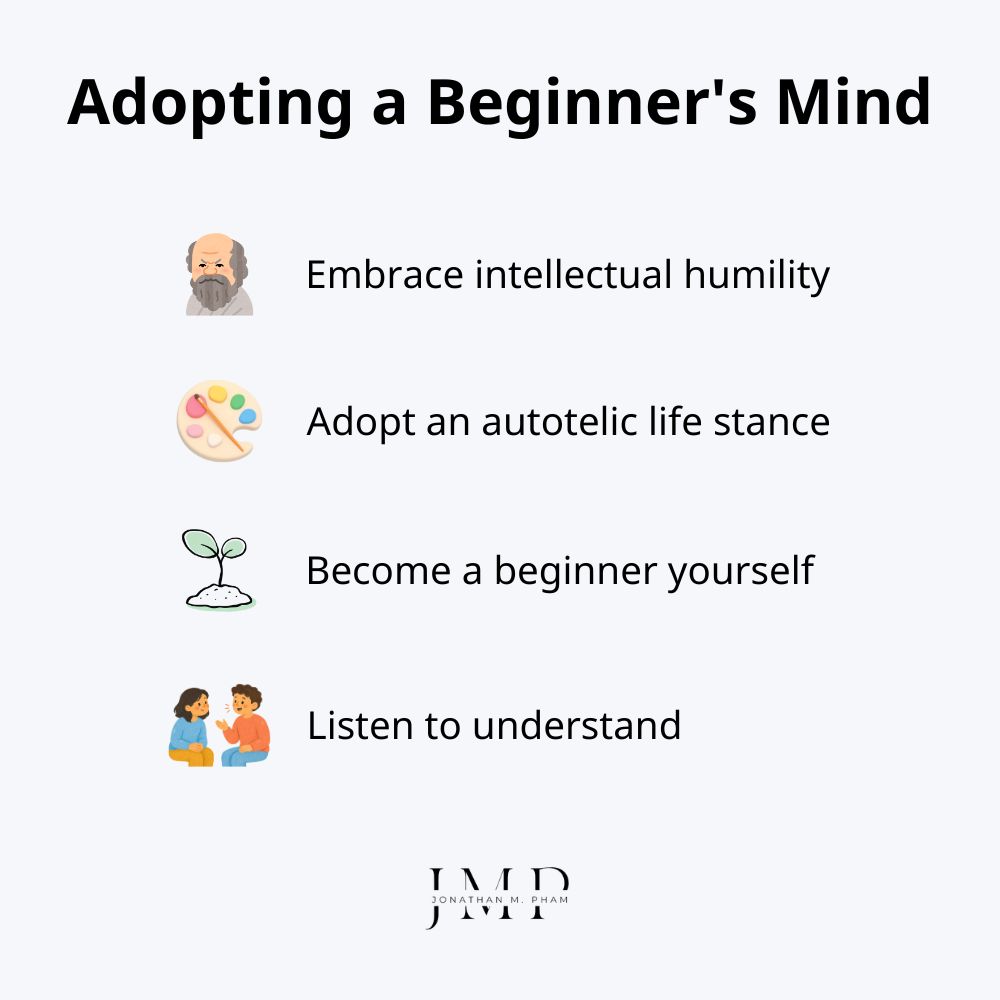
Embrace intellectual humility
The first step to cultivating Shoshin is to be comfortable with “not knowing”. And the easiest way to do that is to deliberately practice self-doubt. To question everything—even those typically regarded as “common sense” (e.g. “Why is the sky blue?”, “Why do I have to work?”, etc.)
To the modern mind conditioned by the hustle culture, it is indeed tricky to adopt such a stance. We are constantly taught by society to treat doubt as a pathology—a weakness to be cured or masked with "fake it till you make it" confidence. Yet if we look at the history of human thought, it is actually a superpower.
- Socrates established the foundation of Western philosophy on the admission of his own ignorance.
- René Descartes used radical doubt to strip away every false assumption—until the only thing left was the undeniable truth.
- The novelist Franz Kafka’s writings resonated so much precisely because he refused to “perform”—because he wrote from a place of raw vulnerability.
When you practice healthy self-doubt—when you intentionally suspend your judgment and say "I know nothing about this yet"—you naturally create a mental blank slate, the literal definition of the "beginner's mind." And from there, new ideas and perspectives will be able to enter you.
Those who begin with certainty end up in uncertainty. Those who begin with uncertainty, questioning, asking, doubting, probing, those end up with absolute certainty, not relative certainty.
Jiddu Krishnamurti
-
Live autotelically
To cook is not just to prepare food for someone or for yourself; it is to express your sincerity. So when you cook you should express yourself in your activity in the kitchen. You should allow yourself plenty of time; you should work on it with nothing in your mind, and without expecting anything. You should just cook!
Shunryu Suzuki
One of the greatest obstacles that prevents us from growing is the fear of being seen as an "amateur"—producing something unpolished, getting it wrong, or lacking the proper credentials to even try. Most of us, since childhood, have been conditioned to believe that if an action doesn't lead to a measurable outcome, a title, or a financial return, it’s a waste of time.
That's why it's crucial that we learn to live autotelically. Derived from the Greek words auto (self) and telos (goal), an autotelic activity is one that is done fully for its own sake. The doing itself is the reward.
Speaking of which, I am reminded of how I have always found it a bit ironic for me to blog extensively about deep philosophical, ontological, and existential topics—despite never having gone through any formal academic philosophy training. Many times, I find myself wondering if I should give up and return to more “practical” topics. After all, how am I supposed to match the expertise of those who have spent decades in university halls pondering reality? How can an “amateur” like me churn out flawless, expert-level philosophical pieces like the ones published on platforms such as Aeon?
But then I realize: that’s not the point. Writing is not a tool for me to impress anyone, but to think, to understand myself, and to find joy in the process.
And to be fair, not having a formal degree is actually an advantage. It means I am completely free from the burden of academic "jargonitis." I don't have to pick a specific doctrinal camp to defend, I don't need forty footnotes to validate an observation, and I'm not haunted by the fear of a dissertation committee.
Now I am free to write out of pure curiosity. To synthesize ideas across different disciplines and explain dense concepts in a way that actually connects with a reader's lived experience.
After all, philosophy didn't come from peer-reviewed journals. It started in public squares, over shared meals, and in personal diaries. The original thinkers were, like me, just human beings trying to figure out what on earth was going on.
When you live autotelically, you strip away the pressure of the "finish line". You give yourself permission to embrace the draft-and-revise cycle of life.
You do not say, “This is enlightenment,” or “That is not right practice.” Even in wrong practice, when you realize it and continue, there is right practice.
Shunryu Suzuki

-
Intentionally become a beginner yourself
Expertise creates an insulated bubble; in the words of the philosopher Martin Heidegger, it makes our knowledge ready-to-hand (zuhanden)—operating so smoothly in the background that we no longer consciously think about it. To break out of that "sleepwalking" trance, one effective way is to literally put yourself in a position where you are a novice. To actively seek out environments where all previously accumulated knowledge becomes useless, so that you are forced back into a present-at-hand (vorhanden) state where you must actively grapple with every rule and movement again.
As mentioned, my English teaching experiences went through a critical transformation after I decided to learn a new language (Japanese) myself. It forced me out of the default “expert” mindset to understand how it felt like to be a beginner again; as such, I became much more adept at empathizing with my students and adjusting my teaching accordingly.
You can do the same thing by adopting a few exercises as follows:
- Taking up a hobby where you have zero natural talent: Try a martial art, a musical instrument, or a new subject you are not familiar with.
- Inverting your role: If you are a manager or a senior leader, spend one day doing the tasks of an entry-level employee. Sit in on a meeting in a department you know nothing about, simply as an observer.
- Disrupting the daily routine: Take a completely different route to work. Go to a restaurant and order something you have never heard of.
As simple as they may seem, these practices force a mental shift. When you voluntarily subject yourself to disruption and incompetence, you train the brain to realize that there's always something new to learn. That there are many things you have been taking for granted, and that being a beginner is not a threat to your survival—if any, it’s a valuable chance to grow.
We say, "A good father is not a good father." Do you understand? One who thinks he is a good father is not a good father; one who thinks he is a good husband is not a good husband. One who thinks he is one of the worst husbands may be a good one if he is always trying to be a good husband with a single-hearted effort.
Shunryu Suzuki
-
Listen to understand
Usually when you listen to some statement, you hear it as a kind of echo of yourself. You are actually listening to your own opinion. If it agrees with your opinion you may accept it, but if it does not, you will reject it or you may not even really hear it.
Shunryu Suzuki
As discussed earlier, our social conditioning causes us to put people into static conceptual boxes. When we interact with someone we know well, rarely do we pay attention to what they are actually saying in the moment. The instinctive response, most of the time, is to replay our past memories of them and wait for our turn to speak.
This "expert" stance is particularly common in inter-generational conversations—between parents and their adult children. The former, having spent decades as the undisputed "experts" of their latter's life, frequently look at their kid's challenges through a historical mental framework. When the child shares, the parent typically listens to correct—to offer unsolicited advice based on a playbook from twenty years ago.
Conversely, the adult child, far too often, locks the parent into a static role. They approach conversations with a "pre-judged" filter, rolling their eyes because they assume they already know exactly what the parent is going to say.
Both sides are being caught in the same trap of "I already know"; no wonder conversations usually end up nowhere.
To move forward, it’s crucial that we deliberately drop that "expert" stance, look at the person in front of us as if we are meeting them for the very first time, and say:
"I have my experience, but your reality is different right now. Walk me through it."
When you listen truly to understand—without the urge to interrupt or win the argument—the boundary between self and other begins to thin. Instead of a problem to be "solved", the other person now becomes a source of wonder to be discovered and experienced.
Try not to force your idea on someone, but rather think about it with him. If you feel you have won the discussion, that is the wrong attitude. Try not to win the argument; just listen to it.
Shunryu Suzuki
FAQs
What are the main benefits of having a beginner's mind?
While frequently praised as a tool for creativity and design thinking, the real benefits of Shoshin are psychological and relational. Specifically, it helps:
- Reduce anxiety by removing the ego's need to "perform" or always be right;
- Reclaim the intrinsic joy of learning (and life in general), and;
- Heal relationships with others.
Not at all. Toxic positivity demands that we ignore negative things and force a happy outlook. The beginner’s mind simply means seeing reality clearly, without the baggage of assumptions. It means being fully present for the joyful moments, but also acknowledging pain, frustration, and systemic flaws without the need for immediate judgment.
How is the beginner’s mindset different from a growth mindset?
A "growth mindset" (a term popularized in psychology) is the belief that your skills and intelligence can be improved through effort; it is inherently future-oriented and focused on progress.
A "beginner's mindset", on the other hand, is about a state of presence. It is about suspending your assumptions to experience the moment.
How do you cultivate a beginner's mind in meditation?
Meditation is one of the most direct ways to practice Shoshin. Here is a very brief script you can use to "empty the cup" during the day:
- Sit comfortably: Close your eyes and take a deep breath.
- Notice the label: As you breathe, your mind will naturally try to categorize your experience ("I am stressed," "My back hurts," "I am breathing in").
- Drop the label: Imagine you are a consciousness that has just been dropped into a human body for the very first time. Strip away the words. What does the raw sensation of air entering your lungs actually feel like?

Beginner's mind meditation script
Further Resources
Beginner's mindset quotes
We should not hoard knowledge; we should be free from our knowledge.
Shunryu Suzuki
Before I studied Zen, mountains were mountains and rivers were rivers. While I was studying Zen, mountains were no longer mountains and rivers were no longer rivers. But once I reached enlightenment, mountains were once again mountains and rivers were rivers.
Qingyuan Weixin
There are two ways to wash the dishes. The first is to wash the dishes in order to have clean dishes and the second is to wash the dishes in order to wash the dishes.
Thich Nhat Hanh
Before enlightenment, chop wood, carry water. After enlightenment, chop wood, carry water.
Zen Proverb
Freethinkers are those who are willing to use their minds without prejudice and without fearing to understand things that clash with their own customs, privileges, or beliefs.
Leo Tolstoy
Stay hungry. Stay foolish.
Steve Jobs
Beginner's mindset books
- Zen Mind, Beginner's Mind by Shunryu Suzuki: The foundational text that brought the concept of Shoshin to the West.
- Freedom from the Known by Jiddu Krishnamurti: An exploration of how to strip away social conditioning and dogmas.
- The Miracle of Mindfulness by Thich Nhat Hanh: A practical guide on how to live autotelically and be present in everyday actions.

Final Thoughts
Most of us spend the majority of our lives trying to be "somebody." To accumulate titles, degrees, opinions, and expertise. While we may come up with lots of reasonable excuses for that (e.g., that we are just trying to be responsible providers, contributing members of society, etc.), if we are really honest to ourselves, it's not difficult to realize the true reason: our own fear of the void.
We clothe ourselves with fancies, hopes, jobs, and dogmas because we are too afraid that underneath it all, we might be nothing.
But holding onto those psychological clothes comes with a severe cost: alienation from reality itself. It turns learning into a chore, conversations into battlegrounds, and life into an endless checklist to be conquered.
As such, now is the time for us to take all masks off—to strip away everything we think we know about who we are and what we are owed, so that we may return to a blank mental state. While it may feel daunting to do so, only then may we be free to experience the world as it is.
The Zen master Thich Nhat Hanh once wrote as follows:
"People usually consider walking on water or in thin air a miracle. But I think the real miracle is not to walk either on water or in thin air, but to walk on earth. Every day we are engaged in a miracle which we don't even recognize: a blue sky, white clouds, green leaves, the black, curious eyes of a child—our own two eyes. All is a miracle."
There's no need to travel anywhere far to find truth. It's available to you right here, right now.
All you need to do to see it is to open your heart. To adopt a beginner's mindset. To let go of the need to know, and simply marvel at the wonder of being alive.
Other resources you might be interested in:
- Crisis of Meaning: When the Script of Life Collapses
- Memento Mori: A Reminder of Life’s Impermanence & How to Live the Right Way
- Shikata ga nai (仕方がない): Finding Serenity in Acceptance
- Gaman (我慢): The Unspoken Power of Japanese Endurance (Plus Its Relevance in Today’s World)
- The Curated Self: Why Authenticity on Social Media is Impossible