



01
10
October 2026
It has begun.
And now, it's time for me... no, for us, to wait. Three or more hours.
October 1
Come to think of it, t [...]

I happen to know someone who lives in a state of perpetual surveillance.
Conversations with the person often come with a subtle undercurrent of policing. If you express a raw emotion, make an unconventional choice, or commit a minor social faux pas, you are very likely to be met with swift correction:
“Don’t do that; others will judge you. You’re going to lose face. People will view you as uneducated.”
For a long time, I found their behavior merely annoying. Until recently, as I thought about it, I realized I was witnessing something far more insidious than simple social anxiety.
When the person polices others, they are not actually interacting with distinct human beings who have their own internal logic, emotions, and valid reasons for acting. Rather, they view everyone around them as extensions of their own reputation. In their eyes, you are a chess piece that must be moved correctly so they don’t look bad by association.
Without knowing it, the person is committing a grave philosophical violation: objectification. They are stripping away the subjectivity of the people they love—and turning them into social objects.
Highlights
When we hear the word “objectification,” our minds usually default to the obvious, including:
While those are indeed accurate applications, the root of the phenomenon goes much deeper. More than just a societal failing, objectification is, at its core, a crisis of human connection. It happens when we strip a conscious subject—a person with their own thoughts, feelings, and agency—and treat them as a mere thing to be used.
In contemporary philosophy, objectification is primarily discussed in feminist theory, with a strong focus on how patriarchal societies have reduced women to objects of sexual desire. That being said, the term also has roots in Kantian ethics, Marxist theory, and existentialism.
In the 18th century, the philosopher Immanuel Kant laid down the moral framework that acts as the bedrock for understanding objectification. In the kingdom of ends, as Kant argued, everything has either a price or a dignity. What has a price is fungible; it can be replaced by something else of equal value. (e.g. think about how a broken hammer can be replaced by a new one)
However, a human consciousness—with its boundless inner world, capacity for moral reasoning, and fragile existence—has no equivalent. It has a dignity. It is therefore irreplaceable.
To objectify someone is to strip them of their dignity and slap a price tag on their utility. It is to look at another human being—full of potential and mystery—and ask only: “What can you do for me?”
Marx looked at the factory floor at his time and saw commodification. Under capitalism, the laborer is objectified because they are no longer viewed as a creator, but as a literal “cog in a machine”—valued only for their hourly output.
Thinkers like Jean-Paul Sartre argued that we objectify others to protect our own egos. To face another free, unpredictable human subject is an uncomfortable experience; on the other hand, it is much safer to look at them as an object—a fixed entity we can define, label, and control.
Read more: Being-for-itself – On the Burden & Beauty of Being a Conscious Human
For decades, philosophers such as Martha Nussbaum and Rae Langton have spent time defining the exact features of objectification. In 1995, Nussbaum proposed a 7-component framework, which Langton subsequently expanded by adding three more dimensions.
The most common, and perhaps the most insidious, is instrumentality: the act of viewing a person strictly as a tool for one’s own purposes. In fact, this is something we do subconsciously all the time. For example, think of the way we respond to a customer service representative when the Internet goes down, or how we string along an acquaintance purely because they have a professional network we want to access.
When we instrumentalize someone, their internal world ceases to matter. The individual exists only as a lever we are pulling to get what we want.
Closely tied to this is fungibility—treating a person as interchangeable. In doing so, you strip away their nuance and turn them into LEGO bricks.
Example: In the modern dating landscape, where endless swiping trains us to view romantic prospects as a limitless catalog of replaceable options, many people are drowning in fungibility. If this one is slightly flawed, discard it and grab another of the exact same type.
Then comes the denial of autonomy and inertness: treating someone as if they lack the capacity to choose, as if their experiences and feelings are entirely irrelevant. We act as though they are passive clay waiting to be molded by our desires, while ignoring the reality that they are complex beings actively experiencing the world.
Example: A manager micromanaging a capable team member’s every second. To them, the employee is an inert hand that needs to be manually moved, not a thinker who is able—and deserves—to act independently.
This happens when one views another individual as lacking boundary integrity—something that can be broken into, smashed, or violated without consequence. In one’s eyes, the person is simply a possession that can be bought, sold, or owned.
Example: A controlling partner who dictates who their spouse can see and what they can wear, operating under the assumption of “you belong to me.”
This refers to judging someone solely by how they look or the image they project. In doing so, we turn them into a purely aesthetic object, while ignoring their intellect and humanity.
Example: Hiring or valuing a receptionist based only on their looks, which effectively turns the receptionist into nothing more than a decorative piece of office furniture.
For this type of objectification, the person is treated as if their experiences, feelings, and internal world do not exist or do not matter—and as if they don’t have the capacity to speak and be heard.
Example: Consistently talking over a colleague in meetings or rendering their voice legally or socially powerless.
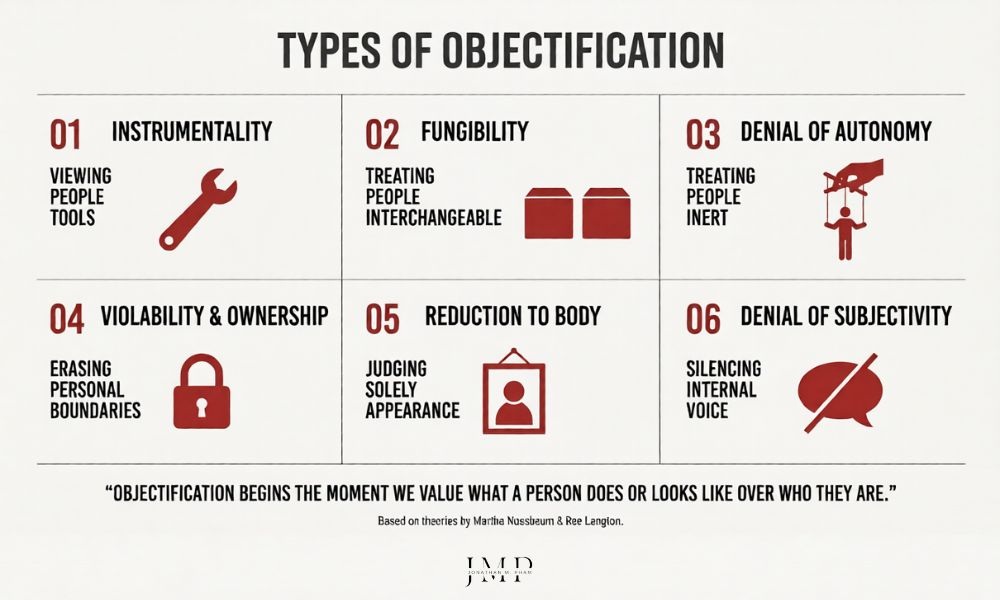
What does it mean to objectify someone?
If we are honest to ourselves, looking at the above list should be enough for us to realize the truth: none of us is exempt from the “sin” of objectifying others (and even ourselves). Which brings us to a haunting question: is objectification always inherently evil?
According to Nussbaum, in specific, highly trusted contexts, objectification may actually be benign—even beautiful. For instance, let’s say you are lying on the couch reading a book when your partner comes in, rests their head on your stomach, and falls asleep. In that exact moment, your partner is treating you as a tool (a pillow) and an inert object (something to rest upon). Technically, their act checks the boxes of instrumentality and inertness.
And yet, why doesn’t it feel like a violation at all?
The answer: because it is cradled within a broader context of mutual respect and consent.
In deep intimacy, we sometimes play a game of temporary, voluntary objectification. We allow ourselves to be “things” for each other—a comforting presence, a physical anchor, a source of pleasure—because we implicitly trust that our underlying subjectivity is not being denied. The dignity is still intact.
The harm of objectification, then, does not lie in the simple act of being useful to one another. (after all, nobody can survive on their own) It only occurs when the denial of subjectivity becomes permanent—i.e. when we are locked into a box by someone else’s gaze and realize that to them, we are nothing more than objects in their path.
Read more: Are Humans Inherently Good or Evil?
We live in an atmosphere of shame. We are ashamed of everything that is real about us; ashamed of ourselves, of our relatives, of our incomes, of our accents, of our opinions, of our experience, just as we are ashamed of our naked skins.
George Bernard Shaw
Here’s a personal question. Have you ever been completely lost in a moment—singing alone in your car, dancing in the kitchen, or crying quietly on a park bench—only to suddenly realize someone is watching you?
Think about the physical sensation of that exact second. Your stomach drops. A hot flush creeps up your neck. The private “universe” you were inhabiting collapses instantly, and you are forcefully pulled back into the physical boundaries of your body.
In 20th-century French existentialism, this jarring psychological reality is the very cornerstone of human interaction. Jean-Paul Sartre viewed objectification as something more than just a societal flaw. According to him, it is an inherently built-in hazard of being alive—which he referred to using the term “The Look” (Le Regard).
To explain the phenomenon, Sartre presented an unsettling thought experiment: The Keyhole. Imagine a man peeping through a keyhole into a room. In that moment, he is fully absorbed in his subjective experience. He has no awareness of his own body, no ego, no sense of his own identity.
He is being pure, flowing consciousness—the undisputed master of his own universe, viewing the world from the inside out.
Suddenly, the floorboards creak behind him. He hears footsteps. He realizes he is being watched.
In a fraction of a second, the man undergoes a radical transformation. He is caught in “The Look” of the Other. He is violently dragged from being a free, observing subject into being an object in someone else’s environment.
Suddenly, he is defined from the outside as “the creepy peeping Tom.” He has lost control of the narrative.
This is why being perceived feels so inherently threatening. According to Sartre, humanity is constantly engaged in a silent tug-of-war for one’s own subjectivity. When someone truly looks at us, they strip us of our boundless freedom and freeze us into a “thing” in their world.
Objectification in philosophy
The undeniable proof of this objectification is shame. Unlike guilt—which is about a behavior (“I did a bad thing”), shame is about identity (“I am a bad person”). As Sartre noted, it only happens when you are in front of someone else.
When you feel ashamed, you are subconsciously agreeing with the Other’s assessment of you. You are admitting that you have an “outside”—a physical body and a reputation that you cannot control, vulnerable to the merciless judgment of the world.
Given that such vulnerability feels so uncomfortable, most of us instinctively try to run away from it. And ironically, the most common way we escape the discomfort of being objectified is by willingly objectifying ourselves—i.e. limiting our existence to a label. (e.g. a rigid corporate persona) Our underlying assumption is:
“If I act exactly like what they expect me to be, they can’t actually perceive the real me.”
Sartre called such an act “Bad Faith” (Mauvaise Foi): the denial of one’s inherent freedom. To him, being a conscious human being means admitting that you have no fixed essence—that you are responsible for making your own choices at every single moment. This radical autonomy breeds a sense of dizzying anxiety (or Angst); to numb it, most pretend that we are objects defined by external circumstances.
An example Sartre used to illustrate that tendency is a Parisian café waiter whose movements are just a little too precise, too mechanical. He balances his tray with the stiffness of an automaton; his voice drips with a slightly exaggerated, solicitous eagerness.
The man, as Sartre realized, is “playing” at being a waiter. Instead of facing the reality that he is a free agent who could put down the tray and walk out the door at any moment, the man pretends that his essence is fixed. He pretends to be a “waiter machine.”
By reducing his fluid consciousness into a static object, he finds a comfortable hiding place from the burden of freedom.
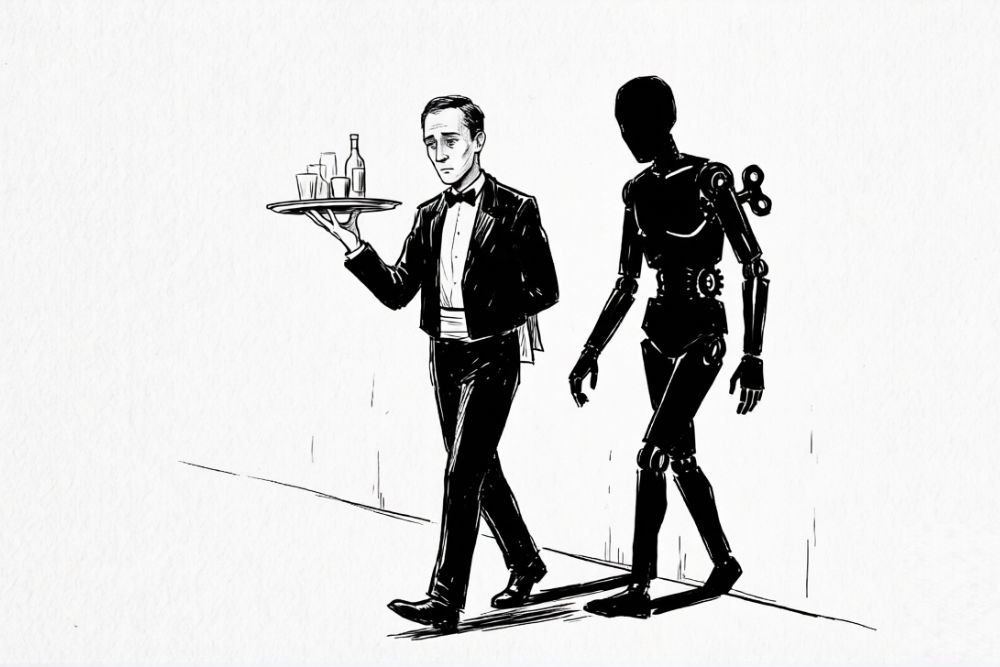
More than just an individual hiding mechanism, the above-mentioned type of objectification has long been society’s architectural blueprint. Simone de Beauvoir, Sartre’s counterpart, took his abstract idea of “The Look” and applied it to the reality of marginalized groups—most notably in her groundbreaking work The Second Sex.
As observed by Beauvoir, patriarchal society has historically set man up as the Absolute “Subject”—the one granted transcendence, the freedom to act, explore, and shape his destiny. Consequently, woman was relegated to “The Other”—the object, forced into immanence, stagnation, and a mere bodily existence meant to be looked at.
When an individual, regardless of their gender, is born into a society that constantly looks at one as an object, it is nearly impossible not to internalize that gaze. Over time, you become your own keyhole watcher. You begin to objectify yourself—i.e. monitor your appearance, police your behavior—simply so that you can survive a world that refuses to see you as a Subject.
Today’s society is characterized by achievement orientation, and consequently it adores people who are successful and happy… It virtually ignores the value of all those who are otherwise, and in so doing blurs the decisive difference between being valuable in the sense of dignity and being valuable in the sense of usefulness.
Viktor Frankl, “Man’s Search for Meaning”
When Sartre’s café waiter nervously stiffens his posture and plays at being a “waiter machine,” he is mostly doing it privately to escape the anxiety of his own freedom. And yet, what happens when the world he lives in actively demands that he be a machine?
What happens when objectification is dressed up in a suit and tie, socially incentivized, and renamed “professionalism”?
This is exactly what is happening in the modern world, and its roots can be traced back centuries ago—when humanity’s relationship with the world was fractured under the weight of mechanization. As observed by the sociologist Max Weber, the Industrial Revolution birthed the era of “Instrumental Reason“, when people began looking at the natural world as nothing more than a stockpile of raw materials. In their eyes, a lush forest became “timber”, and a rushing river was “hydroelectric potential.”
Over time, this utilitarian lens turned inward, prompting us to view ourselves as “cosmic gas stations”—reserves of energy to be optimized for economic output. In a sense, we transformed from being “human beings” to “human doings”. To, literally, “human resources.”
Nowhere is this type of objectification more evident than in the modern corporate domain. In fact, you can see it simply by listening closely to the daily language of business, self-help, and “hustle culture.”
Far too often, we talk about “investing in ourselves,” “maximizing our potential,” and “building our personal brand.” On the surface, these phrases sound incredibly empowering. Yet if you put them under a philosophical microscope, it’s just a matter of time before you realize that the language is of purely transactional nature.
Why then? Because it treats the human soul as a product to be upgraded.
Subtly, these “motivational phrases” reinforce the idea that your worth is not intrinsic—that you do not possess Kant’s unquantifiable dignity—but rather, that you possess a price dictated by your utility. Even positive corporate initiatives like “talent development” are, many times, just motives for securing a higher return on investment.
This systemic objectification creates a fascinating clash when it meets reality. Remember the anxiety (angst) we discussed earlier? The feeling of dizziness that comes with being a free, conscious creature?
Corporate culture is terrified of that angst. To it, existential dread—a natural part of the human condition—is a “bug” in the software. When you experience a sense of meaninglessness or exhaustion, the system’s immediate response is to fix you. It prescribes wellness seminars, mindfulness apps, and SMART goals. It demands a superficial, HR-approved version of authenticity:
“Be your authentic self, as long as your authentic self is a cheerful, cooperative team player.”
Trying to coach away the weight of human existence with a productivity planner is, at the end of the day, a quintessential act of Bad Faith. A further attempt to objectify the person.

The most heartbreaking part of that “cult of usefulness” is that we rarely leave it at the office. In the attempt to feel in control, we become our own “toxic managers”—willingly slicing ourselves into data points.
Think of the modern obsession with extreme productivity and biohacking—of how many people obsessively track their sleep cycles to the minute, count every step they make, and measure their caloric intake on a daily basis. Instead of experiencing the joy of being alive, they get caught up within themselves and view everything—including their own body—as engines to be optimized for maximum output. Never do they stop to ask “How do I feel right now?”; their inner monologue always revolves around something like:
In doing so, they forget that human existence can never be defined by the sum of one’s outputs. That their obsession is slowly turning them into rigid statues, deprived of the ability to feel happy and connected to the moment.
Read more: Are You Living or Just Existing?
It’s safe to say that objectification is the very architecture of the online media world. At a systemic level, the algorithm does not possess the capacity to see your “Kantian dignity”. It cannot comprehend your hopes, dread, and moral complexities.
In its eyes, you are nothing more than an attention mine. Every act of hesitation as you scroll, every click, every engagement is extracted and reduced to a data point. Your boundless human consciousness is translated into a monetization stream.
And that’s not all; the very nature of the media world is driving many to gladly objectify themselves and each other. To stand out online, we are subtly trained to look at our own experiences and ask: “How can I optimize this for engagement?” Now, a beautiful sunset, a personal struggle, or a tender moment with a child suddenly becomes raw material to be packaged and fed to the feed.
In a sense, we split ourselves in two: the biological entity living the moment, and the digital manager exploiting that moment for social currency.
This transactional “gaze” inevitably spills over into how we view strangers. A striking example is the recent Internet trend of referring to other people as “NPCs” (Non-Player Characters). Originally a video game term for background characters programmed with a few lines of repetitive dialogue, the NPC label is textbook objectification.
When we look at a stranger on the subway or a cashier at the grocery store and subconsciously categorize them as an NPC, we are denying their subjectivity. If others are just mindless background props in the movie of our lives, it’s just natural that we feel justified in secretly filming them, mocking them, or using them as content for our own entertainment.
This digital flattening reaches its most volatile peak as people gather together. When it comes to phenomena like online pile-ons or cancel culture, the philosophical framework of objectification explains exactly why they feel so dehumanizing to witness and experience.
In the 19th century, the philosopher Søren Kierkegaard strictly warned against people’s tendency to affiliate themselves with “the Crowd”—which he deemed as a force of “untruth.” Given that making one’s own nuanced, independent choices brings anxiety, we often default to adopting the fashionable outrage or the accepted social script. After all, the Crowd offers an intoxicating sense of relief that standing on one’s own—as “liberating” as it may seem—cannot replicate.
But look at what the Crowd actually does to its target. Look at how it systematically applies every single feature of objectification.
First, the mob employs a brutal denial of autonomy. A complex human being is reduced to their worst mistake, often frozen in time by a single 280-character tweet or a short video clip. The mob acts as if this person is an immutable “thing.” Because an inanimate object cannot undergo growth, learn, or repent, digital mobs rarely accept apologies. A broken machine cannot be “forgiven”; you can only discard it.
The canceled individual is then instrumentalized. They cease to be a flawed human being and become a highly useful tool.
Finally, the target is rendered fungible. Their identity is simplified as “The Enemy.” Once the mob has exhausted the dopamine hit of public shaming, they seamlessly move on to the next replaceable profile.
Read more: Slave Morality – The Hidden Shadow of Conventional Ethics
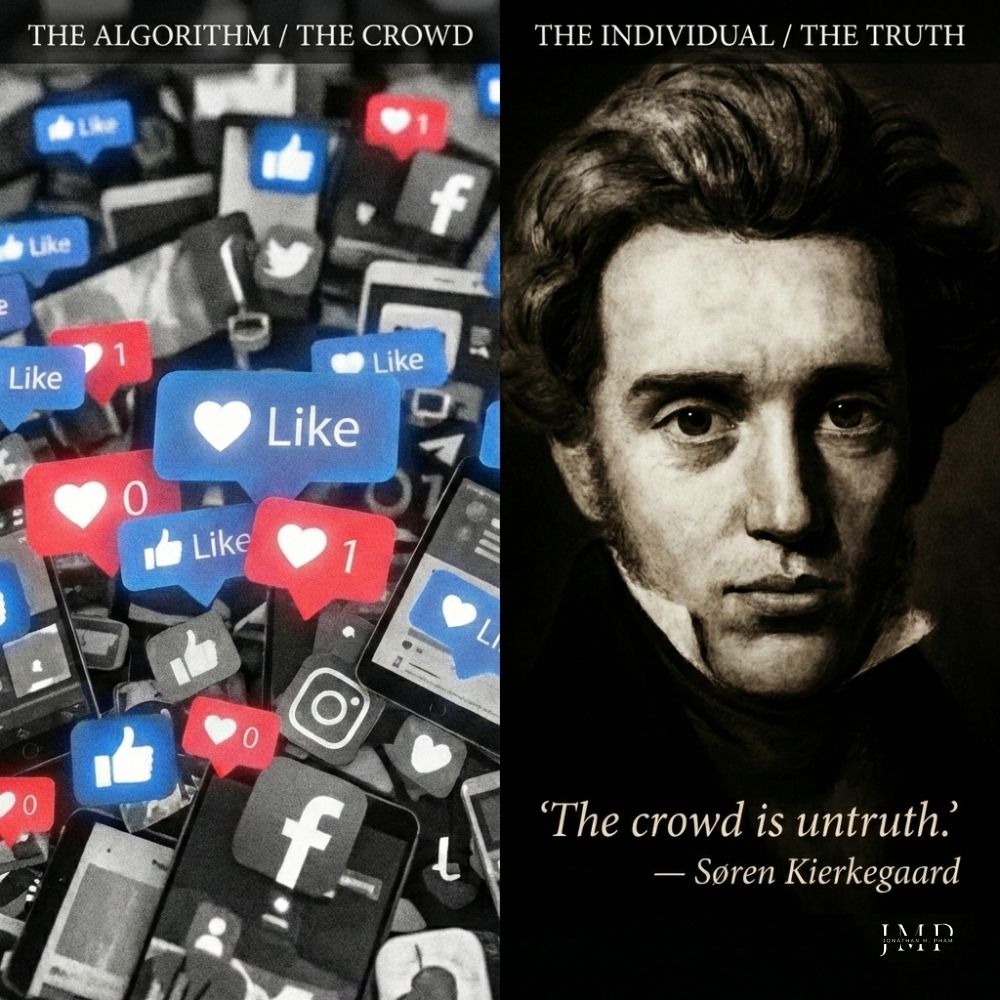
So far, we have covered how prevalent—and damaging—the habit of objectification is. Now the question is: what is the solution?
If we stop at the philosophy of the 20th-century French existentialists, we are left in a rather adversarial universe. In fact, Sartre once concluded that “Hell is other people”; accordingly, we are doomed to an endless cage match for our own subjectivity. In his view, every time we meet another person’s eyes, one of us must become the Subject, and the other must be reduced to the Object.
But does human connection have to be a battlefield? Are we completely doomed to the mechanics of use and extraction?
Around Sartre’s time, there were thinkers who didn’t quite agree with his bleak, hyper-individualistic outlook. The philosopher Martin Buber, in particular, believed that humanity essentially has two ways of engaging with the world: the “I-It” and “I-Thou” relationship.
In the same vein, the Christian existentialist Gabriel Marcel talked extensively about this thing called “creative fidelity”—an active, continuous commitment to being present for another person. At its core, it means being committed to a quiet vow as follows:
“I refuse to put you in a static box. I will honor your right to grow, to change, and to surprise me.”
If we look beyond Western philosophy and take into account Eastern frameworks, then Sartre’s pessimistic view of humanity is challenged even further.
Let us return, for a moment, to Sartre’s café waiter. As he claimed, the man was acting in “Bad Faith” by pretending to be a machine. However, what if that same waiter was acting in a state of “flow”?
In Eastern philosophy, there is a concept called “choiceless awareness”—a state of being completely submerged in the present action, without the psychological resistance of a separated ego. As in the case of the waiter, if he lets go of his self-conscious ego, then the gap between the “waiter” and the “pouring of the coffee” would vanish. He would no longer be trapped in his head, policing his own movements to escape his freedom.
In that moment, he would become pure consciousness.
In this state, the entire nature of “The Look” changes. Specifically, the waiter ceases to view the patron as a mere “source of a tip” (an object), and the patron stops thinking of him as a “servant” (a machine). The transactional nature of the service economy is briefly replaced by a shared, non-dual field of empathetic presence. And the waiter’s role now becomes a vehicle for liberation.
A flower, like everything else, is made entirely of non-flower elements. The whole cosmos has come together in order to help the flower manifest herself. The flower is full of everything except one thing: a separate self, a separate identity. The flower cannot be by herself alone. The flower has to inter-be with the sunshine, the cloud and everything in the cosmos.
Thich Nhat Hanh
The main flaw in Sartre’s philosophy is the assumption that we are completely separate entities to begin with—that there are hard boundaries between “you” and “me.” However, from an Eastern perspective, we are all interconnected souls within a greater ecosystem.
Just as a sheet of paper cannot exist without the cloud that rained on the tree, human identity does not develop in a vacuum. We are fundamentally wired for resonance and connection—our neurological mirrors mimic others’ pain, our language is a shared inheritance, and our sense of self is co-created through our relationships.
Through this lens, the footsteps in Sartre’s hallway do not have to cause shame. The gaze of the Other doesn’t have to steal your freedom.
When we look at each other without an agenda of utility, the Other’s look only validates our existence. It brings us into completion.
Read more: Authentic Love – Beyond Possession and Romanticism

To wrap it up, I would like to share a story I once came across on the Internet—which, as I found out later, seems to be a synthesis of Eastern Orthodox and Zen traditions. At its core, its speaks to the striking difference between a gaze that reduces and one that liberates.
Two monks were walking through a bustling city market. As they walked, they passed a remarkably beautiful woman, who was dressed quite immodestly by the standards of the day.
The younger monk immediately looked down at the cobblestones. He kept his eyes fixed on the ground until she was long gone. The elder monk, however, stopped in his tracks. He turned and stared intently at the woman as she passed, his eyes following her until she disappeared into the crowd.
The younger monk kept his silence, but he seethed with righteous indignation. Miles outside the city, he could contain himself no longer.
“Brother! What were you doing? That woman was dressed immodestly. She was parading herself in sin. You know that as monks, we must guard our eyes from such worldly traps!”
The elder monk turned to look at his companion. To the younger monk’s absolute surprise, the elder’s eyes were filled with tears.
“I did not look at her with lust, my brother.” he replied softly. “I looked at her with sorrow. I wept because God created something so beautiful, yet it has been so cheapened and degraded by the world. I was mourning the loss of her true dignity.”
“But tell me, brother—if you were looking at the ground the entire time, how did you know exactly how she was dressed?”
To me, the story is a perfect capture of the invisible mechanics behind objectification.
The younger monk followed the legalistic rule, yet his mind was filled with judgment. By averting his eyes, he believed he was being righteous; yet in his mental narrative, he had already reduced the woman to a mere symbol—a temptation, a moral failing, an obstacle to his own purity. He treated her as a “thing.”
The elder monk, however, possessed a transcendent presence. He did not reduce the woman to her appearance; nor did he use her as a mirror for his own ego.
He looked straight through the transactional gaze of the world and saw her original, unquantifiable dignity. He realized a sacred “Thou” wandering through an “It” world—and his only response was compassion.
Most of us—being trapped in our own conditioned, self-righteous mind—are only acting like the younger monk. We assume that if we just shrink the world enough—if we can optimize our bodies, categorize our neighbors, and enframe our digital networks—we will finally feel safe and in control.
Without realizing it, we are turning everyone and everything into pure objects. And a world composed entirely of objects is a terribly lonely place to live.
The cure to this loneliness is nothing special: be mindful of our own “gaze”. The moment we catch ourselves treating a cashier as a vending machine, a romantic partner as a validation tool, or an online opponent as a fungible avatar, let us consciously choose to soften our eyes.
Let us be reminded that behind every passing face on the street, every job title, every curated profile, there is an irreplaceable human consciousness waiting to be acknowledged.
Let us learn to look at one another as “mysteries” to be honored, rather than “labels” to be categorized.
Do you know that even when you look at a tree and say, `That is an oak tree’, or `that is a banyan tree’, the naming of the tree, which is botanical knowledge, has so conditioned your mind that the word comes between you and actually seeing the tree? To come in contact with the tree you have to put your hand on it and the word will not help you to touch it.
Jiddu Krishnamurti, “Freedom from the Known”
Other resources you might be interested in: