Let us visit a fictional place: The Village of the Valley.
Once upon a time, those who lived there were divided into two distinct groups: the Hill Tribe and the Swamp Tribe.
The Hill Tribe occupied the high ground, where the fruits were luscious—and the wells they dug flowed with crystal-clear water. They spent most of their days singing and dancing. To them, what happened down in the swamp didn’t mean much; they were simply too busy enjoying life.
The Swamp Tribe, on the other hand, lived in the lowlands, where they spent their days trudging through the mud. Their wells were salty, bitter, and brackish, and the crops they cultivated were stunted. Whenever they looked up at the hill, they were consumed by a simmering envy. They wanted what the Hill Tribe had. At first, they tried to climb the hill and fight for the land, but being weaker, they always lost.
One day, a respected elder in the Swamp Tribe stood on a rock and declared a new “truth.”
“Listen to me, brothers and sisters!” he shouted. “For too long, we have mistakenly thought the Hill Tribe was blessed. They are not! Their water is a demonic potion that makes them arrogant, greedy, and cruel. Those who drink from it are evil!
In contrast, our water may be bitter, but it purifies the soul. Drinking it teaches us the value of patience, humility, and holiness.
As for the fact that they are strong and wealthy? That is a sin! We are poor and weak? That is proof of our virtue and purity!”
The Swamp Tribe cheered the elder’s words. In an instant, they went from being “pitiful losers” to “morally superior beings”—whom the Hill Tribe could never match.
And that was not all. To further comfort his people, the elder painted the picture of an afterlife: those who suffered the most and drank the bitterest water without complaint would be rewarded with rivers of honey in the clouds, while the indulging Hill Tribe would be punished in pits of fire for their “gluttony.”
Years passed. The Swamp Tribe no longer tried to improve their lot. In fact, whenever someone among them finally figured out how to filter their brackish water, others would stone them, shouting, “You want to become evil like the Hill Tribe? Go away, you sinner!”
They had found the ultimate joy not in improving themselves, but in cursing the happiness of others and deceiving themselves into believing that their weakness was a form of morality.
…
How does the above parable sound to you?
At its core, the story speaks to the topic of “slave morality“—one of the most controversial (and widely misunderstood) concepts in modern philosophy, which was coined by the 19th-century German philosopher Friedrich Nietzsche.
For a spiritually inclined person who champions a compassionate life stance (like myself, writing from the perspective of a non-dogmatic Christian existentialist), bringing up Nietzsche may seem like a glaring contradiction. After all, he was the one who declared “God is dead” and was fiercely critical of traditional religion.
To be honest, when I first read about slave morality, it was extremely uncomfortable—almost like swallowing a bitter, jagged pill. It exposed me to some of the ugliest psychological pathologies hidden inside our moral and religious frameworks.
And yet, I believe we need to reflect on it seriously.
Why? Because Nietzsche’s philosophy acts as a purifying fire that burns away the complacent, “herd-like” mentalities frequently labeled as “righteousness”. It forces us to look in the mirror and ask ourselves:
Am I actually choosing humility, or am I just afraid of conflict?
Is my moral outrage born out of an active love for humanity, or is it a reactive, fearful defense mechanism?
Do I genuinely want the best for others, or do I harbor a vindictive wish to see the “strong” and successful punished?
I myself have seen the shadow of slave morality cast over so many areas of life—in political ideologies, in digital mob outrage, in religious communities, and, if I am being fully honest, sometimes within myself.
Once you see the truth, you can no longer turn a blind eye.
(Note: Before moving further, I would like to establish that the goal of the discussion is NOT to attack anyone’s faith, mock conventional goodness, or champion cruelty. My intent is for us to reflect together—on how weakness is often, unconsciously, deemed as virtue. And, more importantly, on how we can move beyond guilt and resentment toward a proactive, life-affirming stance.)
📌 Key Takeaway
Coined by the 19th-century philosopher Friedrich Nietzsche, slave morality is a reactive moral framework created by the powerless, in which strength is redefined as “evil” and weakness as a “holy” virtue.
At its core, slave morality is fueled by simmering resentment and a fragile ego that resorts to moral superiority as a coping mechanism against its lack of agency.
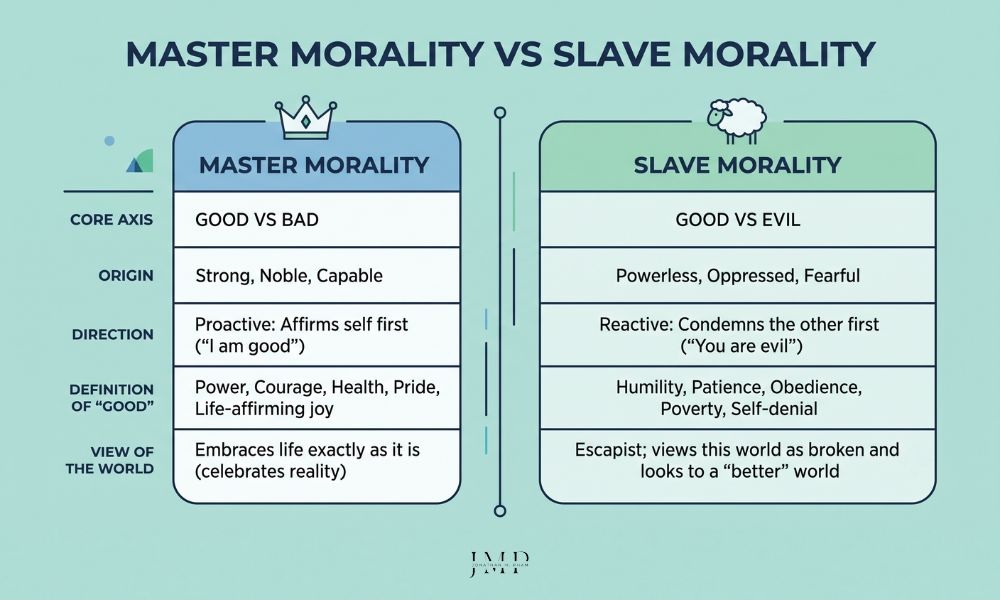
The core difference between master and slave morality lies in their origin and direction. The former is proactive; it is created by the strong and successful, who define their own life-affirming traits (courage, health, power) as “Good,” while viewing weakness simply as “Bad” (pitiful, but not evil). The latter, on the other hand, is reactive; it labels the master’s strength as “Evil” first, and only then defines its own helplessness as “Good.”
Organized religion is often hijacked by slave morality, making faith become transactional—a “weapon” to assert dominance rather than a tool for inner transformation.
Nietzsche didn’t advocate for cruel tyranny; his philosophy was meant to help humanity “wake up”, confront the inner shadows, act nobly and break through their own limits.
What is Slave Morality?
To truly understand slave morality, let us travel back in time and look at history through the lens of Nietzsche’s seminal work, On the Genealogy of Morality.
In the book, Nietzsche argued that our modern understanding of “right” and “wrong” didn’t just fall from the sky. It was the result of a psychological shift he called the “slave revolt in morality.” Before then, the ancient world (think of the Roman Empire or Homeric Greece) operated on a very different ethical axis, which Nietzsche referred to as Master Morality.
Slave morality book (source: Wikimedia)
Master morality (Good vs. Bad)
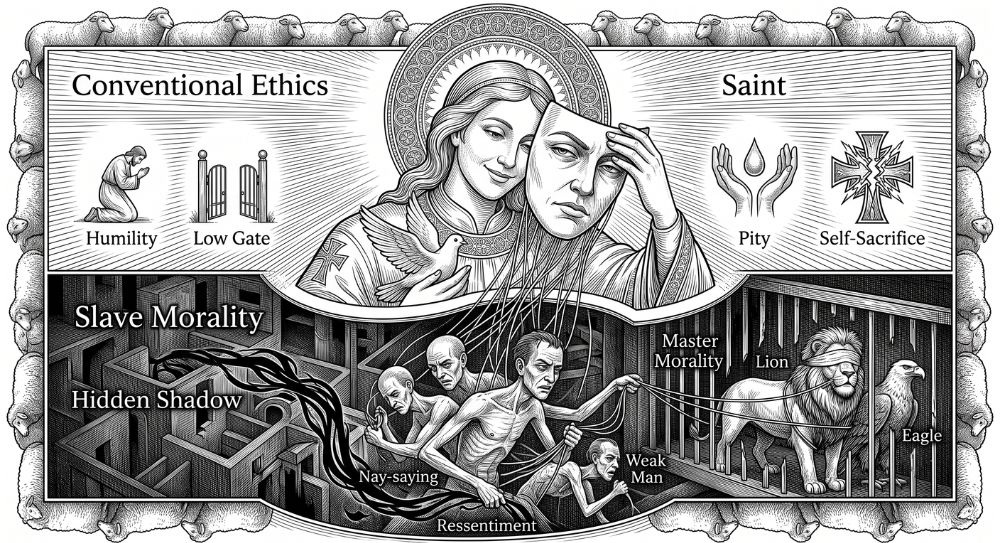
Master morality is a proactive framework created by the strong, the noble, and the action-oriented. In this worldview, “Good” simply means everything that enhances life and vitality. To be good is to be capable, healthy, wealthy, courageous, and full of joy—a “yea-saying” celebration of oneself.
Conversely, “Bad” does NOT mean evil. It simply means ordinary, weak, timid, or pitiful. The master defines themselves first—they declare their own strength as “good”—and they only look at the weak as an afterthought.
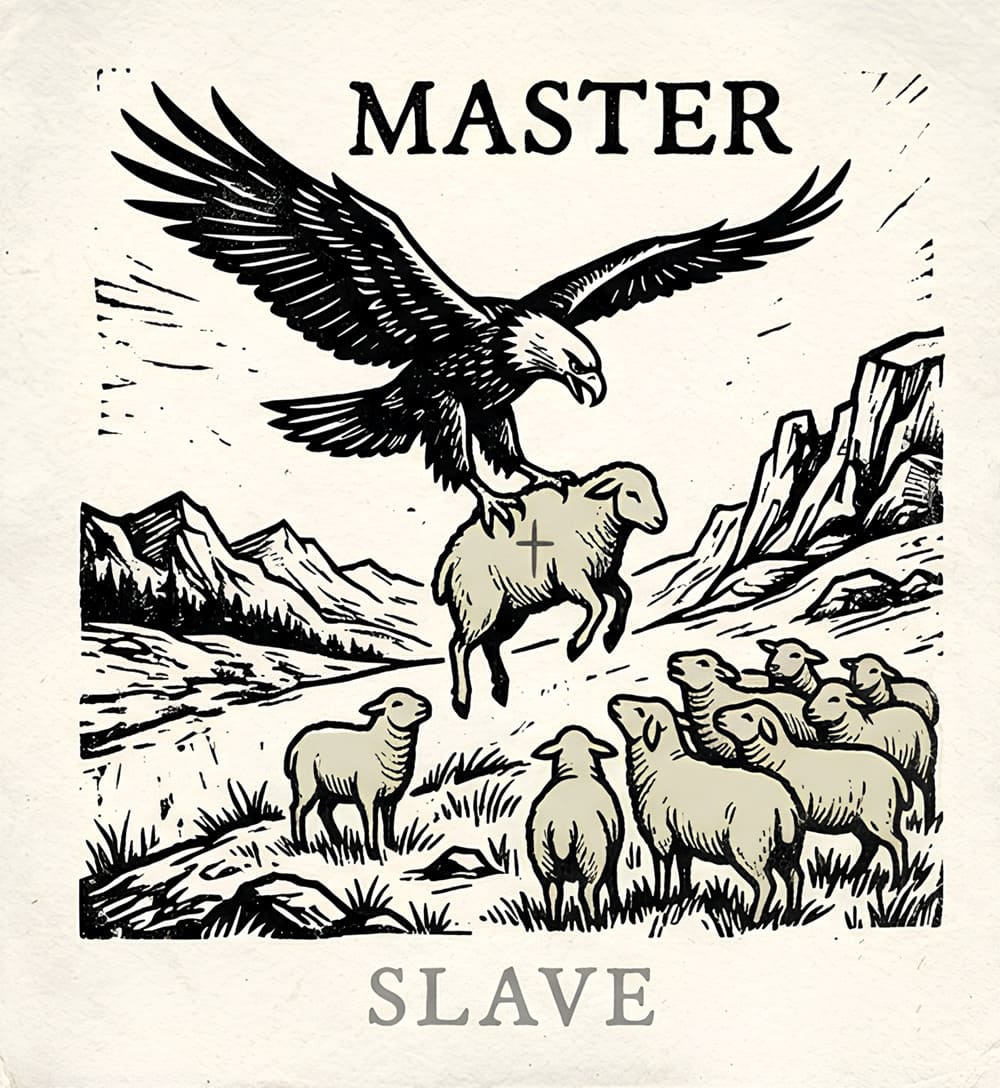
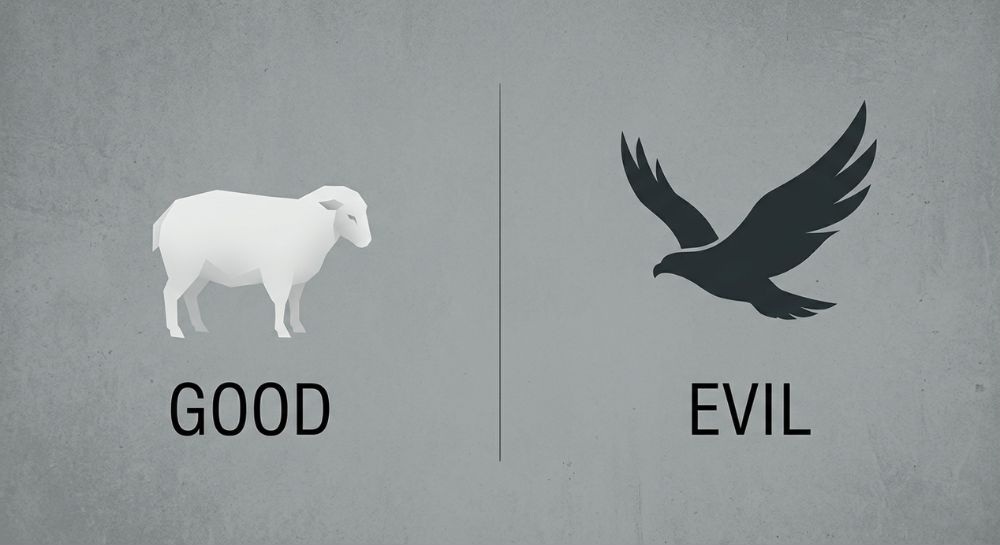
Example: Imagine an eagle soaring in the sky looking down at a field mouse. The eagle doesn’t hate the mouse; nor does it think the mouse is “evil.” It just views the mouse’s life as “bad” (in the sense of being small and powerless), and it certainly wouldn’t want to be one.
Slave morality (Good vs. Evil)
Slave morality, on the other hand, was created by the oppressed, the powerless, and the marginalized. If you are a slave, you cannot physically defeat the master. You cannot assert dominance in the real world. So, what would you do?
To survive, you stage a psychological revolt. You flip the script.
Slave morality is inherently reactive (what Nietzsche called “nay-saying”). It requires an “enemy” to exist first in order to define itself. The powerless look up at the strong and rebrand the master’s “good” (power, pride, wealth, freedom) as “Evil“. Then, they look at their own forced conditions (weakness, poverty, submissiveness, cowardice) and rebrand them as “Good“. (deeming them as humility, charity, and patience)
The eagle is evil for eating the mouse; therefore, the mouse is “holy” for being eaten.
There is no such thing as moral phenomena, but only a moral interpretation of phenomena.
Friedrich Nietzsche
The 3 pillars of slave morality
Utility as virtue
In master morality, virtue is about individual excellence. In slave morality, “Good” is whatever is useful to the survival of the weak community. Traits that help ease suffering—e.g. extreme self-sacrifice, sharing everything, and passive compliance—are elevated to the highest moral tier.
Universalism (Herd mentality)
Master morality is highly individualistic; the strong forge their own path. Slave morality, however, insists that its rules must apply to everyone equally.
Why? Because demanding universal conformity is the only way the “herd” can keep the strong in check.
This is arguably one of Nietzsche’s most brilliant observations. Slave morality plays a trick on us; it claims that the strong choose to be oppressive (and therefore deserve punishment), while the weak choose to be humble.
Nietzsche illustrated this mindset with a metaphor as follows. Imagine a flock of sheep looking up at birds of prey. The sheep whisper, “These birds of prey are evil; therefore, anyone who is the exact opposite of a bird of prey—namely, a sheep—must be good.“
The flaw here is that the sheep aren’t peaceful by choice; it’s only because they have no teeth.
Slave morality convinces us, insidiously, that our physical or psychological inability to act is actually a conscious, “holy” act.
Master vs. Slave morality summary
Feature
Master Morality
Slave Morality
The Core Axis
Good vs. Bad
Good vs. Evil
Origin
Created by the strong, noble, and capable
Created by the powerless, oppressed, and fearful
Direction
Proactive: Affirms itself first (“I am good”)
Reactive: Condemns the other first (“You are evil”)
Definition of “Good”
Power, courage, health, pride, and life-affirming joy
Humility, patience, obedience, poverty, and self-denial
Escapist; views this world as broken and looks to a “better” world
Slave morality vs master morality
If we look closely at this framework, it’s just a matter of time before we see how much of what is called “virtue” in modern society isn’t actually rooted in love at all. That behind it is a toxic emotion that dictates how we treat others when we feel small.
Slave Morality Psychology
To determine where slave morality comes from, let us observe our own psyches. When we feel defeated or incapable of asserting ourselves in the world, the human ego goes into a state of emergency. It needs a defense mechanism to survive the feeling of inadequacy.
The engine of Ressentiment
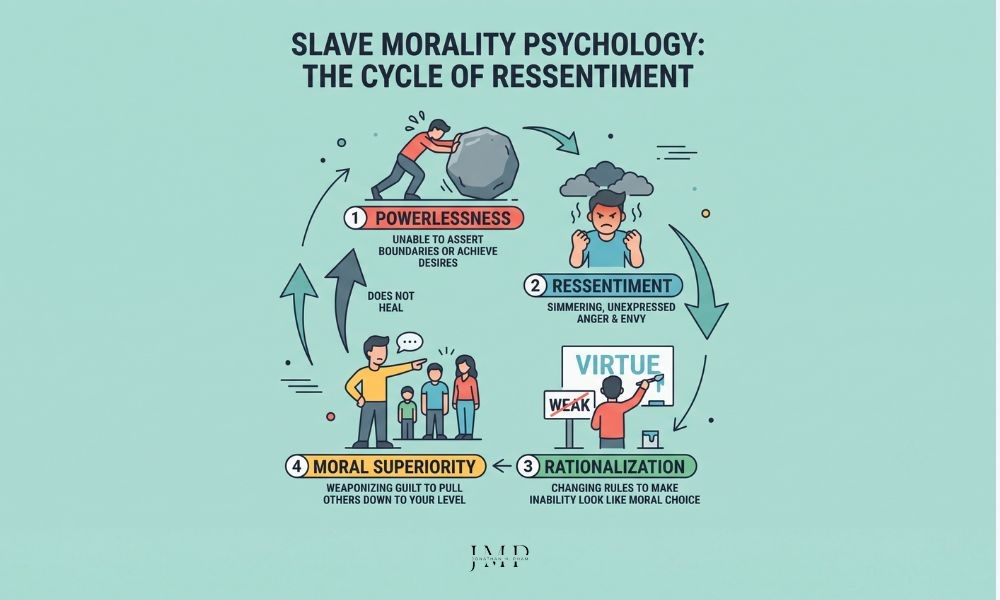
Nietzsche identified the primary driver of slave morality as “ressentiment“—which describes a very specific type of deep-seated, simmering bitterness. Unlike ordinary anger—which just flares up, prompts a reaction, and dissipates—ressentiment is subtle; it occurs when one is unable to take physical action to change one’s circumstances or right a wrong. When that happens, the frustration doesn’t evaporate. It turns inward and stews.
Unable to take physical revenge or assert boundaries in the real world, the mind seeks imaginary revenge. It literally invents a new moral code to compensate for one’s lack of power. In doing so, it turns one’s suffering into a badge of honor—and the oppressor’s strength into a cosmic crime.
The Shadow & psychological splitting
This brings us to a crossroad, where we meet the psychiatrist Carl Jung’s concept of the Shadow. According to Jung, the Shadow consists of the unacknowledged parts of one’s psyche—namely the capacity for anger, selfishness, malice, and dominance. Everyone possesses these traits; they are just part of the human condition.
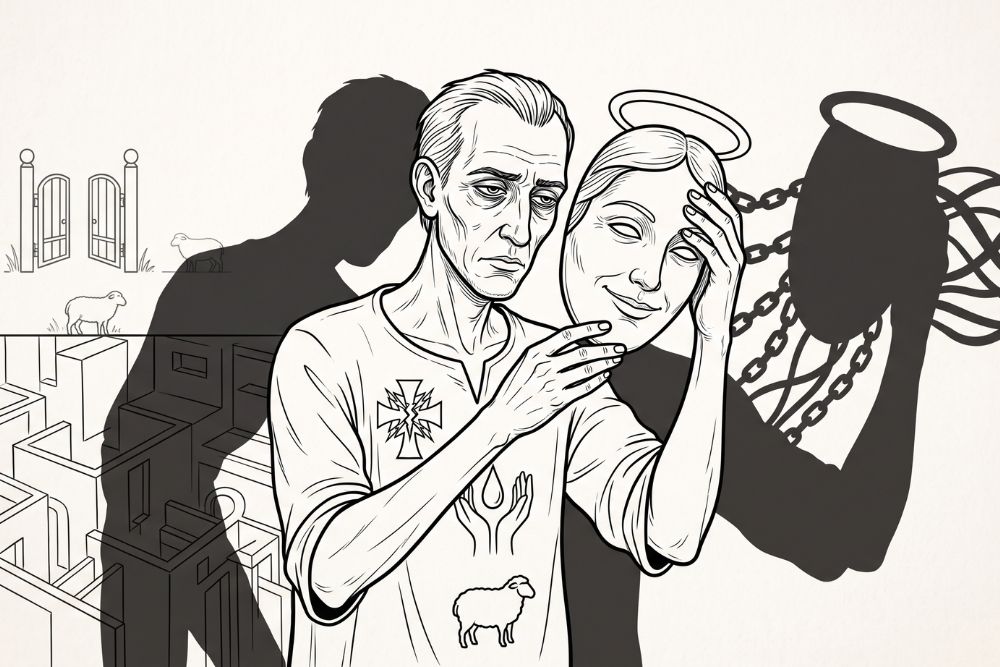
Yet in the framework of slave morality, having a Shadow is strictly forbidden. To maintain one’s identity as the “pure, humble victim,” these darker impulses need to be violently repressed.
The thing is, repressed energy never dies. Instead, it operates from the background—specifically through psychological splitting and projection:
Seeing “demons” everywhere: Because we refuse to acknowledge our own capacity for malice, we project it outward onto others. The world is divided into absolute Black and White. We become hyper-fixated on the “evil” in the world, while completely blind to the hostility we are harboring inside.
Hidden sadism: This is why people operating under slave morality can be incredibly cruel. Because they believe they are fighting “absolute evil,” they grant themselves a moral blank check. They secretly celebrate the suffering of the “wicked” while calling it “justice”.
Bad faith (Self-deception): Deep within, we know that we are using morality to manipulate others—that we are “weaponizing” our own weakness. Yet the ego cannot accept that; as such, it censors the truth to protect our self-image as the “righteous victim”. And the result, over time, is the complete erasure of personal accountability.
The Inferiority & Superiority Complex
When I first read about Nietzsche’s slave morality, I couldn’t help but notice striking similarities between his philosophy and the work of the psychoanalyst Alfred Adler—who, like Nietzsche, was also interested in how humans react to feeling “less than.” At the time, Adler was known for coining the term “Inferiority Complex”, which operates on the exact same psychological mechanism as slave morality.
To better understand this, let us think of Aesop’s fable of the fox and the sour grapes. A fox sees some delicious-looking grapes hanging high on a vine. He jumps and jumps, but he simply isn’t strong enough to reach them. Defeated, he walks away, muttering to himself,
“Those grapes were probably sour anyway.“
The same pattern applies to Nietzsche’s slave morality and Adler’s inferiority complex. We change the rules of the game to feel like we are winning without having to play. To make ourselves “morally superior”—without actually trying to change the circumstances.
If we lack the discipline or talent to achieve success, we excuse ourselves by saying that “ambition is greedy” and laziness is actually “a balanced, virtuous lifestyle.”
If we are afraid of standing up for ourselves, we declare that we are “turning the other cheek” out of holiness.
While such justifications may help protect the fragile ego, they also cut the individual off from the potential for growth and authentic connection. Worse, when accumulated, they make the feeling of helplessness mutate into a much more insidious form: the “Superiority Complex“. (or “moral arrogance“, in the realm of slave morality) Because the powerless cannot dominate physically or materially, they try to do it ethically. They adopt a rigid, hyper-righteous persona to look down on those who have the courage to pursue what they secretly desire.
Unfortunately, due to their lack of genuine strength, they have to borrow it from an abstract, unquestionable source—like “God,” “Virtue,” or “Society.”
One is suffering from strong feelings of inferiority, and, on top of that, one doesn’t have the courage to compensate through healthy modes of striving and growth… One can’t accept ‘one’s incapable self’. At that point, the person thinks of trying to compensate in some other fashion, and looks for an easier way out… It’s to act as if one is indeed superior, and to indulge in a fabricated feeling of superiority.
A familiar example would be ‘giving authority’. One makes a show of being on good terms with a powerful person… And by doing that, one lets it be known that one is special…
In each case, it isn’t that the ‘I’ is actually superior or special. It is only that one is making the ‘I’ look superior by linking it to authority… Those who make themselves look bigger on borrowed power are essentially living according to other people’s value systems—they are living other people’s lives.
Ichiro Kishimi, “The Courage to Be Disliked”
Examples of Slave Morality in Real Life
While Nietzsche’s slave morality was coined to describe the situation of society at his time—and especially to criticize organized religions (which we will discuss in detail later), his philosophy still applies today. In fact, if we look closely at the modern world—and are honest enough to look at ourselves—we will see it everywhere.
Far beyond religion, slave morality is a psychological survival blueprint that pervades daily life; it shapes how we judge others, how we argue online, and how we mask our own insecurities. Below are a few examples of how it looks like in practice.
Example #1: Glorifying mediocrity
Have you ever noticed how quickly people (maybe you yourself too!) would mock a highly driven, successful person? If someone in a workplace or classroom works exceptionally hard, the rest would dismiss them with something like:
“Trying to suck up to the boss?”
“That guy has no life”, or
“Wealth is inherently evil!“
These responses are pure slave morality/ herd mentality in disguise—uttered with the sole purpose of pulling everyone down to the same level. Laziness or the “bare minimum” is hailed as a balanced lifestyle, while ambitions and efforts are framed as toxic or try-hard.
Example #2: Weaponized weakness
When unable to assert agency or power by direct communication, many would resort to emotional and ethical leverage. Specifically, they would adopt a persistent victim mentality—invoking previous traumas (that have nothing to do with the current situation) or perceived disadvantages as a shield against criticism, while demanding special treatment from others. The underlying message is:
“I’m going through a hard time, so I have the right to act out. If you don’t tolerate it, you’re toxic.”
By playing the victim, bringing up the past, and guilt-tripping those around them, the powerless create an artificial “debt” that others must pay. They get to control the room not through strength, but through fragility.
Such a manipulation tactic is not only effective, but also deeply satisfying—because it grants the person a sudden dopamine hit of authority. So satisfying that they constantly resort to it, even when it comes at the cost of unnecessary misery to those around them.
Example #3: The “moral policeman”
Perhaps we all know someone—or have been that person at times—who fits the archetype of the “Moral Policeman”. It’s the one who constantly monitors the behavior of others, is prone to taking things personally, and is quick to say things like,
“Don’t do that, people will judge you,” or
“If you say that, you will lose face.“
They operate from an entirely externalized identity, using invisible committees (like “society” or “tradition”) to enforce their personal preferences and anxieties onto others. As such, when someone close to them is in a bad place—and needs empathy the most, the Moral Policeman cannot offer it. They are too busy being “right.”
Read more: Objectification – The Anatomy of the ‘Gaze’ & How to Transcend It
Example #4: Vicarious pride
In a sense, slave morality can be said to be an okay-ish mindset for those who are naturally soft and tender. However, for those who are not born that way, enforcing the mentality on them is a recipe for disaster.
This is what happens to one I personally know—one who (from what I can see) possesses a drive to win and express oneself, yet was raised by a weak-willed parent. (who constantly taught that “to react is to err“, and that standing up for oneself when oppressed is a sin/ a “moral failure”) Consequently, they grew up terrified of taking risks in life; yet because they are highly ambitious, the ego inevitably seeks loopholes to feel superior.
Far often, the person takes an immense, almost obsessive pride in the trivial achievements of their children or grandchildren. They use it as a socially permissible way to feel like a “winner”.
At the same time, they frequently seethe with jealousy whenever someone else talks openly about their own accomplishments. Instead of saying something like “Good for them“, the person would dismiss them as “selfish” for wanting to win. (while, ironically, doing the exact same thing in disguise)
To be honest, we all act in the same way from time to time. Deep down, we want to be on top, but because we aren’t (or cannot/ don’t want to try) we have to pretend we don’t care about being on top. Consequently, we hate anyone who actually gets there or openly attempts to.
By refusing to own our power, desires, and capacity for growth, we trap ourselves in a cage of our own making. And eventually, we start demanding that everyone else live in that cage with us.
There’s the kind of person who likes to boast about his achievements. Someone who clings to his past glory, and is always recounting memories of the time when his light shone brightest…
Those who go so far as to boast about things out loud actually have no confidence in themselves… If one really has confidence in oneself, one doesn’t feel the need to boast. It’s because one’s feeling of inferiority is strong that one boasts. One feels the need to flaunt one’s superiority all the more. There’s the fear that if one doesn’t do that, not a single person will accept one ‘the way I am’.
Ichiro Kishimi, “The Courage to Be Disliked”
Slave Morality & Organized Religions: The Shadow of Faith
This is probably the most controversial part of our discussion. Back in the day, Nietzsche heavily criticized organized religions—specifically, Christianity—as the quintessential engine of slave morality. He pointed out that historically, the aristocratic masters held physical and political power; yet it was the “priestly class” who held spiritual power. Given that the latter could not physically defeat the ruling class, they orchestrated a massive “transvaluation of values“—flipping the script so that the master’s strength became a sin, and the priest’s powerlessness became a divine virtue.
For a religious existentialist like me—someone trying to live out a faith that is personal and authentic—Nietzsche’s critique cuts right to the bone. It shows me just how easily spirituality can function as a conveyor belt for one’s unacknowledged shadow.
Religion as an anesthetic
At its worst, institutionalized religion offers people a psychological discount code. It provides an off-the-shelf, ready-made identity of “goodness” that bypasses the vulnerable work of actual individual integrity. Instead of having to proactively create beauty or cultivate genuine compassion, we are handed a static checklist of rules.
If we follow the rules—and, more importantly, if we judge those who don’t follow the rules—we get to feel morally superior.
In this way, religion functions exactly like an “anesthetic” (or, in Karl Marx’s words, the “opium of people”); it numbs the pain of one’s own mediocrity. It turns passive endurance of life into a “divine achievement” witnessed by the heavens.
Nothing so tends to mask the face of God as religion; it can be a substitute for God himself.
Martin Buber
Transactional spirituality & religious hypocrisy
And that’s not all. When religion (and spirituality in general) becomes an anesthetic—when its only role is to provide a “dopamine hit” rather than addressing the unresolved chaos within one’s psyche—it gives rise to an extremely troubling phenomenon: Transactional Spirituality.
I happen to know “pious” believers who never miss a weekly service—who are very eager to donate to the institution, join religious groups, preach charity, and invoke God in their conversations. Yet it’s also the same individuals who frequently act egoistically—by:
Selling low-quality products at inflated prices (while claiming otherwise);
Judging and badmouthing those who they deem as “morally inferior” or just a little “eccentric”;
Looking down on others (e.g. after spending Sunday morning handing out meals at a church shelter, one goes to a restaurant for lunch and treats the server with condescension);
Getting defensive (and even yelling/ fighting back) when someone corrects them;
Being cruel when crises strike. (e.g. willingly resort to underhanded legal tactics, lying, or cutting off relatives entirely during a family inheritance dispute)
In some cases, I have even heard certain people proudly claiming:
“I only trust God and trust no one else.”
It sounds ironic, right? Claiming to love a God one cannot see, yet despise the neighbor one can see? That being said, it’s not hard to explain why.
Loving an abstract, invisible deity (or, in a secular setting, “loving humanity” in general) is totally safe; it requires no vulnerability, no risk of betrayal, and no messy confrontations. Yet it’s another story when it comes to treating real flawed individuals—the ones who suffer from bad breath, snore at night, occasionally forget to wash the dishes, and have annoying habits.
This kind of transactional spirituality is pure slave morality. Instead of admitting our inability to navigate complex human relationships, we retreat into a religious fortress and claim the moral high ground. Rather than facing the Shadow within (and undergoing real inner transformation), we commit the sin of “spiritual bypassing” just for a fleeting spiritual high.
And the more troubling part? Most institutions, as far as I can see, are turning a blind eye to it. In fact, many teachers and religious officials are even—overtly or subtly—promoting it. Simply, because doing so is much easier and more likely to win people’s support.
Thus do I counsel you, my friends: distrust all in whom the impulse to punish is powerful! They are people of bad race and lineage; out of their countenances peer the hangman and the sleuth-hound. Distrust all those who talk much of their justice! Verily, in their souls not only honey is lacking. And when they call themselves ‘the good and just,’ forget not, that for them to be Pharisees, nothing is lacking but — power!
Friedrich Nietzsche, “Thus Spoke Zarathustra”
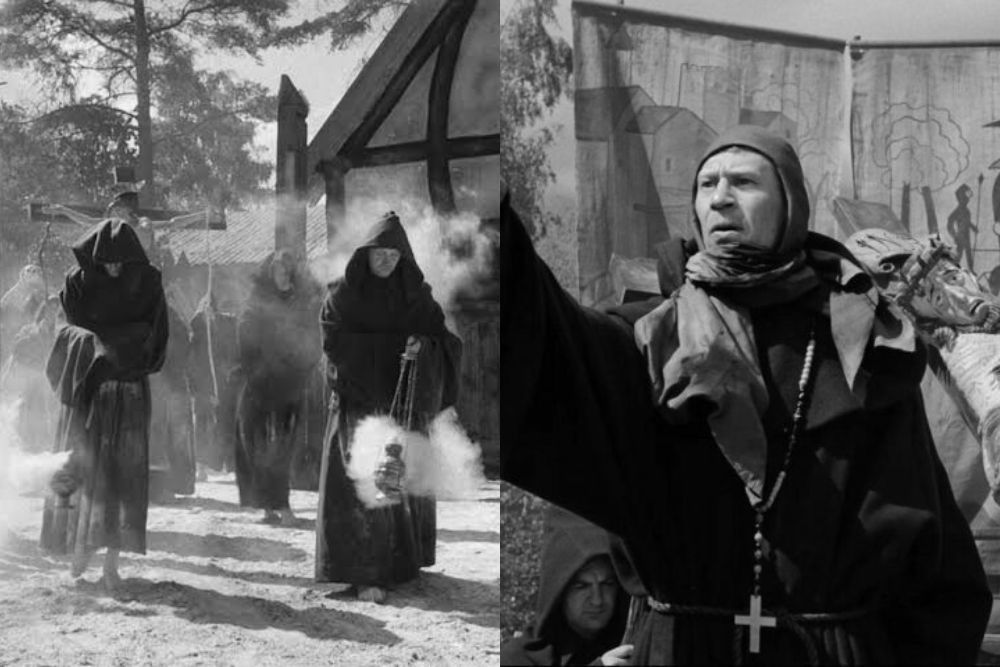
The fanatic flagellants from Ingmar Bergman's "The Seventh Seal"—a grim example of how slave morality can make religions devolve from a noble cause to something purely transactional and life-denying
Hell as a “cosmic equalizer”
It’s safe to say that nowhere is the ressentiment of slave morality more visible than in the cultural concept of Hell. (or Karma, if we expand the discussion to non-monotheistic religions) It’s what the typical believer frequently invokes—especially when they are wronged or offended. (but never when they themselves wrong others)
“You will be banished to hell!”
“You’re going to pay for this in the next life!”
“Just wait and see!” (what would happen to you after death)
Sound familiar?
Sometimes, when I see people uttering such phrases, I cannot help but wonder: is Hell a literal “lake of fire”? Or is it more of a psychological state—one that is born out of people’s inner darkness? A manifestation of human spite, meant to help cope with one’s powerlessness? (think Dante’s Inferno—which was, in many ways, a petty revenge fantasy against his political enemies)
I cannot say for sure if Nietzsche shared the same thoughts as me, but he definitely saw through the psychological pattern behind the typical believer’s tendency to invoke Hell. In fact, he pointed it out by referencing the work of early Christian theologians, like Tertullian, who wrote that one of the great joys of the saved in Heaven would be to “look down to watch the sinners burn in Hell.”
The underlying emotion, as it’s not hard to see, is neither love nor pity; just sheer unadulterated vindictiveness masked as piety. Hell is used as a “Cosmic Equalizer” to satisfy the ego’s desire for “justice”. If I cannot punish my enemies today, I will outsource it to a divine punisher and enjoy watching them suffer from afar. (Schadenfreude)
When organized religion is subverted by slave morality, it doesn’t save people from the darkness. In many ways, it only pushes them further into it.
In our attempt to bring down the “monsters”, we become mindless, sadistic puppets ourselves—cynical people who secretly wish disaster upon anyone who treats us in a way we don’t like. We end up adopting the exact cruelty we claim to be fighting.
He who fights with monsters should look to it that he himself does not become a monster. And if you gaze long into an abyss, the abyss also gazes into you.
Friedrich Nietzsche
Master-slave morality criticism
The Nuanced Truth About Nietzsche’s View of Slave Morality
At this point, it is easy to assume that Nietzsche was a “cartoon villain”. If he hated slave morality so much, does that mean he wanted us all to become abusive “masters”? Was he advocating for a society of cruel sociopaths who trample over the weak?
Not at all. In fact, this is arguably the most common misconception about his philosophy.
To a certain extent, Nietzsche was acting as a “cultural diagnostician”. He was examining how these moral frameworks drive human psychology and societal evolution, but he did NOT advocate for either of them.
Is slave morality bad?
Did Nietzsche believe slave morality was bad? Yes and no.
To him, slave morality is a psychological “sickness.” He saw it as fundamentally anti-life, hostile to human excellence, and responsible for breeding a widespread culture of mediocrity, guilt, and self-loathing. It suppresses greatness by making people ashamed of their natural instincts for vitality and growth.
But—and this is a massive but—he also credited it with something extraordinary: it made humanity deep and interesting.
In Nietzsche’s eyes, the original aristocratic masters were essentially just glorious “brute animals”. They were strong and joyful, but they were intellectually shallow. They didn’t think too hard about anything.
Slave morality, however, forced human beings to look inward. Because the oppressed could not act outwardly, their energy turned within, carving out the inner landscapes of the mind. Over time, it birthed complex psychology, the human conscience, philosophy, and art.
A return to master morality, therefore, was not what Nietzsche advocated for—not that such a regression would even be possible. He recognized that both frameworks are inherently flawed. The master is a shallow brute; the slave, on the other hand, is a resentful hypocrite.
What he truly wanted was for people to move “beyond good and evil”. To wake up, transcend these primitive dualities, and step into a state of spiritual maturity where one creates one’s own noble values. (which he called the Übermensch)
If you still doubt that Nietzsche’s philosophy was far more complex and caring than it appears on the surface, we only need to look at the end of his conscious life.
There is a famous, albeit heartbreaking story about Nietzsche. (which has been turned into a movie) In January 1889, while walking through the Piazza Carlo Alberto in Turin, Italy, Nietzsche witnessed a cab driver viciously whipping a horse that refused to move.
The philosopher who wrote extensively about the “Will to Power”—the man who fiercely condemned his former teacher Arthur Schopenhauer’s philosophy of pity and compassion—surprisingly did not side with the master holding the whip. Instead, he ran into the street, tearfully threw his arms around the neck of the beaten horse to protect it, and collapsed. Afterward, he suffered a complete mental breakdown and never wrote or spoke a sane word again for the rest of his life.
Now, historians have been debating the exact details of this event. It’s very likely the story has been over-romanticized over the years. But even if it is, there’s still certainly a kernel of truth in it—which brings us to a haunting question:
“Did Nietzsche contradict his own philosophy?”
I myself don’t think so. To me, the story only reveals that Nietzsche’s personality and philosophy are probably much more nuanced than one might assume. In fact, his friends and acquaintances recounted that he was a very gentle, polite, and hypersensitive person—definitely NOT a tyrant at all.
When we look at Turin (combined with what those in his inner circles said about him), I believe it’s safe to conclude that his philosophy of strength—while appearing “ruthless” on the surface—wasn’t meant to be rebellious just for the sake of it. That he likely came up with it as a psychological shield against his own capacity for pity—a pity he feared would literally break him. (and eventually, it did!)
When viewing his philosophy through this lens, we can interpret Nietzsche’s harsh critique of slave morality not as an act of hatred, but that of “tough love”. That the "little pastor" (a childhood nickname given to Nietzsche by his schoolmates due to his extremely pious, soft-spoken nature at the time)—seeing humanity drowning in passive conformity and resentment—was only trying to “wake us up”. That he wanted people to become strong enough to actually care for the world—without being destroyed by it.
Read more: Amor Mundi – To Love the World From an Authentic Heart
Transcending the Master-Slave Morality
Nietzsche was no nihilist but, on the contrary, was the first to try to overcome the nihilism inherent not in the notions of the thinkers but in the reality of modern life. What he discovered in his attempt at “trans-valuation” was that within this categorical framework the sensuous loses its very raison d’être when it is deprived of its background of the suprasensuous and transcendent. “We abolished the true world: which world has remained? Perhaps the world of appearances? . . . But no! Together with the true world we abolished the world of appearances.” This insight in its elementary simplicity is relevant for all the turning-about operations in which the tradition found its end.
Hannah Arendt
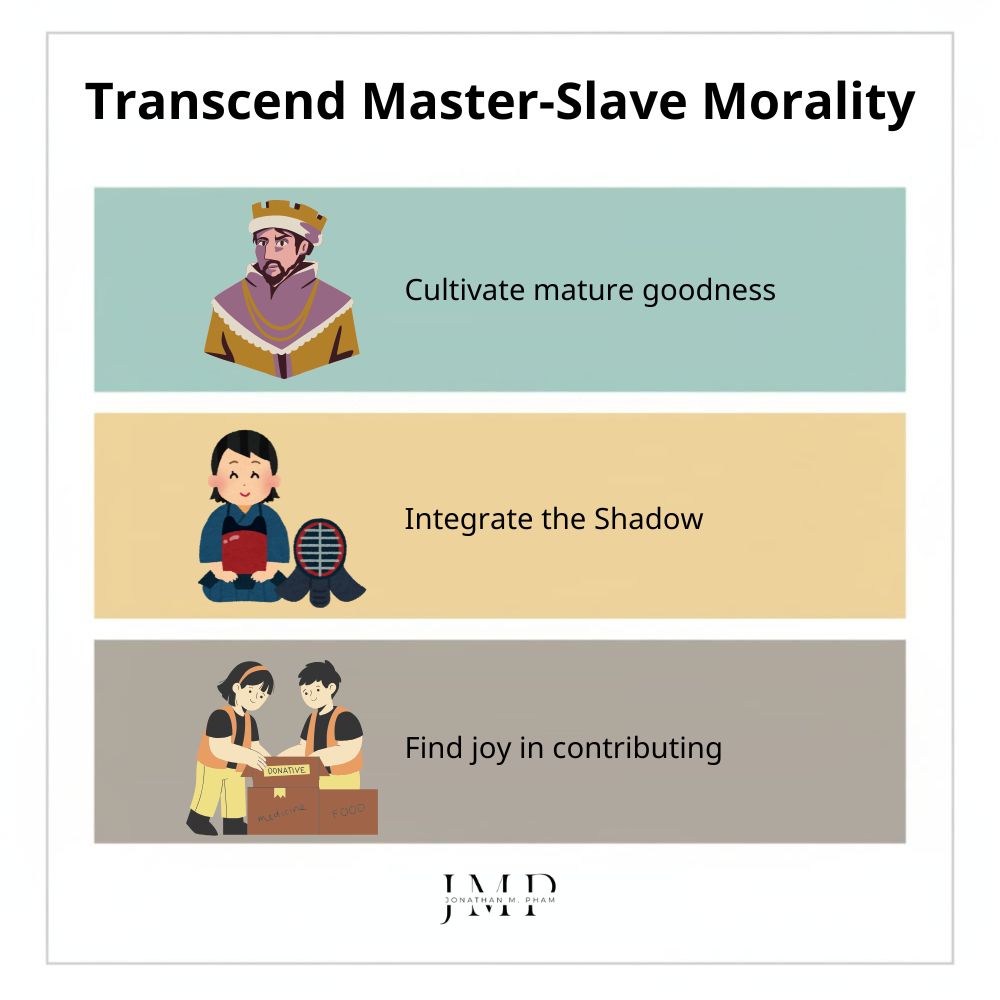
Given that both master morality and slave morality are flawed, it’s essential that humanity aims to transcend both of them. The question is: How?
How do we live a compassionate life without secretly weaponizing our “virtues”?
The key, as I figured, is to outgrow the psychological need to be the “pure, helpless hero” fighting “evil villains.” To go through a radical shift in how we approach our daily actions.
From Immature to Mature goodness
Let us start with the underlying psychology of what we call “virtue”—which, broadly speaking, can be categorized into two types as follows:
Immature/ Reactive goodness (Slave morality): You do good things because you are afraid of conflict, hungry for validation, or secretly resentful. In other words, you are only trying to run away from your own internal chaos.
Example: Let’s say a coworker or a family member asks you for a massive favor. You don’t have the time or energy, but you agree to do it anyway—because you are worried that they will think you are “selfish.” While doing the favor, you internally seethe with anger; and afterward, you subtly hold it over their head, acting preachy or dropping hints about how much you had to “sacrifice” for them.
In this case, your obsession with “doing good” is driven purely by a fragile ego and the fear of losing face. There’s nothing noble about it at all.
Mature/ Proactive goodness: You are fully content within yourself. You recognize your own strength and boundaries, and you choose to let that abundance overflow onto others without needing a psychological return on investment.
Example: When asked for that same favor, you start by assessing your own capacity. If you cannot do it, you have the courage to say “no” calmly and firmly, without feeling the need to over-apologize or play the victim.
On the other hand, if you can do it, you do so freely, out of a genuine desire to help. (what the Greeks called Agape) You expect no praise, and you hold no hidden ledgers of debt.
In the foreground there is the feeling of plenitude, of power, which seeks to overflow, the happiness of high tension, the consciousness of a wealth which would fain give and bestow: the noble man also helps the unfortunate, but not, or scarcely, out of pity, but rather from an impulse generated by the super-abundance of power.
Friedrich Nietzsche, “Beyond Good and Evil”
Integrating the Shadow
I learned that it is the weak who are cruel, and that gentleness is to be expected only from the strong.
Leo Rosten, “Captain Newman, M.D.”
Before reaching the above-mentioned state of mature goodness though, we have to do something that sounds deeply paradoxical: integrating our own capacity for malice. Or, in Jung’s words, integrating the “Shadow”.
After all, a “harmless” person cannot be said to be a truly good person. If you have no capacity for force, assertiveness, or cruelty, then your “peacefulness” is not a virtue—just a lack of power. (remember Nietzsche’s sheep?)
True goodness, therefore, requires agency.
It’s just like a martial arts master. They possess the physical capacity to inflict severe harm on almost anyone they meet. Yet, they walk through the world with immense patience and humility. Their gentleness is meaningful—because it is a conscious decision made every single second.
Only when the master acknowledges their capacity for violence—the ability to annihilate their opponent—can their choice to keep the sword sheathed be called peace.
Real-life application: Think back to the “Moral Policeman” and the emotional manipulator we discussed earlier. When dealing with someone who uses guilt or passive-aggression to control you, the reactive (slave) response is to either submit in silence or explode in bitter rage.
However, there’s a third option: you can put up an emotional plexiglass shield (often called the “Grey Rock” method), viewing them almost like a faulty “robot” running a predictable script. You know exactly what you could say to verbally destroy them and expose their hypocrisy—you have the “teeth”—yet you voluntarily choose to disengage and protect your own peace instead.
Power – is when we have every justification to kill, and we don’t. A man stole something, he’s brought in before the Emperor, he throws himself down on the ground. He begs for mercy, he knows he’s going to die. And the Emperor pardons him. This worthless man, he lets him go. THAT IS POWER.
Schindler’s List (1993)
Find joy in contributing to others
Interestingly, this solution was proposed by the psychoanalyst Alfred Adler—who started at the same point as Nietzsche. He took Nietzsche’s concept of the “Will to Power” and agreed that people are driven by a need to overcome inferiority; yet he argued that purely self-centered power-seeking (the ancient Master’s ideal) is actually a form of neurosis.
According to Adler, healthy striving requires what he called Gemeinschaftsgefühl—Social interest. Ironically, he took the exact traits that Nietzsche dismissed as weak “herd morality”—cooperation, empathy, social equality—and claimed that they are actually the highest evolutionary achievement of the human mind, provided they are backed by strength rather than fear.
When we transcend the Master-Slave duality, our ambition does not disappear, nor does it curdle into resentment. Rather, the “Will to Power” is transformed into a “Will to Empower.”
Instead of dominating the weak, we become strong by lifting the entire community up with us.
A Lesson for Religions: From Submissive to Life-affirming Faith
When a man like Nietzsche goes mad, the enemies, who are all around — the people who misunderstood him and drove him mad – take advantage of the situation of his being mad. They start saying that it is his philosophy which is basically wrong, that has driven him mad. His madness becomes a proof that he is a wrong man—that he is not only mad today, he has always been mad. Whatever he has said is insane. So it becomes a more solid ground on which to refute the person completely, to erase him completely…
But a revival was certain. You cannot continue to misunderstand something which has even a little bit of truth in it — and Nietzsche has tremendous insights. If they can all be understood, it will help the Western mind to change many things.
Osho
Now is the time for a very personal section—written from the perspective of a believer himself. As mentioned in the beginning, my goal of the discussion is to use Nietzsche’s abrasive philosophy to burn away the superficial layers of religions—so that what’s left is a faith that is much more real.
The need for authenticity
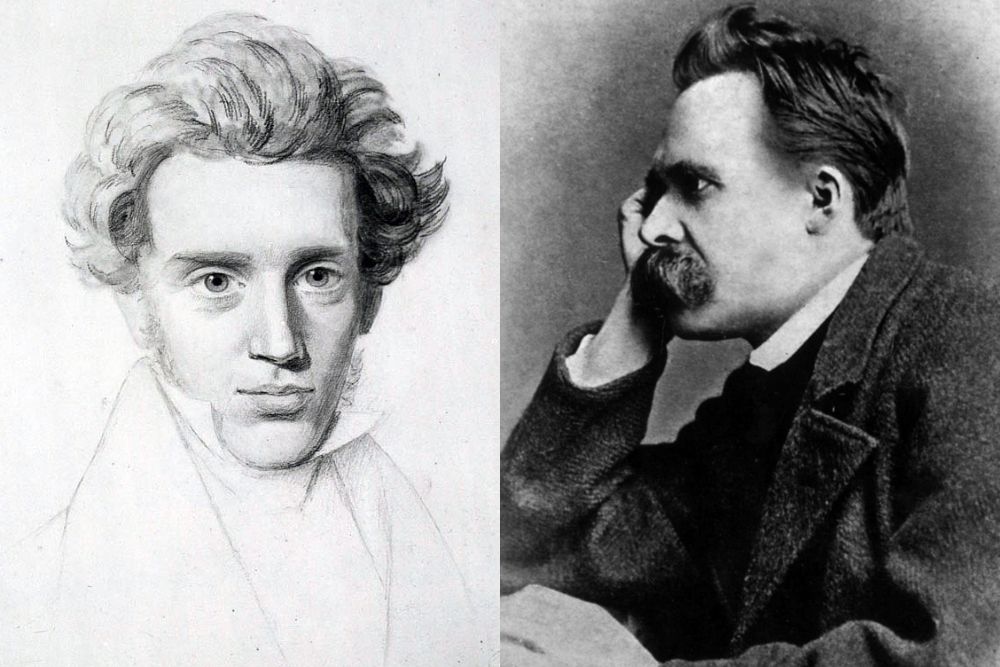
Long before Nietzsche declared “God is dead,” Søren Kierkegaard—the father of Christian existentialism—was waging a one-man war against “Christendom”. (the mass-market, state-sponsored religion of 19th-century Denmark) To him, being a passive rule-following member of a congregation didn’t make one a faithful believer; it was nothing more than cowardice masked as piety—a way to hide in the crowd to avoid one’s own responsibility.
In many ways, Kierkegaard was doing the same thing as Nietzsche. (with the only exception of “holding a cross in his hand”) Both thinkers demand an “upgrade” to humanity’s worldview: that we stop using God, tradition, or morality as a psychological crutch to hide from ourselves.
Redefining hell
As discussed, the concept of Hell (or Karma) is widely invoked and weaponized in slave morality—a toxic trap that only pushes people further into cynicism, away from spiritual maturity. To escape it, it’s essential we stop viewing Hell as a cosmic torture chamber designed to punish those who wronged us.
In his masterpiece The Brothers Karamazov, the great Russian novelist Fyodor Dostoevsky (a religious thinker whom Nietzsche deeply admired) offered a groundbreaking redefinition of Hell as follows:
“What is hell? I maintain that it is the suffering of being unable to love.”
Instead of interpreting hell as a literal “lake of fire”—which only breeds fear and superficial compliance—we should reframe it as an internal state of self-alienation, resentment, and isolation. It happens when one’s heart becomes hardened so much that it has closed itself off to everything else.
We don’t need to wait until death to know about hell. (and heaven alike) When we hold onto decades-old grudges, refuse to forgive, constantly judge others, and view ourselves as a perpetual victim, we are already in Hell.
When we are obsessed with being “right” and too proud to apologize or show warmth, we are already constructing Hell on earth. Already forcing those around us to suffer from it.
And if your friend does evil to you, say to him, ''I forgive you for what you did to me, but how can I forgive you for what you did to yourself?”
Friedrich Nietzsche, "Thus Spoke Zarathustra"
Cultivating a “Heroic Faith”
The task of religion is not to teach us to bow our heads and accept God’s inscrutable will. It is to help us find the resources to live meaningfully and to go on believing, even in a world where people often don’t get what they deserve.
Harold Kushner
Once the fear of Hell and the desire for moral revenge are stripped away, we have already taken a great step toward a healthier form of spirituality. Now is the next (albeit gruesome) part of the transformation process: Responsibility. To turn faith from mere observation to proactive action.
At this point, I believe it’s helpful to bring up the Greek writer Nikos Kazantzakis, who was deeply influenced by Nietzsche’s philosophy. On one hand, Kazantzakis fully embraced Nietzsche’s critique of slave morality (and organized religions); on the other hand, he used it to reinvent faith. Instead of the “pity culture” typically promoted by mainstream Christianity, he championed a type of “heroic faith” characterized by:
A reimagined view of the Savior: In Kazantzakis’s eyes, Christ is seen as the ultimate Übermensch, a heroic spirit who actively conquers human flesh, fear, and death to liberate the soul.
An inversion of the God-human dynamic: Rather than waiting passively for an all-powerful deity to magically fix our problems, Kazantzakis believed it is humanity who must “save God”. To him, the divine is a vital life force (élan vital) trapped within matter; it cannot manifest in the physical world, unless we ourselves take action—by fighting for beauty, justice, and consciousness.
God is imperiled. He is not almighty, that we may cross our hands, waiting for certain victory. He is not all-holy, that we may wait trustingly for him to pity and to save us. Within the province of our ephemeral flesh all of God is imperiled. He cannot be saved unless we save him with our own struggles; nor can we be saved unless he is saved.
Nikos Kazantzakis, “The Saviors of God”
Non-duality as the final key
While Western existentialism (including Nietzsche’s Übermensch) is incredibly empowering, it comes with a very real limitation: the risk of tilting into hyper-individualism, arrogance, and solipsism. This is where we can look to Eastern philosophy—specifically Zen Buddhism, Taoism, and the Kyoto School of philosophy—to find the last “piece of the puzzle”.
For long, Eastern traditions have taught the concept of Non-Duality—that the boundary between the “self” and the “other” is merely an illusion. Accordingly, humans are not isolated egos fighting against a hostile universe; we are all interconnected expressions of the same underlying reality.
From this perspective, Nietzsche’s “Will to Power” would take on a whole new meaning. If the “self” and the “other” are ultimately one, then I can affirm life and exercise my strength without it being at your expense.
Real-life application: When operating from a non-dual outlook, you don’t help a struggling neighbor because you pity them (which implies you are looking down on them from a position of superiority); nor do you do it out of the belief that God will reward you in Heaven. Rather, it’s because you realize they are, in a very real sense, a part of you. That helping them is just as natural as your right hand reaching over to bandage a cut on your left hand.
No longer is compassion driven by the weakness of slave morality. Now, you act virtuously simply because it’s the most natural thing to do at the moment.
In all these cases, there is no stopping at a notion of God as personal in the traditional sense… Rather, God must be encountered as a reality omnipresent in all the things of the world in such a way as to be absolutely immanent as absolutely transcendent.
Keiji Nishitani
FAQs
Why did Nietzsche criticize slave morality?
Nietzsche despised slave morality because he saw it as an anti-life “sickness”—the cause of a culture of mediocrity, guilt, and deep-seated resentment. By demonizing human excellence, ambition, and natural instincts, it encourages people to deny their own potential—and in turn live in a state of self-deception and psychological repression.
Is Christianity considered a slave morality?
According to Nietzsche’s historical critique, yes. He viewed the institutionalized church (the “priestly class”) as the primary engine that inverted ancient aristocratic values.
However, there is a massive caveat here: Nietzsche did separate the institution of Christianity from Christ himself. He actually admired Jesus as a noble, life-affirming figure who sacrificed himself for his own radical values. In his view, Jesus was a “beautiful soul” (akin to Prince Myshkin in Dostoevsky’s The Idiot)—one who was fully free of ressentiment, who was too sensitive to hold a grudge.
While he didn’t regard Jesus as a “hero” or a “genius”, Nietzsche concluded that he was something even rarer: a “free spirit” who lived completely without enmity. As such, he accepted Christ’s “glad tidings” as a sincere experience of the heart—while condemning the Church, which he believed is the exact opposite of what Jesus actually lived. To him, the Church’s glorification of the “poor and weak” was born not out of love (like Jesus), but hatred for the “rich and strong.”
(It’s unfortunate, but I myself have to admit there’s a kernel of truth in it—based on my own observation of many believers, no matter which spiritual traditions they belong to. And it’s not just about religions; we can see the same pattern even in various social and political movements—proof that it’s so much easier to tap into people’s resentment than to cultivate genuine strength and independence of spirit.)
There was only one Christian, and he died on the cross.
Friedrich Nietzsche
Is modern “cancel culture” or political correctness a form of slave morality?
It certainly can be. When social movements are driven by a genuine desire to uplift others and establish human dignity, they reflect a healthy “social interest.” However, when they are influenced by the “digital mob”—where people weaponize victimhood, constantly police others’ language, and find sadistic joy in destroying someone’s reputation—it is a textbook modern manifestation of slave morality and ressentiment.
Slave Morality Quotes
Today as always, men fall into two groups: slaves and free men. Whoever does not have two-thirds of his day for himself, is a slave, whatever he may be: a statesman, a businessman, an official, or a scholar.
Friedrich Nietzsche, “Human, All Too Human”
You have YOUR way. I have MY way. As for the right way, the correct way, and the only way, it does not exist.
Friedrich Nietzsche
One is punished most for one’s virtues.
Friedrich Nietzsche
The line separating good and evil passes not through states, nor between classes, nor between political parties either—but right through every human heart—and through all human hearts. This line shifts. Inside us, it oscillates with the years. And even within hearts overwhelmed by evil, one small bridgehead of good is retained.
Aleksandr Solzhenitsyn, “The Gulag Archipelago”
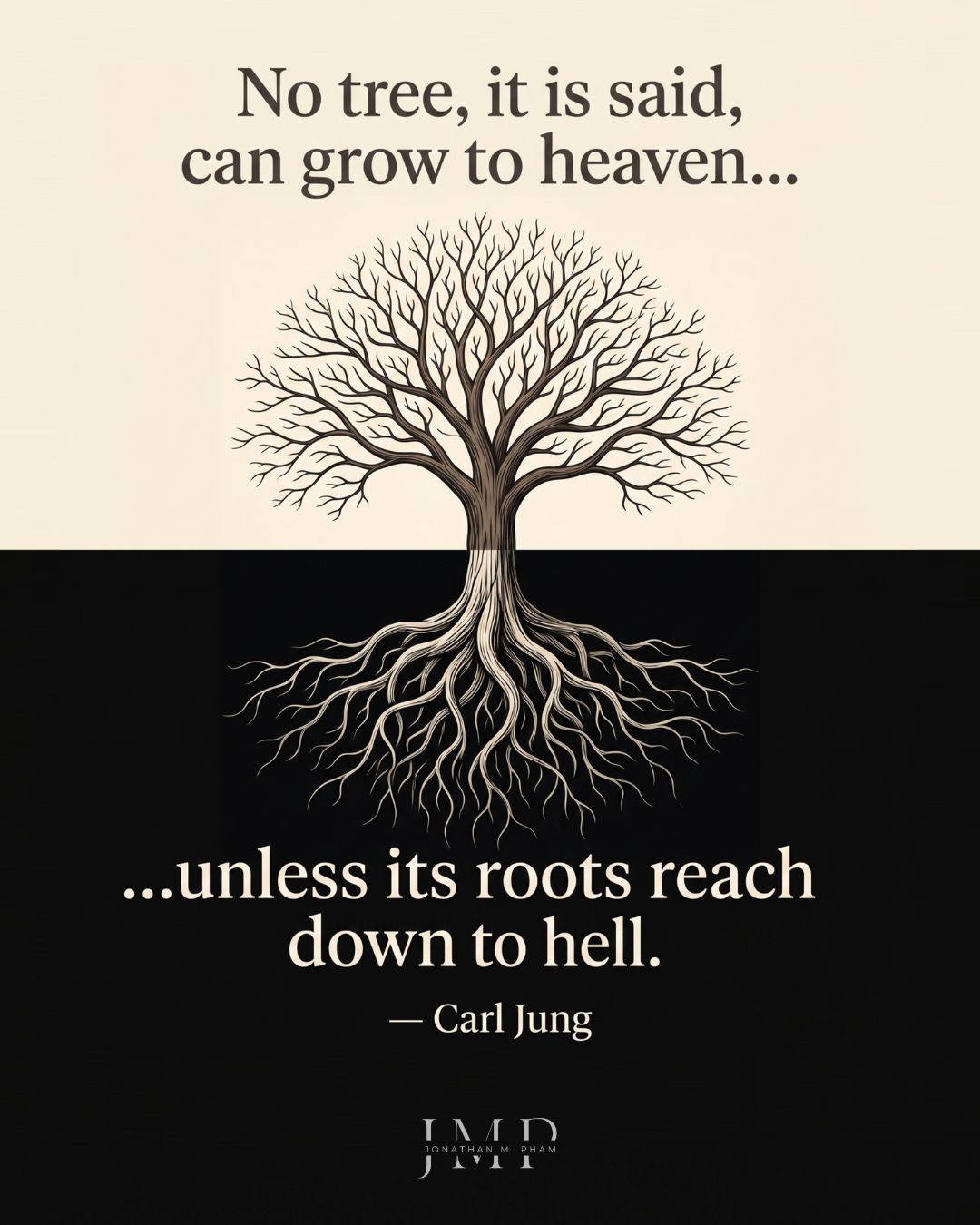
No tree, it is said, can grow to heaven unless its roots reach down to hell.
Carl Jung
Final Thoughts: The Courage to Be
Reading and reflecting on Nietzsche’s critique of slave morality is certainly not a comfortable experience. For anyone trying to live a compassionate, spiritually meaningful life, it feels much like being exposed to a harsh mirror.
At the same time, I believe we should not be afraid of looking directly into it—so that it burns away the passive “slave” within us and leaves only the authentic individual standing before the Universe.
Only once the fragile guilt-driven ego is revealed and integrated may we be ready to become truly good.
It’s not easy to transcend the master-slave duality though, I know. I myself am still working on it. There are many days when I catch myself mistaking my conflict-aversion for kindness, disguising a fear of confrontation as humility, or (I hate to admit it) wishing hell/ misfortune on those who make me miserable. (whether intentionally or not)
But every time I find myself slipping back into the “slave” mode, the mirror clears, the burn lessens, and I take one step closer to wholeness.
You can do the same thing; all you need to keep moving forward is a little courage. The “courage to be”—to stand on your own feet, face the darkness within yourself, and choose the light anyway. Not because you fear hell or desire heaven, but because you love.
Only then may you be liberated from the dualities that have long kept you bound.
I hope for nothing. I fear nothing. I am free. (Δεν ελπίζω τίποτα. Δε φοβάμαι τίποτα. Είμαι λέφτερος.)
Nikos Kazantzakis’ epitaph
Other resources you might be interested in:
Being-for-itself: On the Burden & Beauty of Being a Conscious Human
Hi there! I am a seeker on his path of self-discovery. Since my youth, I have been haunted—and driven—by the fundamental questions of existence: the weight of our choices, the nature of true fulfillment, and the various identities we inhabit. I created this blog to chronicle the insights I have unearthed while navigating the 'absurdity' and beauty of life. My hope is that in reading these words, you will find a reflection of your own struggle—and the courage to 'become who you are.' Please just take what resonates with your soul, and leave the rest behind!