


01
10
October 2026
It has begun.
And now, it's time for me... no, for us, to wait. Three or more hours.
October 1
Come to think of it, t [...]
I still remember the day I turned down a very good job opportunity for a group of people I had only just met.
At the time, I was going through a period of extreme disillusionment. I felt disconnected from my work, unsure of the path forward, and desperate for a sense of meaning. That was when I stumbled into a religious group that—unbeknownst to me at the time—operated very much like a cult.
In the beginning, everything was beautiful. The members were incredibly kind and accommodating. More than just a place to sit, they gave me an identity. A sense of belonging. A feeling of significance.
But over time, something strange happened. I found myself literally obeying every command of the group leader. The mere thought of challenging his ideas made me feel uneasy.
Then came the job offer I have mentioned above. It was a great part-time opportunity, but the hours clashed with the group’s meeting schedule.
When I brought the problem up, hoping to negotiate my attendance, the room’s atmosphere shifted. Immediately, the leader and the group members guilt-tripped me. They framed my decision to accept the job as a sign of disrespect toward them—even though I had never agreed to a fixed schedule in the first place.
What was even more alarming was my reaction to their manipulation. I folded. I denied the job opportunity. I traded my own autonomy for their approval—without a second thought.
Looking back now, I cannot help but ask myself:
“How could I have been that naive? Why didn’t I see through it? Why was I so people-pleasing?”
The answer, as I’ve come to realize, is simple: it’s because I’m a human being.
As humans, we are wired to seek out the safety of the group. When thrown into life’s chaotic mess, our psychological default is to find a crowd and blend in.
Conformity, in and of itself, is a survival instinct. There’s nothing inherently wrong with it. That said, there’s a line we should be aware of crossing.
When we remain in a state of blind conformity—swallowing rules we don’t actually believe in, silencing our own doubts, and letting others dictate our reality—we are essentially committing a form of “spiritual suicide”.
Highlights
Whenever we talk about the dangers of “following the crowd,” there is a temptation to swing to the extreme opposite and view all conformity as a weakness. Yet is that true? Is conformity always a bad thing?
Absolutely not.
If we all refused to comply, society would instantly collapse into chaos.
This is healthy conformity. It is voluntary, consensus-based, and rooted in mutual respect. It is the social contract that allows human beings to coexist peacefully.
The problem arises when conformity becomes blind. When we stop verifying the truth of what we are doing. When we outsource our intellect and conscience to a proxy—whether it is a charismatic leader, a political party, a corporate boss, or the digital mob on social media.
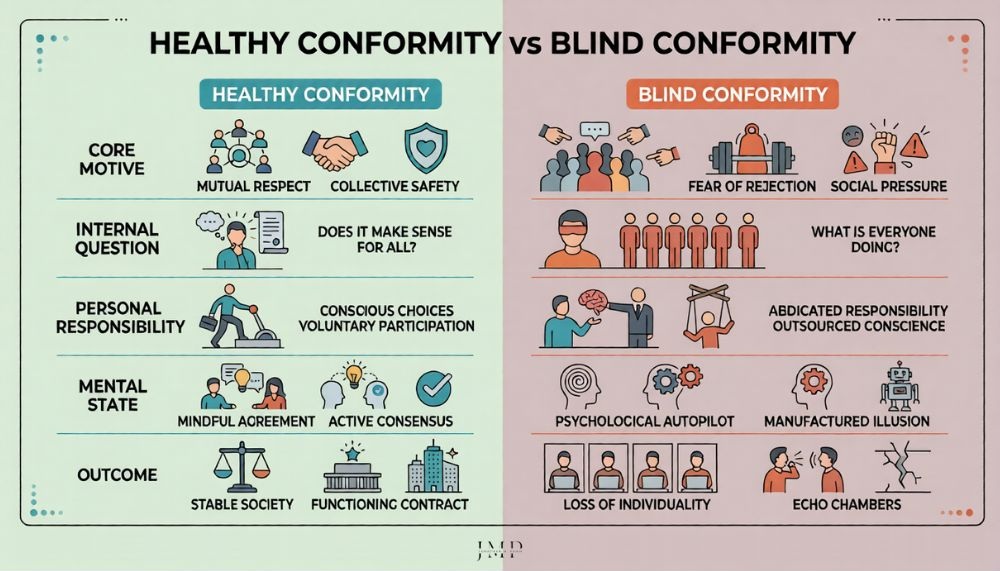
To understand the difference, let us look at the internal mechanics of how we make choices:
The latter, therefore, involves an abdication of personal responsibility. It happens when we agree to live inside a manufactured illusion—simply because “everyone is doing so”. (psychology calls this the Bandwagon Effect) Instead of accepting the burden of our own freedom, we prioritize the comfort of being in a herd.
| Dimension | Healthy Conformity | Blind Conformity (Herd Mentality) |
| Core Motive | Mutual respect, social order, and collective safety. | Fear of rejection, social pressure, and comfort in numbers. |
| Internal Question | “Does this rule make sense for the collective good and reality?” | “What is everyone else doing, and how do I do the same?” |
| Personal Responsibility | Retained; choices are conscious and voluntary. | Abdicated; intellect and conscience are outsourced to a proxy. |
| Mental State | Mindful agreement, active consensus. | Psychological autopilot, manufactured illusion. |
| Outcome | A stable, functioning social contract. | Loss of individuality, echo chambers, and collective harm. |
| Examples | Stopping at red lights, waiting in lines, following scientific laws. | Mirroring a digital mob, unquestioning loyalty to a leader. |
Blind conformity in social psychology
What’s so insidious about blind conformity is that it rarely announces itself with a megaphone. In fact, it is subtly woven seamlessly into every corner of the daily life—into the workplace, family dynamics, politics, digital spaces, etc. Quite often, people, whether intentionally or not, mistake it for “professionalism,” “tradition,” or even “moral duty.”
If you have ever worked in a heavily structured corporate environment, you have likely experienced a toxic fallacy: “The Leadership is Always Right”. Because age, seniority, or a fancy job title is equated with infallibility, psychological safety is destroyed. Even if people notice ineffective or even unethical behavior, many choose to stay quiet to keep their jobs and fit into the company culture.
In such environments, idolization is frequently pushed to the extreme—not only of the leaders, but also of the work itself. It’s a very peculiar kind of collective trance: people endlessly chasing metrics, telling each other to “pray” for a KPI/ project to be successful, and immediately looking to external “experts” for a solution the moment things do not go their way. A KPI—originally just a proxy, a metric to gauge progress—is now treated as if it has independent power. As if it’s a form of “deity” to be worshipped.
Philosophically, we can call this “Bad Faith“—a term used by the existentialist philosopher Jean-Paul Sartre to describe the act of lying to oneself and pretending we are mere “objects” with no agency. In the corporate world, Bad Faith is, far too often, normalized to the point that most simply accept it as “common sense.”
Read more: Hustle Culture – The Sickness of the Modern Era

Blind conformity in the workplace
This is something I myself have witnessed firsthand, particularly within dogmatic families or shame-based collectivist cultures. It is the weaponization of tradition—most notably, filial piety. Usually, it manifests as a parent telling their child:
“I have taken care of you; now it’s time for you to pay it back.“
And the child, conditioned by society, agrees.
While the parent’s reasoning may seem solid, it misses the mark entirely. Simply, because the child never had the ability to intentionally consent to it in the beginning.
They did not choose to be born. To quote the philosopher Martin Heidegger, they were violently “thrown” into this world.
To suddenly saddle a human being with a life-long debt for a decision they had no part in making—that is not fair at all. And even if it is, it is NOT going to secure genuine buy-in.
For the child to take care of an aging parent, it should ideally be an authentic choice—an act of basic human decency, rooted in empathy for an elder who has lost the ability to care for themselves. But in reality, most children—especially in hyper-collectivist, dogmatic communities—are forced to submit. To suppress their true self and blindly conform to high-status, socially approved life scripts—just to preserve the family’s “face”.
It is a tragic twisting of love into obligation, driven by fear and vulnerability. And unfortunately, society rarely questions it.
Those who can make you believe absurdities, can make you commit atrocities.
Voltaire (paraphrased)
Perhaps the most visible modern arena for blind conformity is the Internet. In fact, social media has essentially weaponized herd mentality, creating an environment where complex, nuanced human beings are flattened into “avatars”.
The result is the emergence of the Cancel Culture, characterized by online crowds so willingly harassing, shaming, and “canceling” others. Typically, such mobs operate as follows:
When a digital mob believes they are fighting for a “sacred cause” (this mindset is especially common when it comes to politics, religions, ideologies, etc.), they grant themselves a moral blank check. In their fervent attempt to attack a flawed individual/ system, many end up becoming ideologically possessed and committing atrocities—sometimes even worse than the one they oppose. Eventually, they devolve into the exact “monsters” they initially sought to overthrow.
Whether it is hyper-nationalism, toxic corporate culture, or the pressure to perform on social media, the mechanism is exactly the same: The environment demands uniformity, and we, too afraid of standing alone, willingly hand over our own minds.

Blind conformity in everyday life
When we look at the atrocities committed in the name of the crowd, or even our own personal moments of failing to speak up, it is easy to feel a haunting sense of shame. To beat up on ourselves:
“Why am I so weak? Why don’t I just stand up for what I believe in?”
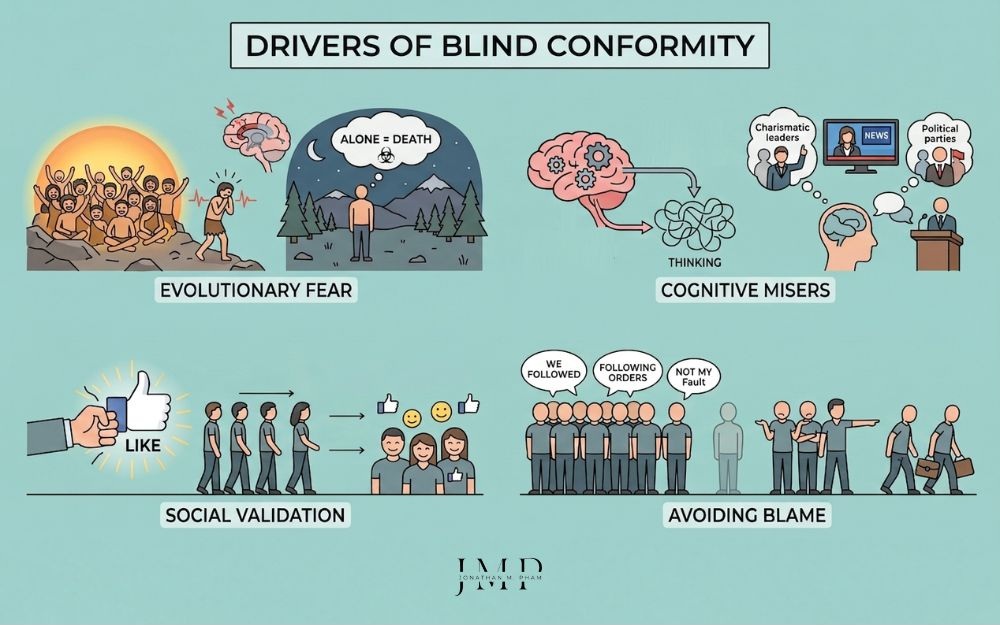
As it turns out, blind conformity rarely has to do with a weak character. Many times, it is the result of biological, psychological, and systemic drivers working exactly as they were designed to.
For most of human history, ostracization meant death—literally. A human being cast out of the tribe could not survive alone in the wilderness. Consequently, our brains have developed to treat social rejection as a life-threatening emergency.
As revealed by modern neuroscience, the pain of being “ex-communicated” by a group registers in the exact same region of the brain (the dorsal anterior cingulate cortex) as physical trauma. When you feel the intense pressure to agree with the room, it’s not merely happening in your mind—your body is literally screaming at you to survive. Standing alone physically hurts.
In the Solomon Asch conformity experiments (1951), participants were put in a room with actors and asked to match the lengths of lines on a card. When the actors purposely gave obvious, undeniably wrong answers, 75% of the real participants conformed at least once.
Why did they doubt their own eyes? According to psychologists, two main drivers were at play:
Everyone wants the same; everyone is the same: he who feels differently goes voluntarily into the madhouse.
Friedrich Nietzsche
Crowd psychology: Blind conformity experiments
The modern world, after all, is terrifyingly complex. Thinking critically, analyzing every piece of information, and charting an independent path requires an immense amount of mental energy.
Because we are naturally “cognitive misers,” our brains look for shortcuts to save bandwidth. One of the easiest shortcuts is epistemic outsourcing—handing one’s own thinking over to proxies like news anchors, political parties, or charismatic leaders.
Speaking of which, I remember back in the day, as a kid and teenager, I really adored some of my teachers. It got to the point that I took all of their words as absolute truth, and I frequently got offended if someone dared to challenge or question them.
This is a classic example of the Halo Effect—a cognitive bias where a positive impression in one area (like a teacher’s charisma or intelligence) spills over, causing us to view them as morally infallible. We wholeheartedly embrace their worldview because it is far easier than coming up with our own.
Read more: Personal Philosophy – What is Your Truth & Stance for Living?
Another cause of blind conformity stems from the fact that society actively trains us to perform for validation. For instance, I once listened to an acquaintance talk about liking their friends’ social media posts. To them, it was just “common sense”: you are friends, so you automatically like each other’s content.
But I wonder: is that engagement really authentic? Or is it only a “social duty”—a form of bad faith?
When we mindlessly smash the like button on superficial content—things that don’t truly resonate with our soul, we are exchanging automated social currency. We are doing it merely to maintain an atmosphere of forced harmony.
Nothing in the world is harder than speaking the truth and nothing easier than flattery.
Fyodor Dostoyevsky, “Crime and Punishment”
Blind conformity to mass thought
And finally, there is a very dark driver behind society’s obsession with herd mentality: it absolves people of blame.
By outsourcing decision-making to a leader or a crowd, individuals shed the weight of personal responsibility. If things go wrong, they can simply say,
“I was just following orders.“
This was the chilling conclusion of the Stanley Milgram obedience to authority experiments (1961), where 65% of participants were willing to deliver potentially lethal electric shocks to a screaming actor—simply because a scientist in a lab coat told them to continue. Essentially, the participants entered an “Agentic State”—they stopped viewing themselves as moral agents and became mere instruments of the authority figure.
When you combine this mindless obedience with the Bystander Effect—where individual responsibility diffuses in a large crowd—you get a perfect storm for blind conformity. In a crowd of fifty people, you feel only 2% responsible for what happens. The guilt of inaction, or that of joining the mob, is shared. And when guilt is shared, the individual conscience goes to sleep.
Read more: Being-for-itself – On the Burden & Beauty of Being a Conscious Human
The science of peer pressure & authority
Why do people blindly conform to a group?
Psychology and biology help explain human nature—why we are so strongly pulled toward the crowd. And yet, it is philosophy that forces us to confront the consequences of staying there.
What exactly happens when compliance goes too far? When we surrender our own inner compass to the herd?
The crowd is untruth.
Søren Kierkegaard
Back in the day, the philosopher Søren Kierkegaard warned of a specific issue he called “unconscious despair”. It happens when a person conforms so perfectly to society’s expectations that they build a flawless outward life—the prestigious job, the approved lifestyle, the “right” opinions—but remain completely hollow inside.
The result? Such people suffer from a spiritually starved, non-existent self. They become the “Mass Man“: a psychological archetype of someone who is complacent, demands no special effort of himself, and simply drifts along with whatever the crowd dictates.
To live that way is to be physically alive, but existentially dead. By merging completely with the public, individual responsibility evaporates, and one’s unique identity dissolves.
The greatest hazard of all, losing one’s self, can occur very quietly in the world, as if it were nothing at all.
Søren Kierkegaard, “The Sickness Unto Death”
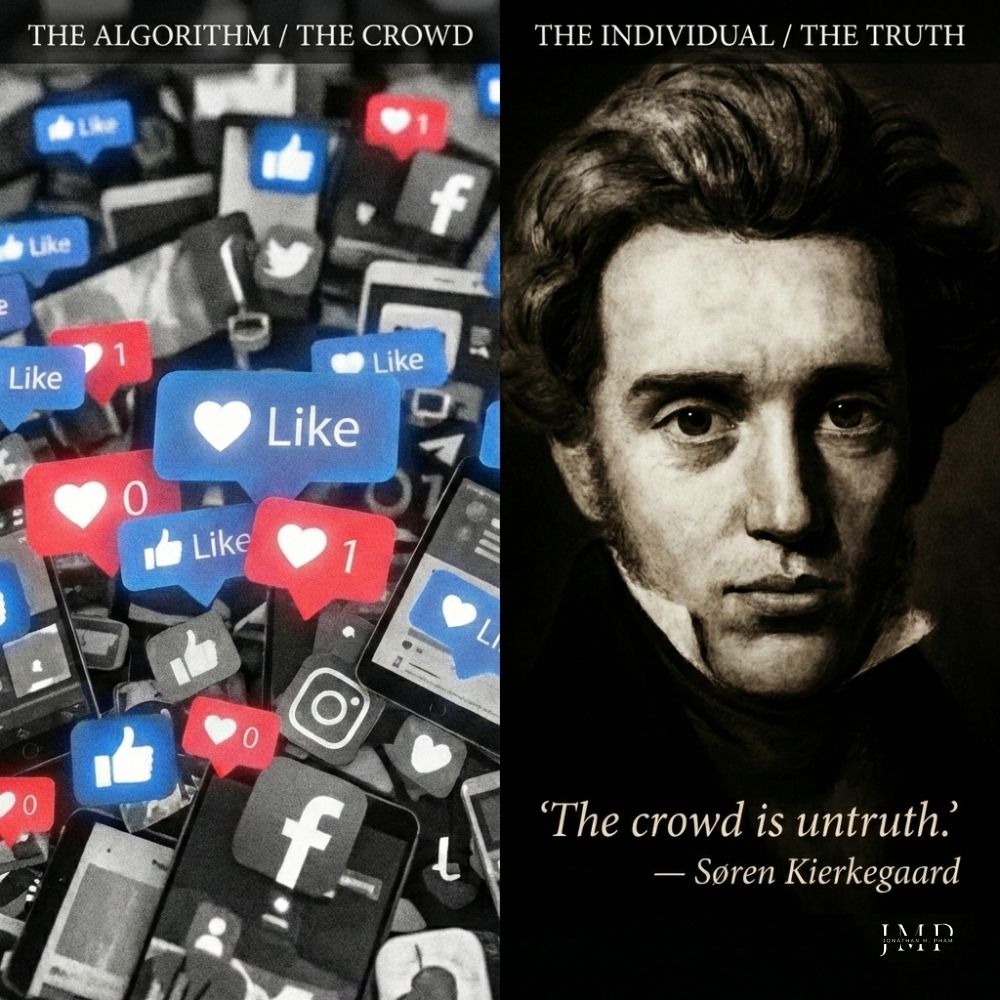
To flee into “Bad Faith” and play the roles society writes for us—the stereotypical good employee, the obedient child, the performative social media avatar—is to “objectify” ourselves. In doing so, we treat ourselves as instruments rather than free, thinking beings.
Over time, it rots us from the inside. When your true thoughts are suppressed to keep the peace, you are essentially lying to yourself. And a life built on self-deception eventually destroys the capacity for genuine human connection.
This is exactly what the Russian novelist Fyodor Dostoevsky described in his masterpiece The Brothers Karamazov:
“Do not lie to yourself. A man who lies to himself and listens to his own lie comes to a point where he does not discern any truth either in himself or anywhere around him, and thus falls into disrespect towards himself and others. Not respecting anyone, he ceases to love.”
You cannot truly love your community, family, or friends if you are hiding behind a mask. True harmony requires two authentic individuals; otherwise, what you get is only a room full of ghosts.
Read more: I-Thou Relationship – The Cure for Modern Alienation
Blind conformity offers the illusion of safety. It promises that if we just keep our heads down, follow the rules, and agree with the leader, we will be protected. And yet, nothing can be further from the truth than that.
In George Orwell’s Animal Farm, the character of Boxer the horse represents the ultimate blind conformist. Boxer is hard-working, loyal, and fundamentally good. Unfortunately, instead of thinking critically about the corruption happening on the farm, he outsources his intellect. He adopts two thought-terminating clichés as his life mottos:
In the end, Boxer’s reward for his unquestioning loyalty is terrifying: the moment he becomes injured and can no longer work, the leaders (the pigs) sell him to the slaughterhouse.
The same tragedy is playing out in the real world every day.
As demonstrated through the above examples, a life built on the shifting sands of crowd approval is destined to collapse.
Read more: Human Being vs Human Doing – Reclaiming the Soul in the Age of Optimization
This is arguably the ultimate cost of blind conformity. When individual unconscious despair scales up to the level of a nation or a culture, the result is what the philosopher Hannah Arendt called the “Banality of Evil“—a term she coined while covering the trial of Adolf Eichmann, one of the Holocaust’s major organizers. As observed by Arendt, history’s greatest atrocities are rarely carried out by cartoonish, sadistic sociopaths—but quite often by ordinary, unthinking conformists. Like Eichmann, they are the people who mindlessly follow the rules of their society to advance their careers, avoid conflict, or simply “do their jobs”.
When groupthink takes over, individuals undergo a psychological regression—i.e. they lose their intellect and nuance. Swept up in the delusion of the crowd’s absolute moral superiority, ordinary people can feel completely justified in committing—or remaining silent in the face of—the most terrible evil.
Read more: Are Humans Inherently Good or Evil?
If you seek authenticity for authenticity’s sake, you are no longer authentic.
Jean-Paul Sartre
When we first wake up to the dangers of blind conformity, our immediate instinct is typically to swing the pendulum as far in the opposite direction as possible. We assume that if following the crowd is destructive, the solution is to “fight the system”. To defy the norms loudly.
That said, it is—quite often—just a trap. In many ways, what we call “rebellion” is nothing more than a different type of conformity in disguise.
In Fyodor Dostoevsky’s Notes from Underground, readers are introduced to the “Underground Man”—an intensely bitter, isolated character who despises society. He argues that humans are not piano keys governed by math and science—that a human will deliberately act against their own best interests (like refusing medical treatment) just to prove they have free will.
But as we read his confessions, a tragic irony gradually emerges. By constantly “rebelling” without a higher cause—by acting purely out of spite, the Underground Man does not achieve true freedom. He is still trapped—albeit in a different kind of prison. His entire existence is dictated by the very society he hates, because all of his actions are merely reactions to it.
If you spend your whole life doing the exact opposite of what the crowd does, the crowd is technically still the one pulling your strings.
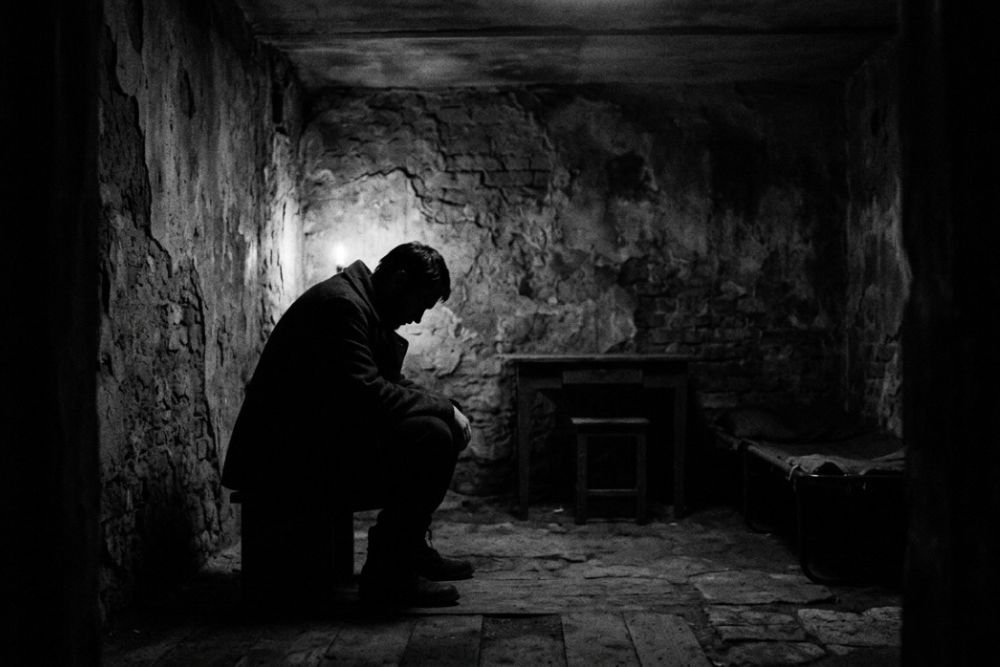
This dynamic is playing out constantly in modern life. For instance, we see it in the “disobedient” teenagers who aggressively defy society’s norms. They dress differently, speak profanely, and adopt provocative opinions. While it may look (and feel) like radical independence, most of the time, it is simply a desire for attention and validation, albeit in a twisted manner. Their behavior is still driven by the system—just in reverse.
The same pattern applies to Internet “edgelords” who pride themselves on being contrarian. These people are not actually standing in their own truth; deep down, they are only trying to guarantee that society looks at them.
When rebellion is not grounded in internal convictions, it typically morphs into ideological possession—which can easily be observed in extreme reactionaries. In their fervent attempt to attack a corrupt system, they shift from wishing to heal the world to simply wanting to burn it down.
In their efforts to fight corruption, many become corrupted themselves.
In their zeal to fight a “monster”, they themselves become mindless, sadistic puppets.
When you are possessed by an ideology, you grant yourself a moral blank check. You lose your human nuance, and eventually, you rebuild the exact same crowd you were trying to escape.
If you gaze long into an abyss, the abyss will gaze back into you.
Friedrich Nietzsche

Read more: Slave Morality – The Hidden Shadow of Conventional Ethics
Given that loud rebellion is not the real solution, where does that leave us? How do we actually break the cycle without becoming isolated outcasts?
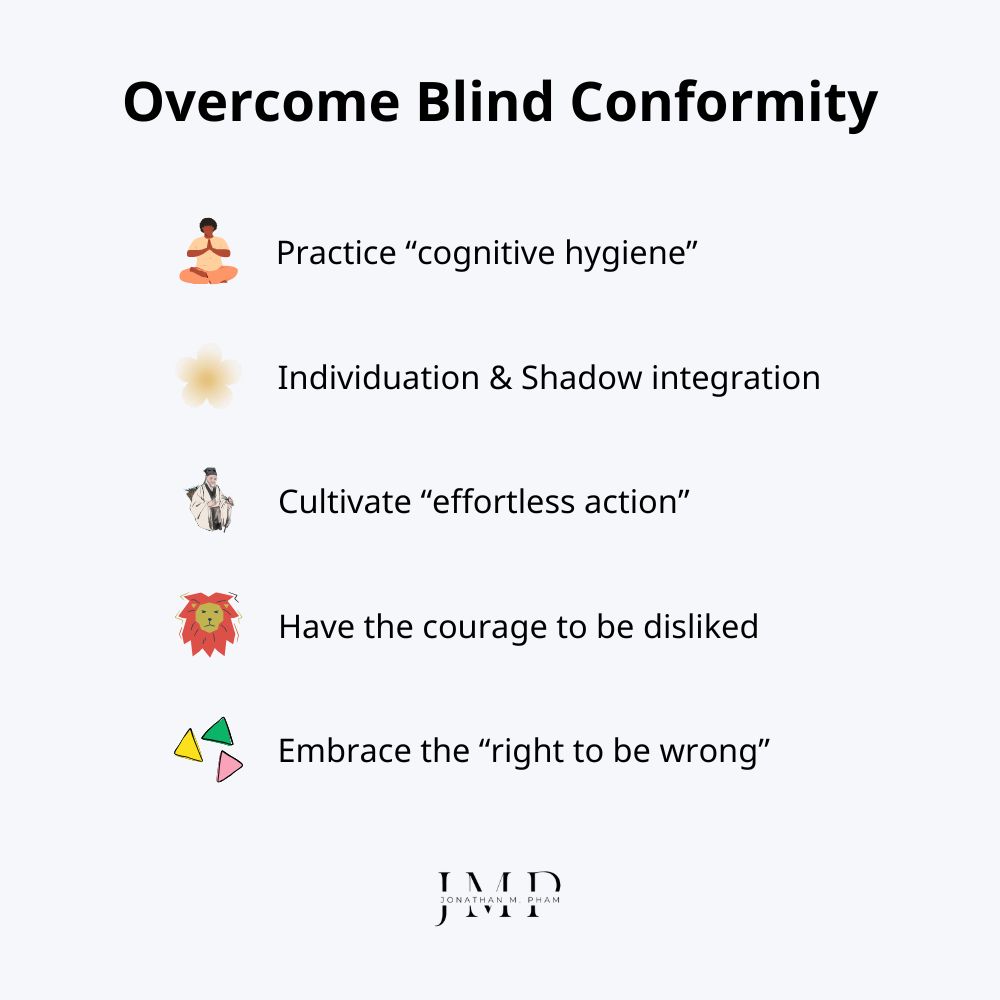
The answer is that we must shift the focus from fighting the external system to fortifying our internal foundation.
Free thinkers are those who are willing to use their minds without prejudice and without fearing to understand things that clash with their own customs, privileges, or beliefs. This state of mind is not common, but it is essential for right thinking.
Leo Tolstoy
To avoid being swept up in groupthink, we need practical boundaries for the mind. Specifically, it’s essential we adopt daily habits that protect our intellect from being hijacked.
Most of us frequently fall for the Halo Effect—i.e. assuming that because someone is highly charismatic or a brilliant entrepreneur, they must also be a moral authority.
The key to avoiding this trap is to isolate attributes. For instance, you can admire a boss’s strategic mind while maintaining total skepticism of their ethics.
High-control groups and toxic corporate cultures rely on manufactured urgency. Whether you are asked to join a community, sign up for a retreat, or agree to a massive ideological shift, never commit in the room. If possible, force a 24-hour buffer.
Distance is critical for breaking the spell of the crowd’s emotional contagion.
To distinguish healthy empowerment from toxic indoctrination, just ask one question: “What happens if I disagree?“
A healthy group would welcome dissent; a blind crowd, on the other hand, would punish it.
Read more: Existential Communication – The Art of Truly Meeting One Another
The psychologist Carl Jung believed that the ultimate goal of human life is Individuation—the process of becoming a whole, integrated person. That said, it’s impossible to become whole if you are terrified of your own flaws.
As noted by Jung, the process requires integrating the “Shadow”—i.e. the repressed, darker traits of our personality. When we refuse to acknowledge our own capacity for selfishness, envy, or cruelty, we inevitably become vulnerable to the crowd.
By having the courage to acknowledge your own flaws, you no longer need the crowd to validate your righteousness. Your sense of identity is already anchored internally.
Read more: Spiritual Crisis – Finding Light in the “Dark Night of the Soul”
When Tao is lost, there is goodness.
When goodness is lost, there is kindness.
When kindness is lost, there is justice.
When justice is lost, there is ritual.
Now ritual is the husk of faith and loyalty, the beginning of confusion.Tao Te Ching, Chapter 38
Long ago, Eastern philosophy, particularly Taoism, has already mapped out a roadmap for authenticity. As Lao Tzu observed, the decline of society begins when people lose touch with their inner essence. (the Tao—i.e. effortless alignment with nature) When that happens, humanity devolves into forced virtue, then forced righteousness, and finally Li (rigid ritual and law).
Society today is, unfortunately, over-obsessed with Li; it hails massive bureaucracy, external rules, and superficial compliance. While laws may indeed guarantee harmony, it’s never a sustainable solution, simply because it doesn’t address the root cause: the corruption of people’s internal compass.
The antidote to the above issue, as proposed by Taoism, is Wu Wei (無為)—typically translated as “effortless action”. Instead of screaming one’s truth from the rooftops, one acts from a place of direct, unconditioned perception. (or, as the philosopher Krishnamurti called it, “choiceless awareness”) Rather than the “flower” (the superficial display), the focus is now placed on the “fruit”. (the internal essence)
When you are deeply grounded in who you are, you don’t need to put on a performance of compliance or one of rebellion. You simply act.
Truth is a pathless land.
Jiddu Krishnamurti
One of the hardest barriers to breaking blind conformity is the fear of upsetting people we care about—which is especially true when it comes to toxic collectivism or family guilt. The key to overcoming it is to practice what Adlerian psychology refers to as the “Separation of Tasks“.
When you decide to live authentically, someone around you is definitely going to be disappointed. Your parents may feel betrayed because you didn’t follow their life script; a friend might feel abandoned because you stopped engaging in toxic gossip.
At such moments, it is essential to realize that their emotional reaction is their task to manage, not yours. Your only task is to live in accordance with your own principles.
Contribution to others does not connote self-sacrifice. Those who sacrifice their own lives for others are people who have conformed to society too much.
Ichiro Kishimi, “The Courage to be Disliked”
As we strive for authenticity, we also need to watch out for the trap of replacing society’s rigid perfectionism with our own. In other words, it’s about epistemological fallibilism—the recognition that we can never be 100% sure we are right.
If we demand that we, or those around us, never make a mistake, we are only building a new prison. To quote the philosopher John Stuart Mill, silencing false opinions is a form of robbery, because we lose the “livelier impression of truth produced by its collision with error.”
To demand perfection, therefore, is to demand that humans cease to be human.
Grant yourself—and others too—the grace to stumble, to question, to fail, and to learn without the fear of being crushed by the crowd. Only then may there be hope for society to systematically dismantle the trap of blind conformity.
Read more: How to Take a Leap of Faith – Trusting Intuition Over Logic
At the end of the day, the goal of fighting blind obedience is not to become a hyper-individualistic outcast who rejects every social norm out of principle—nor to retreat to a mountaintop and live as a hermit. For most of us, we still have to hold jobs, navigate family dinners, and exist within a flawed society.
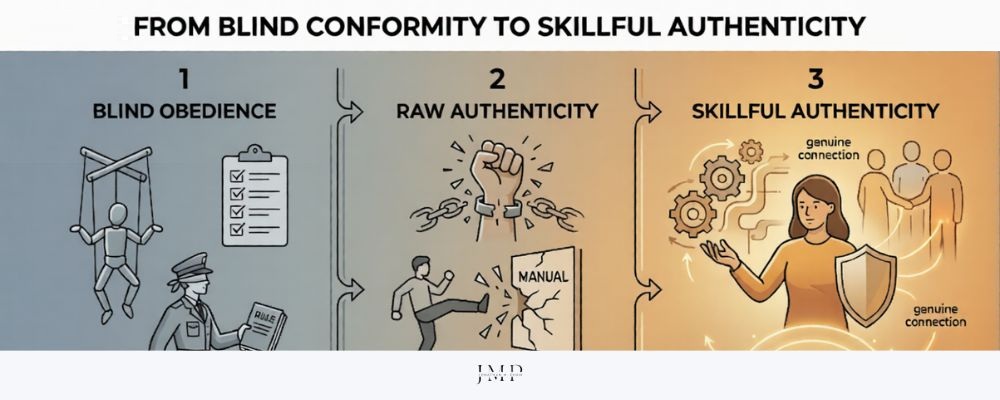
What really matters is to “awaken” to reality. And most of the time, this journey of waking up progresses through three distinct stages as follows.
This is where most of us start. You do what you are told, follow the manual, and prioritize fitting in over being effective or truthful. You are the “Good Employee,” the “Perfect Child,” or the “Compliant Citizen,” even when the system’s demands are completely disconnected from reality.
Eventually, you realize the system is flawed and decide to buck it to do what is right. You accept the conflict. At this stage, authenticity often manifests as loud, unpolished, and highly disruptive.
Speaking of which, I am reminded of an incident that happened years ago. At the time, I decided to create a local website for a company I was working for. The jarring part was that I did it completely on my own, without informing the headquarters’ team (who were extremely bureaucratic).
From the perspective of the “System” (the corporate structure), my action seemed like a blatant act of defiance. Yet I knew, deep down, that I was not just trying to break the norms. That I was being fully honest with myself. That I was acting out of the authentic belief that it would address the real needs of the local customers we served—needs that the headquarters was oblivious to, whether intentionally or not.
Needless to say, my action resulted in a lot of chaos within the company. Hadn’t it been for my manager’s intervention, I probably would have faced serious consequences for being so “arrogant” and “defiant”.
And the funny part? I didn’t regret it at all. In fact, I took great pride in “unnerving” the headquarters.

Now looking back, I do admit that I was probably a little too self-centered at that time. Even though my decision turned out to be “right” (eventually, I managed to gather the necessary data to justify my unconventionally bold strategy to headquarters), it was still a little egoistic. A little unskillful.
Even though my actions were “righteous,” they still caused massive, perhaps unnecessary, conflict.
Which brings us to the final stage of the journey.
This is the ultimate goal. Skillful authenticity means learning how to navigate, influence, or gently subvert a flawed system to achieve the right outcome without getting needlessly burned by the machinery.
A person operating in Stage 3 doesn’t kick the door down just to prove they are free. They understand the rules of the game so well that they can play it on their own terms.
Back to my previous story. If I were to approach that website project today with Skillful Authenticity, I probably wouldn’t have built it completely in the shadows just to prove a point. Instead, I might have been more transparent. I could have framed the website as a small, “low-risk beta test” to gather customer data.
Every human being must have a point at which he stands against the culture, where he says, “This is me and the world be damned!” Leaders have always been the ones to stand against the society — Socrates, Christ, Freud, all the way down the line.
Rollo May
When individuals finally attain this state of Skillful Authenticity, the fruit is a beautiful synthesis: Individualistic Collectivism—a mindset that is becoming more and more prevalent in modern society. No longer is there the need to choose between betraying oneself and abandoning the community.
In fact, we are seeing this shift happening right now, particularly among younger generations in traditionally collectivist cultures like East Asia. Absolute submission to authority figures (e.g. a young person must sacrifice their chosen career or marry according to a parental script just to save “face” for the family)—which was once taken for granted—is being actively reimagined. Now, more and more people are choosing to deeply honor their parents/ elders, care for them, and respect their heritage, while still drawing a boundary around their own life choices.
With individualistic collectivism, you learn the most difficult, yet most rewarding, balancing act of the human experience: the ability to stand firmly in your own truth, while still keeping your heart open and holding hands with the community.
In choosing myself, I choose man.
Jean-Paul Sartre, “Existentialism is a Humanism”
In social psychology (often drawing on the work of Herbert Kelman), conformity is generally broken down into three levels of depth:
Philosophically, we can also divide it simply into healthy conformity (voluntary, consensus-based social contracts like traffic laws) and blind conformity (unquestioning obedience that requires suppressing one’s conscience).
While these two are interconnected, they operate on different levels.
Beyond the existential loss of self, blind conformity severely impairs decision-making. It creates a breeding ground for cognitive dissonance (the mental stress of acting against one’s own beliefs). Over time, individuals lose their capacity for critical thinking, experience a diffusion of responsibility (the bystander effect), and become highly susceptible to mass hysteria.
If liberty means anything at all, it means the right to tell people what they do not want to hear.
George Orwell
Social platforms are engineered to exploit people’s evolutionary need for belonging. Algorithms reward consensus and outrage, which results in intense echo chambers. Additionally, engagement metrics (likes, shares, followers) act as quantified “social proof.” This digital architecture makes going against the grain feel like social suicide; over time, everyday users are slowly turned into an invisible crowd who is quick to conform to the latest trend or outrage.

Herd behavior
The nail that sticks out gets hammered down. (出る杭は打たれる/ Deru kui wa utareru)
Japanese Proverb (a very infamous one, which can either be interpreted as a plea for compliance—or a call to stand your ground, take the blow, and forge genuine harmony as a result)
The ‘They’ prescribes one’s state of mind and determines what and how one ‘sees’.
Martin Heidegger
The real hopeless victims of mental illness are to be found among those who appear to be most normal. … They are normal only in relation to a profoundly abnormal society. Their perfect adjustment to that abnormal society is a measure of their mental sickness.
Aldous Huxley
The opposite of courage in our society is not cowardice, it is conformity.
Rollo May
Don’t go by reports, by legends, by traditions, by scripture, by logical conjecture, by inference, by analogies, by agreement through pondering views, by probability, or by the thought, ‘This contemplative is our teacher.’ When you know for yourselves that, ‘These qualities are skillful; these qualities are blameless; these qualities are praised by the wise; these qualities, when adopted & carried out, lead to welfare & to happiness’ — then you should enter & remain in them.
Kalama Sutta
In his Commentaries on Living Series 3, the Indian philosopher Jiddu Krishnamurti offered a truly thought-provoking reflection as follows:
“Is society healthy, that an individual should return to it? Has not society itself helped to make the individual unhealthy? Of course, the unhealthy must be made healthy, that goes without saying; but why should the individual adjust himself to an unhealthy society? If he is healthy, he will not be a part of it. Without first questioning the health of society, what is the good of helping misfits to conform to society?”
For far too long, we have largely treated non-conformity as a symptom of being a “misfit” who needs to be fixed, disciplined, or shamed back into the mold. But when a society is suffering from the spiritual sickness of “bad faith”, hyper-bureaucracy, and toxic collectivism, perfect adjustment to it would only worsen the human condition.
As such, it is time for each and every one of us to “wake up” from the herd—and reclaim our authenticity.
A world made entirely of crowd-followers is a fragile house of cards—one that is prone to totalitarianism, mass hysteria, and the “banality of evil”. But one comprised of fully individuated people—those who practice skillful authenticity, who defend the right to be wrong, and who choose connection over compliance—is incredibly resilient.
As “rebellious” as it may look to others, standing in your own truth is not an act of selfishness or vanity. In fact, it may actually be the greatest gift you can offer humanity.

Other resources you might be interested in: