For as long as I can remember, I have been haunted by a single question: “What is the point of it all?” While I cannot recall exactly when this inquiry first took root, I do know the moment it cemented itself in my psyche.
About 6 years ago, while browsing the Internet, I happened to stumble across Mark Manson’s article about life purpose. Reading his words, I couldn’t help but notice an abrupt internal shift—as if I had unburied a treasure map that I didn’t know I had been searching for.
Fast forward to two years ago, I decided to launch my blog’s newsletter series. Almost immediately, the question of life’s meaning pulled me back in. Since then, no matter what subjects I try to explore, an invisible gravity always seems to drag me back to this central theme.
And it’s not just me; I dare say most people share the same fixation, whether they admit it or not. As the psychiatrist Viktor Frankl has put it, we human beings possess an innate hunger for meaning. Far from a luxury, meaning is the psychological scaffolding that allows us to survive, navigate this chaotic world, and endure inevitable tragedies. (“He who has a why to live can bear almost any how.”)
That said, because we need this scaffolding so desperately, its collapse is utterly devastating. When the anchors we thought gave us absolute meaning—a long-term relationship, a prestigious career, a religious doctrine, or a rigid identity—suddenly shatter, it feels as if the ground beneath us crumbles, and we are left suspended over a bottomless “Abyss”, facing an indifferent universe.
This psychological collapse is what we define as a “crisis of meaning.” When it happens, we have a choice: to remain paralyzed by the void, or to rebuild our internal world from the ground up.
Understanding how we fall into this rupture—and how it alters us—is the first step toward surviving it.
Highlights
A crisis of meaning is not the same as clinical depression; it is an “existential vacuum” triggered by the collapse of one’s old worldview and the shedding of a False Self.
Modern society’s lack of meaning is fueled by a combination of the death of inherited cultural narratives, the isolating nature of the digital world, and the trap of tying one’s self-worth purely to productivity (Hustle Culture).
When faced with the anxiety of the void, it’s essential that we avoid living in “bad faith” (pretending we have no choices), retreating into rigid dogma (spiritual bypassing), or trying to purely intellectualize a way out.
You cannot “math” your way out of an existential crisis. Meaning is an experience enacted through micro-accomplishments, physical grounding, and practicing “active love” toward others.
Questioning the purpose of your life is in itself a profoundly human, “religious” act.
What is a Crisis of Meaning?
When hearing the word “crisis”, many of us tend to immediately think of something loud and dramatic—e.g., a spectacular breakdown, a tearful collapse on the kitchen floor. Yet when it comes to a crisis of meaning, things are usually much quieter. In fact, it can arrive unexpectedly on an ordinary Monday morning during your commute, or in the stillness of a Sunday afternoon.
At its core, a crisis of meaning (also called an “existential vacuum”) is the chilling realization that you are on autopilot, playing a character in a script you did not write. The things that once gave your life direction and coherence—e.g., the promotion you chased, the social circles you maintained, the lifestyle you built—suddenly feel hollow. The world no longer makes sense to you, and you are left with an utterly devastating sense of emptiness.
Common signs & symptoms include:
The “Arrival Fallacy” realization: Experiencing a deep sense of disappointment after achieving a major goal, realizing it didn’t bring the lasting happiness you expected.
Depersonalization: Feeling like a detached observer in your own life; going through the motions without any emotional connection to what you do.
Apathy toward former passions: Hobbies and goals that were once exciting now strike you as pointless or arbitrary.
Chronic “Why?” syndrome: Second-guessing the fundamental purpose behind your daily mundane tasks.
A sense of isolation: Feeling a deep disconnect from friends and family because they seem perfectly content playing a “game” you no longer see the point of.
Crisis of Meaning Examples
If you are attentive enough, you should see this vacuum everywhere:
You see it in the dedicated parent whose children finally leave the nest, leaving them to wonder, “Who am I if I am not caretaking?”
You see it in the mid-life professional who spends two decades climbing the corporate ladder, only to reach the top and realize it was leaning against the wrong wall.
You see it in the young university graduate who finally lands their “dream job,” only to stare at their cubicle wall and think, “Is this it? Is this the next forty years of my life?”
Existential crisis of meaning
I myself experienced it firsthand about 3 years ago, right when I was supposedly at the peak of my career. At that time, I was working as a manager at a digital agency while juggling two other part-time gigs (one of which was incredibly toxic) and learning a new foreign language—all at the same time. In a sense, I was running on pure adrenaline.
To the outside world, I was “crushing it.” The hustle afforded me a very generous income; I could eat out whenever I wanted and buy things I didn’t even need. As “crazy” as my routine might sound to you, I was fully confident I was doing the “right” thing.
But it didn’t take long for the burnout and frustration to catch up with me. Until one rainy afternoon, while I was reading Marshall Goldsmith’s The Earned Life, the illusion completely shattered. Suddenly, I plummeted into a crisis of meaning and realized how remarkably hollow my “comfortable” existence had been—a life built on endless accumulation without any genuine fulfillment.
When the ego runs out of things to chase, the silence that follows is, paradoxically, deafening.
What Causes a Crisis of Meaning? (plus Types of Crises)
Finitude in awareness is anxiety.
Paul Tillich
While it can strike randomly, a crisis of meaning is usually precipitated by a shift in one’s reality. Some of the most common causes include:
Major life transitions: Graduating, getting married, retiring, or moving to a new city.
Profound loss: The death of a loved one, a divorce, or the loss of a career.
Exposure to new paradigms: Reading a perspective-altering book, traveling, or being exposed to new philosophical ideas that challenge your worldview.
Depending on what the specific trigger is, the existential vacuum might take on a specific flavor:
The quarter-life crisis: Centered around identity, independence, and picking a life path in your 20s or early 30s.
The mid-life crisis: Centered around mortality, legacy, and questioning past choices.
The spiritual/ intellectual crisis: Triggered when the religious, cultural, or ideological frameworks you were raised with no longer hold up to your personal truth.
Is a Crisis of Meaning the Same as Depression?
A common question people ask when trapped in this void is: “Am I just depressed?” While an existential crisis shares many overlapping symptoms with clinical depression—namely lethargy, overwhelming sadness, and a loss of interest in once-loved activities—they are different in nature. (note: a severe crisis of meaning can certainly trigger or exacerbate clinical depression, and if you are struggling to function, seeking professional help is highly recommended)
Generally speaking, depression is typically a biological and psychological condition requiring clinical treatment. A crisis of meaning, on the other hand, is deeply philosophical and spiritual.
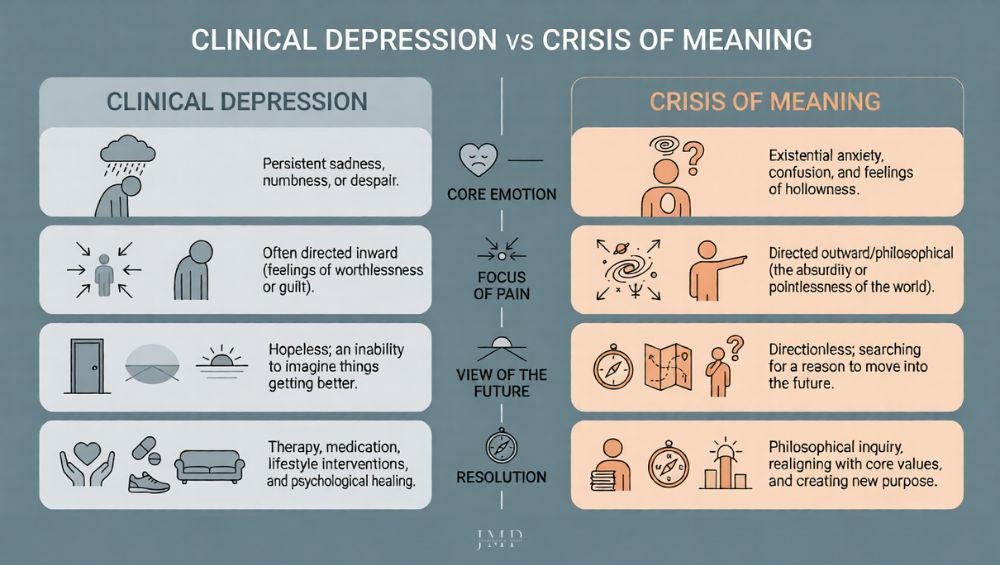
Feature
Clinical Depression
Crisis of Meaning
Core Emotion
Persistent sadness, numbness, or despair.
Existential anxiety, confusion, and feelings of hollowness.
Focus of Pain
Often directed inward (feelings of worthlessness or guilt).
Directed outward/philosophical (the absurdity or pointlessness of the world).
View of the Future
Hopeless; an inability to imagine things getting better.
Directionless; searching for a reason to move into the future.
Resolution
Therapy, medication, lifestyle interventions, and psychological healing.
Philosophical inquiry, realigning with core values, and creating new purpose.
Difference between depression and a crisis of meaning
As discussed by the psychologist Kazimierz Dąbrowski in his theory of “Positive Disintegration”, a crisis of meaning involves a structural collapse of the False Self (i.e. the mask we wear to conform to society’s expectations). It hurts because your psyche is outgrowing the shallow container it was living in.
If left unaddressed, that existential vacuum can become very dangerous. According to Frankl, when people cannot find meaning, they typically turn to what he called the “mass neurotic triad”: depression, aggression, and addiction. Specifically, people will scroll endlessly on their phones, chase chemical highs, or lash out in anger—doing anything just to feel something that distracts them from the inner emptiness.
Drinking this expensive sake is like paying myself back with poison for the way I lived all these years.
Kanji Watanabe, “Ikiru” (1952)
When is a Crisis of Meaning Triggered?
The delusion of the joys of life that had formerly stifled my fear of the dragon no longer deceived me… Now I cannot help seeing day and night chasing me and leading me to my death. This is all I can see because it is the only truth.
Leo Tolstoy, “A Confession and Other Religious Writings”
For many, their confrontation with the void typically occurs in mid-life. After spending decades following society’s script—getting the degree, securing the mortgage, raising the kids—they finally have a moment of quiet to ask themselves, “Is this what I actually wanted?“
But for others, it can come very early—when you suddenly realize that the world you were born into is established on fragile illusions. When the protective buffers of childhood fall away, and you are forced to wake up to life’s uncompromising realities:
That your parents will eventually die, and so will you.
That despite society’s structures and promises, nobody can actually guarantee you absolute safety.
That, at the end of the day, no matter how much you are loved, you are fundamentally alone in your own mind. (a state referred to as “existential isolation”)
That you are—to quote the existentialist philosopher Jean-Paul Sartre—”condemned to be free”. Your identity and morality are not handed to you in a pre-packaged box. There is no universal authority figure coming to save you, nor is there anyone to objectively dictate what is “right” or “wrong,” or to grade your life as a “success” or a “failure.” You are completely responsible for how you live.
I myself experienced this sort of intellectual awakening when I was younger. Back in the day, I grew up in a deeply insular, strict religious community—where 99.9% of people practiced Catholicism. It was a heavily structured, hyper-sensitive environment where daily life was marked by surface-level policing, the constant judgment of others, and dogmatic teachings. Because most people never ventured outside the local community, their view of the world was heavily distorted by “straw man” propaganda.
I remember attending a Mass where the priest attempted to discredit evolution and reincarnation. His reasoning was shockingly rudimentary:
“If evolution is true, just bring an ape home and domesticate it. It will eventually become human,” and
“If reincarnation is true, how come the human population keeps rising?”
Nobody in the room questioned his logic. As for me, even though my teenage brain was unable to articulate why, I couldn’t help but feel restless. Part of my discomfort had to do with the priest’s sheer lack of empathy toward other beliefs, but another part was my intuition screaming that his reasoning was fundamentally flawed.
It didn’t take long for me to educate myself and learn just how ignorant the priest was of how these concepts actually worked—that evolution spans millions of years, and that reincarnation stems from a vastly different metaphysical view of the universe.
That discovery—that crisis of truth—completely “broke” me. It made me question the meaning of everything I had been believing in so far. If the adults I trusted didn’t really know the truth, then who am I? What is actually important? What is my purpose—now that I can’t blindly trust the script I was handed?
While I still remain in my faith today, that moment forever shattered my illusions. Since then, I have accepted that my job is to rebuild my own worldview from scratch, constantly assess it every day, and “become who I am”—actively untangling myself from the social conditioning I was born into.
Why is Modern Society Experiencing a Meaning Crisis?
About a third of my cases are suffering from no clinically definable neurosis, but from the senselessness and emptiness of their lives.
Carl Jung
My personal awakening in that church pew was just a micro-example of a global phenomenon. No longer an isolated event experienced by a few rebellious teenagers or mid-life executives, the shattering of lifelong illusions has become a defining psychological crisis of our time.
According to recent research tracking future optimism, only 59% of respondents believe their lives will be good in five years—the lowest metric recorded in nearly two decades. As noted by the researchers, there is a deep undercurrent of “collective gloom” regarding the direction of modern society.
In an empirical study utilizing the LOGO-test (a psychometric tool designed specifically to measure existential fulfillment), researchers found that 24% of respondents were in severe mental distress and “seriously existentially endangered”.
The World Health Organization estimates that roughly 29% of U.S. adults will experience clinical depression in their lifetimes, and academic meta-analyses consistently point to a lack of meaning as a primary accelerator for these spikes in anxiety and despair.
Perhaps most alarming is how early this void is opening up. A recent study by Gallup revealed that 45% of Gen Z adults report lacking meaning, purpose, or both in their lives.
When we look at these statistics, the question is: what exactly is happening? Why are so many of us, despite living in the most technologically advanced and materially comfortable era in human history, feeling like we are trapped in an empty room?
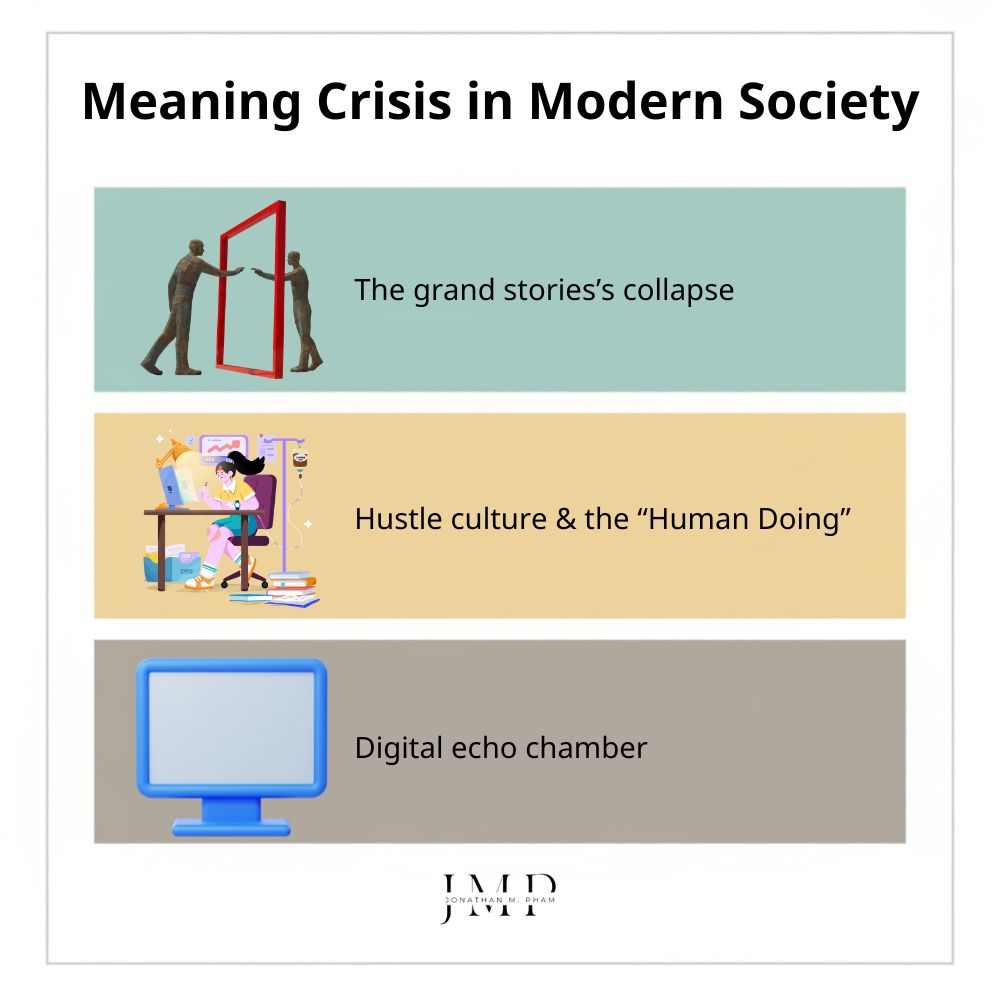
The collapse of the grand stories
God is dead. God remains dead. And we have killed him. How shall we comfort ourselves, the murderers of all murderers? What was holiest and mightiest of all that the world has yet owned has bled to death under our knives: who will wipe this blood off us? What water is there for us to clean ourselves? What festivals of atonement, what sacred games shall we have to invent?
Friedrich Nietzsche
To understand the root cause of the problem, let us look back at how humans traditionally survived. For thousands of years, meaning was not something to be “found” or “created”. There was virtually no need to ask “What is the meaning of my life?“, simply because the answer was already addressed in what the postmodern philosopher Jean-François Lyotard referred to as “meta-narratives“—overarching stories that explained the universe and our place in it. Whether it was the promise of a heavenly afterlife or the noble pursuit of building a utopian nation, these grand stories provided a comforting roof over humanity’s head.
But over the latest centuries, as science, globalization, and access to information accelerated, that roof gradually caved in. And the result is what the sociologist Max Weber called the “disenchantment of the world“—where the grand stories were deconstructed, culminating in the realization (just as I did with the priest’s bad logic) that many of the old structures were flawed, dogmatic, or scientifically inaccurate.
However, in tearing down the old house, we forgot to build a new one. Without the anchors that once glued people together—e.g. myth, magic, sacred communal ties, among others—humanity became left with a fractured cultural landscape of “my truth” and “your truth,” yet absolutely no shared, collective purpose.
For when Truth enters the lists against the falsehood of ages, shocks are bound to ensue, and a spell of earthquakes, followed by the transposition of hills and valleys, such as the world has never yet imagined even in its dreams. The concept “politics” then becomes elevated entirely to the sphere of spiritual warfare. All the mighty realms of the ancient order of society are blown into space—for they are all based on falsehood: there will be wars, the like of which have never been seen on earth before.
Friedrich Nietzsche
(As grim as it is, Nietzsche’s prediction sadly came true in the 20th century—marked by the onset of World War I, World War II, and the rise of totalitarian regimes like Fascism and Communism that turned politics into total, ideological warfare. Even as of today, his words still ring true; in fact, we are witnessing a new kind of “transposition of hills and valleys,” where shared objective reality collapses, and micro-ideologies fight for total dominance over the human psyche.
When a world’s foundational anchors are lost, humanity inevitably plunges into an existential vacuum.)
Hustle culture: The trap of the “Human doing”
Nature, as it always was, abhors a vacuum. Because most humans cannot survive without meaning, we immediately tried to fill the empty room with new, secular “religions”. (e.g. bureaucracy, materialism, extreme individualism, communism, etc.) Among them, the most prominent one today is arguably the “hustle culture.”
Stripped of spiritual and communal anchors, modern society constantly tells us that one’s worth can be measured solely by one’s economic output and social status. Consequently, many people—as I myself experienced during my own burnout phase—become obsessed with accumulation. We convince ourselves that if we just optimize our routines, work three jobs, and buy enough comfortable things, the existential dread will stay at bay.
Unfortunately, tying one’s self-worth to productivity is a fragile game. The moment you achieve the goal—or the moment you face burnout, illness, or an economic downturn, your entire source of meaning vanishes.
At that moment, it dawns on you that you have optimized your whole life for speed, but completely forgot to pick a destination.
To make matters worse, as the physical communities once holding us together disintegrate, people, naturally, migrate to the Internet. We become “atomized”—a sociological term known as anomie, where rapid social changes break down communal ties, leaving individuals feeling isolated and normless. To meet their needs for belonging, many end up in digital echo chambers, replacing real human connection with the fleeting dopamine of social media validation.
That substitution, as simple and attractive as it may sound, does not present a real solution to the crisis of meaning at all. Simply, because it doesn’t address the loss of what the cognitive scientist John Vervaeke referred to as our “ecologies of practices.”
In the past, societies had rich wisdom traditions: rituals, deep meditation, rites of passage, and embodied dialogues that trained people to experience genuine connectedness to the world and to each other. Yet today, those practices have largely been abandoned. And the result?
Humanity is drowning in a sea of endless information, yet we are starving for wisdom.
We have access to endless data, but not a sustainable framework for making sense of our existence.
When we replace ancient, embodied practices with digital echoes—trading a community grief ritual for a sad emoji, or a rite of passage for a viral trend—the trade-off is more than just the loss of social connections. We have also abandoned the tools required to cultivate depth, purpose, and meaning.
Facing the Crisis of Meaning: Common Pitfalls to Avoid
When confronting a crisis of meaning, the immediate response for most of us is to panic. In our rush to “fix” it, we frequently fall into the following psychological traps—false cures that only deepen our sense of alienation.
Living in “bad faith” (Fleeing from freedom)
As discussed earlier, the most unsettling aspect of an existential crisis is the realization of one’s own radical freedom. Specifically, you are fully responsible for authoring your existence and giving meaning to it. There’s nobody to blame or look to for answers; if you fail, it’s on you.
Most people are not equipped to handle that burden; they would rather excuse themselves by claiming that they “have no choice.” That they are merely a “cog in a machine”, completely dictated by external circumstances.
Sartre called this act of self-deception “bad faith”. And it is something we all see everyday, everywhere:
It’s the person who stays in a soul-crushing corporate job for decades, telling themselves, “This is just what adults do.“
It is the individual who remains in a loveless relationship because “this is just how life is.“
By pretending we are objects stripped of agency, we temporarily escape the anxiety that comes with stepping into the unknown. (i.e. breaking the script and taking responsibility for our own decisions) But the cost is catastrophic: we lose our authenticity, and the inner hollowness only grows larger.
Another common trap is the temptation to surrender one’s own intellect to rigid dogma. Instead of engaging with your own unresolved emotions, you seek out a pre-packaged belief system—a cult, an extremist political ideology, or an authoritarian religious group (like the hyper-sensitive community of my childhood). You adopt a ready-made collective identity and absolve yourself of the burden of thinking independently.
This is known as “spiritual bypassing”. It provides the illusion of meaning by promising absolute certainty and a clear list of enemies. Without being aware of it, you are only putting on a new False Self—a superficial bandage over the internal void. And when the dogma inevitably clashes with your internal reality, the collapse is twice as devastating.
Intellectualization
It is the duty of the human understanding to understand that there are things which it cannot understand.
Soren Kierkegaard
Given that modern humans are hyper-rational creatures, our default reaction to every problem—including our own crisis of meaning—is to intellectualize it. We believe that if we just read enough self-help books, optimize our daily routines, or logically deduce the perfect philosophical framework, we will “solve” our lack of meaning like a math problem.
But the truth is, meaning cannot be found in a purely intellectual equation. The more one tries to “make sense” of it, the more one would fall into paralysis and despair.
This is exactly what happens in Dostoevsky’s masterpiece The Brothers Karamazov—which takes place in 19th-century Russia, a society deeply fractured by the collision of traditional faith and the rise of European nihilism. At the center of the story is the character Ivan Karamazov—a brilliant and hyper-rational intellectual. He is consumed by the “problem of evil”—specifically, the irrational suffering of innocent children. Looking at a world filled with beastly cruelty, he determines that even if a higher power or grand meaning exists, he would refuse to participate in it.
Because Ivan is fiercely logical, he adopts a purely nihilistic premise: “If there is no inherent moral order, then everything is lawful.” To him, it’s just a thought experiment hatched in the safety of his intellect. Yet it’s exactly the cause of Ivan’s tragedy: his cynical half-brother, Smerdyakov, takes his abstract philosophy literally and uses it to justify a brutal murder.
This shatters Ivan completely. Realizing that his intellectual “games” came with real-world devastating consequences, Ivan’s psyche implodes, driving him into a state of literal “brain fever.” In the end, he learns the truth the hard way: trying to rationalize a universe without meaning based on intellect alone is a recipe for madness.
On the other side of the story is Ivan’s younger brother, Alyosha, who manages to find a way through his own “dark night of the soul”. When Alyosha’s respected spiritual mentor—Father Zosima—passes away, Alyosha expects a miracle, but is met only with the cruel reality of his mentor’s body decomposing.
This throws Alyosha into a deep crisis of meaning. Yet instead of retreating into cynical abstractions like his brother Ivan, Alyosha eventually decides to “rise up”. To confront the irrational reality of the world. To embrace “active love” and engage with the suffering people around him.
The verdict from the story is clear: You cannot out-think the void. You cannot hyper-rationalize your way out of an existential vacuum.
Meaning is an experience—something to be enacted. Sitting alone in a room logically deducing it—like Ivan does—is futile. Only through active participation in life may the answer to your emptiness gradually emerge.
What is meaningful cannot in fact be isolated… We achieve understanding within a circular movement from particular facts to the whole that includes them and back again from the whole thus reached to the particular significant facts.
Karl Jaspers
How to Overcome a Crisis of Meaning
Transitioning from abstract philosophy to bodily survival requires a completely different set of tools. If you are currently drowning in the existential vacuum, here are a few practical steps to help you reconnect with purpose.
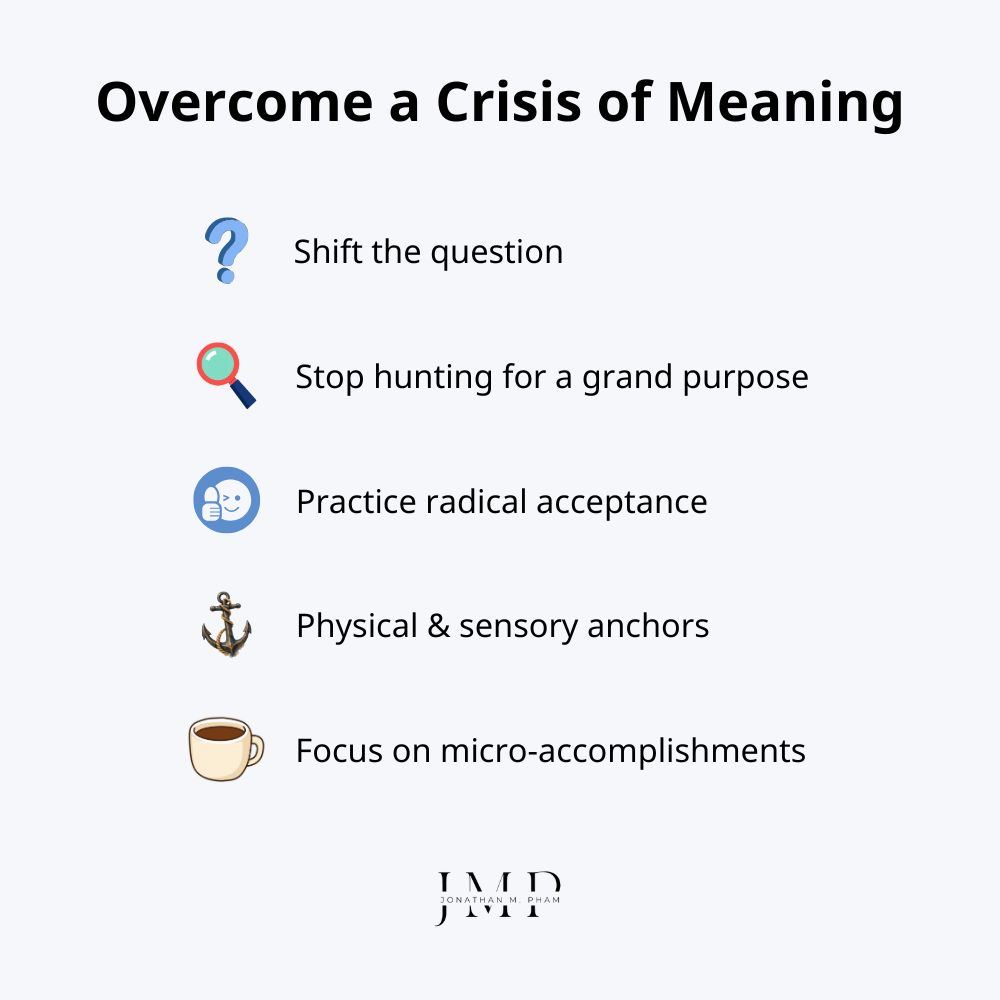
Shift the question (The core of Logotherapy)
Ultimately, man should not ask what the meaning of his life is, but rather must recognize that it is he who is asked. In a word, each man is questioned by life; and he can only answer to life by answering for his own life; to life he can only respond by being responsible.
Viktor E. Frankl, “Man’s Search for Meaning”
When we are in a crisis, our instinctive response is to scream, “What is the meaning of all of this?” We want the universe to hand us a pre-packaged answer. However, to demand an explanation is to have the dynamic completely backwards.
Every single day, life places situations, challenges, and people in front of you; it’s up to you to answer through your actions.
Your friend is grieving; how will you show up?
Your career stalled; how will you adapt?
You have a free afternoon; what will you create?
Meaning is strange; it comes when you are not demands-testing life for it. When you stop forcing things to yield a purpose for your own satisfaction—when you take responsibility for the immediate reality in front of you, then unexpectedly, mysteriously, meaning is there—born of a readiness to answer life’s call.
Adjust your “zoom” (Stop hunting for a grand purpose)
The knowledge that nothing matters, while accurate, gets you nowhere. The planet is dying. The sun is exploding. The universe is cooling. Nothing’s going to matter. The further back you pull the more that truth will endure. But, when you zoom in on earth, when you zoom in to a family, when you zoom into a human brain and a childhood and experience, you see all these things that matter.
Dan Harmon
One of the main reasons we feel purposeless is that we are stuck at the wrong level of magnification. Like Ivan Karamazov, we measure our daily lives against the infinite universe or the grand arc of history. At that macro level, every human endeavor—of course—rounds down to zero.
To overcome a crisis of meaning, it’s essential that you lower the stakes. Stop trying to figure out your “Grand Cosmic Purpose” or how to save the world. You do not need to solve world hunger to have a meaningful afternoon.
Instead, focus on micro-meaning: brewing a really good cup of coffee, texting a friend who is struggling, or finishing a small creative task.
Practice radical acceptance
It’s impossible to heal if you are constantly beating yourself up for feeling lost. Doing so would only waste a massive amount of psychological energy. When you resist your current reality—judging yourself for being “broken” or panicking because you aren’t “fixed” yet—you essentially end up fighting a war on two fronts.
Therefore, give yourself permission to be in the void. Say to yourself:
“Right now, nothing makes sense, my life feels completely without direction. That is where I am. And that is okay.“
Depathologizing your distress—accepting that crisis is a normal, healthy part of human development (a “positive disintegration”)—is the first step toward cultivating resilience.
Read more: Amor Fati (Love Your Fate) – When Existentialism Meets Stoicism
Bypass the brain (Physical & sensory anchors)
Given that the crisis of meaning is characterized by overthinking, your brain is currently an unreliable ally. You need to move from the mind into the body. When the macro-world feels empty, you survive by shrinking your attention to the immediate micro-world.
The gravity connection: When existential anxiety causes you to feel like you are floating in a void, try literally lying flat on your back on a hard floor. Lay there for five minutes and focus solely on the physical sensation of being physically “held” by gravity.
Temperature shocks: If you find yourself slipping into the “zombie mode” autopilot, try splashing ice-cold water on your face or holding an ice cube in your hand. This forces your amygdala to drop its abstract philosophical panic and immediately switch to present-moment reality.
Tactile anchoring: Keep a smooth stone or a heavy coin in your pocket. Throughout the day, when your mind starts drifting, touch it. It’s simple, yet a very effective way to remain tethered to the “here and now.”
Focus on micro-accomplishments
When you are in a crisis of meaning, your brain is starved of dopamine and momentum. Hence, instead of trying to overhaul your entire life, it’s recommended that you shift the daily math to low-demand routines that generate micro-utility.
The 2-minute outside window: Step outside for just two minutes a day, without your phone. Feel the air. Look at the sky. Doing so registers to your nervous system that a wider world exists outside of your own head.
Be useful to others: The fastest way out of your own head is to alleviate someone else’s suffering. No need to do anything grand; just helping a neighbor carry groceries or mentoring a junior coworker—any act that generates real-world value for someone else—is enough to create an anchor of meaning.
The glimmer hunt (Micro-journaling): Rather than journaling only about how lost you feel, try writing down three tiny things that simply “didn’t suck today.” (e.g., “The water in the shower was hot. A dog looked at me on the sidewalk. The coffee was decent.”) As simple as it may sound, you are essentially retraining the brain to spot significance in a world it previously labeled as “empty”.
How to address a crisis of meaning
Looking Beyond the Crisis of Meaning to Touch Reality
I continue to believe that this world has no ultimate meaning. But I know that something in it has a meaning and that is man, because he is the only creature to insist on having one.
Albert Camus
So far, we have covered virtually everything about the meaning crisis—from the common triggers, how it ends up becoming such a global phenomenon, and the specific steps to resolve it. Yet there remains a question: why do we desire meaning in the beginning?
If we are, as some extreme materialists typically argue, just highly evolved meat machines operating on biological instincts, why do we care so much about everything? Why aren’t we perfectly content the moment we have enough food, a warm bed, and a stable paycheck? Why does the absence of a “why” cause us such agonizing pain?
Here’s my answer: because we are far more than biology.
The fact that we feel hurt by a lack of meaning is the ultimate proof of our depth.
The theologian Paul Tillich spent his life studying this exact phenomenon. He proposed that the quest for meaning is, at its absolute core, the result of a “religious” impulse.
Now, I suppose when hearing the word religious, many would instinctively flinch. You may immediately think of the narrow definition: the rigid institutions, the unquestionable dogmas, and the hyper-sensitive, policing communities (like the one I grew up in).
But being “religious” has nothing to do with dogma. At its broadest, most human sense, it means being grasped by an “Ultimate Concern.”
If you are care about the truth of reality; if you ache for justice in a broken world; if you are moved to your core by the selfless act of a stranger; or if you are simply lying awake at night demanding to know why we are here—YOU ARE experiencing a religious impulse.
Even if you consider yourself a staunch atheist, a pragmatic agnostic, or someone completely disillusioned by institutional faith, the sheer fact that you demand that life matters—that you refuse to accept an indifferent universe—means you share the exact same psychological DNA as the mystics and spiritual seekers of the ancient world.
If we were merely “meat machines,” a meaningless universe would never bother us. A rock does not despair over its lack of purpose; a wolf does not experience an identity crisis after securing its meal.
We humans, on the other hand, suffer because we are misaligned with a fundamental truth: we are creatures wired for transcendence.
The modern world is designed to treat us from the neck down. It offers a checklist that it claims would guarantee us “happiness”: Production (work harder to achieve status); Consumption (buy more to numb the boredom); and Distraction (scroll endlessly to quiet the background noise). Yet in promoting this purely “horizontal” existence—in reducing human existence to mere survival and superficial comfort—it also gives rise to the crisis of meaning we are seeing today.
To resolve it, we have to break through the surface of daily survival. To stop waiting for a clear-cut answer from the sky. To look directly into the universe’s silence—and have the courage to say “yes” to it anyway.
By being present, caring deeply, engaging in acts of creation, and serving the common good, we touch a much deeper layer of reality. From there, what started as no meaning would be turned into a source of Great Meaning.
Read more: Amor Mundi – To Love the World From an Authentic Heart
Final Thoughts
When you are in the middle of a crisis of meaning, it’s very tempting to become overwhelmed with doubt. To assume that you are “failing” at life. To lose faith and fall into despair as a result.
But I want you to know this: you are not broken.
The existential vacuum you are going through—it’s just a sign that you are shedding the False Self that once limited you. That you are ready to step out of the “Well” and into the open “Ocean”.
Sure, it is an uncomfortable experience. The waves are daunting, and there is no universal authority coming to hand you a map. But the “Ocean” is also the only place where you can finally learn how to swim.
There’s no need to figure everything out at once. You just need to be willing enough to take the first step. To trust that despite the overwhelming evidence of suffering and absurdity in the world, life is still worth living.
As far as we can discern, the sole purpose of human existence is to kindle a light in the darkness of mere being.
Hi there! I am a seeker on his path of self-discovery. Since my youth, I have been haunted—and driven—by the fundamental questions of existence: the weight of our choices, the nature of true fulfillment, and the various identities we inhabit. I created this blog to chronicle the insights I have unearthed while navigating the 'absurdity' and beauty of life. My hope is that in reading these words, you will find a reflection of your own struggle—and the courage to 'become who you are.' Please just take what resonates with your soul, and leave the rest behind!