Has this ever happened to you? Let’s say you are sitting on the couch after a long day. You open Netflix, scroll through the trending page, then the newly added section, then the categories the algorithms have built just for you. You watch a few trailers. You weigh a gritty true-crime documentary against a lighthearted sitcom.
Forty minutes later, you haven’t made a decision yet. Feeling inexplicably tired and irritable, you end up turning off the TV and going to sleep.
If we are attentive enough, we should see the same phenomenon everywhere:
It is the Tinder user swiping through thousands of faces, constantly driven by the illusion of finding a "perfect" partner.
It is the trivial $15 Amazon purchase that somehow mutates into a three-hour research project comparing reviews, specs, and shipping times.
I myself am no exception to it. Many days, I wake up with a dozen ideas to pursue—I could either work on a new philosophical essay, tweak the SEO on my blog, do a part-time gig, or study a language. And somehow I often find myself sitting there, oscillating between tasks, unable to decide what is the most "optimal" or "meaningful" thing to do first.
Predictably, many times I end up doing nothing at all.
It’s a very strange problem of the modern world. We now have much more options than our ancestors in virtually every aspect of life; yet instead of being “liberated”, many people become trapped in their own mind.
“Infinite freedom”, instead of making us happy, now becomes an invisible burden of choice—a perpetual cause of paralysis, stress and dissatisfaction.
Why is it the case then? And what can we do to deal with this burden?
📌 Key Takeaway
The “burden of choice”—also referred to in psychology and economics as the “paradox of choice,” “choice overload,” or “overchoice”—is the phenomenon where having an abundance of options actually results in psychological stress and inaction.
Conventional productivity hacks (like automating routines) may work for trivial matters, but usually fall apart when it comes to life-altering choices or deep existential crises.
According to existential philosophy, the burden of choice is a byproduct of the realization that we are completely free to author our own lives.
In impossible "Limit Situations," pure rationality breaks down. In these moments, we must rely on our innate moral compass, trusting intuition and compassion to guide us.
Taking ownership of one's life is essential for one to move from the burden of choice to a state of "choiceless" flow.
The ultimate goal is not to overcome the burden of choice, but to love your fate—embracing the chaos and sacrifices that follow after major life pivots.
What is the Burden of Choice?
For most of human history, choice was scarce. You lived where you were born, you took up the profession of your parents, and you married someone from your village. Survival was hard, but the path was clear. There was very little reason to agonize over your life direction.
That is no longer the case. These days, the supermarket aisles are filled with 80 different types of toothpaste, and we are told that our identity—our career, partner, lifestyle—is completely up to us. This unprecedented freedom, strangely enough, has given rise to a dilemma where people become cognitively overwhelmed by having too many similar options.
In 1970, the futurist Alvin Toffler coined the term "overchoice" to describe this psychological phenomenon. Years later, the concept was brought into the mainstream spotlight by psychologist Barry Schwartz in his book “The Paradox of Choice”. According to Schwartz, while some choice is undeniably better than none, more is not always better than some. In fact, having too much choice actually makes us miserable.
Schwartz paradox
Another milestone that helped popularize the theory was the 2000 "Jam Study", in which psychologists Sheena Iyengar and Mark Lepper set up a tasting booth in a gourmet grocery store. On one day, they offered shoppers 24 varieties of jam; on another day, only 6.
The results were staggering. The 24-jam display attracted more onlookers, but when it came time to actually buy something, only 3% of people made a purchase. In contrast, when presented with just 6 jams, 30% of people bought a jar.
Burden of choice
Why Too Many Choices Burden Us
As shown in Iyengar and Lepper’s study, having more options—while seemingly desirable in theory—only makes people less likely to choose anything at all. The question is: why?
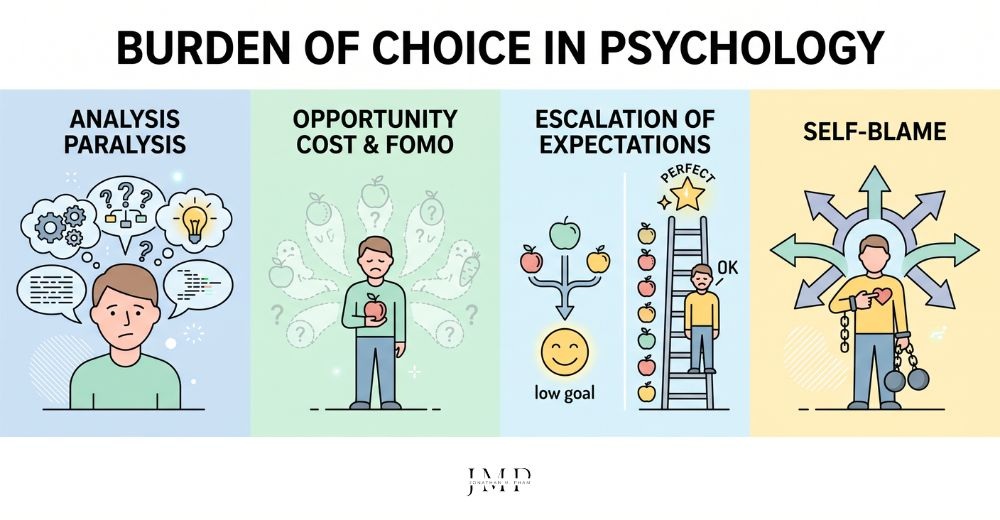
Psychologists have identified a few underlying cognitive mechanisms as follows:
Analysis paralysis
Every time you add an option to your plate, your brain has to process it, compare it to the others, and evaluate its worth. The result is what psychologists call cognitive load. When you try to weigh 50 different career paths or 50 different laptops, your brain simply runs out of RAM. The cognitive effort required to make the decision outweighs the benefit of the decision itself; as a result, you are likely to either arrive at a rash choice just to get it over with, or to make no choice at all.
Opportunity cost & FOMO (Fear of Missing Out)
Every choice you make inherently contains the ghosts of the ones you didn't. If you pick one path out of a hundred, you are simultaneously giving up ninety-nine other potential futures.
As humans, we innately mourn these lost possibilities. The pain of missing out mathematically subtracts from the satisfaction of whatever we actually end up choosing.
The escalation of expectations
If a store only sells two styles of jeans, and the pair you buy is slightly uncomfortable, you normally don't think much of it. It's not your fault; after all, they only had two pairs.
On the other hand, if a store offers 500 styles of jeans, your expectations naturally skyrocket. With that much variety, you are prompted to subconsciously believe that there must be a perfectly tailored pair waiting for you. When the jeans you pick inevitably end up being just "okay," disappointment is guaranteed.
Self-blame
When your options are limited, if something goes wrong, you can conveniently blame the store or your own circumstances. But in a world of infinite choices, if you end up in a job you hate, or a mediocre relationship, it’s all because of you. You had the freedom to choose anything, and you chose this. Only you are to blame for not choosing better.
Burden of choice in psychology
Why Conventional "Life Hacks" Cannot Solve the Burden of Choice
If you type "how to overcome decision fatigue" (or a similar keyphrase) into a search engine, you would likely be met with a tidal wave of modern psychology, self-help articles, and productivity coaching. The advice would be predictable:
Automate your life.
Create morning routines.
Set artificial constraints (e.g., only look at three options before buying).
Adopt a uniform (like Steve Jobs' black turtleneck) to save mental energy.
I myself once subscribed wholeheartedly to these practices. To be fair, they are fine for dealing with the trivial things in daily life. Automating your breakfast or limiting your Amazon scrolling would, undeniably, save you a few units of cognitive load.
That being said, if we rigidly apply the same strategies to trajectory-altering decisions, they typically fall flat. And the reason has to do with the mindset behind them.
Treating symptoms only: Productivity hacks focus on how to choose faster or more efficiently, without asking why we care about the choice in the first place—or what it reveals about our inner values.
The limits of pure rationality: Conventional life advice typically assumes that humans are completely logical calculators—that life is a “problem” to be fixed, like an Excel spreadsheet. On the contrary, the “irrational” emotional and spiritual drivers that actually dictate human fulfillment are, unfortunately, left off the table.
Fragility in extraordinary crises: Most life hacks rely on stable baselines and predictable environments. That’s why they would break down when faced with a paradigm-shifting life event. (what philosophers call a "Limit Situation") When a real existential crisis strikes, it's impossible to "time-block" your way through it.
The philosopher Ruth Chang once gave a TED Talk in which she classified choices into two types: Easy and Hard. When the options given have a quantitative difference (e.g., a job paying $100,000 vs. one paying $10,000), it’s very simple to choose. Yet it’s another story when it comes to “hard choices”, because the options are "on a par." Because they come with completely different kinds of value.
Now, let’s say a person is a talented artist—while also holding a stable, high-paying corporate job. The conflict between these two lives is tearing them apart. If they reach out to their peers, boss, HR staff, or a career coach for advice, they would almost always be handed a "Synthesis" solution:
"Why not be a ‘creative executive’? Do both!"
On the surface, it sounds very logical—a win-win for everyone. But in reality, it usually falls short and makes the person miserable.
Why? Because it treats the dilemma as nothing more than a scheduling puzzle.
The "synthesis" advice assumes that human identity and creative energy can be neatly partitioned into 50% corporate executive and 50% free artist. However, it overlooks something much more fundamental: the conflict between the safety of conformity and the calling of authentic creation. And it ignores the fact that mastery in any field typically requires total psychological immersion.
Burden of choice
This is a problem that I, as a content creator, can personally relate to. There was a time when I tried to serve two “masters” with my writing: the Master of Money (getting a stable income through high-intent SEO keywords and affiliate funnels) and the Master of Truth (writing in-depth philosophical essays that don't target high search volume). I tried so hard to bridge the two, and the result—predictably—was a toxic compromise:
I churned out tons of surface-level listicle articles (e.g. ”Best X,” “Top 10 Y”) mostly to “cheat” search engines and increase the site’s traffic as quickly as possible.
Many of my posts addressed shallow topics that didn’t quite get to the root of the human condition; yet because I went too deeply into them, the content became too heavy and esoteric for the masses looking for quick self-help tips.
Over time, I have come to realize the hard truth—that if I want money, I need to do something else rather than “monetizing truth”. As difficult as it was, the conclusion allowed me to finally put an end to the inner spiritual crisis.
Now I write because I have something to say—something that resonates with my soul and makes me whole. Not because I have to say something—just to get the likes, the clicks, the subs.
You cannot put the safety of a career and the unknown potential of a passion into the same category. The more you try to apply the modern world's hyper-optimization mindset to your life, the more of an “impostor” you would become.
Burden of Choice in Philosophy
If modern psychology, self-help and coaching tend to view the burden of choice as a "bug" in the human operating system—something to be (and can be) patched with routines and life hacks—philosophy, especially existentialism, takes a drastically different perspective.
To existentialist thinkers, there is no “cure” for this burden—because it is precisely what makes us human. While running from it may look tempting, in doing so, we deny the very thing that gives meaning and dignity to life.
The "dizziness" of freedom
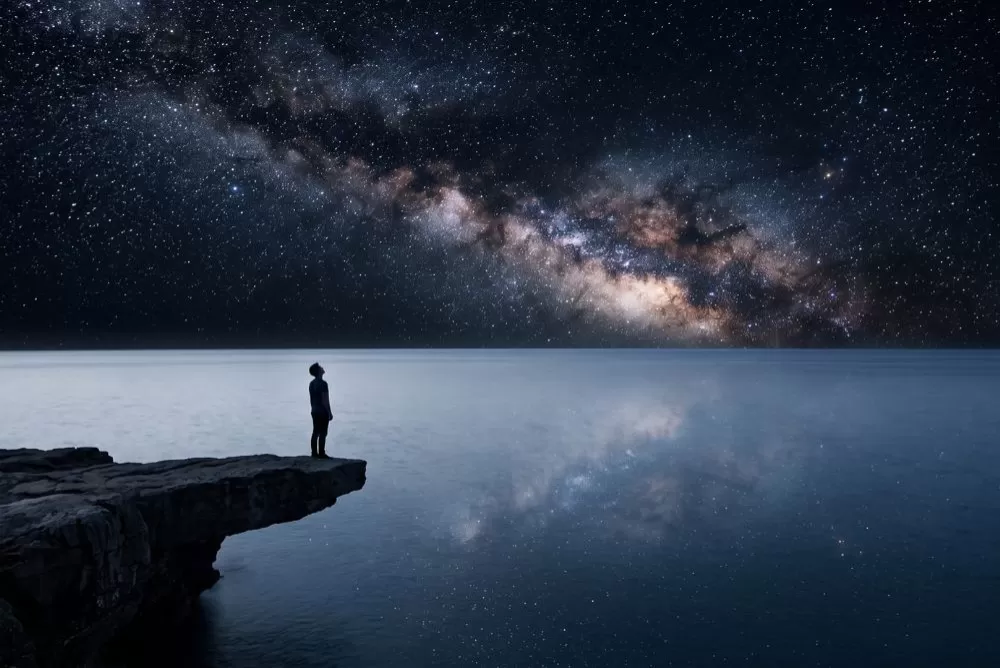
Long before Amazon or Netflix existed, the 19th-century Danish philosopher Søren Kierkegaard had understood the same weight of infinite options, which he illustrated with a striking metaphor. Let's say you are standing at the edge of a towering cliff. When you look down into the "abyss" below, you feel fear. Part of that fear, obviously, stems from the worry that you may accidentally slip and fall.
However, beneath it is a much more chilling terror: the realization that theoretically speaking, you could jump.
Nothing is stopping you. Your body is under your control. In that split second, you suddenly come to terms with the full magnitude of your own freedom.
That "nauseating" internal state—which Kierkegaard referred to as the "dizziness of freedom"—is the very feeling people have when facing a major life choice—whether to quit a job, end a relationship, or move across the world. At that moment, most of us are hesitant to take action—because we are aware that it's up to us to steer lifein any direction. And we alone have to live with the consequences.
Burden of choice
"Condemned" to define oneself
Man is condemned to be free; because once thrown into the world, he is responsible for everything he does.
Jean-Paul Sartre
In the 20th century, the French philosopher Jean-Paul Sartre took Kierkegaard's idea even further and stated "existence precedes essence." According to him, human existence is unique in that we are "beings-for-itself" (pour-soi)—dynamic and unconstrained. Unlike a knife, which is designed with a specific purpose (its essence) before it is ever created, we are thrown into the world blank. There is no pre-written destiny or a cosmic order detailing a universally "correct" path for one's life. We exist first, and then it's up to us to decide who we are (our "essence") through the choices we make.
Given that we didn't choose to be born, yet here we are, completely responsible for everything we do, most of us instinctively look to external authority—rules, frameworks, traditions, teachers—to escape the burden of choice. (what Sartre called "bad faith") To demonstrate this tendency, Sartre once told the story of a student who came to him for advice during World War II. At that moment, the young man was torn between two paths:
Path A - The Duty of Devotion: Stay at home and care for his ailing mother, who relied on him to survive. (her other son had already been killed)
Path B - The Duty of Action: Leave home to join the French Resistance and fight the Nazis to free his country.
The student wanted to know which was the morally "right" choice—to which Sartre pointed out that no system could provide a satisfactory answer:
Christian ethics would tell him to love his neighbor—but who was his neighbor? His mother, or the people of France?
Kantian ethics would teach him to never treat people as a "means to an end"; yet if he stayed, he was using the Resistance as a means to stay safe. If he left, he was using his mother as a means to feel heroic.
Eventually, Sartre gave the young man a chilling conclusion:
"You are free, therefore choose, that is to say, invent."
The student simply had to choose, and by choosing, he would declare to the world what he valued most. To look elsewhere for a clue would not help him at all; in fact, as Sartre argued, even if the young man went to a priest or a philosopher for advice, choosing which advisor to trust is itself a choice.
If he reached out to a priest who advocated for the Resistance, he had already decided his path before he even asked.
The burden of choice philosophy
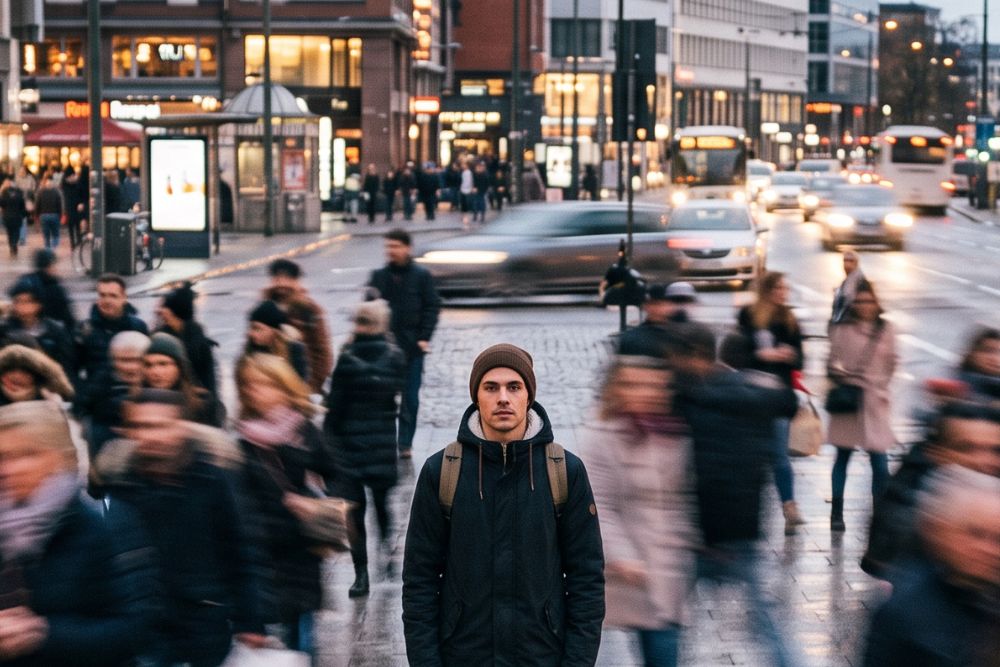
Blending in the Crowd
Another way people frequently flee from the burden of choice is to adopt others' values, beliefs, and lifestyle choices. To give up on one's own agency and surrender to what the German philosopher Martin Heidegger called Das Man. ("The They" or "The Crowd")
When you don't know what to do with your life, it is much easier (and so tempting) to just do what they do.
They say you should go to college, get a corporate job, and buy a house.
They say you should be married by thirty.
They say success looks like a certain number in a bank account.
Recently, "The They" has taken on a much different form following the invention and development of AI tools. In fact, due to the perceived "objectivity" and our obsession with efficiency (we should blame the hustle culture for this), more and more people are turning to AI as a way to dodge making hard decisions themselves. (e.g. whether they should make a career change; how they should approach a relationship conflict, etc.)
It's true that conforming to Das Man is comfortable—that it lifts the burden of choice from our shoulders. However, the cost is a loss of authenticity and personal responsibility.
When we let society, algorithms, or productivity hacks dictate our choices for us, life may indeed become much more "convenient"; but without being aware of it, we have already lost ourselves in the process.
Earlier, we talked about "Opportunity Cost" and "FOMO" (Fear of Missing Out) as cognitive mechanisms when it comes to making choices. Before modern psychology came up with these names, Kierkegaard had already captured the same phenomena in his book "Either/Or":
"Marry, and you will regret it; don’t marry, you will also regret it; marry or don’t marry, you will regret both... Hang yourself, you will regret it; do not hang yourself, and you will also regret that... This, gentlemen, is the sum and substance of all philosophy."
His observation may sound like dark humor, but it actually pointed to a fundamental truth: regret is an unavoidable “tax” on human existence. Given that we all live in a finite world with a limited amount of time, it’s impossible to have everything.
Choosing a stable life means "killing" the globe-trotting adventurer life.
On the other hand, choosing to be an artist means "killing" the comfortable corporate life.
When we feel the burden of choice, it's usually just us grieving the unchosen paths. We hesitate because we don't want to let any of our potential futures die.
The thing is, if you delay the decision long enough to avoid the pain of "Either/Or," the world would eventually choose for you. And when it does, there's no turning back. By then, you have, most of the time, devolved into a “cog in the machine”.
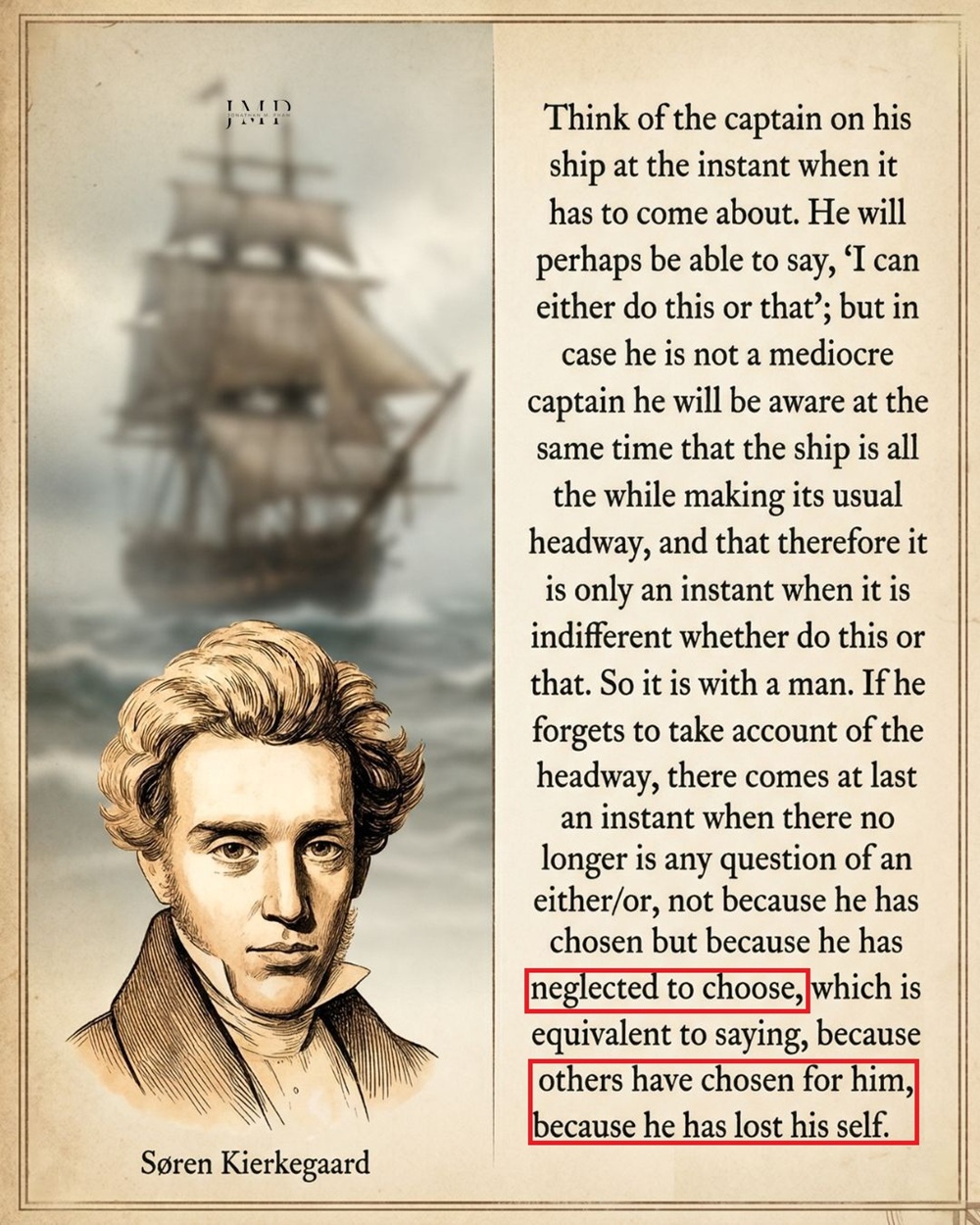
Think of the captain on his ship at the instant when it has to come about. He will perhaps be able to say, ‘I can either do this or that’; but in case he is not a mediocre captain he will be aware at the same time that the ship is all the while making its usual headway, and that therefore it is only an instant when it is indifferent whether he do this or that.
So it is with a man. If he forgets to take account of the headway, there comes at last an instant when there no longer is any question of an either/or, not because he has chosen but because he has neglected to choose, which is equivalent to saying, because others have chosen for him, because he has lost his self.
Søren Kierkegaard
To avoid such a situation, your only option is to move forward. Accept the sacrifice. Be willing to author your life, even when there is no guarantee of the outcome.
My Own Story of Living with the Burden of Choice
For a long time, my understanding of these philosophical concepts was strictly abstract. I would read the books, highlight the quotes, and ponder them from the safety of my own room or a cozy coffee shop.
It wasn’t until I was forced to make an extreme pivot myself—and live with its unintended consequences—that I finally understood what the burden of choice actually feels like to carry.
The “leap of faith”
Faith is precisely the contradiction between the infinite passion of the individual’s inwardness and the objective uncertainty.
Søren Kierkegaard
About three years ago, I quit my job as a manager at a digital agency. To be honest, it was a decision that required an unprecedented amount of bravery. I had no backup plan, no next job lined up, and no clear idea of the future—only an instinctive gut feeling that the current path was stifling my soul.
In the eyes of society (and certainly in the eyes of Das Man), my choice was pure madness. I was throwing away the predictability and stability of corporate life to step literally into “nothingness.” Since then, my life has been a mix of learning languages, blogging, philosophizing, and piecing together an independent income from various sources.
To some people, such a routine may seem “liberating” or desirable, but I doubt it. Back in the day, everything was guaranteed. Now, there is no safety net—nobody to tell me what to do next. I am left on my own, completely responsible for every outcome of my decisions.
And trust me, that experience is not always comfortable.
When reality strikes
The most tangible consequence of that "leap of faith" was losing my financial predictability—a reality I tasted bitterly a few months ago when my father was, out of the blue, diagnosed with cancer.
It was a true "Limit Situation." Suddenly, all my abstract ideals were stripped away, and I was forced to confront reality exactly as it is: raw, brutal, absurd.
Faced with my family's crisis and my own financial constraints (having lived for more than two years without a monthly paycheck), I couldn’t help but, for a moment, feel an urge to "go back" to the corporate world. To regain stability. To ease the burden.
To the typical person, that would undeniably be the “right” thing to do—a way to fulfill my duty for filial piety, as it is typically expected in East Asian societies. (as well as in my own religion and many other traditions)
Yet, after the initial panic subsided, I knew I could not—and would not—return.
I have changed into a whole new person over these past three years. To go back to a path that fundamentally contradicts my current self would be succumbing to what Kierkegaard termed the "sickness unto death"—the despair of refusing to be oneself.
And as I look at the situation now, my "leap" was probably not a mistake at all. In fact, it has given me the very resource my father needs most right now: time sovereignty.
If I were still working 80-hour corporate weeks, I would likely have a larger bank account to support his treatments. However, I would surely lack the physical, mental, and spiritual bandwidth to sit by his bed at the hospital, just as I am doing right now.
By making the "irrational" choice, I inadvertently gained the capacity to show up for what truly matters.
Burden of choice
Bearing the burden in silence
And that is not the whole story. The most awkward part of the situation is that my family does not know I have quit the corporate world. They assume I am still employed at my last company—that I am working remotely during my trips to the hospital with my father.
It is a secret that I have—after painstaking consideration—decided to keep to myself.
Now, some of you may wonder why I would do something so extreme as hiding my life path from my loved ones for over two years. And I’ll tell you why: they would not be able to understand it.
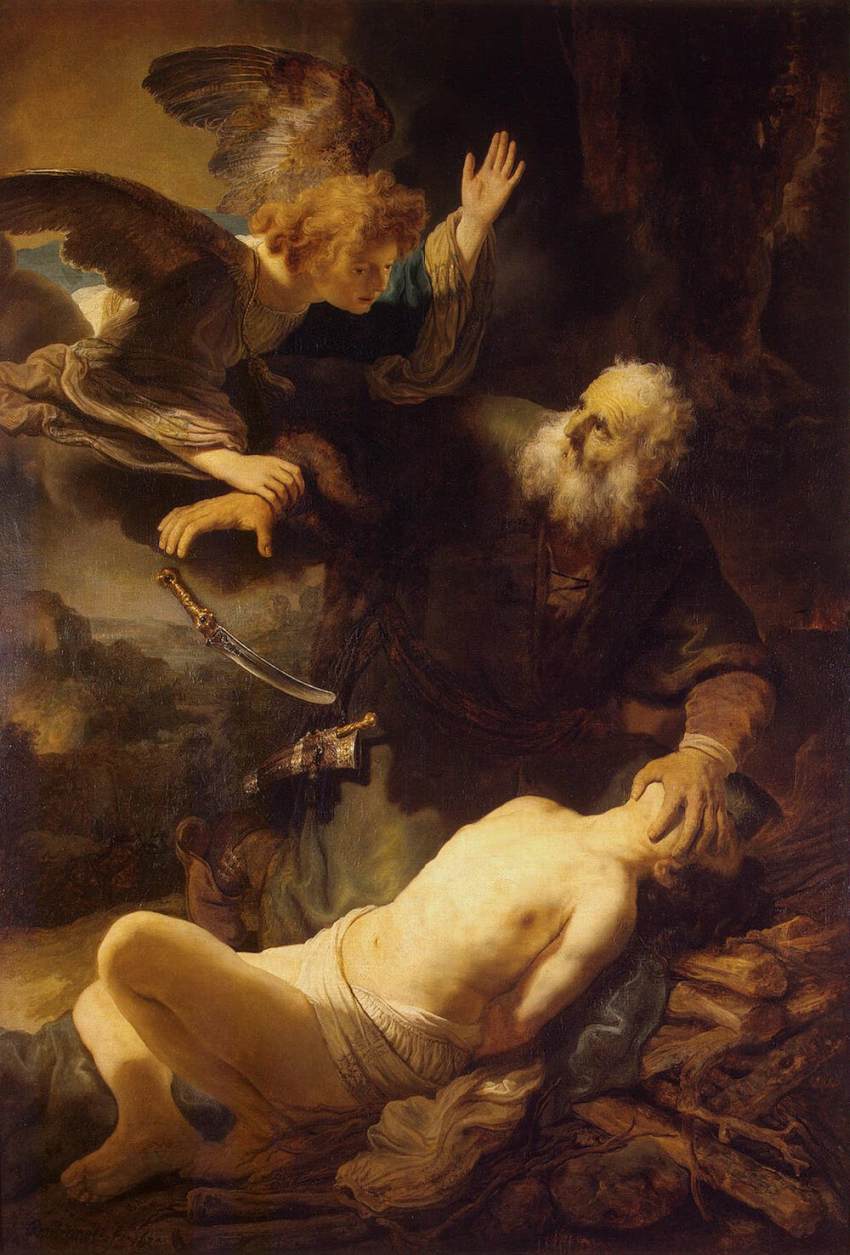
Kierkegaard discussed the exact same phenomenon in his book “Fear and Trembling”, in which he recited the biblical story of Abraham and Isaac. In the story, Abraham was commanded by God to sacrifice his son—a command that, by every human metric, made zero sense.
From a conventional ethical perspective, Abraham should have disobeyed God. Yet he didn’t. He decided to step outside the "Universal" (the shared rules, logic, and expectations of society) to heed a private calling—one that he could not, by any means, explain to anyone else.
If Abraham had tried to rationalize his choice to others, he would have sounded like a monster or a madman. He was, after all, operating on a wavelength that conventional language simply could not translate.
As a result, he was condemned to absolute silence and had to carry the burden alone.
When I first read Kierkegaard’s analysis of Abraham (whom he called the “Knight of Faith”), I couldn’t help but relate it back to my own circumstances. Like Abraham, the decision to keep my “leap of faith” a secret is not driven by deceit or cowardice. Just an act of protective containment.
Subconsciously, I know my family’s frame of reference cannot digest my “absurd” choices without panicking. Hence, I chose to absorb the shockwave myself rather than spilling my anxiety onto them—especially now, when what they need from me is grounding, not a crisis of identity.
Two different realities
Many times, when I sit next to my dad in the hospital, I feel as if I am in a completely different world from his—even though physically speaking, we are occupying the same space.
For my dad, he is living in the universe of the "Universal", where sons have stable jobs, clear titles, and predictable trajectories.
As for me, I am in the universe of the "Absurd": facing the unknown, forging my own essence, and following an inner voice that no one else can hear.
It’s a very peculiar type of loneliness—to realize that no matter how close I and my father are to each other, we are still separated by an unbridgeable gap. And to reflect on the fact that my decision to live authentically constitutes a major part of that gap.
That’s what it means to live with the burden of choice. You forfeit the comfort of being understood to become the sole author of your life—without demanding that the world understand you.
While such a prospect may sound like madness to the typical person, I have found that it is the very key that opens the door to a more vibrant and meaningful existence.
How to Face & Carry the Burden of Choice
Given that the burden of choice is a fundamental part of the human condition, I believe the goal shouldn't be to "hack" or eliminate it. We should focus, instead, on building the psychological and spiritual muscles required to carry it.
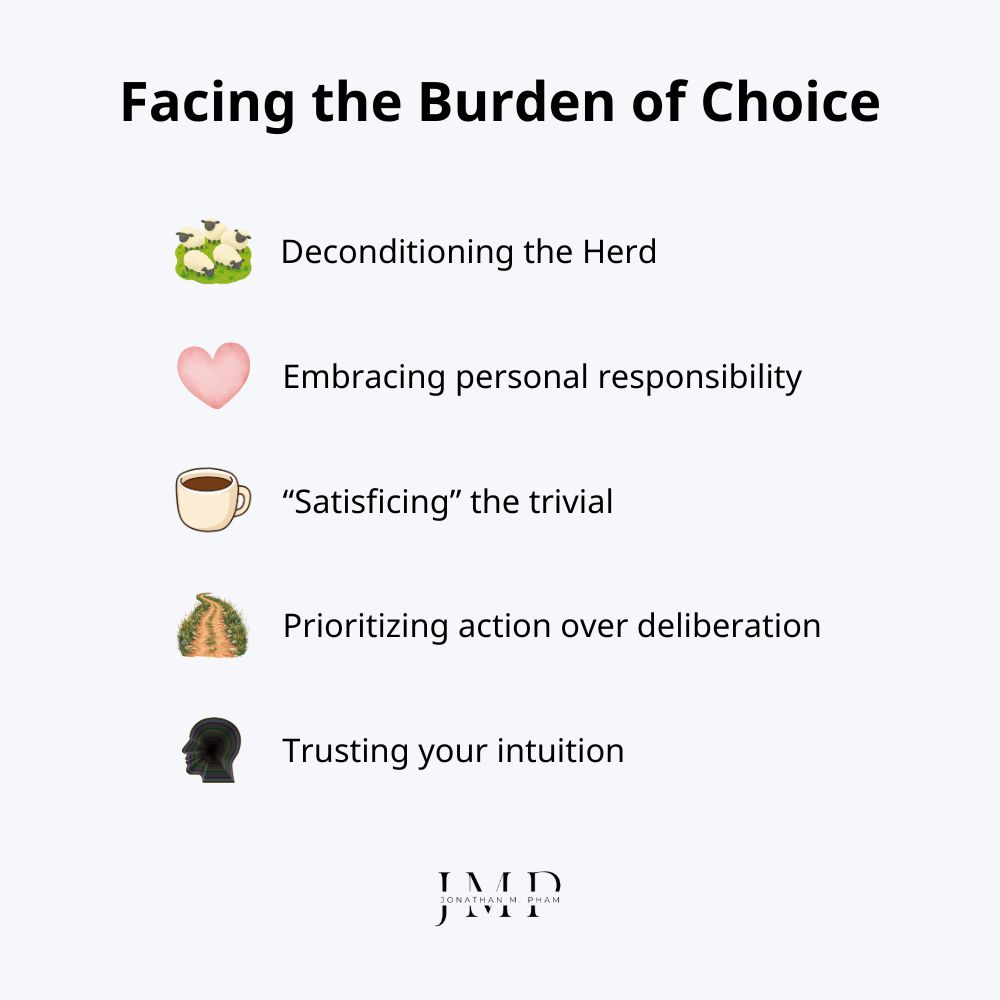
Deconditioning the Herd
Let’s be honest here: stepping away from the Crowd—a crucial requirement for making authentic choices—is not easy at all, and for good reason. From a biological perspective, for 99% of human history, leaving the tribe meant certain death. When you do something that defies societal expectations (like quitting a stable job, breaking off a "good on paper" engagement, or pursuing an unconventional lifestyle), your brain interprets it as a literal threat to your survival.
The panic you feel is, at the end of the day, just your nervous system reacting to stepping into the dark alone. As such, it’s important that you consciously rewire it by:
"Micro-dosing" discomfort
The idea here is to gradually cultivate tolerance to social disapproval through daily practices. For example, intentionally say "No" to a social invitation without offering a fabricated excuse just to avoid offending people. Let the awkward silence hang in the air.
Be comfortable with holding your boundary on small matters so that when it’s time for a massive life choice, your nervous system is already accustomed to the experience of standing alone.
Processing the "hangover of freedom"
When you finally decide for yourself, you will likely be hit with intense guilt. At that moment, it is crucial to distinguish between two types of emotional pain: Clean and Dirty.
The former is the natural grief of making a hard choice. (e.g. hurting someone’s feelings by saying no, or leaving financial stability behind to pursue your passion) It is clean because it is honest, unavoidable, and passes naturally.
The latter, on the other hand, is the circular mental layer you stack on top of it. (”Why am I so selfish? I ruined everything. They are going to hate me forever. I’m a terrible person”) Most of the time, it is a culturally conditioned belief passed on to you by others.
When the hangover hits, strip away the dirty pain. Give yourself permission to feel the clean pain of the transition without inventing a narrative that casts you as the villain.
Use the deathbed filter
When you find yourself immobilized by what your peers, parents, or society will think of your decisions, try transporting yourself to the end of your life. Ask your 90-year-old self:
“Which will I regret more—disappointing the Crowd today, or pretending to be someone else for the next 30 years?”
When we die, Das Man doesn't matter. The crowd will not be there to carry your regrets. So what’s the point of bothering with them right now?
Read more: Memento Mori - A Reminder of Life’s Impermanence & How to Live the Right Way
Embracing personal responsibility
There is a deeply ingrained psychological tendency in all of us, known as “responsibility aversion”. Naturally, we all want to avoid making difficult decisions—because we are afraid of the potential negative consequences, the social judgment, and the burden of self-doubt if things go wrong.
Outsourcing accountability is a tale as old as time. In the biblical story of Exodus, when the prophet Moses was delayed on the mountain, the ancient Israelites panicked in the face of their newfound freedom. As such, they melted down their gold and created a physical idol—a Golden Calf—to worship. They built a system to bear the burden of choice rather than facing the unknown on their own.
The same thing is happening today. As we touched upon earlier, countless people are asking AI to make daily choices for them. Additionally, we also outsource the decision-making process to corporate protocols, HR flowcharts, data metrics, and traditional societal milestones.
We turn to these modern "Golden Calves" because they offer us a very desirable reward: "moral immunity."
If a doctor follows standard protocol and a patient dies, the doctor is legally and socially protected. ("I just followed the rules.")
If you conform to societal expectations, get the standard degree, take the standard job, and end up miserable, you don't have to blame yourself. ("I just did what I was supposed to do.")
However, there is a grave danger in letting systems dictate your path. While a protocol or an algorithm can process information efficiently, it lacks the intent, values, fairness, and a true understanding of human consequences.
Difficult decisions are, after all, essential to the human condition. When you outsource your choices, you outsource your own growth.
As excruciating as it may feel, it is in the act of confronting hard choices head-on that character, emotional intelligence, and wisdom—the very qualities that make us human—can be cultivated.
“Satisficing” the trivial
Not all choices in life are created equal. Given that the ones that truly have an impact (like me quitting the corporate world) typically demand so much of our courage and psychological bandwidth, we should do our best to not waste energy on the mundane.
Back in the day, when studying how people approach the decision-making process, researcher Barry Schwartz identified two distinct personality styles: Maximizers and Satisficers.
Maximizers are people who must be assured that every choice they make is the absolute best. If they need a new vacuum cleaner, they will read fifty reviews, compare technical specs on three different websites, and agonize over the purchase for days. While they may occasionally achieve a slightly better objective outcome, Schwartz noted that Maximizers tend to suffer much worse from choice overload, buyer’s remorse, and mental exhaustion.
Satisficers, on the other hand, have specific requirements for making choices. They know what they need, and they simply go with the first option that meets those criteria. For them, "good enough" is truly good enough. Given their immunity to the escalation of expectations, Satisficers are generally much happier and less stressed.
If you want to carry the burden of choice without going insane, learn to be a Satisficer for the trivial things. Put a 10-minute timer on your Amazon purchases. Pick the first Netflix movie that looks mildly interesting. Save your cognitive load for the life-altering decisions that actually require your soul's attention.
As I shared with you in the beginning, there are days when I wake up immobilized by the number of options available to me. I have a dozen ideas I could write about, and because they all seem equally good, I frequently end up doing nothing—and beating up on myself as a result.
Eventually, I figured out a “trick” to snap me out of the paralysis: if I cannot decide on what to do, just pick one random thing and go with it wholeheartedly.
Now, I suppose some of you may not be satisfied with this seemingly “nonsensical” solution. However, as I have learned from my own experiences, sometimes rationality alone will only trap you in an endless loop. At such moments—when you don’t know for sure which is the most optimal path—your only option is to act. To choose one path and go with it, without worrying if it will get you “there”.
In Lewis Carroll's Alice in Wonderland, there’s a scene that captures this tension quite well. Alice, lost, asks the Cheshire Cat:
“Would you tell me, please, which way I ought to go from here?” “That depends a good deal on where you want to get to,” said the Cat. “I don’t much care where—” “Then it doesn’t matter which way you go.”
While the Cat’s answer may seem indifferent on the surface, he’s actually speaking a pragmatic truth here: if you do not have a guaranteed destination, no choice is inherently better or worse than any other.
When you are trapped between options that are "on a par," it’s a sign that rationality has reached its limit. Now is the time for you to break the deadlock by asserting your own agency.
Many times, you just have to pick a path at random, commit to it fully, and force yourself to forget the rest. While the idea may sound frightening, I myself have figured—after reflecting on my life so far—that there’s nothing called a “right” choice in the beginning.
A path only becomes right because you chose it. Because you invested your life into making it real.
Action creates momentum; deliberation does not.
Every path is the right path. Everything could’ve been anything else. And it would have just as much meaning.
Nemo Nobody, ‘Mr. Nobody’ (2009)
Trusting your intuition
Some people may dismiss the idea of picking a random path as a YOLO, "anything goes" mindset. However, that's not what I'm advocating for. My point is that we should recognize the inherent flaws of pure reason—and learn to tap into a very powerful decision-making tool we all have (but are often too afraid to embrace): intuition.
This is especially the case when it comes to a true "Limit Situation"—when the stakes are unimaginably high and the "correct" path is completely obscured. At that moment, pure rationality usually breaks down, leaving us with only one compass to rely on: our innver voice. And that inner voice, most of the time, does not follow a clear-cut logic.
To the modern mind—conditioned by Das Man's obsession with data, optimization and certainty—tuning in to the intuition may sound "suicidal". But the thing is, history is filled with countless moments where an impossible choice was carried successfully by this very "irrational" gut feeling.
Burden of choice
◆ Example #1: Louis Pasteur & Joseph Meister
In 1885, a nine-year-old boy named Joseph Meister was brought to the French chemist Louis Pasteur. The boy had been brutally attacked by a rabid dog. At the time, a rabies vaccine had been developed, yet it had only ever been tested on animals.
The incident put Pasteur in an impossible dilemma. He had no proof that the vaccine would work on humans; not to mention, he was a chemist, not a licensed medical physician.
If he followed standard medical protocol and did nothing, the boy would die, but society would view it as a tragic accident of nature.
If he administered the untested treatment and Meister died, he would likely be prosecuted, professionally ruined, and labeled a murderer.
Eventually, he decided to trust his inner moral compass and administered the vaccine. It was an excruciating decision—one that, as later revealed in his notes and letters, gave him nightmares for the next 10 days.
In the end, Pasteur's gut feeling proved right. Joseph Meister lived, and modern immunology was forever changed—all thanks to a man who decided to leap into the unknown rather than conforming to Das Man.
◆ Example #2: Stanislav Petrov
Almost a century later, the fate of the whole world hinged on a similar intuitive leap. In September 1983, at the height of the Cold War, a Soviet military officer named Stanislav Petrov was on duty at a nuclear early-warning center. Suddenly, the alarms blared. The system's computers reported that the United States had just launched five nuclear missiles at the Soviet Union.
Petrov had strict orders. The military protocol dictated that he must immediately report the incoming strike to his superiors, which would trigger a retaliatory nuclear launch. World War III would likely begin in a matter of minutes.
The data said the missiles were real. The rules demanded a response from him. But as Petrov stared at the flashing red screens, he felt something was wrong. If the Americans were going to start a nuclear war, he reasoned, why would they only fire five missiles?
Despite the very tangible objective proof, Petrov decided to trust his gut, reported the alarm as a system malfunction, and did nothing. And he was proven right.
By prioritizing his intuition over blind adherence to a system, Petrov literally saved the world.
◆ Putting it together
Now, most of us will never have to make choices that dictate the survival of humanity. That said, the underlying mechanics remain the same.
When you stand at the edge of the cliff, pondering whether to pivot your career, end a long-term relationship, or upend your life, you can only run the data for so long. Eventually, the spreadsheets, the advice of your peers, and the societal protocols will run out of usefulness.
At that moment, your only option is to listen to the voice in your gut—despite how "irrational" it may seem and how Das Man would say about you.
After all, as modern psychology and neuroscience have validated, your intuition is the very culmination of your life experiences, core values, and authentic self. It is capable of synthesizing information much faster than your conscious brain can articulate.
Many times, what it tells you is a truth you already know; just that it is buried at a depth of consciousness that you cannot always measure.
At the point where the road swings off (and where that is cannot be stated objectively, since it is precisely subjectivity), objective knowledge is suspended. Objectively he then has only uncertainty, but this is precisely what intensifies the infinite passion of inwardness, and truth is precisely the daring venture of choosing the objective uncertainty with the passion of the infinite.
Søren Kierkegaard
From Burden of Choice to "Choiceless" Flow
Up to this point, we have primarily looked at the burden of choice through the lens of Western philosophy and existentialism. The overarching message has been one of individualism: you are the author of your life, you must make hard choices, and you must carry the weight of the consequences alone.
It is indeed an empowering way to live. But if we are not careful, that hyper-focus on "being the chooser" can easily trap us.
The trap of the binary
You always own the option of having no opinion. There is never any need to get worked up or to trouble your soul about things you can't control.
Marcus Aurelius
When taking our responsibility to choose too seriously, we are likely to succumb to the illusion that every situation in life is a strict binary—that we must pick a side, or else we are failing at our life duty.
Ironically, Jean-Paul Sartre himself fell into this trap. During the Cold War, the world was split into two opposed factions: the capitalist West and the communist East. Sartre, believing that a philosopher must be engaged in the political realities of his time, felt pressured to pick a side. And he aligned himself with the Soviet Union.
He made that choice despite knowing about the authoritarian nature of the regime and the horrors of its labor camps—which were fundamentally incompatible with his own philosophy. In his mind, he had to support what he saw as the “historical momentum” of the working class. He was “conditioned” by the Western binary view of the world to make a definitive choice, and because he was so attached to the outcome, he compromised his own moral clarity.
His contemporary and friend, Albert Camus, took a different approach—one that cost him his friendship with Sartre. Camus refused to align with either the Soviets or the Western bloc. He recognized that both sides were committing atrocities in the name of ideology. Instead of picking the "lesser of two evils," he decided to stay independent, advocating for human life and rebellion against tyranny, regardless of which side was perpetrating it.
Sometimes, walking away from a forced dilemma—refusing to be bothered by a choice that the world demands you make—is the most authentic thing you can possibly do.
The absurd does not liberate; it binds. It does not authorize all actions. “Everything is permitted” does not mean that nothing is forbidden.
Albert Camus
Loosening the grip of the ego
If Western philosophy teaches us how to bear the burden of choice on our own, Eastern philosophy offers a complementary secret: how to see through the nature of that burden.
Here’s the question: when you sit on the couch being torn apart by your life’s trajectory, who is it that is actually suffering?
According to Eastern philosophy, it is the Ego. The agony comes from the belief that there is an isolated "Self" that must orchestrate the universe to be happy. And the antidote, according to Buddhism, is the realization of Anatta. ("No-Self")
Anatta does not mean you literally do not exist. Its core message is that the "I" you think you are—the "I" that is afraid of making a mistake and craves validation from Das Man—is nothing more than a psychological construct. It is dynamic, ever-changing, and always interconnected with the world around.
Given that there is no permanent “Self”, it’s ridiculous to strive for absolute perfection. As soon as you internalize this fundamental truth, the burden of making the “right” choice would, naturally, evaporate.
When the ego’s obsessive attachment to outcomes is stripped away—when you stop viewing life as a math problem to be solved—you are now equipped to observe reality as it is. To act with mindful presence: engaging fully with your goals, career, and relationships with an open hand.
You still care about the outcome, but your inner peace is no longer held hostage by it. As soon as that happens, the right choice would reveal itself to you, without any need for crippling deliberation.
It is man’s pretence that because he has choice he is free. Freedom is pure observation without direction, without fear of punishment and reward. Freedom is without motive; freedom is not at the end of the evolution of man but lies in the first step of his existence. In observation one begins to discover the lack of freedom. Freedom is found in the choiceless awareness of our daily existence.
Jiddu Krishnamurti
Acting out of love, not fear
If you look closely at the moments when the burden of choice feels the most crushing, you will usually find a hidden culprit lurking in the background: Fear. Specifically, the fear of how we will be perceived by others.
Sartre called this psychological phenomenon "The Look of the Other." When we feel that society, our family, or even history is watching us, we freeze. In that moment, we stop acting as free agents and instead start “playing” for an imaginary audience—all because of the desire for approval.
Let us think back to Sartre’s student, who was torn between caring for his mother and joining the French Resistance. On the surface, he appeared to be caring for morality; yet if we take a closer look, it’s not hard to see the real driver behind his burden.
Deep down, the young man was searching for a system—be it religion or philosophy—that would grant him immunity from blame and assure him that he was a "good person." He was operating out of the fear of being wrong.
To a certain extent, we are all like that student. Most of the time, our choices are not truly our own; just defense mechanisms designed to deflect the judgment of others. We fear too much, and it is exactly fear that makes the burden of choice unbearable.
That’s why to move forward, there needs to be a radical shift in perspective: from choosing out of fear to acting out of love.
At this point, I would like to bring up a famous Zen Buddhist parable about two monks, Tanzan and Ekido, who were traveling together down a muddy road in a heavy downpour. As they approached an intersection, they saw a beautiful young woman in a silk kimono, unable to cross the street because of the mud.
According to monastic rules, monks were strictly forbidden from touching women. Yet without a second of hesitation, Tanzan walked over, picked the woman up in his arms, and carried her across the mud to safety.
Ekido was horrified by his peer’s act. He didn't say a word, but he stewed in silent judgment for hours as they continued their journey. Finally, when they reached their destination that night, Ekido couldn't hold it in any longer.
"We monks are not supposed to go near females. Especially not young and lovely ones. It is dangerous. Why did you do that?"
Tanzan looked at him and smiled.
"I left the girl back there at the intersection. Are you still carrying her?"
Notice the stark difference between Sartre’s student and the Zen monk. Faced with a dilemma, Tanzan did not stop to deliberate. He didn't consult the monastic rulebook or worry about how his peer would judge his morality.
He simply saw another human being in need, and he acted.
The student was immobilized by the rules; the monk, on the other hand, was driven by compassion.
When the ego's need for validation is removed, you don't actually need to "choose" at all. Love decides for you.
You simply do what the present moment asks of you, without caring about the "opportunity cost" or what society would think of you.
Read more: Slave Morality - The Hidden Shadow of Conventional Ethics
Freedom from the burden of choice
Beware of "spiritual bypassing"
There is a very real trap to watch out here though. Philosophies like "No-Self" are NOT meant to be adopted without being preceded by the necessary inner work; otherwise, it's very easy to succumb to "spiritual bypassing"—using noble spiritual ideas to shirk one's own responsibility.
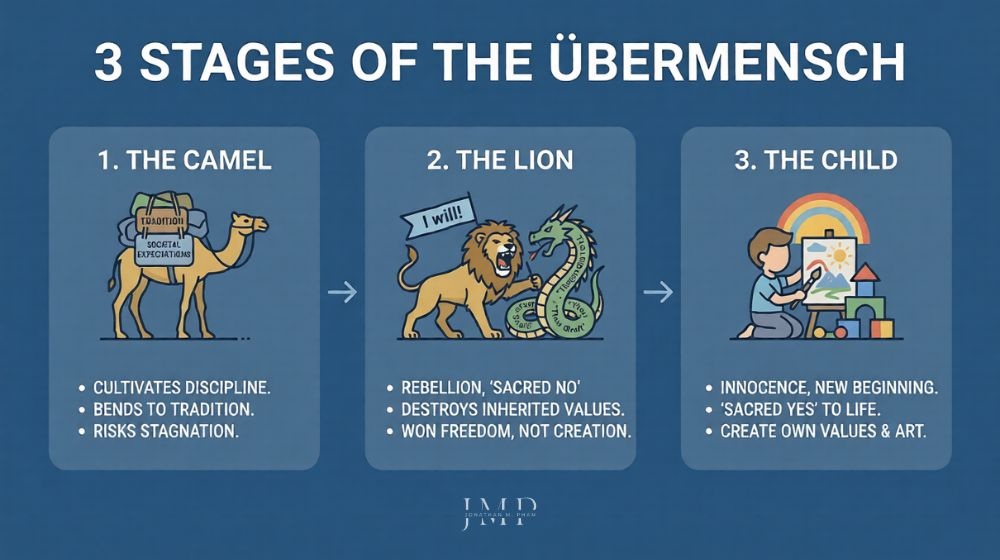
Back in the day, the German philosopher Friedrich Nietzsche described the evolution of the human spirit through three distinct stages: the Camel, the Lion, and the Child.
The Camel represents blind conformity. It kneels down and lets society load it up with rules and traditions. It does what it is told (e.g., getting the "right" job, buying the "right" house) without ever questioning the expectations of the Herd.
The Lion represents rebellion and existential awakening. It realizes it has a choice. It defies societal expectations and claims ownership of its life, but in doing so, it takes on the burden of choice we discussed earlier.
The Child represents spiritual maturity. It does not need to roar or fight. It simply says "yes" to life—playing and creating freely. As such, it is the state of "choiceless" flow.
The thing is, you cannot skip the Lion. You cannot jump straight from the Camel to the Child.
If you try to adopt a "go with the flow" mentality without first taking ownership of your life, you are just being passive. Not enlightened at all.
The path to inner peace moves from Innocence, through Complexity, into Simplicity. You need to first take on the responsibility of the ego, make the hard choices, and figure out who you truly are. The right to be "choiceless" must be earned.
◆ The cautionary tale of "Warrior Zen"
History is full of incidents that show what would happen when people try to drop their ego and “bypass” their responsibility. For instance, during World War II, the Imperial Japanese military co-opted the traditions of Zen Buddhism to serve the state—a phenomenon later termed "Zen Nationalism" or "Warrior Zen." They took concepts like "no-self," "emptying the mind," and "detachment from outcomes" and weaponized them.
Soldiers were taught to dissolve their egos, not out of love, but so they could act as mindless instruments of the Emperor.
By stripping away their agency and telling them to detach from the fear of death, the state created kamikaze pilots and individuals who blindly carried out horrific atrocities without a shred of moral hesitation. (e.g. young medical interns and nurses who assisted in the illegal vivisection of American POWs, treating human beings like laboratory objects to advance their careers or because they were told to do so)
It’s true that the people successfully "emptied their minds," yet because they bypassed the stage of the “Lion”—because they lacked a personal ethical framework—the result was an empty space that was later hijacked by Das Man. (or in this case, toxic ideologies and manipulative leaders)
This is exactly why Sartre and the Western existentialists were right—that we need to be uncompromising about personal responsibility. We can never afford to completely discard our human agency.
To really attain “choiceless” flow, we have to reconcile the West and the East. To cultivate the radical accountability of Western philosophy, while simultaneously practicing the compassionate detachment of Eastern spirituality.
We must hold on to our values tightly enough that we cannot be manipulated by Das Man, but loosely enough that we do not collapse under the weight of infinite choices.
FAQs
Why do choices matter in life?
Choices matter because they are the raw material of our identity. Philosophically speaking, you are not born with a pre-written destiny. You are a blank slate, and every decision you make is a brushstroke that paints your character, values, and ultimate "essence."
Are humans meant to have so many choices?
Biologically and historically, no. For 99% of human history, we lived in small tribes with clear-cut paths tailored for survival. Our brains simply never developed to process the thousands of micro and macro decisions the 21st century demands of us daily.
Is having too many choices a bad thing?
Up to a certain point, choice is liberating and necessary for happiness. However, once options pass a certain threshold, the psychological benefits disappear. In fact, having too many options is a common cause of cognitive fatigue, unrealistic expectations, and a constant fear that we did something wrong.
Do humans have freedom of choice?
Yes, though it is not absolute. We cannot decide our genetics, where we were born, or the unexpected tragedies that strike us (what philosophers call our Facticity). However, we retain freedom over how we respond to those circumstances, and what meaning we assign to them.
Why is freedom of choice important?
Without freedom of choice, there is no moral responsibility, no individuality, and no capacity for true love or courage. It is the very foundation of human dignity.
The ability to choose—even when it causes us anxiety—is what separates a human being (being-for-itself) from a programmed machine. (being-in-itself)
Additional Resources for Navigating the Burden of Choice
When you have to make a choice and don't make it, that is in itself a choice.
William James
Between stimulus and response there is a space. In that space is our power to choose our response. In our response lies our growth and our freedom.
Viktor Frankl
To venture causes anxiety, but not to venture is to lose one’s self…. And to venture in the highest is precisely to be conscious of one’s self.
Søren Kierkegaard
I say unto you: one must still have chaos in oneself to be able to give birth to a dancing star.
Friedrich Nietzsche
Books
The Paradox of Choice by Barry Schwartz. (The foundational psychology book that scientifically breaks down why "more is less")
Escape from Freedom by Erich Fromm. (A psychoanalytical and philosophical look at why humans are afraid of their own independence and frequently look for authoritarian systems to follow)
The Ethics of Ambiguity by Simone de Beauvoir. (A critical examination of how we can act ethically and find meaning in a chaotic universe).
Man’s Search for Meaning by Viktor Frankl. (A testament to humanity's ultimate choice: choosing one's inner attitude in the face of unimaginable suffering)
Final Thoughts
When it comes to discussing the burden of choice, most people tend to focus too much on the dramatic climax—the moment one stands at the edge of the cliff and finally takes the "leap of faith." But as I sit here in the hospital room, watching the IV drip, I am reminded of a much more somber truth: the leap is not always the heaviest part of the burden. Sometimes, it is the waiting period inside the choice you have already made.
There are moments when I look at the medical bills and feel a sharp pang of inadequacy. At those moments, I cannot help but be reminded of how my decision to abandon the corporate world has left me limited in the ability to financially support my family.
I know that eventually, I will have to make a pivot. I will need to soon find an anchor—a job that allows me to be more financially stable without sacrificing my soul or abandoning the philosophical path I’ve fought so hard to walk. (which I, for now, plan to be teaching full-time)
But right now? Now is NOT the time for a new job.
Now is the time to sit by my father’s bed, hold his hand, and wait.
It’s not easy to accept the current reality—knowing what should be done, yet unable to take action yet. That said, at the end of the day, nobody can have everything.
Our job is to choose what we are willing to sacrifice. To embrace the chaos and imperfection of the path we have picked, simply because it is our path.
After all, the burden of choice is only a burden if we are excessively concerned with a guaranteed “happy ending”. Otherwise, it’s just a natural part of being human.
Be patient toward all that is unsolved in your heart and try to love the questions themselves, like locked rooms and like books that are now written in a very foreign tongue. Do not now seek the answers, which cannot be given you because you would not be able to live them. And the point is, to live everything. Live the questions now. Perhaps you will then gradually, without noticing it, live along some distant day into the answer.
Rainer Maria Rilke
Other resources you might be interested in:
Amor Fati (Love Your Fate): When Existentialism Meets Stoicism
Amor Mundi: To Love the World From an Authentic Heart
Hi there! I am a seeker on his path of self-discovery. Since my youth, I have been haunted—and driven—by the fundamental questions of existence: the weight of our choices, the nature of true fulfillment, and the various identities we inhabit. I created this blog to chronicle the insights I have unearthed while navigating the 'absurdity' and beauty of life. My hope is that in reading these words, you will find a reflection of your own struggle—and the courage to 'become who you are.' Please just take what resonates with your soul, and leave the rest behind!