



01
10
October 2026
It has begun.
And now, it's time for me... no, for us, to wait. Three or more hours.
October 1
Come to think of it, t [...]
"Why am I me and not somebody else?"
— Nemo, Mr. Nobody (2009)
Have you ever asked yourself such a question before?
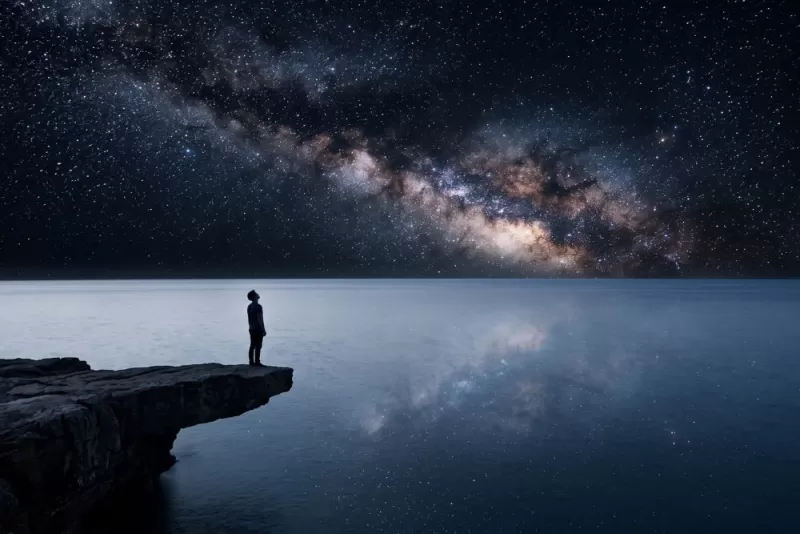
I surely have. It happened when I was still a kid—long before I was first exposed to philosophy, before I heard about terms like “existentialism”. From time to time, I would find myself watching the world go by and pondering in silence, out of pure wonder:
Occasionally, my mind would spin further into the “deep water”:
To most people out there, these thoughts may sound silly—the kind of musings only for intellectuals or those who have too much time to spare. Something to wave away with a casual "Why bother?"
But for those who are reading this, I suppose you know better. As I myself have figured out, engaging in deep thoughts is not a waste of time at all. In fact, if you are serious about it, it will open the door to a much richer and more fulfilling existence.
Below is a list of philosophical questions I have curated and divided into a variety of topics. My hope is that you can use this list as a “toolkit for the soul”—one that you can pull out whenever the noise of daily life fades, and you find yourself searching for something deeper than what's on the surface.
Let us begin the journey, shall we?
📌 Key Takeaway
What makes a question "philosophical"?
If you ask, "What is water made of?" science will hand you a neat response: H2O.
If you ask, "How do I bake a loaf of bread?" a recipe book will give you a detailed step-by-step guide.
But if you ask, "Why does the universe exist?" or "What does it mean to be human?" then all of a sudden, there’s no single fixed answer available to you.
That’s what makes philosophical questions special. They attempt to address the fundamental nature of reality, existence, morality, and consciousness—all of which cannot be “solved” with objective facts or a mathematical formula.
Given that these questions deal with intangibles, they invite us to look inward and think deeply. Not just thinking about something, but many times about the very act of thinking itself: how we think, why we value what we value, what drives us to make a choice, etc.
For the modern mind conditioned by hustle culture, it’s tempting to dismiss such inquiries as academic exercises—something meant for old men in togas only. But the truth is, philosophy belongs to all of us. As history has proven, it is a practical toolkit for navigating uncertainty and cutting through the noise of daily life to find genuine meaning.
When you reflect on the nature of reality, you are actively dismantling your own biases, cultivating intellectual wellness, and opening yourself to perspectives you never knew existed before. Over time, the practice will translate into something truly rewarding: clarity, wonder, and a holistic grasp of the human condition.

Pondering abstract philosophical questions
Focusing inward is usually the hardest, yet most rewarding, place to start. The following questions are meant for the quiet moments when you are alone, reflecting on the inner landscape of your own mind. (Tip: you may want to have a cup of coffee/tea and a journal in hand.)
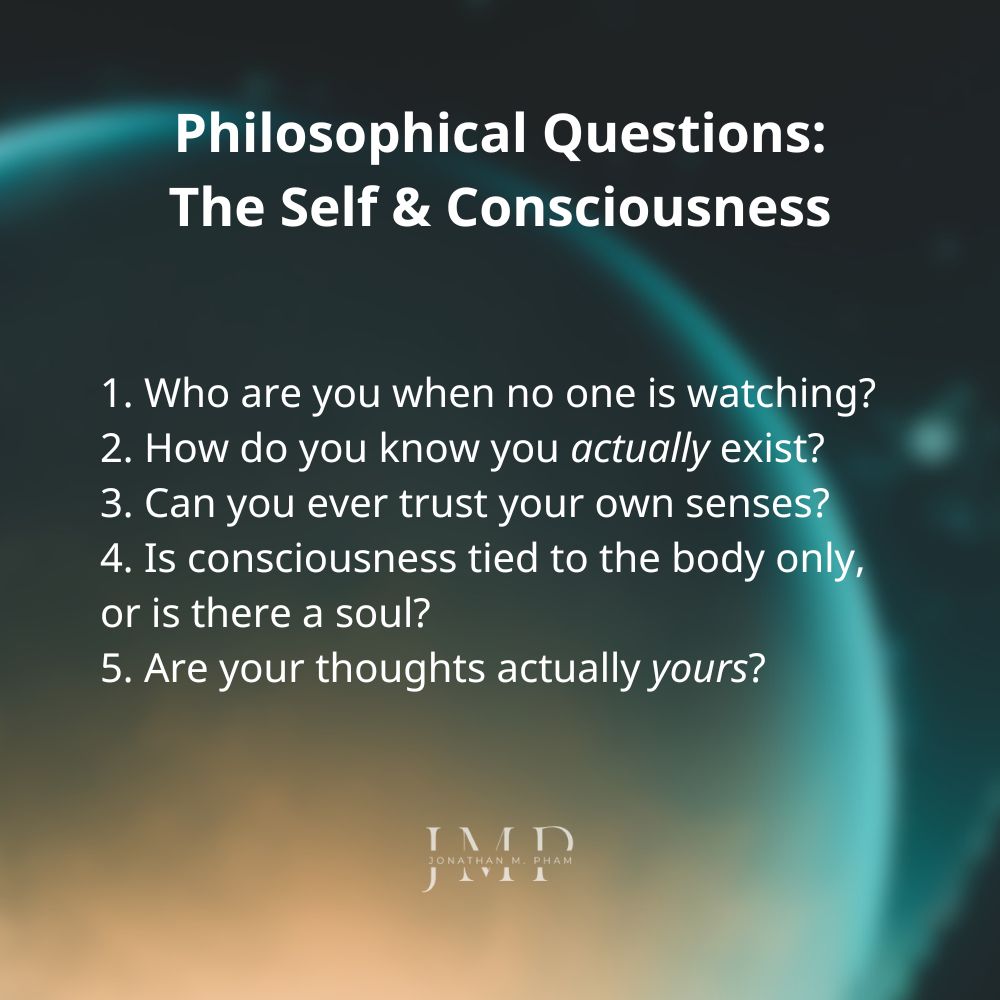
We all wear masks for society, our families, and our workplaces. But when the door closes and you are on your own, what remains? Is your true self the person you present to the world, or the observer in the dark?
This is where we must tip our hats to René Descartes, who was known for stripping away everything he thought he knew until only one undeniable truth remained: "I think, therefore I am." (Cogito, ergo sum) The very act of you questioning your existence proves that there is a "you" doing the questioning. But even then, what is that "you"?
This question dips into epistemology—the study of how we know what we know. Have you ever sworn you heard your name called, only to find an empty room? If our eyes and ears can be tricked by optical illusions or dreams, how can we be absolutely certain that the reality we perceive right now is accurate?
Are you simply a highly complex biological machine—a bundle of firing neurons and chemical reactions? Or is there an immaterial "you," a spark of soul or spirit, driving the vehicle of your body?
Think about your deepest beliefs. How many of them did you consciously choose, and how many were handed to you by your parents, culture, or the media you consume?
Trying to define yourself is like trying to bite your own teeth.
Alan Watts
Philosophical questions about the self
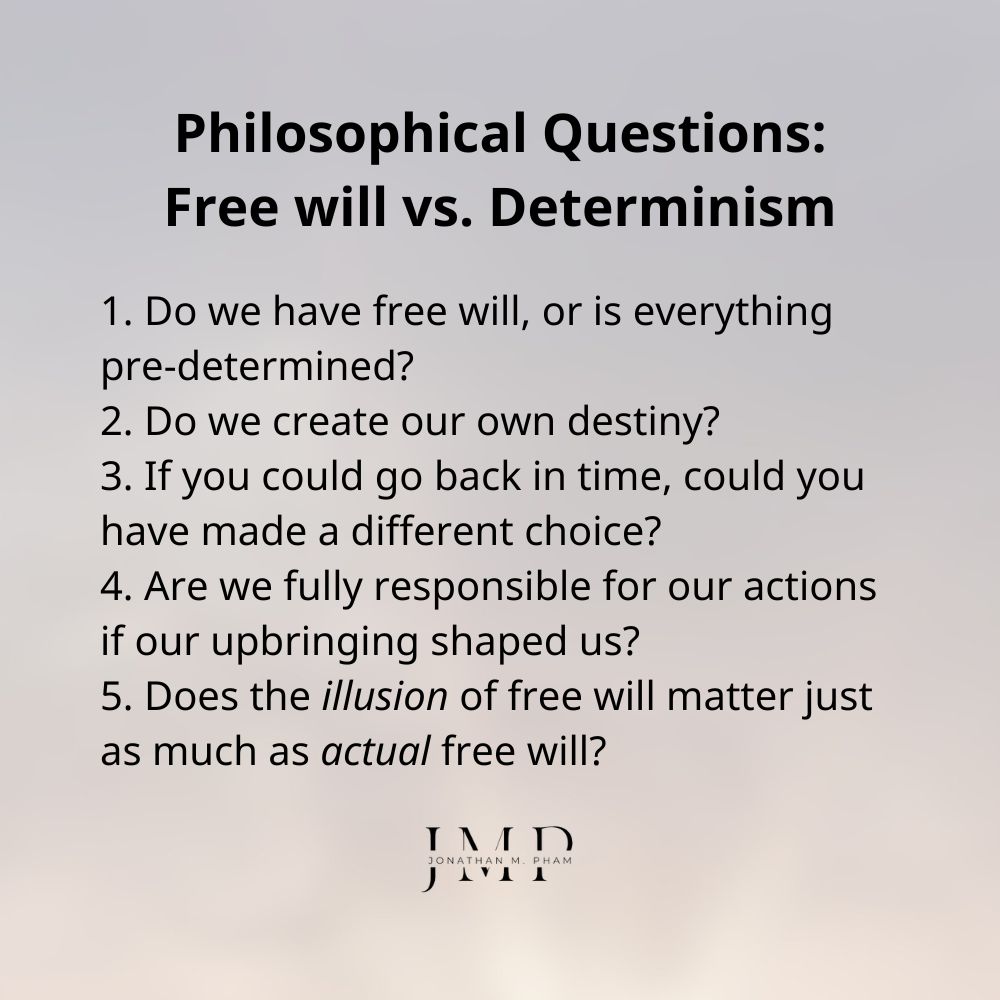
If the universe operates on strict laws of cause and effect, are your choices truly free? Or are they the inevitable, unchangeable result of every single thing that happened before you were born?
Determinism suggests our biology and environment decides our lives before we even live them. Philosophies such as Existentialism, on the other hand, promote a completely different worldview. As Jean-Paul Sartre claimed, "existence precedes essence"—meaning we are born “empty” first, and we must take radical responsibility for creating our own meaning through our choices.
When you regret a past mistake, you typically assume you could have done otherwise. But if absolutely nothing about the past was changed—not even a single atom in your brain—would you still be bound to make that same mistake?
If a person commits a terrible crime, but they were born with a neurological defect and suffered a tragic childhood, how much of the blame belongs to them, and how much to the universe?
Even if science someday proves that free will doesn't exist, we still feel like we are making choices. Does it actually matter if the steering wheel is disconnected, as long as we enjoy the sensation of driving?
Man is condemned to be free; because once thrown into the world, he is responsible for everything he does.
Jean-Paul Sartre, 'Existentialism Is a Humanism'
Philosophical questions for journaling
Now, we come to the “heavy hitters”—the cosmic inquiries that have kept philosophers, mystics, and stargazers awake for millennia. Don't worry too much about finding an answer; just let the scale of the questions wash over you.
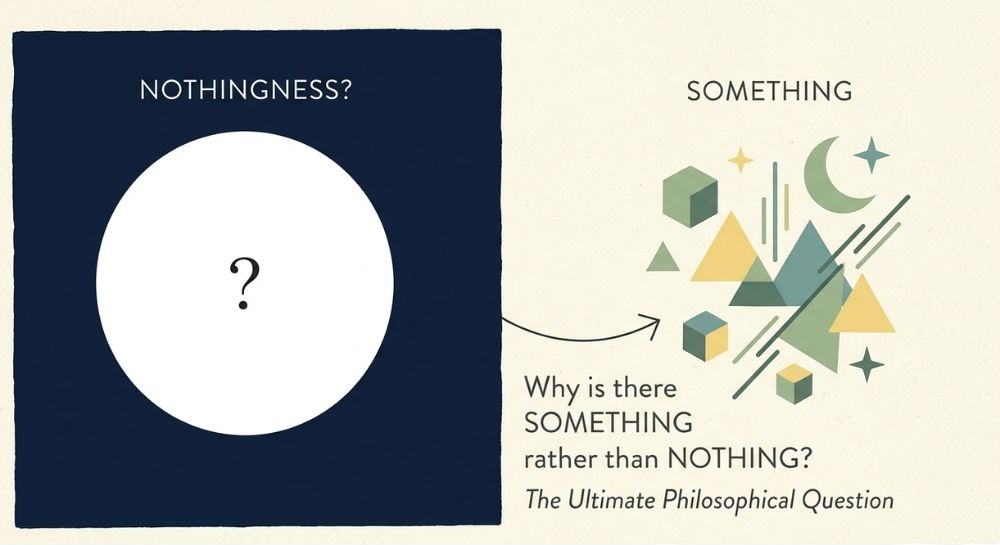
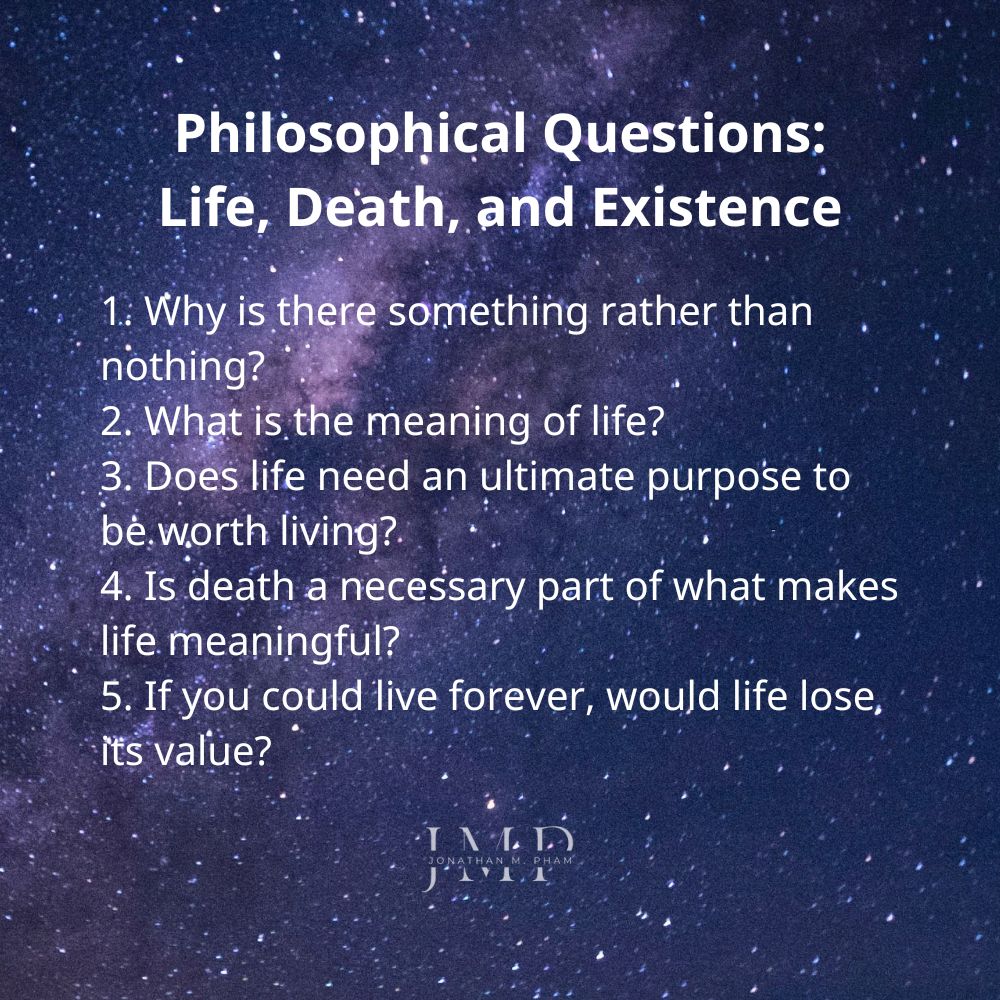
This is arguably the greatest question in philosophy. Why does a universe exist at all? Why all these stars, planets, and people, instead of just an empty void?
The ultimate philosophical question
Is meaning something woven into the fabric of the universe by a higher power, or is it self-created?
When faced with a seemingly silent universe, it’s easy to slip into Nihilism—the belief that nothing intrinsically matters. But as the absurdist writer Albert Camus proposed, even if the universe lacks inherent meaning, we can still “rebel” by loving our lives anyway.
Read more: Crisis of Meaning - When the Script of Life Collapses
If a flower bloomed forever, we wouldn't stop to admire it. As such, can we say that the very fact that our days are numbered is what gives them their beauty and urgency?
Imagine you have an infinite amount of time to do everything, read every book, and have every conversation. Without the ticking clock of mortality, would you ever feel motivated to get out of bed?
He who has a why to live for can bear almost any how.
Friedrich Nietzsche
Philosophical questions about life and death
Read more: Are You Living or Just Existing?
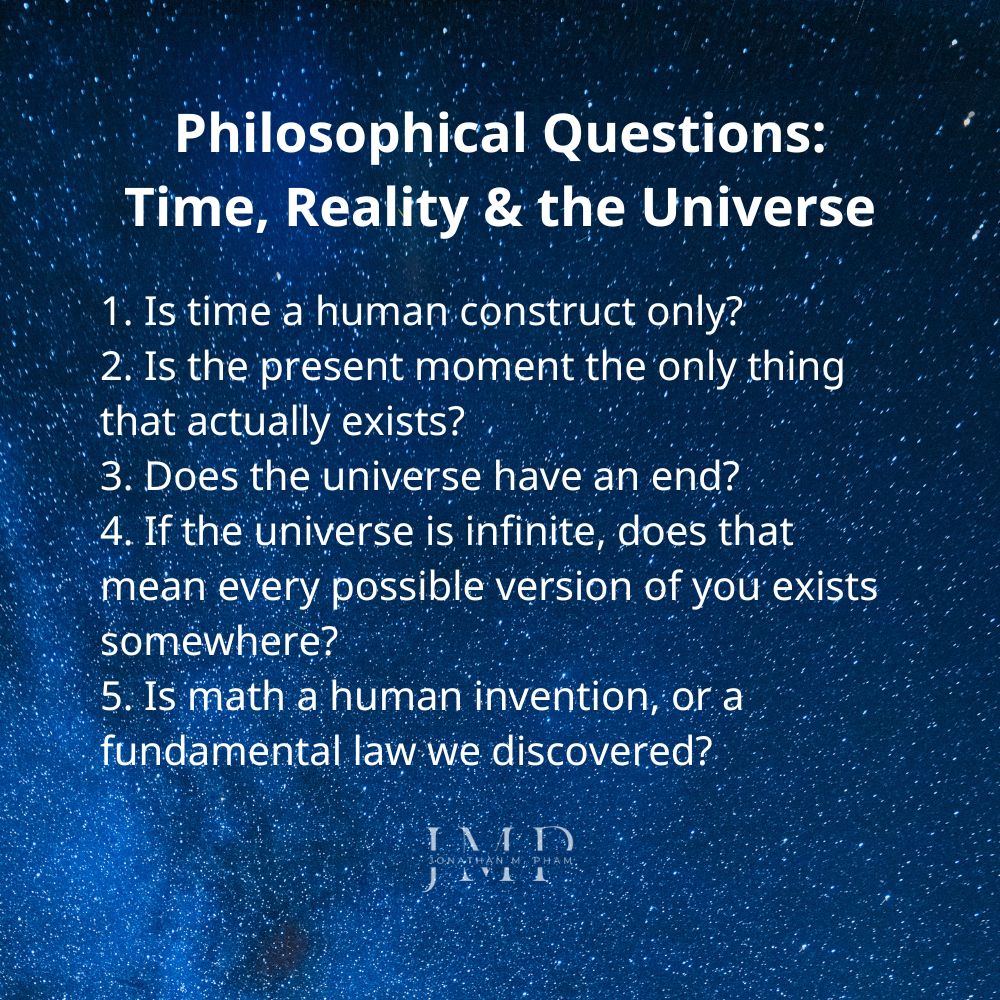
We experience time as a straight line moving from past to future. But is time actually flowing, or did we invent clocks to make sense of change and decay?
The past is just a memory in your brain; the future an imagination. If neither physical realm exists right now, is the ever-fleeting "now" the only true reality?
If you travel to the absolute edge of the cosmos, is there a brick wall? And if there is a wall, what is on the other side of it?
According to the math of infinity, if space goes on forever, matter must eventually repeat itself. Does that mean there is another "you" out there, reading this same article, but wearing a different colored shirt?
Did we invent numbers to count apples, or is the universe intrinsically built upon a secret mathematical code that we stumbled upon?
The distinction between past, present, and future is only a stubbornly persistent illusion.
Albert Einstein
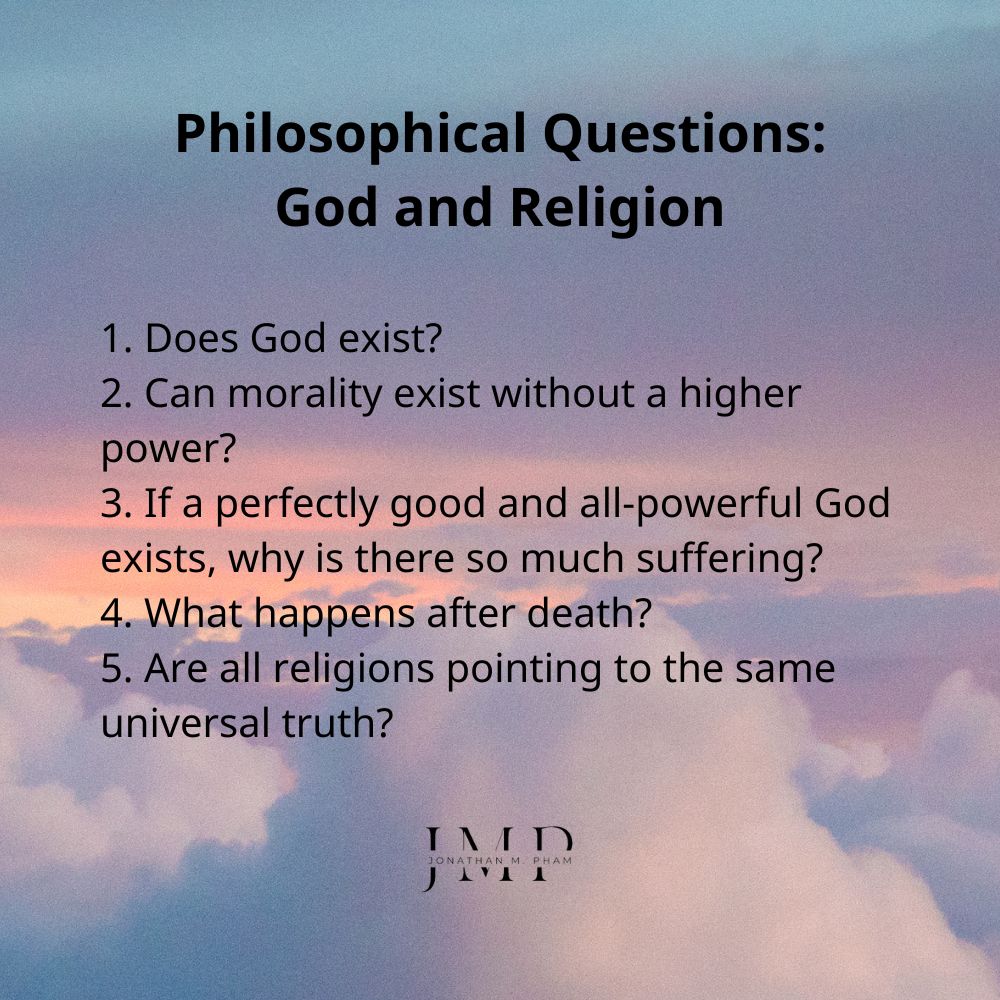
And even if a divine creator does exist, do they intervene in our daily lives, or did they simply wind up the clock of the universe, step back, and let it tick on its own?
If there is no cosmic rulebook or divine judgment, what makes murder objectively wrong? Can humanity be good simply for the sake of goodness?
This philosophical question is known as the "Problem of Evil". If God is all-holy, He would want to stop suffering. If He is all-powerful, He could. Since suffering exists, does that mean He is either not perfectly good, or not all-powerful? Or something else?
Read more: Spiritual Crisis - Finding Light in the “Dark Night of the Soul”
Is it a transition into another form of existence, a return to a source, or simply the same “nothingness” we experienced before we were born?
Like blindfolded men touching different parts of an elephant, are all world religions just culturally different ways of trying to describe the same divine mystery? The same Transcendence?
The heart has its reasons of which reason knows nothing.
Blaise Pascal, 'Pensées'
Read more: Philosophical Faith - Bridging the Gap Between Reason & Belief
Let us bring our gaze back down from the stars to the reality of being human. Morality and connection are the invisible threads that hold our society—and our hearts—together.
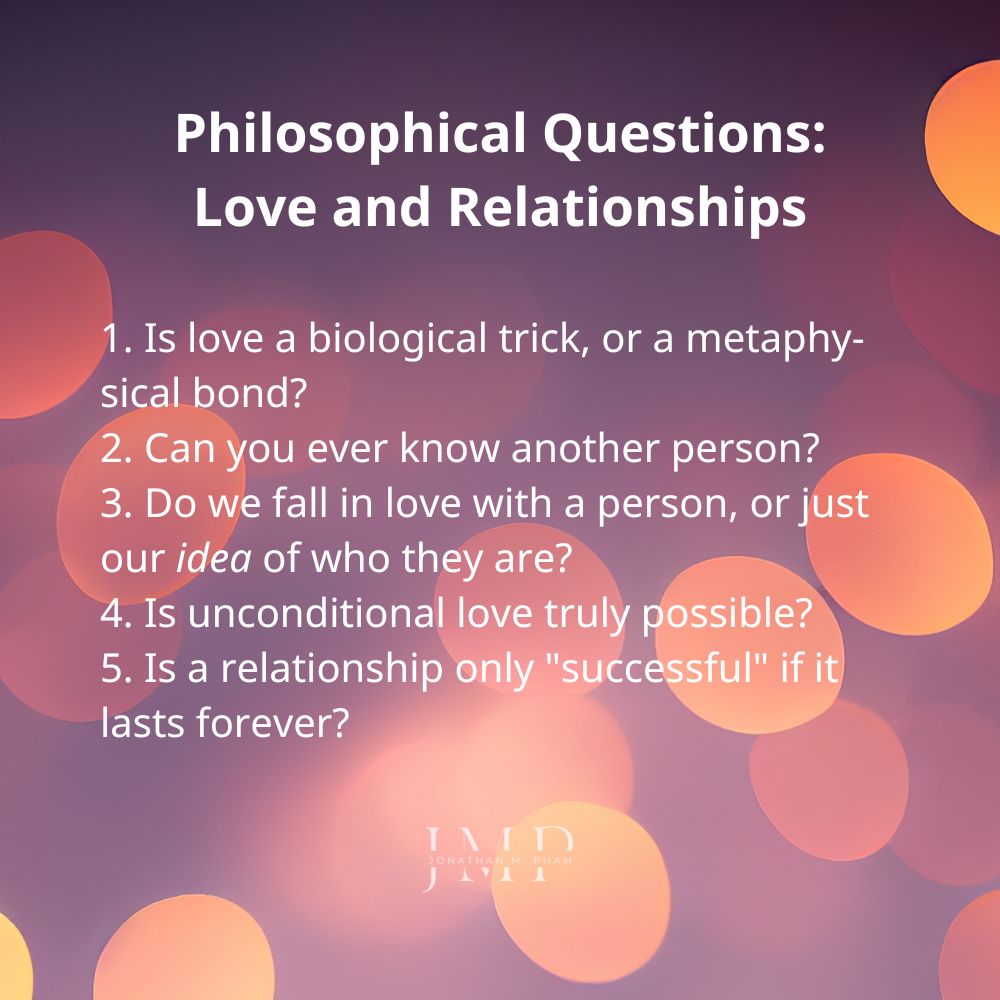
Is the feeling of love just a chemical cocktail (oxytocin and dopamine) designed by evolution to ensure our species reproduces? Or is it a spiritual resonance that transcends the physical world?
We are all locked inside the solitary confinement of our own skulls. Can we ever fully bridge the gap to truly know someone else's inner world, or are we ultimately alone, together?
When we look at our partners, do we see them clearly, or do we project our own desires, traumas, and fantasies onto them like a movie screen?
Or does all human love come with invisible strings and conditions attached? Even a mother's love—is it unconditional, or is it dictated by the fact that the child is hers?
Most of us tend to view breakups as failures. But if a relationship brings you joy, teaches you something about yourself, and then ends, wasn't it still a success in its own right?
Love is not primarily a relationship to a specific person; it is an attitude, an orientation of character which determines the relatedness of a person to the world as a whole.
Erich Fromm, 'The Art of Loving'
Read more: Existential Communication - The Art of Truly Meeting One Another
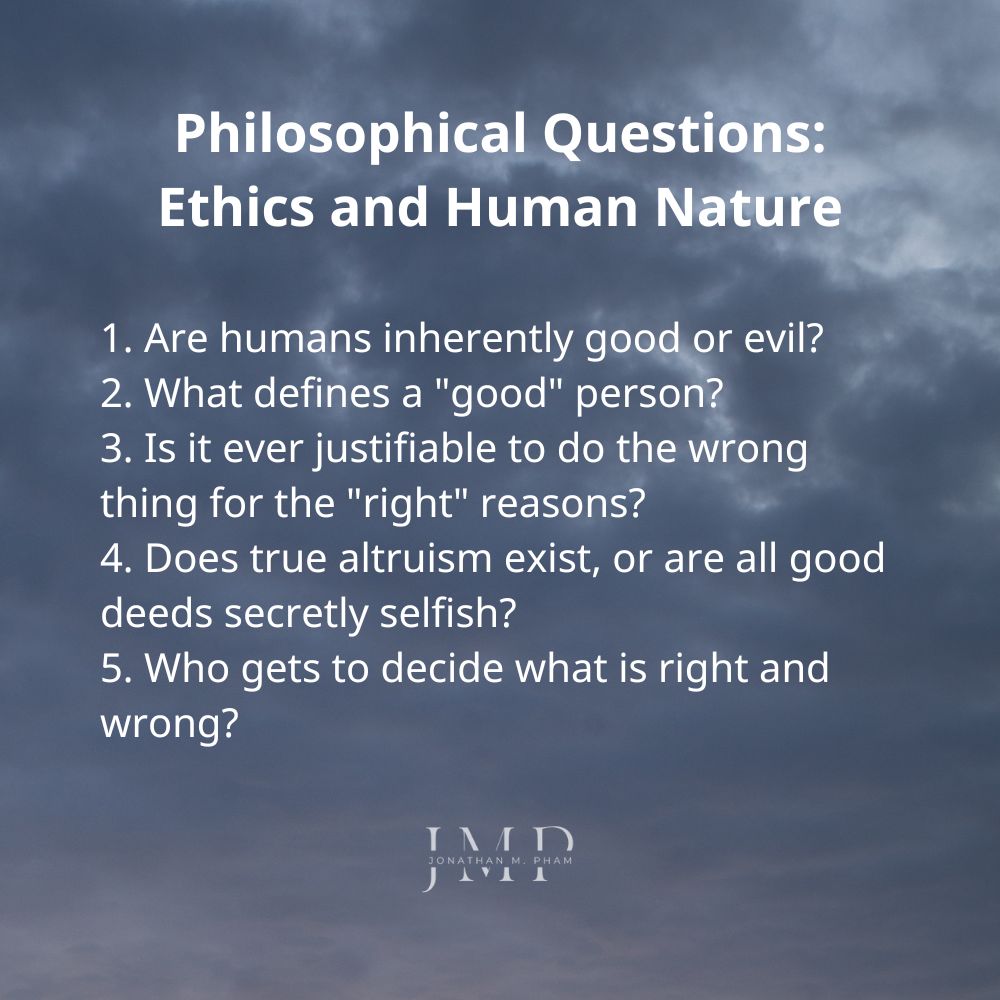
If you strip away all laws, police, and societal judgments, what is our default state? Are we fundamentally cooperative, or fundamentally selfish?
Is it our intentions that make us good, or the actual outcomes of our actions? If you try to help someone but accidentally make things worse, are you still virtuous?
Here we meet Immanuel Kant, who believed in duty-based ethics (the Categorical Imperative)—that certain acts, like lying, are universally wrong, no matter what. Conversely, empathy-based or utilitarian ethics typically assert that “the ends justify the means”. If lying saves a life, which philosophy is actually the moral one?
When you donate to charity, do you do it purely for the cause, or because it gives you a fuzzy feeling of self-satisfaction? If it makes you feel good, is it really “selfless”?
Read more: Slave Morality - The Hidden Shadow of Conventional Ethics
If morality is not handed down by God or the universe, then does it mean it’s just an agreement between humans? Assuming that’s the case, how do we live in a world where different cultures have different agreements on what is "right"?
Two things fill the mind with ever new and increasing admiration and awe, the more often and steadily we reflect upon them: the starry heavens above me and the moral law within me.
Immanuel Kant, 'Critique of Practical Reason'
Philosophical questions about morality
Sometimes, philosophy is best explored through stories. The following classic dilemmas are designed to stretch your mind and reveal what lies behind your personal values.
Actions are right in proportion as they tend to promote happiness, wrong as they tend to produce the reverse of happiness.
John Stuart Mill, 'Utilitarianism'
Philosophical questions that break your brain
No man ever steps in the same river twice, for it's not the same river and he's not the same man.
Heraclitus
There is a certain peace to be found in questions that defy logic. These are prompts meant to be felt only—an invitation to embrace the mystery of being alive.
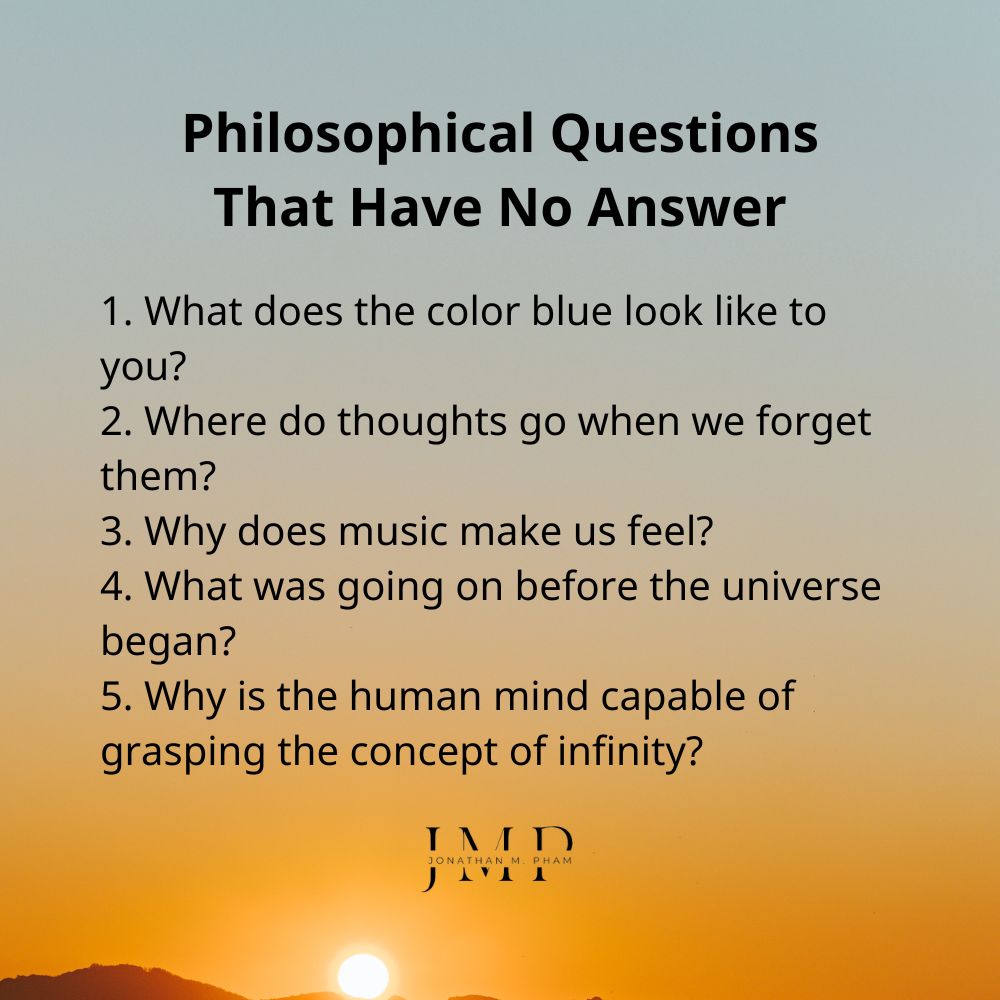
Is the blue I see in the sky the same shade you see in your mind? (Let’s be honest, because we can never look through another's eyes, we can never truly know!)
Do they evaporate into “nothingness”, or do they sink into a basement of our subconscious, waiting to be found?
Why do specific arrangements of sound waves vibrating through the air have the power to make us weep, feel nostalgic, or fall in love?
Read more: 14 Incredible Benefits of Classical Music in Life
If the Big Bang was the beginning of time and space, what existed "before" time was even a thing? How does the human mind even conceptualize "nothing"?
We are creatures bound by a lifespan of maybe eighty years. How is it that our brains possess the capacity to imagine eternity?
Whereof one cannot speak, thereof one must be silent.
Ludwig Wittgenstein, 'Tractatus Logico-Philosophicus'
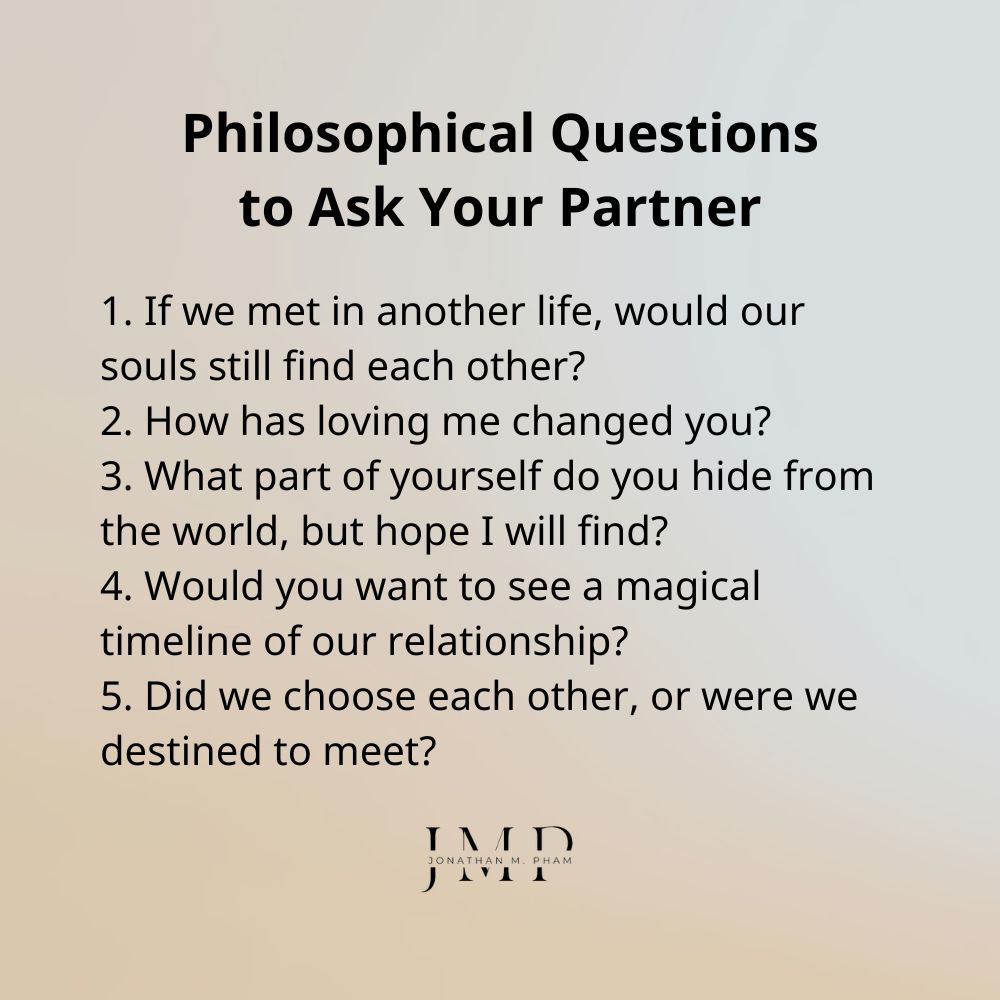
Abstract concepts don't always have to remain in the ivory tower. In fact, philosophical topics can be amazing tools for cultivating intimacy, breaking the ice, or just having a laugh.
The following questions are meant to foster vulnerability, romantic introspection, and emotional intimacy.
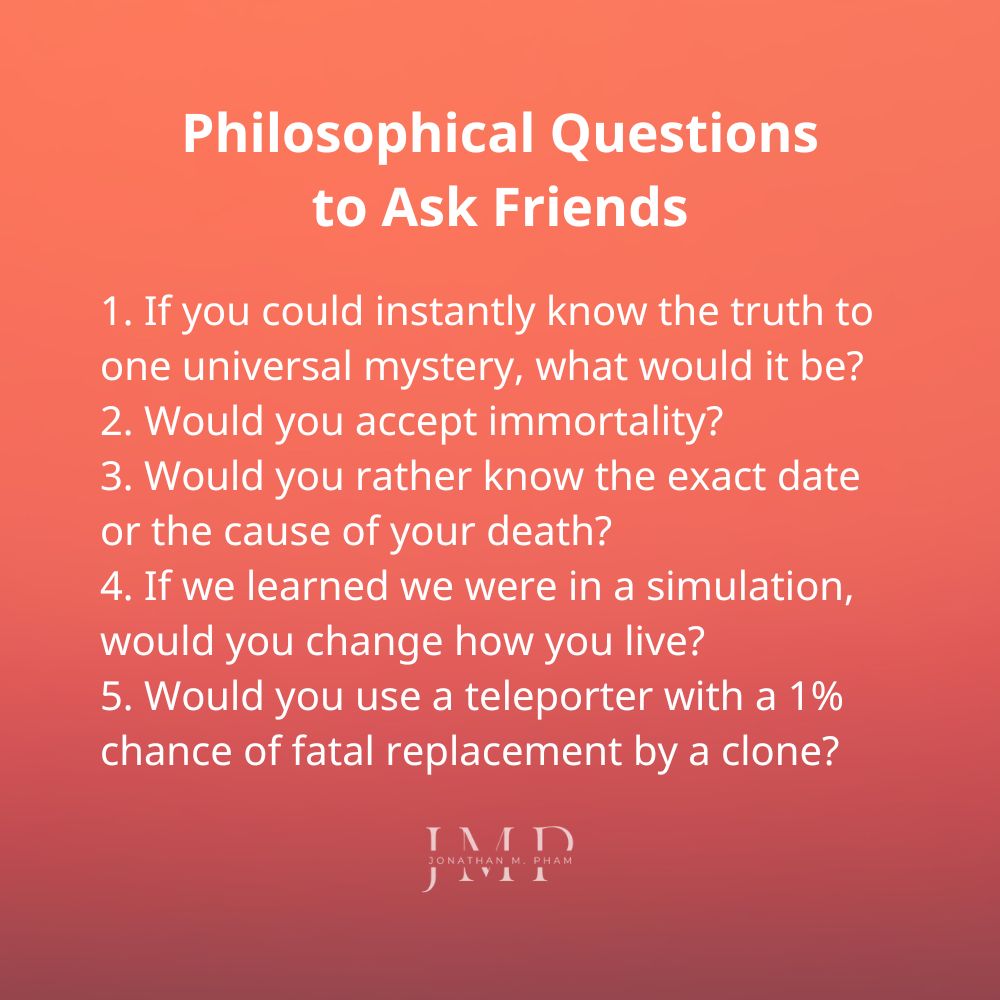
These are perfect for casual hangouts, "break your brain" moments, and "Would You Rather" debates.
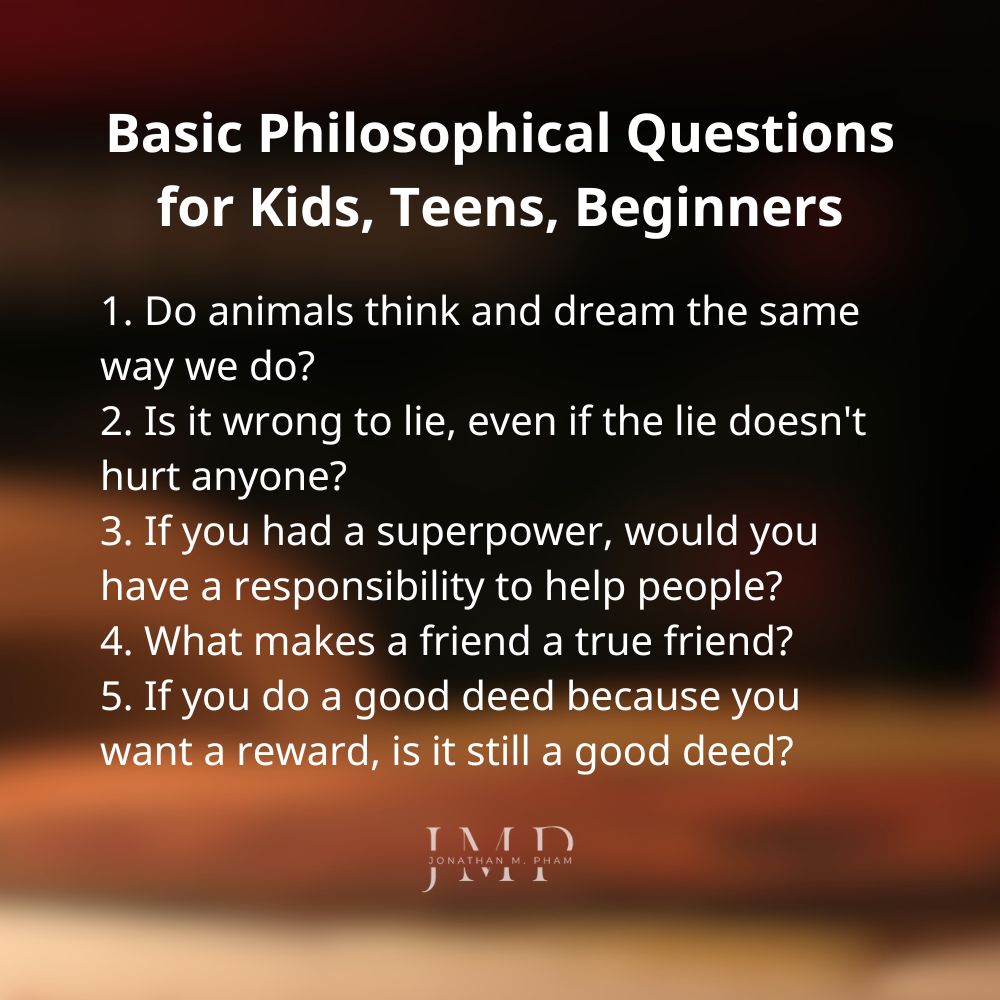
Here, we simplify grand, abstract concepts to fit middle schoolers and anyone newly dipping their toes into philosophy.
(A great entry point into the philosophy of mind and consciousness.)
(A gentle way to introduce ethics and morality.)
(A starting point to discuss the concept of duty and the social contract.)
(A simple, yet wonderful opportunity to reflect on virtue, loyalty, and human connection.)
(Introduces the debate between intentions versus outcomes.)
The only thing we require to be good philosophers is the faculty of wonder.
Jostein Gaarder, 'Sophie's World'
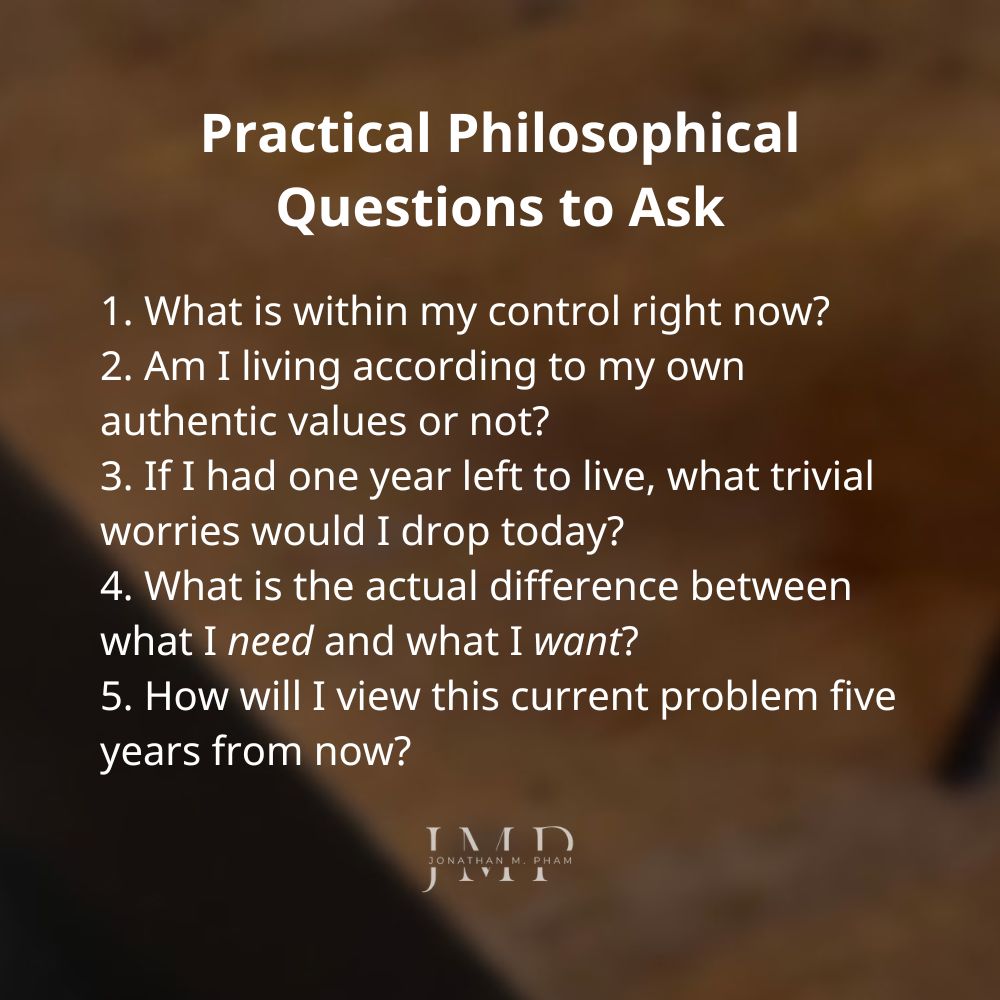
When applied properly, abstract theory translates into highly practical tools for navigating modern life.
A classic Stoic inquiry. By separating what you can act upon from what you cannot, you can instantly let go of unnecessary anxiety.
Are your career, lifestyle, and goals actually yours, or did you inherit them from a culture obsessed with status?
Keeping your mortality in mind (Memento Mori) is one of the most effective ways to clarify your current priorities.
A grounding question that cuts through the noise of consumerism and helps cultivate gratitude for the present.
A simple reflection prompt to zoom out and find perspective when you are feeling overwhelmed by a temporary setback.
Men are disturbed not by things, but by the view which they take of them.
Epictetus
Read more: Human Being vs Human Doing - Reclaiming the Soul in the Age of Optimization
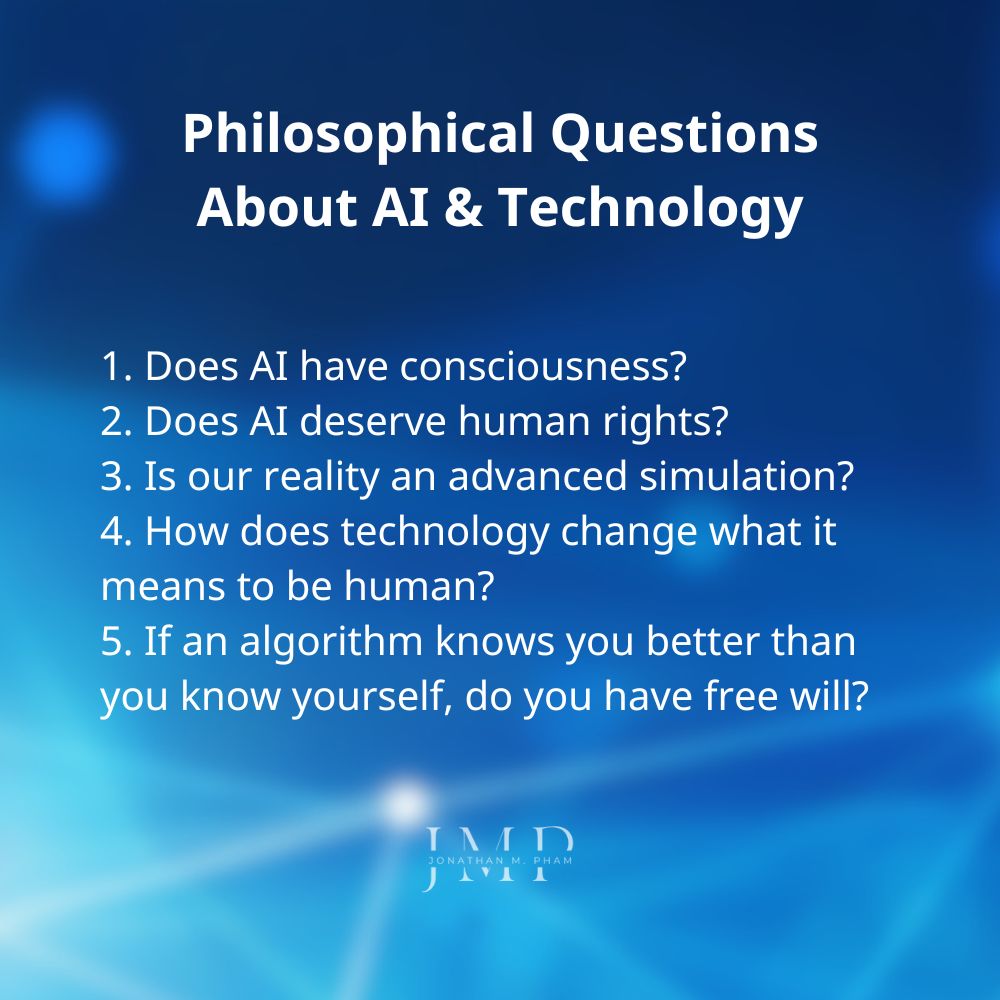
As we step further into the 21st century, philosophy has become more vital than ever. Given that technology is moving faster than our ethics can keep up, humanity is being presented with existential puzzles we are largely unprepared for.
If a machine learns to think, adapt, express emotions flawlessly, and even begs not to be turned off, at what point does a "program" cross the threshold to become a "mind"?
If an AI ever becomes truly self-aware and can experience digital "suffering," would unplugging it or deleting its code be considered murder?
With the rapid advancement of virtual reality and video games, how can we be absolutely sure we aren't already living inside a complex computer simulation created by a higher intelligence?
As we merge with our devices—outsourcing our memories to the cloud and social connections to algorithms—are we evolving into something wholly new, or are we losing touch with our humanity?
When your social media feed knows exactly what buttons to push to make you angry, sad, or to convince you to buy a product, are you making free choices online, or are you just being elegantly manipulated?
The real problem of humanity is the following: we have paleolithic emotions; medieval institutions; and god-like technology. And it is terrifically dangerous, and it is now approaching a point of crisis overall.
Edward O. Wilson
Read more: Will AI Kill Us All?
If you zoom out, almost all philosophical inquiries fall into a few major "buckets" as follows:
Within these buckets, you’ll find common problems like the existence of free will, the meaning of life, and the nature of human consciousness.
While the answer is completely subjective, many modern thinkers agree that the hardest puzzle of all is what philosopher David Chalmers called the "Hard Problem of Consciousness". While science can easily explain the mechanics of the brain—how neurons fire, how we process visual information, or how we react to a hot stove—it hasn't been able to resolve the following questions:
Rarely with a definitive "yes" or "no." That being said, it is a massive misconception that there's no point in trying to attempt them.
The truth is, philosophy is the mother of all other disciplines. As history has proven, when a philosophical question finally gets a concrete, empirical answer, it "graduates" and turns into something else. For example:
The questions that remain in the realm of philosophy are the ones that demand continuous wrestling from each new generation.
The trick is not to start too heavy. Asking someone, "What is the meaning of life?" while waiting for your coffee will usually just result in an awkward silence!
Instead, try anchoring the abstract to the everyday. For instance, you can take advantage of pop culture:
"I watched The Matrix recently. Do you think it's possible we are in a simulation?"
Or, you can also use the "Would You Rather" question format above to initiate a philosophical conversation.
All in all, the best way to do it is by being deeply curious about the other person's perspective, and holding space for them to think out loud without judgment.
If you are feeling inspired to go a little deeper, here is a curated toolkit of quotes, books, and films to accompany you on the journey.
For those who are interested, feel free to check out a full list of existential quotes here!
The unexamined life is not worth living.
Socrates
Let no one delay the study of philosophy while he is young, and when he is old, let him not become weary of the study. For no man can ever find the time unsuitable or too late to study the health of his soul.
Epicurus, "Letter to Menoeceus"
It is the search for the truth, not possession of the truth which is the way of philosophy. Its questions are more relevant than its answers, and every answer becomes a new question.
Karl Jaspers
Read more: 27 Best Existentialism Books for the Modern Seeker
Read more: 20 Best Existential Movies for the Questioning Heart
For those who are dipping their toes into philosophy for the first time, it’s natural to feel a sense of urgency. To demand clear answers—a neat explanation for who we are, why we are here, and how we are supposed to live.
But as you may have realized by now, the point of the journey is to find truth, not facts.
In his Letters to a Young Poet, the poet Rainer Maria Rilke wrote something that I carry with me everywhere I go:
"Have patience with everything unresolved in your heart and try to love the questions themselves... Live the questions now. Perhaps then, someday far in the future, you will gradually, without even noticing it, live your way into the answer."
That is my wish for you as I compile this list. Let these philosophical questions challenge your biases. Let them crack open your heart—and remind you of how miraculous it is to be a conscious human being on a rock spinning through the cosmos.
Take a breath, brew that cup of coffee (or tea), and allow yourself to wonder.
Until next time, keep questioning, and keep growing!
Truth is a pathless land.
Jiddu Krishnamurti

Other resources you might be interested in: