




01
10
October 2026
It has begun.
And now, it's time for me... no, for us, to wait. Three or more hours.
October 1
Come to think of it, t [...]
“Your father has cancer, and the situation doesn’t look good. He should be hospitalized immediately.”
Even now, I still vividly recall that moment about half a year ago, when a clinic’s doctor gave me and my sister that grim announcement out of the blue. Within just a few words, the whole architecture of my reality shifted.
Before that, my life had been following a predictable and comfortable rhythm. Three years ago, I decided to walk away from the constant grind of the corporate world—where I once worked as a manager at a digital agency—to reclaim my time. Since then, I have been sustaining myself on part-time gigs and various sources of passive income, dedicating my days to researching philosophy, working on this blog, and plotting out my next long-term goals—including returning to university and applying for scholarships.
Then came the diagnosis.
Suddenly, my routine was violently disrupted. Instead of spending time philosophizing and preparing for my planned transition, I now find myself taking on the role of a caregiver, whose job is to accompany my father during his chemotherapy sessions and remain in a state of "always on"—ready to react at a moment's notice to the grueling side effects of his treatment.
Suddenly, the hospital wards have replaced the coffee shop as the backdrop of my life. Something I never expected to happen as the year started.
If you live long enough, you will eventually experience a moment like this: going about your daily routine, fully convinced that you are in control—until you crash into an immovable wall that comes out of nowhere:
Whatever shape it takes, what sets the experience apart is that you cannot fix it. No matter how much money you have, how many “life hacks” you look up, or how hard you try to rationalize it, nothing works against it. In fact, the more you try to get out of it, the more miserable you will become.
In existential philosophy, we call it a Limit Situation. It’s what happens when you slam against a boundary of human existence—death, suffering, guilt, or absolute contingency. At that moment, all illusions are shattered, and the only way forward is to “wake up”. To confront reality as it is, accept the situation, and start living authentically.
📌 Key Takeaway
The term "limit situation" (German: Grenzsituation, also commonly translated as "boundary situation") was coined by the German philosopher and psychiatrist Karl Jaspers in his 1919 book Psychology of Worldviews and later expanded upon in his 1932 masterwork, Philosophy. At its core, it refers to a life-changing human experience that cannot be avoided, altered, or fully comprehended by ordinary logic.
As observed by Jaspers, human beings are always in "situations"—most of which can be resolved simply by manipulating the surrounding environment.
However, it’s another story when it comes to limit situations—which act like an unbreakable “wall” that separates the familiar world we know from the unknown. At that moment, all of the daily coping strategies fail. No matter how hard we try, we cannot bypass that wall. We cannot change it, outsmart it, or negotiate with it.
Examples of limit situations in everyday life:

A limit situation is a very peculiar type of experience. As we have briefly touched upon, most of life’s problems have a technical solution. For instance, if your car breaks down on the highway, it is surely a massive inconvenience, but it is fixable. Just call a tow truck and/or pay a mechanic—the problem will be resolved, and you can return to life as you were before.
A limit situation, however, is insoluble. You cannot "solve" a terminal diagnosis, "fix" the permanent loss of a loved one, or undo a tragic accident. As such, your only option is to patiently experience it—and let it transform you.
| Feature | Ordinary Problem | Limit Situation |
| The Nature | Fluid and avoidable |
Inescapable and life-changing
|
| The Solution | Technical (requires tools, money, logic, or effort to fix) |
Insoluble (requires a radical shift in perspective)
|
| Our Control | High. We have the agency to change the external circumstances |
Zero. The external environment cannot be changed; we only control our internal response
|
| Our Typical Reaction | Frustration, stress, or annoyance |
Existential dread, anxiety (Angst), and a sense of total failure
|
| The Outcome | The problem is resolved. You remain the same person |
The situation remains. You are essentially transformed
|
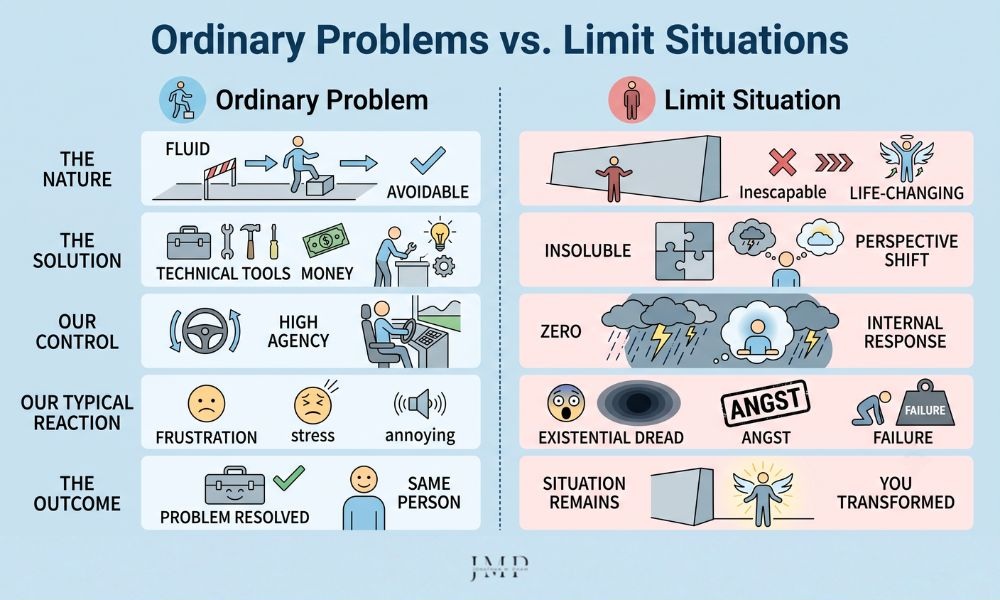
Boundary situation in philosophy
No matter how painful they are, limit situations play a crucial role in life. According to Jaspers, they serve as a “wake-up call”—a catalyst for individuals to shift from Dasein to Existenz.
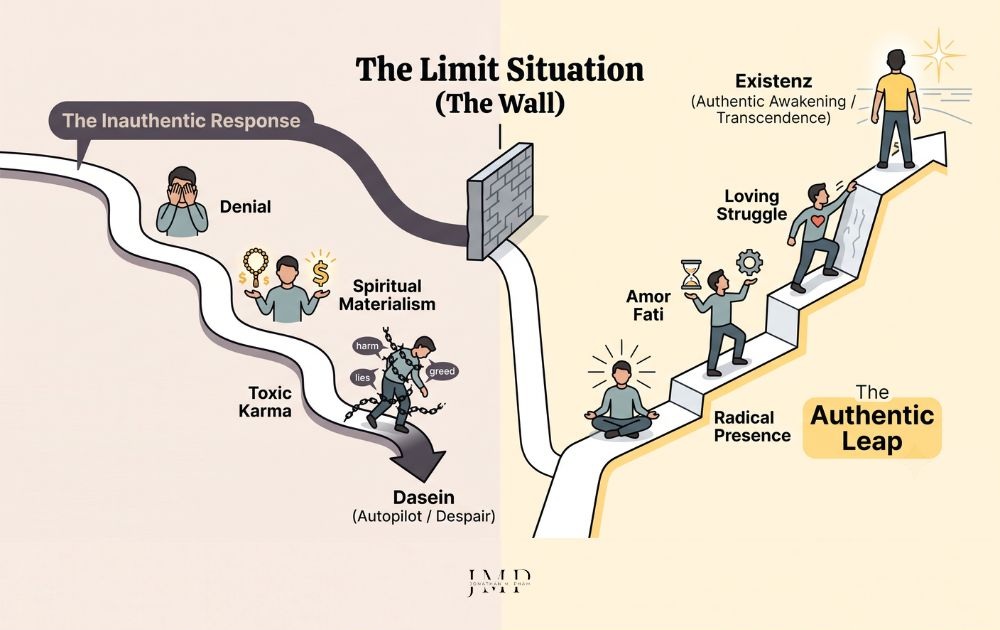
Most of us spend the majority of our time in Dasein—a state of superficial complacency where we are distracted by our routines, consumerism, and the illusion that we are fully in control of our destinies. In Dasein, we feel safe because we believe the world is predictable.
This is the state of true self-realization, where one becomes aware of their own freedom, choices, and what really matters to them. But the catch? It cannot be attained by contemplation alone.
Only when a limit situation violently shatters our Dasein may we be equipped to transition into Existenz.
When we hit a wall, our daily worldview collapses. At that moment—face-to-face with undeniable suffering or mortality—we cannot help but realize that our wealth, social status, and clever “tricks” mean nothing at all. What follows, naturally, is a sense of total failure (what Jaspers called Scheitern, or "shipwreck"), as if the world has come to an end.
As daunting as it may feel, that “shipwreck” also presents an opportunity. When the illusions of the autopilot life break down, we are finally forced to confront our true self. Provided that we are courageous enough to face it (rather than running away in denial), we will be equipped to make a "leap" from mere Dasein to authentic Existenz.
Note: The Dasein discussed here is not the same as Martin Heidegger's concept of the same name. While Jaspers' Dasein refers to "mere existence"—a superficial state of routine that we must transcend—Heidegger used the term to mean "being-there"—specifically, human existence as the entity for whom Being is a question. To Heidegger, it represents the human capacity to question our own existence and seek authenticity right from within our everyday lives.
Existential vulnerability
Jaspers originally identified four primary boundary situations that every human being must eventually collide with. Today, the framework has been expanded to cover five core pillars as follows.
Most of us go through every day under the unconscious assumption that we are the sole authors of our own stories. That is, until the universe reminds us of how little control we actually have—how we are totally vulnerable to blind luck, natural disasters, accidents, and illnesses. And the way it does that is, quite often, not comfortable at all.
◆ Example: The absurd bike accident
Speaking of which, I am reminded of the last time I was completely stripped off my own agency.
It happened on a Sunday evening in late October 2022. I was heading home on a Grab bike when we were nearly at the entrance of my alley. The driver, who was seemingly careless and inexperienced, overshot the turn. As I pointed it out—and he quickly wheeled around without looking back, another driver rammed right into us from behind, sending us almost flying.
It was over in mere seconds, yet it remains one of the most terrifying moments of my life. Never had I been that close to death; never had I felt such an absolute loss of control.
Somehow, I escaped with only a broken toe, but it doesn’t diminish the seriousness of the situation. In fact, the experience has taught me a grim lesson: Fate is unpredictable.
As Jean-Paul Sartre noted, our natural human instinct is to "lapse" into habitual ignorance and forget our own fragility so that we can function. That is, until we are reminded of the total randomness of the universe, at which point we cannot help but pivot toward humility.
I pray but I am lost. Am I just praying to silence?
Father Rodrigues, "Silence" (2016)
As humans, our innate tendency is to want to believe in a direct correlation between our efforts and our well-being. Yet no matter how hard we try, suffering—whether physical, emotional, or psychological—remains an inevitable boundary.
◆ Example: The unexpected gout diagnosis
Recently, I received a diagnosis of gout out of nowhere. It came as a massive shock to me, given that I had been maintaining an overall decent diet and lifestyle until then. Following the diagnosis was a “nightmarish” week during which I ended up completely immobilized in bed for days due to the flare-up. Not only did the illness cost me time and money, it also severely disrupted my plans. Worse, it left me with no option other than to wait and do nothing—until the pain subsided.
This is the limit situation of suffering. It shatters the illusion of "If I do everything right, I am safe." Many times, despite our best efforts, we still cannot escape the fact that we inhabit a biological body subject to unpredictable constraints and a random genetic lottery.
Read more: The World is Not Black and White - Finding Grace in the Grey
The guilt we talk about here is not only the result of intentionally doing something evil. In existential philosophy, it refers to the realization that simply by existing, participating in society, and making choices, we inevitably inflict harm or carry the weight of things we cannot control.
◆ Example: A crisis at a previous company
Years ago, while I was working as a junior content officer in the e-commerce department of a retail company, a messy compliance system led to inaccurate information being published on a product page. Upon detecting it, ministry officials issued a severe regulatory threat. Because I was the main person in charge—though in reality, the whole content production process had been carried out by a chaotic web of interns, operational staff, and poor procedures long before my onboarding—I was forced to face the very likely scenario of being fired. (or moved to a different department, as a manager subtly hinted at)
Honestly speaking, the following days were like a nightmare. It was as if I had been plunged into a bottomless “void”, unable to do anything but to wait for the punishment to come.
Fortunately, I survived the situation without being fired or relocated, but the aftermath was not great at all: the company responded with a "bureaucratic reflex," stripping away personal autonomy and turning my role into robotic data entry—just to protect its own liability. In the end, I was forced to carry the weight of outcomes I didn't fully cause, all because of a flawed system.
No matter how peaceful we try to be, it’s impossible for us to exist without taking up space, resources, and emotional bandwidth. In other words, conflict is unavoidable—whether it is the clash of differing values within our own families, the competition for livelihood, or the internal war between who we are and who we want to be.
◆ Example: The decision to defy a company's norms
A few years ago, I found myself caught in a dilemma while working as a digital marketing executive at an old-fashioned company. At the time, the company had various local centers, but only one website in English; as a result, I was extremely limited in my ability to leverage my skills and reach potential audiences. On one side was the bureaucratic headquarters team—slow to adapt while demanding that we push aggressively for growth metrics. On the other side stood my personal values: a desire to actually add value and utilize my marketing knowledge.
For months, I tried to compromise and battle with the team—to seemingly no avail. Until one day, I decided to break out of the “trance” and do something unimaginable: building a local website on my own. I did it without informing anyone, purely out of the conviction that I was doing the “right” thing.
As you may be able to predict, things didn’t go smoothly for me later. Had it not been for my own manager’s intervention, I probably would have faced serious consequences for acting in such an “arrogant” manner. (though to be honest, I didn’t regret the decision at all; in fact, I believe it is one of the most authentic choices I have ever committed to)
We cannot avoid conflict, conflict with society, other individuals and with oneself. Conflicts may be the sources of defeat, lost life and a limitation of our potentiality but they may also lead to greater depth of living and the birth of more far-reaching unities, which flourish in the tensions that engender them.
Karl Jaspers
Death is, arguably speaking, the heavy hitter of limit situations. It represents the absolute boundary of earthly existence—the one wall none of us can bypass.
◆ Example: The Covid-19 pandemic
I still remember the time when I was completely alone in a rooming house following the outbreak of the Covid-19 pandemic in my country. For three consecutive months in the summer of 2021, I was separated from my family—my parents were in our hometown, while my sister was with her husband and daughter.
During those months, I watched from afar as people around me slowly got infected. Every day brought news of new cases and new deaths, leaving me with no choice but to remain in a state of constant ambiguity ("Did I have it? Am I safe?") and hyper-vigilance ("Should I reach out to this person? Will I be infected? Will I cause them to get infected?"). To continue living while the shadow of death was everywhere, without any relational safety nets to rely on.
When we collide with these five walls, our daily worldview shatters. At this very point of existential vulnerability, we are faced with a choice. Either we panic and try to hide from it, or we courageously allow reality to become the “sun” (to borrow Irvin Yalom’s metaphor) that illuminates and gives color to our present life.
Read more: The Arrival Fallacy - Why Reaching the Top Frequently Leaves Us Empty
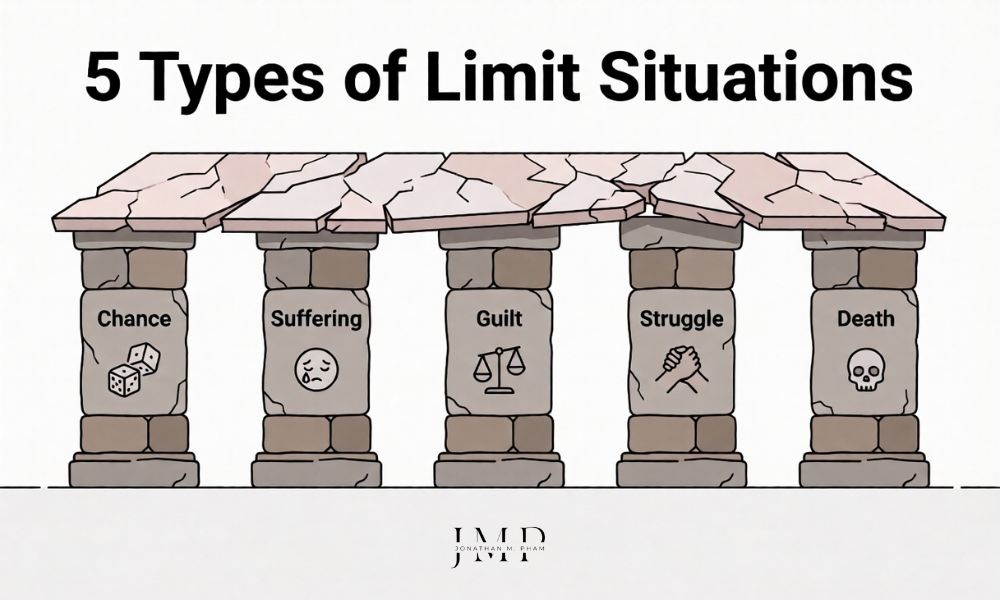
Limit situation in philosophy
Every truth that we may think complete will prove itself untruth at the moment of shipwreck.
Karl Jaspers, “Tragedy is Not Enough”
Upon crashing into a limit situation, our instinctive response—as Jaspers pointed out—is rarely acceptance. Out of the desire for total control, we would try to look away, deny the truth, or force reality into a neat “box”. That being said, doing so would only push us further down into the “abyss” of existence.
Modern society is heavily incentivized to keep people distracted from their own limits. Most of us are taught that if we just hustle harder, buy the “right” products, or stay busy enough, we won't have to worry about anything. That with enough accumulation of wealth and status, all of our sufferings would be kept at bay.
If you look closely enough, it’s not hard to see the real driver behind people’s behavior these days:
By treating the limit situations of life as undesirable "glitches" to be fixed or ignored, most of us remain asleep on autopilot. (Jaspers’ Dasein) We deny ourselves the very chance for inner work and maturity.
The thing is, limit situations are inescapable. No amount of wealth, status, or distraction can permanently shield us from suffering, guilt, conflict, or mortality. Eventually, a crisis that cannot be pushed away would arrive, and our daily reality would crumble to dust as a result.
The delusion of the joys of life that had formerly stifled my fear of the dragon no longer deceived me... Now I cannot help seeing day and night chasing me and leading me to my death. This is all I can see because it is the only truth.
Leo Tolstoy, “A Confession and Other Religious Writings”
Following my father’s cancer diagnosis, things went out in a somehow messy manner. Not only was my routine interrupted, but I also had to deal with people who were ill-equipped to handle the situation.
My mother, in particular, has been triggering me frequently. Whenever we are with each other, she constantly reminds me of how utterly important money is (“See? I told you! You need money; otherwise, people will let you die!”), given that my father’s treatment has been very costly so far. (partially because my sister demands that he gets the best medications possible—for which she is willing to pay herself) No matter how hard I try to converse peacefully with her, my mother always aims to assert her dominance and “rightness”. In fact, it has got to the point that many times, I end up saying nothing or even telling her to stop (“Mom, please! That’s enough! Let’s talk about something else!”)—just to protect my own peace.
Following these conversations, I cannot help but be haunted by how much of a contrast it is between what my mother says and what she actually does. On one hand, she—an old-fashioned dogmatic believer—frequently appears pious by talking about religions and ethics. On the other hand, her actions in the face of my family’s crisis scream of nothing but “materialism”.
It feels extremely frustrating, though I can understand the reason behind her blind obsession with accumulation.
What my mother is experiencing is a textbook ego-defense mechanism—what the Buddhist teacher Chögyam Trungpa referred to as "Spiritual Materialism."
While fully aware of the reason behind her behavior, I still have to point out that it’s completely futile. That it achieves nothing; if any, it only creates an illusion of action and projects her own frustration onto everyone else. (in fact, I have, many times, witnessed how it caused her to argue with my father about very trivial matters)
In a limit situation like this, more than ever, we need to lean on each other. Yet for that to happen, we have to let go of the ego’s insidious grip first.
If change and growth are not programmed into your spirituality, if there are not serious warnings about the blinding nature of fear and fanaticism, your religion will always end up worshiping the status quo and protecting your present ego position and personal advantage as if it were God.
Richard Rohr, "Falling Upward"
If this is the best of possible worlds, what then are the others?
Voltaire, "Candide" (1759)
Upon witnessing the absurd suffering of others, our minds would, naturally, scramble to make sense of it. If bad things happen to good people randomly, it means we aren't safe either. To protect ourselves (as well as our worldviews), many rely on frameworks like "Karma" or divine retribution to rationalize the tragedy.
Speaking of which, I am reminded of two related instances in my life:
At first glance, it feels tempting to buy into these beliefs—after all, they provide a sense of logical order in a seemingly chaotic universe (which is known in psychology as the "Just-World Fallacy"). But as I have realized by now, it’s a very toxic trap that should be avoided at all costs.
Why? Because when we use cosmic rationalization to explain away a tragedy, we create moral distance between ourselves and the victims. Subconsciously, we are saying,
"They must have done something to deserve this; therefore, I am safe because I haven't."
Even if there’s a kernel of truth in it, such a perspective is inherently problematic, because it places theory above empathy. To borrow Indian philosophy’s terms, it prioritizes Karma over Dharma.
In a limit situation, forcing a dogmatic explanation on it is of no use; if any, it only destroys the capacity for active compassion—which all spiritual and ethical traditions advocate for. The more we try to arrive at an explanation that “makes sense”, the more we are prevented from acting meaningfully, and the greater the “darkness”—both externally and internally—would grow.
What speech to hold to victims of such ruth!
Add not such cruel outrage to their pain.Voltaire, "Poem on the Lisbon Disaster"
Man, if he is to remain man, must advance by way of consciousness. There is no road leading backward... We can no longer veil reality from ourselves by renouncing self-consciousness without simultaneously excluding ourselves from the historical course of human existence.
Karl Jaspers
As discussed, a limit situation strips us violently of all illusions. It forces us to stand completely naked before the wall—with nowhere left to hide. From there, we can either react inauthentically (by succumbing to the traps of denial, spiritual materialism, and toxic rationalization above), or we can make a “leap” into the unknown. Into authentic Existenz.
Before the truth sets you free, it tends to make you miserable.
Richard Rohr
Psychologically speaking, colliding with a limit situation induces what various spiritual traditions refer to as the "Dark Night of the Soul". It is a zero-point where all of the old structures of meaning—what we do, what we have, how well we follow the rules—fall apart under the weight of reality. At that point, the ego can no longer rely on its familiar defenses, beliefs, or coping mechanisms.
While psychologically agonizing, the experience serves as a "necessary fall"—a stepping stone toward breakthroughs. By burning away the psyche’s superficial layers (the False Self), the Dark Night initiates a new phase of life, where we stop sleepwalking and awaken to who we truly are. (the True Self)
Stripped of the roles we once played and the illusions we had been chasing, the autopilot mode switches off, and we finally have the opportunity to consciously participate in our own existence.
In the second half of life, we do not have strong and final opinions about everything, every event, or most people, as much as we allow things and people to delight us, sadden us, and truly influence us.
Richard Rohr, "Falling Upward"

Existential vulnerability
It is important to note that nobody is alone in this vertigo. If we take a close look, we can see that limit situations have long been the very engine of human history.
According to Jaspers, humanity’s greatest spiritual leaps occurred during the First Axial Age (roughly 800–200 BCE). Before this period, people mostly lived in a "mythical age" where the tribe and the cosmos provided all answers to their problems.
Then came the Axial Age, when humanity collectively "woke up" and experienced an existential shipwreck on a global scale—following the breakdown of the old worldview. In response, the world’s "First Responders"—the Great Teachers—forged and passed down the tools to survive specific limit situations:
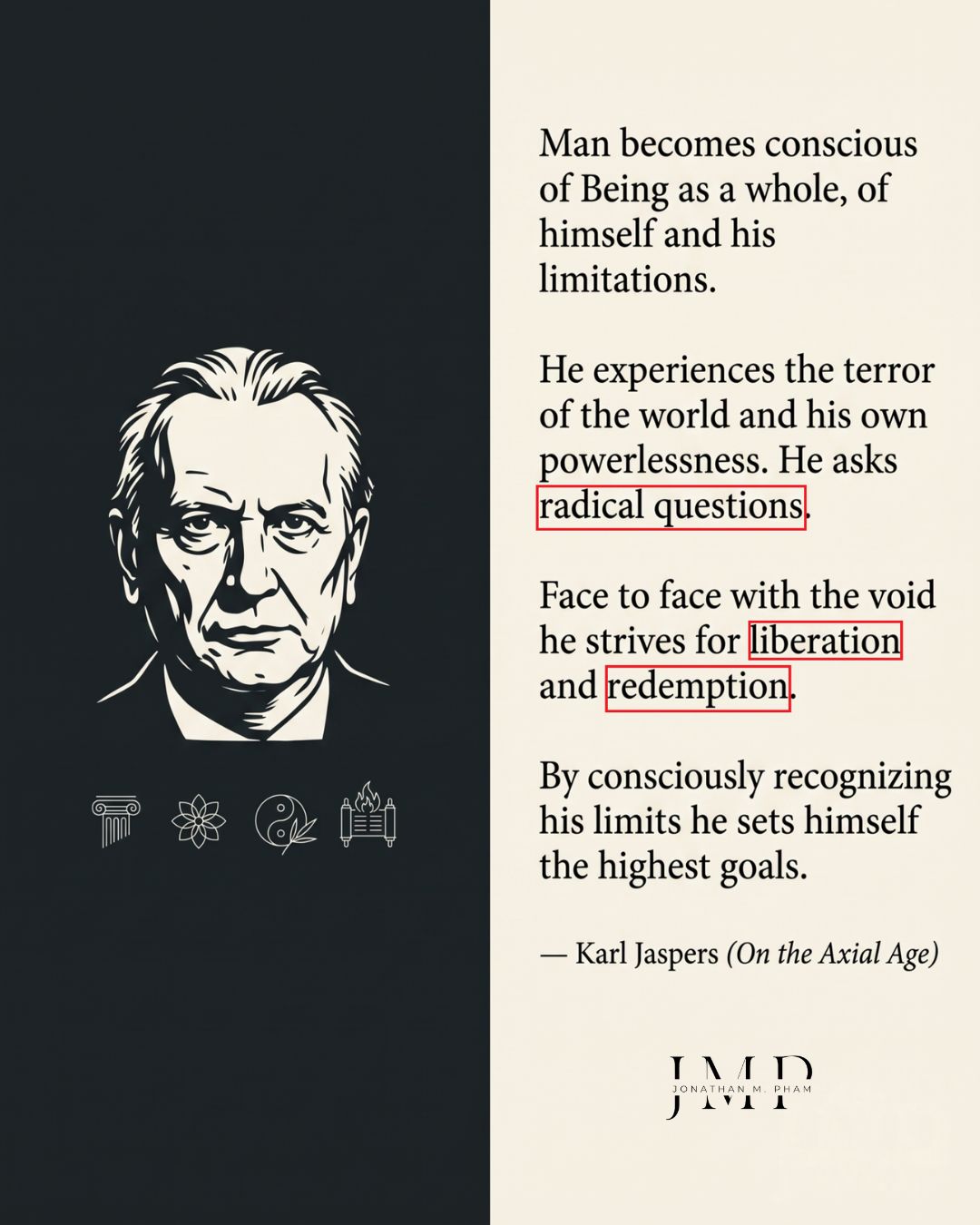
Man becomes conscious of Being as a whole, of himself and his limitations. He experiences the terror of the world and his own powerlessness. He asks radical questions. Face to face with the void he strives for liberation and redemption. By consciously recognising his limits he sets himself the highest goals.
Karl Jaspers on the Axial Age
Today, according to contemporary thinkers and cognitive scientists (like Karen Armstrong and John Vervaeke), humanity is entering a Second Axial Age. Due to hyper-connectivity, globalization, and a massive "meaning crisis", the scale of limit situations has mutated from the personal to the planetary.
More than just individual mortality, we are now confronting species-level problems: climate change, the threat of omnicide, the rise of Artificial Intelligence (AI), the fragmentation of shared reality via deepfakes, and the isolation caused by algorithms hijacking people's attention. Just like the First Axial Age, our collective illusions are breaking down, and we are being pushed to the wall.
Whether we can emerge from that wall—both from a personal and a global perspective—depends a lot on if we can undergo a fundamental shift in our consciousness:
The First Axial Age taught us to ask 'What ought I to do?'. The Second Axial Age forces us to ask 'What must we become?'.
Read more: Human Being vs Human Doing - Reclaiming the Soul in the Age of Optimization
The transition from Dasein to authentic Existenz requires a very specific shift in posture—from being obsessed with how the universe should work to accepting how it actually works. Here are a few practical steps to making that leap.
When we are plunged into a crisis, our mind naturally projects into the future and calculates every possible disastrous outcome. We want to white-knuckle our way through the situation—to discover a "fix" to an unfixable problem. That being said, looking ahead when the future is still shrouded in uncertainty is a recipe for panic.
The first step to surviving a limit situation, therefore, is to narrow the focus and practice what Heidegger called Gelassenheit—typically translated as "letting be". It means clearing the table of your old expectations so that you can see reality exactly as it is, without trying to change or control it.
◆ Example: Shrinking the horizon in the hospital
When my father first began his chemotherapy, I found myself constantly overwhelmed by the scale of the months ahead. (“How much will this cost? What if the side effects worsen? How long will my own life be put on hold?”) My mind was spinning in endless loops, until I eventually figured that if I kept looking at the mountain, I would surely collapse.
So I decided to shrink my timeline to the present day. To remind myself that "it cannot be helped" (or Shikata ga nai—as it is called in Japanese philosophy) and accept the situation wholeheartedly. To move away from intellectually wrestling with the cancer (which is beyond my control) and ask myself:
"What is the single next right move, right now?"
Sometimes, the only right move is to simply be there. To sit in the hospital chair and breathe through the second.
How can I find a true answer when I am confused? If I am confused, I can only receive an answer which is also confused... Whatever answer I receive will be through this screen of confusion, anxiety, and fear; therefore, the answer will be perverted.
So, what is important is ... to clear the confusion that is within you. It is like a blind man who asks, “What is light?” If I tell him what light is, he will listen according to his blindness, according to his darkness; but suppose he is able to see, then, he will never ask the question “What is light?”. It is there.
Similarly, if you can clarify the confusion within yourself... you will not have to ask, you will not have to look for it; all that you have to do is to be free from those causes which bring about confusion.
Jiddu Krishnamurti
Modern society, driven by its obsession with certainty, has conditioned people to rely on data, pros-and-cons lists, and pure rationality to make decisions. Yet all of these are useless in a limit situation. No spreadsheet can tell you how to navigate a terminal illness, and no algorithm can resolve existential guilt.
When objective knowledge fails us, it’s time for us to take a "leap of faith". As "irrational" as it may sound, it is precisely in moments of ambiguity that we have to rely on the “infinite passion” of inwardness. To tune in to our own intuition.
◆ Example: Making choices without any proof of "rightness"
When my job was threatened due to the compliance crisis years ago, no amount of logic could guarantee my safety. I could not out-think the bureaucratic machine. In the end, I stopped worrying about the "what ifs" and trusted my gut to carry me through.
In limit situations, accepting that you are operating in the dark is crucial. There’s no evidence that the ground will hold you if you take a step forward; that said, you still proceed because you intuitively know you must keep walking.
At the point where the road swings off (and where that is cannot be stated objectively, since it is precisely subjectivity), objective knowledge is suspended. Objectively he then has only uncertainty, but this is precisely what intensifies the infinite passion of inwardness, and truth is precisely the daring venture of choosing the objective uncertainty with the passion of the infinite.
Søren Kierkegaard

Limit experiences
The general fellowship of our human situation has been rendered even more dubious than before, inasmuch as, though the old ties of caste have been loosened, a new restriction of the individual to some prescribed status in society is manifest. Less than ever, perhaps, is it possible for a man to transcend the limitations imposed by his social origins.
Karl Jaspers, “Man in the Modern Age”
Limit situations frequently force our personal values to collide with societal norms. When disaster strikes, the "herd mentality" pressures us to regress into conventional, “acceptable” behaviors. Yet if we are to survive the “abyss”, our job is to refuse blind conformity and decide what should be done on our own terms.
◆ Example: Reconsidering filial piety
As I mentioned earlier, my mother’s reaction to my father’s diagnosis is rooted in the belief that money is the ultimate savior. Because my sister is generously providing the financial capital for the treatments, I frequently find myself haunted by an unspoken pressure:
“Should I abandon my philosophical calling? Should I go back to the corporate grind to make money and appease my mother's anxiety?”
If we adopt the lens of traditional "filial piety" (as it is widely advocated for in East Asian societies) and hustle culture, the answer would be “yes”. At the same time, I’m fully aware that betraying my own calling just to comfort someone else would be an act of Bad Faith. (self-deception) It would lead to what Kierkegaard called a "Sickness Unto Death"—the despair of not being oneself.
After much grueling thought, I concluded that it’s time for me to redefine my duty. Given that my sister is providing the material care (which she is capable of), it’s up to me to ensure the spiritual and emotional capital.
As it has dawned on me by now, had it not been for my philosophical reflections over the last three years, I would have been unable to do all of these things. If I were still in the corporate grind, I would have a larger bank account to support my family, but surely I would not be able to offer my presence—which is absolutely necessary in a limit situation, and which cannot be bought by money at all.
We are sorely deficient in talking with each other and listening to each other. We lack mobility, criticism and self-criticism. We incline to doctrinism. What makes it worse is that so many people do not really want to think. They want only slogans and obedience. They ask no questions and they give no answers, except by repeating drilled-in phrases. They can only assert and obey, neither probe nor apprehend. Thus they cannot be convinced, either. How shall we talk with people who will not go where others probe and think, where men seek independence in insight and conviction?
Karl Jaspers, “The Question of German Guilt” (1947)
Did you ever say Yes to one joy? O my friends, then you said Yes to all woe as well. All things are chained and entwined together, all things are in love.
Friedrich Nietzsche, "Thus Spoke Zarathustra"
It’s tempting to cry out "Why me?" when life pushes us into a wall, but agonizing over the reason behind our suffering is of no use. If any, it only keeps us trapped in a mindset of victimhood, wishing for a past that no longer exists.
To transition into authenticity, it’s essential we shift the question to:
"Now that this is reality, what is required of me?"
It’s akin to what the philosopher Friedrich Nietzsche advocated for in his principle of Amor Fati (Loving one's fate)—embracing one’s own circumstances wholeheartedly. Rather than giving in to passive resignation ("The universe crushed me, so I will just lie here"), we now consciously make a declaration to ourselves:
"This situation is what I have been handed, so I will own it and make the best of it."
◆ Example: Embracing the new “arena”
When my father’s cancer disrupted my daily routine and future plans, I was initially struck by frustration. It took a while for me to come to terms with the fact that resistance was only draining my energy; hence, I’d better adapt my posture and accept the situation at hand.
As soon as that shift in perspective occured, the experience became much more bearable to me. Now I can look at the hospital room with dignity and adjust my schedule—without wandering unconstructively into the dark corners of my psyche.
Ultimately, man should not ask what the meaning of his life is, but rather must recognize that it is he who is asked. In a word, each man is questioned by life; and he can only answer to life by answering for his own life; to life he can only respond by being responsible.
Viktor Frankl

The teacher of love teaches struggle. The teacher of lifeless isolation from the world teaches peace.
Karl Jaspers
A cornerstone of Jaspers’ philosophy—unlike many other existentialist thinkers—is the belief that humans cannot live in isolation. When we are caught in a limit situation, all superficial masks burn away; as such, we need vulnerable soul-to-soul communication with others who are also facing the “abyss”.
Jaspers called this experience Liebender Kampf, or the "loving struggle." It’s the kind of intimate human connection that only happens when people drop their ego-defenses, stop trying to dominate or "fix" one another, and reveal their deepest truths and vulnerabilities.
When you sit in an oncology ward (as I am doing now with my father) or navigate a global pandemic, the superficial differences between us—wealth, status, background—become completely blurred. At that moment, you realize that everyone is carrying a burden. As such, there’s no reason to be afraid of admitting our own weaknesses, reaching out to each other, and sharing a laugh together. (much like the people in my hospital room who tell lighthearted jokes to make everyone feel better)
And he knew, also, what the old man was thinking as his tears flowed, and he, Rieux, thought it too: that a loveless world is a dead world, and always there comes an hour when one is weary of prisons, of one's work, and of devotion to duty, and all one craves for is a loved face, the warmth and wonder of a loving heart.
Albert Camus, "The Plague"
We do not have to (and definitely should not) wait until a limit situation strikes to start engaging in existential thoughts. In fact, if we spend our whole life strictly inside our comfort zones, we will be left defenseless when the wall inevitably appears.
One simple way to prepare ourselves is to engineer "micro-leaps"—taking calculated psychological risks, intentionally facing our own fears, and exposing ourselves to small doses of uncertainty every day. In Stoicism, this technique is called Premeditatio malorum, which translates to the "premeditation of evils". (or negative visualization, as people sometimes refer to it) The idea is to regularly take a moment to visualize the loss of the things you hold dear—your health, job, loved ones, etc.
Now, don’t assume doing so would turn you into a pessimistic person. Quite the opposite; it would sow the seeds of resilience and gratitude within you.
By mentally rehearsing the limit situation of permanent loss, you strip away all senses of entitlement and open your eyes to the things you typically take for granted: the morning coffee, your healthy body, a simple conversation with a friend, etc. Not only will the experience teach you the value of these things, it will also loosen the grip of fear over losing them.
When you actively rehearse adversity in your mind, it’s just a matter of time before you arrive at the truth: that even if the worst were to happen, you possess an inner reservoir of adaptability strong enough to survive it.
He robs present ills of their power who has perceived their coming beforehand.
Seneca, "Letters from a Stoic"
If you call ‘religious’ a man who believes in what I call a Supermeaning, a meaning so comprehensive that you can no longer grasp it, get hold of it in rational intellectual terminology, then one should feel free to call me religious, really.
Viktor Frankl
And here, we arrive at the ultimate threshold of the limit situation. When we stop trying to outsmart the crisis—and fully surrender the ego's demand for control, we experience what Jaspers called the Transcendence.
Now, I suppose some of you, upon hearing the term Transcendence, would assume it to be an abstract or overly religious concept. But in real life, it is a very tangible and recognizable human experience.
Most people, as discussed, spend their whole life inside the safe walls of the immanent daily world, concerned only with what can be secured and managed. When those boundaries fracture, the familiar floor drops out from beneath us. At that moment, we find ourselves face-to-face with a vastness that logic alone cannot explain, and willpower cannot conquer.
If we are courageous enough to stop fighting reality, that is when Transcendence happens. It is the realization that there’s no need to explain the universe empirically; all we have to do is to trust that there is a deeper meaning running through it.
When you open yourself to Transcendence, you understand that while suffering and death are undeniable facts of life, they do not have the final word. That beneath the chaos is a current of love and connection—one that doesn’t conform to human logic. It’s what drives people to commit extraordinary acts—like the prisoners in Auschwitz’s concentration camps, stripped of everything, yet still willing to carry on and give away their last piece of bread to a stranger.
Strangely enough, it is only by crashing into the wall that we can finally feel it.
In the filth of Auschwitz, the “individual differences” did not “blur” but, on the contrary, people became more different; people unmasked themselves, both the swine and the saints. And today you need no longer hesitate to use the word “saints”: think of Father Maximilian Kolbe who was starved and finally murdered by an injection of carbolic acid at Auschwitz and who in 1983 was canonized.
Viktor Frankl, “Man’s Search for Meaning”
Boundary situation in philosophy
Read more: Christian Existentialism - From Dogma to the Ultimate Reality
Following World War II, psychiatrists started adapting Jaspers' philosophy into practical therapeutic frameworks.
These days, the concept of limit situations still plays a crucial role in the field of crisis management. Rather than treating trauma as a medical "problem to be fixed", existential therapists typically focus on helping individuals integrate reality into their worldview to foster psychological resilience and personal growth.
While Jaspers viewed limit situations as an inescapable part of the individual human condition, the Brazilian educator and philosopher Paulo Freire shifted the concept to the socio-historical level. In his book Pedagogy of the Oppressed, Freire argued that systemic injustices—like extreme poverty, racism, and political oppression—are perceived by the oppressed as natural "limit situations." However, he believed these specific socio-economic walls can be dismantled. As such, he advocated for "Limit-Acts" (courageous, collective actions) to break through these systemic barriers and achieve "Untested Feasibility"—a liberated reality that was previously thought impossible.
"Limit situations" is a highly searched and studied concept in clinical ethics, palliative care, and nursing—given that medical professionals frequently interact with individuals who are facing terminal diagnoses, trauma, or the end of life. Researching Jaspers’ philosophical framework provides a chance for healthcare providers to better understand their patients and provide compassionate presence when it is most needed.
We become ourselves by entering with open eyes into the limit situations.
Karl Jaspers
One does not become enlightened by imagining figures of light, but by making the darkness conscious.
Carl Jung
With despair, true optimism begins: the optimism of the man who expects nothing, who knows he has no rights and nothing coming to him, who rejoices in counting on himself alone and in acting alone for the good of all.
Jean-Paul Sartre
When we are no longer able to change a situation, we are challenged to change ourselves.
Viktor Frankl
A blazing fire makes flame and brightness out of everything that is thrown into it.
Marcus Aurelius
The physical boundary of death destroys us, the idea of death saves us.
Irvin Yalom
I hope for nothing. I fear nothing. I am free. (Δεν ελπίζω τίποτα. Δε φοβάμαι τίποτα. Είμαι λέφτερος.)
Nikos Kazantzakis

As I write this, my father still has cancer. The limit situation has not been "solved" yet. The uncertainty of the future still hangs in the air.
And yet, one thing has been changed for the better. It’s me—the person sitting in the hospital chair.
Before the experience, I had been philosophizing from a safe distance. I was living in a predictable world and planning my life under the assumption that I was fully in control. That is, until the wall appeared out of nowhere, and the whole illusion collapsed.
What followed was truly terrifying. Yet as I have learned from the last few months, we can only “become who we are” by entering boundary situations with open eyes. By letting go of all superficial attachments, anxieties, and social masks—so that what’s left is the authentic True Self.
After all, nobody is spared from limit situations. At some point in life, we will inevitably crash into the unyielding walls of chance, suffering, guilt, conflict, and mortality.
When your time comes, my advice for you is this: do not look away. Do not rationalize the situation or hide behind any form of fleeting entertainment.
Instead, take a breath, shrink your horizon, and, above all else, step forward—even when everything is still shrouded in darkness.
The wall may look intimidating, but within you lies an even greater source of power. All you have to do is to “wake up” and let it transform you.
In the midst of winter, I found there was, within me, an invincible summer.
Albert Camus

Other resources you might be interested in: